•  
China Lunar Exploration Project 20 Years Exhibition in Beijing

China Lunar Exploration Project 20 Years Exhibition in Beijing

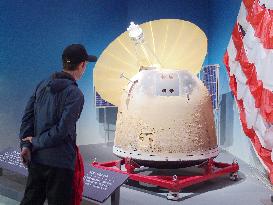
BEIJING, CHINA - APRIL 2, 2025 - A visitor looks at the Chang 'e-6 orbiter at an exhibition on China's 20-year lunar exploration project in Beijing, China on April 2, 2025.

  •  
Thanksgiving Beyond Earth

Thanksgiving Beyond Earth

Handout photo dated November 27, 2018 shows Getting all ten members of an aggregation consisting of seven Endeavour astronauts and three Expedition 18 crewmembers into a single photo wasn't easy as the two crews shared a Thanksgiving meal on the middeck of the orbiter. Astronaut Sandra Magnus, Expedition 18 flight engineer, appears at top center. Clockwise from her position are astronauts Shane Kimbrough and Eric Boe, along with cosmonaut Yury Lonchakov, and astronauts Steve Bowen (partially visible behind Lonchakov), Donald Pettit, Michael Fincke, Gregory Chamitoff, Heidemarie Stefanyshyn-Piper and Chris Ferguson (partially visible at top right). Ferguson is STS-126 commander, and Fincke is commander for the station crew. Since 1973, astronauts have celebrated Thanksgiving in space, bringing a cherished tradition far beyond Earth. The first Thanksgiving in orbit took place aboard Skylab during the Skylab 4 mission, where astronauts Gerald Carr, Edward Gibson, and William Pogue marked the day with an improvis

  •  
Cave On The Moon Could Be A Future Base

Cave On The Moon Could Be A Future Base

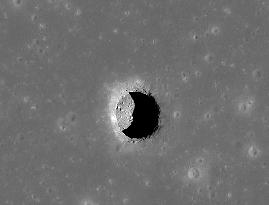
Hand out photo shows the Mare Tranquillitatis pit as seen by NASA's Lunar Reconnaissance Orbiter. Radar data from NASA’s Lunar Reconnaissance Orbiter have revealed what they think may be the deepest known cave on the moon, with a "skylight" entrance 330 feet (100 meters) wide. The cave, which could potentially be a location for a future moon base, is in Mare Tranquillitatis—Latin for Sea of Tranquility—close to the landing spot of Apollo 11, the first mission to land people on the moon 55 years ago this week. Researchers at the University of Trento in Italy have revealed more about Mare Tranquillitatis Pit in a paper published on Monday July 15, 2024 in Nature Astronomy. It is one of about 200 on the moon. A pit is an opening on the lunar surface that could be an entrance to a cave or lava tube. The latter forms when underground rivers of lava empty out. Pits are believed to form when parts of a lava tube's ceiling collapse, and those that directly expose the interior are called skylights. About 16 of the 200

  •  
Cave On The Moon Could Be A Future Base

Cave On The Moon Could Be A Future Base

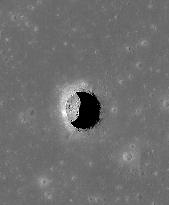
Hand out photo shows the Mare Tranquillitatis pit as seen by NASA's Lunar Reconnaissance Orbiter. Radar data from NASA’s Lunar Reconnaissance Orbiter have revealed what they think may be the deepest known cave on the moon, with a "skylight" entrance 330 feet (100 meters) wide. The cave, which could potentially be a location for a future moon base, is in Mare Tranquillitatis—Latin for Sea of Tranquility—close to the landing spot of Apollo 11, the first mission to land people on the moon 55 years ago this week. Researchers at the University of Trento in Italy have revealed more about Mare Tranquillitatis Pit in a paper published on Monday July 15, 2024 in Nature Astronomy. It is one of about 200 on the moon. A pit is an opening on the lunar surface that could be an entrance to a cave or lava tube. The latter forms when underground rivers of lava empty out. Pits are believed to form when parts of a lava tube's ceiling collapse, and those that directly expose the interior are called skylights. About 16 of the 200

  •  

China's Chang'e-6 brings back first samples from moon's far side to Earth

STORY: China's Chang'e-6 brings back first samples from moon's far side to Earth SHOOTING TIME: June 25, 2024 DATELINE: June 25, 2024 LENGTH: 00:00:51 LOCATION: HOHHOT, China CATEGORY: TECHNOLOGY SHOTLIST: 1. various of the site STORYLINE: The returner of the Chang'e-6 probe touched down on Earth on Tuesday, bringing back the world's first samples collected from the moon's far side. The return capsule landed precisely in the designated area in Siziwang Banner, north China's Inner Mongolia Autonomous Region, and the mission is a complete success, according to the China National Space Administration (CNSA). Chang'e-6 is one of the most complex and challenging missions in China's space exploration efforts to date. Consisting of an orbiter, a returner, a lander and an ascender, it was launched on May 3 this year, and has gone through various stages such as Earth-moon transfer, near-moon braking, lunar orbiting and separation of the lander-ascender combination and the orbiter-returner combination. S

  •  
(EyesOnSci)CHINA-BEIJING-CHANG'E-6-RETURNER (CN)

(EyesOnSci)CHINA-BEIJING-CHANG'E-6-RETURNER (CN)

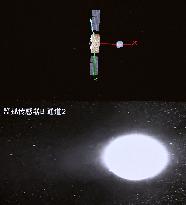
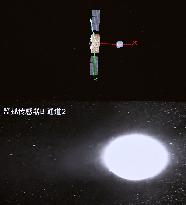
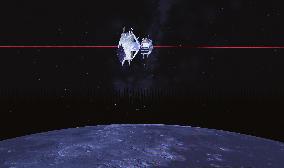
(240625) -- BEIJING, June 25, 2024 Photo by Xinhua/ABACAPRESS.COM) -- This image taken from video animation at Beijing Aerospace Control Center on June 25, 2024 shows the returner of the Chang'e-6 probe separating from the orbiter. The returner of the Chang'e-6 probe touched down on Earth on Tuesday, bringing back the world's first samples collected from the moon's far side, and marking another remarkable achievement in China's space exploration endeavors. Photo by Xinhua/ABACAPRESS.COM/Jin Liangkuai)

  •  
(EyesOnSci)CHINA-BEIJING-CHANG'E-6-RETURNER (CN)

(EyesOnSci)CHINA-BEIJING-CHANG'E-6-RETURNER (CN)

(240625) -- BEIJING, June 25, 2024 Photo by Xinhua/ABACAPRESS.COM) -- This image taken from video animation at Beijing Aerospace Control Center on June 25, 2024 shows the returner of the Chang'e-6 probe after separating from the orbiter. The returner of the Chang'e-6 probe touched down on Earth on Tuesday, bringing back the world's first samples collected from the moon's far side, and marking another remarkable achievement in China's space exploration endeavors. Photo by Xinhua/ABACAPRESS.COM/Jin Liangkuai)

  •  
(EyesOnSci)CHINA-BEIJING-CHANG'E-6-RETURNER (CN)

(EyesOnSci)CHINA-BEIJING-CHANG'E-6-RETURNER (CN)

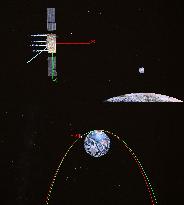
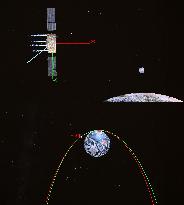
(240625) -- BEIJING, June 25, 2024 (Xinhua) -- This image taken from video animation at Beijing Aerospace Control Center on June 25, 2024 shows the returner of the Chang'e-6 probe separating from the orbiter. The returner of the Chang'e-6 probe touched down on Earth on Tuesday, bringing back the world's first samples collected from the moon's far side, and marking another remarkable achievement in China's space exploration endeavors. (Xinhua/Jin Liangkuai)

  •  
(EyesOnSci)CHINA-BEIJING-CHANG'E-6-RETURNER (CN)

(EyesOnSci)CHINA-BEIJING-CHANG'E-6-RETURNER (CN)

(240625) -- BEIJING, June 25, 2024 (Xinhua) -- This image taken from video animation at Beijing Aerospace Control Center on June 25, 2024 shows the returner of the Chang'e-6 probe after separating from the orbiter. The returner of the Chang'e-6 probe touched down on Earth on Tuesday, bringing back the world's first samples collected from the moon's far side, and marking another remarkable achievement in China's space exploration endeavors. (Xinhua/Jin Liangkuai)

  •  
(EyesonSci)CHINA-CHANG'E-6-LUNAR ORBIT-DOCKING-SAMPLES TRANSFER (CN)

(EyesonSci)CHINA-CHANG'E-6-LUNAR ORBIT-DOCKING-SAMPLES TRANSFER (CN)

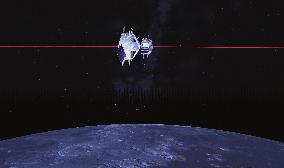
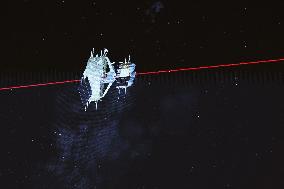
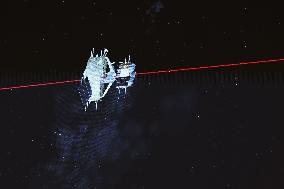
(240606) -- BEIJING, June 6, 2024 Photo by Xinhua/ABACAPRESS.COM) -- This video animation image displayed at Beijing Aerospace Control Center (BACC) on June 6, 2024 shows the ascender of China's Chang'e-6 probe rendezvousing and docking with the probe's orbiter-returner combination in lunar orbit. The ascender of China's Chang'e-6 probe successfully rendezvoused and docked with the probe's orbiter-returner combination in lunar orbit at 2:48 p.m. (Beijing Time) on Thursday, the China National Space Administration (CNSA) announced. The container carrying the world's first samples from the far side of the moon had been transferred from the ascender to the returner safely by 3:24 p.m., the CNSA said. This is the second time that Chinese spacecraft carried out rendezvous and docking in lunar orbit, with Chang'e-5 realizing the first one in 2020. Photo by Xinhua/ABACAPRESS.COM/Jin Liwang)

  •  
(EyesonSci)CHINA-CHANG'E-6-LUNAR ORBIT-DOCKING-SAMPLES TRANSFER (CN)

(EyesonSci)CHINA-CHANG'E-6-LUNAR ORBIT-DOCKING-SAMPLES TRANSFER (CN)

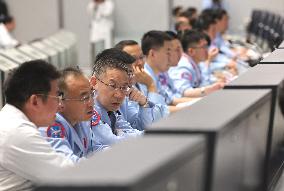
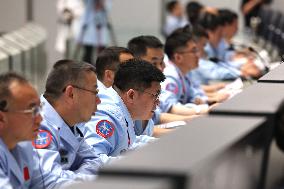
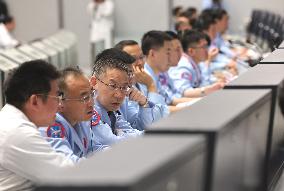
(240606) -- BEIJING, June 6, 2024 Photo by Xinhua/ABACAPRESS.COM) -- Technical personnel work at the Beijing Aerospace Control Center (BACC) in Beijing, capital of China, June 6, 2024. The ascender of China's Chang'e-6 probe successfully rendezvoused and docked with the probe's orbiter-returner combination in lunar orbit at 2:48 p.m. (Beijing Time) on Thursday, the China National Space Administration (CNSA) announced. The container carrying the world's first samples from the far side of the moon had been transferred from the ascender to the returner safely by 3:24 p.m., the CNSA said. This is the second time that Chinese spacecraft carried out rendezvous and docking in lunar orbit, with Chang'e-5 realizing the first one in 2020. Photo by Xinhua/ABACAPRESS.COM/Jin Liwang)

  •  
(EyesonSci)CHINA-CHANG'E-6-LUNAR ORBIT-DOCKING-SAMPLES TRANSFER (CN)

(EyesonSci)CHINA-CHANG'E-6-LUNAR ORBIT-DOCKING-SAMPLES TRANSFER (CN)

(240606) -- BEIJING, June 6, 2024 Photo by Xinhua/ABACAPRESS.COM) -- This video animation image displayed at Beijing Aerospace Control Center (BACC) on June 6, 2024 shows the ascender of China's Chang'e-6 probe rendezvousing and docking with the probe's orbiter-returner combination in lunar orbit. The ascender of China's Chang'e-6 probe successfully rendezvoused and docked with the probe's orbiter-returner combination in lunar orbit at 2:48 p.m. (Beijing Time) on Thursday, the China National Space Administration (CNSA) announced. The container carrying the world's first samples from the far side of the moon had been transferred from the ascender to the returner safely by 3:24 p.m., the CNSA said. This is the second time that Chinese spacecraft carried out rendezvous and docking in lunar orbit, with Chang'e-5 realizing the first one in 2020. Photo by Xinhua/ABACAPRESS.COM/Jin Liwang)

  •  
(EyesonSci)CHINA-CHANG'E-6-LUNAR ORBIT-DOCKING-SAMPLES TRANSFER (CN)

(EyesonSci)CHINA-CHANG'E-6-LUNAR ORBIT-DOCKING-SAMPLES TRANSFER (CN)

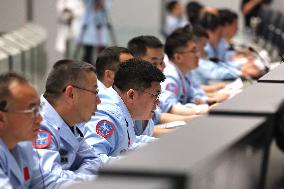
(240606) -- BEIJING, June 6, 2024 Photo by Xinhua/ABACAPRESS.COM) -- Technical personnel work at the Beijing Aerospace Control Center (BACC) in Beijing, capital of China, June 6, 2024. The ascender of China's Chang'e-6 probe successfully rendezvoused and docked with the probe's orbiter-returner combination in lunar orbit at 2:48 p.m. (Beijing Time) on Thursday, the China National Space Administration (CNSA) announced. The container carrying the world's first samples from the far side of the moon had been transferred from the ascender to the returner safely by 3:24 p.m., the CNSA said. This is the second time that Chinese spacecraft carried out rendezvous and docking in lunar orbit, with Chang'e-5 realizing the first one in 2020. Photo by Xinhua/ABACAPRESS.COM/Jin Liwang)

  •  
(EyesonSci)CHINA-CHANG'E-6-LUNAR ORBIT-DOCKING-SAMPLES TRANSFER (CN)

(EyesonSci)CHINA-CHANG'E-6-LUNAR ORBIT-DOCKING-SAMPLES TRANSFER (CN)

(240606) -- BEIJING, June 6, 2024 (Xinhua) -- Technical personnel work at the Beijing Aerospace Control Center (BACC) in Beijing, capital of China, June 6, 2024. The ascender of China's Chang'e-6 probe successfully rendezvoused and docked with the probe's orbiter-returner combination in lunar orbit at 2:48 p.m. (Beijing Time) on Thursday, the China National Space Administration (CNSA) announced. The container carrying the world's first samples from the far side of the moon had been transferred from the ascender to the returner safely by 3:24 p.m., the CNSA said. This is the second time that Chinese spacecraft carried out rendezvous and docking in lunar orbit, with Chang'e-5 realizing the first one in 2020. (Xinhua/Jin Liwang)

  •  
(EyesonSci)CHINA-CHANG'E-6-LUNAR ORBIT-DOCKING-SAMPLES TRANSFER (CN)

(EyesonSci)CHINA-CHANG'E-6-LUNAR ORBIT-DOCKING-SAMPLES TRANSFER (CN)

(240606) -- BEIJING, June 6, 2024 (Xinhua) -- Technical personnel work at the Beijing Aerospace Control Center (BACC) in Beijing, capital of China, June 6, 2024. The ascender of China's Chang'e-6 probe successfully rendezvoused and docked with the probe's orbiter-returner combination in lunar orbit at 2:48 p.m. (Beijing Time) on Thursday, the China National Space Administration (CNSA) announced. The container carrying the world's first samples from the far side of the moon had been transferred from the ascender to the returner safely by 3:24 p.m., the CNSA said. This is the second time that Chinese spacecraft carried out rendezvous and docking in lunar orbit, with Chang'e-5 realizing the first one in 2020. (Xinhua/Jin Liwang)

  •  
(EyesonSci)CHINA-CHANG'E-6-LUNAR ORBIT-DOCKING-SAMPLES TRANSFER (CN)

(EyesonSci)CHINA-CHANG'E-6-LUNAR ORBIT-DOCKING-SAMPLES TRANSFER (CN)

(240606) -- BEIJING, June 6, 2024 (Xinhua) -- This video animation image displayed at Beijing Aerospace Control Center (BACC) on June 6, 2024 shows the ascender of China's Chang'e-6 probe rendezvousing and docking with the probe's orbiter-returner combination in lunar orbit. The ascender of China's Chang'e-6 probe successfully rendezvoused and docked with the probe's orbiter-returner combination in lunar orbit at 2:48 p.m. (Beijing Time) on Thursday, the China National Space Administration (CNSA) announced. The container carrying the world's first samples from the far side of the moon had been transferred from the ascender to the returner safely by 3:24 p.m., the CNSA said. This is the second time that Chinese spacecraft carried out rendezvous and docking in lunar orbit, with Chang'e-5 realizing the first one in 2020. (Xinhua/Jin Liwang)

  •  
(EyesonSci)CHINA-CHANG'E-6-LUNAR ORBIT-DOCKING-SAMPLES TRANSFER (CN)

(EyesonSci)CHINA-CHANG'E-6-LUNAR ORBIT-DOCKING-SAMPLES TRANSFER (CN)

(240606) -- BEIJING, June 6, 2024 (Xinhua) -- This video animation image displayed at Beijing Aerospace Control Center (BACC) on June 6, 2024 shows the ascender of China's Chang'e-6 probe rendezvousing and docking with the probe's orbiter-returner combination in lunar orbit. The ascender of China's Chang'e-6 probe successfully rendezvoused and docked with the probe's orbiter-returner combination in lunar orbit at 2:48 p.m. (Beijing Time) on Thursday, the China National Space Administration (CNSA) announced. The container carrying the world's first samples from the far side of the moon had been transferred from the ascender to the returner safely by 3:24 p.m., the CNSA said. This is the second time that Chinese spacecraft carried out rendezvous and docking in lunar orbit, with Chang'e-5 realizing the first one in 2020. (Xinhua/Jin Liwang)

  •  

China's Chang'e-6 lands on moon's far side to collect samples

STORY: China's Chang'e-6 lands on moon's far side to collect samples SHOOTING TIME: June 2, 2024 DATELINE: June 2, 2024 LENGTH: 00:01:02 LOCATION: Beijing CATEGORY: TECHNOLOGY/SCIENCE SHOTLIST: 1. footage of Chang'e-6 touching down on the far side of the moon 2. launching of Chang'e-6 on May 3 STORYLINE: China's Chang'e-6 touched down on the far side of the moon on Sunday morning, and will collect samples from this rarely explored terrain for the first time in human history, the China National Space Administration (CNSA) announced. Supported by the Queqiao-2 relay satellite, the lander-ascender combination of the Chang'e-6 probe successfully landed at the designated landing area at 6:23 a.m. (Beijing Time) in the South Pole-Aitken (SPA) Basin. Chang'e-6 consists of an orbiter, a returner, a lander and an ascender. Since its launch on May 3 this year, it has gone through various stages such as Earth-moon transfer, near-moon braking, lunar orbiting and landing descent. The CNSA said the lander-asce

  •  

China releases global color images of Mars

STORY: China releases global color images of Mars DATELINE: April 24, 2023 LENGTH: 00:00:32 LOCATION: HEFEI, China CATEGORY: SCIENCE SHOTLIST: 1. various of the launch event of the Space Day of China in Hefei, China's Anhui Province 2. various of images of Mars (courtesy of the China National Space Administration) STORYLINE: The China National Space Administration (CNSA) and the Chinese Academy of Sciences on Monday jointly released a series of global images of Mars obtained during China's first Mars exploration mission. According to the CNSA, these images are based on 14,757 image data acquired by a remote-sensing camera on the Tianwen-1 orbiter over eight months from November 2021 to July 2022. Starting from May 1 this year, the scientific data of Tianwen-1 will be open to the world. Xinhua News Agency correspondents reporting from Hefei, China. (XHTV)

  •  
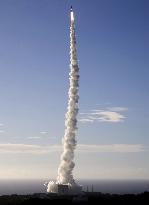
Japan launches 1st lunar explorer

Japan launches 1st lunar explorer

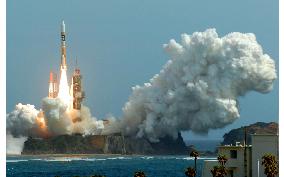
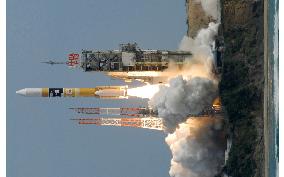
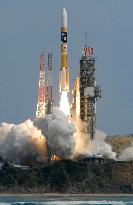
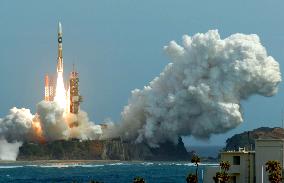
TANEGASHIMA, Japan - A domestically developed H-2A rocket carrying Japan's first lunar orbiter is launched from the Tanegashima Space Center in Kagoshima Prefecture on Sept. 14. The rocket carries the Selenological and Engineering Explorer, nicknamed ''Kaguya'' after a moon princess in an ancient Japanese folktale.

  •  
Japan launches 1st lunar explorer

Japan launches 1st lunar explorer

TANEGASHIMA, Japan - A domestically developed H-2A rocket carrying Japan's first lunar orbiter is launched from the Tanegashima Space Center in Kagoshima Prefecture on Sept. 14. The rocket carries the Selenological and Engineering Explorer, nicknamed ''Kaguya'' after a moon princess in an ancient Japanese folktale.

  •  
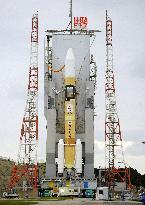
Rocket to launch Venus probe

Rocket to launch Venus probe

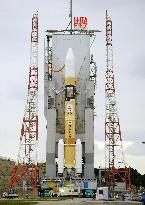
TANEGASHIMA, Japan - An H-2A rocket arrives at its launch pad at Tanegashima Space Center, southwestern Japan, on May 17, 2010. The rocket carrying Venus climate orbiter Akatsuki is scheduled to lift off the following day.

  •  
Tests conducted on Kibo space lab's robotic arm

Tests conducted on Kibo space lab's robotic arm

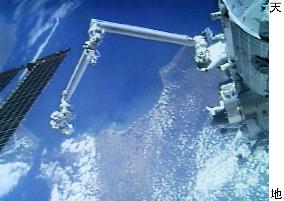
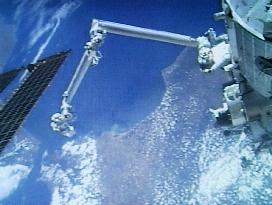
HOUSTON, United States - Tests are conducted on the robotic arm attached to Japan's ''Kibo'' research lab in the International Space Station. On the left is part of a solar panel of the international orbiter. (Photo taken from NASA TV)

  •  
Astronauts inspect Discovery's heat shield

Astronauts inspect Discovery's heat shield

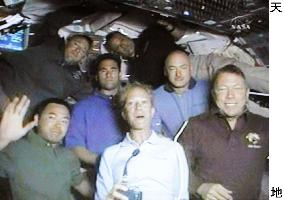
HOUSTON, United States - Japanese astronaut Akihiko Hoshide (L in front) waves to a camera from the flight deck of the space shuttle Discovery in this image from NASA TV on June 1. The seven crew members aboard the space shuttle Discovery began their first full day of work in space and inspected the orbiter's heat shields in preparation for their arrival at the International Space Station on June 2.

  •  
Endeavour crew heads to shuttle orbiter to await liftoff

Endeavour crew heads to shuttle orbiter to await liftoff

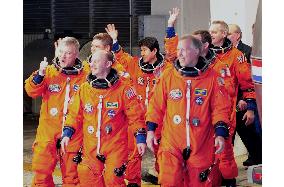
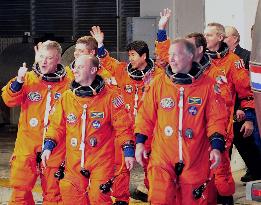
CAPE CANAVERAL, United States - The crew of the U.S. space shuttle Endeavour, including Japanese astronaut Takao Doi (C), heads to the Kennedy Space Center launch pad in Cape Canaveral, Florida, March 10 to await liftoff scheduled for 2:28 a.m. (3:28 p.m. Japan time) on March 11. The astronauts will install the Japanese-made module 'Kibo' in the International Space Station during their 16-day mission.

  •  
Endeavour crew heads to shuttle orbiter to await liftoff

Endeavour crew heads to shuttle orbiter to await liftoff

CAPE CANAVERAL, United States - Japanese astronaut Takao Doi (C) waves to well-wishers as he and other members of the U.S. space shuttle Endeavour crew head to the Kennedy Space Center launch pad in Cape Canaveral, Florida, in the evening of March 10 to await liftoff scheduled for 2:28 a.m. (3:28 p.m. Japan time) on March 11. The astronauts will install the Japanese-made module 'Kibo' in the International Space Station during their 16-day mission.

  •  
Endeavour crew heads to shuttle orbiter to await liftoff

Endeavour crew heads to shuttle orbiter to await liftoff

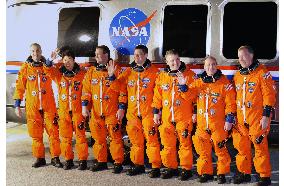
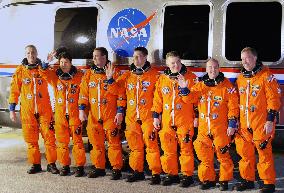
CAPE CANAVERAL, United States - The seven-member crew of the U.S. space shuttle Endeavour, including Japanese astronaut Takao Doi (2nd L), pose for photographers before heading to the Kennedy Space Center launch pad in Cape Canaveral, Florida, March 10 to await liftoff scheduled for 2:28 a.m. (3:28 p.m. Japan time) on March 11. The astronauts will install the Japanese-made module 'Kibo' in the International Space Station during their 16-day mission.

  •  
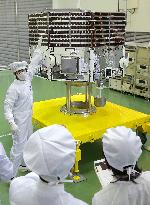
Japan's 1st lunar orbiter spacecraft on display

Japan's 1st lunar orbiter spacecraft on display

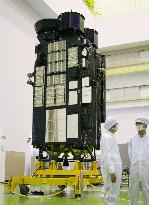
TANEGASHIMA, Japan - Japan's first lunar orbiter Kaguya, scheduled to be launched Aug. 16 aboard an H-2A rocket, is on display at the Tanegashima Space Center in Kagoshima Prefecture on June 18. According to the Japan Aerospace Exploration Agency, the 3-ton, 5.5-meter-tall unmanned spacecraft will be used to collect scientific data to help scientists better understand about the origin of the moon and its transformational history. Among the scientific data to be observed during the orbiter's one-year mission include the moon's gravity, distribution of its magnetic field and the structure of the moon surface.

  •  

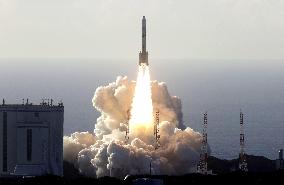
UAE's Mars orbiter launched on Japanese rocket

MINAMITANE, Japan Kyodo - An H2A rocket carrying Hope, a Mars orbiter developed by the United Arab Emirates, takes off from Tanegashima Space Center in Kagoshima Prefecture, southwestern Japan, on July 20, 2020. (Kyodo)

  •  
(EyesonSci) CHINA-TIANWEN-1-NEW MARS IMAGES-UNVEILING (CN)

(EyesonSci) CHINA-TIANWEN-1-NEW MARS IMAGES-UNVEILING (CN)

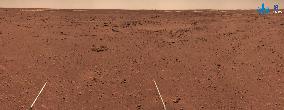
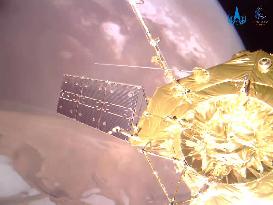
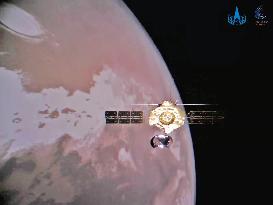
(220101) -- BEIJING, Jan. 1, 2022 (Xinhua) -- Photo released on Jan. 1, 2022 by the China National Space Administration (CNSA) shows the surface landscape taken by the rover Zhurong. China released on the first day of 2022 a group of new Mars images taken by the Tianwen-1 probe. These new images showed diverse working conditions of the probe's orbiter and rover, as well as the Mars surface topography obtained by them, said the China National Space Administration. The images include the group photo of the orbiter and Mars, closeup of the orbiter, ice sheet on Mars' north pole area, surface landscape taken by the rover Zhurong. China's Tianwen-1 mission, consisting of an orbiter, a lander and a rover, was launched on July 23, 2020. (CNSA/Handout via Xinhua)

  •  
(EyesonSci) CHINA-TIANWEN-1-NEW MARS IMAGES-UNVEILING (CN)

(EyesonSci) CHINA-TIANWEN-1-NEW MARS IMAGES-UNVEILING (CN)

(220101) -- BEIJING, Jan. 1, 2022 (Xinhua) -- Photo released on Jan. 1, 2022 by the China National Space Administration (CNSA) shows the ice sheet on Mars' north pole area. China released on the first day of 2022 a group of new Mars images taken by the Tianwen-1 probe. These new images showed diverse working conditions of the probe's orbiter and rover, as well as the Mars surface topography obtained by them, said the China National Space Administration. The images include the group photo of the orbiter and Mars, closeup of the orbiter, ice sheet on Mars' north pole area, surface landscape taken by the rover Zhurong. China's Tianwen-1 mission, consisting of an orbiter, a lander and a rover, was launched on July 23, 2020. (CNSA/Handout via Xinhua)

  •  
(EyesonSci) CHINA-TIANWEN-1-NEW MARS IMAGES-UNVEILING (CN)

(EyesonSci) CHINA-TIANWEN-1-NEW MARS IMAGES-UNVEILING (CN)

(220101) -- BEIJING, Jan. 1, 2022 (Xinhua) -- Photo released on Jan. 1, 2022 by the China National Space Administration (CNSA) shows the closeup of the orbiter. China released on the first day of 2022 a group of new Mars images taken by the Tianwen-1 probe. These new images showed diverse working conditions of the probe's orbiter and rover, as well as the Mars surface topography obtained by them, said the China National Space Administration. The images include the group photo of the orbiter and Mars, closeup of the orbiter, ice sheet on Mars' north pole area, surface landscape taken by the rover Zhurong. China's Tianwen-1 mission, consisting of an orbiter, a lander and a rover, was launched on July 23, 2020. (CNSA/Handout via Xinhua)

  •  
(EyesonSci) CHINA-TIANWEN-1-NEW MARS IMAGES-UNVEILING (CN)

(EyesonSci) CHINA-TIANWEN-1-NEW MARS IMAGES-UNVEILING (CN)

(220101) -- BEIJING, Jan. 1, 2022 (Xinhua) -- Photo released on Jan. 1, 2022 by the China National Space Administration (CNSA) shows the group photo of the orbiter and Mars. China released on the first day of 2022 a group of new Mars images taken by the Tianwen-1 probe. These new images showed diverse working conditions of the probe's orbiter and rover, as well as the Mars surface topography obtained by them, said the China National Space Administration. The images include the group photo of the orbiter and Mars, closeup of the orbiter, ice sheet on Mars' north pole area, surface landscape taken by the rover Zhurong. China's Tianwen-1 mission, consisting of an orbiter, a lander and a rover, was launched on July 23, 2020. (CNSA/Handout via Xinhua)

  •  
Japan's 1st lunar orbiter spacecraft on display

Japan's 1st lunar orbiter spacecraft on display

TANEGASHIMA, Japan - Japan's first lunar orbiter Kaguya, scheduled to be launched Aug. 16 aboard an H-2A rocket, is on display at the Tanegashima Space Center in Kagoshima Prefecture on June 18. According to the Japan Aerospace Exploration Agency, the 3-ton, 5.5-meter-tall unmanned spacecraft will be used to collect scientific data to help scientists better understand about the origin of the moon and its transformational history. Among the scientific data to be observed during the orbiter's one-year mission include the moon's gravity, distribution of its magnetic field and the structure of the moon surface. (Kyodo)

  •  
Japan launches 1st lunar explorer

Japan launches 1st lunar explorer

TANEGASHIMA, Japan - A domestically developed H-2A rocket carrying Japan's first lunar orbiter is launched from the Tanegashima Space Center in Kagoshima Prefecture on Sept. 14. The rocket carries the Selenological and Engineering Explorer, nicknamed ''Kaguya'' after a moon princess in an ancient Japanese folktale. (Kyodo)

  •  
Japan launches 1st lunar explorer

Japan launches 1st lunar explorer

TANEGASHIMA, Japan - A domestically developed H-2A rocket carrying Japan's first lunar orbiter is launched from the Tanegashima Space Center in Kagoshima Prefecture on Sept. 14. The rocket carries the Selenological and Engineering Explorer, nicknamed ''Kaguya'' after a moon princess in an ancient Japanese folktale. (Kyodo)

  •  
Endeavour crew heads to shuttle orbiter to await liftoff

Endeavour crew heads to shuttle orbiter to await liftoff

CAPE CANAVERAL, United States - Japanese astronaut Takao Doi (C) waves to well-wishers as he and other members of the U.S. space shuttle Endeavour crew head to the Kennedy Space Center launch pad in Cape Canaveral, Florida, in the evening of March 10 to await liftoff scheduled for 2:28 a.m. (3:28 p.m. Japan time) on March 11. The astronauts will install the Japanese-made module 'Kibo' in the International Space Station during their 16-day mission. (Kyodo)

  •  
Endeavour crew heads to shuttle orbiter to await liftoff

Endeavour crew heads to shuttle orbiter to await liftoff

CAPE CANAVERAL, United States - The crew of the U.S. space shuttle Endeavour, including Japanese astronaut Takao Doi (C), heads to the Kennedy Space Center launch pad in Cape Canaveral, Florida, March 10 to await liftoff scheduled for 2:28 a.m. (3:28 p.m. Japan time) on March 11. The astronauts will install the Japanese-made module 'Kibo' in the International Space Station during their 16-day mission. (Kyodo)

  •  
Endeavour crew heads to shuttle orbiter to await liftoff

Endeavour crew heads to shuttle orbiter to await liftoff

CAPE CANAVERAL, United States - The seven-member crew of the U.S. space shuttle Endeavour, including Japanese astronaut Takao Doi (2nd L), pose for photographers before heading to the Kennedy Space Center launch pad in Cape Canaveral, Florida, March 10 to await liftoff scheduled for 2:28 a.m. (3:28 p.m. Japan time) on March 11. The astronauts will install the Japanese-made module 'Kibo' in the International Space Station during their 16-day mission. (Kyodo)

  •  
Astronauts inspect Discovery's heat shield

Astronauts inspect Discovery's heat shield

HOUSTON, United States - Japanese astronaut Akihiko Hoshide (L in front) waves to a camera from the flight deck of the space shuttle Discovery in this image from NASA TV on June 1. The seven crew members aboard the space shuttle Discovery began their first full day of work in space and inspected the orbiter's heat shields in preparation for their arrival at the International Space Station on June 2. (Kyodo)

  •  
Tests conducted on Kibo space lab's robotic arm

Tests conducted on Kibo space lab's robotic arm

HOUSTON, United States - Tests are conducted on the robotic arm attached to Japan's ''Kibo'' research lab in the International Space Station. On the left is part of a solar panel of the international orbiter. (Photo taken from NASA TV) (Kyodo)

  •  
JAXA shows Mercury probe to press

JAXA shows Mercury probe to press

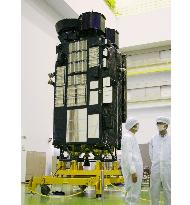
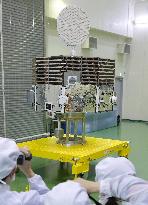
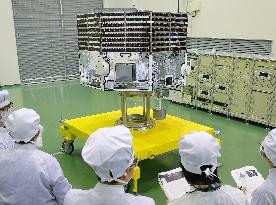
The Japan Aerospace Exploration Agency displays its Mercury Magnetospheric Orbiter in Sagamihara, Kanagawa Prefecture, to the press in March 2015. The probe is due to be launched during fiscal 2016 and start observation in 2024. (Kyodo) ==Kyodo

  •  
JAXA project manager speaks to press about Mercury probe

JAXA project manager speaks to press about Mercury probe

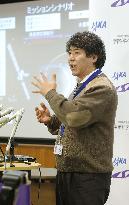
Project manager Hajime Hayakawa at the Japan Aerospace Exploration Agency speaks to the press about the Mercury Magnetospheric Orbiter at the Sagamihara Campus in Kanagawa Prefecture on March 15, 2015. JAXA plans to launch the MMO spacecraft in fiscal 2016 to study the magnetic field and magnetosphere of Mercury. (Kyodo) ==Kyodo

  •  
JAXA project manager explains Mercury probe

JAXA project manager explains Mercury probe

Project manager Hajime Hayakawa at the Japan Aerospace Exploration Agency talks about the Mercury Magnetospheric Orbiter at the Sagamihara Campus in Kanagawa Prefecture on March 15, 2015. JAXA plans to launch the MMO spacecraft in fiscal 2016 to study the magnetic field and magnetosphere of Mercury. MMO's arrival to Mercury is expected around January 2024. (Kyodo) ==Kyodo

  •  
JAXA displays Mercury probe to press

JAXA displays Mercury probe to press

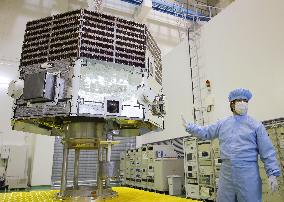
The Japan Aerospace Exploration Agency shows the Mercury Magnetospheric Orbiter at JAXA's Sagamihara Campus in Kanagawa Prefecture on March 15, 2015. JAXA plans to launch the MMO spacecraft in fiscal 2016 to study the magnetic field and magnetosphere of Mercury. (Kyodo) ==Kyodo

  •  
JAXA shows Mercury probe to press

JAXA shows Mercury probe to press

The Japan Aerospace Exploration Agency shows the Mercury Magnetospheric Orbiter to the press at JAXA's Sagamihara Campus in Kanagawa Prefecture on March 15, 2015. JAXA plans to launch the MMO spacecraft in fiscal 2016 to study the magnetic field and magnetosphere of Mercury. (Kyodo) ==Kyodo

  •  
JAXA Prof. explains plan to put Akatsuki into Venus orbit

JAXA Prof. explains plan to put Akatsuki into Venus orbit

Masato Nakamura, project manager of the Japanese Venus orbiter project at the Japan Aerospace Exploration Agency, explains on Nov. 9, 2015, in Tokyo JAXA's second attempt to put the Venus Climate Orbiter Akatsuki into the Venus orbit on Dec. 7. JAXA will brief on the result on Dec. 9. (Kyodo) ==Kyodo

  •  
Rocket to launch Venus probe

Rocket to launch Venus probe

TANEGASHIMA, Japan - An H-2A rocket arrives at its launch pad at Tanegashima Space Center, southwestern Japan, on May 17, 2010. The rocket carrying Venus climate orbiter Akatsuki is scheduled to lift off the following day. (Kyodo)

  •  
UAE's Mars orbiter launched on Japanese rocket

UAE's Mars orbiter launched on Japanese rocket

An H2A rocket carrying Hope, a Mars orbiter developed by the United Arab Emirates, takes off from Tanegashima Space Center in Kagoshima Prefecture, southwestern Japan, on July 20, 2020.

  •  
UAE's Mars orbiter launched on Japanese rocket

UAE's Mars orbiter launched on Japanese rocket

An H2A rocket carrying Hope, a Mars orbiter developed by the United Arab Emirates, takes off from Tanegashima Space Center in Kagoshima Prefecture, southwestern Japan, on July 20, 2020.

  • Main
  • Top
  • Editorial
  • Creative
  • About Us
  • About ILG
  • Terms of use
  • Company
  • BEHIND
  • Price List
  • Single Plan
  • Monthly Plan
  • Services
  • Shooting
  • Rights Clearance
  • Support
  • FAQ
  • How To Buy
  • Contact Us
  • Become a Partner

© KYODO NEWS IMAGES INC

All Rights Reserved.

  • Editorial
  • Olympics
  • News
  • Sports
  • Japan
  • Tech
  • Royal
  • Disaster
  • NorthKorea
  • Old Japan
  • SNS

  • Creative
  • Food
  • Japan
  • Landscape
  • Animal
  • Popular
  • #Ukraine
  • #Thailand
  • #coronavirus
  • #N. Korea
  • #China
  • #Russia
  • #Ukraine
  • #Thailand
  • #coronavirus
  • #N. Korea
  • #China
  • #Russia
  • Food
  • Japan
  • Landscape
  • Animal
  • Olympics
  • News
  • Sports
  • Japan
  • Tech
  • Royal
  • Disaster
  • NorthKorea
  • Old Japan
  • SNS