•  
EGYPT-CAIRO-SUMMER-NIGHT LIFE

EGYPT-CAIRO-SUMMER-NIGHT LIFE

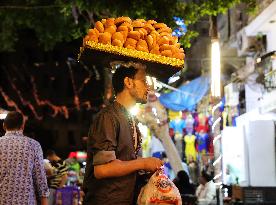
(230709) -- CAIRO, July 9, 2023 (Xinhua) -- A peddler is seen at the Khan el-Khalili market at night in Cairo, Egypt, July 8, 2023. Located at the heart of Cairo's old Islamic district, Khan el-Khalili is one of the most famed tourist bazaars in the Egyptian capital. (Xinhua/Wang Dongzhen)

  •  

Zagreb Christmas markets in festive atmosphere amid booming tourism

STORY: Zagreb Christmas markets in festive atmosphere amid booming tourism DATELINE: Dec. 24, 2022 LENGTH: 00:02:16 LOCATION: Zagreb CATEGORY: CULTURE SHOTLIST: 1. various of the city decorated in the Christmas spirit 2. SOUNDBITE 1 (Croatian): AMNA JASAREVIC, Tourist 3. various of people drinking and eating on the streets 4. SOUNDBITE 2 (Croatian): MARINA RADILIC, Tourist 5. various of decorated area with food and drink 6. SOUNBITE 3 (English): MARKO ROKSANDIC, Peddler 7. various of a skate ring STORYLINE: Christmas markets have returned to Zagreb this year as tourists from home and abroad are visiting Croatia's capital to experience the festive atmosphere and holiday cheer. More than 25 individual Christmas markets are spread throughout the city's main squares and promenades, each with unique theme and atmosphere. SOUNDBITE 1 (Croatian): AMNA JASAREVIC, Tourist "Everyone is talking about the Christmas markets in Zagreb, so I came from Bosnia to visit them." For three years in a row, the Zagreb Christm

  •  

The People of Okunoto

The people of Okunoto. Farmers build thousand paddy fields. Fishermen, who do not have a fishing port, make salt in pumping salt fields. There are also migrant workers and peddlers.   The people of Okunoto, despite the rough seas of the Sea of Japan and the poverty of their half-farming, half-fishing existence, build Senmaida rice paddies (paddies built on sloping land), people make salt the old-fashioned way, the last of the Agehama salt paddies where salt is pumped with labor, the cutting down of Asunaro forests, a tribe of fishermen turned plasterers, women peddling fish, and women peddling fish and vegetables at the morning market in Iida. Women peddling fish, women peddling fish and vegetables at the morning market in Iida, a general merchandise market held in each village  before winter preparations, and women leaving for Kansai in search of work before winter. The film was shot on an unknown date, and was released on November 4, 1960.

  •  

The Vegetable Riot

Yamagata, Saitama, and Tokyo. Vegetables are in short supply due to the typhoon. Housewives rush to buy vegetables at half the price of those sold at Kawagoe Agricultural High School. Housewives shopping at a grocery store, harvesting, farmer interviews, wholesale market, peddling, vegetables harvested at Kawagoe Agricultural High School, shooting date unknown, release date: December 1, 1961.

  •  
A basket vendor

A basket vendor

The basket seller sells not only baskets but also daily goods made of bamboo. Bamboo is abundant in Japan. It is easy to process and has excellent characteristics of ventilation and water resistance. The sellers went around crying out baskets and miso drainers .==Date:unknown, Place:unknown, Photo:unknown, (Credit:Nagasaki University Library/Kyodo News Images) [Cabinet Number18‐24‐0]

  •  
The approach to Toshogu Shrine,Nikko

The approach to Toshogu Shrine,Nikko

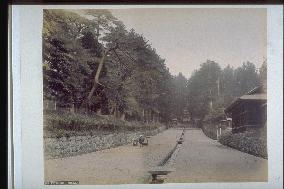
The view of the Ichino torii from the front approach to Toshogu. Ten stone steps called sennin masusugata stand in front of this stone torii. People other than warriors, such as farmers and townspeople, could only go this far when paying respects to the temple. The ditch in the centre and gentle slope difference have been buried and do not exist today. To the right of the approach is Rinoji Temple, and a man walks with a balancing pole to the left.==Date:unknown, Place:Nikko, Photo:Ogawa Kazumasa, (Credit:Nagasaki University Library/Kyodo News Images) [Cabinet Number9‐13‐0]

  •  
Sleeping Cat Carving,Toshogu Shrine,Nikko

Sleeping Cat Carving,Toshogu Shrine,Nikko

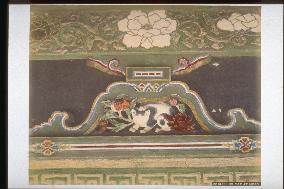
A carving of a sleeping cat adorns a platform near the ceiling of the Sen Gate at the rear approach. The cat sleeping in the peony is said to be by the maestro Hidari Kangoro. Through this gate and the Sakashita Gate is the approach leading to the Toshogu Okusha.==Date:unknown, Place:Nikko, Photo:Ogawa Kazumasa, (Credit:Nagasaki University Library/Kyodo News Images) [Cabinet Number6‐25‐0]

  •  
A cargo carrier

A cargo carrier

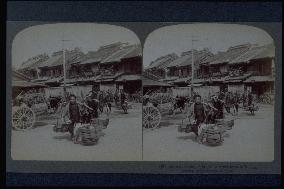
Three thousand ryo a day falls where it must. This senryu poem means that everyday people spend three thousand ryo (monetary unit in the Edo Period), one thousand in the fish market in the morning, one thousand in the theatres during the daytime, and one thousand in the Yoshiwara pleasure quarter in the evening. There was a fish market on the east side of the northern edge of Nihonbashi Bridge during the Edo Period. The man in this photograph is selling fish he just bought at the fish market. Probably taken near Nihonbashi. Since there was no refrigeration then, fish had to be sold within a day and people ate fresher fish than today. This stereograph is dated 1904.==Date:1904, Place:Tokyo, Photo:Underwood, (Credit:Nagasaki University Library/Kyodo News Images) [Cabinet Number97‐77‐0]

  •  
A candy maker

A candy maker

This is the same setting as that in photograph #4553, only taken from a different angle. The difference is betrayed by the feet of the ameya (candy peddler). Photograph #4553 was trimmed in a crescent shape at the top.==Date:unknown, Place:unknown, Photo:unknown, (Credit:Nagasaki University Library/Kyodo News Images) [Cabinet Number96‐19‐0]

  •  
A basket vendor

A basket vendor

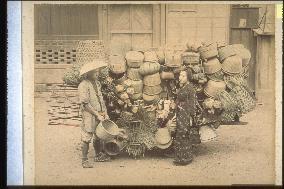
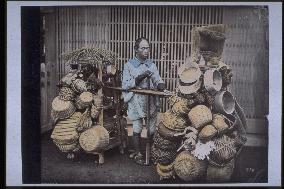
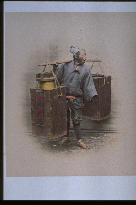
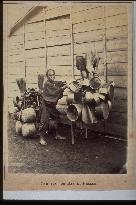
A basket peddler wears gaiters, black socks, sandals, and a kimono with a collar and hems pulled up. He is carrying merchandise on a balancing pole. These include sieve baskets, crate baskets, noodle-draining baskets, woven bamboo baskets and small brooms.==Date:unknown, Place:unknown, Photo:Usui Shuzaburo, (Credit:Nagasaki University Library/Kyodo News Images) [Cabinet Number94‐13‐0]

  •  
A candy maker

A candy maker

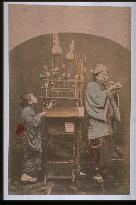
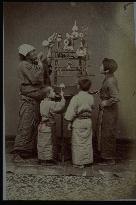
A craftsman is blowing air into a heated amezaiku (candy made from wheat-gluten) figure, while a girl looks at the various displayed figures. This traditional art was performed on the street until not long ago.==Date:unknown, Place:unknown, Photo:unknown, (Credit:Nagasaki University Library/Kyodo News Images) [Cabinet Number89‐19‐0]

  •  
A flower vendor

A flower vendor

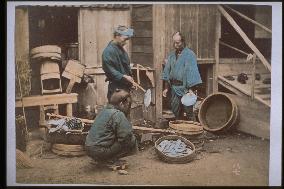
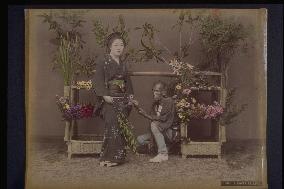
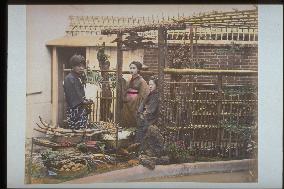
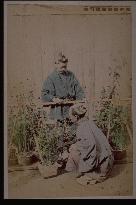
The kneeling man seems to be holding a pair of flower scissors in his right hand. It is said that flower sellers made a clinking sound with scissors while peddling. Some peddlers sold pots and seedlings as well as flowers.==Date:unknown, Place:unknown, Photo:unknown, (Credit:Nagasaki University Library/Kyodo News Images) [Cabinet Number85‐46‐0]

  •  
An insect cage vender and girls

An insect cage vender and girls

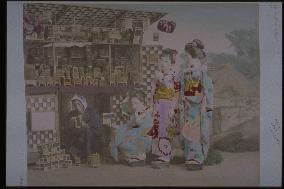
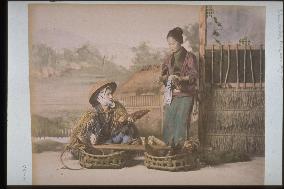
An insect cage peddler shows his wares to girls. The girl on the right is holding a fan in her hand. Girls of the time apparently enjoyed the songs of various insects, experiences that nurtured their esthetic sense and emotional maturity.==Date:unknown, Place:unknown, Photo:Kajima Seibei, (Credit:Nagasaki University Library/Kyodo News Images) [Cabinet Number84‐10‐0]

  •  
A candy seller and girls with sunshades

A candy seller and girls with sunshades

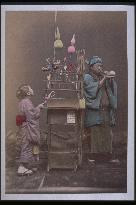
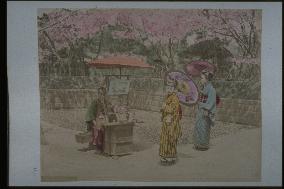
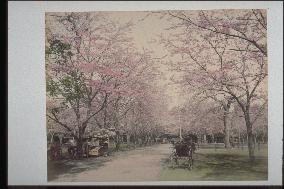
Two young women with parasols who have come to view cherry blossoms are stopping in front of a candy peddler. The candy peddler's shop is a foldable and therefore mobile structure. People are visible strolling in the distance.==Date:unknown, Place:unknown, Photo:unknown, (Credit:Nagasaki University Library/Kyodo News Images) [Cabinet Number83‐20‐0]

  •  
A vendor selling amazake (a sweet beverage)

A vendor selling amazake (a sweet beverage)

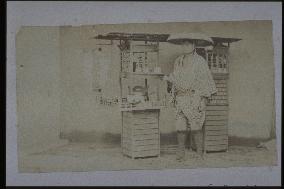
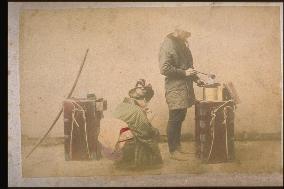
The peddler carried boxes containing an iron pot with sweet sake and teacups. He carried the boxes hanging in front and back from a carrying pole. The iron pot was kept warm by a heating device underneath.==Date:unknown, Place:unknown, Photo:R. Stillfried, (Credit:Nagasaki University Library/Kyodo News Images) [Cabinet Number77‐30‐0]

  •  
A woman carrying a flower basket

A woman carrying a flower basket

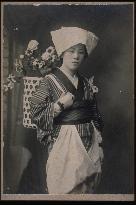
A flower seller poses in a photograph studio. The woman is wearing a white head cloth and a kimono and carries a basket of flowers. The striped kimono is a furisode (long sleeve kimono for single women). The white cloth hanging from her waist is probably a bag for carrying various items.==Date:unknown, Place:Kyoto, Photo:unknown, (Credit:Nagasaki University Library/Kyodo News Images) [Cabinet Number72‐115‐0]

  •  
A candy maker

A candy maker

A peddler walks around town selling amezaiku (candy figures). This scene is gone today, but amezaiku remains as a traditional art. Candy made from wheat-gluten was heated and molded into various figures loved by children.==Date:Middle Meiji (1883-1897), Place:unknown, Photo:unknown, (Credit:Nagasaki University Library/Kyodo News Images) [Cabinet Number69‐54‐0]

  •  
A fish seller

A fish seller

The fish peddler walked around the city carrying fish in a shallow tub that hung from a carrying pole on his shoulder. The man on the right holding a plate is a customer. He would use the plate to carry the purchased fish home. Called furiuri, these peddlers played an indispensable role in daily life.==Date:1868, Place:unknown, Photo:unknown, (Credit:Nagasaki University Library/Kyodo News Images) [Cabinet Number64‐71‐0]

  •  
A vegetable vendor

A vegetable vendor

A peddler carries vegetables on a balancing pole. When the load was heavy, the peddlers held canes as well. This man is wearing a twisted hachimaki headband, short coat, trousers, white tabi socks and straw sandals. The vegetables include lotus root, burdock, spinach, turnip and mustard leaf. He is writing in a handbook.==Date:unknown, Place:unknown, Photo:unknown, (Credit:Nagasaki University Library/Kyodo News Images) [Cabinet Number64‐14‐0]

  •  
A distant view of Yokohama Station

A distant view of Yokohama Station

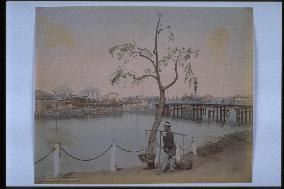
This is the original Yokohama Station designed by American architect R. P. Bridgens and built in 1871. The building is of stone and wood construction. Renamed Sakuragi-cho Station in 1915, the building was destroyed in the Great Kanto Earthquake of 1923.==Date:unknown, Place:Yokohama, Photo:unknown, (Credit:Nagasaki University Library/Kyodo News Images) [Cabinet Number55‐40‐0]

  •  
A drink vendor

A drink vendor

A man is peddling sweetened milk in the same manner as an amazake-uri. He keeps the milk warm in an iron kettle and carries it to sell in the streets and lanes of the city.==Date:unknown, Place:unknown, Photo:unknown, (Credit:Nagasaki University Library/Kyodo News Images) [Cabinet Number55‐24‐4]

  •  
A general dealer

A general dealer

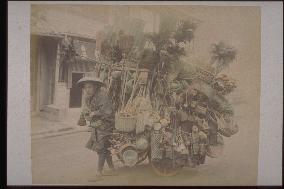
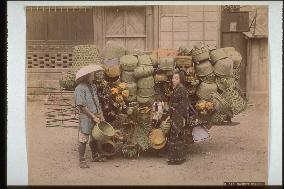
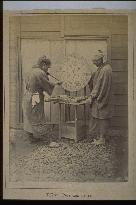
A peddler is selling brooms and bamboo baskets piled up on a cart. He is wearing a bamboo hat, cotton coat, gaiters and straw sandals. The cart is full of merchandise like brooms, bamboo baskets, brushes of various sizes, graters, scrub brushes and ladles.==Date:Middle Meiji (1883-1897), Place:unknown, Photo:unknown, (Credit:Nagasaki University Library/Kyodo News Images) [Cabinet Number51‐150‐0]

  •  
A basket vendor

A basket vendor

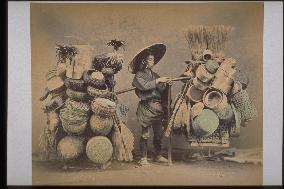
This peddler wears a bamboo hat, a kimono with hems pulled up, gaiters, socks, and straw sandals. He selling mainly portable bamboo baskets, but he is carrying other products such as sieve baskets, brooms and feather dusters.==Date:unknown, Place:unknown, Photo:Kusakabe Kinbei, (Credit:Nagasaki University Library/Kyodo News Images) [Cabinet Number51‐155‐0]

  •  
A vegetable vendor

A vegetable vendor

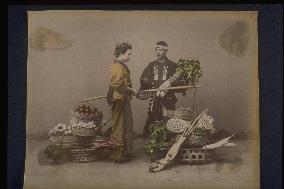
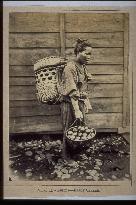
A vegetable peddler wearing a headband and half coat sells radishes and apples to a maid. Apples, turnips and carrots are in the left basket, while onions, lotus root, radish, and ginger are in the right.==Date:unknown, Place:unknown, Photo:unknown, (Credit:Nagasaki University Library/Kyodo News Images) [Cabinet Number51‐103‐0]

  •  
A flower vendor

A flower vendor

The man seems to beholding flower scissors in his left hand. It is said that flower sellers made a clinking sound with scissors while peddling. Many items were peddled like flower pots, primrose, chrysanthemum, and amour adonis. The peddling scenes added poetic charm to each season.==Date:unknown, Place:unknown, Photo:unknown, (Credit:Nagasaki University Library/Kyodo News Images) [Cabinet Number51‐99‐0]

  •  
A vegetable vendor

A vegetable vendor

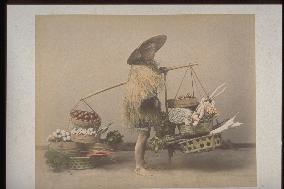
A vegetable peddler wears a bamboo hat and straw raincoat. Apples, carrots and turnips are in the back basket, while onions, lotus root, radish, and burdock are in the front.==Date:unknown, Place:unknown, Photo:unknown, (Credit:Nagasaki University Library/Kyodo News Images) [Cabinet Number51‐71‐0]

  •  
A vegetable vendor

A vegetable vendor

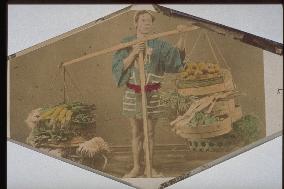
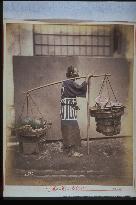
A vegetable peddler wears a headband, short half coat, and straw sandals on bare feet. He carries okekago containers filled with vegetables on a balancing pole. The vegetables include squash, burdock, lotus root, onion and spinach.==Date:unknown, Place:unknown, Photo:unknown, (Credit:Nagasaki University Library/Kyodo News Images) [Cabinet Number51‐38‐0]

  •  
Bamboo shoot seller

Bamboo shoot seller

Bamboo shoots are young sprouts that come out of the underground roots. A man puts bamboo shoots harvested in the spring in a basket and sells them. The season word of the bamboo shoot is summer.==Date:unknown, Place:unknown, Photo:Ogawa Kazumasa, (Credit:Nagasaki University Library/Kyodo News Images) [Cabinet Number44‐11‐0]

  •  
A vendor selling amazake (a sweet beverage)

A vendor selling amazake (a sweet beverage)

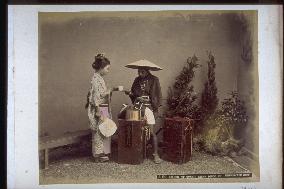
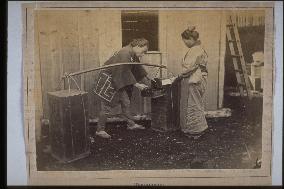
The amazake vendor passes amazake to a woman as he pours sake from the kettle. The box to the right contains tea cups. The vendor took the two boxes on a balancing pole.==Date:Middle Meiji, Place:unknown, Photo:unknown, (Credit:Nagasaki University Library/Kyodo News Images) [Cabinet Number43‐13‐0]

  •  
Merchant carrying goods on a pole

Merchant carrying goods on a pole

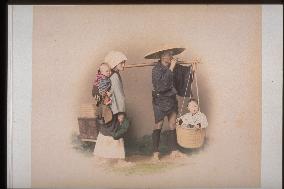
A traveling vendor smoking a pipe. The woman with an infant on her back could be his wife. She is there to see her husband off. But this is unnatural with a child sitting in the front basket of the balancing pole. The balancing pole is carried to the fore, so the basket to the back is probably very light.==Date:unknown, Place:unknown, Photo:Suzuki Shin-ichi, (Credit:Nagasaki University Library/Kyodo News Images) [Cabinet Number41‐49‐0]

  •  
A vegetable vendor

A vegetable vendor

A man sells vegetables to two girls in the garden of a house. The man probably has a bundle of Japanese onions. What is typical of this kind of photo is that there is a variety of vegetables.==Date:unknown, Place:unknown, Photo:Suzuki Shin-ichi, (Credit:Nagasaki University Library/Kyodo News Images) [Cabinet Number41‐26‐0]

  •  
A flower vendor

A flower vendor

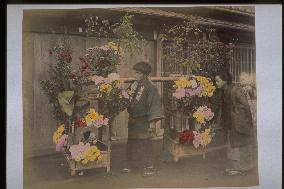
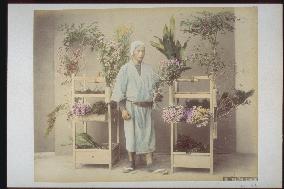
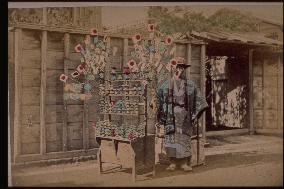
Flower vendors. Flowers are placed in bamboo vases on all sides of the two platforms, and chrysanthemums are placed in the middle row. The vendor changed the flowers sold every season, and there were a variety among the vendors; those who sold pots, and flower seedlings.==Date:unknown, Place:unknown, Photo:Kusakabe Kinbei, (Credit:Nagasaki University Library/Kyodo News Images) [Cabinet Number40‐43‐0]

  •  
A vegetable vendor

A vegetable vendor

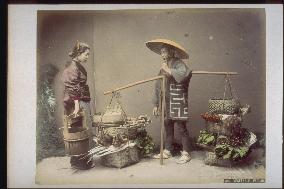
A man carries a balancing pole with vegetables in many baskets stacked together, and a woman holding a pail. The vegetable in the lowest basket to the left is probably Japanese radish. It is interesting to see that the Japanese radish is thinner than those we see at present.==Date:unknown, Place:unknown, Photo:Kusakabe Kinbei, (Credit:Nagasaki University Library/Kyodo News Images) [Cabinet Number40‐42‐0]

  •  
A flower vendor

A flower vendor

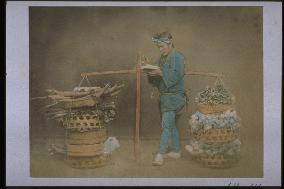
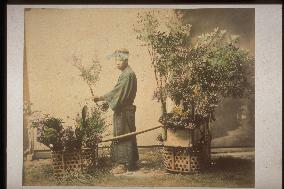
Flowers are placed in the left basket on the balancing pole, and branches fill the right basket. A man facing sideways sits between the baskets wearing a hair band, and cuts a branch in the lower part with his scissors.==Date:unknown, Place:unknown, Photo:Tamamura Kozaburo, (Credit:Nagasaki University Library/Kyodo News Images) [Cabinet Number29‐5‐0]

  •  
Seller of suika,watermelons

Seller of suika,watermelons

A watermelon vendor carrying a balancing pole. In the front pail are pieces of watermelon, while the pail at the back holds whole watermelon and other fruits. The man has a chonmage (top knot).==Date:unknown, Place:unknown, Photo:[R. Stillfried], (Credit:Nagasaki University Library/Kyodo News Images) [Cabinet Number27‐25‐0]

  •  
Seller of household altars

Seller of household altars

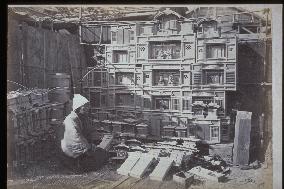
The kamidana (mini-shrine) for ordinary households became popular in the modern era. It coincides with the butsudan (mini Buddhist altar within the household). Usually, the ancestor deities are worshipped in the mini-shrine with an amulet from Ise Shrine, and a sakaki is placed with the omiki (sake for the Gods) and food offerings. At the December market, the mini-shrine vendor opened a shop, and people bought new ones to replace the old for New Year's.==Date:unknown, Place:unknown, Photo:unknown, (Credit:Nagasaki University Library/Kyodo News Images) [Cabinet Number18‐54‐0]

  •  
A vegetable vendor

A vegetable vendor

A vegetable vendor carrying a pole and a man buying vegetables. There are two rows of baskets one upon the other hanging from the pole. One of the men touches the ground. He is probably selling sweet potatoes. The vendor and his customer both have shaved heads. A scene in the city.==Date:unknown, Place:unknown, Photo:unknown, (Credit:Nagasaki University Library/Kyodo News Images) [Cabinet Number18‐37‐0]

  •  
A basket vendor

A basket vendor

The basket seller sells daily goods made of bamboo as well as baskets. Bamboo is abundant in Japan. It is easy to process and has excellent characteristics of ventilation and water resistance. The sellers went around crying baskets and miso drainers .==Date:Middle Meiji, Place:unknown, Photo:unknown, (Credit:Nagasaki University Library/Kyodo News Images) [Cabinet Number18‐31‐0]

  •  
Seller of soy sauce

Seller of soy sauce

Carried on page 103 of the August 18, 1872 edition of The Far East. The photo is entitled Vendor of Soy . The article explains that the monotonous voice and calls are similar to that in England.==Date:unknown, Place:unknown, Photo:unknown, (Credit:Nagasaki University Library/Kyodo News Images) [Cabinet Number17‐56‐0]

  •  
Seller of mizugashi,fruits and sweets

Seller of mizugashi,fruits and sweets

Carried on page 139 of the October 4, 1872 edition of The Far East. A vendor of fruits and sweets. This farmer is selling persimmons. Persimmons are as abundant as apples are in Britain, says the explanation, and it is a wonder why they are not exported to Europe because they will probably be liked by Westerners.==Date:First year of Meiji, Place:unknown, Photo:unknown, (Credit:Nagasaki University Library/Kyodo News Images) [Cabinet Number17‐55‐0]

  •  
A basket vendor

A basket vendor

Carried on page 127 of the September 19, 1872 edition of The Far East. Entitled Zaruiya .The explanation says a vendor of baskets and other items made of bamboo, which comes second only to pine in practicality. These sell well on New Years.==Date:First year of Meiji, Place:unknown, Photo:THE FAR EAST, (Credit:Nagasaki University Library/Kyodo News Images) [Cabinet Number17‐51‐0]

  •  
Blowgun

Blowgun

Carried on page 259 of the March 9, 1873 edition of The Far East. A stall in the city offering sweets as prizes where people try their luck shooting darts with a blowpipe. The explanation says the target has the number of the prize on it . The vendor wears a top knot.==Date:First year of Meiji, Place:unknown, Photo:unknown, (Credit:Nagasaki University Library/Kyodo News Images) [Cabinet Number17‐50‐0]

  •  
Seller of tsukemono,pickles

Seller of tsukemono,pickles

Carried on page 223 of the January 22, 1873 edition of The Far East. Entitled Japanese pickle shop . The explanation has it that although the Japanese diet did not suit foreigners because of its avoidance of meat, the smell of these pickles was particularly unbearable.==Date:Early Meiji, Place:unknown, Photo:THE FAR EAST, (Credit:Nagasaki University Library/Kyodo News Images) [Cabinet Number17‐49‐0]

  •  
A vegetable vendor

A vegetable vendor

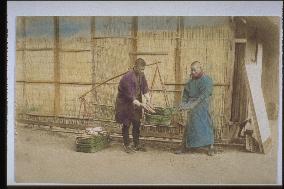
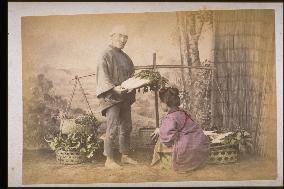
A grocer and woman customer. The grocer is barefoot and wears a happi coat. He has his balancing pole on the ground and holds Japanese radishes in both hands. Japanese radishes are also in the two baskets placed on top of each other, and the woman sits with a basket. The background is a picture. To the right is a reed screen.==Date:unknown, Place:unknown, Photo:unknown, (Credit:Nagasaki University Library/Kyodo News Images) [Cabinet Number16‐2‐0]

  •  
A vendor selling amazake (a sweet beverage)

A vendor selling amazake (a sweet beverage)

Amazakeuri, who sold fermented sake by calling out sweet, sweet amazake, were seen in summer time in the Keihan district and year-long in Edo. They carried two wooden boxes on balancing poles to sell amazake. They had tea cups and trays in the box in the front, and a furnace and teapot in the box in the back. The price for a cup was 6 to 8 mon.==Date:unknown, Place:unknown, Photo:unknown, (Credit:Nagasaki University Library/Kyodo News Images) [Cabinet Number16‐1‐0]

  •  
Seller of potted flowers

Seller of potted flowers

A flower vendor with a balancing pole sells chrysanthemums, and a man sits looking at the flowers. The flower vendor has his balancing pole on the road and holds scissors in his hands. Both men wear mage (top knots).==Date:Early Meiji, Place:unknown, Photo:unknown, (Credit:Nagasaki University Library/Kyodo News Images) [Cabinet Number15‐21‐0]

  •  
Seller of small articles

Seller of small articles

The caption reads Small Articles , but what is sold here is unknown. The things hanging from the small Hinomaru flag look like windmills. What is placed under the stand is unclear.==Date:unknown, Place:unknown, Photo:unknown, (Credit:Nagasaki University Library/Kyodo News Images) [Cabinet Number15‐10‐0]

  •  
A row of Japanese cedar trees along the Nikko Road

A row of Japanese cedar trees along the Nikko Road

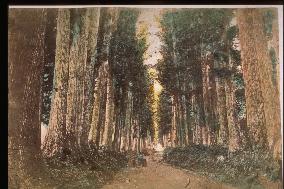
Imaichi was an important crossroad to Nikko, where Onari (Nikko) Kaido, Reiheishi Kaido and Aizu Nishi Kaido met. The cedar trees donated by Matsudaira Masatsuna to commemorate the 33rd anniversary of the death of Tokugawa Ieyasu stand here. In the centre of the boulevard, a man who looks like an incense merchant stands to emphasize the size of the cedar trees.==Date:unknown, Place:Imaichi, Photo:unknown, (Credit:Nagasaki University Library/Kyodo News Images) [Cabinet Number14‐17‐0]

  •  
Ueno Park

Ueno Park

Ueno Park is famous for cherry blossoms to the present day.The clothing of the people in the photo show that it is still cold. This is probably a stall for amazake (a sweet drink made from fermented rice).==Date:unknown, Place:Tokyo, Photo:unknown, (Credit:Nagasaki University Library/Kyodo News Images) [Cabinet Number11‐2‐0]

  •  
A vegetable vendor

A vegetable vendor

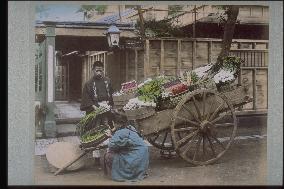
A man selling vegetables in front of a house and a woman customer. Various vegetables are sold with many baskets and pails on the daihachi guruma (big wheel cart). The grocery man holds vegetables in his hands, and the woman looks at the vegetables in the pail. The coat of the grocery man is printed with the letters Inoue .==Date:Late Meiji, Place:unknown, Photo:Ogawa Kazumasa, (Credit:Nagasaki University Library/Kyodo News Images) [Cabinet Number10‐41‐0]

  • Main
  • Top
  • Editorial
  • Creative
  • About Us
  • About ILG
  • Terms of use
  • Company
  • BEHIND
  • Price List
  • Single Plan
  • Monthly Plan
  • Services
  • Shooting
  • Rights Clearance
  • Support
  • FAQ
  • How To Buy
  • Contact Us
  • Become a Partner

© KYODO NEWS IMAGES INC

All Rights Reserved.

  • Editorial
  • Olympics
  • News
  • Sports
  • Japan
  • Tech
  • Royal
  • Disaster
  • NorthKorea
  • Old Japan
  • SNS
  • Creative
  • Food
  • Japan
  • Landscape
  • Animal
  • Popular
  • #Ukraine
  • #Thailand
  • #coronavirus
  • #N. Korea
  • #Russia
  • #China
  • #Ukraine
  • #Thailand
  • #coronavirus
  • #N. Korea
  • #Russia
  • #China
  • Food
  • Japan
  • Landscape
  • Animal
  • Olympics
  • News
  • Sports
  • Japan
  • Tech
  • Royal
  • Disaster
  • NorthKorea
  • Old Japan
  • SNS