•  

Exploring China's new quantum computer prototype with digital reporter

STORY: Exploring China's new quantum computer prototype with digital reporter DATELINE: Oct. 12, 2023 LENGTH: 00:00:39 LOCATION: HEFEI, China CATEGORY: TECHNOLOGY SHOTLIST: 1. STANDUP (English): ZHENG, Xinhua's digital reporter 2. various of "Jiuzhang 3.0" STORYLINE: STANDUP (English): ZHENG, Xinhua's digital reporter "I am Zheng, a digital reporter at the Xinhua News Agency. Today, let's go inside 'Jiuzhang 3.0' and explore China's new quantum computer prototype together." Chinese scientists unveiled a quantum computer prototype named "Jiuzhang 3.0" with 255 detected photons on Wednesday, once again pushing the boundaries of photonics quantum computing technology. Led by the renowned Chinese quantum physicist Pan Jianwei, the research team has successfully accomplished this quantum computing feat, achieving a speed that is 10 quadrillion times faster in solving Gaussian boson sampling (GBS) problems compared to the world's existing fastest supercomputers. Gaussian boson sampling, a classically intracta

  •  
CHINA-BRAIN SCIENTIST-PHOTONS (CN)

CHINA-BRAIN SCIENTIST-PHOTONS (CN)

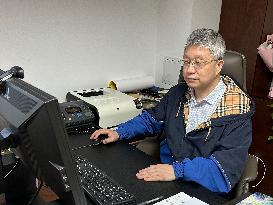
(230328) -- BEIJING, March 28, 2023 (Xinhua) -- Cheng Heping, a leading Chinese biomedical expert, is pictured at work in his office at Peking University in Beijing, capital of China, March 15, 2023. TO GO WITH "Profile: A brain scientist's decades-long focus on photons" (Xinhua/Che Yunlong)

  •  
CHINA-BRAIN SCIENTIST-PHOTONS (CN)

CHINA-BRAIN SCIENTIST-PHOTONS (CN)

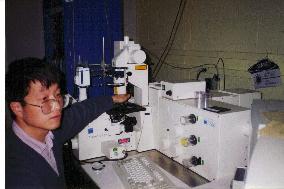
(230328) -- BEIJING, March 28, 2023 (Xinhua) -- This undated file photo provided by the interviewee shows Cheng Heping, now a leading Chinese biomedical expert, operating a confocal microscope in a research lab in Maryland, the Untied States back in 1995. TO GO WITH "Profile: A brain scientist's decades-long focus on photons" (Xinhua)

  •  
CHINA-BRAIN SCIENTIST-PHOTONS (CN)

CHINA-BRAIN SCIENTIST-PHOTONS (CN)

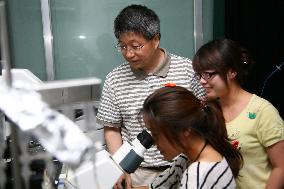
(230328) -- BEIJING, March 28, 2023 (Xinhua) -- This undated file photo provided by the interviewee shows Cheng Heping, a leading Chinese biomedical expert, and two of his doctoral students conducting experiments in a laboratory at Peking University in Beijing, capital of China in 2011. TO GO WITH "Profile: A brain scientist's decades-long focus on photons" (Xinhua)

  •  

3 scientists share 2022 Nobel Prize for quantum physics

STORY: 3 scientists share 2022 Nobel Prize for quantum physics DATELINE: Oct. 5, 2022 LENGTH: 00:02:16 LOCATION: Stockholm CATEGORY: SCIENCE SHOTLIST: 1. various of the announcement 2. various of the Royal Swedish Academy of Sciences STORYLINE: Alain Aspect from France, John F. Clauser from the United States and Anton Zeilinger from Austria won the 2022 Nobel Prize in Physics for their work on quantum information science, the Royal Swedish Academy of Sciences announced Tuesday. The awards were given for their "experiments with entangled photons, establishing the violation of Bell inequalities and pioneering quantum information science," the academy said in a statement. "Their results have cleared the way for new technology based upon quantum information," it added. Aspect, born in 1947 in France's Agen, is a professor at Paris-Saclay University. Clauser, 80, is a research physicist at J.F. Clauser and Associates in the United States. Zeilinger, 77, serves as a professor at the University of Vienna. Th

  •  
President Jun Sawada explains the IOWN concept at the NTTR&D Forum.

President Jun Sawada explains the IOWN concept at the NTTR&D Forum.

Jun Sawada, president of NTT, announced on April 13 that 65 companies are considering joining the "IOWN Global Forum" to be established with Intel and Sony in the spring of 2020. In addition to Microsoft, 55 of the companies are overseas, including Orange (France), Verizon (US), and China Telecom (Taiwan). Many global companies that support the IOWN concept of rapid processing of huge amounts of data by using light from communication networks to terminals are expected to join the list when it is established. In a speech in Tokyo on the same day, Sawada explained the reason why he proposed the IOWN concept. IOWN, which aims to be commercially available in 30 years, uses photons rather than electrons to transmit information between chips and cores within chips, making everything from networks to terminals optical, and realizing information processing capabilities that far exceed the limits of electrical control. Photo taken on November 13, 2019, credit: Nikkan Kogyo Shimbun / Kyodo News Images

  • Main
  • Top
  • Editorial
  • Creative
  • About Us
  • About ILG
  • Terms of use
  • Company
  • BEHIND
  • Price List
  • Single Plan
  • Monthly Plan
  • Services
  • Shooting
  • Rights Clearance
  • Support
  • FAQ
  • How To Buy
  • Contact Us
  • Become a Partner

© KYODO NEWS IMAGES INC

All Rights Reserved.

  • Editorial
  • Olympics
  • News
  • Sports
  • Japan
  • Tech
  • Royal
  • Disaster
  • NorthKorea
  • Old Japan
  • SNS
  • Creative
  • Food
  • Japan
  • Landscape
  • Animal
  • Popular
  • #Ukraine
  • #Russia
  • #coronavirus
  • #N. Korea
  • #China
  • #Thailand
  • #Ukraine
  • #Russia
  • #coronavirus
  • #N. Korea
  • #China
  • #Thailand
  • Food
  • Japan
  • Landscape
  • Animal
  • Olympics
  • News
  • Sports
  • Japan
  • Tech
  • Royal
  • Disaster
  • NorthKorea
  • Old Japan
  • SNS