•  
Nobel laureate Nakamura visits education minister

Nobel laureate Nakamura visits education minister

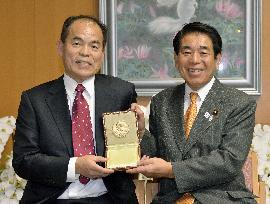
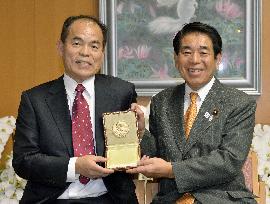
TOKYO, Japan - Shuji Nakamura (L), a Japan-born American professor at the University of California, Santa Barbara, and Japanese Education, Culture, Sports, Science and Technology Minister Hakubun Shimomura pose with Nakamura's Nobel physics prize medal at the education ministry in Tokyo on Jan. 15, 2015, as Nakamura paid a courtesy visit on Shimomura. Nakamura along with two Japanese physicists won the prize last year, for contribution to the development of light-emitting diodes.

  •  
Nobel laureate Amano shows certificate upon return home

Nobel laureate Amano shows certificate upon return home

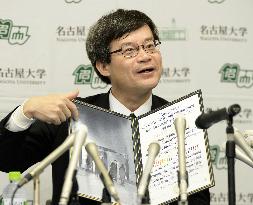
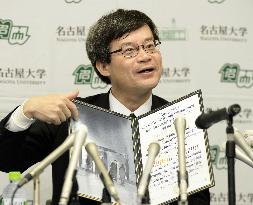
NAGOYA, Japan - Nagoya University professor Hiroshi Amano, one of the three Japanese physicists awarded the 2014 Nobel Prize in Physics, shows his certificate at a press conference at Chubu Centrair International Airport near Nagoya, central Japan, on Dec. 16, 2014, upon returning home from an award ceremony in Stockholm, Sweden.

  •  
2 Japanese, American awarded Nobel Prize for inventing blue LED

2 Japanese, American awarded Nobel Prize for inventing blue LED

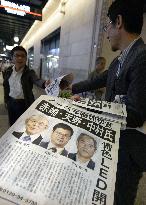
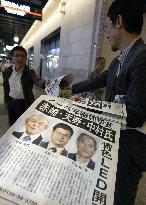
OSAKA, Japan - Newspaper extra editions, reporting the awarding of the Nobel Prize in Physics 2014 to two Japanese and a Japanese-born American physicists, are handed out to passers-by in Osaka's Namba district on Oct. 7, 2014. Two Japanese physicists -- Isamu Akasaki and Hiroshi Amano -- and Japanese-born American Shuji Nakamura were awarded the prize for the invention of efficient blue light-emitting diodes.

  •  
Selection of Kitakami as candidate site for ILC in doubt

Selection of Kitakami as candidate site for ILC in doubt

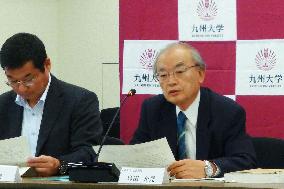
FUKUOKA, Japan - Nobutaka Shimada (R), professor emeritus at Kyushu University, announces the results of an investigation by his group at a press conference in Fukuoka, southwestern Japan, on Sept. 19, 2014, calling into question the selection of the Kitakami mountain range in Iwate Prefecture by a panel of physicists as Japan's candidate site for building the International Linear Collider.

  •  
CERN physicists find new particle considered Higgs boson

CERN physicists find new particle considered Higgs boson

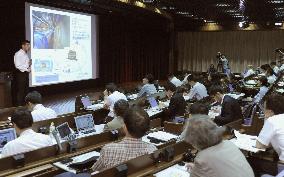
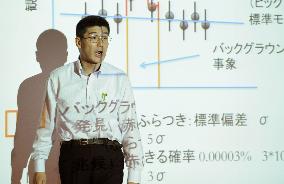
TOKYO, Japan - Shoji Asai (L back), associate professor at the University of Tokyo, speaks to researchers and reporters at the university in Tokyo on July 4, 2012. The European Organization for Nuclear Research (CERN) announced the same day the discovery of a new particle believed to be the so-called Higgs boson, the most fundamental particle that gives mass to all other elementary particles. Asai was among the members of the Atlas group of scientists at CERN, which has confirmed the existence of the Higgs boson with a certainty of more than 99.9999%.

  •  
CERN physicists find new particle considered Higgs boson

CERN physicists find new particle considered Higgs boson

TOKYO, Japan - Shoji Asai, associate professor at the University of Tokyo, speaks at a press conference at the university in Tokyo on July 4, 2012. The European Organization for Nuclear Research (CERN) announced the same day the discovery of a new particle believed to be the so-called Higgs boson, the most fundamental particle that gives mass to all other elementary particles. Asai was among the members of the Atlas group of scientists at CERN, which has confirmed the existence of the Higgs boson with a certainty of more than 99.9999%.

  •  
CERN physicists find new particle considered Higgs boson

CERN physicists find new particle considered Higgs boson

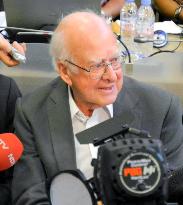
GENEVA, Switzerland - British physicist Peter Higgs is surrounded by reporters prior to a press conference at the European Organization for Nuclear Research (CERN) in a suburb of Geneva on July 4, 2012. CERN announced the same day the discovery of a new particle believed to be the so-called Higgs boson, the most fundamental particle that gives mass to all other elementary particles. The Higgs boson was theorized by Higgs at the University of Edinburgh in Scotland, among others, in 1964.

  •  
Physicist Tonomura dies at 70

Physicist Tonomura dies at 70

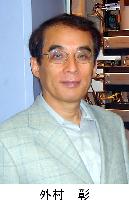
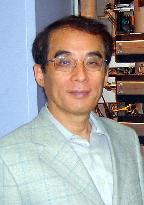
TOKYO, Japan - File photo taken in August 2006 shows Japanese physicist Akira Tonomura. A fellow at electronics giant Hitachi Ltd. tipped as a future Nobel Prize winner for years, Tonomura died of pancreatic cancer early on May 2, 2012, at a hospital in Hidaka, Saitama Prefecture. He was 70. Tonomura was known for developing electron holography for observing microscopic structures in matter using the wave nature of electrons and confirming the so-called Aharonov-Bohm effect, the existence of which had long been disputed among physicists.

  •  
Neutrino test tank shown to press

Neutrino test tank shown to press

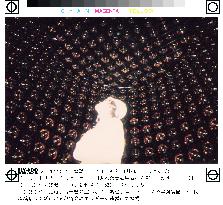
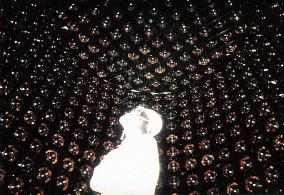
The photo shows a huge tank-shaped facility designed to detect neutrinos which physicists say pass through all substances. The test facility equipped with 680 lenses attached to the ceiling was shown to the press Monday Nov. 9 at the Education Ministry's High Energy Accelerator Research Organization in Tukuba, Ibaraki Prefecture.

  •  
The Physicists - film (1963)

The Physicists - film (1963)

Eric Porter Television: The Physicists (1962) 23 October 1963 Date: 23-Oct-63

  •  
Woman in news: Physicist wins international prize

Woman in news: Physicist wins international prize

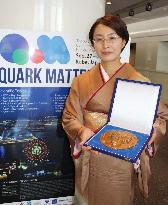
Photo shows Chihiro Sasaki, the first woman to win the Zimanyi Medal Award for young physicists for her theoretical research on quarks, one type of matter particle. The award was presented at an international conference held between late September and early October in Kobe, western Japan. (Kyodo) ==Kyodo

  •  
Physicist Tonomura dies at 70

Physicist Tonomura dies at 70

TOKYO, Japan - File photo taken in August 2006 shows Japanese physicist Akira Tonomura. A fellow at electronics giant Hitachi Ltd. tipped as a future Nobel Prize winner for years, Tonomura died of pancreatic cancer early on May 2, 2012, at a hospital in Hidaka, Saitama Prefecture. He was 70. Tonomura was known for developing electron holography for observing microscopic structures in matter using the wave nature of electrons and confirming the so-called Aharonov-Bohm effect, the existence of which had long been disputed among physicists. (Kyodo)

  •  
Nobel laureate Nakamura visits education minister

Nobel laureate Nakamura visits education minister

TOKYO, Japan - Shuji Nakamura (L), a Japan-born American professor at the University of California, Santa Barbara, and Japanese Education, Culture, Sports, Science and Technology Minister Hakubun Shimomura pose with Nakamura's Nobel physics prize medal at the education ministry in Tokyo on Jan. 15, 2015, as Nakamura paid a courtesy visit on Shimomura. Nakamura along with two Japanese physicists won the prize last year, for contribution to the development of light-emitting diodes. (Kyodo)

  •  
Nobel laureate Amano shows certificate upon return home

Nobel laureate Amano shows certificate upon return home

NAGOYA, Japan - Nagoya University professor Hiroshi Amano, one of the three Japanese physicists awarded the 2014 Nobel Prize in Physics, shows his certificate at a press conference at Chubu Centrair International Airport near Nagoya, central Japan, on Dec. 16, 2014, upon returning home from an award ceremony in Stockholm, Sweden. (Kyodo)

  •  
2 Japanese, American awarded Nobel Prize for inventing blue LED

2 Japanese, American awarded Nobel Prize for inventing blue LED

OSAKA, Japan - Newspaper extra editions, reporting the awarding of the Nobel Prize in Physics 2014 to two Japanese and a Japanese-born American physicists, are handed out to passers-by in Osaka's Namba district on Oct. 7, 2014. Two Japanese physicists -- Isamu Akasaki and Hiroshi Amano -- and Japanese-born American Shuji Nakamura were awarded the prize for the invention of efficient blue light-emitting diodes. (Kyodo)

  •  
Japanese, U.S. physicists to share Israel's Wolf Prize

Japanese, U.S. physicists to share Israel's Wolf Prize

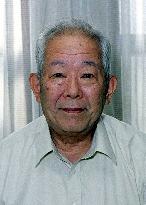
TOKYO, Japan - Masatoshi Koshiba, professor emeritus at the University of Tokyo who will share the 2000 Wolf Prize in physics with a U.S. scientist, is shown in a file photo. The Israel-based Wolf Foundation said on Jan. 18 Koshiba, 73, and Raymond Davis Jr., 85, a professor at the University of Pennsylvania, will share the 100,000 dollar prize, to be presented in Jerusalem in May. Koshiba has led a series of experiments on neutrinos, using the Kamiokande and Super-Kamiokande detectors in the town of Kamioka, Gifu Prefecture, to study the subatomic particles emitted by supernovas.

  •  
Neutrino test tank shown to press

Neutrino test tank shown to press

The photo shows a huge tank-shaped facility designed to detect neutrinos which physicists say pass through all substances. The test facility equipped with 680 lenses attached to the ceiling was shown to the press Monday Nov. 9 at the Education Ministry's High Energy Accelerator Research Organization in Tukuba, Ibaraki Prefecture. ==Kyodo

  • Main
  • Top
  • Editorial
  • Creative
  • About Us
  • About ILG
  • Terms of use
  • Company
  • BEHIND
  • Price List
  • Single Plan
  • Monthly Plan
  • Services
  • Shooting
  • Rights Clearance
  • Support
  • FAQ
  • How To Buy
  • Contact Us
  • Become a Partner

© KYODO NEWS IMAGES INC

All Rights Reserved.

  • Editorial
  • Olympics
  • News
  • Sports
  • Japan
  • Tech
  • Royal
  • Disaster
  • NorthKorea
  • Old Japan
  • SNS
  • Creative
  • Food
  • Japan
  • Landscape
  • Animal
  • Popular
  • #Ukraine
  • #Russia
  • #coronavirus
  • #N. Korea
  • #China
  • #Thailand
  • #Ukraine
  • #Russia
  • #coronavirus
  • #N. Korea
  • #China
  • #Thailand
  • Food
  • Japan
  • Landscape
  • Animal
  • Olympics
  • News
  • Sports
  • Japan
  • Tech
  • Royal
  • Disaster
  • NorthKorea
  • Old Japan
  • SNS