•  
The Sanmon Gate,Shiba Zojoji Temple

The Sanmon Gate,Shiba Zojoji Temple

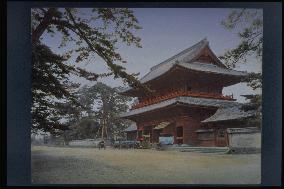
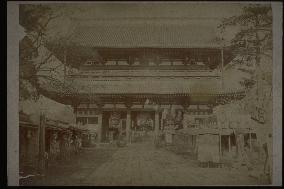
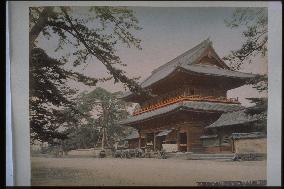
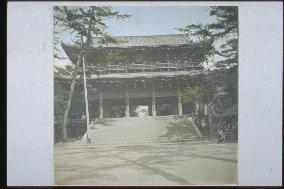
This is Sangedatsu Gate (Sanmon), the middle gate in the temple precincts. The name (lit. three liberations) is said to refer to the Buddhist concept of release from the three poisons (greed, anger, and complaint), or to the three gates (Kuumon, Musoumon, Muganmon) in Paradise. It is said that the gate was reconstructed in 1623. The rickshaws visible in front of the gate started service in Tokyo in 1870, and by the following year there were 10,000 working the streets.==Date:unknown, Place:Tokyo, Photo:unknown, (Credit:Nagasaki University Library/Kyodo News Images) [Cabinet Number96‐65‐0]

  •  
The Sanmon Gate,Sofukuji Temple

The Sanmon Gate,Sofukuji Temple

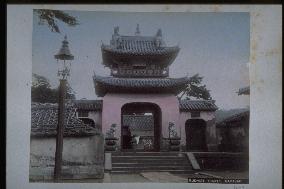
The Sanmon Gate,Sofukuji Temple==Date:unknown, Place:Nagasaki, Photo:unknown, (Credit:Nagasaki University Library/Kyodo News Images)

  •  
Tatsuno-dera Temple,Katase

Tatsuno-dera Temple,Katase

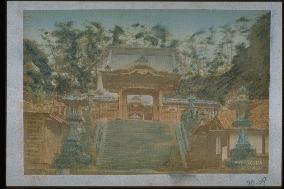
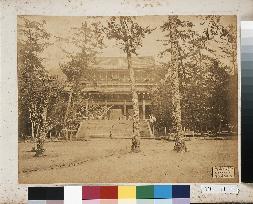
The main hall is visible through the Sanmon (main gate). The official name of the temple is Jakkozan Ryukoji Temple. The construction of the gate in 1864 was sponsored by Kashimaya, a wealthy merchant house in Osaka. The main hall, Sanmon, and the all night lanterns remain to this day. The construction of Nio Gate at the bottom of the stairs in 1973 changed the landscape dramatically.==Date:unknown, Place:Fujisawa, Photo:unknown, (Credit:Nagasaki University Library/Kyodo News Images) [Cabinet Number90‐29‐0]

  •  
The Sanmon Gate of Yasaka Shrine,Gion,Kyoto

The Sanmon Gate of Yasaka Shrine,Gion,Kyoto

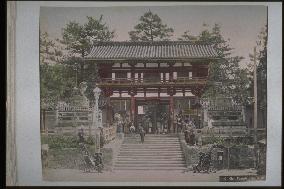
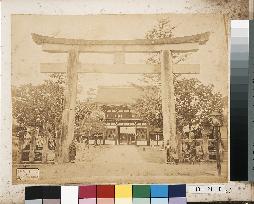
View of the western romon gate of Yasaka Shinto Shrine. Statues of komainu (guardian dogs) stand on both sides of the gate. Rickshaw drivers are relaxing while women and children stand in front of the stone walls and gate. A gaslight and electric pole are visible near the stone walls. The gate roof was covered with hinoki tree bark in 1497 and re-covered with roof tiles during the Eiroku Period (1558-1570). The gate in the picture is painted red, with a kirizuma style roof and roof tiles. There are statues of two ministers within the shrine grounds.==Date:unknown, Place:Kyoto, Photo:unknown, (Credit:Nagasaki University Library/Kyodo News Images) [Cabinet Number87‐37‐0]

  •  
Maruyama Yaami Hotel

Maruyama Yaami Hotel

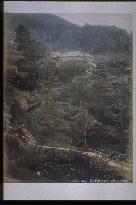
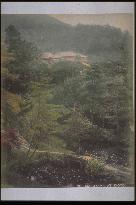
Distant view of the Maruyama Yaami Hotel from the top of the Sanmon Gate at Chion-in Temple, facing southeast. Long stone stairs, the stone bridge over the pond, and abundant nature with tall pines and maple trees are visible in the foreground. Several buildings of the Yaami Hotel stand on the Maruyama hillside, as well as a terrace built on the west side to enjoy the view.==Date:unknown, Place:Kyoto, Photo:Tamamura Kozaburo, (Credit:Nagasaki University Library/Kyodo News Images) [Cabinet Number80‐4‐0]

  •  
Images of Buddha in the inner sanctuary at Chion-in Temple

Images of Buddha in the inner sanctuary at Chion-in Temple

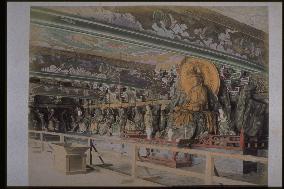
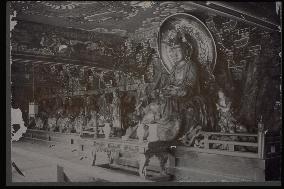
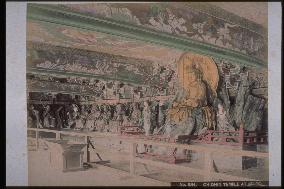
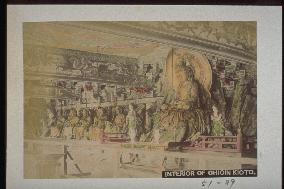
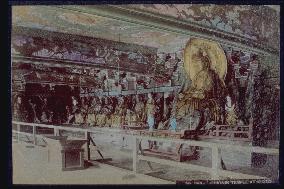
Buddhist statues on the Sanmon Gate of Chion-in Temple. The Buddha is seated in the middle, flanked by Zenzai-doji, Shudatsu-choja, and the 16 Buddhist Saints. Unryu (dragons in clouds) and other motifs are painted on the ceiling. Taken by Tamamura Kozaburo.==Date:unknown, Place:Kyoto, Photo:unknown, (Credit:Nagasaki University Library/Kyodo News Images) [Cabinet Number80‐7‐0]

  •  
The Sanmon Gate,Shiba Zojoji Temple

The Sanmon Gate,Shiba Zojoji Temple

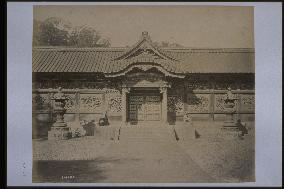
This mukaikarahafu style gate is located just past Chokugaku Gate, the entrance to the mausoleum. There were corridors on both sides and a front corridor that led to the shrine. Three bronze lanterns donated by feudal lords stood on each side.==Date:unknown, Place:Tokyo, Photo:R. Stillfried, (Credit:Nagasaki University Library/Kyodo News Images) [Cabinet Number78‐29‐0]

  •  
The Sanmon Gate,Shiba Zojoji Temple

The Sanmon Gate,Shiba Zojoji Temple

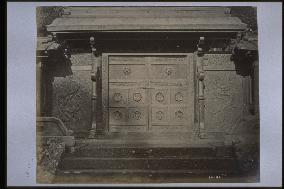
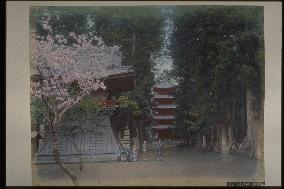
This is the bronze gate in front of the pagoda in the deepest part of Bunshoin Mausoleum. Two dragons, once ascending and one descending, are cast on the panels on the walls on both sides of the gate. Gates were built for the tombs of five shoguns in the north mausoleum, but this is the only one made of bronze. The gate survived the air raids of 1945 and currently is the gate to the restored Tokugawa family tomb.==Date:unknown, Place:Tokyo, Photo:R. Stillfried, (Credit:Nagasaki University Library/Kyodo News Images) [Cabinet Number78‐30‐0]

  •  
The Sanmon Gate at Sensoji Temple

The Sanmon Gate at Sensoji Temple

The sanmon (front gate) at Sensoji Temple was called Niomon because statues of the guardian deities Kongo Rikishi were installed on both the right and left (present-day Hozomon). Statues of Monju Bosatsu (Manjusri Bodhisattva) and Shiten (four angels) are installed on the second floor of the gate building. The plaque Sensoji is based on calligraphy by the head priest of the Tendai Sect, Ryosho Hoshin-o. This photograph was taken before brick buildings were erected in the Nakamise commercial area in 1885.==Date:unknown, Place:Tokyo, Photo:unknown, (Credit:Nagasaki University Library/Kyodo News Images) [Cabinet Number72‐123‐0]

  •  
An image of Buddha at the top of Sanmon Gate Building,Chion-in Temple

An image of Buddha at the top of Sanmon Gate Building,Chion-in Temple

Buddhist statues on the Sanmon Gate of Chion-in Temple. The Buddha is seated in the middle, flanked by Zenzai-doji, Shudatsu-choja, and the 16 Buddhist Saints. Unryu (dragons in clouds) and other motifs are painted on the ceiling. This is the largest gate of its kind in Japan, with five bays and three entrances. Built in two-story irimoya style, it has a tiled roof and was erected in 1619 by the second shogun Tokugawa Ietada.==Date:unknown, Place:Kyoto, Photo:unknown, (Credit:Nagasaki University Library/Kyodo News Images) [Cabinet Number72‐42‐0]

  •  
The gate to Takanawa Tozenji Temple,the British Legation

The gate to Takanawa Tozenji Temple,the British Legation

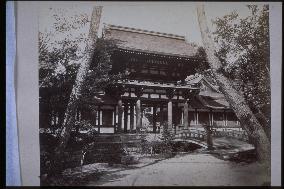
Sanmon gate of Tozenji Temple viewed from the temple grounds (opposite from photograph #3420). Since one of the leaning pines has been cut down, this photograph was taken after #3420, probably at the beginning of the Meiji Period. The sea coast came up to the gate at that time. At present, due to landfill, the coast is located at a greater distance. According to Tokyo Annai (Tokyo Information), Tozenji Temple belongs to the Myoshinji School of Rinzai Zen Buddhism and was built in 1610. Built initially built above the reservoir as Reinan-an by the Buddhist priest Reinan, it was moved to Takanawa in 1636 and the name was changed to Tozenji.==Date:Early Meiji, Place:Tokyo, Photo:unknown, (Credit:Nagasaki University Library/Kyodo News Images) [Cabinet Number71‐2‐0]

  •  
The gate to Takanawa Tozenji Temple,the British Legation

The gate to Takanawa Tozenji Temple,the British Legation

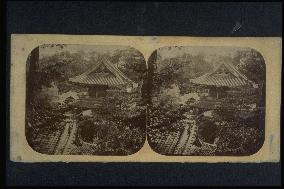
This stereograph bears the caption View taken from the United States Legation, at Yedo and is said to depict Tempukuji Temple in Azabu, but this is incorrect. The temple is actually Tozenji, located in present-day Takanawa 3-chome. The Shogunate concluded a treaty pact with Great Britain (Anglo-Japanese Treaty of Commerce) in 1858, and Tozenji Temple was designated as the site of the British Legation. This was taken by Swiss Pierre Rossier at the end of the Edo Period. This is a side view of the sanmon gate, also seen in photographs #3420 and #3443.==Date:1859, Place:Tokyo, Photo:Pierre Rossier, (Credit:Nagasaki University Library/Kyodo News Images) [Cabinet Number70‐7‐0]

  •  
The Sanmon Gate,Sofukuji Temple

The Sanmon Gate,Sofukuji Temple

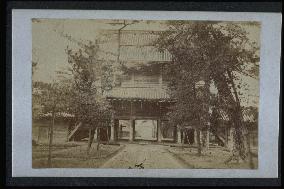
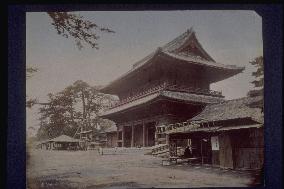
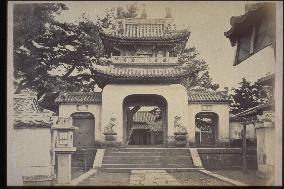
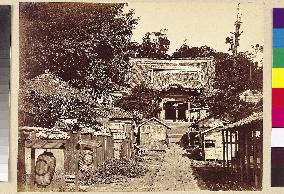
The Sanmon (Romon) Gate at Sofukuji Temple. Date unknown. The gate was rebuilt in dragon palace gate style in 1849. A famous tourist attraction in Nagasaki, it remains to this day as a nationally designated Important Cultural Asset.==Date:about 1865, Place:Nagasaki, Photo:F. Beato, (Credit:Nagasaki University Library/Kyodo News Images) [Cabinet Number66‐28‐0]

  •  
The Sanmon Gate of Chion-in Temple

The Sanmon Gate of Chion-in Temple

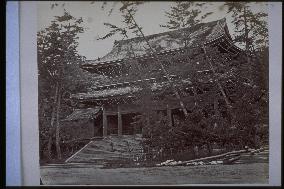
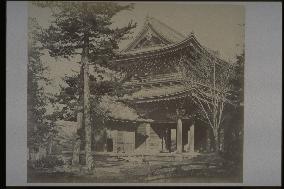
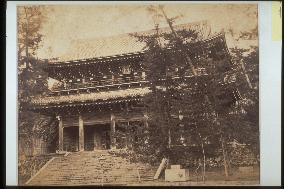
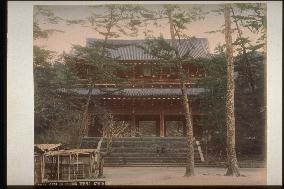
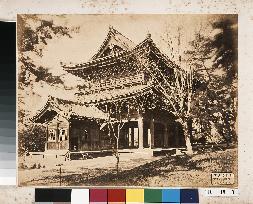
The Sanmon Gate of Chion-in Temple is viewed from the southwest. The tall pine trees south of the gate are slanted due to the wind, and pine logs are scattered about underneath. This is the largest gate of its kind in Japan, with five bays and three entrances. Built in two-story irimoya style, it has a tiled roof and was erected in 1619 by the second shogun Tokugawa Ietada.==Date:unknown, Place:Kyoto, Photo:R. Stillfried, (Credit:Nagasaki University Library/Kyodo News Images) [Cabinet Number63‐17‐0]

  •  
The sanmon (entrance) gate of a shrine

The sanmon (entrance) gate of a shrine

The sanmon (entrance) gate of a shrine==Date:unknown, Place:unknown, Photo:R. Stillfried, (Credit:Nagasaki University Library/Kyodo News Images)

  •  
The Sanmon Gate of Nishi Otani Temple

The Sanmon Gate of Nishi Otani Temple

Main gate of the Otani Honbyo (Mausoleum) of Nishi Otani Temple, looking from the east side of the water fountain facing west-northwest. The irimoya style gate has a hiwada (Japanese hinoki tree bark) roof. Pine trees are growing in the back. The stone pavement in the foreground leads to the Otani honbyo (Mausoleum). Taken by Felix Beato.==Date:unknown, Place:Kyoto, Photo:F. Beato, (Credit:Nagasaki University Library/Kyodo News Images) [Cabinet Number62‐27‐0]

  •  
Monju-do,Kurodani Konkai Komyoji Temple

Monju-do,Kurodani Konkai Komyoji Temple

The Sanmon (two-story gate) of Kurodani Konkai Komyoji Temple was built in 1860 in the irimoya style (hip and gable roof) with ornate roof tiles. A hanging plaque bears an inscription by Emperor Gokomatsu (1377-1433) saying, The First Gate of Jodo Shinshu (Pure Land Buddhism). A stone bridge is visible in the right foreground. Taken by Felix Beato.==Date:unknown, Place:Kyoto, Photo:F. Beato, (Credit:Nagasaki University Library/Kyodo News Images) [Cabinet Number62‐26‐0]

  •  
Nishi Otani (Otani Honbyo Mausoleum of Honganji Temple)

Nishi Otani (Otani Honbyo Mausoleum of Honganji Temple)

The approach to Nishi-Otani Temple is viewed from the western edge of Entsu Bridge, facing east. There are two giant pine trees by the sanmon gate in the back. This stone bridge was built in 1865. It was referred to as a spectacles bridge because of its shape. It was famous for its red and white lotus flowers in the mid-19th century. There are teahouses with benches on the northwestern edge of the bridge. Taken by F. Beato.==Date:unknown, Place:Kyoto, Photo:F. Beato, (Credit:Nagasaki University Library/Kyodo News Images) [Cabinet Number62‐19‐0]

  •  
Ikegami Honmonji Temple

Ikegami Honmonji Temple

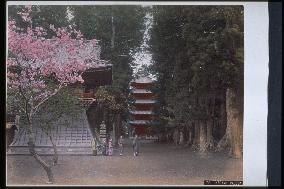
Visitors to the temple saw this scene after passing through the front gate (existent) built between 1688 and 1704, going up the stairs donated by Kato Kiyomasa and installed between 1596 and 1615, and then passing through the sanmon gate built along with the five-story pagoda by the second shogun Tokugawa Hidetada in 1608. The building on the left is the drum tower where ceremonial drums were stored. Both the gate and the drum tower were destroyed in World War II. The 29.5-meter pagoda however survived and still stands today as the oldest pagoda in the Kanto region and a National Important Cultural Asset. Mid-Meiji Period.==Date:unknown, Place:Tokyo, Photo:unknown, (Credit:Nagasaki University Library/Kyodo News Images) [Cabinet Number59‐19‐0]

  •  
The Sanmon Gate,Sofukuji Temple

The Sanmon Gate,Sofukuji Temple

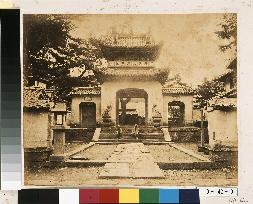
The Sanmon (Romon) Gate at Sofukuji Temple. Date unknown. The gate was rebuilt in dragon palace gate style in 1849. A famous tourist attraction in Nagasaki, it remains to this day as a nationally designated Important Cultural Asset.==Date:unknown, Place:Nagasaki, Photo:unknown, (Credit:Nagasaki University Library/Kyodo News Images) [Cabinet Number58‐28‐4]

  •  
Katase

Katase

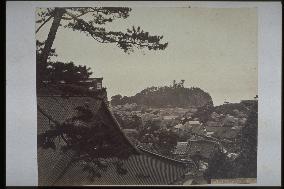
This photograph was taken from Shichimendo in the precincts of Ryukoji Temple. The roof of the main hall is visible to the lower right and the Sanmon (main gate) to the lower right. This was the location of an execution site called Tatsunokuchi during the Kamakura Period. Ryukoji Temple was built here because the site was considered sacred by Nichiren Sect followers, the reason being that Nichiren was almost executed here for criticizing government policies.==Date:unknown, Place:Fujisawa, Photo:unknown, (Credit:Nagasaki University Library/Kyodo News Images) [Cabinet Number58‐28‐0]

  •  
Maruyama Yaami Hotel

Maruyama Yaami Hotel

Distant view of the Maruyama Yaami Hotel from the top of the Sanmon Gate at Chion-in Temple, facing southeast. Long stone stairs, the stone bridge over the pond, and abundant nature with tall pines and maple trees are visible in the foreground. Several buildings of the Yaami Hotel stand on the Maruyama hillside, as well as a terrace built on the west side to enjoy the view.==Date:unknown, Place:Kyoto, Photo:unknown, (Credit:Nagasaki University Library/Kyodo News Images) [Cabinet Number57‐11‐2]

  •  
The Sanmon Gate,Shiba Zojoji Temple

The Sanmon Gate,Shiba Zojoji Temple

This is Sangedatsu Gate (Sanmon), the middle gate in the temple precincts. The name (lit. three liberations) is said to refer to the Buddhist concept of release from the three poisons (greed, anger, and complaint), or to the three gates (Kuumon, Musoumon, Muganmon) in Paradise. It is said that the gate was reconstructed in 1623. The rickshaws visible in front of the gate started service in Tokyo in 1870, and by the following year there were 10,000 working the streets.==Date:unknown, Place:Tokyo, Photo:unknown, (Credit:Nagasaki University Library/Kyodo News Images) [Cabinet Number53‐47‐0]

  •  
Ikegami Honmonji Temple

Ikegami Honmonji Temple

Visitors to the temple saw this scene after passing through the front gate (existent) built between 1688 and 1704, going up the stairs donated by Kato Kiyomasa and installed between 1596 and 1615, and then passing through the sanmon gate built along with the five-story pagoda by the second shogun Tokugawa Hidetada in 1608. The building on the left is the drum tower where ceremonial drums were stored. Both the gate and the drum tower were destroyed in World War II. The 29.5-meter pagoda however survived and still stands today as the oldest pagoda in the Kanto region and a National Important Cultural Asset. Mid-Meiji Period.==Date:unknown, Place:Tokyo, Photo:unknown, (Credit:Nagasaki University Library/Kyodo News Images) [Cabinet Number53‐2‐0]

  •  
A view of the city from the Otani Main Tomb,Nishi Honganji Temple

A view of the city from the Otani Main Tomb,Nishi Honganji Temple

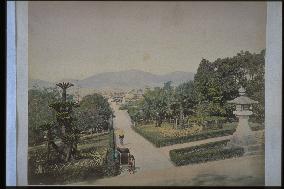
The temple approach is seen from the sanmon gate of Nishi-Otani Temple, facing west. The city of Kyoto and the Nishiyama Mountain Range are visible in the background. A stone lantern stands in front of the gate. The garden is well maintained and has cycad trees. A driver, his rickshaw and a person with an umbrella are visible at the gate. Tall trees are visible to the north.==Date:unknown, Place:Kyoto, Photo:unknown, (Credit:Nagasaki University Library/Kyodo News Images) [Cabinet Number52‐23‐0]

  •  
Images of Buddha in the inner sanctuary at Chion-in Temple

Images of Buddha in the inner sanctuary at Chion-in Temple

Buddhist statues on the Sanmon Gate of Chion-in Temple. The Buddha is seated in the middle, flanked by Zenzai-doji, Shudatsu-choja, and the 16 Buddhist Saints. Unryu (dragons in clouds) and other motifs are painted on the ceiling. Taken by Tamamura Kozaburo.==Date:unknown, Place:Kyoto, Photo:unknown, (Credit:Nagasaki University Library/Kyodo News Images) [Cabinet Number52‐17‐2]

  •  
Images of Buddha in the inner sanctuary at Chion-in Temple

Images of Buddha in the inner sanctuary at Chion-in Temple

Buddhist statues on the Sanmon Gate of Chion-in Temple. The Buddha is seated in the middle, flanked by Zenzai-doji, Shudatsu-choja, and the 16 Buddhist Saints. Unryu (dragons in clouds) and other motifs are painted on the ceiling.==Date:unknown, Place:Kyoto, Photo:unknown, (Credit:Nagasaki University Library/Kyodo News Images) [Cabinet Number51‐89‐0]

  •  
The naiden of Chion-in Temple

The naiden of Chion-in Temple

Buddhist statues on the Sanmon Gate of Chion-in Temple. The Buddha is seated in the middle, flanked by Zenzai-doji, Shudatsu-choja, and the 16 Buddhist Saints. Unryu (dragons in clouds) and other motifs are painted on the ceiling. Taken by Tamamura Kozaburo.==Date:unknown, Place:Kyoto, Photo:Tamamura Kozaburo, (Credit:Nagasaki University Library/Kyodo News Images) [Cabinet Number48‐112‐0]

  •  
The Sanmon Gate of Chion-in Temple

The Sanmon Gate of Chion-in Temple

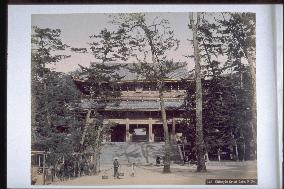
The Sanmon Gate of Chion-in is viewed from the west. The board south of the gate says Religious Lecture. A rickshaw with a passenger is visible. This is the largest gate of its kind in Japan, with five bays and three entrances. Built in two-story irimoya style, it has a tiled roof and was erected in 1619 by the second shogun Tokugawa Ietada. The word Kachozan on the tablet at the front of the gate is said to be the calligraphy of Emperor Reigen (1654-1732).==Date:unknown, Place:Kyoto, Photo:unknown, (Credit:Nagasaki University Library/Kyodo News Images) [Cabinet Number46‐89‐0]

  •  
Sanmon gate of a temple

Sanmon gate of a temple

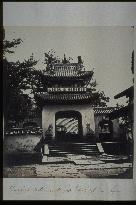
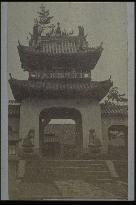
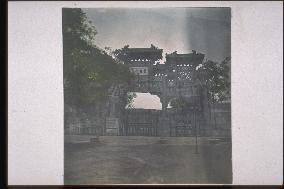
Sanmon gate of a temple==Date:unknown, Place:China, Photo:unknown, (Credit:Nagasaki University Library/Kyodo News Images)

  •  
Square and Sanmon gate

Square and Sanmon gate

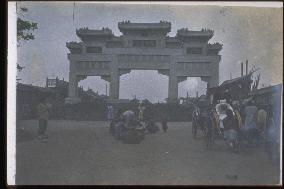
Square and Sanmon gate==Date:unknown, Place:China, Photo:unknown, (Credit:Nagasaki University Library/Kyodo News Images)

  •  
The Sanmon Gate,Shiba Zojoji Temple

The Sanmon Gate,Shiba Zojoji Temple

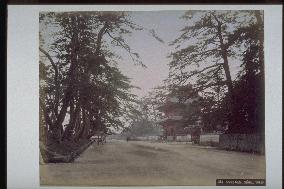
The great avenue in front of the gate of Zojoji. There are ditches on both sides of the road, and the tea house which was seen before has disappeared.==Date:unknown, Place:Tokyo, Photo:unknown, (Credit:Nagasaki University Library/Kyodo News Images) [Cabinet Number42‐43‐0]

  •  
The Sanmon Gate of Chion-in Temple

The Sanmon Gate of Chion-in Temple

The western side of Chion-in Temple Sanmon Gate is seen looking east. There are three rickshaws parked in front, a vendor, and a child. This is the largest gate of its kind in Japan, with five bays and three entrances. Built in two-story irimoya style, it has a tiled roof and was erected in 1619 by the second shogun Tokugawa Ietada. The word Kachozan on the tablet at the front of the gate is said to be the calligraphy of Emperor Reigen (1654-1732).==Date:unknown, Place:Kyoto, Photo:unknown, (Credit:Nagasaki University Library/Kyodo News Images) [Cabinet Number42‐22‐0]

  •  
Sanmon of Seijokoji Temple in Fujisawa

Sanmon of Seijokoji Temple in Fujisawa

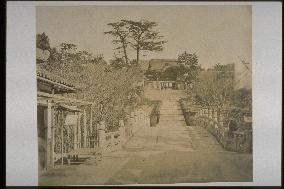
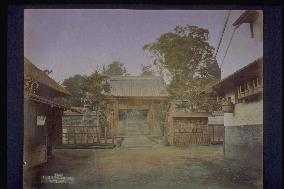
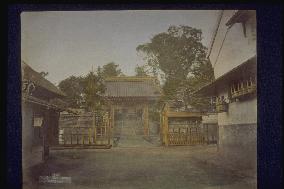
A gate is seen in the facade, and a stone pavement leads to the rear. Pails are lined up along the white walls of the building. (Same as that numbered 37-4 )==Date:unknown, Place:Fujisawa, Photo:unknown, (Credit:Nagasaki University Library/Kyodo News Images) [Cabinet Number37‐80‐0]

  •  
The Sanmon Gate,Shiba Zojoji Temple

The Sanmon Gate,Shiba Zojoji Temple

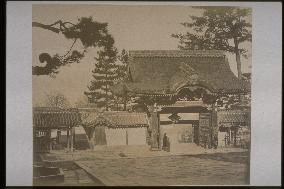
The entrance gate of Zojoji. A tea house can be seen next to the temple, with Musashiya, the name of the shop written on the paper doors. Under the veranda is seen a panel with Shiba written in both Chinese characters and the alphabet, probably for commemorative photos.==Date:unknown, Place:Tokyo, Photo:unknown, (Credit:Nagasaki University Library/Kyodo News Images) [Cabinet Number37‐69‐0]

  •  
Sanmon of Seijokoji Temple in Fujisawa

Sanmon of Seijokoji Temple in Fujisawa

A gate is in the front, and stone pavement continues on. Pails are arranged in rows by the white building to the right of the road. (Identical to the photo numbered 37-80.)==Date:unknown, Place:Fujisawa, Photo:unknown, (Credit:Nagasaki University Library/Kyodo News Images) [Cabinet Number37‐4‐0]

  •  
The Sanmon Gate of Chion-in Temple

The Sanmon Gate of Chion-in Temple

The Sanmon Gate of Chion-in Temple==Date:unknown, Place:Kyoto, Photo:[R. Stillfried], (Credit:Nagasaki University Library/Kyodo News Images)

  •  
The Sanmon Gate,Sofukuji Temple

The Sanmon Gate,Sofukuji Temple

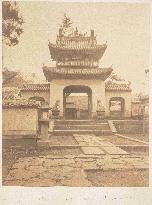
The Chinese-style gate at Sofukuji, a temple of the Obaku Sect in Kajiya-machi Nagasaki city. It was established by the Chinese priest Chonen in 1635. There are many cultural assets among the buildings of Sofukuji. This gate has also been designated an important cultural asset.==Date:1872, Place:Nagasaki, Photo:unknown, (Credit:Nagasaki University Library/Kyodo News Images) [Cabinet Number21‐29‐0]

  •  
The Sanmon Gate of Chion-in Temple

The Sanmon Gate of Chion-in Temple

Shinbashi dori of the Higashiyama district, Kyoto City. Chionin Temple was founded as Kissui Zenbo, of Honen a hermitage of the priest. It is the head temple of the Jodo Sect. The gate is the largest cherry gate made by Tokugawa Hidetada. The construction was initiated in 1619 and completed 2 years later. The photo looks up at the overall gate. The plaque with the characters Kachozan on the top tier of the gate features calligraphy by Emperor Reigen. White trees line the entrance. People are visible on the steps.==Date:unknown, Place:Kyoto, Photo:A. Farsari, (Credit:Nagasaki University Library/Kyodo News Images) [Cabinet Number18‐9‐0]

  •  
The Sanmon Gate of Chion-in Temple

The Sanmon Gate of Chion-in Temple

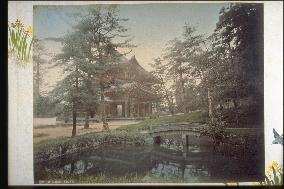
Shinbashi Street of the Higashiyama district of Kyoto City. Chionin is the head temple of the Jodo Sect which was initiated by Honen Jonin of Yoshimizu Zenbo (temple of the Zen sect). The gate is the largest Sakura Gate in Japan, built by Tokugawa Hidetada. The construction was started in 1619 and completed two years later. The photo looks at the gate over the stone bridge to the right of the lake within the temple.==Date:unknown, Place:Kyoto, Photo:Ogawa Kazumasa, (Credit:Nagasaki University Library/Kyodo News Images) [Cabinet Number5‐40‐0]

  •  
Inside of main gate of chion-in temple

Inside of main gate of chion-in temple

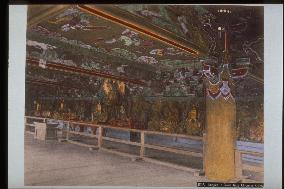
In the tower of the Sanmon at Chion-in Temple. The mirrored ceiling has coloured illustrations of angels and Kalavinka (an imaginary bird referred to in Buddhist sutras). Mitesaki tokyo (entablature in square frames) can be seen between the ceiling and pillars. The mirrored ceiling and entablature are features of the Zen Sect widely adopted after the Muromachi era. The image of Shakyamuni is in the centre and the 16 Arhats in the back.==Date:unknown, Place:Kyoto, Photo:Kusakabe Kinbei, (Credit:Nagasaki University Library/Kyodo News Images) [Cabinet Number2‐17‐0]

  •  
Zenpukuji Temple,Azabu

Zenpukuji Temple,Azabu

This is a Shingon Sect temple established by Kukai (Kobo Taishi) in 824. The sanmon and main hall are in the foreground and background, respectively. The large tree on the left is the upside-down gingko, which is still the largest gingko tree in Tokyo. This spot became the site of the American Legation after the effectuation of the Japan-U.S. Commercial Treaty in June 1859. Townsend Harris was the first envoy. The Legation moved to Tsukiji Akashi-machi in 1875. This photograph was taken in 1863 by Felix Beato, soon after Harris' arrival in Japan. The study was later burned to the ground by angry samurai from the Mito Clan.==Date:unknown, Place:Tokyo, Photo:F. Beato, (Credit:Nagasaki University Library/Kyodo News Images) [Cabinet Number104‐12‐0]

  •  
The Romon of Sofukuji Temple

The Romon of Sofukuji Temple

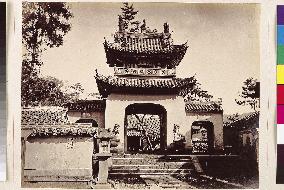
This is a photograph of the Sanmon (Romon) gate of Sofukuji Temple taken between 1860 and 1870. The gate was reconstructed in dragon palace gate style. This is the outermost gate of the temple and consists of a central gate with two side doors. This type of gate is called sanmon (three gates).==Date:unknown, Place:Nagasaki, Photo:Ueno Hikoma, (Credit:Nagasaki University Library/Kyodo News Images) [Cabinet Number102‐14‐0]

  •  
The Sanmon Gate,Sofukuji Temple

The Sanmon Gate,Sofukuji Temple

The Sanmon Gate,Sofukuji Temple==Date:about 1874, Place:Nagasaki, Photo:Ueno Hikoma?, (Credit:Nagasaki University Library/Kyodo News Images)

  •  
The Sanmon Gate,Sofukuji Temple

The Sanmon Gate,Sofukuji Temple

The Sanmon Gate,Sofukuji Temple==Date:unknown, Place:Nagasaki, Photo:unknown, (Credit:Nagasaki University Library/Kyodo News Images)

  •  
Sanmon at Chion-in Temple

Sanmon at Chion-in Temple

Sanmon at Chion-in Temple==Date:unknown, Place:Kyoto, Photo:unknown, (Credit:Nagasaki University Library/Kyodo News Images)

  •  
The Sanmon Gate of Yasaka Shrine,Gion,Kyoto

The Sanmon Gate of Yasaka Shrine,Gion,Kyoto

The Sanmon Gate of Yasaka Shrine,Gion,Kyoto==Date:unknown, Place:Kyoto, Photo:unknown, (Credit:Nagasaki University Library/Kyodo News Images)

  •  
Sanmon at Chion-in Temple

Sanmon at Chion-in Temple

Sanmon at Chion-in Temple==Date:unknown, Place:Kyoto, Photo:unknown, (Credit:Nagasaki University Library/Kyodo News Images)

  • Main
  • Top
  • Editorial
  • Creative
  • About Us
  • About ILG
  • Terms of use
  • Company
  • BEHIND
  • Price List
  • Single Plan
  • Monthly Plan
  • Services
  • Shooting
  • Rights Clearance
  • Support
  • FAQ
  • How To Buy
  • Contact Us
  • Become a Partner

© KYODO NEWS IMAGES INC

All Rights Reserved.

  • Editorial
  • Olympics
  • News
  • Sports
  • Japan
  • Tech
  • Royal
  • Disaster
  • NorthKorea
  • Old Japan
  • SNS
  • Creative
  • Food
  • Japan
  • Landscape
  • Animal
  • Popular
  • #Ukraine
  • #Russia
  • #coronavirus
  • #N. Korea
  • #China
  • #Thailand
  • #Ukraine
  • #Russia
  • #coronavirus
  • #N. Korea
  • #China
  • #Thailand
  • Food
  • Japan
  • Landscape
  • Animal
  • Olympics
  • News
  • Sports
  • Japan
  • Tech
  • Royal
  • Disaster
  • NorthKorea
  • Old Japan
  • SNS