•  
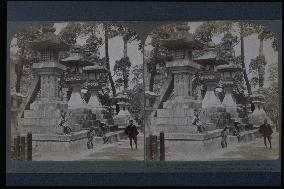
Stone Lantern in Sumiyoshi Shrine

Stone Lantern in Sumiyoshi Shrine

Many stone lanterns were donated to Sumiyoshi Shinto Shrine as prayers for safe sea voyages and successful business. Probably taken in the beginning of the Meiji Period.==Date:1904, Place:Osaka, Photo:Underwood, (Credit:Nagasaki University Library/Kyodo News Images) [Cabinet Number97‐18‐0]

  •  
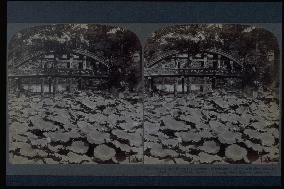
Soribashi bridge at Sumiyoshi Shrine

Soribashi bridge at Sumiyoshi Shrine

This stereograph depicts Soribashi Bridge and the lotus pond. The parapets of Yorubehashi seem different from those depicted in photograph #4595, indicating that this photograph was taken sometime later. Latter half of the Meiji Period.==Date:1904, Place:Osaka, Photo:Underwood, (Credit:Nagasaki University Library/Kyodo News Images) [Cabinet Number97‐11‐0]

  •  
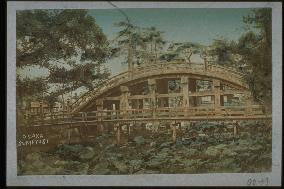
Soribashi bridge at Sumiyoshi Shrine

Soribashi bridge at Sumiyoshi Shrine

A lotus pond is below Soribashi Bridge. The bridge in front of it is Yorubehashi built in 1873. The photograph is dated around 1888.==Date:unknown, Place:Osaka, Photo:unknown, (Credit:Nagasaki University Library/Kyodo News Images) [Cabinet Number90‐37‐0]

  •  
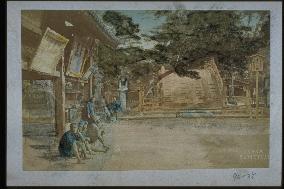
Soribashi bridge at Sumiyoshi Shrine

Soribashi bridge at Sumiyoshi Shrine

Ema-do is visible on the left. People donated ema (votive tablets) and stone lanterns as prayers for safe voyages at sea and success in business. Early Meiji Period.==Date:unknown, Place:Osaka, Photo:unknown, (Credit:Nagasaki University Library/Kyodo News Images) [Cabinet Number90‐35‐0]

  •  
Miyajima Island,Aki

Miyajima Island,Aki

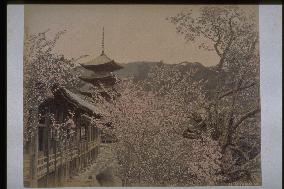
The five-story pagoda is viewed from Toyokuni Shrine (Senjokaku, or One Thousand Mat Hall ) on Tonooka Hill on the east side of Itsukushima Shinto Shrine. Senjokaku Hall was built in 1587 by Toyotomi Hideyoshi for the monthly Buddhist rite of reading of the Senbukyo sutra. The magnificent hall was built in irimoya architectural style with a tiled roof. The cross beams span about 27.27m and the parallel beams about 14.5m.==Date:unknown, Place:Miyajima, Photo:unknown, (Credit:Nagasaki University Library/Kyodo News Images) [Cabinet Number85‐30‐0]

  •  
Soribashi bridge at Sumiyoshi Shrine

Soribashi bridge at Sumiyoshi Shrine

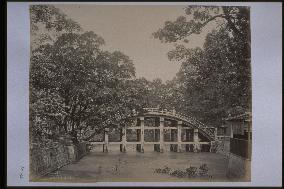
Soribashi Bridge at Sumiyoshi Shinto Shrine was also called the Drum Bridge (Taikobashi). This bridge was originally built for the symbolic crossing of Shinto deities, but eventually people were allowed to use it. Mikoshi, a portable shrine, is carried across the bridge during a summer festival. Mid-Meiji Period.==Date:unknown, Place:Osaka, Photo:R. Stillfried, (Credit:Nagasaki University Library/Kyodo News Images) [Cabinet Number78‐42‐0]

  •  
Kozu-sha,Osaka

Kozu-sha,Osaka

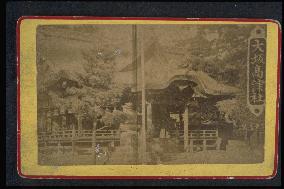
Legend has it that Emperor Nintoku, now enshrined at Takatsu Shinto Shrine, canceled all taxation for a period of three years after noting from the top of this hill that no smoke was coming out of the chimneys of houses below. The shrine is located on the cliff at Ue-machi and commands a panoramic view of the city of Osaka. Probably taken in the second decade of the Meiji Period (1877-1887).==Date:unknown, Place:Osaka, Photo:unknown, (Credit:Nagasaki University Library/Kyodo News Images) [Cabinet Number71‐12‐0]

  •  
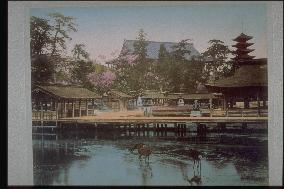
Miyajima Island,Aki

Miyajima Island,Aki

Itsukushima Shinto Shrine was completed by Taira-no-Kiyomori during the Heian Period, and its splendor is still intact today. The Gakubo and Kadomarodo shrines are viewed from the western side of the Hirabutai stage in the main shrine building. In the distance is Toyokuni Shrine (Senjokaku Hall) on Tonooka Hill with cherry trees in full bloom and the five-story pagoda (Important Cultural Asset) constructed in 1407. On the left is the grass-covered Mt. Kamei.==Date:unknown, Place:Miyajima, Photo:unknown, (Credit:Nagasaki University Library/Kyodo News Images) [Cabinet Number59‐41‐0]

  •  
ITSUKUSHIMA shrine

ITSUKUSHIMA shrine

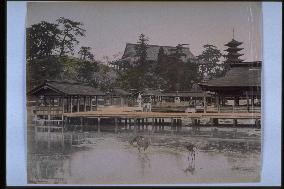
Itsukushima Shinto Shrine at Miyajima was built in 592, when Emperor Suiko succeeded to the throne. It served as a place of worship for the imperial family as well as for the daimyo (feudal lords) during the Warring State Period. At the end of the Heian Period, Taira-no-Kiyomori completed the shrine buildings that are still standing today.==Date:unknown, Place:Miyajima, Photo:unknown, (Credit:Nagasaki University Library/Kyodo News Images) [Cabinet Number37‐15‐0]

  •  
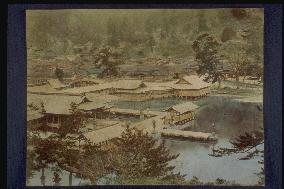
Miyajima Island,Aki

Miyajima Island,Aki

Itsukushima Shinto Shrine was completed by Taira-no-Kiyomori during the Heian Period, and its splendor is still intact today. The Gakubo and Kadomarodo shrines are viewed from the western side of the Hirabutai stage in the main shrine building. In the distance is Toyokuni Shrine (Senjokaku Hall) on Tonooka Hill with cherry trees in full bloom and the five-story pagoda (Important Cultural Asset) constructed in 1407. On the left is the grass-covered Mt. Kamei.==Date:unknown, Place:Miyajima, Photo:Ogawa Kazumasa, (Credit:Nagasaki University Library/Kyodo News Images) [Cabinet Number10‐33‐0]

  •  
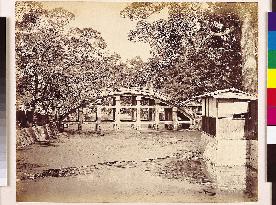
Suminoe

Suminoe

Soribashi Bridge at Sumiyoshi Shinto Shrine. This photograph was taken from a point a little further back from photograph #4024. Mid-Meiji Period.==Date:unknown, Place:Osaka, Photo:unknown, (Credit:Nagasaki University Library/Kyodo News Images) [Cabinet Number103‐5‐0]

  • Main
  • Top
  • Editorial
  • Creative
  • About Us
  • About ILG
  • Terms of use
  • Company
  • BEHIND
  • Price List
  • Single Plan
  • Monthly Plan
  • Services
  • Shooting
  • Rights Clearance
  • Support
  • FAQ
  • How To Buy
  • Contact Us
  • Become a Partner

© KYODO NEWS IMAGES INC

All Rights Reserved.

  • Editorial
  • Olympics
  • News
  • Sports
  • Japan
  • Tech
  • Royal
  • Disaster
  • NorthKorea
  • Old Japan
  • SNS
  • Creative
  • Food
  • Japan
  • Landscape
  • Animal
  • Popular
  • #Ukraine
  • #Russia
  • #coronavirus
  • #N. Korea
  • #China
  • #Thailand
  • #Ukraine
  • #Russia
  • #coronavirus
  • #N. Korea
  • #China
  • #Thailand
  • Food
  • Japan
  • Landscape
  • Animal
  • Olympics
  • News
  • Sports
  • Japan
  • Tech
  • Royal
  • Disaster
  • NorthKorea
  • Old Japan
  • SNS