•  
Kashmiri Shiites Mark Muharram Mourning - India

Kashmiri Shiites Mark Muharram Mourning - India

A security team with a vehicle displaying a Palestinian flag protects visitors during a Muharram procession in Srinagar, Jammu and Kashmir, on July 3, 2025, the seventh day of the Islamic holy month. The event honors the martyrdom of Imam Hussain, blending religious mourning with political symbolism in a region of heightened sensitivity. Photo by Umar Altaf/Middle East Images/ABACAPRESS.COM

  •  
Spherical Radio Telescope - China

Spherical Radio Telescope - China

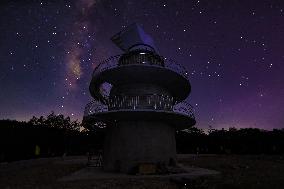
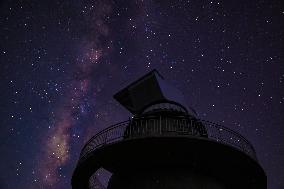
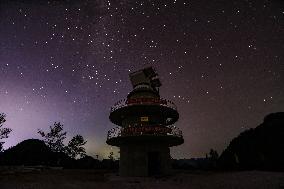
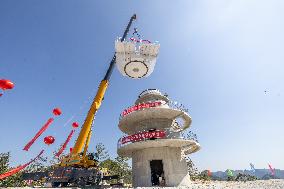
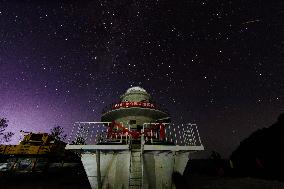
This photo taken on September 25, 2024 shows the newly installed first test prototype of the Core Array of China's Five-hundred-meter Aperture Spherical Radio Telescope under the starry sky in southwest China's Guizhou Province. Wednesday marks the eighth anniversary of the launch of China's Five-hundred-meter Aperture Spherical Radio Telescope (FAST). On the same day, the construction of the Core Array of FAST started, highlighting China's growing potential in global radio astronomy research. As a proposed extension of FAST, the world's largest single-dish radio telescope, the Core Array integrates 24 secondary 40-meter antennas implanted within 5 kilometers of the FAST site. The Chinese-designed array will combine the unprecedented sensitivity of FAST with a high angular resolution, thereby exceeding the capabilities at similar frequencies of next-generation arrays in the world. Photo by Xinhua/Liu Xu/ABACAPRESS.COM

  •  
Spherical Radio Telescope - China

Spherical Radio Telescope - China

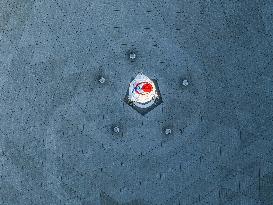
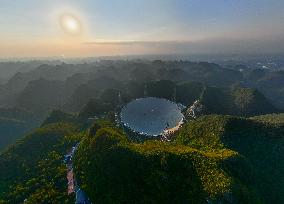
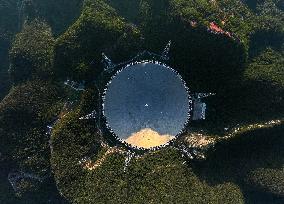
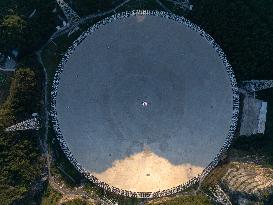
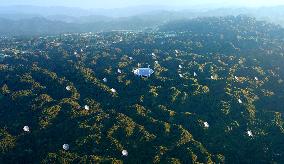
An aerial drone photo taken on September 25, 2024 shows China's Five-hundred-meter Aperture Spherical Radio Telescope (FAST) under maintenance in southwest China's Guizhou Province. Wednesday marks the eighth anniversary of the launch of China's Five-hundred-meter Aperture Spherical Radio Telescope (FAST). On the same day, the construction of the Core Array of FAST started, highlighting China's growing potential in global radio astronomy research. As a proposed extension of FAST, the world's largest single-dish radio telescope, the Core Array integrates 24 secondary 40-meter antennas implanted within 5 kilometers of the FAST site. The Chinese-designed array will combine the unprecedented sensitivity of FAST with a high angular resolution, thereby exceeding the capabilities at similar frequencies of next-generation arrays in the world. Photo by Xinhua/Liu Xu/ABACAPRESS.COM

  •  
Spherical Radio Telescope - China

Spherical Radio Telescope - China

An aerial drone photo taken on September 25, 2024 shows China's Five-hundred-meter Aperture Spherical Radio Telescope (FAST) under maintenance in southwest China's Guizhou Province. Wednesday marks the eighth anniversary of the launch of China's Five-hundred-meter Aperture Spherical Radio Telescope (FAST). On the same day, the construction of the Core Array of FAST started, highlighting China's growing potential in global radio astronomy research. As a proposed extension of FAST, the world's largest single-dish radio telescope, the Core Array integrates 24 secondary 40-meter antennas implanted within 5 kilometers of the FAST site. The Chinese-designed array will combine the unprecedented sensitivity of FAST with a high angular resolution, thereby exceeding the capabilities at similar frequencies of next-generation arrays in the world. Photo by Xinhua/Liu Xu/ABACAPRESS.COM

  •  
Spherical Radio Telescope - China

Spherical Radio Telescope - China

This photo taken on September 25, 2024 shows the newly installed first test prototype of the Core Array of China's Five-hundred-meter Aperture Spherical Radio Telescope under the starry sky in southwest China's Guizhou Province. Wednesday marks the eighth anniversary of the launch of China's Five-hundred-meter Aperture Spherical Radio Telescope (FAST). On the same day, the construction of the Core Array of FAST started, highlighting China's growing potential in global radio astronomy research. As a proposed extension of FAST, the world's largest single-dish radio telescope, the Core Array integrates 24 secondary 40-meter antennas implanted within 5 kilometers of the FAST site. The Chinese-designed array will combine the unprecedented sensitivity of FAST with a high angular resolution, thereby exceeding the capabilities at similar frequencies of next-generation arrays in the world. Photo by Xinhua/Liu Xu/ABACAPRESS.COM

  •  
Spherical Radio Telescope - China

Spherical Radio Telescope - China

This photo taken on September 25, 2024 shows the newly installed first test prototype of the Core Array of China's Five-hundred-meter Aperture Spherical Radio Telescope under the starry sky in southwest China's Guizhou Province. Wednesday marks the eighth anniversary of the launch of China's Five-hundred-meter Aperture Spherical Radio Telescope (FAST). On the same day, the construction of the Core Array of FAST started, highlighting China's growing potential in global radio astronomy research. As a proposed extension of FAST, the world's largest single-dish radio telescope, the Core Array integrates 24 secondary 40-meter antennas implanted within 5 kilometers of the FAST site. The Chinese-designed array will combine the unprecedented sensitivity of FAST with a high angular resolution, thereby exceeding the capabilities at similar frequencies of next-generation arrays in the world. Photo by Xinhua/Liu Xu/ABACAPRESS.COM

  •  
Spherical Radio Telescope - China

Spherical Radio Telescope - China

An aerial drone photo taken on September 25, 2024 shows China's Five-hundred-meter Aperture Spherical Radio Telescope (FAST) under maintenance in southwest China's Guizhou Province. Wednesday marks the eighth anniversary of the launch of China's Five-hundred-meter Aperture Spherical Radio Telescope (FAST). On the same day, the construction of the Core Array of FAST started, highlighting China's growing potential in global radio astronomy research. As a proposed extension of FAST, the world's largest single-dish radio telescope, the Core Array integrates 24 secondary 40-meter antennas implanted within 5 kilometers of the FAST site. The Chinese-designed array will combine the unprecedented sensitivity of FAST with a high angular resolution, thereby exceeding the capabilities at similar frequencies of next-generation arrays in the world. Photo by Xinhua/Liu Xu/ABACAPRESS.COM

  •  
Spherical Radio Telescope - China

Spherical Radio Telescope - China

An aerial drone photo taken on September 25, 2024 shows China's Five-hundred-meter Aperture Spherical Radio Telescope (FAST) under maintenance in southwest China's Guizhou Province. Wednesday marks the eighth anniversary of the launch of China's Five-hundred-meter Aperture Spherical Radio Telescope (FAST). On the same day, the construction of the Core Array of FAST started, highlighting China's growing potential in global radio astronomy research. As a proposed extension of FAST, the world's largest single-dish radio telescope, the Core Array integrates 24 secondary 40-meter antennas implanted within 5 kilometers of the FAST site. The Chinese-designed array will combine the unprecedented sensitivity of FAST with a high angular resolution, thereby exceeding the capabilities at similar frequencies of next-generation arrays in the world. Photo by Xinhua/Liu Xu/ABACAPRESS.COM

  •  
Spherical Radio Telescope - China

Spherical Radio Telescope - China

An aerial drone photo taken on September 25, 2024 shows China's Five-hundred-meter Aperture Spherical Radio Telescope (FAST) under maintenance in southwest China's Guizhou Province. Wednesday marks the eighth anniversary of the launch of China's Five-hundred-meter Aperture Spherical Radio Telescope (FAST). On the same day, the construction of the Core Array of FAST started, highlighting China's growing potential in global radio astronomy research. As a proposed extension of FAST, the world's largest single-dish radio telescope, the Core Array integrates 24 secondary 40-meter antennas implanted within 5 kilometers of the FAST site. The Chinese-designed array will combine the unprecedented sensitivity of FAST with a high angular resolution, thereby exceeding the capabilities at similar frequencies of next-generation arrays in the world. Photo by Xinhua/Liu Xu/ABACAPRESS.COM

  •  
Spherical Radio Telescope - China

Spherical Radio Telescope - China

An aerial drone photo taken on September 25, 2024 shows China's Five-hundred-meter Aperture Spherical Radio Telescope (FAST) under maintenance in southwest China's Guizhou Province. Wednesday marks the eighth anniversary of the launch of China's Five-hundred-meter Aperture Spherical Radio Telescope (FAST). On the same day, the construction of the Core Array of FAST started, highlighting China's growing potential in global radio astronomy research. As a proposed extension of FAST, the world's largest single-dish radio telescope, the Core Array integrates 24 secondary 40-meter antennas implanted within 5 kilometers of the FAST site. The Chinese-designed array will combine the unprecedented sensitivity of FAST with a high angular resolution, thereby exceeding the capabilities at similar frequencies of next-generation arrays in the world. Photo by Xinhua/Liu Xu/ABACAPRESS.COM

  •  
Spherical Radio Telescope - China

Spherical Radio Telescope - China

An aerial drone photo taken on September 25, 2024 shows China's Five-hundred-meter Aperture Spherical Radio Telescope (FAST) under maintenance in southwest China's Guizhou Province. Wednesday marks the eighth anniversary of the launch of China's Five-hundred-meter Aperture Spherical Radio Telescope (FAST). On the same day, the construction of the Core Array of FAST started, highlighting China's growing potential in global radio astronomy research. As a proposed extension of FAST, the world's largest single-dish radio telescope, the Core Array integrates 24 secondary 40-meter antennas implanted within 5 kilometers of the FAST site. The Chinese-designed array will combine the unprecedented sensitivity of FAST with a high angular resolution, thereby exceeding the capabilities at similar frequencies of next-generation arrays in the world. Photo by Xinhua/Liu Xu/ABACAPRESS.COM

  •  
500m Aperture Spherical Radio Telescope Construction - China

500m Aperture Spherical Radio Telescope Construction - China

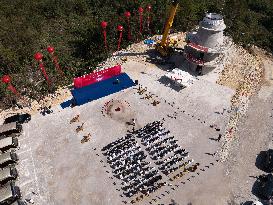
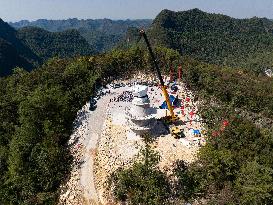
An aerial drone photo taken on September 25, 2024 shows the groundbreaking ceremony for the construction of the Core Array of China's Five-hundred-meter Aperture Spherical Radio Telescope (FAST) in southwest China's Guizhou Province. The construction of the Core Array of China's Five-hundred-meter Aperture Spherical Radio Telescope (FAST) started Wednesday, highlighting China's growing potential in global radio astronomy research. As a proposed extension of FAST, the Core Array integrates 24 secondary 40-meter antennas implanted within 5 kilometers of the FAST site, said Jiang Peng, deputy director of the National Astronomical Observatories under the Chinese Academy of Sciences. The Chinese-designed array will combine the unprecedented sensitivity of FAST with a high angular resolution, thereby exceeding the capabilities at similar frequencies of next-generation arrays in the world. The FAST Core Array is estimated to be completed and put into operation in 2027. (Photo by Liu Xu/Xinhua/ABACAPRESS.COM

  •  
500m Aperture Spherical Radio Telescope Construction - China

500m Aperture Spherical Radio Telescope Construction - China

This undated simulated diagram shows the Core Array of China's Five-hundred-meter Aperture Spherical Radio Telescope (FAST) upon completion in southwest China's Guizhou Province. The construction of the Core Array of China's Five-hundred-meter Aperture Spherical Radio Telescope (FAST) started Wednesday, highlighting China's growing potential in global radio astronomy research. As a proposed extension of FAST, the Core Array integrates 24 secondary 40-meter antennas implanted within 5 kilometers of the FAST site, said Jiang Peng, deputy director of the National Astronomical Observatories under the Chinese Academy of Sciences. The Chinese-designed array will combine the unprecedented sensitivity of FAST with a high angular resolution, thereby exceeding the capabilities at similar frequencies of next-generation arrays in the world. The FAST Core Array is estimated to be completed and put into operation in 2027. Photo by Xinhua/ABACAPRESS.COM

  •  
500m Aperture Spherical Radio Telescope Construction - China

500m Aperture Spherical Radio Telescope Construction - China

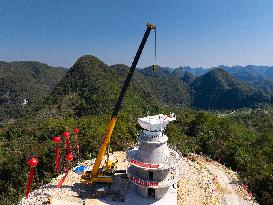
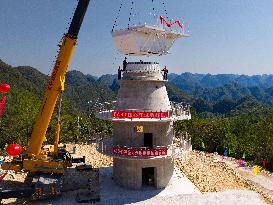
This photo taken on September 25, 2024 shows the first test prototype of the Core Array of China's Five-hundred-meter Aperture Spherical Radio Telescope (FAST) being installed in southwest China's Guizhou Province. The construction of the Core Array of China's Five-hundred-meter Aperture Spherical Radio Telescope (FAST) started Wednesday, highlighting China's growing potential in global radio astronomy research. As a proposed extension of FAST, the Core Array integrates 24 secondary 40-meter antennas implanted within 5 kilometers of the FAST site, said Jiang Peng, deputy director of the National Astronomical Observatories under the Chinese Academy of Sciences. The Chinese-designed array will combine the unprecedented sensitivity of FAST with a high angular resolution, thereby exceeding the capabilities at similar frequencies of next-generation arrays in the world. The FAST Core Array is estimated to be completed and put into operation in 2027. Photo by Ou Dongqu/Xinhua/ABACAPRESS.COM

  •  
500m Aperture Spherical Radio Telescope Construction - China

500m Aperture Spherical Radio Telescope Construction - China

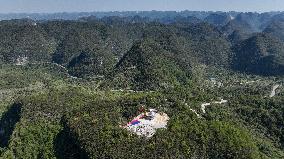
An aerial drone photo taken on September 25, 2024 shows the first test prototype of the Core Array of China's Five-hundred-meter Aperture Spherical Radio Telescope (FAST) being installed in southwest China's Guizhou Province. The construction of the Core Array of China's Five-hundred-meter Aperture Spherical Radio Telescope (FAST) started Wednesday, highlighting China's growing potential in global radio astronomy research. As a proposed extension of FAST, the Core Array integrates 24 secondary 40-meter antennas implanted within 5 kilometers of the FAST site, said Jiang Peng, deputy director of the National Astronomical Observatories under the Chinese Academy of Sciences. The Chinese-designed array will combine the unprecedented sensitivity of FAST with a high angular resolution, thereby exceeding the capabilities at similar frequencies of next-generation arrays in the world. The FAST Core Array is estimated to be completed and put into operation in 2027. (Photo by Liu Xu/Xinhua/ABACAPRESS.COM

  •  
500m Aperture Spherical Radio Telescope Construction - China

500m Aperture Spherical Radio Telescope Construction - China

An aerial drone photo taken on September 25, 2024 shows the newly installed first test prototype (up, R) of the Core Array of China's Five-hundred-meter Aperture Spherical Radio Telescope (FAST) and the FAST (up, L) in southwest China's Guizhou Province. The construction of the Core Array of China's Five-hundred-meter Aperture Spherical Radio Telescope (FAST) started Wednesday, highlighting China's growing potential in global radio astronomy research. As a proposed extension of FAST, the Core Array integrates 24 secondary 40-meter antennas implanted within 5 kilometers of the FAST site, said Jiang Peng, deputy director of the National Astronomical Observatories under the Chinese Academy of Sciences. The Chinese-designed array will combine the unprecedented sensitivity of FAST with a high angular resolution, thereby exceeding the capabilities at similar frequencies of next-generation arrays in the world. The FAST Core Array is estimated to be completed and put into operation in 2027. (Photo by Liu Xu/Xinhua/AB

  •  
500m Aperture Spherical Radio Telescope Construction - China

500m Aperture Spherical Radio Telescope Construction - China

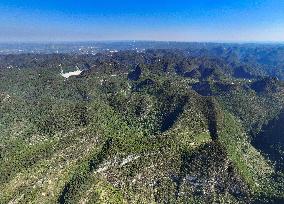
An aerial panoramic photo taken on September 25, 2024 shows the first test prototype of the Core Array of China's Five-hundred-meter Aperture Spherical Radio Telescope (FAST) being installed in southwest China's Guizhou Province. The construction of the Core Array of China's Five-hundred-meter Aperture Spherical Radio Telescope (FAST) started Wednesday, highlighting China's growing potential in global radio astronomy research. As a proposed extension of FAST, the Core Array integrates 24 secondary 40-meter antennas implanted within 5 kilometers of the FAST site, said Jiang Peng, deputy director of the National Astronomical Observatories under the Chinese Academy of Sciences. The Chinese-designed array will combine the unprecedented sensitivity of FAST with a high angular resolution, thereby exceeding the capabilities at similar frequencies of next-generation arrays in the world. The FAST Core Array is estimated to be completed and put into operation in 2027. Photo by Ou Dongqu/Xinhua/ABACAPRESS.COM

  •  
500m Aperture Spherical Radio Telescope Construction - China

500m Aperture Spherical Radio Telescope Construction - China

An aerial drone photo taken on September 25, 2024 shows the first test prototype of the Core Array of China's Five-hundred-meter Aperture Spherical Radio Telescope (FAST) being installed in southwest China's Guizhou Province. The construction of the Core Array of China's Five-hundred-meter Aperture Spherical Radio Telescope (FAST) started Wednesday, highlighting China's growing potential in global radio astronomy research. As a proposed extension of FAST, the Core Array integrates 24 secondary 40-meter antennas implanted within 5 kilometers of the FAST site, said Jiang Peng, deputy director of the National Astronomical Observatories under the Chinese Academy of Sciences. The Chinese-designed array will combine the unprecedented sensitivity of FAST with a high angular resolution, thereby exceeding the capabilities at similar frequencies of next-generation arrays in the world. The FAST Core Array is estimated to be completed and put into operation in 2027. Photo by Ou Dongqu/Xinhua/ABACAPRESS.COM

  •  
500m Aperture Spherical Radio Telescope Construction - China

500m Aperture Spherical Radio Telescope Construction - China

An aerial drone photo taken on September 25, 2024 shows the first test prototype of the Core Array of China's Five-hundred-meter Aperture Spherical Radio Telescope (FAST) being installed in southwest China's Guizhou Province. The construction of the Core Array of China's Five-hundred-meter Aperture Spherical Radio Telescope (FAST) started Wednesday, highlighting China's growing potential in global radio astronomy research. As a proposed extension of FAST, the Core Array integrates 24 secondary 40-meter antennas implanted within 5 kilometers of the FAST site, said Jiang Peng, deputy director of the National Astronomical Observatories under the Chinese Academy of Sciences. The Chinese-designed array will combine the unprecedented sensitivity of FAST with a high angular resolution, thereby exceeding the capabilities at similar frequencies of next-generation arrays in the world. The FAST Core Array is estimated to be completed and put into operation in 2027. (Photo by Liu Xu/Xinhua/ABACAPRESS.COM

  •  
500m Aperture Spherical Radio Telescope Construction - China

500m Aperture Spherical Radio Telescope Construction - China

An aerial drone photo taken on September 25, 2024 shows the groundbreaking ceremony for the construction of the Core Array of China's Five-hundred-meter Aperture Spherical Radio Telescope (FAST) in southwest China's Guizhou Province. The construction of the Core Array of China's Five-hundred-meter Aperture Spherical Radio Telescope (FAST) started Wednesday, highlighting China's growing potential in global radio astronomy research. As a proposed extension of FAST, the Core Array integrates 24 secondary 40-meter antennas implanted within 5 kilometers of the FAST site, said Jiang Peng, deputy director of the National Astronomical Observatories under the Chinese Academy of Sciences. The Chinese-designed array will combine the unprecedented sensitivity of FAST with a high angular resolution, thereby exceeding the capabilities at similar frequencies of next-generation arrays in the world. The FAST Core Array is estimated to be completed and put into operation in 2027. (Photo by Liu Xu/Xinhua/ABACAPRESS.COM

  •  
500m Aperture Spherical Radio Telescope Construction - China

500m Aperture Spherical Radio Telescope Construction - China

An aerial drone photo taken on September 25, 2024 shows China's Five-hundred-meter Aperture Spherical Radio Telescope (FAST) under maintenance in southwest China's Guizhou Province. The construction of the Core Array of China's Five-hundred-meter Aperture Spherical Radio Telescope (FAST) started Wednesday, highlighting China's growing potential in global radio astronomy research. As a proposed extension of FAST, the Core Array integrates 24 secondary 40-meter antennas implanted within 5 kilometers of the FAST site, said Jiang Peng, deputy director of the National Astronomical Observatories under the Chinese Academy of Sciences. The Chinese-designed array will combine the unprecedented sensitivity of FAST with a high angular resolution, thereby exceeding the capabilities at similar frequencies of next-generation arrays in the world. The FAST Core Array is estimated to be completed and put into operation in 2027. (Photo by Liu Xu/Xinhua/ABACAPRESS.COM

  •  
500m Aperture Spherical Radio Telescope Construction - China

500m Aperture Spherical Radio Telescope Construction - China

An aerial drone photo taken on September 25, 2024 shows the first test prototype of the Core Array of China's Five-hundred-meter Aperture Spherical Radio Telescope (FAST) being installed in southwest China's Guizhou Province. The construction of the Core Array of China's Five-hundred-meter Aperture Spherical Radio Telescope (FAST) started Wednesday, highlighting China's growing potential in global radio astronomy research. As a proposed extension of FAST, the Core Array integrates 24 secondary 40-meter antennas implanted within 5 kilometers of the FAST site, said Jiang Peng, deputy director of the National Astronomical Observatories under the Chinese Academy of Sciences. The Chinese-designed array will combine the unprecedented sensitivity of FAST with a high angular resolution, thereby exceeding the capabilities at similar frequencies of next-generation arrays in the world. The FAST Core Array is estimated to be completed and put into operation in 2027. (Photo by Liu Xu/Xinhua/ABACAPRESS.COM

  •  
500m Aperture Spherical Radio Telescope Construction - China

500m Aperture Spherical Radio Telescope Construction - China

An aerial drone photo taken on September 25, 2024 shows China's Five-hundred-meter Aperture Spherical Radio Telescope (FAST) under maintenance in southwest China's Guizhou Province. The construction of the Core Array of China's Five-hundred-meter Aperture Spherical Radio Telescope (FAST) started Wednesday, highlighting China's growing potential in global radio astronomy research. As a proposed extension of FAST, the Core Array integrates 24 secondary 40-meter antennas implanted within 5 kilometers of the FAST site, said Jiang Peng, deputy director of the National Astronomical Observatories under the Chinese Academy of Sciences. The Chinese-designed array will combine the unprecedented sensitivity of FAST with a high angular resolution, thereby exceeding the capabilities at similar frequencies of next-generation arrays in the world. The FAST Core Array is estimated to be completed and put into operation in 2027. (Photo by Liu Xu/Xinhua/ABACAPRESS.COM

  •  
500m Aperture Spherical Radio Telescope Construction - China

500m Aperture Spherical Radio Telescope Construction - China

A drone photo taken on September 25, 2024 shows the first test prototype of the Core Array of China's Five-hundred-meter Aperture Spherical Radio Telescope (FAST) being installed in southwest China's Guizhou Province. The construction of the Core Array of China's Five-hundred-meter Aperture Spherical Radio Telescope (FAST) started Wednesday, highlighting China's growing potential in global radio astronomy research. As a proposed extension of FAST, the Core Array integrates 24 secondary 40-meter antennas implanted within 5 kilometers of the FAST site, said Jiang Peng, deputy director of the National Astronomical Observatories under the Chinese Academy of Sciences. The Chinese-designed array will combine the unprecedented sensitivity of FAST with a high angular resolution, thereby exceeding the capabilities at similar frequencies of next-generation arrays in the world. The FAST Core Array is estimated to be completed and put into operation in 2027. (Photo by Liu Xu/Xinhua/ABACAPRESS.COM

  •  
500m Aperture Spherical Radio Telescope Construction - China

500m Aperture Spherical Radio Telescope Construction - China

A drone photo taken on September 24, 2024 shows the first test prototype of the Core Array of China's Five-hundred-meter Aperture Spherical Radio Telescope (FAST) waiting to be installed in southwest China's Guizhou Province. The construction of the Core Array of China's Five-hundred-meter Aperture Spherical Radio Telescope (FAST) started Wednesday, highlighting China's growing potential in global radio astronomy research. As a proposed extension of FAST, the Core Array integrates 24 secondary 40-meter antennas implanted within 5 kilometers of the FAST site, said Jiang Peng, deputy director of the National Astronomical Observatories under the Chinese Academy of Sciences. The Chinese-designed array will combine the unprecedented sensitivity of FAST with a high angular resolution, thereby exceeding the capabilities at similar frequencies of next-generation arrays in the world. The FAST Core Array is estimated to be completed and put into operation in 2027. (Photo by Liu Xu/Xinhua/ABACAPRESS.COM

  •  
James Webb View Of The Ring Nebula

James Webb View Of The Ring Nebula

The NASA/ESA/CSA James Webb Space Telescope has observed the well-known Ring Nebula with unprecedented detail. Formed by a star throwing off its outer layers as it runs out of fuel, the Ring Nebula is an archetypal planetary nebula. Also known as M57 and NGC 6720, it is both relatively close to Earth at roughly 2,500 light-years away. This new image provides unprecedented spatial resolution and spectral sensitivity. For example, the intricate details of the filament structure of the inner ring are particularly visible in this dataset. There are some 20,000 dense globules in the nebula, which are rich in molecular hydrogen. In contrast, the inner region shows very hot gas. The main shell contains a thin ring of enhanced emission fromcarbon-based molecules known as polycyclic aromatic hydrocarbons (PAHs). Roughly ten concentric arcs are located just beyond the outer edge of the main ring. The arcs are thought to originate from the interaction of the central star with a low-mass companion orbiting at a distance

  •  
James Webb View Of The Ring Nebula

James Webb View Of The Ring Nebula

The NASA/ESA/CSA James Webb Space Telescope has observed the well-known Ring Nebula with unprecedented detail. Formed by a star throwing off its outer layers as it runs out of fuel, the Ring Nebula is an archetypal planetary nebula. Also known as M57 and NGC 6720, it is both relatively close to Earth at roughly 2,500 light-years away. This new image provides unprecedented spatial resolution and spectral sensitivity. In particular, Webb’s MIRI (Mid-InfraRed Instrument) reveals particular details in the concentric features in the outer regions of the nebulae’s ring (right). There are some 20,000 dense globules in the nebula, which are rich in molecular hydrogen. In contrast, the inner region shows very hot gas. The main shell contains a thin ring of enhanced emission fromcarbon-based molecules known as polycyclic aromatic hydrocarbons (PAHs). Roughly ten concentric arcs located just beyond the outer edge of the main ring. The arcs are thought to originate from the interaction of the central star with a low-mass

  •  
James Webb View Of The Ring Nebula

James Webb View Of The Ring Nebula

New images from NASA’s James Webb Space Telescope of the well-known Ring Nebula provide unprecedented spatial resolution and spectral sensitivity. In the NIRCam (Near-Infrared Camera) image on the left, the intricate details of the filament structure of the inner ring are particularly visible in this dataset. On the right, the MIRI (Mid-InfraRed Instrument) image reveals particular details in the concentric features in the outer regions of the nebulae’s ring. Photo by ESA/Webb, NASA, CSA, M. Barlow, N. Cox, R. Wesson via CNP/ABACAPRESS.COM

  •  

China's FAST telescope finds key evidence for nanohertz gravitational waves

STORY: China's FAST telescope finds key evidence for nanohertz gravitational waves DATELINE: June 29, 2023 LENGTH: 00:01:42 LOCATION: GUIYANG, China CATEGORY: TECHNOLOGY SHOTLIST: 1. various of FAST telescope 2. various of scientists and their research work with FAST telescope 3. various of images caught by FAST telescope STORYLINE: China's FAST telescope has found key evidence for the existence of nanohertz gravitational waves. The research, conducted by scientists from the National Astronomical Observatories of the Chinese Academy of Sciences (NAOC) and other institutes, was published in the journal Research in Astronomy and Astrophysics Thursday. Gravitational waves are the "ripples" produced by massive objects such as black holes as they rapidly move through the fabric of spacetime. The scientists monitored 57 millisecond pulsars with regular cadence for 41 months by taking advantage of the high sensitivity of FAST. Eventually, they found key evidence for quadrupole correlation signatures compatibl

  •  

Israeli researchers develop robot with bio nose

STORY: Israeli researchers develop robot with bio nose DATELINE: Jan. 18, 2023 LENGTH: 0:02:00 LOCATION: Jerusalem CATEGORY: TECHNOLOGY SHOTLIST: 1. various of Tel Aviv University 2. various of smelling robot STORYLINE: Israeli researchers developed a smelling ability for a robot, using a biological sensor, Tel Aviv University (TAU) in central Israel said Monday. This is the first time in the world that a robot has been able to detect a smell in its surroundings using a biosensor, TAU said, adding that it even sent electrical signals that could be classified according to the smell type. In experiments, the researchers connected the biological sensor, based on a locust antenna, to an electronic system. Using a machine learning algorithm, they sorted odors with a sensitivity 10,000 times higher than existing electronic devices. The new biohybrid system could thus identify a wide range of smells, such as geranium, lemon, marzipan, and even some types of Scotch whisky, then the researchers were able to cre

  •  
Stricter border control on passengers from COVID-hit mainland China

Stricter border control on passengers from COVID-hit mainland China

Passengers from Shanghai line up to take a higher-sensitivity COVID-19 antigen test at Narita airport near Tokyo on Jan. 8, 2023. Japan started requiring travelers from mainland China to undergo such a test the same day amid a surge of cases in the country.

  •  
Japanese Defense Minister Kitazawa in S. Korea

Japanese Defense Minister Kitazawa in S. Korea

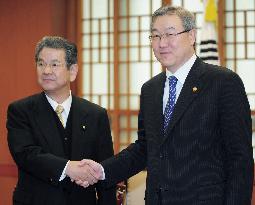
SEOUL, South Korea - South Korean Foreign Affairs and Trade Minister Kim Sung Hwan (R) and Japanese Defense Minister Toshimi Kitazawa meet in Seoul on Jan. 11, 2011. Kitazawa expressed his eagerness to boost defense cooperation between the countries, while Kim appeared cautious about rushing the process, given South Korean sensitivity about Japan's past colonial rule of the Korean Peninsula.

  •  
Japanese Defense Minister Kitazawa in S. Korea

Japanese Defense Minister Kitazawa in S. Korea

SEOUL, South Korea - South Korean Foreign Affairs and Trade Minister Kim Sung Hwan (R) and Japanese Defense Minister Toshimi Kitazawa shake hands in Seoul on Jan. 11, 2011, prior to their meeting. Kitazawa expressed his eagerness to boost defense cooperation between the countries, while Kim appeared cautious about rushing the process, given South Korean sensitivity about Japan's past colonial rule of the Korean Peninsula.

  •  

Visually impaired volunteer assists COVID-19 fight in Beijing

STORY: Visually impaired volunteer assists COVID-19 fight in Beijing DATELINE: May 21, 2022 LENGTH: 00:01:36 LOCATION: Beijing CATEGORY: SOCIETY SHOTLIST: 1. various of Ma working 2. SOUNDBITE 1 (Chinese): MA ERDONG, Community worker in Haidian District, Beijing 3. SOUNDBITE 2 (Chinese): MA ERDONG, Community worker in Haidian District, Beijing STORYLINE: Ma Erdong is a community worker in charge of disability affairs in Haidian District, Beijing. Though a visually impaired person herself, she has volunteered to help with the COVID-19 fight in her community amid the latest resurgence of coronavirus infections in the city. SOUNDBITE 1 (Chinese): MA ERDONG, Community worker in Haidian District, Beijing "Since 2006, I have been working here (at Capital Normal University community) for 16 years. I was born with retinitis pigmentosa, which affects me with poor vision and sensitivity to light." "Please keep a distance of two meters, with your ID cards in your hands." Beijing has conducted rounds of nucleic ac

  •  

NATO expansion root cause of Ukraine crisis: former senior French official

STORY: NATO expansion root cause of Ukraine crisis: former senior French official DATELINE: May 17, 2022 LENGTH: 0:02:35 LOCATION: GENEVA, Switzerland CATEGORY: POLITICS SHOTLIST: 1. various of NATO's Headquarters and military exercises 2. SOUNDBITE (French): PIERRE CONESA, Former French Defense Ministry official STORYLINE: Finland and Sweden have both announced decisions to apply for the NATO membership. If the two countries join the military alliance, it would end their long-standing policy of military non-alignment. Pierre Conesa, a former French Defense Ministry official, says that all the developments contribute to a missed opportunity to propose an inclusive European security architecture to Russia, wherein lies the source of the ongoing Ukrainian crisis. SOUNDBITE (French): PIERRE CONESA, Former French Defense Ministry official We know this provokes a crisis. For example, Russia's sensitivity towards Sweden and Finland is that today Swedish and Finnish neutrality allows Russia to access the port

  •  
U.S.-WASHINGTON, D.C.-COVID-19 TEST DEMO

U.S.-WASHINGTON, D.C.-COVID-19 TEST DEMO

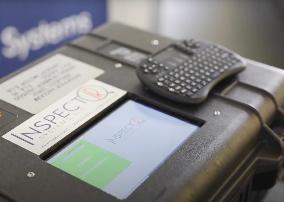
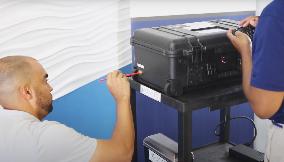
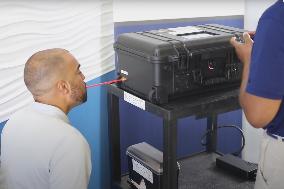
(220415) -- WASHINGTON, D.C., April 15, 2022 (Xinhua) -- A screenshot taken on April 14, 2022 from a video released by InspectIR Systems shows the InspectIR PNY-1000 COVID Testing Demo. The U.S. Food and Drug Administration (FDA) issued an emergency use authorization on Thursday for the country's first COVID-19 diagnostic test that detects chemical compounds in breath samples associated with a SARS-CoV-2 infection. The test can be performed in environments where the patient specimen is both collected and analyzed, such as doctor's offices, hospitals and mobile testing sites, using an instrument about the size of a piece of carry-on luggage, according to the FDA. The results of the test will show in less than three minutes. The performance of the test, called InspectIR COVID-19 Breathalyzer, was validated in a large study of 2,409 individuals, including those with and without symptoms. In the study, the test was shown to have 91.2 percent sensitivity and 99.3 percent specificity, according to the FDA.

  •  
U.S.-WASHINGTON, D.C.-COVID-19 TEST DEMO

U.S.-WASHINGTON, D.C.-COVID-19 TEST DEMO

(220415) -- WASHINGTON, D.C., April 15, 2022 (Xinhua) -- A screenshot taken on April 14, 2022 from a video released by InspectIR Systems shows the InspectIR PNY-1000 COVID Testing Demo. The U.S. Food and Drug Administration (FDA) issued an emergency use authorization on Thursday for the country's first COVID-19 diagnostic test that detects chemical compounds in breath samples associated with a SARS-CoV-2 infection. The test can be performed in environments where the patient specimen is both collected and analyzed, such as doctor's offices, hospitals and mobile testing sites, using an instrument about the size of a piece of carry-on luggage, according to the FDA. The results of the test will show in less than three minutes. The performance of the test, called InspectIR COVID-19 Breathalyzer, was validated in a large study of 2,409 individuals, including those with and without symptoms. In the study, the test was shown to have 91.2 percent sensitivity and 99.3 percent specificity, according to the FDA.

  •  
U.S.-WASHINGTON, D.C.-COVID-19 TEST DEMO

U.S.-WASHINGTON, D.C.-COVID-19 TEST DEMO

(220415) -- WASHINGTON, D.C., April 15, 2022 (Xinhua) -- A screenshot taken on April 14, 2022 from a video released by InspectIR Systems shows the InspectIR PNY-1000 COVID Testing Demo. The U.S. Food and Drug Administration (FDA) issued an emergency use authorization on Thursday for the country's first COVID-19 diagnostic test that detects chemical compounds in breath samples associated with a SARS-CoV-2 infection. The test can be performed in environments where the patient specimen is both collected and analyzed, such as doctor's offices, hospitals and mobile testing sites, using an instrument about the size of a piece of carry-on luggage, according to the FDA. The results of the test will show in less than three minutes. The performance of the test, called InspectIR COVID-19 Breathalyzer, was validated in a large study of 2,409 individuals, including those with and without symptoms. In the study, the test was shown to have 91.2 percent sensitivity and 99.3 percent specificity, according to the FDA.

  •  
NASA Delays The James Webb Space Telescope Launch Again

NASA Delays The James Webb Space Telescope Launch Again

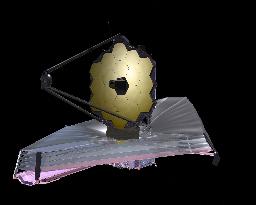
★Handout photo dated June 27, 2014 of The James Webb Space Telescope (sometimes called JWST or Webb) is an orbiting infrared observatory that will complement and extend the discoveries of the Hubble Space Telescope, with longer wavelength coverage and greatly improved sensitivity. Last summer, NASA and the European Space Agency (ESA) set an October 31, 2021, launch date for the $ 10 billion James Webb Space Telescope, but it's having to delay the science observatory's trip into space once again. Thankfully, the launch might take place just a few weeks later, in November or early December. A rescheduled date is unlikely to be confirmed until later this summer or perhaps in the fall. The instrument, successor to NASA's Hubble Space Telescope, which is the largest science observatory ever placed into space, will launch on a European Ariane 5 rocket from a spaceport in French Guiana. Photo by

  •  
NASAâÂÂs SpaceX Crew-1 Splashdown

NASAâÂÂs SpaceX Crew-1 Splashdown

The SpaceX Crew Dragon Resilience spacecraft is seen in the distance as it lands with NASA astronauts Mike Hopkins, Shannon Walker, and Victor Glover, and Japan Aerospace Exploration Agency (JAXA) astronaut Soichi Noguchi aboard in the Gulf of Mexico off the coast of Panama City, Florida, Sunday, May 2, 2021. NASAâÂÂs SpaceX Crew-1 mission was the first crew rotation flight of the SpaceX Crew Dragon spacecraft and Falcon 9 rocket with astronauts to the International Space Station as part of the agencyâÂÂs Commercial Crew Program. Note - this image noise is a result of using a very high sensitivity setting in the camera in a very dark situation. Photo by Bill Ingalls / NASA via CNP /ABACAPRESS.COM

  •  
Kanden Engineering's Newly Introduced VR Device for Experiencing Danger

Kanden Engineering's Newly Introduced VR Device for Experiencing Danger

Kanden Engineering Co., Ltd. (Kita Ward, Osaka City) expanded its facilities for experiencing dangerous acts during construction, inspection, and diagnosis of electrical equipment, etc., and opened the new "Safety and Technology Training Center" (Settsu City, Osaka Prefecture) on April 14. The facility will be used to train about 600 people a year, including all employees and subcontractors. The company analyzed past occupational accidents such as electric shock, crashes and falls, and equipment accidents caused by mishandling, and compiled a booklet with mottoes and lessons learned, "100 Failures of Engineering Version," which took two years to complete. The related investment was about 45 million yen. Mr. Aoshima hopes that the booklet and the facility will "help people improve their sensitivity to danger with their minds and bodies. (November 14, 2019, Safety & Technology Training Center, Settsu City, Osaka Prefecture; Credit: Nikkan Kogyo Shimbun / Kyodo News Images)

  •  
Strange Wilderness (2008)

Strange Wilderness (2008)

Allen Covert & Robert Patrick Characters: Fred & Gus Hayden Film: Strange Wilderness (2008) Director: Fred Wolf 01 February 2008 Photo by Darren Michaels [,Beginning of Shooting Data Section] Nikon D2X Focal Length: 85mm Optimize Image: Color Mode: Mode I (sRGB) Noise Reduction: OFF 2005/11/30 20:41:37.3 Exposure Mode: Manual White Balance: Incandescent Tone Comp: Auto RAW (12-bit) Metering Mode: Multi-Pattern AF Mode: Manual Hue Adjustment: 08 Image Size: 4320 x 2868 1/80 sec - F/2.8 Flash Sync Mode: Not Attached Saturation: Normal Exposure Comp.: 0 EV Sharpening: None Lens: 85mm F/1.4 D Sensitivity: Image Comment: [,End of Shooting Data Section] Date: 01 February 2008

  •  
Strange Wilderness (2008)

Strange Wilderness (2008)

Ashley Scott, Justin Long, Peter Dante, Kevin Heffernan & Jonah Hill Characters: Cheryl,Junior,Danny Gutierrez,Whitaker & Cooker Film: Strange Wilderness (2008) Director: Fred Wolf 01 February 2008 Photo by Darren Michaels [,Beginning of Shooting Data Section] Nikon D2X Focal Length: 0mm Optimize Image: Color Mode: Mode I (sRGB) Noise Reduction: OFF 2005/12/06 17:09:41.3 Exposure Mode: Aperture Priority White Balance: Shade Tone Comp: Auto RAW (12-bit) Metering Mode: Center-Weighted AF Mode: Manual Hue Adjustment: 08 Image Size: 4320 x 2868 1/40 sec - F/0 Flash Sync Mode: Not Attached Saturation: Normal Exposure Comp.: -0.3 EV Sharpening: None Lens: Sensitivity: ISO 160 Image Comment: [,End of Shooting Data Section] Date: 01 February 2008

  •  
Strange Wilderness (2008)

Strange Wilderness (2008)

Steve Zahn Characters: Peter Film: Strange Wilderness (2008) Director: Fred Wolf 01 February 2008 Photo by Darren Michaels [,Beginning of Shooting Data Section] Nikon D2X Focal Length: 28mm Optimize Image: Color Mode: Mode I (sRGB) Noise Reduction: OFF 2005/11/22 09:01:18.3 Exposure Mode: Manual White Balance: Cloudy Tone Comp: Auto RAW (12-bit) Metering Mode: Center-Weighted AF Mode: Manual Hue Adjustment: 08 Image Size: 4320 x 2868 1/125 sec - F/4 Flash Sync Mode: Not Attached Saturation: Normal Exposure Comp.: 0 EV Sharpening: None Lens: 28mm F/1.4 D Sensitivity: ISO 125 Image Comment: [,End of Shooting Data Section] Date: 01 February 2008

  •  
Strange Wilderness (2008)

Strange Wilderness (2008)

Steve Zahn & Jonah Hill Characters: Peter & Cooker Film: Strange Wilderness (2008) Director: Fred Wolf 01 February 2008 Photo by Darren Michaels [,Beginning of Shooting Data Section] Nikon D2X Focal Length: 0mm Optimize Image: Color Mode: Mode I (sRGB) Noise Reduction: OFF 2005/11/21 08:16:25.6 Exposure Mode: Manual White Balance: Cloudy Tone Comp: Auto RAW (12-bit) Metering Mode: Center-Weighted AF Mode: Manual Hue Adjustment: 08 Image Size: 4320 x 2868 1/100 sec - F/0 Flash Sync Mode: Not Attached Saturation: Normal Exposure Comp.: 0 EV Sharpening: None Lens: Sensitivity: ISO 320 Image Comment: [,End of Shooting Data Section] Date: 01 February 2008

  •  
Strange Wilderness (2008)

Strange Wilderness (2008)

Justin Long Characters: Junior Film: Strange Wilderness (2008) Director: Fred Wolf 01 February 2008 Photo by Darren Michaels [,Beginning of Shooting Data Section] Nikon D2X Focal Length: 180mm Optimize Image: Color Mode: Mode I (sRGB) Noise Reduction: OFF 2005/12/15 10:45:07.5 Exposure Mode: Manual White Balance: Incandescent Tone Comp: Auto RAW (12-bit) Metering Mode: Multi-Pattern AF Mode: AF-S Hue Adjustment: 08 Image Size: 2868 x 4320 1/80 sec - F/3.5 Flash Sync Mode: Not Attached Saturation: Normal Exposure Comp.: 0 EV Sharpening: None Lens: 180mm F/2.8 D Sensitivity: Image Comment: [,End of Shooting Data Section] Date: 01 February 2008

  •  
Strange Wilderness (2008)

Strange Wilderness (2008)

Allen Covert & Steve Zahn Characters: Fred & Peter Film: Strange Wilderness (2008) Director: Fred Wolf 01 February 2008 Photo by Darren Michaels [,Beginning of Shooting Data Section] Nikon D2X Focal Length: 0mm Optimize Image: Color Mode: Mode I (sRGB) Noise Reduction: OFF 2005/11/18 11:08:18.2 Exposure Mode: Manual White Balance: Shade Tone Comp: Auto RAW (12-bit) Metering Mode: Center-Weighted AF Mode: Manual Hue Adjustment: 08 Image Size: 4320 x 2868 1/800 sec - F/0 Flash Sync Mode: Not Attached Saturation: Normal Exposure Comp.: 0 EV Sharpening: None Lens: Sensitivity: ISO 125 Image Comment: [,End of Shooting Data Section] Date: 01 February 2008

  •  
Strange Wilderness (2008)

Strange Wilderness (2008)

Peter Dante Characters: Danny Gutierrez Film: Strange Wilderness (2008) Director: Fred Wolf 01 February 2008 Photo by Darren Michaels [,Beginning of Shooting Data Section] Nikon D2X Focal Length: 50mm Optimize Image: Color Mode: Mode I (sRGB) Noise Reduction: OFF 2005/12/06 08:59:17.2 Exposure Mode: Manual White Balance: Shade Tone Comp: Auto RAW (12-bit) Metering Mode: Multi-Pattern AF Mode: Manual Hue Adjustment: 08 Image Size: 4320 x 2868 1/125 sec - F/3.8 Flash Sync Mode: Not Attached Saturation: Normal Exposure Comp.: +0.3 EV Sharpening: None Lens: Sensitivity: ISO 100 Image Comment: [,End of Shooting Data Section] Date: 01 February 2008

  •  
Strange Wilderness (2008)

Strange Wilderness (2008)

Steve Zahn & Kevin Heffernan Characters: Peter & Whitaker Film: Strange Wilderness (2008) Director: Fred Wolf 01 February 2008 Photo by Darren Michaels [,Beginning of Shooting Data Section] Nikon D2X Focal Length: 0mm Optimize Image: Color Mode: Mode I (sRGB) Noise Reduction: OFF 2005/11/23 15:23:45.1 Exposure Mode: Manual White Balance: Cloudy Tone Comp: Auto RAW (12-bit) Metering Mode: Center-Weighted AF Mode: Manual Hue Adjustment: 08 Image Size: 4320 x 2868 1/80 sec - F/0 Flash Sync Mode: Not Attached Saturation: Normal Exposure Comp.: 0 EV Sharpening: None Lens: Sensitivity: ISO 250 Image Comment: [,End of Shooting Data Section] Date: 01 February 2008

  •  
Strange Wilderness (2008)

Strange Wilderness (2008)

Ashley Scott & Justin Long Characters: Cheryl & Junior Film: Strange Wilderness (2008) Director: Fred Wolf 01 February 2008 Photo by Darren Michaels [,Beginning of Shooting Data Section] Nikon D2X Focal Length: 0mm Optimize Image: Color Mode: Mode I (sRGB) Noise Reduction: OFF 2005/12/01 22:51:55.7 Exposure Mode: Manual White Balance: Incandescent Tone Comp: Auto RAW (12-bit) Metering Mode: Center-Weighted AF Mode: Manual Hue Adjustment: 08 Image Size: 4320 x 2868 1/80 sec - F/0 Flash Sync Mode: Not Attached Saturation: Normal Exposure Comp.: 0 EV Sharpening: None Lens: Sensitivity: Image Comment: [,End of Shooting Data Section] Date: 01 February 2008

  • Main
  • Top
  • Editorial
  • Creative
  • About Us
  • About ILG
  • Terms of use
  • Company
  • BEHIND
  • Price List
  • Single Plan
  • Monthly Plan
  • Services
  • Shooting
  • Rights Clearance
  • Support
  • FAQ
  • How To Buy
  • Contact Us
  • Become a Partner

© KYODO NEWS IMAGES INC

All Rights Reserved.

  • Editorial
  • Olympics
  • News
  • Sports
  • Japan
  • Tech
  • Royal
  • Disaster
  • NorthKorea
  • Old Japan
  • SNS

  • Creative
  • Food
  • Japan
  • Landscape
  • Animal
  • Popular
  • #Ukraine
  • #Thailand
  • #coronavirus
  • #N. Korea
  • #Russia
  • #China
  • #Ukraine
  • #Thailand
  • #coronavirus
  • #N. Korea
  • #Russia
  • #China
  • Food
  • Japan
  • Landscape
  • Animal
  • Olympics
  • News
  • Sports
  • Japan
  • Tech
  • Royal
  • Disaster
  • NorthKorea
  • Old Japan
  • SNS