•  
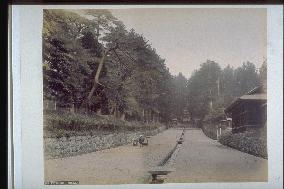
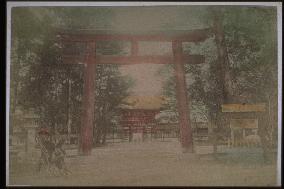
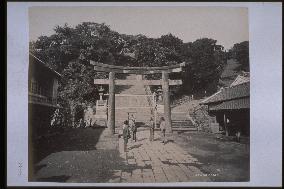
The approach to Toshogu Shrine,Nikko

The approach to Toshogu Shrine,Nikko

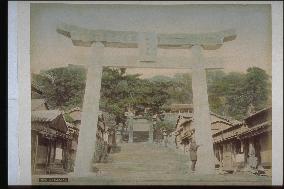
The view of the Ichino torii from the front approach to Toshogu. Ten stone steps called sennin masusugata stand in front of this stone torii. People other than warriors, such as farmers and townspeople, could only go this far when paying respects to the temple. The ditch in the centre and gentle slope difference have been buried and do not exist today. To the right of the approach is Rinoji Temple, and a man walks with a balancing pole to the left.==Date:unknown, Place:Nikko, Photo:Ogawa Kazumasa, (Credit:Nagasaki University Library/Kyodo News Images) [Cabinet Number9‐13‐0]

  •  
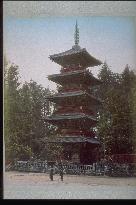
The five-story pagoda,Toshogu Shrine,Nikko

The five-story pagoda,Toshogu Shrine,Nikko

The five-story pagoda of Nikko Toshogu is at the left rear of the Ichino torii. The red-painted pagoda is done in Chinese style at the fifth story, but the other stories are done in Japanese style. The twelve horary signs are carved under the roof of the first floor. The Gochi Nyorai is placed inside the pagoda. A man wearing a sedge hat and a man carrying his hat on his back pass by.==Date:unknown, Place:Nikko, Photo:Ogawa Kazumasa, (Credit:Nagasaki University Library/Kyodo News Images) [Cabinet Number10‐4‐0]

  •  
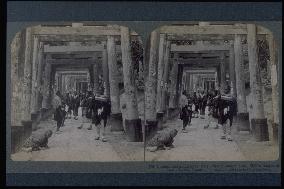
Torii gates at Fushimi Shrine

Torii gates at Fushimi Shrine

The red Senbon Torii (one thousand gates) along the eastern approach to Fushimi Inari Taisha are viewed looking southeast. The approach starts at Kamigoden Hall on the east side of the shrine precincts and stretches in a southeasterly direction to the foot of Mt. Inari, Myobusha. There are many visitors. The man on the lower left may be a beggar. The marks on the torii gate indicate that this photograph was taken after February 1889, probably by British photographer H. G. Ponting.==Date:1904, Place:Kyoto, Photo:Underwood, (Credit:Nagasaki University Library/Kyodo News Images) [Cabinet Number97‐36‐0]

  •  
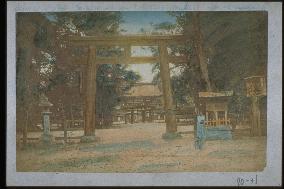
Shimogamo Shirine

Shimogamo Shirine

View of the second torii gate and two-story romon gate of Shimogamo Shinto Shrine from the shrine approach, facing north. On the left and right is a stone lantern and a wooden seisatsu sign with a kirizuma roof on the left. The words Take Heed are written on the sign in Japanese. A man wearing a yukata (summer kimono) is standing with his arms crossed on the west side of the seisatsu. The seisatsu prohibited entry to carriages, hunting, fishing and the cutting of trees and plants by order of the Department of Internal Affairs and Kyoto Prefecture. A coniferous forest with huge trees surrounds the area.==Date:unknown, Place:Kyoto, Photo:unknown, (Credit:Nagasaki University Library/Kyodo News Images) [Cabinet Number90‐31‐0]

  •  
Shimogamo Shirine

Shimogamo Shirine

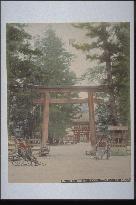
View of the second torii gate and two-story romon gate of Shimogamo Shinto Shrine from the shrine approach, facing north. A young man is looking at the camera, sitting on a rickshaw in front of the stone lantern to the left. There is a wooden seisatsu sign with a kirizuma roof on the left. The seisatsu carried a message prohibiting entry to carriages, hunting, fishing and the cutting of trees and plants by order of the Department of Internal Affairs and Kyoto Prefecture. A coniferous forest with huge trees surrounds the area.==Date:unknown, Place:Kyoto, Photo:unknown, (Credit:Nagasaki University Library/Kyodo News Images) [Cabinet Number89‐12‐0]

  •  
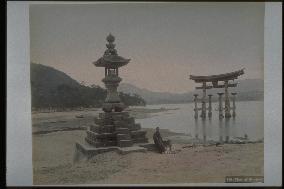
Miyajima Island,Aki

Miyajima Island,Aki

This is the view of the Grand Torii Gate from Mikasa Beach. The vista is still intact today. Nowadays people take photographs to include the red torii gate of Itsukushima Shinto Shrine in the background. To the left is the stone lantern donated by Konya Kochu of Awa (present-day Tokushima Prefecture) in 1805. This is the largest of the many stone lanterns in the shrine.==Date:unknown, Place:Miyajima, Photo:unknown, (Credit:Nagasaki University Library/Kyodo News Images) [Cabinet Number87‐48‐0]

  •  
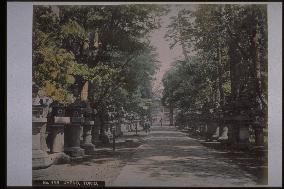
The approach to Toshogu Shrine,Ueno

The approach to Toshogu Shrine,Ueno

The entrance to the main hall of Toshogu Shrine is seen from the direction of the approach. A total of 195 large stone lanterns donated by feudal lords stand along it. The enormous size of the lanterns and the torii gate can be judged by comparing them with the people walking along the approach. The torii gate depicted in #2202 is visible behind the torii gate in the centre.==Date:unknown, Place:Ueno, Photo:Tamamura Kozaburo, (Credit:Nagasaki University Library/Kyodo News Images) [Cabinet Number80‐29‐0]

  •  
The hundred-step Otokozaka slope at Mt. Atago

The hundred-step Otokozaka slope at Mt. Atago

The stone stairs leading to Atago Shinto Shrine at the top of Mt. Atago. The steps in the centre, Otoko-zaka (Man Slope), are mentioned in old stories and songs as the place where Magaki Heikuro ascended and descended on horseback. The inclination of about 40 degrees seems too steep for a horse. The gently-sloping staircase on the right is Onna-zaka (Woman Slope). There was a third slope called Shin-zaka (New Slope) at the other side of the mountain. One of the photographs in the album sold by Baron Raimund von Stillfried Rathenitz, this may have been taken by Felix Beato in the early years of the Meiji Period.==Date:unknown, Place:Tokyo, Photo:R. Stillfried, (Credit:Nagasaki University Library/Kyodo News Images) [Cabinet Number78‐24‐0]

  •  
Shinto priests

Shinto priests

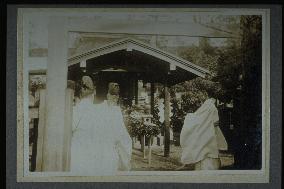
This photograph, taken from just outside the torii gate of a shrine, shows Shinto priests conducting a religious ritual, Elderly priests wearing formal robes face each other. An irimoya-style altar has been installed in front of the shrine. A koan with a small altar on top is placed on the straw matting. The location is not known.==Date:unknown, Place:Kyoto, Photo:unknown, (Credit:Nagasaki University Library/Kyodo News Images) [Cabinet Number72‐13‐0]

  •  
A passenger on a horse and the driver

A passenger on a horse and the driver

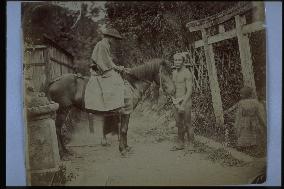
A man in a loincloth is pulling a horse with a rider. Part of a torii shrine gate and a small child are visible on the right.==Date:unknown, Place:unknown, Photo:unknown, (Credit:Nagasaki University Library/Kyodo News Images) [Cabinet Number69‐71‐0]

  •  
Hakone Shrine

Hakone Shrine

This is a photo with the Second Torii Gate of Hakone Shrine and the palanquin men. Although the sign board is on the right side of the gate in the picture painted by Kiyochika Kobayashi in 1880, it is moved to the left of the gate. Two iron pots made during the Kamakura Period to thank gods (Designated Important Cultural Asset) were moved to the main hall of the shrine and not visible on this photo. Lake Ashinoko can be seen behind.==Date:unknown, Place:Hakone, Photo:unknown, (Credit:Nagasaki University Library/Kyodo News Images) [Cabinet Number59‐53‐0]

  •  
Shimogamo Shirine

Shimogamo Shirine

Shimokamo Shinto Shrine is located on the delta of Kamo River and Takano River in the Sakyo district of Kyoto. A torii in the popular Myojo style stands in the trees of Tadasuno Forest, and the main building can be seen in the rear. At Shimokamo Shrine, Shikinen Sengu (removal and dedication of the shrine) has been conducted every 20 years since the Heian period, but the present main hall was built in 1863 and exhibits nagare zukuri (a shrine construction style with the front roof spreading out in arch form, seen from the fist half of the Heian period) . At the foot of the torii are rickshaws with their handles placed down. One is empty, but the rickshaw man sits on the other one wearing a manto hat.==Date:unknown, Place:Kyoto, Photo:Tamamura Kozaburo, (Credit:Nagasaki University Library/Kyodo News Images) [Cabinet Number11‐37‐0]

  •  
Lake Chuzenji

Lake Chuzenji

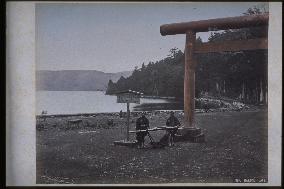
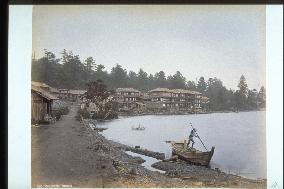
The torii of Chuguji of Futarasan Shrine and the Japanese-style hotels facing the lake near Osaki, which lies on the north bank of Chuzenji Lake. A boat man plies his boat near the shore. The right corner is near Oshiri Bridge.==Date:unknown, Place:Nikko, Photo:Ogawa Kazumasa, (Credit:Nagasaki University Library/Kyodo News Images) [Cabinet Number9‐22‐0]

  •  
Hakone Shrine

Hakone Shrine

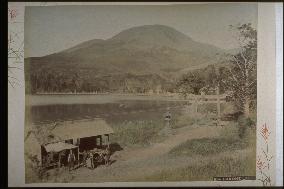
The scenery near the Ichino torii of Hakone Shinto Shrine. A woman and man stand together dressed in Western-style near a tea house. Since there is no molten iron kettle next to the torii, it is clear that this photo was taken after 1881. Since an electric wire seems to be seen, it may be as late as 1912.==Date:unknown, Place:Hakone, Photo:Ogawa Kazumasa, (Credit:Nagasaki University Library/Kyodo News Images) [Cabinet Number5‐20‐0]

  •  
The Great Torii,Suwa Shrine

The Great Torii,Suwa Shrine

The great torii arch at Suwa Shinto Shrine in Kami-Nishiyamacho, Nagasaki City. A man wearing a hanten (short coat) has his arms around the pillar to show the size of the arch. The German caption in the bottom part of the photo reads Torii in a Shinto shrine in Nagasaki.==Date:unknown, Place:Nagasaki, Photo:Kusakabe Kinbei, (Credit:Nagasaki University Library/Kyodo News Images) [Cabinet Number1‐19‐0]

  • Main
  • Top
  • Editorial
  • Creative
  • About Us
  • About ILG
  • Terms of use
  • Company
  • BEHIND
  • Price List
  • Single Plan
  • Monthly Plan
  • Services
  • Shooting
  • Rights Clearance
  • Support
  • FAQ
  • How To Buy
  • Contact Us
  • Become a Partner

© KYODO NEWS IMAGES INC

All Rights Reserved.

  • Editorial
  • Olympics
  • News
  • Sports
  • Japan
  • Tech
  • Royal
  • Disaster
  • NorthKorea
  • Old Japan
  • SNS
  • Creative
  • Food
  • Japan
  • Landscape
  • Animal
  • Popular
  • #Ukraine
  • #Thailand
  • #coronavirus
  • #N. Korea
  • #China
  • #Russia
  • #Ukraine
  • #Thailand
  • #coronavirus
  • #N. Korea
  • #China
  • #Russia
  • Food
  • Japan
  • Landscape
  • Animal
  • Olympics
  • News
  • Sports
  • Japan
  • Tech
  • Royal
  • Disaster
  • NorthKorea
  • Old Japan
  • SNS