•  
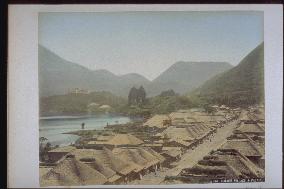
The Hakone post town

The Hakone post town

The Hakonejuku from the Mishima-cho towards the direction of Odawara. It was a small shukuba with a population of 5000 and 150 houses, but it had six Honjin (lodgings for the provincial lords), which was the largest numbers together with Hamamatsu. The Hakone summer palace can be seen to the left in the hills which was completed in 1886.==Date:unknown, Place:Hakone, Photo:Kusakabe Kinbei, (Credit:Nagasaki University Library/Kyodo News Images) [Cabinet Number40‐16‐0]

  •  
Inns at Nakasendo Niegawa

Inns at Nakasendo Niegawa

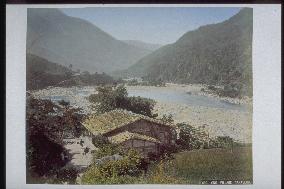
A photo of the Niekawa village which was a shukuba on the Nakasendo. Two people are seen in the center below. There is not much cultivating land due to the mountainous region, but villagers ran a business during the months without agricultural labor. It was combined with the Narai village in 1909 when administrative reform took place, and the new name of the village became Narakawa village.==Date:unknown, Place:Nagano, Photo:Kusakabe Kinbei, (Credit:Nagasaki University Library/Kyodo News Images) [Cabinet Number38‐28‐0]

  •  
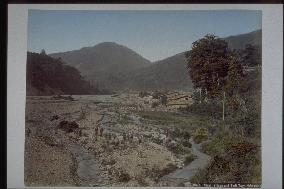
Nakasendo Torii Pass and Narai Inns

Nakasendo Torii Pass and Narai Inns

The difficult spot of Torii range on the Nakasendo and a view of Narai village at its foot. Some villagers are seen in the central river bed. The village was designated as a shukuba of the Nakasendo in the 7th year of Keicho (1602). It was not a good location for agriculture due to the high altitude and low temperature. The main industry was crafts.==Date:unknown, Place:Nagano, Photo:Kusakabe Kinbei, (Credit:Nagasaki University Library/Kyodo News Images) [Cabinet Number38‐26‐0]

  •  
Mt. Komagatake from Nakasendo Hiyoshi Village

Mt. Komagatake from Nakasendo Hiyoshi Village

The Kiso Komagatake seen from Hishoshimura which was a shukuba of the former Nakasendo. Hiyoshimura is located to the northeast of Kisogun and southwest of Nagano prefecture, and most of the land is forest. Komagatake is a beautiful mountain made of all granite, in the north of the Kiso range, and to the west of Ina Basin.==Date:unknown, Place:Nagano, Photo:Kusakabe Kinbei, (Credit:Nagasaki University Library/Kyodo News Images) [Cabinet Number38‐18‐0]

  •  
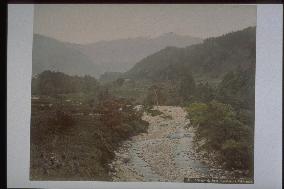
Gorge over Kiso River near Nakasendo Uematsu?

Gorge over Kiso River near Nakasendo Uematsu?

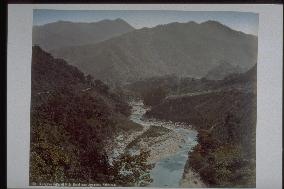
The Hon Bridge which is built over the Kiso River, one of the three fastest rivers in Japan, is seen small to the center of the photo. It is probably near Agematsu juku, on the Nakasendo. The villages of Agematsu juku were hit by numerous fires, but the shukuba was rebuilt every time.==Date:unknown, Place:Nagano, Photo:Kusakabe Kinbei, (Credit:Nagasaki University Library/Kyodo News Images) [Cabinet Number38‐15‐0]

  •  
Nakasendo Ono Village

Nakasendo Ono Village

Houses which form a part of Ono village are photographed with the Kiso River in the background. Under the roof, 2 people who look like they are carrying loads are faintly seen. Ono village was a shukuba of the Nakasendo, but because the route was changed, it became part of a short cut route to Suwa and Kiso.==Date:unknown, Place:Nagano, Photo:Kusakabe Kinbei, (Credit:Nagasaki University Library/Kyodo News Images) [Cabinet Number38‐5‐0]

  •  
Post town on the highway

Post town on the highway

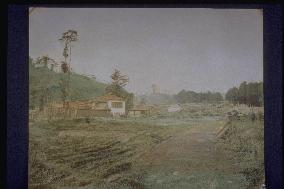
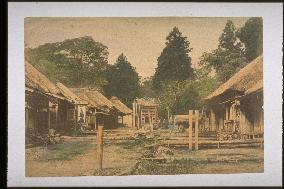
A rather lonesome shukuba city taking in consideration that it is along the Kaido. People are nowhere to be seen. Only the white walls of the house to the fore stand out. This photo is more like that of a lonesome village in the mountains rather than a shukubamachi.==Date:unknown, Place:unknown, Photo:unknown, (Credit:Nagasaki University Library/Kyodo News Images) [Cabinet Number37‐82‐0]

  •  
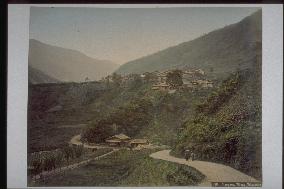
Post town at the lakeside

Post town at the lakeside

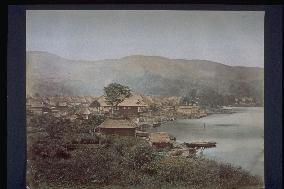
There are no clues to estimating the location of the photo, but from a comparison with other pictures, it is probably the area around Lake Ashino. In any case, it is a shukuba city bustling with energy. This photo is also beautiful as a landscape picture.==Date:unknown, Place:unknown, Photo:unknown, (Credit:Nagasaki University Library/Kyodo News Images) [Cabinet Number37‐75‐0]

  •  
Post town

Post town

The shukuba (post-town) goes back to the Taika Reformation of 645. It developed significantly during the Edo era, and many shukuba towns were formed, such as the Gojusan-tsugi (53 Shukuba) of Tokaido and Rokujunana-tsugi (67 Shukuba) of Nakasendo. A certain number of people and horses were prepared for use by the Shogunate, and transport workers to provide convenience to general travelers also assembled in these towns. Many hotels and tea houses were opened for lodging and rest.==Date:unknown, Place:unknown, Photo:unknown, (Credit:Nagasaki University Library/Kyodo News Images) [Cabinet Number13‐21‐0]

  • Main
  • Top
  • Editorial
  • Creative
  • About Us
  • About ILG
  • Terms of use
  • Company
  • BEHIND
  • Price List
  • Single Plan
  • Monthly Plan
  • Services
  • Shooting
  • Rights Clearance
  • Support
  • FAQ
  • How To Buy
  • Contact Us
  • Become a Partner

© KYODO NEWS IMAGES INC

All Rights Reserved.

  • Editorial
  • Olympics
  • News
  • Sports
  • Japan
  • Tech
  • Royal
  • Disaster
  • NorthKorea
  • Old Japan
  • SNS
  • Creative
  • Food
  • Japan
  • Landscape
  • Animal
  • Popular
  • #Ukraine
  • #China
  • #coronavirus
  • #N. Korea
  • #Russia
  • #Thailand
  • #Ukraine
  • #China
  • #coronavirus
  • #N. Korea
  • #Russia
  • #Thailand
  • Food
  • Japan
  • Landscape
  • Animal
  • Olympics
  • News
  • Sports
  • Japan
  • Tech
  • Royal
  • Disaster
  • NorthKorea
  • Old Japan
  • SNS