•  
TEPCO to raise household electricity rates 8.46% from Sept.

TEPCO to raise household electricity rates 8.46% from Sept.

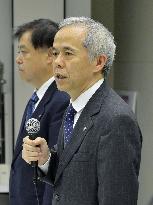
TOKYO, Japan - Tokyo Electric Power Co. President Naomi Hirose (front) speaks at a press conference at the company's headquarters in Tokyo on July 25, 2012. TEPCO won government approval the same day to raise household electricity rates by an average 8.46 percent from Sept. 1, lower than the initially planned 10.28 percent. The utility said the rate hike is needed to keep it solvent despite paying massive compensation for the Fukushima Daiichi nuclear power plant disaster.

  •  
Fish-cake cooking oil converted to bio-diesel fuel in Miyagi

Fish-cake cooking oil converted to bio-diesel fuel in Miyagi

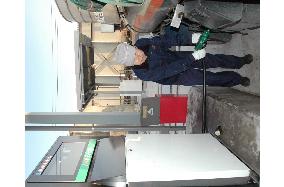
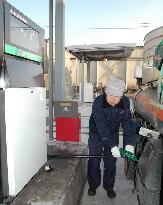
SENDAI, Japan - The city of Shiogama, Miyagi Prefecture, Japan's largest fish-cake processing base, has been producing bio-diesel from cooking oil disposed by fish-cake makers in the city, selling the product at 105 yen per liter, substantially cheaper than ordinary diesel sold at gas filling stations. Each year, fish-cake makers in Shiogama dispose of more than 500,000 liters of used cooking oil, which had been sold to outside dealers for use as fat in pet food or as ink solvent. The city started converting used cooking oil to bio-diesel in November 2006 with subsidies from the Ministry of Environment. The photo shows an employee at the bio-diesel fuel station in Shiogama filling up a diesel truck.

  •  
Atmospheric pressure plasma system for Kai Semiconductor

Atmospheric pressure plasma system for Kai Semiconductor

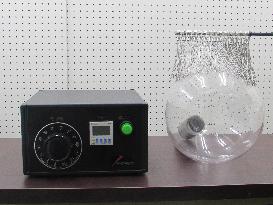
Kai Semiconductor (Shimogyo-ku,Kyoto City) will release on December 2 an atmospheric pressure plasma system "GaCo (get a command of)," which enables plasma processing of curved surfaces, which has been difficult to do at atmospheric pressure. By placing it on the object to be processed and tracing it, even curved shapes can be processed efficiently. The dielectric barrier discharge, which discharges at a low temperature, does not burden or affect the object. The standard model, the 200, processes 100 millimeters per second with a processing width of 200 millimeters and a maximum width of 1,100 millimeters. Plasma treatment is promising for use in pre-treatment to improve adhesion in the tempered glass coating process. In the case of curved surface treatment, vacuum plasma treatment is inefficient due to batch processing, and solvent treatment requires large equipment. Photo taken on November 20, 2019, credit: Nikkan Kogyo Shimbun / Kyodo News Images

  •  
Alloy Giken Automates Brazing Process Cleaning

Alloy Giken Automates Brazing Process Cleaning

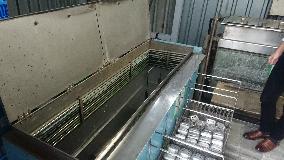
Alloy Giken (Iwatsuki Ward, Saitama City) has automated the cleaning process, which is a preliminary step in the brazing process. In addition to addressing the shortage of manpower, the company aims to improve the working environment by reducing the emission of volatile organic solvents through the use of a sealed cleaning tank. Since the machine is about 2 meters square and 1.7 meters high, the space for the washing process was expanded. In anticipation of future restrictions on organic solvents and other cleaning fluids, a general-purpose cleaning tank was used. In the past, baskets containing parts were manually moved in and out of the cleaning tank, but now that the tank is sealed, "workers will not be bothered by the strong smell of volatile solvents," according to the company. The company says that this will also lead to a reduction in solvent costs. Photo taken on October 24, 2019, credit: Nikkan Kogyo Shimbun / Kyodo News Images

  •  
Fish-cake cooking oil converted to bio-diesel fuel in Miyagi

Fish-cake cooking oil converted to bio-diesel fuel in Miyagi

SENDAI, Japan - The city of Shiogama, Miyagi Prefecture, Japan's largest fish-cake processing base, has been producing bio-diesel from cooking oil disposed by fish-cake makers in the city, selling the product at 105 yen per liter, substantially cheaper than ordinary diesel sold at gas filling stations. Each year, fish-cake makers in Shiogama dispose of more than 500,000 liters of used cooking oil, which had been sold to outside dealers for use as fat in pet food or as ink solvent. The city started converting used cooking oil to bio-diesel in November 2006 with subsidies from the Ministry of Environment. The photo shows an employee at the bio-diesel fuel station in Shiogama filling up a diesel truck. (Kyodo)

  •  
Painting designs on porcelain

Painting designs on porcelain

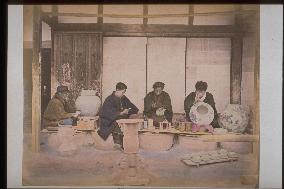
Four men colour a porcelain vase. Manufacturing porcelain involved the process of mixing raw materials, forming the shape, heating, drawing a rough draft, covering it with a solvent, baking, colouring the picture, and baking the picture. Drawing the picture was divided into the rough draft and the actual colouring, depending on whether it was done before or after covering the vase with solvent.==Date:unknown, Place:unknown, Photo:Suzuki Shin-ichi, (Credit:Nagasaki University Library/Kyodo News Images) [Cabinet Number41‐44‐0]

  • Main
  • Top
  • Editorial
  • Creative
  • About Us
  • About ILG
  • Terms of use
  • Company
  • BEHIND
  • Price List
  • Single Plan
  • Monthly Plan
  • Services
  • Shooting
  • Rights Clearance
  • Support
  • FAQ
  • How To Buy
  • Contact Us
  • Become a Partner

© KYODO NEWS IMAGES INC

All Rights Reserved.

  • Editorial
  • Olympics
  • News
  • Sports
  • Japan
  • Tech
  • Royal
  • Disaster
  • NorthKorea
  • Old Japan
  • SNS
  • Creative
  • Food
  • Japan
  • Landscape
  • Animal
  • Popular
  • #Ukraine
  • #Russia
  • #coronavirus
  • #N. Korea
  • #Thailand
  • #China
  • #Ukraine
  • #Russia
  • #coronavirus
  • #N. Korea
  • #Thailand
  • #China
  • Food
  • Japan
  • Landscape
  • Animal
  • Olympics
  • News
  • Sports
  • Japan
  • Tech
  • Royal
  • Disaster
  • NorthKorea
  • Old Japan
  • SNS