•  

Philippines: Typhoon Kalmaegi Triggers Severe Flooding, Displacing Thousands 2

Severe flooding has submerged towns and displaced hundreds of thousands as Typhoon Kalmaegi battered the central Philippines. Rivers overflowed in Cebu and nearby islands, forcing residents onto rooftops while cars and containers were swept through the streets. Local officials said some evacuation centers were inundated, and many survivors of a recent earthquake had to be evacuated again. More than 380,000 people fled their homes across the Visayas, southern Luzon, and northern Mindanao. Kalmaegi, locally named Tino, made landfall late Monday, November 3 with winds of up to 130 kph before moving toward the South China Sea on Tuesday, November 4.

  •  

China: Tourists and Locals Rescue Yaks from Mud Pit in Qinghai

In Qinghai, China, tourists and locals joined forces with an excavator operator to rescue four yaks stuck in deep mud on September 30, 2025. After spotting the trapped animals, the tourists alerted a herdsman and enlisted help from a nearby construction site. Working for nearly an hour, they freed all four yaks safely. The herdsman said the rescue prevented losses of over RMB 40,000.

  •  

US: North Dakota Sees Powerful Winds Amid Tornado-Producing Storm

Severe weather swept across the upper Midwest on Friday, June 20, bringing powerful winds and leaving at least 3 dead in North Dakota as a tornado ripped through the area.

  •  

China: Typhoon Wutip Darkens Hainan Skies Ahead of Landfall in Hainan

This is the terrifying moment a massive wall of dark clouds engulfed the skies over Hainan as Typhoon Wutip approached southern China. On June 11, 2025, in Hainan, China, video captured thick, menacing clouds rolling in ahead of Typhoon Wutip's landfall. The sky turned eerily dark as the season’s first typhoon neared, creating a heavy, ominous atmosphere. The storm made landfall around 11 p.m. on June 13 along the coast of Dongfang, a city in Hainan, with winds reaching up to 30 meters per second and a central pressure of 980 hPa. Heavy rain swept through southern parts of the island, with some areas experiencing torrential downpours and localized extreme rainfall. According to China National Radio, by June 15, Typhoon Wutip had weakened into a tropical depression after moving inland into Jiangxi Province, and continued to lose strength. The video ends with the storm clouds blanketing the landscape as residents brace for the typhoon’s impact.

  •  

Japan: Heavy Snowfall Hits Sea Of Japan Coast 4

Heavy snowfall has battered a wide area of Japan, especially the Hokuriku region along the Sea of Japan coast. This video shows blizzard conditions in the city Otaru, Hokkaido.

  •  

US: EF-1 Tornado Touches Down In Athens, AL, Leaving Devastating Damage

The National Weather Service in Huntsville has confirmed that an EF-1 tornado touched down in downtown Athens, Alabama, on Saturday night, December 28.

  •  

Philippines: Typhoon Yinxing Makes Landfall In Cagayan, Damaging Infrastructure 3

Typhoon Yinxing, known as Marce in the Philippines, made landfall near Santa Ana, Cagayan, on Thursday afternoon, November 7, forcing more than 21,000 people to evacuate and damaging two domestic airports and homes. Telecommunications and power supplies have remained down due to damaged cables and power lines, severely affecting residents in the affected areas.

  •  

Philippines: Typhoon Yinxing Makes Landfall In Cagayan, Damaging Infrastructure 2

Typhoon Yinxing, known as Marce in the Philippines, made landfall near Santa Ana, Cagayan, on Thursday afternoon, November 7, forcing more than 21,000 people to evacuate and damaging two domestic airports and homes. Telecommunications and power supplies have remained down due to damaged cables and power lines, severely affecting residents in the affected areas.

  •  

Thailand: Overflowing Of Ping River Causes Flooding In Chiang Mai Amid Rainy Season 3

Water levels in the Ping River rose, causing severe flooding across Chiang Mai on September 25 and affecting infrastructure. Small vehicles were stranded on flooded roads, and local shops and stalls were forced to close.

  •  

US: Beryl Causes Widespread Power Outages And Flooding, Leaves Multiple Dead In Texas 4

Beryl has weakened into a tropical storm after making landfall as a category 1 hurricane near Matagorda in Texas, on Monday, July 8, shortly before 4 a.m. local time. The hurricane caused power outages and life-threatening flooding and left multiple dead in Houston and the surrounding areas.

  •  

US: Days-Long Winter Storm Dumps Heavy Snow On Sierra Nevada, Closing Roads, Schools

A days-long winter storm dumped heavy snow on the Sierra Nevada, closing major highways, ski resorts, and schools in parts of California. More than 10 feet of snow and hurricane-force wind gusts of 170 mph-plus were reported.

  •  

US: Strong Winter Storm Brings Blizzard Conditions To Sierra Nevada

A strong winter storm hit the Sierra Nevada on Friday, March 1, bringing heavy snow and high winds. Blizzard Warnings were issued for the Sierra, including Lake Tahoe and eastern Nevada. The Sierra Avalanche Center warned that the danger of avalanches was high. Yosemite National Park and many ski resorts in the region announced they were closing at least for the day.

  •  
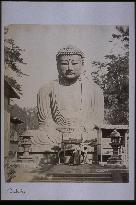
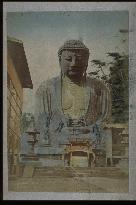
Daibutsu (the Great Buddha) of Kamakura

Daibutsu (the Great Buddha) of Kamakura

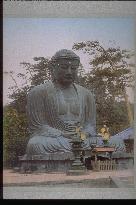
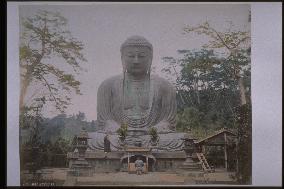
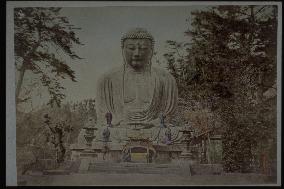
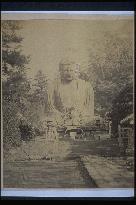
The Daibutsu is the main Buddha at the Kotokuin and used to be inside a building called the Daibutsuden. It was originally a wooden statue, but in Azuma Kagami (historical record of the Kamakura Shogunate), there is mention of starting to mold the gold and copper Shakanyorai Buddha (actually Amida statue) in 1252 in Fukasawa.==Date:unknown, Place:Kamakura, Photo:Ogawa Kazumasa, (Credit:Nagasaki University Library/Kyodo News Images) [Cabinet Number10‐17‐0]

  •  
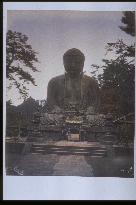
Daibutsu (the Great Buddha) of Kamakura

Daibutsu (the Great Buddha) of Kamakura

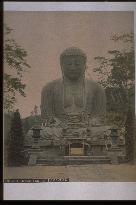
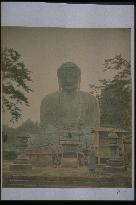
The Daibutsu (Great Buddha) is the main Buddha of the Kotokuin (Daiisan Kotokuin Josenji). The statue was initially enshrined in a hall like the Daibutsu in Nara. Old records show that the priest Joko of Toe planned the construction of the Buddha in 1236, the year that Hojo Yasutoki was Shikken (regent).==Date:unknown, Place:Kamakura, Photo:Kusakabe Kinbei, (Credit:Nagasaki University Library/Kyodo News Images) [Cabinet Number4‐26‐0]

  •  
Daibutsu (the Great Buddha) of Kamakura

Daibutsu (the Great Buddha) of Kamakura

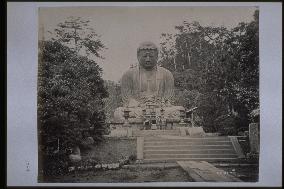
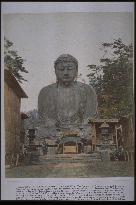
The Great Buddha of Kamakura is a seated Amitabha Buddha (Amida Nyorai) made of bronze. Designated as a National Treasure in 1897, it is the main object of worship at Kohtokuin Shojosenji Temple. Historic documents state that work began on a gilt statue of Shaka Nyorai Buddha about 13.5 meters in height in the year 1252. It is not known when it became a statue of Amida Buddha. The exact date of the photograph is unknown.==Date:1904, Place:Kamakura, Photo:unknown, (Credit:Nagasaki University Library/Kyodo News Images) [Cabinet Number98‐4‐0]

  •  
Daibutsu (the Great Buddha) of Kamakura

Daibutsu (the Great Buddha) of Kamakura

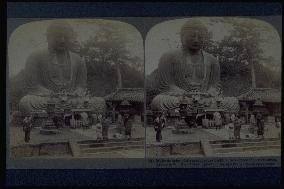
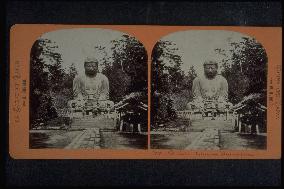
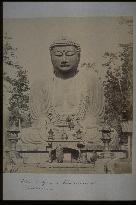
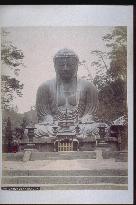
The bronze lanterns on both sides of the statue were donated in January 1712 and still exist today. Behind them are the two stones presumed to be foundations of the former Great Buddha building. The label under the caption on the lower right border of the stereograph reads Copyright 1904 by Underwood & Underwood, indicating that the photograph was taken around 1904.==Date:1904, Place:Kamakura, Photo:Underwood, (Credit:Nagasaki University Library/Kyodo News Images) [Cabinet Number97‐86‐0]

  •  
Daibutsu (the Great Buddha) of Kamakura

Daibutsu (the Great Buddha) of Kamakura

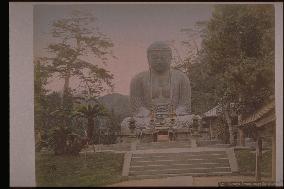
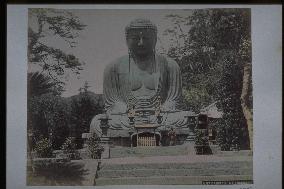
The words STILLFRIED(?) C. 1875 are visible on the mount. This photograph is said to have been taken by Stillfried around 1875, but the presence of the same temporary shack as that in photograph #2748 and the signboard on the left reading Names of Donors for Reconstruction Work suggest that it was taken a little later, probably the second decade of the Meiji Period.==Date:about 1875, Place:Kamakura, Photo:R. Stillfried, (Credit:Nagasaki University Library/Kyodo News Images) [Cabinet Number96‐70‐0]

  •  
Daibutsu (the Great Buddha) of Kamakura

Daibutsu (the Great Buddha) of Kamakura

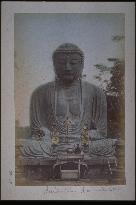
The photograph bears the inscription One Hundred Nineteen 119. There are no bronze lotus petals. The building on the right side of the statue is probably the same as that in photograph #3997. The sharply-raking finials on the two bronze lanterns in front of the statue indicate that this photograph was taken at the beginning of the Meiji Period, but there seems to be a slight time difference from photograph #3997.==Date:unknown, Place:Kamakura, Photo:Usui Shuzaburo, (Credit:Nagasaki University Library/Kyodo News Images) [Cabinet Number94‐10‐0]

  •  
Daibutsu (the Great Buddha) of Kamakura

Daibutsu (the Great Buddha) of Kamakura

The two large flat stones in front of the statue may be the foundation stones of the former temple building. Recent excavations revealed several foundation bases, evidence that the former temple building had a north-south length of about 42.5 meters and an east-west width of 44 meters. The exact date of this photograph is unknown. The Great Buddha is an object of worship and climbing upon it is prohibited today.==Date:unknown, Place:Kamakura, Photo:unknown, (Credit:Nagasaki University Library/Kyodo News Images) [Cabinet Number93‐37‐0]

  •  
Daibutsu (the Great Buddha) of Kamakura

Daibutsu (the Great Buddha) of Kamakura

The exact date of the photograph is unknown. The only historical information about the former Great Buddha Hall is that it collapsed twice, once in 1334 and again in 1369. Since there is no record of reconstruction after the earthquake of 1498, it is like that the statue has been exposed outdoors since that time. The Great Buddha is an object of worship and climbing upon it is prohibited today.==Date:unknown, Place:Kamakura, Photo:unknown, (Credit:Nagasaki University Library/Kyodo News Images) [Cabinet Number92‐15‐0]

  •  
Daibutsu (the Great Buddha) of Kamakura

Daibutsu (the Great Buddha) of Kamakura

The photograph was probably taken around the same time as photograph #2748. Kotokuin Temple began to collect donations for the reconstruction of the temple in 1879. However, a change in public opinion caused the plan to be suspended in 1889. It is documented that the donated money was later used to enlarge the temple grounds, to plant trees, and to build rest areas. The Great Buddha is an object of worship and climbing upon it is prohibited today.==Date:unknown, Place:Kamakura, Photo:unknown, (Credit:Nagasaki University Library/Kyodo News Images) [Cabinet Number90‐28‐0]

  •  
Daibutsu (the Great Buddha) of Kamakura

Daibutsu (the Great Buddha) of Kamakura

The photograph is entitled Daibutzu Kamakura. The bronze lotus petals are visible, but the building on the right of the Buddha is more dilapidated than it appears in photograph #2747. Therefore, this photograph was probably taken later than photograph #2747, in the early part of the Meiji Period. It is recorded that these petals were made in 1736. The Great Buddha is an object of worship and climbing upon it is prohibited today.==Date:unknown, Place:Kamakura, Photo:unknown, (Credit:Nagasaki University Library/Kyodo News Images) [Cabinet Number87‐30‐0]

  •  
Daibutsu (the Great Buddha) of Kamakura

Daibutsu (the Great Buddha) of Kamakura

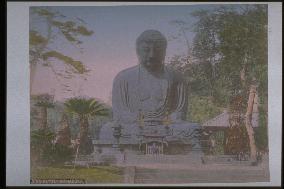
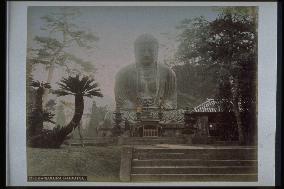
The photograph is labeled 9 DAIBUTSU, KAMAKURA. The two flat rocks in front of the statue could be foundation stones of the former building. A simple structure with a thatched roof is visible behind the cycad tree to the left of the statue. The exact date is not known.==Date:unknown, Place:Kamakura, Photo:unknown, (Credit:Nagasaki University Library/Kyodo News Images) [Cabinet Number86‐9‐0]

  •  
Daibutsu (the Great Buddha) of Kamakura

Daibutsu (the Great Buddha) of Kamakura

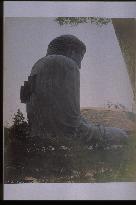
The photograph is labeled L22 DAI BUTSU(SIDE). The thatched roof in the background is that of the kuri (priests' quarters). There are doors (still extant) in the Buddha's back. It is reported that these doors were donated by the subtemples of Kenchoji Temple in 1736. The exact date of this photograph is unknown.==Date:unknown, Place:Kamakura, Photo:A. Farsari, (Credit:Nagasaki University Library/Kyodo News Images) [Cabinet Number82‐19‐0]

  •  
Daibutsu (the Great Buddha) of Kamakura

Daibutsu (the Great Buddha) of Kamakura

The photograph is labeled L19 DAIBUTSU (A). The building to the right side of the statue is the same as that in photograph #3375, and there are three large flat stones at the lower left side of the statue. Also, there are roof tiles piled up under the bronze altar placed in front of the pedestal. The Great Buddha is an object of worship and climbing upon it is prohibited today.==Date:unknown, Place:Kamakura, Photo:A. Farsari, (Credit:Nagasaki University Library/Kyodo News Images) [Cabinet Number82‐18‐0]

  •  
Daibutsu (the Great Buddha) of Kamakura

Daibutsu (the Great Buddha) of Kamakura

The photograph is labeled No.534 DAIBUTSU AT KAMAKURA. The exact date is unknown. People are standing in the cupped hands of the statue and other spots. The palm of the statue is large, possibly about 3.8 square meters. The Great Buddha is an object of worship and climbing upon it is prohibited today.==Date:unknown, Place:Kamakura, Photo:Tamamura Kozaburo, (Credit:Nagasaki University Library/Kyodo News Images) [Cabinet Number80‐18‐0]

  •  
Daibutsu (the Great Buddha) of Kamakura

Daibutsu (the Great Buddha) of Kamakura

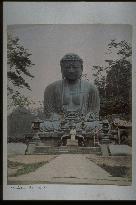
Two bronze lotus petals (four existing today) are visible on the front of the pedestal, and a simple building stands on the right. There are large flat stones in front of the lotus petals to both the left and right. The fact that the petals are intact and the accompanying structure is different indicates that this photograph was taken later than the beginning of the Meiji Period when photograph #4464 was apparently taken. The Great Buddha is an object of worship and climbing upon it is prohibited today.==Date:unknown, Place:Kamakura, Photo:R. Stillfried, (Credit:Nagasaki University Library/Kyodo News Images) [Cabinet Number78‐15‐0]

  •  
Daibutsu (the Great Buddha) of Kamakura

Daibutsu (the Great Buddha) of Kamakura

This stereograph entitled No.301 Daibuts-Statue in Kamakura is thought to have been taken in the beginning of the Meiji Period because there are bronze lotus petals in front of the statue. The stone paved approach is the same as that in photograph #5372. The monument in the photograph, which carries the inscription Donated Stone Pavement was made in 1780, so it is likely that this stone pavement was laid at the same time.==Date:unknown, Place:Kamakura, Photo:Wilhelm Burger, (Credit:Nagasaki University Library/Kyodo News Images) [Cabinet Number70‐22‐0]

  •  
Daibutsu (the Great Buddha) of Kamakura

Daibutsu (the Great Buddha) of Kamakura

The photograph was probably taken at the beginning of the Meiji Period. There are two large flat stones in front of the pedestal, and the same simple building as that in photograph #3997 is visible to the right of the statue. However, the lack of bronze lotus petals indicates that it was taken at a slightly later date. The Great Buddha is an object of worship and climbing upon it is prohibited today.==Date:unknown, Place:Kamakura, Photo:unknown, (Credit:Nagasaki University Library/Kyodo News Images) [Cabinet Number69‐44‐0]

  •  
Daibutsu (the Great Buddha) of Kamakura

Daibutsu (the Great Buddha) of Kamakura

Like photographs #2748 and #3132, this is thought to have been taken between 1877 and 1887 when the reconstruction of the building was underway. However, no donors' signboards are visible. Also, there is a temporary shack on the lower right of the statue, but it is empty. This photograph may have been taken by Usui Shuzaburo (a 19th-century photographer in Yokohama). The Great Buddha is an object of worship and climbing upon it is prohibited today.==Date:unknown, Place:Kamakura, Photo:Usui Shuzaburo?, (Credit:Nagasaki University Library/Kyodo News Images) [Cabinet Number65‐6‐0]

  •  
Daibutsu (the Great Buddha) of Kamakura

Daibutsu (the Great Buddha) of Kamakura

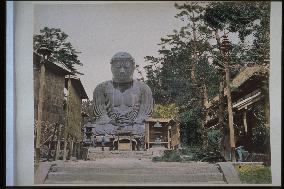
The photograph was probably taken around the same time as photograph #2748, i.e. the first decade of the Meiji Period. It is thought to have been taken by Stillfried. Three signboards stand on both sides of the paved stone approach, one saying, The names of donors for the reconstruction work. There are many roof tiles piled under the floor of the shack on the right and a few placed on the floor. These tiles may have been donated for the reconstruction.==Date:unknown, Place:Kamakura, Photo:unknown, (Credit:Nagasaki University Library/Kyodo News Images) [Cabinet Number64‐30‐0]

  •  
Daibutsu (the Great Buddha) of Kamakura

Daibutsu (the Great Buddha) of Kamakura

The photograph is entitled JP Daibutzu of Kamacura / Japanese Buddha/ . There are sharply raking finials protruding from the caps of the bronze lanterns, which no longer exist. The photographer is thought to be Felix Beato. Beato's travel records suggest that it was taken at the end of the Edo or the beginning of the Meiji Period. The Great Buddha is an object of worship and climbing upon it is prohibited today.==Date:unknown, Place:Kamakura, Photo:F. Beato, (Credit:Nagasaki University Library/Kyodo News Images) [Cabinet Number62‐13‐0]

  •  
Daibutsu (the Great Buddha) of Kamakura

Daibutsu (the Great Buddha) of Kamakura

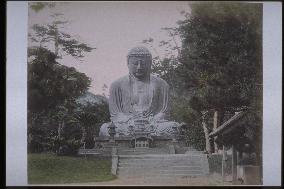
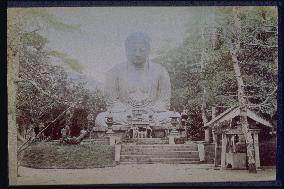
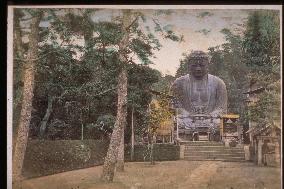
A pine forest surrounds the Great Buddha in Kamakura. There are large flat rocks in front of the statue. The stone cleansing basin at the lower right was donated in 1749. There are no bronze lotus petals. The exact date of the photograph is unknown.==Date:unknown, Place:Kamakura, Photo:unknown, (Credit:Nagasaki University Library/Kyodo News Images) [Cabinet Number61‐19‐0]

  •  
Daibutsu (the Great Buddha) of Kamakura

Daibutsu (the Great Buddha) of Kamakura

There is a thatched-roof building at the back right of the statue. The same building is evident in the photograph album entitled Kakuchi Meisho ( Famous Places Here and There ) printed in 1893 for the Abe Family, former lords of the Fukuyama Clan. Therefore, it is assumed that this photograph was taken after that date.==Date:unknown, Place:Kamakura, Photo:unknown, (Credit:Nagasaki University Library/Kyodo News Images) [Cabinet Number59‐56‐2]

  •  
Daibutsu (the Great Buddha) of Kamakura

Daibutsu (the Great Buddha) of Kamakura

The date of the photograph is unknown. The large flat stones in front of the statue may be the former foundation stones. A document from the mid-Edo Period states that 60 foundation stones lined the perimeter of the statue, about 38 meters on the north and south sides and about 45 on the east and west. The Great Buddha is an object of worship and climbing upon it is prohibited today.==Date:unknown, Place:Kamakura, Photo:unknown, (Credit:Nagasaki University Library/Kyodo News Images) [Cabinet Number55‐25‐0]

  •  
Daibutsu (the Great Buddha) of Kamakura

Daibutsu (the Great Buddha) of Kamakura

There are gas lights to the right and left sides and the kuri (rectory) on the right. Kotokuin Temple began to collect donations after receiving government permission to rebuild the Great Buddha Hall in 1879. The three signboards on the left may be lists of the names of donors. There is a shack to the lower right of the statue. Since another photograph shows roof tiles piled up here, this spot may have been a booth for the donation of roof tiles as part of the reconstruction project.==Date:unknown, Place:Kamakura, Photo:unknown, (Credit:Nagasaki University Library/Kyodo News Images) [Cabinet Number55‐21‐0]

  •  
Daibutsu (the Great Buddha) of Kamakura

Daibutsu (the Great Buddha) of Kamakura

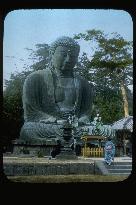
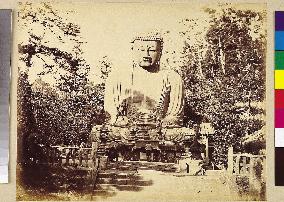
Bronze lotus petals (four existing today) are visible at the front of the pedestal of the Great Buddha. The building with a thatched roof on the right and the sharply raking finials on the cap of the lantern in the foreground are the same as those depicted in a photograph in the May 30th, 1870 issue of The Far East, indicating that it was taken around the same time. The Great Buddha is an object of worship and climbing upon it is prohibited today.==Date:unknown, Place:Kamakura, Photo:unknown, (Credit:Nagasaki University Library/Kyodo News Images) [Cabinet Number55‐20‐0]

  •  
Daibutsu (the Great Buddha) of Kamakura

Daibutsu (the Great Buddha) of Kamakura

This is the same photograph as #2252. Two flat rocks are placed in front of the pedestal. A map of the temple grounds dated 1899 shows four stones placed at the corners surrounding the statue, suggesting that the foundation stones of the former Great Buddha hall were still in their original locations. A total of 59 such stones still remain in the present-day temple grounds.==Date:unknown, Place:Kamakura, Photo:Tamamura Kozaburo, (Credit:Nagasaki University Library/Kyodo News Images) [Cabinet Number48‐137‐0]

  •  
Daibutsu (the Great Buddha) of Kamakura

Daibutsu (the Great Buddha) of Kamakura

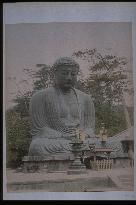
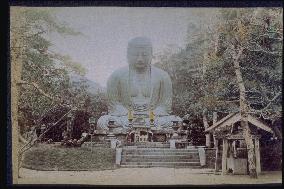
The stone cleansing basin in the foreground was donated in 1749. At present it is situated at the entrance of the temple grounds along with its roof. There are two flat rocks placed in front of the statue. The symmetrical position of these rocks suggests that they were used as foundation stones for the former Great Buddha Hall. This photograph is included in the Tamamura Kozaburo (1856-?) Photograph Collection. The date of the photograph is not known.==Date:unknown, Place:Kamakura, Photo:Tamamura Kozaburo, (Credit:Nagasaki University Library/Kyodo News Images) [Cabinet Number48‐105‐0]

  •  
Daibutsu (the Great Buddha) of Kamakura

Daibutsu (the Great Buddha) of Kamakura

The photograph is labeled 42 DAIBUTSU KAMAKURA. The exact date is unknown. The weight of the Great Buddha (Daibutsu) is 122 tons. According to the latest digital measurements, the height (from the top of the statue to the ground) is 11.310 m, and the length from the top of the head to the jaw is 3.678 m. The Great Buddha is an object of worship and climbing upon it is prohibited today.==Date:unknown, Place:Kamakura, Photo:unknown, (Credit:Nagasaki University Library/Kyodo News Images) [Cabinet Number47‐9‐0]

  •  
Daibutsu (the Great Buddha) of Kamakura

Daibutsu (the Great Buddha) of Kamakura

The Daibutsu in Kamakura. This area is called Fukazawa . The mountain slope to the west of the Daibutsu is called Daibutsu Kiridoshi , and leads to Tokiwa and Kajiwara. Advancing to the northwest from the gate of the old Kotokuin, visitors arrive at the Kiridoshi. The name is Fukazawa Kiridoshi .==Date:unknown, Place:Kamakura, Photo:unknown, (Credit:Nagasaki University Library/Kyodo News Images) [Cabinet Number14‐49‐0]

  •  
Daibutsu (the Great Buddha) of Kamakura

Daibutsu (the Great Buddha) of Kamakura

Same as the photograph by Felix Beato (1825-1904?) preserved at the Yokohama Archives of History. Beato is said to have visited Kamakura in 1864 and again in 1868. The photograph shows three bronze lotus petals and the monument with the inscription Donated Stone Pavement erected in 1789. Both remain today. The Great Buddha is an object of worship and climbing upon it is prohibited today.==Date:unknown, Place:Kamakura, Photo:F. Beato, (Credit:Nagasaki University Library/Kyodo News Images) [Cabinet Number104‐9‐0]

  • Main
  • Top
  • Editorial
  • Creative
  • About Us
  • About ILG
  • Terms of use
  • Company
  • BEHIND
  • Price List
  • Single Plan
  • Monthly Plan
  • Services
  • Shooting
  • Rights Clearance
  • Support
  • FAQ
  • How To Buy
  • Contact Us
  • Become a Partner

© KYODO NEWS IMAGES INC

All Rights Reserved.

  • Editorial
  • Olympics
  • News
  • Sports
  • Japan
  • Tech
  • Royal
  • Disaster
  • NorthKorea
  • Old Japan
  • SNS
  • Creative
  • Food
  • Japan
  • Landscape
  • Animal
  • Popular
  • #Ukraine
  • #Thailand
  • #coronavirus
  • #N. Korea
  • #China
  • #Russia
  • #Ukraine
  • #Thailand
  • #coronavirus
  • #N. Korea
  • #China
  • #Russia
  • Food
  • Japan
  • Landscape
  • Animal
  • Olympics
  • News
  • Sports
  • Japan
  • Tech
  • Royal
  • Disaster
  • NorthKorea
  • Old Japan
  • SNS