•  
Human bones over 9,000 years old found in Okinawa

Human bones over 9,000 years old found in Okinawa

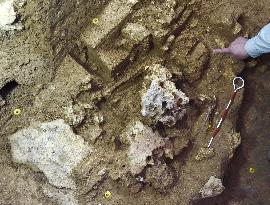
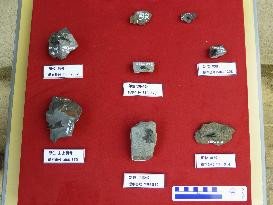
NANJO, Japan - The Okinawa Prefectural Museum and Art Museum unveils human bones excavated from a stratum more than 9,000 years old in the Sakitari Cave in Nanjo, Okinawa Prefecture, southwestern Japan, on Dec. 11, 2014. A finger indicates the location of the skull.

  •  
Fukui museum displays fossil of primitive bird

Fukui museum displays fossil of primitive bird

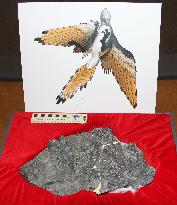
FUKUI, Japan - The Fukui Prefectural Dinosaur Museum shows to the media on Jan. 5, 2015, the fossil of a bird, found in a stratum some 120 million years old in Katsuyama, western Japan.

  •  
Prehistory fish fossils found as new freshwater species

Prehistory fish fossils found as new freshwater species

KANAZWA, Japan - The education board in Hakusan, Ishikawa Prefecture, displays fossils of a new freshwater fish species of the Sinamia family unearthed from a stratum in the first half of the Cretaceous period, or 130 million years ago, in the Sea of Japan city on Oct. 1, 2014. The board has given the scientific name of Sinamia Kukurihime to the fish after the name of a local shrine.

  •  
9-year-old girl discovers fossil of new species of lobster

9-year-old girl discovers fossil of new species of lobster

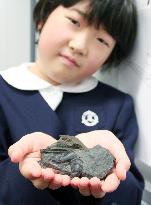
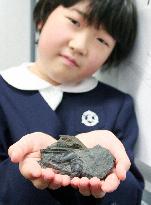
WAKAYAMA, Japan - Natsumi Kumagai from Hannan, Osaka Prefecture, holds fossil remains of a new species of lobster at the Wakayama prefectural government building in the city of Wakayama on Dec. 10. The nine-year-old dug out the fossil of the new lobster ''Hoploparia natsumiae,'' which was named after her given name, from the Lower Cretaceous stratum (130 million years ago) in the town of Yuasa, Wakayama Prefecture, in December last year.

  •  
Fossil of extinct primitive ant found 1st time in Japan

Fossil of extinct primitive ant found 1st time in Japan

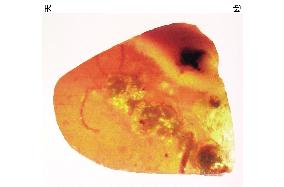
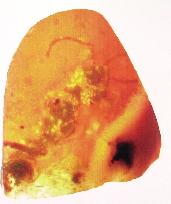
FUKUSHIMA, Japan - A fossil of an extinct species of a primitive ant dating back to around 85 million years ago, belonging in the sphecomyrminae, has been discovered in Japan for the first time, the Myrmecological Society of Japan said on May 5. The fossil of the wasp-like ant has so far only been found in the United States and Russia, the society said. The fossil was found preserved in amber (in photo), which was taken from a stratum from the late Cretaceous period in Iwaki and Hirono, Fukushima Prefecture.

  •  
World's oldest fossil of sea lion found in Nagano Pref.

World's oldest fossil of sea lion found in Nagano Pref.

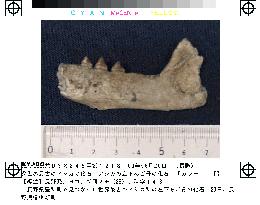
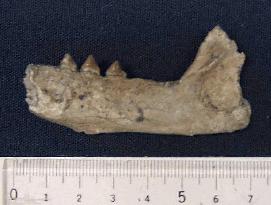
NAGANO, Japan - A fossil (in photo) discovered four years ago in a stratum 12-13 million years old in Nagano Prefecture has been found to a part of the jawbone of a sea lion, making it the world's oldest fossil of the mammal, researchers at the Shinshushinmachi Fossil Museum said June 20. The oldest fossil of a sea lion up until now has been a fossil roughly 7 million years old found in California, they said.

  •  
9-year-old girl discovers fossil of new species of lobster

9-year-old girl discovers fossil of new species of lobster

WAKAYAMA, Japan - Natsumi Kumagai from Hannan, Osaka Prefecture, holds fossil remains of a new species of lobster at the Wakayama prefectural government building in the city of Wakayama on Dec. 10. The nine-year-old dug out the fossil of the new lobster ''Hoploparia natsumiae,'' which was named after her given name, from the Lower Cretaceous stratum (130 million years ago) in the town of Yuasa, Wakayama Prefecture, in December last year. (Kyodo)

  •  
Fossil of extinct primitive ant found 1st time in Japan

Fossil of extinct primitive ant found 1st time in Japan

FUKUSHIMA, Japan - A fossil of an extinct species of a primitive ant dating back to around 85 million years ago, belonging in the sphecomyrminae, has been discovered in Japan for the first time, the Myrmecological Society of Japan said on May 5. The fossil of the wasp-like ant has so far only been found in the United States and Russia, the society said. The fossil was found preserved in amber (in photo), which was taken from a stratum from the late Cretaceous period in Iwaki and Hirono, Fukushima Prefecture. (Kyodo)

  •  
World's oldest fossil of sea lion found in Nagano Pref.

World's oldest fossil of sea lion found in Nagano Pref.

NAGANO, Japan - A fossil (in photo) discovered four years ago in a stratum 12-13 million years old in Nagano Prefecture has been found to a part of the jawbone of a sea lion, making it the world's oldest fossil of the mammal, researchers at the Shinshushinmachi Fossil Museum said June 20. The oldest fossil of a sea lion up until now has been a fossil roughly 7 million years old found in California, they said. (Kyodo)

  •  
Dinosaur foreleg fossil found in Fukui, largest class in Japan

Dinosaur foreleg fossil found in Fukui, largest class in Japan

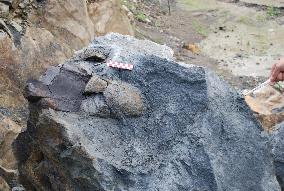
FUKUI, Japan - A fossil of a foreleg believed to belong to a large plant-eating dinosaur was excavated in a stratum from the Cretaceous period in Katsuyama, Fukui Prefecture, the Fukui Prefectural Dinosaur Museum said July 11. The fossil is one of the largest foreleg fossils ever discovered in Japan, with its length estimated at about 90 centimeters and width about 25 cm, according to the museum. Photo was provided by the museum. (Kyodo)

  •  
Fukui museum displays fossil of primitive bird

Fukui museum displays fossil of primitive bird

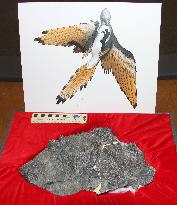
FUKUI, Japan - The Fukui Prefectural Dinosaur Museum shows to the media on Jan. 5, 2015, the fossil of a bird, found in a stratum some 120 million years old in Katsuyama, western Japan. (Kyodo)

  •  
Human bones over 9,000 years old found in Okinawa

Human bones over 9,000 years old found in Okinawa

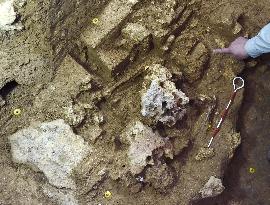
NANJO, Japan - The Okinawa Prefectural Museum and Art Museum unveils human bones excavated from a stratum more than 9,000 years old in the Sakitari Cave in Nanjo, Okinawa Prefecture, southwestern Japan, on Dec. 11, 2014. A finger indicates the location of the skull. (Kyodo)

  •  
Prehistory fish fossils found as new freshwater species

Prehistory fish fossils found as new freshwater species

KANAZWA, Japan - The education board in Hakusan, Ishikawa Prefecture, displays fossils of a new freshwater fish species of the Sinamia family unearthed from a stratum in the first half of the Cretaceous period, or 130 million years ago, in the Sea of Japan city on Oct. 1, 2014. The board has given the scientific name of Sinamia Kukurihime to the fish after the name of a local shrine. (Kyodo)

  •  
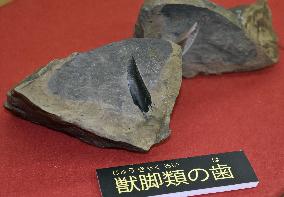
Spinosaurus teeth found in central Japan

Spinosaurus teeth found in central Japan

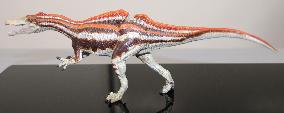
Photo taken in Katsuyama in Fukui Prefecture on July 14, 2020, shows a model produced by Kazunari Araki that restores a Spinosaurus, a large carnivorous dinosaur believed to have lived near water and eaten fish. Fossilized Spinosaurus teeth have been found in the central Japan city in a geological stratum dating back about 120 million years.

  •  
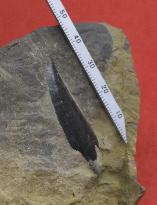
Spinosaurus teeth found in central Japan

Spinosaurus teeth found in central Japan

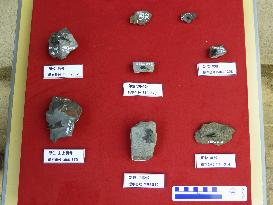
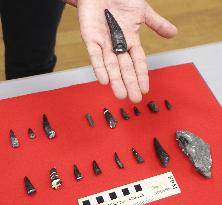
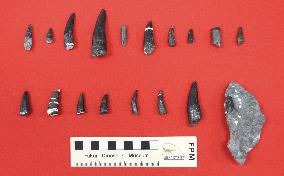
Photo taken July 14, 2020, shows fossilized Spinosaurus teeth unearthed between 1991 and 2019 from a geological stratum dating back about 120 million years in Katsuyama in Fukui Prefecture, central Japan. Fukui Prefectural Dinosaur Museum will put them on display from July 23.

  •  
Spinosaurus teeth found in central Japan

Spinosaurus teeth found in central Japan

Photo taken July 14, 2020, shows fossilized Spinosaurus teeth unearthed between 1991 and 2019 from a geological stratum dating back about 120 million years in Katsuyama in Fukui Prefecture, central Japan. Fukui Prefectural Dinosaur Museum will put them on display from July 23.

  •  
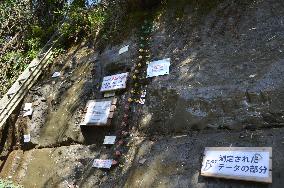
Stratum representing "Chibanian" geologic age

Stratum representing "Chibanian" geologic age

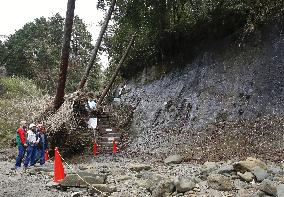
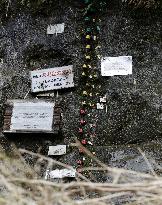
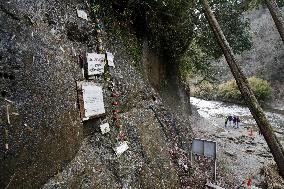
Photo taken Jan. 17, 2020, shows a stratum discovered in Ichihara in Chiba Prefecture, east of Tokyo, from which the name "Chibanian" for the geologic age spanning 770,000 to 126,000 years ago derives. The name meaning "Chiba age" was formally adopted the same day at an executive meeting of the International Union of Geological Sciences in Busan, South Korea. (Kyodo) ==Kyodo

  •  
Stratum representing "Chibanian" geologic age

Stratum representing "Chibanian" geologic age

Photo taken Jan. 17, 2020, shows a stratum discovered in Ichihara in Chiba Prefecture, east of Tokyo, from which the name "Chibanian" for the geologic age spanning 770,000 to 126,000 years ago derives. The name meaning "Chiba age" was formally adopted the same day at an executive meeting of the International Union of Geological Sciences in Busan, South Korea. (Kyodo) ==Kyodo

  •  
Stratum representing "Chibanian" geologic age

Stratum representing "Chibanian" geologic age

Photo taken Jan. 17, 2020, shows a stratum discovered in Ichihara in Chiba Prefecture, east of Tokyo, from which the name "Chibanian" for the geologic age spanning 770,000 to 126,000 years ago derives. The name meaning "Chiba age" was formally adopted the same day at an executive meeting of the International Union of Geological Sciences in Busan, South Korea. (Kyodo) ==Kyodo

  •  
Stratum representing "Chibanian" geologic age

Stratum representing "Chibanian" geologic age

Photo taken Jan. 17, 2020, shows a stratum discovered in Ichihara in Chiba Prefecture, east of Tokyo, from which the name "Chibanian" for the geologic age spanning 770,000 to 126,000 years ago derives. The name meaning "Chiba age" was formally adopted the same day at an executive meeting of the International Union of Geological Sciences in Busan, South Korea. (Kyodo) ==Kyodo

  •  
Fossil tooth of carnivorous dinosaur found in Japan

Fossil tooth of carnivorous dinosaur found in Japan

Photo taken Dec. 20, 2019, in Katsuura in Tokushima Prefecture, western Japan, shows a fossil tooth of a carnivorous dinosaur discovered in a stratum in the town believed to date back 130 million years, during the Early Cretaceous period. (Kyodo) ==Kyodo

  •  
Fossil tooth of carnivorous dinosaur found in Japan

Fossil tooth of carnivorous dinosaur found in Japan

Photo taken Dec. 20, 2019, in Katsuura in Tokushima Prefecture, western Japan, shows a fossil tooth of a carnivorous dinosaur discovered in a stratum in the town believed to date back 130 million years, during the Early Cretaceous period. (Kyodo) ==Kyodo

  •  
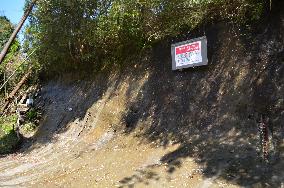
Japan researchers to seek to have Chiba stratum represent geologic age

Japan researchers to seek to have Chiba stratum represent geologic age

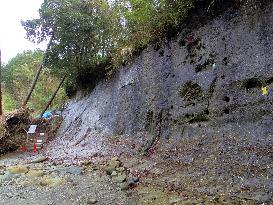
Photo taken April 25, 2017, shows a stratum in Ichihara, Chiba Prefecture, where evidence of the last geomagnetic reversal occurring 770,000 years ago was found preserved in good condition. Based on this stratum, Japanese researchers will file an application in May 2017 with an international geological organization to have the name "Chibanian" represent the middle Pleistocene stage. (Kyodo) ==Kyodo

  •  
Japan researchers to seek to have Chiba stratum represent geologic age

Japan researchers to seek to have Chiba stratum represent geologic age

Photo taken April 25, 2017, shows a stratum in Ichihara, Chiba Prefecture, where evidence of the last geomagnetic reversal occurring 770,000 years ago was found preserved in good condition. Based on this stratum, Japanese researchers will file an application in May 2017 with an international geological organization to have the name "Chibanian" represent the middle Pleistocene stage. (Kyodo) ==Kyodo

  • Main
  • Top
  • Editorial
  • Creative
  • About Us
  • About ILG
  • Terms of use
  • Company
  • BEHIND
  • Price List
  • Single Plan
  • Monthly Plan
  • Services
  • Shooting
  • Rights Clearance
  • Support
  • FAQ
  • How To Buy
  • Contact Us
  • Become a Partner

© KYODO NEWS IMAGES INC

All Rights Reserved.

  • Editorial
  • Olympics
  • News
  • Sports
  • Japan
  • Tech
  • Royal
  • Disaster
  • NorthKorea
  • Old Japan
  • SNS
  • Creative
  • Food
  • Japan
  • Landscape
  • Animal
  • Popular
  • #Ukraine
  • #Thailand
  • #coronavirus
  • #N. Korea
  • #China
  • #Russia
  • #Ukraine
  • #Thailand
  • #coronavirus
  • #N. Korea
  • #China
  • #Russia
  • Food
  • Japan
  • Landscape
  • Animal
  • Olympics
  • News
  • Sports
  • Japan
  • Tech
  • Royal
  • Disaster
  • NorthKorea
  • Old Japan
  • SNS