•  
Hubble Seeks Clusters in Lost Galaxy

Hubble Seeks Clusters in Lost Galaxy

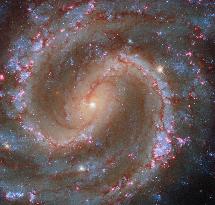
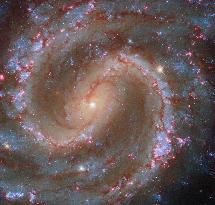
Handout Photo shows NASA/ESA Hubble Space Telescope image features the spiral galaxy NGC 4535, which is situated about 50 million light-years away in the constellation Virgo (the Maiden). Through a small telescope, this galaxy appears extremely faint, giving it the nickname ‘Lost Galaxy’. With a mirror spanning nearly eight feet (2.4 meters) across and its location above Earth’s light-obscuring atmosphere, Hubble can easily observe dim galaxies like NGC 4535 and pick out features like its massive spiral arms and central bar of stars. This image features NGC 4535’s young star clusters, which dot the galaxy’s spiral arms. Glowing-pink clouds surround many of these bright-blue star groupings. These clouds, called H II (‘H-two’) regions, are a sign that the galaxy is home to especially young, hot, and massive stars that blaze with high-energy radiation. Such massive stars shake up their surroundings by heating their birth clouds with powerful stellar winds, eventually exploding as supernovae. The image incorporat

  •  
Hubble Seeks Clusters in ‘Lost Galaxy’

Hubble Seeks Clusters in ‘Lost Galaxy’

NASA/ESA Hubble Space Telescope image features the spiral galaxy NGC 4535, which is situated about 50 million light-years away in the constellation Virgo (the Maiden). Through a small telescope, this galaxy appears extremely faint, giving it the nickname ‘Lost Galaxy’. With a mirror spanning nearly eight feet (2.4 meters) across and its location above Earth’s light-obscuring atmosphere, Hubble can easily observe dim galaxies like NGC 4535 and pick out features like its massive spiral arms and central bar of stars. This image features NGC 4535’s young star clusters, which dot the galaxy’s spiral arms. Glowing-pink clouds surround many of these bright-blue star groupings. These clouds, called H II (‘H-two’) regions, are a sign that the galaxy is home to especially young, hot, and massive stars that blaze with high-energy radiation. Such massive stars shake up their surroundings by heating their birth clouds with powerful stellar winds, eventually exploding as supernovae. The image incorporates data from an obse

  •  

4 scientists worldwide win Shaw Prize in 2024

STORY: 4 scientists worldwide win Shaw Prize in 2024 SHOOTING TIME: May 21, 2024 DATELINE: May 22, 2024 LENGTH: 00:00:52 LOCATION: HONG KONG, China CATEGORY: TECHNOLOGY SHOTLIST: 1. various of the press conference STORYLINE: Four scientists won the Shaw Prize this year for their outstanding work in the prize's three categories, the Shaw Prize Foundation announced on Tuesday. The Astronomy prize went to Shrinivas R Kulkarni, George Ellery Hale Professor of Astronomy and Planetary Science at the California Institute of Technology, for his discoveries about millisecond pulsars, gamma-ray bursts, supernovae, and other variable or transient astronomical objects. The Life Science and Medicine prize is awarded in equal shares to Swee Lay Thein from the National Institutes of Health in the United States and Stuart Orkin from Harvard Medical School, for their discovery of the genetic and molecular mechanisms underlying the fetal-to-adult hemoglobin switch that facilitated treatment for devastating blood diseases

  •  
Galactic Island Of Tranquillity

Galactic Island Of Tranquillity

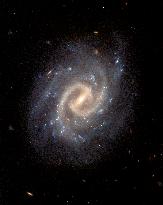
Handout photo shows The tranquil spiral galaxy UGC 12295 basks leisurely in this image from the NASA/ESA Hubble Space Telescope. This galaxy lies around 192 million light-years away in the constellation Pisces, and is almost face-on when viewed from Earth, displaying a bright central bar and tightly wound spiral arms. Despite appearing as an island of tranquillity in this image, UGC 12295 played host to a catastrophically violent explosion - a supernova - that was first detected in 2015. This supernova prompted two different teams of astronomers to propose Hubble observations of UGC 12295 that would sift through the wreckage of this vast stellar explosion. Supernovae are the explosive deaths of massive stars, and are responsible for forging many of the elements found here on Earth. The first team of astronomers used Hubble’s Wide Field Camera 3 (WFC3) to examine the detritus left behind by the supernova in order to better understand the evolution of matter in our Universe.  The second team of astronomers also

  • Main
  • Top
  • Editorial
  • Creative
  • About Us
  • About ILG
  • Terms of use
  • Company
  • BEHIND
  • Price List
  • Single Plan
  • Monthly Plan
  • Services
  • Shooting
  • Rights Clearance
  • Support
  • FAQ
  • How To Buy
  • Contact Us
  • Become a Partner

© KYODO NEWS IMAGES INC

All Rights Reserved.

  • Editorial
  • Olympics
  • News
  • Sports
  • Japan
  • Tech
  • Royal
  • Disaster
  • NorthKorea
  • Old Japan
  • SNS
  • Creative
  • Food
  • Japan
  • Landscape
  • Animal
  • Popular
  • #Ukraine
  • #Thailand
  • #coronavirus
  • #N. Korea
  • #China
  • #Russia
  • #Ukraine
  • #Thailand
  • #coronavirus
  • #N. Korea
  • #China
  • #Russia
  • Food
  • Japan
  • Landscape
  • Animal
  • Olympics
  • News
  • Sports
  • Japan
  • Tech
  • Royal
  • Disaster
  • NorthKorea
  • Old Japan
  • SNS