•  
Illustration - Surtourisme

Illustration - Surtourisme

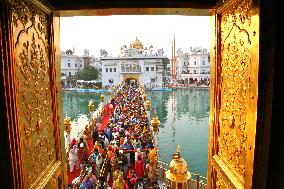
INDIA. AMRITSAR. VIEW OF THE GURU'S BRIDGE FROM GOLDEN TEMPLE Photo by Severine Dabadie/Only World/ABACAPRESS.COM

  •  

Storm Kathleen Brings Strong Winds, High Waves To Ireland, UK Coasts 2

Storm Kathleen brought strong winds to Ireland, Northern Ireland, Scotland and parts of western England on Saturday, April 6. Videos posted on social media show big waves hitting the coasts across the regions.

  •  
Stone steps of Kurodani Konkai Komyoji Temple

Stone steps of Kurodani Konkai Komyoji Temple

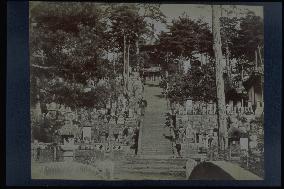
View of the stairs of Kurodani Komyoji Temple taken from Gokuraku-bashi, a stone bridge. Gravestones flank both sides of the stairs. A woman with a parasol poses for the camera in the middle of the stairs. Monju Pagoda rises behind the trees above the stairs. Renchi-in (Kumagai-do) is visible on the right. The statue of Amida Buddha on the left of the stairs was moved and no longer exists today.==Date:unknown, Place:Kyoto, Photo:Nobushige Horiuchi, (Credit:Nagasaki University Library/Kyodo News Images) [Cabinet Number96‐94‐0]

  •  
Yaomatsu Restaurant, Mukojima

Yaomatsu Restaurant, Mukojima

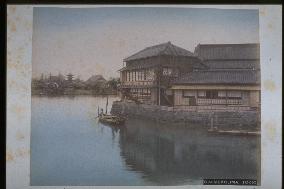
Yaomatsu-ro Restaurant seen from Makura Bridge at confluence of the Gennomori and Sumida rivers. The restaurant was opened in April 1870 as a branch of Yaomatsu located at Suijin-no-Mori. Customers drank sake while enjoying the view of boats crossing the Sumida River and Sensoji Temple across the river, and Yaomatsu-ro gained popularity as an early waterfront restaurant. Taken between 1887 and 1897. Same as photograph #2104.==Date:unknown, Place:Tokyo, Photo:unknown, (Credit:Nagasaki University Library/Kyodo News Images) [Cabinet Number93‐14‐0]

  •  
Nishi Otani Entsu-kyo Bridge

Nishi Otani Entsu-kyo Bridge

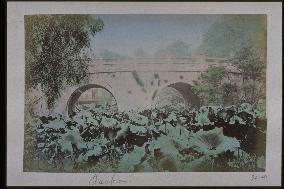
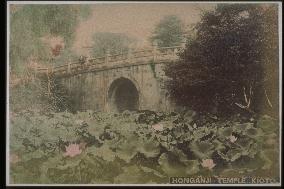
Enzu-kyo Bridge at Nishi Otani Temple, looking north-northeast from the southwestern edge of Kogetsu Pond. Made of stone, the bridge was built in 1865. Called Spectacles Bridge because of its shape, the bridge bustled with people who came here to view the red and white lotus flowers from the end of the Edo to the Meiji Period. There is a tea house on the other side of the bridge. The quality of the photo tinting is poor.==Date:unknown, Place:Kyoto, Photo:unknown, (Credit:Nagasaki University Library/Kyodo News Images) [Cabinet Number92‐20‐0]

  •  
Nishi Otani Entsu-kyo Bridge

Nishi Otani Entsu-kyo Bridge

Enzu-kyo Bridge at Nishi Otani Temple, looking north from the southern edge of Kogetsu Pond. Made of stone, the bridge was built in 1865. Called Spectacles Bridge because of its shape, the bridge bustled with people who came here to view the red and white lotus flowers from the end of the Edo to the Meiji Period. There is a tea house on the other side of the bridge. The quality of the photo tinting is poor.==Date:unknown, Place:Kyoto, Photo:unknown, (Credit:Nagasaki University Library/Kyodo News Images) [Cabinet Number90‐32‐0]

  •  
The approach to Enkakuji Temple,Kamakura

The approach to Enkakuji Temple,Kamakura

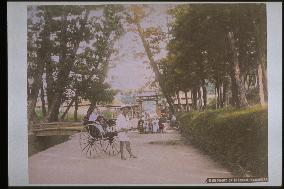
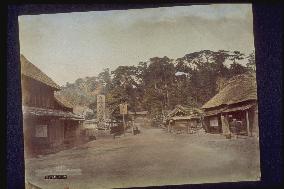
View of the Enkakuji Temple entrance area from the site of present-day Kita-Kamakura Station. There are two gates facing the street in front of the temple. The one in the background is the southeast gate. The temple is on the other side of the bridge. A horse road passes behind the mound on the right. It is possible that commoners were forbidden to use this gate during the Edo Period. The rickshaw in the centre seems to be an early model, indicating that this photograph was taken at the beginning of the Meiji Period.==Date:unknown, Place:Kamakura, Photo:unknown, (Credit:Nagasaki University Library/Kyodo News Images) [Cabinet Number86‐8‐0]

  •  
Nishi Otani Entsu-kyo Bridge

Nishi Otani Entsu-kyo Bridge

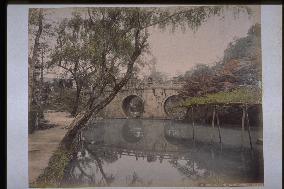
Enzu-kyo Bridge at Nishi Otani Temple, looking north from the southern edge of Kogetsu Pond. Made of stone, the bridge was built in 1865. Called Spectacles Bridge because of its shape, the bridge bustled with people who came here to view the red and white lotus flowers from the end of the Edo to the Meiji Period, but no flowers are visible here. Poles to support the branches of pine trees rise from the pond. The branches of a willow tree extend from the west bank.==Date:unknown, Place:Kyoto, Photo:unknown, (Credit:Nagasaki University Library/Kyodo News Images) [Cabinet Number85‐27‐0]

  •  
Benten Pond,Eikan-do Temple

Benten Pond,Eikan-do Temple

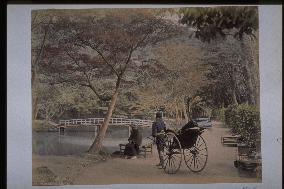
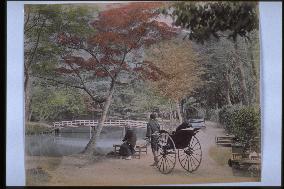
View of the Hojo Pond at Eikando Temple, looking south-southeast. A young rickshaw driver and an old woman sitting on a bench fill the centre of the picture. The gently curving wooden bridge connects to Benten Island on the left. The stone bridge leading to the main hall is visible in the rear. Japanese maple trees are growing along the pond. The goal of this photo is to show that Eikando was a well-known place for the enjoyment of autumn colours.==Date:unknown, Place:Kyoto, Photo:unknown, (Credit:Nagasaki University Library/Kyodo News Images) [Cabinet Number85‐25‐0]

  •  
Nishi Otani Entsu-kyo Bridge

Nishi Otani Entsu-kyo Bridge

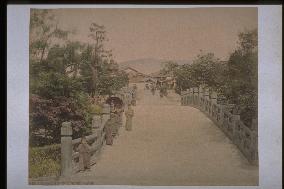
Enzu-kyo Bridge at Nishi Otani Temple, looking west from the edge of the bridge. Made of stone, the bridge was built in 1865. It was called Spectacles Bridge because of its shape and bustled with people who came here to view the red and white lotus flowers from the end of the Edo to the Meiji Period. There are women and children standing along one of the bridge's railings. In the far back are private houses and people visiting the temple.==Date:unknown, Place:Kyoto, Photo:unknown, (Credit:Nagasaki University Library/Kyodo News Images) [Cabinet Number85‐23‐0]

  •  
Maruyama Yaami Hotel

Maruyama Yaami Hotel

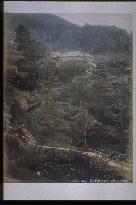
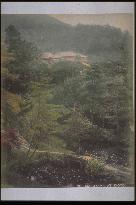
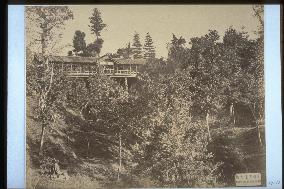
Distant view of the Maruyama Yaami Hotel from the top of the Sanmon Gate at Chion-in Temple, facing southeast. Long stone stairs, the stone bridge over the pond, and abundant nature with tall pines and maple trees are visible in the foreground. Several buildings of the Yaami Hotel stand on the Maruyama hillside, as well as a terrace built on the west side to enjoy the view.==Date:unknown, Place:Kyoto, Photo:Tamamura Kozaburo, (Credit:Nagasaki University Library/Kyodo News Images) [Cabinet Number80‐4‐0]

  •  
Lake Biwa seen from Ishiyama

Lake Biwa seen from Ishiyama

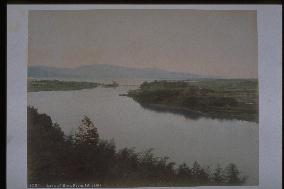
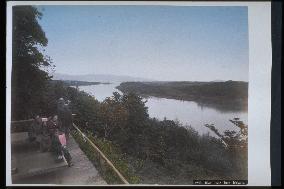
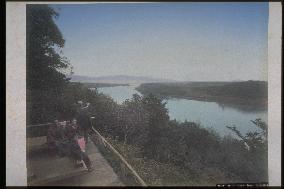
View of Seta River from Tsukimi-tei at Ishiyamadera Temple, with Lake Biwa and the Hira Mountain Range in the distance. The bridge in the centre is Seta-no-Karahashi, formerly the only bridge spanning Seta River and an important transportation route in ancient times. At present there are many bridges over the river.==Date:unknown, Place:Shiga, Photo:Tamamura Kozaburo, (Credit:Nagasaki University Library/Kyodo News Images) [Cabinet Number79‐14‐0]

  •  
Arima Spa

Arima Spa

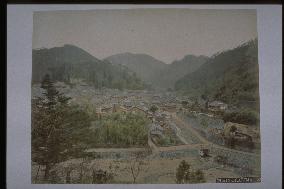
View of the ancient Arima Spa, taken from the north looking south. Visitors crossed Taikobashi Bridge, visible in the background, and proceeded to the left (east) to the bath houses (present-day Kin-no-yu). Zenpukuji, a temple of the Soto Sect of Zen Buddhism, is on the right. Taikobashi Bridge was replaced with an iron bridge in 1891, indicating that this photograph was taken before that year, probably in the mid-Meiji Period. Present-day Kita Ward.==Date:unknown, Place:Kobe, Photo:Tamamura Kozaburo, (Credit:Nagasaki University Library/Kyodo News Images) [Cabinet Number79‐12‐0]

  •  
The garden of Ginkakuji Temple

The garden of Ginkakuji Temple

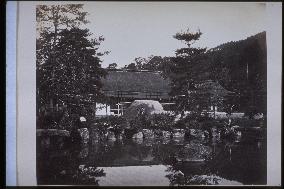
View of the main hall of Jionji Temple (left) and Togu-do (right) from the edge of Kinkyo Pond, from south of the Silver Pavilion facing east north-east. The truncated-cone shaped Kogetsudai, a sand form, in the middle and Ginshadan, on the right, are visible on the far side of Kinkyo Pond. Bunkai Bridge and Geisen Bridge are on the right and left, respectively. Both the main hall and Togu-do were constructed by order of Ashikaga Yoshimasa in 1486, and they were restored in 1615 and 1640.==Date:unknown, Place:Kyoto, Photo:R. Stillfried, (Credit:Nagasaki University Library/Kyodo News Images) [Cabinet Number63‐11‐0]

  •  
Mt. Fuji seen from Suzukawa

Mt. Fuji seen from Suzukawa

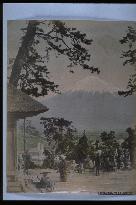
Northern view of Mt. Fuji from Jizo-do on the sand dune of Suzukawa in Fuji City. Stone jizo statues line a path in the temple grounds, and the Jizo-do temple is partially visible. The four people are obviously posing for the photograph. The train tracks of Tokaido Line and Kawai Bridge are visible in the background, indicating that the photograph was taken after 1890.==Date:unknown, Place:Shizuoka, Photo:unknown, (Credit:Nagasaki University Library/Kyodo News Images) [Cabinet Number59‐47‐0]

  •  
A view of Lake Biwa from Ishiyamadera Temple

A view of Lake Biwa from Ishiyamadera Temple

View of Seta River from Tsukimi-tei at Ishiyamadera Temple. During the Heian Period, aristocratic women worshipped at the temple, and in later years it attracted many commoners as the 13th temple in the circuit of 33 Holy Kannon Temples of Western Japan. One of the Eight Scenes of Oumi, it was referred to as Ishiyama-no-Shugetsu (Autumn Moon at Ishiyama Temple). This image appears on postcards and in various photographs.==Date:unknown, Place:Shiga, Photo:unknown, (Credit:Nagasaki University Library/Kyodo News Images) [Cabinet Number59‐23‐0]

  •  
Maruyama Yaami Hotel

Maruyama Yaami Hotel

Distant view of the Maruyama Yaami Hotel from the top of the Sanmon Gate at Chion-in Temple, facing southeast. Long stone stairs, the stone bridge over the pond, and abundant nature with tall pines and maple trees are visible in the foreground. Several buildings of the Yaami Hotel stand on the Maruyama hillside, as well as a terrace built on the west side to enjoy the view.==Date:unknown, Place:Kyoto, Photo:unknown, (Credit:Nagasaki University Library/Kyodo News Images) [Cabinet Number57‐11‐2]

  •  
Nishi Otani Entsu-kyo Bridge

Nishi Otani Entsu-kyo Bridge

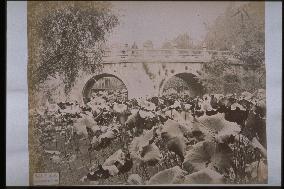
Enzu-kyo Bridge at Nishi Otani Temple, looking north-northeast from the southwestern edge of Kogetsu Pond. Made of stone, the bridge was built in 1865. Called Spectacles Bridge because of its shape, the bridge bustled with people who came here to view the red and white lotus flowers from the end of the Edo to the Meiji Period. Two men are posing on the bridge looking down at the flowers. People are also visible in the tea house on the other side of the bridge.==Date:unknown, Place:Kyoto, Photo:unknown, (Credit:Nagasaki University Library/Kyodo News Images) [Cabinet Number52‐25‐0]

  •  
A view of Lake Biwa from Ishiyamadera Temple

A view of Lake Biwa from Ishiyamadera Temple

View of Seta River from Tsukimi-tei at Ishiyamadera Temple. During the Heian Period, aristocratic women worshipped at the temple, and in later years it attracted many commoners as the 13th temple in the circuit of 33 Holy Kannon Temples of Western Japan. One of the Eight Scenes of Oumi, it was referred to as Ishiyama-no-Shugetsu (Autumn Moon at Ishiyama Temple). This image appears on postcards and in various photographs.==Date:unknown, Place:Shiga, Photo:unknown, (Credit:Nagasaki University Library/Kyodo News Images) [Cabinet Number52‐18‐0]

  •  
Benten Pond,Eikan-do Temple

Benten Pond,Eikan-do Temple

View of the Hojo Pond at Eikando Temple, looking south-southeast. A young rickshaw driver and an old woman sitting on a bench fill the centre of the picture. The gently curving wooden bridge connects to Benten Island on the left. The stone bridge leading to the main hall is visible in the rear. Japanese maple trees are growing along the pond. The goal of this photo is to show that Eikando was a well-known place for the enjoyment of autumn colours.==Date:unknown, Place:Kyoto, Photo:unknown, (Credit:Nagasaki University Library/Kyodo News Images) [Cabinet Number52‐11‐0]

  •  
Nishi Otani Entsu-kyo Bridge

Nishi Otani Entsu-kyo Bridge

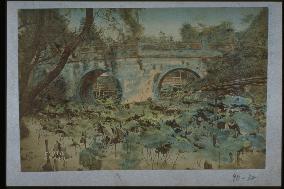
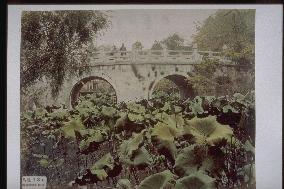
Enzu-kyo Bridge at Nishi Otani Temple, looking north from the southern edge of Kogetsu Pond. Made of stone, the bridge was built in 1865. Called Spectacles Bridge because of its shape, the bridge bustled with people who came here to view the red and white lotus flowers from the end of the Edo to the Meiji Period. Two men are posing on the bridge looking down at the flowers. Stone lanterns are installed along the eastern side of the bridge. Red lotus flowers are blooming in the pond.==Date:unknown, Place:Kyoto, Photo:unknown, (Credit:Nagasaki University Library/Kyodo News Images) [Cabinet Number52‐10‐0]

  •  
Nishi Otani Entsu-kyo Bridge

Nishi Otani Entsu-kyo Bridge

Enzu-kyo Bridge at Nishi Otani Temple, looking north-northeast from the southwestern edge of Kogetsu Pond. Made of stone, the bridge was built in 1865. Called Spectacles Bridge because of its shape, the bridge bustled with people who came here to view the red and white lotus flowers from the end of the Edo to the Meiji Period. Two men are posing on the bridge looking down at the flowers. People are also visible in the tea house on the other side of the bridge.==Date:unknown, Place:Kyoto, Photo:unknown, (Credit:Nagasaki University Library/Kyodo News Images) [Cabinet Number47‐38‐0]

  •  
View in front of ikegami honmonji temple

View in front of ikegami honmonji temple

The same structure as the photo numbered 37-5. The panel standing to the left of Taiko bridge reads, Sekkyo . Across the bridge is the gate of the temple, and a long staircase continues beyond leading to the compounds of the temple.==Date:unknown, Place:Fujisawa, Photo:unknown, (Credit:Nagasaki University Library/Kyodo News Images) [Cabinet Number37‐22‐0]

  •  
Tsutenbashi bridge at tofukuji temple

Tsutenbashi bridge at tofukuji temple

Located in the Higashiyama district of Kyoto, Tofukuji is one of the major Zen five temples of Kyoto. It is the head temple of the Tofukuji Branch of the Rinzai Sect. The Tsutenkyo is a corridor which connects the Buddha Hall and Founder's Hall, and the roof is seen in the center. The autumn colours are famous here and have been portrayed in ukiyoe by Hiroshige. A man sits on a mat in the trees to the fore.==Date:unknown, Place:Kyoto, Photo:unknown, (Credit:Nagasaki University Library/Kyodo News Images) [Cabinet Number19‐13‐0]

  •  
The Sanmon Gate of Chion-in Temple

The Sanmon Gate of Chion-in Temple

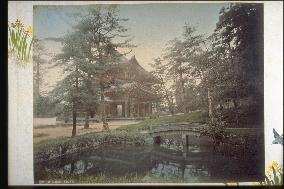
Shinbashi Street of the Higashiyama district of Kyoto City. Chionin is the head temple of the Jodo Sect which was initiated by Honen Jonin of Yoshimizu Zenbo (temple of the Zen sect). The gate is the largest Sakura Gate in Japan, built by Tokugawa Hidetada. The construction was started in 1619 and completed two years later. The photo looks at the gate over the stone bridge to the right of the lake within the temple.==Date:unknown, Place:Kyoto, Photo:Ogawa Kazumasa, (Credit:Nagasaki University Library/Kyodo News Images) [Cabinet Number5‐40‐0]

  • Main
  • Top
  • Editorial
  • Creative
  • About Us
  • About ILG
  • Terms of use
  • Company
  • BEHIND
  • Price List
  • Single Plan
  • Monthly Plan
  • Services
  • Shooting
  • Rights Clearance
  • Support
  • FAQ
  • How To Buy
  • Contact Us
  • Become a Partner

© KYODO NEWS IMAGES INC

All Rights Reserved.

  • Editorial
  • Olympics
  • News
  • Sports
  • Japan
  • Tech
  • Royal
  • Disaster
  • NorthKorea
  • Old Japan
  • SNS
  • Creative
  • Food
  • Japan
  • Landscape
  • Animal
  • Popular
  • #Ukraine
  • #China
  • #coronavirus
  • #N. Korea
  • #Thailand
  • #Russia
  • #Ukraine
  • #China
  • #coronavirus
  • #N. Korea
  • #Thailand
  • #Russia
  • Food
  • Japan
  • Landscape
  • Animal
  • Olympics
  • News
  • Sports
  • Japan
  • Tech
  • Royal
  • Disaster
  • NorthKorea
  • Old Japan
  • SNS