•  
Ancient grave found near World Heritage-listed Japan temple

Ancient grave found near World Heritage-listed Japan temple

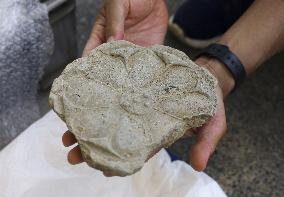
Photo taken Sept. 8, 2023, shows a roof tile discovered in an ancient grave recently found at a parking lot near the World Heritage-listed Horyuji temple in Ikaruga in Nara Prefecture, western Japan. The grave dates back to the late sixth century.

  •  
Ancient grave found near World Heritage-listed Japan temple

Ancient grave found near World Heritage-listed Japan temple

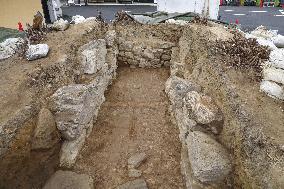
Photo taken Sept. 8, 2023, shows an ancient grave found at a parking lot near the World Heritage-listed Horyuji temple in Ikaruga in Nara Prefecture, western Japan. The grave dates back to the late sixth century.

  •  
China's Hu visits Nara on last leg of official visit to Japan

China's Hu visits Nara on last leg of official visit to Japan

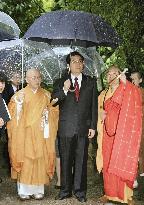
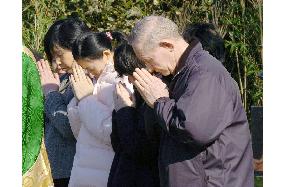
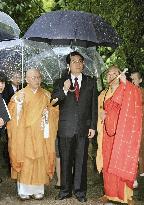
NARA, Japan - Chinese President Hu Jintao (C) is briefed by priests of Toshodaiji Temple in Nara Prefecture on May 10 in front of the grave of Jingzhen, a Chinese Buddhist priest, known as Ganjin in Japanese. The Chinese priest spent over 10 years trying to travel to Japan in order to teach Buddhist precepts and founded Toshodaiji in 759. (Pool photo)

  •  
China's Hu visits Nara on last leg of official visit to Japan

China's Hu visits Nara on last leg of official visit to Japan

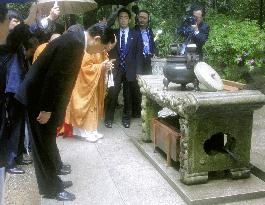
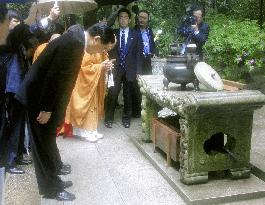
NARA, Japan - Chinese President Hu Jintao (front) pays respect at the grave of Jingzhen, a Chinese Buddhist priest, known as Ganjin in Japanese, at Toshodaiji Temple in Nara Prefecture on May 10. The Chinese priest spent over 10 years trying to travel to Japan in order to teach Buddhist precepts and founded Toshodaiji in 759. (Pool photo)

  •  
(2)Jenkins, Soga, daughters visit ancestors' grave

(2)Jenkins, Soga, daughters visit ancestors' grave

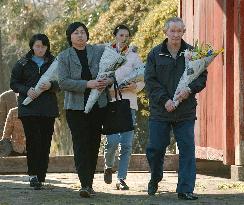
SADO, Japan - Former U.S. Army Sgt. Charles Jenkins (R), his wife and former abductee Hitomi Soga (L), together with their North Korean-born daughters -- Mika (2nd from L) and Brinda (2nd from R) -- pray at the grave of Soga's ancestors at a temple in Sado, Niigata Prefecture, on Dec. 10. (Pool photo)

  •  
(3)Jenkins, Soga, daughters visit ancestors' grave

(3)Jenkins, Soga, daughters visit ancestors' grave

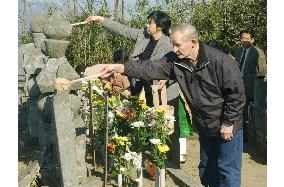
SADO, Japan - Former U.S. Army Sgt. Charles Jenkins (front) and his wife and former abductee Hitomi Soga (back), purify the grave of Soga's ancestors at a temple in Sado, Niigata Prefecture, on Dec. 10. (Pool photo)

  •  
Jenkins, Soga, daughters visit ancestors' grave

Jenkins, Soga, daughters visit ancestors' grave

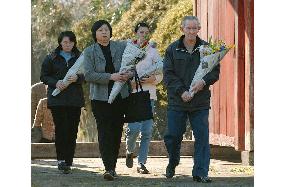
SADO, Japan - Former U.S. Army Sgt. Charles Jenkins (R), his wife and former abductee Hitomi Soga (3rd from R), together with their North Korean-born daughters -- Mika (2nd from R) and Brinda (L) -- head for the grave of Soga's ancestors at a temple in Sado, Niigata Prefecture, on Dec. 10.

  •  
Ashes of Daiei Hawks manager Oh's wife stolen from Tokyo grave

Ashes of Daiei Hawks manager Oh's wife stolen from Tokyo grave

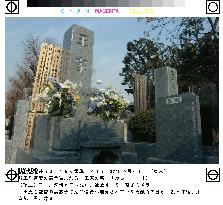
TOKYO, Japan - Photo taken Dec. 25 shows the family grave of Daiei Hawks manager Sadaharu Oh at Enyuji Temple in Tokyo's Meguro Ward, where the ashes of Kyoko Oh, his late wife, have been found stolen. Police said they are investigating the case on suspicion of violation of excavation of a grave and unlawfully taking possession of a corpse.

  •  
100,000 candles lit to honor spirits of ancestors

100,000 candles lit to honor spirits of ancestors

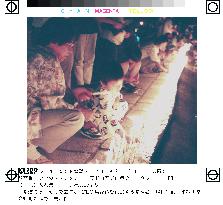
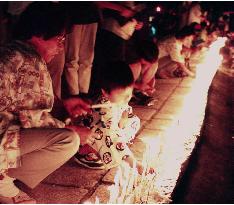
Some 20,000 people gather and light candles at a temple in Koyasan, Wakayama Prefecture, Aug. 13 to honor the spirits of ancestors. The ritual, called ''bon'' festival, is traditionally observed in mid-August in Japan. Some 100,000 candles were lit along a two-kilometer path leading to the grave of Kukai, or Kobo Daishi, a Buddhist priest of the early Heian period (794-1185).

  •  
(3)Jenkins, Soga, daughters visit ancestors' grave

(3)Jenkins, Soga, daughters visit ancestors' grave

SADO, Japan - Former U.S. Army Sgt. Charles Jenkins (front) and his wife and former abductee Hitomi Soga (back), purify the grave of Soga's ancestors at a temple in Sado, Niigata Prefecture, on Dec. 10. (Pool photo)(Kyodo)

  •  
(2)Jenkins, Soga, daughters visit ancestors' grave

(2)Jenkins, Soga, daughters visit ancestors' grave

SADO, Japan - Former U.S. Army Sgt. Charles Jenkins (R), his wife and former abductee Hitomi Soga (L), together with their North Korean-born daughters -- Mika (2nd from L) and Brinda (2nd from R) -- pray at the grave of Soga's ancestors at a temple in Sado, Niigata Prefecture, on Dec. 10. (Pool photo)(Kyodo)

  •  
China's Hu visits Nara on last leg of official visit to Japan

China's Hu visits Nara on last leg of official visit to Japan

NARA, Japan - Chinese President Hu Jintao (front) pays respect at the grave of Jingzhen, a Chinese Buddhist priest, known as Ganjin in Japanese, at Toshodaiji Temple in Nara Prefecture on May 10. The Chinese priest spent over 10 years trying to travel to Japan in order to teach Buddhist precepts and founded Toshodaiji in 759. (Pool photo)(Kyodo)

  •  
China's Hu visits Nara on last leg of official visit to Japan

China's Hu visits Nara on last leg of official visit to Japan

NARA, Japan - Chinese President Hu Jintao (C) is briefed by priests of Toshodaiji Temple in Nara Prefecture on May 10 in front of the grave of Jingzhen, a Chinese Buddhist priest, known as Ganjin in Japanese. The Chinese priest spent over 10 years trying to travel to Japan in order to teach Buddhist precepts and founded Toshodaiji in 759. (Pool photo)(Kyodo)

  •  
Jenkins, Soga, daughters visit ancestors' grave

Jenkins, Soga, daughters visit ancestors' grave

SADO, Japan - Former U.S. Army Sgt. Charles Jenkins (R), his wife and former abductee Hitomi Soga (3rd from R), together with their North Korean-born daughters -- Mika (2nd from R) and Brinda (L) -- head for the grave of Soga's ancestors at a temple in Sado, Niigata Prefecture, on Dec. 10. (Kyodo)

  •  
Ashes of Daiei Hawks manager Oh's wife stolen from Tokyo grave

Ashes of Daiei Hawks manager Oh's wife stolen from Tokyo grave

TOKYO, Japan - Photo taken Dec. 25 shows the family grave of Daiei Hawks manager Sadaharu Oh at Enyuji Temple in Tokyo's Meguro Ward, where the ashes of Kyoko Oh, his late wife, have been found stolen. Police said they are investigating the case on suspicion of violation of excavation of a grave and unlawfully taking possession of a corpse. (Kyodo)

  •  
East Japan city to mark 1,300 yrs of ties with ancient Korea

East Japan city to mark 1,300 yrs of ties with ancient Korea

Photo taken on Nov. 20, 2015, shows Shoden-in, a temple where the grave of Jakko ancient Korean royalty is laid, in Hidaka, Saitama Prefecture, northwest of Tokyo. The city is hosting a series of events for the 1,300th anniversary, to be marked in 2016, of the formation of the former Koma township where descendants of Koguryo, one of the ancient Three Kingdoms of Korea, moved and settled before and after the fall of the monarchy. (Kyodo) ==Kyodo

  •  
Edo-period dramatist Chikamatsu's statue in Amagasaki

Edo-period dramatist Chikamatsu's statue in Amagasaki

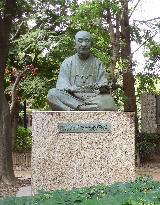
The bronze statue of Chikamatsu Monzaemon, a popular Edo-period dramatist, at the Chikamatsu Park in Amagasaki, Hyogo Prefecture, is pictured on Sept. 27, 2015. His grave exists at the adjacent Kosaiji temple in western Japan. (Kyodo) ==Kyodo

  •  
Chikamatsu Monzaemon's final resting place in western Japan

Chikamatsu Monzaemon's final resting place in western Japan

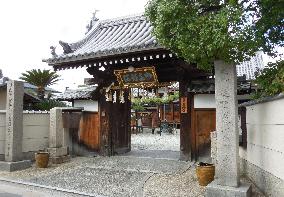
Photo taken in Amagasaki, Hyogo Prefecture, western Japan, Sept. 27, 2015, shows the Kosaiji temple where the grave of Chikamatsu Monzaemon, an Edo-period dramatist, exists. (Kyodo) ==Kyodo

  •  
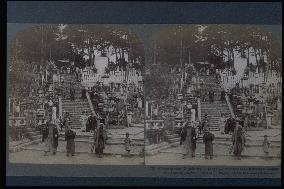
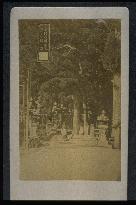
Stone steps of Kurodani Konkai Komyoji Temple

Stone steps of Kurodani Konkai Komyoji Temple

Stereograph depicting the stairs of Kurodani Komyoji Temple, taken from the stone bridge Gokuraku-bashi. Gravestones flank both sides of the stairs. Worshippers who seem to have finished praying are coming down the stairs. Monju Pagoda rises behind the trees above the stairs. The wooden signboard on the right says Gobyo (Mausoleum) . Taken in 1904.==Date:1904, Place:Kyoto, Photo:Underwood, (Credit:Nagasaki University Library/Kyodo News Images) [Cabinet Number97‐17‐0]

  •  
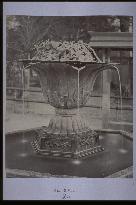
Sacred fountain in the precincts of Nishi Otani Temple

Sacred fountain in the precincts of Nishi Otani Temple

Water fountain at the Otani Honbyo (Mausoleum) of Nishi Otani Temple. The lotus flower shaped fountain is made of bronze. The water falls from the flower petals into the hexagonal water basin. The lid of the fountain is decorated with dragons cast in high relief.==Date:unknown, Place:Kyoto, Photo:unknown, (Credit:Nagasaki University Library/Kyodo News Images) [Cabinet Number96‐105‐0]

  •  
Stone steps of Kurodani Konkai Komyoji Temple

Stone steps of Kurodani Konkai Komyoji Temple

View of the stairs of Kurodani Komyoji Temple taken from Gokuraku-bashi, a stone bridge. Gravestones flank both sides of the stairs. A woman with a parasol poses for the camera in the middle of the stairs. Monju Pagoda rises behind the trees above the stairs. Renchi-in (Kumagai-do) is visible on the right. The statue of Amida Buddha on the left of the stairs was moved and no longer exists today.==Date:unknown, Place:Kyoto, Photo:Nobushige Horiuchi, (Credit:Nagasaki University Library/Kyodo News Images) [Cabinet Number96‐94‐0]

  •  
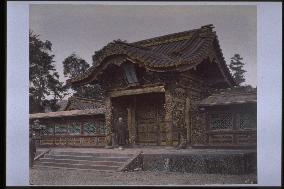
The Chokugaku-mon Gate of Yusho-in Reibyo, Zojoji Temple, Shiba

The Chokugaku-mon Gate of Yusho-in Reibyo, Zojoji Temple, Shiba

Chokugaku Gate is viewed from the northeast, outside Yushoin Mausoleum. Dragons are engraved on the gateposts. Many photographs were taken of these dragons because of their excellent craftsmanship, and many still remain. A Buddhist priest is posing in front of the gate to add to a solemn atmosphere.==Date:unknown, Place:Tokyo, Photo:Usui Shuzaburo, (Credit:Nagasaki University Library/Kyodo News Images) [Cabinet Number94‐35‐0]

  •  
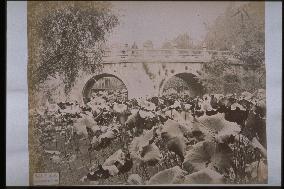
Nishi Otani Entsu-kyo Bridge

Nishi Otani Entsu-kyo Bridge

Enzu-kyo Bridge at Nishi Otani Temple, looking north-northeast from the southwestern edge of Kogetsu Pond. Made of stone, the bridge was built in 1865. Called Spectacles Bridge because of its shape, the bridge bustled with people who came here to view the red and white lotus flowers from the end of the Edo to the Meiji Period. There is a tea house on the other side of the bridge. The quality of the photo tinting is poor.==Date:unknown, Place:Kyoto, Photo:unknown, (Credit:Nagasaki University Library/Kyodo News Images) [Cabinet Number92‐20‐0]

  •  
Nishi Otani Entsu-kyo Bridge

Nishi Otani Entsu-kyo Bridge

Enzu-kyo Bridge at Nishi Otani Temple, looking north from the southern edge of Kogetsu Pond. Made of stone, the bridge was built in 1865. Called Spectacles Bridge because of its shape, the bridge bustled with people who came here to view the red and white lotus flowers from the end of the Edo to the Meiji Period. There is a tea house on the other side of the bridge. The quality of the photo tinting is poor.==Date:unknown, Place:Kyoto, Photo:unknown, (Credit:Nagasaki University Library/Kyodo News Images) [Cabinet Number90‐32‐0]

  •  
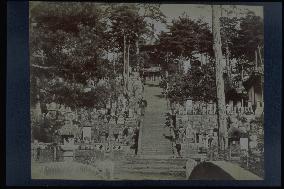
Stone steps of Kurodani Konkai Komyoji Temple

Stone steps of Kurodani Konkai Komyoji Temple

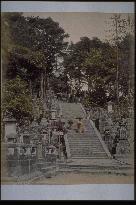
Eastern view of the stairs of Kurodani Konkai Komyoji Temple at the northern approach of Renchi-in (Kumagawa-do). Gravestones flank both sides of the stairs. A mother and daughter walk up the stairs. Monju Pagoda rises behind the trees above the stairs. The statue of Amida Buddha in the centre on the left of the stairs was moved and no longer exists today. The three-story Monju Pagoda was built in 1634 to commemorate Tokugawa Hidetada, the second Tokugawa Shogun.==Date:unknown, Place:Kyoto, Photo:unknown, (Credit:Nagasaki University Library/Kyodo News Images) [Cabinet Number85‐28‐0]

  •  
Nishi Otani Entsu-kyo Bridge

Nishi Otani Entsu-kyo Bridge

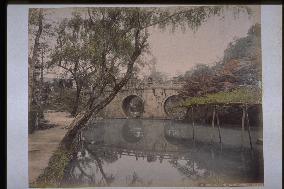
Enzu-kyo Bridge at Nishi Otani Temple, looking north from the southern edge of Kogetsu Pond. Made of stone, the bridge was built in 1865. Called Spectacles Bridge because of its shape, the bridge bustled with people who came here to view the red and white lotus flowers from the end of the Edo to the Meiji Period, but no flowers are visible here. Poles to support the branches of pine trees rise from the pond. The branches of a willow tree extend from the west bank.==Date:unknown, Place:Kyoto, Photo:unknown, (Credit:Nagasaki University Library/Kyodo News Images) [Cabinet Number85‐27‐0]

  •  
Ohashi Bridge at the entrance to the inner sanctum,Mt. Koya

Ohashi Bridge at the entrance to the inner sanctum,Mt. Koya

Okunoin, located on the east side of Mt. Koya, is the sacred land surrounding the grave of the founder, Kobo-Taishi, or Kukai. The worship of Kobo-Taishi spread from Mt. Koya throughout Japan during the Kamakura Period, and now more than 200,000 graves, large and small, can be seen from Ohashi Bridge (Ichino-hashi) at the entrance to the area and the grave of Kobo-Taishi.==Date:unknown, Place:Wakayama, Photo:unknown, (Credit:Nagasaki University Library/Kyodo News Images) [Cabinet Number71‐6‐0]

  •  
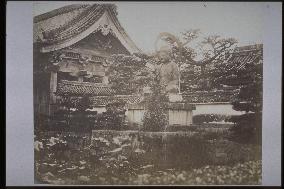
Shinkoji Temple

Shinkoji Temple

The Great Buddha in the lotus pond in front of Shinkoji Temple, probably taken in the mid-Meiji Period. The Omon (Great Gate) rebuilt in 1827 is to the left, and the bell tower, rebuilt in 1772, is on the far right. The mausoleum of Ippen Shonin is located to the south in the temple precincts. The five-story stone pagoda (Nanboku Dynasty), said to mark the grave of Ippen, is designated as a Prefectural Important Cultural Asset.==Date:unknown, Place:Kobe, Photo:R. Stillfried, (Credit:Nagasaki University Library/Kyodo News Images) [Cabinet Number63‐2‐0]

  •  
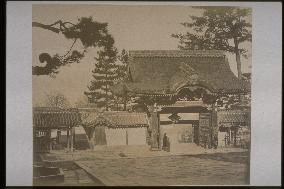
The Sanmon Gate of Nishi Otani Temple

The Sanmon Gate of Nishi Otani Temple

Main gate of the Otani Honbyo (Mausoleum) of Nishi Otani Temple, looking from the east side of the water fountain facing west-northwest. The irimoya style gate has a hiwada (Japanese hinoki tree bark) roof. Pine trees are growing in the back. The stone pavement in the foreground leads to the Otani honbyo (Mausoleum). Taken by Felix Beato.==Date:unknown, Place:Kyoto, Photo:F. Beato, (Credit:Nagasaki University Library/Kyodo News Images) [Cabinet Number62‐27‐0]

  •  
Nishi Otani Entsu-kyo Bridge

Nishi Otani Entsu-kyo Bridge

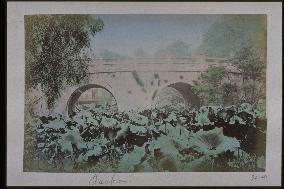
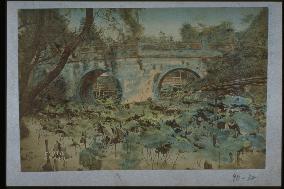
Enzu-kyo Bridge at Nishi Otani Temple, looking north-northeast from the southwestern edge of Kogetsu Pond. Made of stone, the bridge was built in 1865. Called Spectacles Bridge because of its shape, the bridge bustled with people who came here to view the red and white lotus flowers from the end of the Edo to the Meiji Period. Two men are posing on the bridge looking down at the flowers. People are also visible in the tea house on the other side of the bridge.==Date:unknown, Place:Kyoto, Photo:unknown, (Credit:Nagasaki University Library/Kyodo News Images) [Cabinet Number52‐25‐0]

  •  
A view of the city from the Otani Main Tomb,Nishi Honganji Temple

A view of the city from the Otani Main Tomb,Nishi Honganji Temple

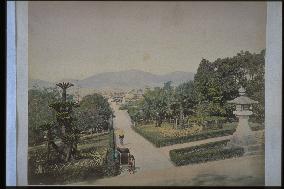
The temple approach is seen from the sanmon gate of Nishi-Otani Temple, facing west. The city of Kyoto and the Nishiyama Mountain Range are visible in the background. A stone lantern stands in front of the gate. The garden is well maintained and has cycad trees. A driver, his rickshaw and a person with an umbrella are visible at the gate. Tall trees are visible to the north.==Date:unknown, Place:Kyoto, Photo:unknown, (Credit:Nagasaki University Library/Kyodo News Images) [Cabinet Number52‐23‐0]

  •  
Nishi Otani Entsu-kyo Bridge

Nishi Otani Entsu-kyo Bridge

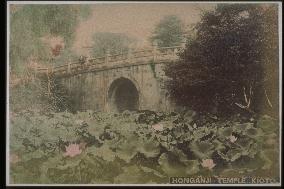
Enzu-kyo Bridge at Nishi Otani Temple, looking north from the southern edge of Kogetsu Pond. Made of stone, the bridge was built in 1865. Called Spectacles Bridge because of its shape, the bridge bustled with people who came here to view the red and white lotus flowers from the end of the Edo to the Meiji Period. Two men are posing on the bridge looking down at the flowers. Stone lanterns are installed along the eastern side of the bridge. Red lotus flowers are blooming in the pond.==Date:unknown, Place:Kyoto, Photo:unknown, (Credit:Nagasaki University Library/Kyodo News Images) [Cabinet Number52‐10‐0]

  •  
Grave of Kiso Yoshinaka at Tokuonji Temple in Nakasendo Miyanokoshi

Grave of Kiso Yoshinaka at Tokuonji Temple in Nakasendo Miyanokoshi

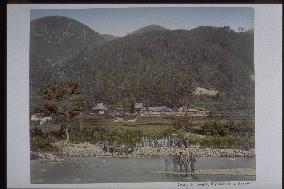
The village in the center of the photo is Hiyoshimura, and the rear is probably Kiso range. 20 villagers stand in the shore and middle island of the Kiso River running to the fore. There are many historical sites in the village such as Kaionji which is the tomb place of Kiso Yoshinaka and others.==Date:unknown, Place:Nagano, Photo:Kusakabe Kinbei, (Credit:Nagasaki University Library/Kyodo News Images) [Cabinet Number38‐19‐0]

  •  
Bronze statue of buddha

Bronze statue of buddha

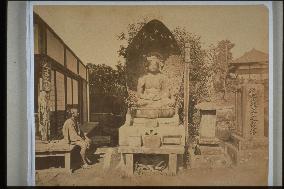
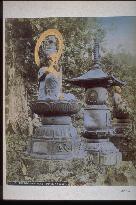
Written, Bronze Image and grave stones on the photo frame. The rain-beaten Amida Buddha of bronze is reminiscent of the Fujiwara Buddha. The man with a topknot sitting and looking at the Buddha to the left could be the grave-keeper. Written KORODANI, at the bottom right, but details are unknown.==Date:unknown, Place:unknown, Photo:F. Beato, (Credit:Nagasaki University Library/Kyodo News Images) [Cabinet Number28‐20‐0]

  •  
Graveyard

Graveyard

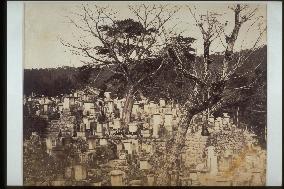
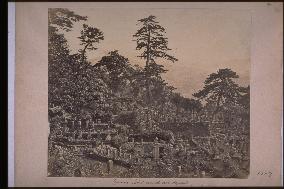
This type of cemetery scene can be observed in some places even now. The place is unknown. It may be a cemetery in the back of a temple in the mountains.==Date:unknown, Place:unknown, Photo:[R. Stillfried], (Credit:Nagasaki University Library/Kyodo News Images) [Cabinet Number27‐11‐0]

  •  
Graveyard

Graveyard

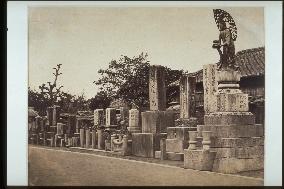
This is probably a cemetery in a temple. The graves are well arranged, so they probably belong to former elite parishioners of the temple. The tombstone with the statue of Kannon stands out.==Date:unknown, Place:unknown, Photo:[R. Stillfried], (Credit:Nagasaki University Library/Kyodo News Images) [Cabinet Number27‐9‐0]

  •  
Graveyard for foreigners in goshinji temple

Graveyard for foreigners in goshinji temple

The foreign cemetery at Goshinji Temple of the Jodo Sect located in the Inasa neighbourhood of Nagasaki. In the centre is the white tower of a Russian Orthodox grave. To its right is the Dutch cemetery, which includes the grave of Hendrik Duurkoop who was a director of the Dutch Factory at Dejima.==Date:Early Meiji, Place:Nagasaki, Photo:unknown, (Credit:Nagasaki University Library/Kyodo News Images) [Cabinet Number26‐20‐0]

  •  
Bronze statue of buddha

Bronze statue of buddha

Jokoji Temple in Nikko stands between the former Imperial Tamozawa summer residence and Daiya River. Two Buddhist statues and a tomb made by a caster of the Sanotenmyo Kanayamachi are placed in the compounds. Before being moved to the temple, the three statues were standing in a line in front of the cedar bush.==Date:unknown, Place:Nikko, Photo:Ogawa Kazumasa, (Credit:Nagasaki University Library/Kyodo News Images) [Cabinet Number25‐56‐0]

  •  
A graveyard,Nagasaki

A graveyard,Nagasaki

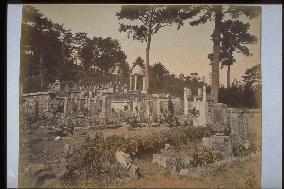
Written March 6, 1866 by Beato. The cemetery within Shuntokuji Temple in Nagasaki. This temple was built on the site of a catholic church called Todos os Santos (All Saints) which was destroyed in 1615. There is monument to Basho and the Kyorai tower.==Date:1866, Place:Nagasaki, Photo:F. Beato, (Credit:Nagasaki University Library/Kyodo News Images) [Cabinet Number17‐7‐0]

  •  
Middle gate of Shotokuin inner building and the treasure tower at Shiba Zojoji Temple

Middle gate of Shotokuin inner building and the treasure tower at Shiba Zojoji Temple

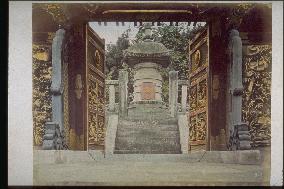
Caption reads Tomb of a shogun in Tokyo in German. This photo shows the middle gate and Hoto (treasure tower) in the tomb of Shotokuin (the 14th Shogun Iemochi) within the Zojoji Temple compound in Shiba, Tokyo. The magnificent carving on the middle gate, which was destroyed in the great Kanto Earthquake, can be observed.==Date:unknown, Place:Tokyo, Photo:Kusakabe Kinbei, (Credit:Nagasaki University Library/Kyodo News Images) [Cabinet Number1‐48‐0]

  •  
Support group to build grave for homeless people

Support group to build grave for homeless people

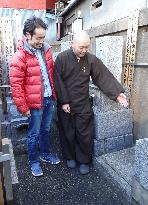
TOKYO, Japan - Kazunori Yui (L), a senior staff member of Tokyo-based nonprofit organization Sanyukai, and Gakugen Yoshimizu, a Buddhist priest at Koshoin temple, stand in front of the planned construction site for a joint grave for financially troubled individuals, including homeless people and day-laborers, at the Tokyo temple on Dec. 26, 2014. The NPO aims to collect 2 million yen to build the grave. (Kyodo)

  •  
100,000 candles lit to honor sp

100,000 candles lit to honor sp

Some 20,000 people gather and light candles at a temple in Koyasan, Wakayama Prefecture, Aug. 13 to honor the spirits of ancestors. The ritual, called ''bon'' festival, is traditionally observed in mid-August in Japan. Some 100,000 candles were lit along a two-kilometer path leading to the grave of Kukai, or Kobo Daishi, a Buddhist priest of the early Heian period (794-1185). ==Kyodo

  • Main
  • Top
  • Editorial
  • Creative
  • About Us
  • About ILG
  • Terms of use
  • Company
  • BEHIND
  • Price List
  • Single Plan
  • Monthly Plan
  • Services
  • Shooting
  • Rights Clearance
  • Support
  • FAQ
  • How To Buy
  • Contact Us
  • Become a Partner

© KYODO NEWS IMAGES INC

All Rights Reserved.

  • Editorial
  • Olympics
  • News
  • Sports
  • Japan
  • Tech
  • Royal
  • Disaster
  • NorthKorea
  • Old Japan
  • SNS
  • Creative
  • Food
  • Japan
  • Landscape
  • Animal
  • Popular
  • #Ukraine
  • #China
  • #coronavirus
  • #N. Korea
  • #Thailand
  • #Russia
  • #Ukraine
  • #China
  • #coronavirus
  • #N. Korea
  • #Thailand
  • #Russia
  • Food
  • Japan
  • Landscape
  • Animal
  • Olympics
  • News
  • Sports
  • Japan
  • Tech
  • Royal
  • Disaster
  • NorthKorea
  • Old Japan
  • SNS