•  
(MASTER OF CRAFTS)CHINA-JIANGXI-GUIXI-COPPER ENGRAVING-INHERITOR (CN)

(MASTER OF CRAFTS)CHINA-JIANGXI-GUIXI-COPPER ENGRAVING-INHERITOR (CN)

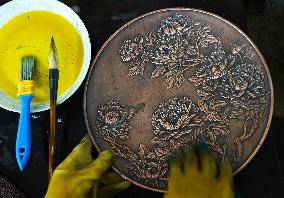
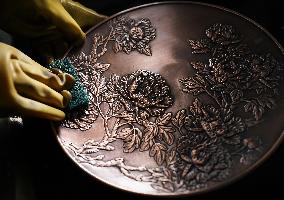
(230815) -- NANCHANG, Aug. 15, 2023 (Xinhua) -- A craftsman tints a copper engraving artwork at Huang Junjun's company in Guixi City, east China's Jiangxi Province, Aug. 9, 2023. Copper engraving, or copper carving, a craft of using knives to carve patterns on copper wares, has a history of about 1,000 years. In 2021, Guixi copper engraving was listed as one of the national-level intangible cultural heritages. The craft needs over 150 different kinds of knives and a dozen of carving skills to create a complete artwork, and the copper ware has to go through over 100,000 times of hammering before being turned into an exquisite artwork. Huang Junjun, 55 years old, is a representative inheritor of Guixi copper engraving, who has been taking the work for 36 years. "My grandpa was a copper ware craftsman, for whom I often acted as an assistant during childhood. I was fascinated with the ancient art," said Huang. As from 1989, he travelled all over the country to seek for masters to study the art, and also worked at

  •  
(MASTER OF CRAFTS)CHINA-JIANGXI-GUIXI-COPPER ENGRAVING-INHERITOR (CN)

(MASTER OF CRAFTS)CHINA-JIANGXI-GUIXI-COPPER ENGRAVING-INHERITOR (CN)

(230815) -- NANCHANG, Aug. 15, 2023 (Xinhua) -- A craftsman tints a copper engraving artwork at Huang Junjun's company in Guixi City, east China's Jiangxi Province, Aug. 9, 2023. Copper engraving, or copper carving, a craft of using knives to carve patterns on copper wares, has a history of about 1,000 years. In 2021, Guixi copper engraving was listed as one of the national-level intangible cultural heritages. The craft needs over 150 different kinds of knives and a dozen of carving skills to create a complete artwork, and the copper ware has to go through over 100,000 times of hammering before being turned into an exquisite artwork. Huang Junjun, 55 years old, is a representative inheritor of Guixi copper engraving, who has been taking the work for 36 years. "My grandpa was a copper ware craftsman, for whom I often acted as an assistant during childhood. I was fascinated with the ancient art," said Huang. As from 1989, he travelled all over the country to seek for masters to study the art, and also worked at

  •  
Autumn tints of Takinogawa, Oji

Autumn tints of Takinogawa, Oji

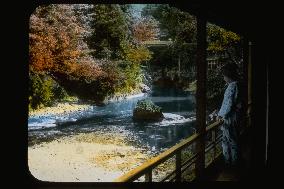
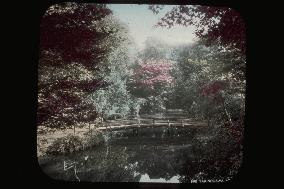
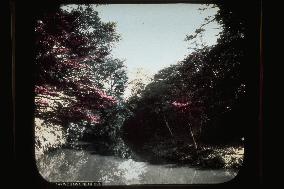
A woman looking at Otonashi River (Shakujii River) from a restaurant in Oji. The river was so clear during the Edo Period that tea made from river water was praised for its high quality. The hillside along the Otonashi River was also suited for tea growing, and the tea grown here was valued on a par with the famous tea from Uji. People were probably able to enjoy this tea here. Taken from a magic lantern made around 1897, this photograph shows that the river was still clean in the Meiji Period.==Date:unknown, Place:Tokyo, Photo:unknown, (Credit:Nagasaki University Library/Kyodo News Images) [Cabinet Number98‐50‐0]

  •  
Autumn tints of Takinogawa, Oji

Autumn tints of Takinogawa, Oji

This seems to be Otonashi River (Shakujii River near Kongoji, the autumn colours temple. A bridge with a romantic atmosphere is said to have spanned a bend in the river. There was a bridge with a pleasant atmosphere. The deity Benzaiten was enshrined in a hollow in the rock near the bridge. A teahouse once stood on the hill. The river merges into Sumida River (formerly Arakawa), which flows northeast. Taken in the mid-Meiji Period.==Date:unknown, Place:Tokyo, Photo:unknown, (Credit:Nagasaki University Library/Kyodo News Images) [Cabinet Number88‐35‐0]

  •  
Autumn tints of Takinogawa, Oji

Autumn tints of Takinogawa, Oji

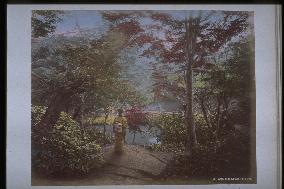
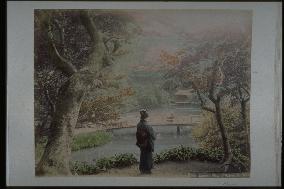
The slow-flowing Shakujii River originates from Sanpoji Pond, Shakujii Pond, and Fujimi Pond, then becomes a rapid stream in the Oji area. It is said that the river roared like a waterfall. Hence, the name of the river became Takinogawa ( Waterfall River). Takinogawa became famous for its autumn colours after the 8th Shogun, Tokugawa Yoshimune, had them planted in this area in 1721. A woman stands in the foreground, enjoying the scenery.==Date:unknown, Place:Tokyo, Photo:Kajima Seibei, (Credit:Nagasaki University Library/Kyodo News Images) [Cabinet Number87‐12‐0]

  •  
Autumn tints of Takinogawa, Oji

Autumn tints of Takinogawa, Oji

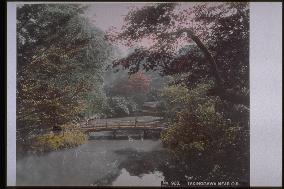
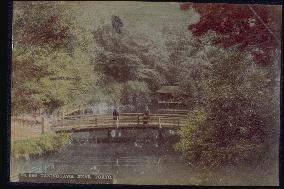
This bridge appears many times in photographs of Takinogawa taken during the Meiji Period. The former Takinogawa Village was located west of Mt. Asuka. The groves of maple trees where people enjoyed the autumn colours centered around Kongoji, which was also called the autumn colours temple (present-day Takinogawa 3-chome, Kita Ward). People enjoyed the cherry blossoms at Mt. Asuka in spring and the colourful leaves of Takinogawa in autumn. Mid-Meiji Period.==Date:unknown, Place:Tokyo, Photo:unknown, (Credit:Nagasaki University Library/Kyodo News Images) [Cabinet Number85‐13‐0]

  •  
Autumn tints of Takinogawa, Oji

Autumn tints of Takinogawa, Oji

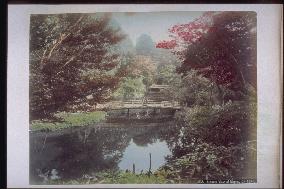
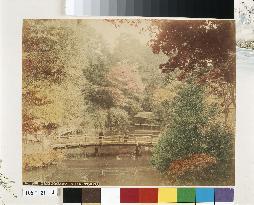
Autumn tints of Takinogawa, Oji==Date:unknown, Place:Tokyo, Photo:A. Farsari, (Credit:Nagasaki University Library/Kyodo News Images)

  •  
Autumn tints of Takinogawa, Oji

Autumn tints of Takinogawa, Oji

The 8th Shogun, Tokugawa Yoshimune, visited this area in 1720-21 and was pleased to find that the Oji Gongen Shrine and the name of the Otonashi River originated in his home province, Kishu. As a result he ordered the planting of Yoshino cherry trees at Mt. Asuka and maple trees along Takinogawa to provide autumn colours. Consequently, the Oji area became a popular tourist spot for people from Edo. Taken in the mid-Meiji Period.==Date:unknown, Place:Tokyo, Photo:unknown, (Credit:Nagasaki University Library/Kyodo News Images) [Cabinet Number80‐34‐0]

  •  
Autumn tints of Takinogawa, Oji

Autumn tints of Takinogawa, Oji

The photographs of Takinogawa taken during the Meiji Period capture the beauty of the autumn colours. However, after World War II, the development of the residential areas changed the area upstream. The river banks were covered with concrete and the river started to smell due to waste water from houses. The local people launched a movement to protect the river, and finally the government built the Otonashi River Shinsui (Water Friendly) Park in 1985. Spring water is mixed with the natural flow and filtered. Thus, clean water is circulated in certain areas. Depicting the area under present-day Otonashi Bridge, this photograph was taken by Kusakabe Kinbei between 1877 and 1887 (second decade of the Meiji Period).==Date:unknown, Place:Tokyo, Photo:Kusakabe Kinbei, (Credit:Nagasaki University Library/Kyodo News Images) [Cabinet Number53‐32‐0]

  •  
Autumn tints of Takinogawa, Oji

Autumn tints of Takinogawa, Oji

Oji Station is built over Shakujii River. In this area the river is called Otonashi River. The reason for this name is as follows. Toyoshima Gonnokami Kiyomitsu, a medieval feudal lord, hailed from Kishu (present-day Wakayama Prefecture) and thus established a shrine to Jakuichi Ouji Gongen (Kumano Gongen) that later became Oji Gongen. Consequently, this area was called Oji, and the river was named after the Otonashi River of Kishu. Upstream on the Otonashi River, Takinogawa Village gained fame for its autumn colours. Taken in the mid-Meiji Period.==Date:unknown, Place:Tokyo, Photo:Tamamura Kozaburo, (Credit:Nagasaki University Library/Kyodo News Images) [Cabinet Number48‐59‐0]

  •  
Autumn tints of Takinogawa, Oji

Autumn tints of Takinogawa, Oji

The red leaves of the Takino River was famous since the Edo era, and many novelists and calligraphers visited the site. The name Takino River originates from the alias of the Shakujii River, and that is the river running in the center.==Date:unknown, Place:Tokyo, Photo:Kusakabe Kinbei, (Credit:Nagasaki University Library/Kyodo News Images) [Cabinet Number40‐7‐0]

  •  
Autumn tints of Takinogawa, Oji

Autumn tints of Takinogawa, Oji

The red leaves of Takino River. Visitors climbing along the river arrive at a place called the red leaves temple or Kongoji of Takino River.==Date:unknown, Place:Tokyo, Photo:Tamamura Kozaburo, (Credit:Nagasaki University Library/Kyodo News Images) [Cabinet Number31‐78‐0]

  •  
Autumn tints of Takinogawa, Oji

Autumn tints of Takinogawa, Oji

The Takino River of Oji was a pleasure spot from the Edo Era, but as the photo shows, the Japanese garden has been rediscovered in a natural setting, reflecting an eye for natural beauty.==Date:unknown, Place:Tokyo, Photo:unknown, (Credit:Nagasaki University Library/Kyodo News Images) [Cabinet Number31‐11‐0]

  •  
Autumn tints of Takinogawa, Oji

Autumn tints of Takinogawa, Oji

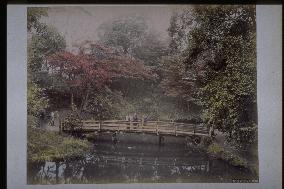
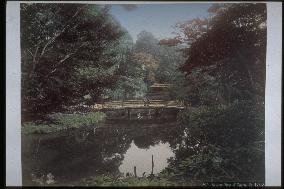
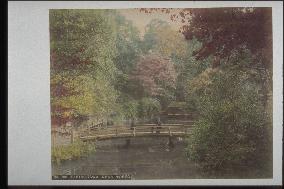
Below the cliffs of Oji Shrine, Takinogawa is famous for the red leaves along the Shakujii River. It was popular as a pleasure spot from the early days. At the centre of the bridge two women can be seen enjoying the view.==Date:unknown, Place:Tokyo, Photo:Tamamura Kozaburo, (Credit:Nagasaki University Library/Kyodo News Images) [Cabinet Number25‐65‐0]

  •  
Autumn tints of Takinogawa, Oji

Autumn tints of Takinogawa, Oji

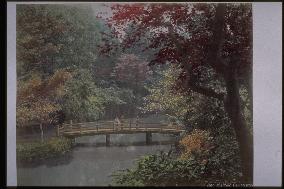
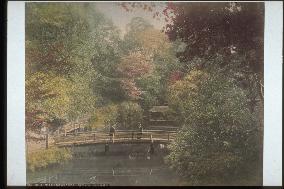
In contrast to the cherry blossoms of Asukayama, Takino River was famous during the Meiji era for the leaves turning red in the autumn. It is a downstream on the Shakujii River. Two women stand on the bridge, and the building in the rear may be for looking at the red leaves. Trees aglow in autumn clours cast their shadow over the surface of the river from the right and the left.==Date:unknown, Place:Tokyo, Photo:Tamamura Kozaburo, (Credit:Nagasaki University Library/Kyodo News Images) [Cabinet Number11‐4‐0]

  •  
Autumn tints of Takinogawa, Oji

Autumn tints of Takinogawa, Oji

Autumn tints of Takinogawa, Oji==Date:unknown, Place:Tokyo, Photo:Tamamura Kozaburo, (Credit:Nagasaki University Library/Kyodo News Images)

  •  
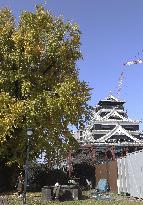
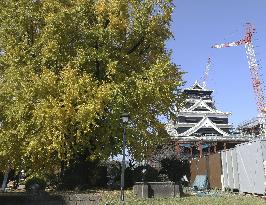
Ginkgo and Kumamoto Castle

Ginkgo and Kumamoto Castle

A ginkgo aflame with autumn tints is pictured on Nov. 22, 2018, against the background of Kumamoto Castle, now under repair following its partial destruction in a massive earthquake that hit the southwestern Japanese prefecture in April 2016. (Kyodo) ==Kyodo

  •  
Ginkgo and Kumamoto Castle

Ginkgo and Kumamoto Castle

A ginkgo aflame with autumn tints is pictured on Nov. 22, 2018, against the background of Kumamoto Castle, now under repair following its partial destruction in a massive earthquake that hit the southwestern Japanese prefecture in April 2016. (Kyodo) ==Kyodo

  • Main
  • Top
  • Editorial
  • Creative
  • About Us
  • About ILG
  • Terms of use
  • Company
  • BEHIND
  • Price List
  • Single Plan
  • Monthly Plan
  • Services
  • Shooting
  • Rights Clearance
  • Support
  • FAQ
  • How To Buy
  • Contact Us
  • Become a Partner

© KYODO NEWS IMAGES INC

All Rights Reserved.

  • Editorial
  • Olympics
  • News
  • Sports
  • Japan
  • Tech
  • Royal
  • Disaster
  • NorthKorea
  • Old Japan
  • SNS
  • Creative
  • Food
  • Japan
  • Landscape
  • Animal
  • Popular
  • #Ukraine
  • #China
  • #coronavirus
  • #N. Korea
  • #Thailand
  • #Russia
  • #Ukraine
  • #China
  • #coronavirus
  • #N. Korea
  • #Thailand
  • #Russia
  • Food
  • Japan
  • Landscape
  • Animal
  • Olympics
  • News
  • Sports
  • Japan
  • Tech
  • Royal
  • Disaster
  • NorthKorea
  • Old Japan
  • SNS