•  
Mirror, sword unearthed from ancient Japan tomb

Mirror, sword unearthed from ancient Japan tomb

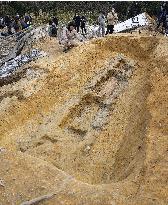
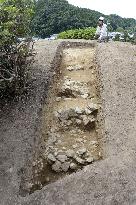
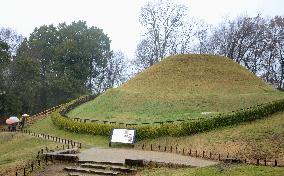
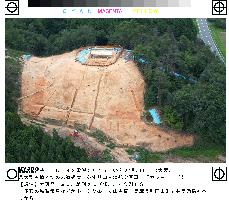
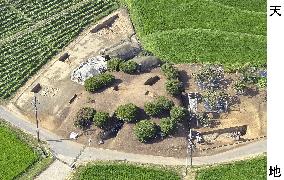
Photo taken on Jan. 25, 2023, shows the Tomio-Maruyama tomb mound in the western Japan city of Nara after an archaeological dig was conducted. The largest bronze mirror and largest "dako" iron sword ever found in Japan were excavated from the tumulus, the city's board of education and an archeological institute that supported the project said the same day.

  •  
Mirror, sword unearthed from ancient Japan tomb

Mirror, sword unearthed from ancient Japan tomb

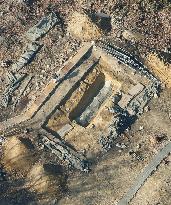
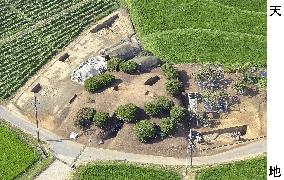
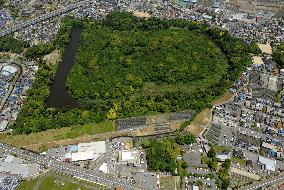
Photo taken from a Kyodo News helicopter on Jan. 20, 2023, shows the Tomio-Maruyama tomb mound in the western Japan city of Nara. The largest bronze mirror and largest "dako" iron sword ever found in Japan were excavated from the tumulus, the city's board of education and an archeological institute that supported the project said on Jan. 25.

  •  
Cleaned murals from ancient tomb ready for public display

Cleaned murals from ancient tomb ready for public display

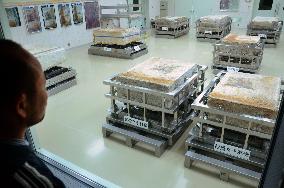
KASHIHARA, Japan - Cleansed murals from the Takamatsuzuka Tomb, an ancient circular tumulus grave in Asuka, Nara Prefecture, western Japan, designated as a national treasure, are shown to the press at the Cultural Affairs Agency's local repairing facility on Jan. 16, 2015, on the eve of public display.

  •  
3D image of fox projected over tumulus in western Japan

3D image of fox projected over tumulus in western Japan

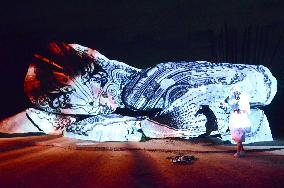
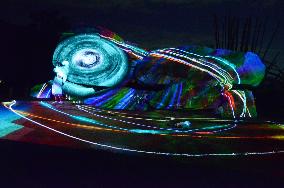
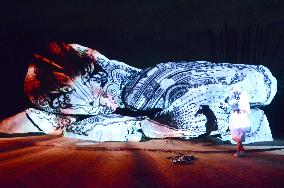
KASHIHARA, Japan - A three-dimensional image of a fox is projected over the Ishibutai tumulus made of large rocks in Asuka, Nara Prefecture, western Japan, on Nov. 13, 2014, for the test illumination of "projection mapping."

  •  
3D image of planet projected on tumulus in west Japan

3D image of planet projected on tumulus in west Japan

KASHIHARA, Japan - A three-dimensional image of a planet is projected over the Ishibutai tumulus made of large rocks in Asuka, Nara Prefecture, western Japan, on Nov. 13, 2014, for the test illumination of "projection mapping."

  •  
Slope found in Itsukahara tumulus

Slope found in Itsukahara tumulus

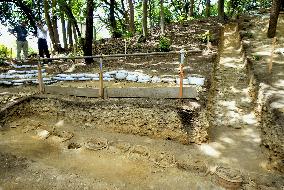
KYOTO, Japan - A slope at Itsukahara tumulus (late 3rd century, keyhole-shaped tumulus) in Muko, Kyoto Prefecture, western Japan, is shown on Oct. 16, 2014. Muko City Center for Archaeological Operations announced that the slope was arranged in a similar manner to the Hashihaka tumulus in Sakurai, Nara Prefecture. Some say Hashihaka is the tomb of Queen Himiko.

  •  
Aerial view of ancient tumuluses in western Japan

Aerial view of ancient tumuluses in western Japan

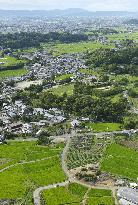
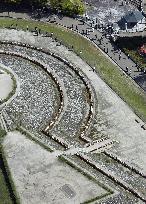
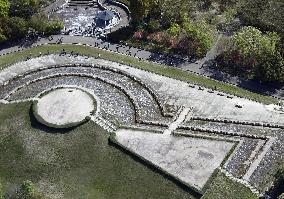
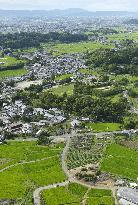
OSAKA, Japan - The Miyakozuka tomb mound in Asuka in the southwestern Japan prefecture of Nara, found to have been shaped like a pyramid and built in the late sixth century, is seen at the bottom of this photo taken on Aug. 5, 2014. The Ishibutai tumulus is located in the middle.

  •  
Big stone coffin found in 6th-century tumulus

Big stone coffin found in 6th-century tumulus

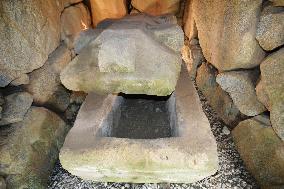
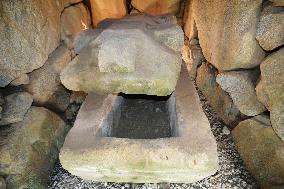
NARA, Japan - A large stone coffin is shown in this photo taken on Aug. 5, 2014, inside the Miyakozuka tomb mound in Asuka in the southwestern Japan prefecture of Nara, which is found to have been shaped like a pyramid. The tumulus was built in the late sixth century.

  •  
Stones found piled up in staircase pattern at tumulus

Stones found piled up in staircase pattern at tumulus

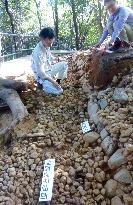
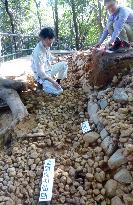
NARA, Japan - Archaeologists find stones piled up in a staircase pattern on the east side of the Miyakozuka tomb mound in Asuka in the southwestern Japan prefecture of Nara, as shown in this photo taken on Aug. 5, 2014. Built in the late sixth century, the tumulus was shaped like a pyramid, according to the archaeologists.

  •  
Aaerial view of ancient tumulus in western Japan

Aaerial view of ancient tumulus in western Japan

OSAKA, Japan - The Miyakozuka tomb mound in Asuka in the southwestern Japan prefecture of Nara is seen in this aerial photo taken on Aug. 5, 2014. Archaeologists say the sixth-century tumulus was a flat-topped burial mound made by piling up stones in a staircase pattern.

  •  
Aerial view of Higashiyama rectangular tomb mound

Aerial view of Higashiyama rectangular tomb mound

OSAKA, Japan - An aerial view of the Higashiyama rectangular-shaped tomb mound (foreground) adjacent to the Konda-gobyoyama tumulus attributed to Emperor Ojin in Habikino, Osaka Prefecture, western Japan, is shown in this file photo taken in May 2014 from a Kyodo News helicopter. The tomb mound measures 57 meters from east to west and 54 meters from north to south, having previously been estimated to be 50 meters each.

  •  
Clay figures found lined up at tomb mound in western Japan

Clay figures found lined up at tomb mound in western Japan

FUJIIDERA, Japan - Clay figures are lined up in circles on a terrace (foreground) at the Higashiyama rectangular-shaped tomb mound in Habikino, Osaka Prefecture, western Japan, on Aug. 7, 2014. The tomb, built in the early fifth century, is attached to the Konda-gobyoyama tumulus believed to belong to Emperor Ojin, described in ancient documents as Japan's 15th emperor.

  •  
Goods unearthed from tumulus on display in Nara

Goods unearthed from tumulus on display in Nara

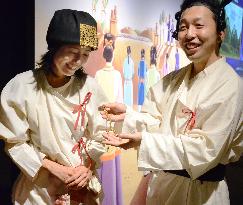
KASHIHARA, Japan - A male member of staff (R) shows a replica of a gold earring with a long chain, one of the articles found in the Niizawa Senzuka tumulus group, comprising about 600 burial mounds concerned with the Silk Road route, in Kashihara, Nara Prefecture, western Japan, on July 2, 2014. Some of the articles are on display at the Kashihara City Museum of History at a two-month exhibition under way from July 5.

  •  
Takamatsuzuka tomb restored, murals to be kept out

Takamatsuzuka tomb restored, murals to be kept out

KASHIHARA, Japan - The Takamatsuzuka Tumulus, an ancient burial mound in the village of Asuka, Nara Prefecture in western Japan, is restored to its original shape as seen on March 26, 2014. Murals excavated from inside the tomb, however, will be preserved elsewhere for the time being to protect them from mold and deterioration.

  •  
Moat, 'haniwa' fragments found at Ikaruga-Otsuka tumulus

Moat, 'haniwa' fragments found at Ikaruga-Otsuka tumulus

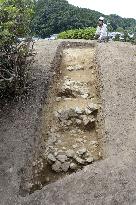
NARA, Japan - Photo taken on March 24, 2014, shows the Ikaruga-Otsuka tumulus' excavation site in Ikaruga town, Nara Prefecture. The education board of the town announced the same day that an ancient moat and fragments of "haniwa" clay figures have been discovered at the site.

  •  
(2)Undisturbed treasures found in tumulus in Hyogo Pref.

(2)Undisturbed treasures found in tumulus in Hyogo Pref.

KOBE, Japan - Photo shows iron tools and helmets discovered at an ancient tumulus, named Chasuriyama, in Wadayama, Hyogo Prefecture. Some 200 iron items, including swords and helmets, and numerous accessories have so far been found in the tumulus, which is the first undisturbed circular mound in the country that has a diameter of more than 80 meters.

  •  
(1)Undisturbed treasures found in tumulus in Hyogo Pref.

(1)Undisturbed treasures found in tumulus in Hyogo Pref.

KOBE, Japan - Aerial photo shows an ancient tumulus, named Chasuriyama, in Wadayama, Hyogo Prefecture, which has turned out to be one of the largest burial mounds in the Kinki region and contains numerous artifacts. The tumulus was built in the early part of the 5th century and has a diameter of about 86 meters.

  •  
Japanese imperial couple visits ancient tomb in Nara

Japanese imperial couple visits ancient tomb in Nara

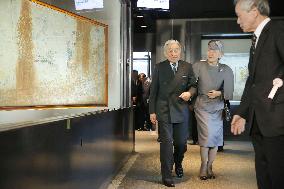
Japanese Emperor Akihito and Empress Michiko (1st and 2nd from L) walk through the Takamatsuzuka Mural Hall in the western Japanese village of Asuka, Nara Prefecture, on April 4, 2016, which exhibits replicas of frescoes found in the adjacent Takamatsuzuka Tomb, a circular tumulus grave from the seventh and eighth centuries. It was the imperial couple's first visit to the ancient tomb, which has been designated as a national special historic site. (Pool photo)(Kyodo) ==Kyodo

  •  
Japanese imperial couple visits ancient tomb in Nara

Japanese imperial couple visits ancient tomb in Nara

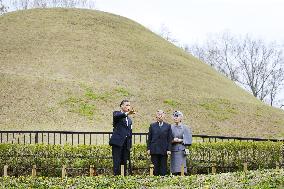
Japanese Emperor Akihito and Empress Michiko (C and R) visit the Takamatsuzuka Tomb, a circular tumulus grave from the seventh and eighth centuries, in the western Japanese village of Asuka, Nara Prefecture, on April 4, 2016. It was the imperial couple's first visit to the tomb, which has been designated as a national special historic site. (Kyodo) ==Kyodo

  •  
House-shaped clay figures found from tumulus in western Japan

House-shaped clay figures found from tumulus in western Japan

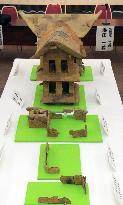
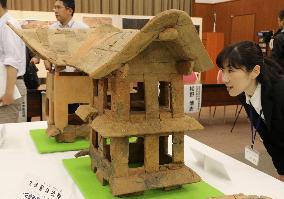
The education board of Akitakata, Hiroshima Prefecture, displays on April 20, 2015, a row of five house-shaped clay figures, discovered in the Kotachi tumulus in the western Japanese city. (Kyodo) ==Kyodo

  •  
House-shaped clay figures found from tumulus in western Japan

House-shaped clay figures found from tumulus in western Japan

House-shaped clay figures, discovered in the Kotachi tumulus in Akitakata, Hiroshima Prefecture, are displayed by the education board of the western Japanese city on April 20, 2015. (Kyodo) ==Kyodo

  •  
Osaka pupils find 5th-century clay figure fractions

Osaka pupils find 5th-century clay figure fractions

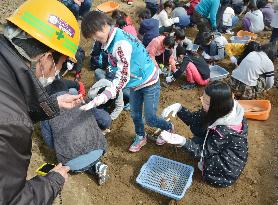
Students at an elementary school in Fujiidera, Osaka Prefecture, unearth fractions of clay figures from around the 5th century at the planned construction site for a temporary schoolhouse on Feb. 25, 2015, for a hands-on experience in excavation. The western Japanese city aims to register the "Mozu-Furuichi Kofungun," an ancient tumulus clusters, on the UNESCO World Heritage list together with the prefecture and other cities. (Kyodo) ==Kyodo

  •  
Tokyo Olympic torch relay

Tokyo Olympic torch relay

Photo taken from a Kyodo News helicopter on April 12, 2021, shows the Tokyo Olympic torch relay (top) passing by an ancient tumulus in Kawai in Nara Prefecture, western Japan, on April 12, 2021.

  •  
Tokyo Olympic torch relay

Tokyo Olympic torch relay

Photo taken from a Kyodo News helicopter on April 12, 2021, shows the Tokyo Olympic torch relay (upper left) passing by an ancient tumulus in Kawai in Nara Prefecture, western Japan.

  •  
3D image of fox projected over tumulus in western Japan

3D image of fox projected over tumulus in western Japan

KASHIHARA, Japan - A three-dimensional image of a fox is projected over the Ishibutai tumulus made of large rocks in Asuka, Nara Prefecture, western Japan, on Nov. 13, 2014, for the test illumination of "projection mapping." (Kyodo)

  •  
Slope found in Itsukahara tumulus

Slope found in Itsukahara tumulus

KYOTO, Japan - A slope at Itsukahara tumulus (late 3rd century, keyhole-shaped tumulus) in Muko, Kyoto Prefecture, western Japan, is shown on Oct. 16, 2014. Muko City Center for Archaeological Operations announced that the slope was arranged in a similar manner to the Hashihaka tumulus in Sakurai, Nara Prefecture. Some say Hashihaka is the tomb of Queen Himiko. (Kyodo)

  •  
Aerial view of ancient tumuluses in western Japan

Aerial view of ancient tumuluses in western Japan

OSAKA, Japan - The Miyakozuka tomb mound in Asuka in the southwestern Japan prefecture of Nara, found to have been shaped like a pyramid and built in the late sixth century, is seen at the bottom of this photo taken on Aug. 5, 2014. The Ishibutai tumulus is located in the middle. (Kyodo)

  •  
Stones found piled up in staircase pattern at tumulus

Stones found piled up in staircase pattern at tumulus

NARA, Japan - Archaeologists find stones piled up in a staircase pattern on the east side of the Miyakozuka tomb mound in Asuka in the southwestern Japan prefecture of Nara, as shown in this photo taken on Aug. 5, 2014. Built in the late sixth century, the tumulus was shaped like a pyramid, according to the archaeologists. (Kyodo)

  •  
Aaerial view of ancient tumulus in western Japan

Aaerial view of ancient tumulus in western Japan

OSAKA, Japan - The Miyakozuka tomb mound in Asuka in the southwestern Japan prefecture of Nara is seen in this aerial photo taken on Aug. 5, 2014. Archaeologists say the sixth-century tumulus was a flat-topped burial mound made by piling up stones in a staircase pattern. (Kyodo)

  •  
Big stone coffin found in 6th-century tumulus

Big stone coffin found in 6th-century tumulus

NARA, Japan - A large stone coffin is shown in this photo taken on Aug. 5, 2014, inside the Miyakozuka tomb mound in Asuka in the southwestern Japan prefecture of Nara, which is found to have been shaped like a pyramid. The tumulus was built in the late sixth century. (Kyodo)

  •  
Aerial view of Higashiyama rectangular tomb mound

Aerial view of Higashiyama rectangular tomb mound

OSAKA, Japan - An aerial view of the Higashiyama rectangular-shaped tomb mound (foreground) adjacent to the Konda-gobyoyama tumulus attributed to Emperor Ojin in Habikino, Osaka Prefecture, western Japan, is shown in this file photo taken in May 2014 from a Kyodo News helicopter. The tomb mound measures 57 meters from east to west and 54 meters from north to south, having previously been estimated to be 50 meters each. (Kyodo)

  •  
Goods unearthed from tumulus on display in Nara

Goods unearthed from tumulus on display in Nara

KASHIHARA, Japan - A male member of staff (R) shows a replica of a gold earring with a long chain, one of the articles found in the Niizawa Senzuka tumulus group, comprising about 600 burial mounds concerned with the Silk Road route, in Kashihara, Nara Prefecture, western Japan, on July 2, 2014. Some of the articles are on display at the Kashihara City Museum of History at a two-month exhibition under way from July 5. (Kyodo)

  •  
Osaka, Siem Reap to promote their World Heritage sites

Osaka, Siem Reap to promote their World Heritage sites

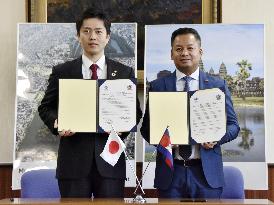
Osaka Gov. Hirofumi Yoshimura (L) and Tea Seiha, governor of the Cambodian province of Siem Reap, pose for a photo in Osaka on Jan. 21, 2020, after pledging to work together to promote their respective World Heritage sites -- the Mozu-Furuichi ancient tumulus clusters in Osaka and the Angkor archaeological sites in Siem Reap. (Kyodo) ==Kyodo

  •  
(2)Undisturbed treasures found in tumulus in Hyogo Pref.

(2)Undisturbed treasures found in tumulus in Hyogo Pref.

KOBE, Japan - Photo shows iron tools and helmets discovered at an ancient tumulus, named Chasuriyama, in Wadayama, Hyogo Prefecture. Some 200 iron items, including swords and helmets, and numerous accessories have so far been found in the tumulus, which is the first undisturbed circular mound in the country that has a diameter of more than 80 meters. (Kyodo)

  •  
(1)Undisturbed treasures found in tumulus in Hyogo Pref.

(1)Undisturbed treasures found in tumulus in Hyogo Pref.

KOBE, Japan - Aerial photo shows an ancient tumulus, named Chasuriyama, in Wadayama, Hyogo Prefecture, which has turned out to be one of the largest burial mounds in the Kinki region and contains numerous artifacts. The tumulus was built in the early part of the 5th century and has a diameter of about 86 meters. (Kyodo)

  •  
Japan's ancient tombs to become world heritage site

Japan's ancient tombs to become world heritage site

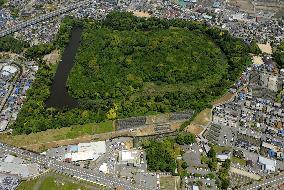
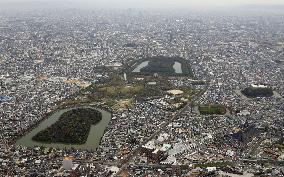
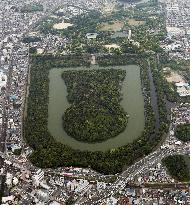
Photo taken April 17, 2019, shows the Emperor Nintoku mausoleum (back), Japan's largest ancient mound, officially called Daisen Kofun, one of the sites collectively called the Mozu-Furuichi tumulus clusters in Osaka Prefecture. UNESCO decided on July 6, 2019, to add the tumulus clusters to the World Heritage list. (Kyodo) ==Kyodo

  •  
Ancient Japanese tombs added to UNESCO World Heritage list

Ancient Japanese tombs added to UNESCO World Heritage list

Osaka Gov. Hirofumi Yoshimura meets the press in Baku, Azerbaijan, on July 6, 2019, after UNESCO decided earlier in the day there to add two tumulus clusters in Osaka Prefecture to the World Heritage list, including the country's largest keyhole-shaped mound named after Emperor Nintoku. (Kyodo) ==Kyodo

  •  
Ancient Japanese tombs added to UNESCO World Heritage list

Ancient Japanese tombs added to UNESCO World Heritage list

Osaka Gov. Hirofumi Yoshimura (C) celebrates in Baku, Azerbaijan, on July 6, 2019, after UNESCO decided earlier in the day there to add two tumulus clusters in Osaka Prefecture to the World Heritage list, including the country's largest keyhole-shaped mound named after Emperor Nintoku. (Kyodo) ==Kyodo

  •  
Ancient Japanese tombs added to UNESCO World Heritage list

Ancient Japanese tombs added to UNESCO World Heritage list

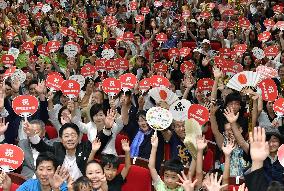
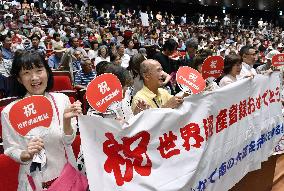
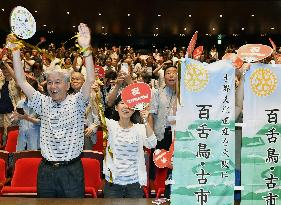
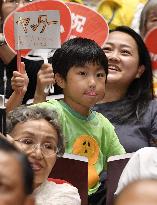
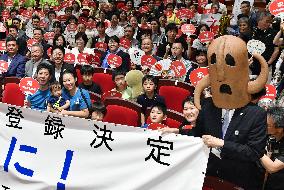
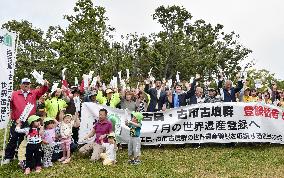
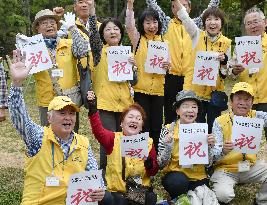
People in the western Japan city of Sakai celebrate on July 6, 2019, after UNESCO decided earlier in the day to add two local tumulus clusters to the World Heritage list, including the country's largest keyhole-shaped mound named after Emperor Nintoku. (Kyodo) ==Kyodo

  •  
Ancient Japanese tombs added to UNESCO World Heritage list

Ancient Japanese tombs added to UNESCO World Heritage list

People in the western Japan city of Sakai celebrate on July 6, 2019, after UNESCO decided earlier in the day to add two local tumulus clusters to the World Heritage list, including the country's largest keyhole-shaped mound named after Emperor Nintoku. (Kyodo) ==Kyodo

  •  
Ancient Japanese tombs added to UNESCO World Heritage list

Ancient Japanese tombs added to UNESCO World Heritage list

People in the western Japan city of Sakai celebrate on July 6, 2019, after UNESCO decided earlier in the day to add two local tumulus clusters to the World Heritage list, including the country's largest keyhole-shaped mound named after Emperor Nintoku. (Kyodo) ==Kyodo

  •  
Ancient Japanese tombs added to UNESCO World Heritage list

Ancient Japanese tombs added to UNESCO World Heritage list

People in the western Japan city of Sakai celebrate on July 6, 2019, after UNESCO decided earlier in the day to add two local tumulus clusters to the World Heritage list, including the country's largest keyhole-shaped mound named after Emperor Nintoku. (Kyodo) ==Kyodo

  •  
Ancient Japanese tombs added to UNESCO World Heritage list

Ancient Japanese tombs added to UNESCO World Heritage list

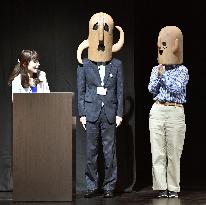
A Sakai city official (C) wearing a "haniwa" -- a clay figure produced during Japan's Kofun period in the 3rd to 6th centuries to decorate tombs for ritual use -- celebrates in the western Japan city on July 6, 2019, after UNESCO decided earlier in the day to add two local tumulus clusters to the World Heritage list, including the country's largest keyhole-shaped mound named after Emperor Nintoku. (Kyodo) ==Kyodo

  •  
Ancient Japanese tombs added to UNESCO World Heritage list

Ancient Japanese tombs added to UNESCO World Heritage list

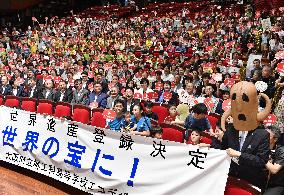
A Sakai city official wearing a "haniwa" -- a clay figure produced during Japan's Kofun period in the 3rd to 6th centuries to decorate tombs for ritual use -- and people in the western Japan city celebrate on July 6, 2019, after UNESCO decided earlier in the day to add two local tumulus clusters to the World Heritage list, including the country's largest keyhole-shaped mound named after Emperor Nintoku. (Kyodo) ==Kyodo

  •  
Ancient Japanese tombs added to UNESCO World Heritage list

Ancient Japanese tombs added to UNESCO World Heritage list

A Sakai city official wearing a "haniwa" -- a clay figure produced during Japan's Kofun period in the 3rd to 6th centuries to decorate tombs for ritual use -- and people in the western Japan city celebrate on July 6, 2019, after UNESCO decided earlier in the day to add two local tumulus clusters to the World Heritage list, including the country's largest keyhole-shaped mound named after Emperor Nintoku. (Kyodo) ==Kyodo

  •  
Ancient burial mound in Osaka

Ancient burial mound in Osaka

File photo taken May 14, 2019, shows what is said to be Emperor Nintoku's mausoleum in Sakai, Osaka Prefecture, western Japan. A UNESCO advisory panel recommended the previous day adding two clusters of ancient burial mounds in the prefecture, including the grave pictured that is officially called Daisen Kofun, to the World Culture Heritage list, as one of the Mozu-Furuichi tumulus clusters. (Kyodo) ==Kyodo

  •  
Japan's ancient tombs eyed to become world heritage site

Japan's ancient tombs eyed to become world heritage site

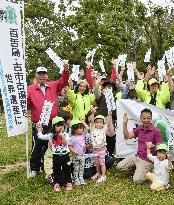
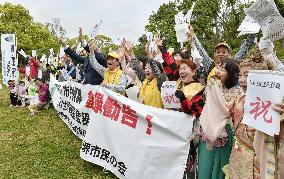
People celebrate in Sakai, Osaka Prefecture, on May 14, 2019, after an advisory panel of the U.N. Educational, Scientific and Cultural Organization recommended adding the prefecture's Mozu-Furuichi tumulus clusters, including Sakai's Daisen Kofun, to the World Cultural Heritage list. (Kyodo) ==Kyodo

  •  
Japan's ancient tombs eyed to become world heritage site

Japan's ancient tombs eyed to become world heritage site

People celebrate in Sakai, Osaka Prefecture, on May 14, 2019, after an advisory panel of the U.N. Educational, Scientific and Cultural Organization recommended adding the prefecture's Mozu-Furuichi tumulus clusters, including Sakai's Daisen Kofun, to the World Cultural Heritage list. (Kyodo) ==Kyodo

  •  
Japan's ancient tombs eyed to become world heritage site

Japan's ancient tombs eyed to become world heritage site

People celebrate in Sakai, Osaka Prefecture, on May 14, 2019, after an advisory panel of the U.N. Educational, Scientific and Cultural Organization recommended adding the prefecture's Mozu-Furuichi tumulus clusters, including Sakai's Daisen Kofun, to the World Cultural Heritage list. (Kyodo) ==Kyodo

  •  
Japan's ancient tombs eyed to become world heritage site

Japan's ancient tombs eyed to become world heritage site

People celebrate in Sakai, Osaka Prefecture, on May 14, 2019, after an advisory panel of the U.N. Educational, Scientific and Cultural Organization recommended adding the prefecture's Mozu-Furuichi tumulus clusters, including Sakai's Daisen Kofun, to the World Cultural Heritage list. (Kyodo) ==Kyodo

  • Main
  • Top
  • Editorial
  • Creative
  • About Us
  • About ILG
  • Terms of use
  • Company
  • BEHIND
  • Price List
  • Single Plan
  • Monthly Plan
  • Services
  • Shooting
  • Rights Clearance
  • Support
  • FAQ
  • How To Buy
  • Contact Us
  • Become a Partner

© KYODO NEWS IMAGES INC

All Rights Reserved.

  • Editorial
  • Olympics
  • News
  • Sports
  • Japan
  • Tech
  • Royal
  • Disaster
  • NorthKorea
  • Old Japan
  • SNS
  • Creative
  • Food
  • Japan
  • Landscape
  • Animal
  • Popular
  • #Ukraine
  • #China
  • #coronavirus
  • #N. Korea
  • #Thailand
  • #Russia
  • #Ukraine
  • #China
  • #coronavirus
  • #N. Korea
  • #Thailand
  • #Russia
  • Food
  • Japan
  • Landscape
  • Animal
  • Olympics
  • News
  • Sports
  • Japan
  • Tech
  • Royal
  • Disaster
  • NorthKorea
  • Old Japan
  • SNS