•  
March Against Pesticides - Paris

March Against Pesticides - Paris

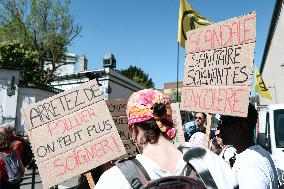
Two protesters holding signs with the words "stop polluting, we can provide better care" and "health scandal, angry caregivers" written on it during the demonstration. Extinction Rebellion and Scientists in Rebellion, joined by other groups, are calling for protests against pesticides and their harmful effects on biodiversity and health, on april 05, 2025 in Paris. Photo by Christophe Michel/ABACAPRESS.COM

  •  
March Against Pesticides - Paris

March Against Pesticides - Paris

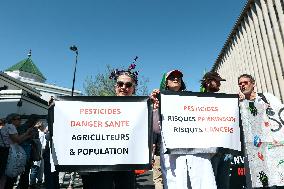
Two protesters holding signs with the words "pesticides, health hazards, farmers and the population" and "pesticides, Parkinson's risks, cancer risks" written on it during the demonstration. Extinction Rebellion and Scientists in Rebellion, joined by other groups, are calling for protests against pesticides and their harmful effects on biodiversity and health, on april 05, 2025 in Paris. Photo by Christophe Michel/ABACAPRESS.COM

  •  
March Against Pesticides - Paris

March Against Pesticides - Paris

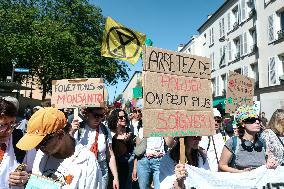
Two protesters in a procession holding signs with the words "Let s whip Monsanto" and "stop polluting, we can no longer treat" written on it during the demonstration. Extinction Rebellion and Scientists in Rebellion, joined by other groups, are calling for protests against pesticides and their harmful effects on biodiversity and health, on april 05, 2025 in Paris. Photo by Christophe Michel/ABACAPRESS.COM

  •  
March Against Pesticides - Paris

March Against Pesticides - Paris

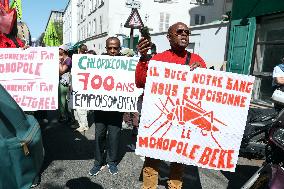
Two protesters in a procession holding signs with the words "Chlordecone, 700 years of poisoning" and "it sucks our blood, poisons us, the Beke monopoly" written on it during the demonstration. Extinction Rebellion and Scientists in Rebellion, joined by other groups, are calling for protests against pesticides and their harmful effects on biodiversity and health, on april 05, 2025 in Paris. Photo by Christophe Michel/ABACAPRESS.COM

  •  
Gators Are Sensitive To Environmental Changes - Everglades

Gators Are Sensitive To Environmental Changes - Everglades

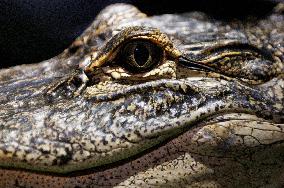
An American alligator sits while researchers collect data during a crocodile and alligator research survey with the University of Florida Croc Docs team Thursday, November 7, 2024, in Everglades National Park, FL, USA. Alligators like to hunt in the dark but tonight they’re the creatures being stalked, not for sport but for science by two University of Florida wildlife biologists, Sergio Balaguera-Reina and Kevin Olejiczak. Alligators, along with their cousins and co-residents crocodiles, are sensitive to environmental changes in the Everglades. That makes them what scientists call a good “indicator species” for assessing progress in the on-going multibillion-dollar effort to restore the natural water flow to the sprawling River of Grass. Gators are a bit like Goldilocks. Too much water, and they use too much energy trying to catching fish and other prey. Not enough, and they struggle to move or mate. They need the water just right. Photo by Alie Skowronski/Miami Herald/TNS/ABACAPRESS.COM

  •  
Gators Are Sensitive To Environmental Changes - Everglades

Gators Are Sensitive To Environmental Changes - Everglades

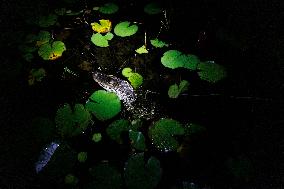
An American alligator swims through the water while attached to the boat for researchers to collect data during a research survey with the University of Florida Croc Docs team Thursday, November 7, 2024, in Everglades National Park. The alligators health is a good indicator of the health of the Everglades. Alligators like to hunt in the dark but tonight they’re the creatures being stalked, not for sport but for science by two University of Florida wildlife biologists, Sergio Balaguera-Reina and Kevin Olejiczak. Alligators, along with their cousins and co-residents crocodiles, are sensitive to environmental changes in the Everglades. That makes them what scientists call a good “indicator species” for assessing progress in the on-going multibillion-dollar effort to restore the natural water flow to the sprawling River of Grass. Gators are a bit like Goldilocks. Too much water, and they use too much energy trying to catching fish and other prey. Not enough, and they struggle to move or mate. They need the water

  •  
Gators Are Sensitive To Environmental Changes - Everglades

Gators Are Sensitive To Environmental Changes - Everglades

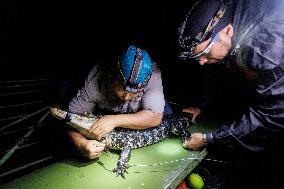
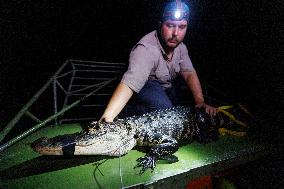
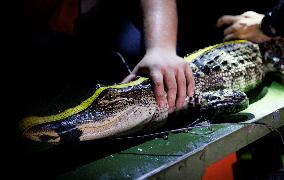
Kevin Olejniczak, wildlife technician, left, holds an American alligator while Sergio Balaguera-Reina, research scientist studying conservation biology, collects data during a research survey with the University of Florida Croc Docs team Thursday, November 7, 2024, in Everglades National Park, FL, USA. Alligators like to hunt in the dark but tonight they’re the creatures being stalked, not for sport but for science by two University of Florida wildlife biologists, Sergio Balaguera-Reina and Kevin Olejiczak. Alligators, along with their cousins and co-residents crocodiles, are sensitive to environmental changes in the Everglades. That makes them what scientists call a good “indicator species” for assessing progress in the on-going multibillion-dollar effort to restore the natural water flow to the sprawling River of Grass. Gators are a bit like Goldilocks. Too much water, and they use too much energy trying to catching fish and other prey. Not enough, and they struggle to move or mate. They need the water just

  •  
Gators Are Sensitive To Environmental Changes - Everglades

Gators Are Sensitive To Environmental Changes - Everglades

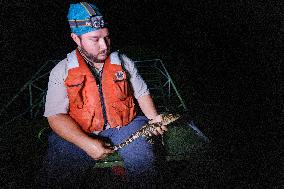
Kevin Olejniczak, wildlife technician, holds a small alligator during a research survey with the University of Florida Croc Docs team Thursday, November 7, 2024, in Everglades National Park. This one was too small to tell the sex, so they put it back and do not collect data on smaller creatures. Alligators like to hunt in the dark but tonight they’re the creatures being stalked, not for sport but for science by two University of Florida wildlife biologists, Sergio Balaguera-Reina and Kevin Olejiczak. Alligators, along with their cousins and co-residents crocodiles, are sensitive to environmental changes in the Everglades. That makes them what scientists call a good “indicator species” for assessing progress in the on-going multibillion-dollar effort to restore the natural water flow to the sprawling River of Grass. Gators are a bit like Goldilocks. Too much water, and they use too much energy trying to catching fish and other prey. Not enough, and they struggle to move or mate. They need the water just right.

  •  
Gators Are Sensitive To Environmental Changes - Everglades

Gators Are Sensitive To Environmental Changes - Everglades

Kevin Olejniczak, wildlife technician, holds down an American alligator while his partner collects data during a research survey with the University of Florida Croc Docs team Thursday, November 7, 2024, in Everglades National Park. The alligators health is a good indicator of the health of the Everglades. Alligators like to hunt in the dark but tonight they’re the creatures being stalked, not for sport but for science by two University of Florida wildlife biologists, Sergio Balaguera-Reina and Kevin Olejiczak. Alligators, along with their cousins and co-residents crocodiles, are sensitive to environmental changes in the Everglades. That makes them what scientists call a good “indicator species” for assessing progress in the on-going multibillion-dollar effort to restore the natural water flow to the sprawling River of Grass. Gators are a bit like Goldilocks. Too much water, and they use too much energy trying to catching fish and other prey. Not enough, and they struggle to move or mate. They need the water j

  •  
Gators Are Sensitive To Environmental Changes - Everglades

Gators Are Sensitive To Environmental Changes - Everglades

Kevin Olejniczak, wildlife technician, left, holds an American alligator while Sergio Balaguera-Reina, research scientist studying conservation biology, collects data during a research survey with the University of Florida Croc Docs team Thursday, November 7, 2024, in Everglades National Park. The alligators health is a good indicator of the health of the Everglades. Alligators like to hunt in the dark but tonight they’re the creatures being stalked, not for sport but for science by two University of Florida wildlife biologists, Sergio Balaguera-Reina and Kevin Olejiczak. Alligators, along with their cousins and co-residents crocodiles, are sensitive to environmental changes in the Everglades. That makes them what scientists call a good “indicator species” for assessing progress in the on-going multibillion-dollar effort to restore the natural water flow to the sprawling River of Grass. Gators are a bit like Goldilocks. Too much water, and they use too much energy trying to catching fish and other prey. Not e

  •  
Chinese Experience in Desert Controi

Chinese Experience in Desert Controi

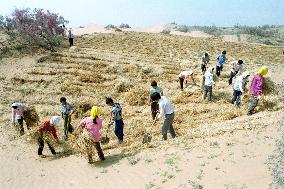
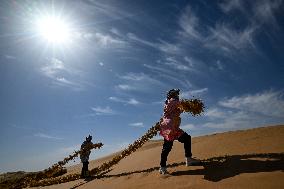
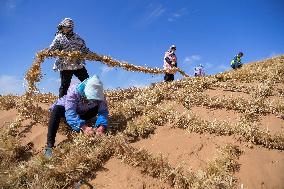
Workers set up straw checkerboards in Zhongwei, northwest China's Ningxia Hui Autonomous Region, Sept. 24, 1994. In the 1950s, to protect China's first railway that runs through a desert, the city of Zhongwei embarked on a journey of desert mitigation. Scientists at the Shapotou Desert Research and Experiment Station, part of the Northwest Institute of Eco-Environment and Resources of the Chinese Academy of Sciences, along with local residents, developed straw checkerboards to stabilize the sand and prevent dunes from shifting. Tang Ximing, a senior engineer at a state-owned forestry farm in Zhongwei, crafted a steel tool that differs from regular shovels by featuring two horizontal bars at the front tip. This innovative tool enables the planting of seedling roots 50 centimeters deep into the moist sand layer. This simple tool increases the survival rate of afforestation by 25 percent to over 85 percent. It has been widely promoted and used in afforestation projects across other regions in northern China. In

  •  
Chinese Experience in Desert Controi

Chinese Experience in Desert Controi

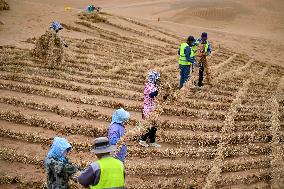
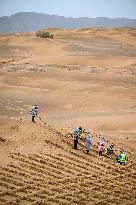
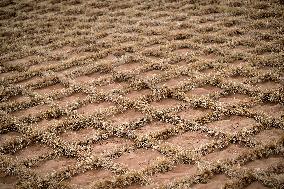
Workers pave straw checkerboards in the Tengger Desert, in Zhongwei of northwest China's Ningxia Hui Autonomous Region, May 29, 2024. In the 1950s, to protect China's first railway that runs through a desert, the city of Zhongwei embarked on a journey of desert mitigation. Scientists at the Shapotou Desert Research and Experiment Station, part of the Northwest Institute of Eco-Environment and Resources of the Chinese Academy of Sciences, along with local residents, developed straw checkerboards to stabilize the sand and prevent dunes from shifting. Tang Ximing, a senior engineer at a state-owned forestry farm in Zhongwei, crafted a steel tool that differs from regular shovels by featuring two horizontal bars at the front tip. This innovative tool enables the planting of seedling roots 50 centimeters deep into the moist sand layer. This simple tool increases the survival rate of afforestation by 25 percent to over 85 percent. It has been widely promoted and used in afforestation projects across other regions i

  •  
Chinese Experience in Desert Controi

Chinese Experience in Desert Controi

Workers pave straw checkerboards in the Tengger Desert, in Zhongwei of northwest China's Ningxia Hui Autonomous Region, May 30, 2024. In the 1950s, to protect China's first railway that runs through a desert, the city of Zhongwei embarked on a journey of desert mitigation. Scientists at the Shapotou Desert Research and Experiment Station, part of the Northwest Institute of Eco-Environment and Resources of the Chinese Academy of Sciences, along with local residents, developed straw checkerboards to stabilize the sand and prevent dunes from shifting. Tang Ximing, a senior engineer at a state-owned forestry farm in Zhongwei, crafted a steel tool that differs from regular shovels by featuring two horizontal bars at the front tip. This innovative tool enables the planting of seedling roots 50 centimeters deep into the moist sand layer. This simple tool increases the survival rate of afforestation by 25 percent to over 85 percent. It has been widely promoted and used in afforestation projects across other regions i

  •  
Chinese Experience in Desert Controi

Chinese Experience in Desert Controi

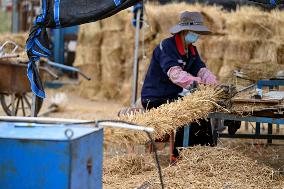
Workers produce straw checkerboard materials in Zhongwei of northwest China's Ningxia Hui Autonomous Region, May 29, 2024. In the 1950s, to protect China's first railway that runs through a desert, the city of Zhongwei embarked on a journey of desert mitigation. Scientists at the Shapotou Desert Research and Experiment Station, part of the Northwest Institute of Eco-Environment and Resources of the Chinese Academy of Sciences, along with local residents, developed straw checkerboards to stabilize the sand and prevent dunes from shifting. Tang Ximing, a senior engineer at a state-owned forestry farm in Zhongwei, crafted a steel tool that differs from regular shovels by featuring two horizontal bars at the front tip. This innovative tool enables the planting of seedling roots 50 centimeters deep into the moist sand layer. This simple tool increases the survival rate of afforestation by 25 percent to over 85 percent. It has been widely promoted and used in afforestation projects across other regions in northern

  •  
Chinese Experience in Desert Controi

Chinese Experience in Desert Controi

Workers set up straw checkerboards in Zhongwei, northwest China's Ningxia Hui Autonomous Region, June 13, 2019. In the 1950s, to protect China's first railway that runs through a desert, the city of Zhongwei embarked on a journey of desert mitigation. Scientists at the Shapotou Desert Research and Experiment Station, part of the Northwest Institute of Eco-Environment and Resources of the Chinese Academy of Sciences, along with local residents, developed straw checkerboards to stabilize the sand and prevent dunes from shifting. Tang Ximing, a senior engineer at a state-owned forestry farm in Zhongwei, crafted a steel tool that differs from regular shovels by featuring two horizontal bars at the front tip. This innovative tool enables the planting of seedling roots 50 centimeters deep into the moist sand layer. This simple tool increases the survival rate of afforestation by 25 percent to over 85 percent. It has been widely promoted and used in afforestation projects across other regions in northern China. In 2

  •  
Chinese Experience in Desert Controi

Chinese Experience in Desert Controi

Workers pave straw checkerboards in the Tengger Desert, in Zhongwei of northwest China's Ningxia Hui Autonomous Region, May 29, 2024. In the 1950s, to protect China's first railway that runs through a desert, the city of Zhongwei embarked on a journey of desert mitigation. Scientists at the Shapotou Desert Research and Experiment Station, part of the Northwest Institute of Eco-Environment and Resources of the Chinese Academy of Sciences, along with local residents, developed straw checkerboards to stabilize the sand and prevent dunes from shifting. Tang Ximing, a senior engineer at a state-owned forestry farm in Zhongwei, crafted a steel tool that differs from regular shovels by featuring two horizontal bars at the front tip. This innovative tool enables the planting of seedling roots 50 centimeters deep into the moist sand layer. This simple tool increases the survival rate of afforestation by 25 percent to over 85 percent. It has been widely promoted and used in afforestation projects across other regions i

  •  
Chinese Experience in Desert Controi

Chinese Experience in Desert Controi

Workers pave straw checkerboards in the Tengger Desert, in Zhongwei of northwest China's Ningxia Hui Autonomous Region, May 30, 2024. In the 1950s, to protect China's first railway that runs through a desert, the city of Zhongwei embarked on a journey of desert mitigation. Scientists at the Shapotou Desert Research and Experiment Station, part of the Northwest Institute of Eco-Environment and Resources of the Chinese Academy of Sciences, along with local residents, developed straw checkerboards to stabilize the sand and prevent dunes from shifting. Tang Ximing, a senior engineer at a state-owned forestry farm in Zhongwei, crafted a steel tool that differs from regular shovels by featuring two horizontal bars at the front tip. This innovative tool enables the planting of seedling roots 50 centimeters deep into the moist sand layer. This simple tool increases the survival rate of afforestation by 25 percent to over 85 percent. It has been widely promoted and used in afforestation projects across other regions i

  •  
Chinese Experience in Desert Controi

Chinese Experience in Desert Controi

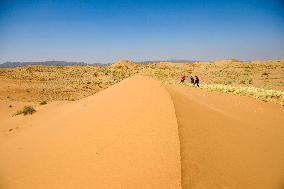
An aerial drone photo taken on May 29, 2024 shows straw checkerboards in the Tengger Desert, northwest China's Ningxia Hui Autonomous Region. In the 1950s, to protect China's first railway that runs through a desert, the city of Zhongwei embarked on a journey of desert mitigation. Scientists at the Shapotou Desert Research and Experiment Station, part of the Northwest Institute of Eco-Environment and Resources of the Chinese Academy of Sciences, along with local residents, developed straw checkerboards to stabilize the sand and prevent dunes from shifting. Tang Ximing, a senior engineer at a state-owned forestry farm in Zhongwei, crafted a steel tool that differs from regular shovels by featuring two horizontal bars at the front tip. This innovative tool enables the planting of seedling roots 50 centimeters deep into the moist sand layer. This simple tool increases the survival rate of afforestation by 25 percent to over 85 percent. It has been widely promoted and used in afforestation projects across other r

  •  
Chinese Experience in Desert Controi

Chinese Experience in Desert Controi

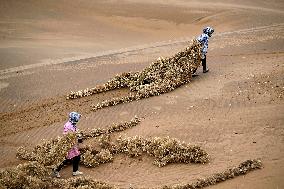
Workers carry straw checkerboards in the Tengger Desert, in Zhongwei of northwest China's Ningxia Hui Autonomous Region, May 30, 2024. In the 1950s, to protect China's first railway that runs through a desert, the city of Zhongwei embarked on a journey of desert mitigation. Scientists at the Shapotou Desert Research and Experiment Station, part of the Northwest Institute of Eco-Environment and Resources of the Chinese Academy of Sciences, along with local residents, developed straw checkerboards to stabilize the sand and prevent dunes from shifting. Tang Ximing, a senior engineer at a state-owned forestry farm in Zhongwei, crafted a steel tool that differs from regular shovels by featuring two horizontal bars at the front tip. This innovative tool enables the planting of seedling roots 50 centimeters deep into the moist sand layer. This simple tool increases the survival rate of afforestation by 25 percent to over 85 percent. It has been widely promoted and used in afforestation projects across other regions

  •  
Chinese Experience in Desert Controi

Chinese Experience in Desert Controi

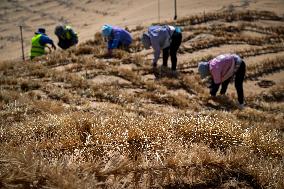
Workers pave straw checkerboards in the Tengger Desert, in Zhongwei of northwest China's Ningxia Hui Autonomous Region, May 30, 2024. In the 1950s, to protect China's first railway that runs through a desert, the city of Zhongwei embarked on a journey of desert mitigation. Scientists at the Shapotou Desert Research and Experiment Station, part of the Northwest Institute of Eco-Environment and Resources of the Chinese Academy of Sciences, along with local residents, developed straw checkerboards to stabilize the sand and prevent dunes from shifting. Tang Ximing, a senior engineer at a state-owned forestry farm in Zhongwei, crafted a steel tool that differs from regular shovels by featuring two horizontal bars at the front tip. This innovative tool enables the planting of seedling roots 50 centimeters deep into the moist sand layer. This simple tool increases the survival rate of afforestation by 25 percent to over 85 percent. It has been widely promoted and used in afforestation projects across other regions i

  •  
Comic Study Finds Laughter Helps Heart Health

Comic Study Finds Laughter Helps Heart Health

IComic: Study Finds Laughter helps heart health, Shanghai, China, August 29, 2023. Science has proven that regular laughter is actually good for you, especially when it comes to your heart health. Half of the patients were asked to watch two different hour-long comedy shows a week for three months, and the other half watched two different serious documentaries a week. When scientists examined their bodies at the end of the 12-week study, they found that the comedy patients' hearts had a 10 percent increase in the flow of oxygen throughout the body, and markers of inflammation were significantly lower. Coronary artery dilation also improved. Studies have found that laughter therapy is a good intervention to help reduce inflammation and reduce the risk of heart attack and stroke."

  •  
Comic Study Finds Laughter Helps Heart Health

Comic Study Finds Laughter Helps Heart Health

IComic: Study Finds Laughter helps heart health, Shanghai, China, August 29, 2023. Science has proven that regular laughter is actually good for you, especially when it comes to your heart health. Half of the patients were asked to watch two different hour-long comedy shows a week for three months, and the other half watched two different serious documentaries a week. When scientists examined their bodies at the end of the 12-week study, they found that the comedy patients' hearts had a 10 percent increase in the flow of oxygen throughout the body, and markers of inflammation were significantly lower. Coronary artery dilation also improved. Studies have found that laughter therapy is a good intervention to help reduce inflammation and reduce the risk of heart attack and stroke."

  •  
Comic Study Finds Laughter Helps Heart Health

Comic Study Finds Laughter Helps Heart Health

IComic: Study Finds Laughter helps heart health, Shanghai, China, August 29, 2023. Science has proven that regular laughter is actually good for you, especially when it comes to your heart health. Half of the patients were asked to watch two different hour-long comedy shows a week for three months, and the other half watched two different serious documentaries a week. When scientists examined their bodies at the end of the 12-week study, they found that the comedy patients' hearts had a 10 percent increase in the flow of oxygen throughout the body, and markers of inflammation were significantly lower. Coronary artery dilation also improved. Studies have found that laughter therapy is a good intervention to help reduce inflammation and reduce the risk of heart attack and stroke."

  •  
Winter illuminations light up Nagoya

Winter illuminations light up Nagoya

NAGOYA, Japan - Nagoya University professor Hiroshi Amano (front C) is congratulated on his winning of the 2014 Nobel Prize in Physics along with two other Japanese-born scientists, as he participated in a lighting ceremony to kick off winter illuminations in Nagoya, central Japan, on Nov. 14, 2014.

  •  
Fukuoka Tower illuminated with blue LEDs

Fukuoka Tower illuminated with blue LEDs

FUKUOKA, Japan - The 234-meter-tall Fukuoka Tower in the city of Fukuoka, southwestern Japan, is illuminated with blue light-emitting diodes and other lighting equipment on Oct. 7, 2014. Two Japanese scientists and one Japan-born scientist with U.S. citizenship were announced the same day as the winners of this year's Nobel Prize in Physics for the invention of blue LEDs.

  •  
PM Abe congratulates Nobel Prize winner Akasaki

PM Abe congratulates Nobel Prize winner Akasaki

TOKYO, Japan - Japanese Prime Minister Shinzo Abe offers congratulations over the phone to Isamu Akasaki, professor at Meijo University, who was announced as a winner of the Nobel Prize in Physics 2014 for the invention of efficient blue LEDs with two other scientists, in Tokyo on Oct. 7, 2014. (Pool photo)

  •  
Nobel laureate Akasaki back in 2006

Nobel laureate Akasaki back in 2006

TOKYO, Japan - Isamu Akasaki (C), professor emeritus at Nagoya University, central Japan, poses for photos in October 2006 in front of a large light-emitting diode display at Akasaki Memorial Research Center at the university in Nagoya. Akasaki was announced as a winner of the Nobel Prize in Physics 2014 for the invention of efficient blue LEDs with two other scientists in October 2014.

  •  
2014 Nobel winner Nakamura in 2005

2014 Nobel winner Nakamura in 2005

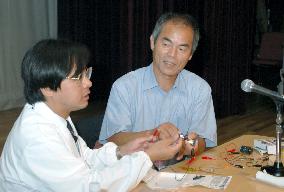
TOKYO, Japan - Shuji Nakamura (R), a Japan-born professor at UC Santa Barbara, conducts an experiment using light-emitting diodes before junior and senior high school students in Sakae village, Nagano Prefecture, central Japan, in July 2005. Nakamura was announced as a winner of the Nobel Prize in Physics 2014 for the invention of efficient blue LEDs along with two other Japanese scientists in October 2014.

  •  
Noyori heads to Stockholm for Nobel Prize ceremony

Noyori heads to Stockholm for Nobel Prize ceremony

NARITA, Japan - Japanese chemist Ryoji Noyori, who won the 2001 Nobel Prize in Chemistry along with two other scientists, prepares to leave Narita airport, east of Tokyo, on Dec. 5 to attend an award ceremony in Stockholm on Dec. 10.

  •  
Noyori with students for 1st time since winning Nobel prize

Noyori with students for 1st time since winning Nobel prize

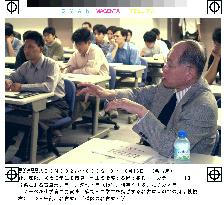
NAGOYA, Japan - Japanese chemist Ryoji Noyori, who along with two other scientists won the 2001 Nobel Prize in Chemistry, makes his first public appearance before students Oct. 13 at a Nagoya University academic venue, since being proclaimed a winner of the coveted prize. During the session, Noyori, 63, listened to students read their research papers.

  •  
(EyesonSci)CHINA-QINGHAI-SCIENTIFIC EXPEDITION-BIODIVERSITY (CN)

(EyesonSci)CHINA-QINGHAI-SCIENTIFIC EXPEDITION-BIODIVERSITY (CN)

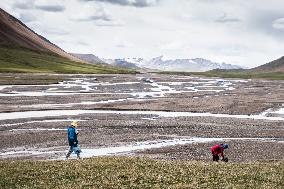
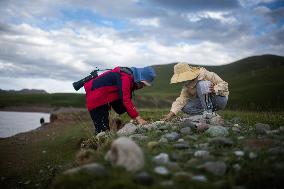
(220727) -- YUSHU, July 27, 2022 (Xinhua) -- Fan Yadong (L) and Zhang Guoyue, members of a scientific expedition team, collect insect samples from a source of the Yangtze River in northwest China's Qinghai Province, July 26, 2022. Chinese scientists launched an expedition on Sunday in the headwater regions of the Yangtze and Lancang rivers in northwest China's Qinghai Province, to investigate the regions' water resources and ecological environment. Zhang Guoyue and Fan Yadong are two female members of the scientific expedition team. To fulfill their duties as "insect catchers" for the sake of biodiversity survey, Zhang and Fan have to work day and night in the headwater regions of the Yangtze and Lancang rivers, regardless of fatigue from long hours of work, coldness at night, and thin air on the Qinghai-Tibet Plateau. The expedition will conduct scientific investigations into the water resources, river hydrology, water ecology, glaciers, soil erosion and permafrost of the regions, among other things, accor

  •  
(EyesonSci)CHINA-QINGHAI-SCIENTIFIC EXPEDITION-BIODIVERSITY (CN)

(EyesonSci)CHINA-QINGHAI-SCIENTIFIC EXPEDITION-BIODIVERSITY (CN)

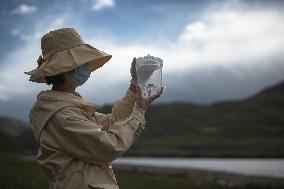
(220727) -- YUSHU, July 27, 2022 (Xinhua) -- Fan Yadong, a member of a scientific expedition team, observes an insect sample she has collected from a source of the Yangtze River in northwest China's Qinghai Province, July 26, 2022. Chinese scientists launched an expedition on Sunday in the headwater regions of the Yangtze and Lancang rivers in northwest China's Qinghai Province, to investigate the regions' water resources and ecological environment. Zhang Guoyue and Fan Yadong are two female members of the scientific expedition team. To fulfill their duties as "insect catchers" for the sake of biodiversity survey, Zhang and Fan have to work day and night in the headwater regions of the Yangtze and Lancang rivers, regardless of fatigue from long hours of work, coldness at night, and thin air on the Qinghai-Tibet Plateau. The expedition will conduct scientific investigations into the water resources, river hydrology, water ecology, glaciers, soil erosion and permafrost of the regions, among other things, acco

  •  
(EyesonSci)CHINA-QINGHAI-SCIENTIFIC EXPEDITION-BIODIVERSITY (CN)

(EyesonSci)CHINA-QINGHAI-SCIENTIFIC EXPEDITION-BIODIVERSITY (CN)

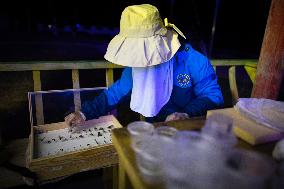
(220727) -- YUSHU, July 27, 2022 (Xinhua) -- Fan Yadong, a member of a scientific expedition team, makes insect specimens in northwest China's Qinghai Province, July 24, 2022. Chinese scientists launched an expedition on Sunday in the headwater regions of the Yangtze and Lancang rivers in northwest China's Qinghai Province, to investigate the regions' water resources and ecological environment. Zhang Guoyue and Fan Yadong are two female members of the scientific expedition team. To fulfill their duties as "insect catchers" for the sake of biodiversity survey, Zhang and Fan have to work day and night in the headwater regions of the Yangtze and Lancang rivers, regardless of fatigue from long hours of work, coldness at night, and thin air on the Qinghai-Tibet Plateau. The expedition will conduct scientific investigations into the water resources, river hydrology, water ecology, glaciers, soil erosion and permafrost of the regions, among other things, according to the Changjiang River Scientific Research Instit

  •  
(EyesonSci)CHINA-QINGHAI-SCIENTIFIC EXPEDITION-BIODIVERSITY (CN)

(EyesonSci)CHINA-QINGHAI-SCIENTIFIC EXPEDITION-BIODIVERSITY (CN)

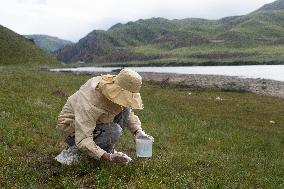
(220727) -- YUSHU, July 27, 2022 (Xinhua) -- Fan Yadong, a member of a scientific expedition team, collects insect samples from a source of the Yangtze River in northwest China's Qinghai Province, July 26, 2022. Chinese scientists launched an expedition on Sunday in the headwater regions of the Yangtze and Lancang rivers in northwest China's Qinghai Province, to investigate the regions' water resources and ecological environment. Zhang Guoyue and Fan Yadong are two female members of the scientific expedition team. To fulfill their duties as "insect catchers" for the sake of biodiversity survey, Zhang and Fan have to work day and night in the headwater regions of the Yangtze and Lancang rivers, regardless of fatigue from long hours of work, coldness at night, and thin air on the Qinghai-Tibet Plateau. The expedition will conduct scientific investigations into the water resources, river hydrology, water ecology, glaciers, soil erosion and permafrost of the regions, among other things, according to the Changji

  •  
(EyesonSci)CHINA-QINGHAI-SCIENTIFIC EXPEDITION-BIODIVERSITY (CN)

(EyesonSci)CHINA-QINGHAI-SCIENTIFIC EXPEDITION-BIODIVERSITY (CN)

(220727) -- YUSHU, July 27, 2022 (Xinhua) -- Zhang Guoyue (L) and Fan Yadong, members of a scientific expedition team, collect insect samples from a source of the Yangtze River in northwest China's Qinghai Province, July 26, 2022. Chinese scientists launched an expedition on Sunday in the headwater regions of the Yangtze and Lancang rivers in northwest China's Qinghai Province, to investigate the regions' water resources and ecological environment. Zhang Guoyue and Fan Yadong are two female members of the scientific expedition team. To fulfill their duties as "insect catchers" for the sake of biodiversity survey, Zhang and Fan have to work day and night in the headwater regions of the Yangtze and Lancang rivers, regardless of fatigue from long hours of work, coldness at night, and thin air on the Qinghai-Tibet Plateau. The expedition will conduct scientific investigations into the water resources, river hydrology, water ecology, glaciers, soil erosion and permafrost of the regions, among other things, accor

  •  
Noyori heads to Stockholm for Nobel Prize ceremony

Noyori heads to Stockholm for Nobel Prize ceremony

NARITA, Japan - Japanese chemist Ryoji Noyori, who won the 2001 Nobel Prize in Chemistry along with two other scientists, prepares to leave Narita airport, east of Tokyo, on Dec. 5 to attend an award ceremony in Stockholm on Dec. 10.

  •  
Nobel award ceremony takes place, 3 Japanese scientists honored

Nobel award ceremony takes place, 3 Japanese scientists honored

STOCKHOLM, Sweden - Osamu Shimomura, professor emeritus at Boston University, receives his medal and diploma from Sweden's King Carl XVI Gustaf at the Stockholm Concert Hall on Dec. 10. Shimomura shared the prize in chemistry with two other scientists -- Martin Chalfie, a professor at Columbia University, and Roger Tsien, a professor at the University of California in San Diego. (Pool photo by Kyodo) (Kyodo)

  •  
Omura donates research equipment

Omura donates research equipment

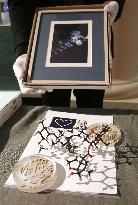
Photo taken Dec. 6, 2015, shows research equipment, including a petri dish (below), and other items donated by Japanese biologist Satoshi Omura, jointly awarded the Nobel Prize in Physiology or Medicine, to the Nobel Museum in Stockholm. Omura and two scientists from Ireland and China were awarded for their discoveries concerning therapies against parasitic diseases. (Kyodo) ==Kyodo

  •  
PM Abe congratulates Nobel Prize winner Akasaki

PM Abe congratulates Nobel Prize winner Akasaki

TOKYO, Japan - Japanese Prime Minister Shinzo Abe offers congratulations over the phone to Isamu Akasaki, professor at Meijo University, who was announced as a winner of the Nobel Prize in Physics 2014 for the invention of efficient blue LEDs with two other scientists, in Tokyo on Oct. 7, 2014. (Pool photo)(Kyodo)

  • Main
  • Top
  • Editorial
  • Creative
  • About Us
  • About ILG
  • Terms of use
  • Company
  • BEHIND
  • Price List
  • Single Plan
  • Monthly Plan
  • Services
  • Shooting
  • Rights Clearance
  • Support
  • FAQ
  • How To Buy
  • Contact Us
  • Become a Partner

© KYODO NEWS IMAGES INC

All Rights Reserved.

  • Editorial
  • Olympics
  • News
  • Sports
  • Japan
  • Tech
  • Royal
  • Disaster
  • NorthKorea
  • Old Japan
  • SNS

  • Creative
  • Food
  • Japan
  • Landscape
  • Animal
  • Popular
  • #Ukraine
  • #China
  • #coronavirus
  • #N. Korea
  • #Thailand
  • #Russia
  • #Ukraine
  • #China
  • #coronavirus
  • #N. Korea
  • #Thailand
  • #Russia
  • Food
  • Japan
  • Landscape
  • Animal
  • Olympics
  • News
  • Sports
  • Japan
  • Tech
  • Royal
  • Disaster
  • NorthKorea
  • Old Japan
  • SNS