•  
First images From Copernicus Sentinel-5A

First images From Copernicus Sentinel-5A

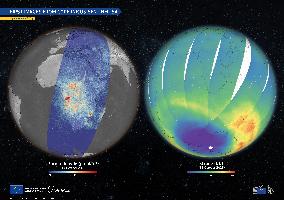
Handout photo dated October 13, 2025 shows Copernicus Sentinel-5A has delivered its first images after its launch on 13 August 2025, marking a significant milestone in the monitoring of air quality from space. The Sentinel-5 mission provides observations of key air pollutants, essential climate variables, and stratospheric ozone, which is the protective layer shielding life on Earth from harmful ultraviolet radiation. This visualisation, created with Sentinel-5A data acquired on 13 October 2025, shows atmospheric concentrations of two trace gases: ozone (O₃) and formaldehyde (HCHO). The image on the left presents the formaldehyde vertical column density. Elevated concentrations along the northwestern coast of Angola are linked to emissions from wildfires, while increased levels over the Central African Republic stem from a combination of fire activity and biogenic emissions. The image on the right shows a global map of ozone. The hole in stratospheric ozone above Antarctica is clearly visible, with column den

  •  
First Images acquired by Sentinel-1D

First Images acquired by Sentinel-1D

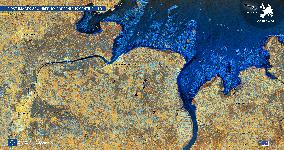
Handout photo dated on November 7, 2025 shows following its launch on 4 November 2025, Copernicus Sentinel-1D has delivered its first images. Among these is this radar image acquired on 7 November 2025, showing northern Germany. The false colour visualisation of the image highlights different types of land cover such as cultivated fields, water bodies, and urban areas, including the cities of Bremen, Bremerhaven, Oldenburg, and Meldorf. The Elbe and Weser rivers flowing into the North Sea are visible in deep blue tones, along with the Wadden Sea. Bremen, Germany on November 7, 2025. Photo by European Union, Copernicus Sentinel-1 imagery via ABACAPRESS.COM

  •  
October 2025, the Third Warmest October on Record

October 2025, the Third Warmest October on Record

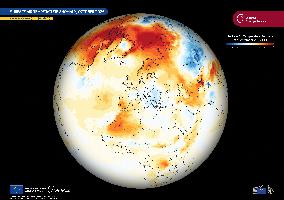
Handout photo dated on 2025 shows The Copernicus Climate Change Service (C3S) has published its latest monthly Climate Bulletin, which focuses on key climate trends in October 2025. The bulletin reports that October 2025 was the third-warmest October globally, with an average surface air temperature of 15.14°C, 0.70°C above the 1991-2020 average for the month. This data visualisation, produced using C3S data, illustrates the surface air temperature anomalies across part of the Northern Hemisphere in October 2025. Warmer-than-average temperatures have been observed over much of northern and western Europe, where the average temperature was 10.19°C, 0.60°C above the average for the month. The Arctic Ocean northeast of Svalbard and the Canadian Arctic Archipelago have also been particularly affected, with surface air temperature anomalies reaching up to 8 °C above average. Photo by European Union, Copernicus Climate Change Service Data via ABACAPRESS.COM

  •  
Wildfire in the Peloponnese Region - Greece

Wildfire in the Peloponnese Region - Greece

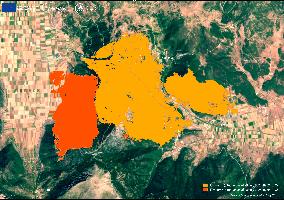
Handout photo dated on July 22, 2025 shows On 22 July 2025, a wildfire erupted in Greece's Northern Peloponnese region, devastating a significant portion of the landscape. Over 340 firefighters, supported by aerial and ground units, worked to combat the flames. On the same day of the fire’s outbreak, the Greek Disaster Planning and Management Directorate - General secretariat for Civil protection - Ministry of Climate Change and Civil Protection activated the Copernicus Emergency Management Service (CEMS) to provide emergency mapping (EMSR815). This data visualisation, based on CEMS data, shows the evolution of the affected area between 23 and 24 July. Greece on July 22, 2025. Photo by European Union, Copernicus Emergency Management Service via ABACAPRESS.COM

  •  
Pillars of Creation Star in New Visualization from NASA's Hubble and Webb Telescopes

Pillars of Creation Star in New Visualization from NASA's Hubble and Webb Telescopes

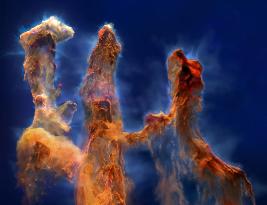
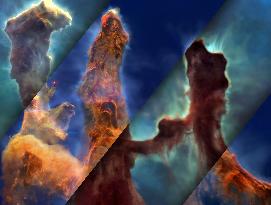
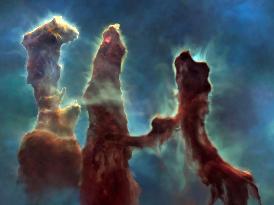
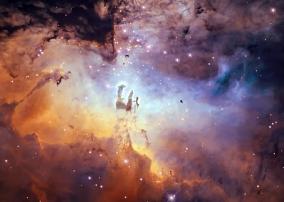
HANDOUT - The Pillars of Creation are one of the most iconic and beautiful sights in deep space - and now NASA has released a 3D visualisation allowing us to really see inside the most stunning part of the Eagle Nebula. Made famous in 1995 by NASA's Hubble Space Telescope, the Pillars of Creation are giant clouds where stars are born. Using data from NASA's Hubble and James Webb space telescopes, astronomers have created a comprehensive and detailed multiwavelength look at these towering celestial structures. By flying past and amongst the pillars, viewers experience their three-dimensional structure and see how they look different in the Hubble visible-light view versus the Webb infrared-light view," explained principal visualization scientist Frank Summers of the Space Telescope Science Institute (STScI) in Baltimore, who led the movie development team for NASA's Universe of Learning. The four Pillars of Creation, made primarily of cool molecular hydrogen and dust, are being eroded by the fierce winds and p

  •  
Pillars of Creation Star in New Visualization from NASA's Hubble and Webb Telescopes

Pillars of Creation Star in New Visualization from NASA's Hubble and Webb Telescopes

HANDOUT - The Pillars of Creation are one of the most iconic and beautiful sights in deep space - and now NASA has released a 3D visualisation allowing us to really see inside the most stunning part of the Eagle Nebula. Made famous in 1995 by NASA's Hubble Space Telescope, the Pillars of Creation are giant clouds where stars are born. Using data from NASA's Hubble and James Webb space telescopes, astronomers have created a comprehensive and detailed multiwavelength look at these towering celestial structures. By flying past and amongst the pillars, viewers experience their three-dimensional structure and see how they look different in the Hubble visible-light view versus the Webb infrared-light view," explained principal visualization scientist Frank Summers of the Space Telescope Science Institute (STScI) in Baltimore, who led the movie development team for NASA's Universe of Learning. The four Pillars of Creation, made primarily of cool molecular hydrogen and dust, are being eroded by the fierce winds and p

  •  
Pillars of Creation Star in New Visualization from NASA's Hubble and Webb Telescopes

Pillars of Creation Star in New Visualization from NASA's Hubble and Webb Telescopes

HANDOUT - The Pillars of Creation are one of the most iconic and beautiful sights in deep space - and now NASA has released a 3D visualisation allowing us to really see inside the most stunning part of the Eagle Nebula. Made famous in 1995 by NASA's Hubble Space Telescope, the Pillars of Creation are giant clouds where stars are born. Using data from NASA's Hubble and James Webb space telescopes, astronomers have created a comprehensive and detailed multiwavelength look at these towering celestial structures. By flying past and amongst the pillars, viewers experience their three-dimensional structure and see how they look different in the Hubble visible-light view versus the Webb infrared-light view," explained principal visualization scientist Frank Summers of the Space Telescope Science Institute (STScI) in Baltimore, who led the movie development team for NASA's Universe of Learning. The four Pillars of Creation, made primarily of cool molecular hydrogen and dust, are being eroded by the fierce winds and p

  •  
Pillars of Creation Star in New Visualization from NASA's Hubble and Webb Telescopes

Pillars of Creation Star in New Visualization from NASA's Hubble and Webb Telescopes

HANDOUT - The Pillars of Creation are one of the most iconic and beautiful sights in deep space - and now NASA has released a 3D visualisation allowing us to really see inside the most stunning part of the Eagle Nebula. Made famous in 1995 by NASA's Hubble Space Telescope, the Pillars of Creation are giant clouds where stars are born. Using data from NASA's Hubble and James Webb space telescopes, astronomers have created a comprehensive and detailed multiwavelength look at these towering celestial structures. By flying past and amongst the pillars, viewers experience their three-dimensional structure and see how they look different in the Hubble visible-light view versus the Webb infrared-light view," explained principal visualization scientist Frank Summers of the Space Telescope Science Institute (STScI) in Baltimore, who led the movie development team for NASA's Universe of Learning. The four Pillars of Creation, made primarily of cool molecular hydrogen and dust, are being eroded by the fierce winds and p

  •  
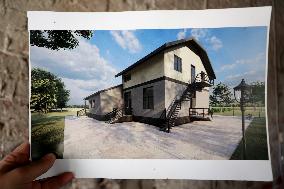
Kalush hospital and rehabilitation centre for military

Kalush hospital and rehabilitation centre for military

KALUSH, UKRAINE - MARCH 4, 2024 - A visualisation of a rehabilitation centre for the military is seen in the printout, Kalush, Ivano-Frankivsk region, western Ukraine.

  •  
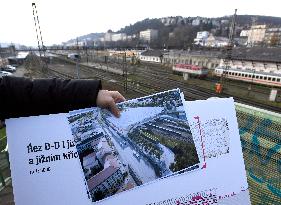
visualisation of future of new Smichov Terminal

visualisation of future of new Smichov Terminal

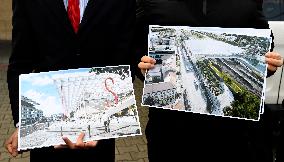
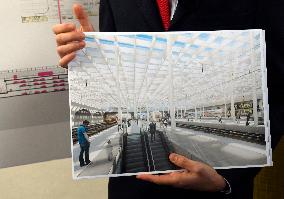
Press conference on future of new Smichov Terminal during guided tour of Prague-Smichov railway station took place at Prague-Smichov railway station, Prague, Czech Republic, on Tuesday, November 19, 2019. (CTK Photo/Michal Krumphanzl)

  •  
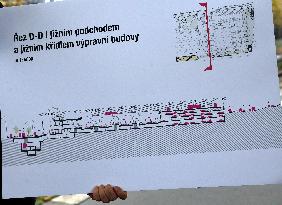
visualisation of future of new Smichov Terminal

visualisation of future of new Smichov Terminal

Press conference on future of new Smichov Terminal during guided tour of Prague-Smichov railway station took place at Prague-Smichov railway station, Prague, Czech Republic, on Tuesday, November 19, 2019. (CTK Photo/Michal Krumphanzl)

  •  
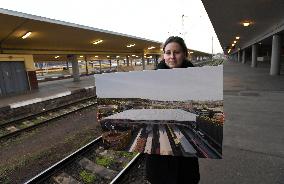
visualisation of future of new Smichov Terminal

visualisation of future of new Smichov Terminal

Press conference on future of new Smichov Terminal during guided tour of Prague-Smichov railway station took place at Prague-Smichov railway station, Prague, Czech Republic, on Tuesday, November 19, 2019. (CTK Photo/Michal Krumphanzl)

  •  
visualisation of future of new Smichov Terminal

visualisation of future of new Smichov Terminal

Press conference on future of new Smichov Terminal during guided tour of Prague-Smichov railway station took place at Prague-Smichov railway station, Prague, Czech Republic, on Tuesday, November 19, 2019. (CTK Photo/Michal Krumphanzl)

  •  
visualisation of future of new Smichov Terminal

visualisation of future of new Smichov Terminal

Press conference on future of new Smichov Terminal during guided tour of Prague-Smichov railway station took place at Prague-Smichov railway station, Prague, Czech Republic, on Tuesday, November 19, 2019. (CTK Photo/Michal Krumphanzl)

  • Main
  • Top
  • Editorial
  • Creative
  • About Us
  • About ILG
  • Terms of use
  • Company
  • BEHIND
  • Price List
  • Single Plan
  • Monthly Plan
  • Services
  • Shooting
  • Rights Clearance
  • Support
  • FAQ
  • How To Buy
  • Contact Us
  • Become a Partner

© KYODO NEWS IMAGES INC

All Rights Reserved.

  • Editorial
  • Olympics
  • News
  • Sports
  • Japan
  • Tech
  • Royal
  • Disaster
  • NorthKorea
  • Old Japan
  • SNS
  • Creative
  • Food
  • Japan
  • Landscape
  • Animal
  • Popular
  • #Ukraine
  • #Russia
  • #coronavirus
  • #N. Korea
  • #China
  • #Thailand
  • #Ukraine
  • #Russia
  • #coronavirus
  • #N. Korea
  • #China
  • #Thailand
  • Food
  • Japan
  • Landscape
  • Animal
  • Olympics
  • News
  • Sports
  • Japan
  • Tech
  • Royal
  • Disaster
  • NorthKorea
  • Old Japan
  • SNS