•  
Red Spider Nebula

Red Spider Nebula

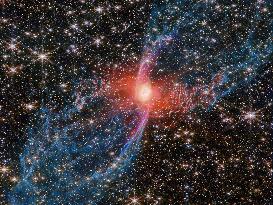
Handout photo dated on October 26, 2025 shows Red Spider Nebula. Using its Near-InfraRed Camera (NIRCam), NASA’s James Webb Space Telescope captured never-before-seen details of the Red Spider Nebula, a planetary nebula, in this image released on Oct. 26, 2025. NIRCam is Webb’s primary near-infrared imager, providing high-resolution imaging and spectroscopy for a wide variety of investigations. Webb’s new view of the Red Spider Nebula reveals for the first time the full extent of the nebula’s outstretched lobes, which form the ‘legs’ of the spider. These lobes, shown in blue, are traced by light emitted from H2 molecules, which contain two hydrogen atoms bonded together. Stretching over the entirety of NIRCam’s field of view, these lobes are shown to be closed, bubble-like structures that each extend about 3 light-years. Outflowing gas from the center of the nebula has inflated these massive bubbles over thousands of years. Photo by ESA/Webb, NASA & CSA, J. H. Kastner (Rochester Institute of Technolo via ABAC

  •  
Webb Reveals Sombrero Galaxy's Hidden Details

Webb Reveals Sombrero Galaxy's Hidden Details

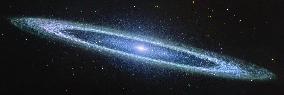
Handout photo dated November 25, 2024 shows NASA’s James Webb Space Telescope recently imaged the Sombrero Galaxy with its MIRI (Mid-Infrared Instrument), resolving the clumpy nature of the dust along the galaxy’s outer ring. NASA’s James Webb Space Telescope captures the Sombrero Galaxy (Messier 104) in stunning mid-infrared detail. This oblong galaxy, named for its resemblance to a wide-brimmed hat, reveals intricate clumps of dust along its outer ring, illuminated in shades of blue and white. Speckles of stars scatter its inner disk, while distant galaxies dot the black cosmic canvas in the background. The new image, taken with Webb's MIRI instrument, offers unprecedented insight into the galaxy’s structure and the faint traces of young star-forming regions. November 25, 2024. Photo by NASA via ABACAPRESS.COM

  •  
Webb Reveals Sombrero Galaxy's Hidden Details

Webb Reveals Sombrero Galaxy's Hidden Details

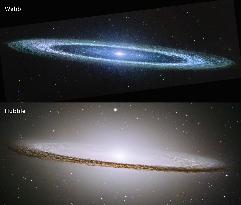
Handout photo dated November 25, 2024 shows the view of the famous Sombrero Galaxy in mid-infrared light (top) and visible light (bottom). The James Webb Space Telescope’s MIRI (Mid-Infrared Instrument) reveals the smooth inner disk of the galaxy, while the Hubble Space Telescope’s visible-light image shows the large and extended glow of the central bulge of stars. NASA’s James Webb Space Telescope captures the Sombrero Galaxy (Messier 104) in stunning mid-infrared detail. This oblong galaxy, named for its resemblance to a wide-brimmed hat, reveals intricate clumps of dust along its outer ring, illuminated in shades of blue and white. Speckles of stars scatter its inner disk, while distant galaxies dot the black cosmic canvas in the background. The new image, taken with Webb's MIRI instrument, offers unprecedented insight into the galaxy’s structure and the faint traces of young star-forming regions. November 25, 2024. Photo by NASA via ABACAPRESS.COM

  •  
Webb Reveals New Structures Within Iconic Supernova

Webb Reveals New Structures Within Iconic Supernova

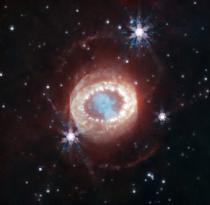
Handout - Webb’s NIRCam (Near-Infrared Camera) captured this detailed image of SN 1987A (Supernova 1987A). At the center, material ejected from the supernova forms a keyhole shape. Just to its left and right are faint crescents newly discovered by Webb. Beyond them an equatorial ring, formed from material ejected tens of thousands of years before the supernova explosion, contains bright hot spots. Exterior to that is diffuse emission and two faint outer rings. This image reveals a central structure like a keyhole. This center is packed with clumpy gas and dust ejected by the supernova explosion. The dust is so dense that even near-infrared light that Webb detects can’t penetrate it, shaping the dark “hole” in the keyhole. Despite the decades of study since the supernova’s initial discovery, there are several mysteries that remain, particularly surrounding the neutron star that should have been formed in the aftermath of the supernova explosion. August 31, 2023. Photo by NASA, ESA, CSA, M. Matsuura (Cardiff Un

  •  
James Webb View Of The Ring Nebula

James Webb View Of The Ring Nebula

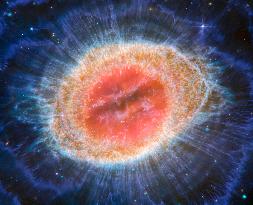
The NASA/ESA/CSA James Webb Space Telescope has observed the well-known Ring Nebula with unprecedented detail. Formed by a star throwing off its outer layers as it runs out of fuel, the Ring Nebula is an archetypal planetary nebula. Also known as M57 and NGC 6720, it is both relatively close to Earth at roughly 2,500 light-years away. This new image provides unprecedented spatial resolution and spectral sensitivity. In particular, Webb’s MIRI (Mid-InfraRed Instrument) reveals particular details in the concentric features in the outer regions of the nebulae’s ring (right). There are some 20,000 dense globules in the nebula, which are rich in molecular hydrogen. In contrast, the inner region shows very hot gas. The main shell contains a thin ring of enhanced emission fromcarbon-based molecules known as polycyclic aromatic hydrocarbons (PAHs). Roughly ten concentric arcs located just beyond the outer edge of the main ring. The arcs are thought to originate from the interaction of the central star with a low-mass

  •  
Webb Celebrates First Year of Science With Close-up on Birth of Sun-like Stars

Webb Celebrates First Year of Science With Close-up on Birth of Sun-like Stars

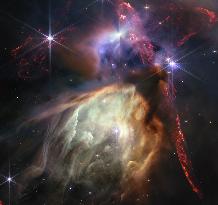
Handout - The first anniversary image from NASA’s James Webb Space Telescope displays star birth like it’s never been seen before, full of detailed, impressionistic texture. The subject is the Rho Ophiuchi cloud complex, the closest star-forming region to Earth. It is a relatively small, quiet stellar nursery, but you’d never know it from Webb’s chaotic close-up. Jets bursting from young stars crisscross the image, impacting the surrounding interstellar gas and lighting up molecular hydrogen, shown in red. Some stars display the telltale shadow of a circumstellar disk, the makings of future planetary systems. July 12, 2023. Photo by Klaus Pontoppidan/STScI, ASA, ESA, CSA /NASA via ABACAPRESS.COM

  •  
View Of Comet Helps Solve Mystery Of Earth's Abundant Water

View Of Comet Helps Solve Mystery Of Earth's Abundant Water

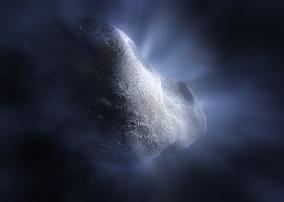
Handout - This artist’s concept of Comet 238P/Read shows the main belt comet sublimating—its water ice vaporising as its orbit approaches the Sun. This is significant, as the sublimation is what distinguishes comets from asteroids, creating their distinctive tail and hazy halo, or coma. The James Webb Space Telescope’s detection of water vapor at Comet Read is a major benchmark in the study of main belt comets, and in the broader investigation of the origin of Earth’s abundant water. NASA's James Webb Space Telescope has enabled another long-sought scientific breakthrough, this time for solar system scientists studying the origins of Earth's abundant water. Using Webb's NIRSpec (Near-Infrared Spectrograph) instrument, astronomers have confirmed gas – specifically water vapor – around a comet in the main asteroid belt for the first time, indicating that water ice from the primordial solar system can be preserved in that region. Comet Read is a main belt comet – an object that resides in the main asteroid belt

  •  
View Of Comet Helps Solve Mystery Of Earth's Abundant Water

View Of Comet Helps Solve Mystery Of Earth's Abundant Water

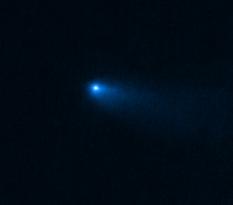
Handout - This image of Comet 238P/Read was captured by the NIRCam (Near-Infrared Camera) instrument on NASA’s James Webb Space Telescope on September 8, 2022. It displays the hazy halo, called the coma, and tail that are characteristic of comets, as opposed to asteroids. The dusty coma and tail result from the vaporization of ices as the Sun warms the main body of the comet. NASA's James Webb Space Telescope has enabled another long-sought scientific breakthrough, this time for solar system scientists studying the origins of Earth's abundant water. Using Webb's NIRSpec (Near-Infrared Spectrograph) instrument, astronomers have confirmed gas – specifically water vapor – around a comet in the main asteroid belt for the first time, indicating that water ice from the primordial solar system can be preserved in that region. Comet Read is a main belt comet – an object that resides in the main asteroid belt but which periodically displays a halo, or coma, and tail like a comet. Main belt comets themselves are a fair

  •  
U.S.-JAMES WEBB SPACE TELESCOPE-FIRST IMAGE

U.S.-JAMES WEBB SPACE TELESCOPE-FIRST IMAGE

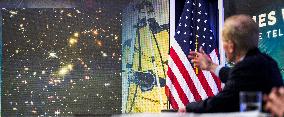
(220712) -- WASHINGTON, D.C., July 12, 2022 (Xinhua) -- U.S. President Joe Biden (2nd L) attends a preview event to release one of the James Webb Space Telescope's first images at the White House in Washington, D.C., the United States, July 11, 2022. U.S. President Joe Biden released one of the James Webb Space Telescope's first images in a preview event at the White House on Monday. This first image from Webb is the deepest and sharpest infrared image of the distant universe to date, NASA said. This image of galaxy cluster SMACS 0723 is filled with thousands of galaxies, including the faintest objects ever observed in the infrared, which have appeared in Webb's view for the first time, said NASA. (NASA/Bill Ingalls/Handout via Xinhua)

  •  
U.S.-JAMES WEBB SPACE TELESCOPE-FIRST IMAGE

U.S.-JAMES WEBB SPACE TELESCOPE-FIRST IMAGE

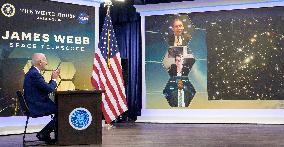
(220712) -- WASHINGTON, D.C., July 12, 2022 (Xinhua) -- NASA Administrator Bill Nelson describes the first image from the James Webb Space Telescope at the White House in Washington, D.C., the United States, July 11, 2022. U.S. President Joe Biden released one of the James Webb Space Telescope's first images in a preview event at the White House on Monday. This first image from Webb is the deepest and sharpest infrared image of the distant universe to date, NASA said. This image of galaxy cluster SMACS 0723 is filled with thousands of galaxies, including the faintest objects ever observed in the infrared, which have appeared in Webb's view for the first time, said NASA. (NASA/Bill Ingalls/Handout via Xinhua)

  •  
U.S.-JAMES WEBB SPACE TELESCOPE-FIRST IMAGE

U.S.-JAMES WEBB SPACE TELESCOPE-FIRST IMAGE

(220712) -- WASHINGTON, D.C., July 12, 2022 (Xinhua) -- U.S. President Joe Biden attends a preview event to release one of the James Webb Space Telescope's first images at the White House in Washington, D.C., the United States, July 11, 2022. U.S. President Joe Biden released one of the James Webb Space Telescope's first images in a preview event at the White House on Monday. This first image from Webb is the deepest and sharpest infrared image of the distant universe to date, NASA said. This image of galaxy cluster SMACS 0723 is filled with thousands of galaxies, including the faintest objects ever observed in the infrared, which have appeared in Webb's view for the first time, said NASA. (NASA/Bill Ingalls/Handout via Xinhua)

  •  
U.S.-JAMES WEBB SPACE TELESCOPE-FIRST IMAGE

U.S.-JAMES WEBB SPACE TELESCOPE-FIRST IMAGE

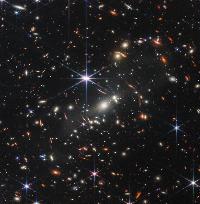
(220712) -- WASHINGTON, D.C., July 12, 2022 (Xinhua) -- Image released by NASA on July 11, 2022 shows galaxy cluster SMACS 0723, captured by the James Webb Space Telescope. U.S. President Joe Biden released one of the James Webb Space Telescope's first images in a preview event at the White House on Monday. This first image from Webb is the deepest and sharpest infrared image of the distant universe to date, NASA said. This image of galaxy cluster SMACS 0723 is filled with thousands of galaxies, including the faintest objects ever observed in the infrared, which have appeared in Webb's view for the first time, said NASA. (NASA/ESA/CSA/STScI/Handout via Xinhua)

  •  
NASA Delays The James Webb Space Telescope Launch Again

NASA Delays The James Webb Space Telescope Launch Again

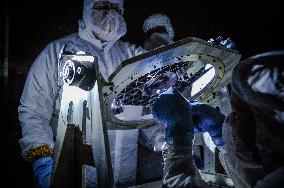
★Handout photo dated September 4, 2014 of NASA engineers inspect a new piece of technology developed for the James Webb Space Telescope, the micro shutter array, with a low light test at NASA's Goddard Space Flight Center in Greenbelt, Maryland. Developed at Goddard to allow Webb's Near Infrared Spectrograph to obtain spectra of more than 100 objects in the universe simultaneously, the micro shutter array uses thousands of tiny shutters to capture spectra from selected objects of interest in space and block out light from all other sources. Last summer, NASA and the European Space Agency (ESA) set an October 31, 2021, launch date for the $ 10 billion James Webb Space Telescope, but it's having to delay the science observatory's trip into space once again. Thankfully, the launch might take place just a few weeks later, in November or early December. A rescheduled date is unlikely to be con

  •  
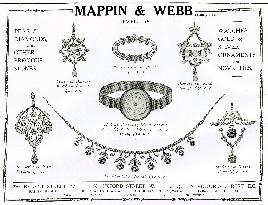
Advert for Mappin & Webb pearl and diamond jewellery 1912

Advert for Mappin & Webb pearl and diamond jewellery 1912

Selection of beautiful brooches, pendants and a necklace all made of pearls, diamonds and other precious stones Date: 1912

  • Main
  • Top
  • Editorial
  • Creative
  • About Us
  • About ILG
  • Terms of use
  • Company
  • BEHIND
  • Price List
  • Single Plan
  • Monthly Plan
  • Services
  • Shooting
  • Rights Clearance
  • Support
  • FAQ
  • How To Buy
  • Contact Us
  • Become a Partner

© KYODO NEWS IMAGES INC

All Rights Reserved.

  • Editorial
  • Olympics
  • News
  • Sports
  • Japan
  • Tech
  • Royal
  • Disaster
  • NorthKorea
  • Old Japan
  • SNS
  • Creative
  • Food
  • Japan
  • Landscape
  • Animal
  • Popular
  • #Ukraine
  • #China
  • #coronavirus
  • #N. Korea
  • #Russia
  • #Thailand
  • #Ukraine
  • #China
  • #coronavirus
  • #N. Korea
  • #Russia
  • #Thailand
  • Food
  • Japan
  • Landscape
  • Animal
  • Olympics
  • News
  • Sports
  • Japan
  • Tech
  • Royal
  • Disaster
  • NorthKorea
  • Old Japan
  • SNS