•  
Dege Sutra Printing House - Tibet

Dege Sutra Printing House - Tibet

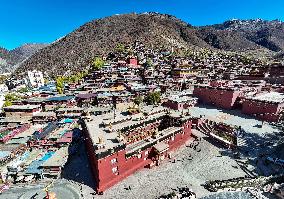
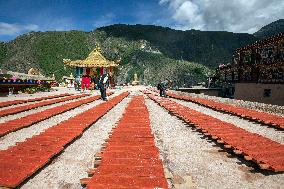
A drone photo taken on Nov. 2, 2024 shows the Dege Sutra Printing House in Dege County of Garze Tibetan Autonomous Prefecture, southwest China's Sichuan Province. Built in 1729, the Dege Sutra Printing House preserves in good condition 325,520 woodcut printing plates containing significant Tibetan classics dating back to the 11th century. The majority of the blocks were carved between the 18th and mid-20th centuries. The printing blocks housed at the Dege Sutra Printing House in Sichuan were listed in this May as documentary heritage on the Asia Pacific regional register of UNESCO's Memory of the World (MOW) Programme. Photo by Wang Xi/Xinhua/ABACAPRESSC.OM

  •  
Dege Sutra Printing House - Tibet

Dege Sutra Printing House - Tibet

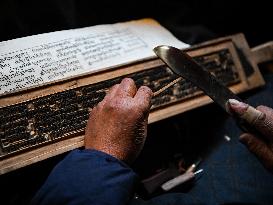
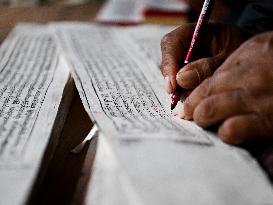
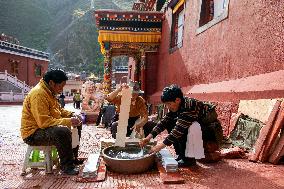
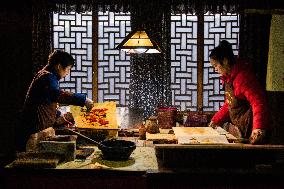
A worker revises a woodcut printing block at the Dege Sutra Printing House in Dege County of Garze Tibetan Autonomous Prefecture, southwest China's Sichuan Province, Nov. 2, 2024. Built in 1729, the Dege Sutra Printing House preserves in good condition 325,520 woodcut printing plates containing significant Tibetan classics dating back to the 11th century. The majority of the blocks were carved between the 18th and mid-20th centuries. The printing blocks housed at the Dege Sutra Printing House in Sichuan were listed in this May as documentary heritage on the Asia Pacific regional register of UNESCO's Memory of the World (MOW) Programme. Photo by Shen Bohan/Xinhua/ABACAPRESS.COM

  •  
Dege Sutra Printing House - Tibet

Dege Sutra Printing House - Tibet

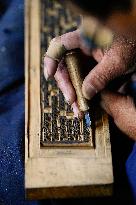
A worker carves a woodcut printing block at the Dege Sutra Printing House in Dege County of Garze Tibetan Autonomous Prefecture, southwest China's Sichuan Province, Nov. 2, 2024. Built in 1729, the Dege Sutra Printing House preserves in good condition 325,520 woodcut printing plates containing significant Tibetan classics dating back to the 11th century. The majority of the blocks were carved between the 18th and mid-20th centuries. The printing blocks housed at the Dege Sutra Printing House in Sichuan were listed in this May as documentary heritage on the Asia Pacific regional register of UNESCO's Memory of the World (MOW) Programme. Photo by Wang Xi/Xinhua/ABACAPRESSC.OM

  •  
Dege Sutra Printing House - Tibet

Dege Sutra Printing House - Tibet

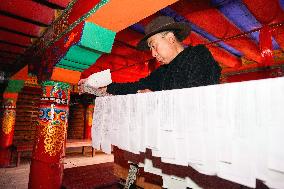
A worker airs fresh prints at the Dege Sutra Printing House in Dege County of Garze Tibetan Autonomous Prefecture, southwest China's Sichuan Province, Nov. 2, 2024. Built in 1729, the Dege Sutra Printing House preserves in good condition 325,520 woodcut printing plates containing significant Tibetan classics dating back to the 11th century. The majority of the blocks were carved between the 18th and mid-20th centuries. The printing blocks housed at the Dege Sutra Printing House in Sichuan were listed in this May as documentary heritage on the Asia Pacific regional register of UNESCO's Memory of the World (MOW) Programme. Photo by Shen Bohan/Xinhua/ABACAPRESS.COM

  •  
Dege Sutra Printing House - Tibet

Dege Sutra Printing House - Tibet

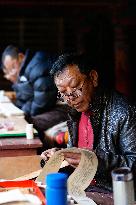
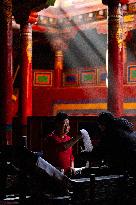
A worker proofreads newly made prints at the Dege Sutra Printing House in Dege County of Garze Tibetan Autonomous Prefecture, southwest China's Sichuan Province, Nov. 2, 2024. Built in 1729, the Dege Sutra Printing House preserves in good condition 325,520 woodcut printing plates containing significant Tibetan classics dating back to the 11th century. The majority of the blocks were carved between the 18th and mid-20th centuries. The printing blocks housed at the Dege Sutra Printing House in Sichuan were listed in this May as documentary heritage on the Asia Pacific regional register of UNESCO's Memory of the World (MOW) Programme. Photo by Wang Xi/Xinhua/ABACAPRESSC.OM

  •  
Dege Sutra Printing House - Tibet

Dege Sutra Printing House - Tibet

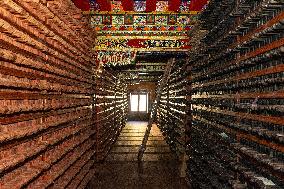
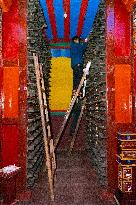
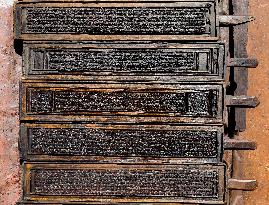
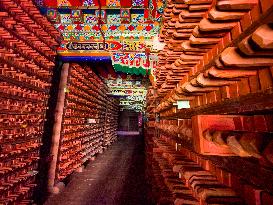
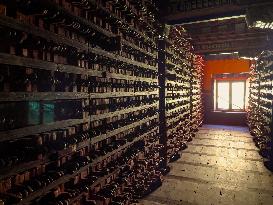
This photo taken on Nov. 2, 2024 shows woodcut printing blocks housed at the Dege Sutra Printing House in Dege County of Garze Tibetan Autonomous Prefecture, southwest China's Sichuan Province. Built in 1729, the Dege Sutra Printing House preserves in good condition 325,520 woodcut printing plates containing significant Tibetan classics dating back to the 11th century. The majority of the blocks were carved between the 18th and mid-20th centuries. The printing blocks housed at the Dege Sutra Printing House in Sichuan were listed in this May as documentary heritage on the Asia Pacific regional register of UNESCO's Memory of the World (MOW) Programme. Photo by Shen Bohan/Xinhua/ABACAPRESS.COM

  •  
Dege Sutra Printing House - Tibet

Dege Sutra Printing House - Tibet

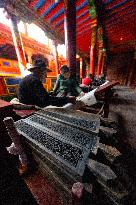
Workers print with vintage woodcut printing blocks at the Dege Sutra Printing House in Dege County of Garze Tibetan Autonomous Prefecture, southwest China's Sichuan Province, Nov. 2, 2024. Built in 1729, the Dege Sutra Printing House preserves in good condition 325,520 woodcut printing plates containing significant Tibetan classics dating back to the 11th century. The majority of the blocks were carved between the 18th and mid-20th centuries. The printing blocks housed at the Dege Sutra Printing House in Sichuan were listed in this May as documentary heritage on the Asia Pacific regional register of UNESCO's Memory of the World (MOW) Programme. Photo by Shen Bohan/Xinhua/ABACAPRESS.COM

  •  
Dege Sutra Printing House - Tibet

Dege Sutra Printing House - Tibet

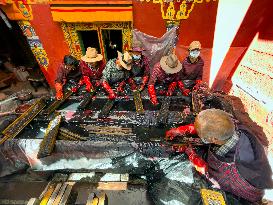
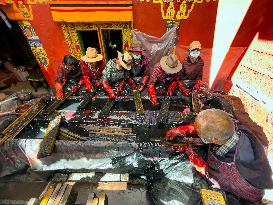
This photo taken on Oct. 3, 2021 shows workers cleaning and maintaining woodcut printing blocks with traditional techniques at the Dege Sutra Printing House in Dege County of Garze Tibetan Autonomous Prefecture, southwest China's Sichuan Province. Built in 1729, the Dege Sutra Printing House preserves in good condition 325,520 woodcut printing plates containing significant Tibetan classics dating back to the 11th century. The majority of the blocks were carved between the 18th and mid-20th centuries. The printing blocks housed at the Dege Sutra Printing House in Sichuan were listed in this May as documentary heritage on the Asia Pacific regional register of UNESCO's Memory of the World (MOW) Programme. Photo by Shen Bohan/Xinhua/ABACAPRESS.COM

  •  
Dege Sutra Printing House - Tibet

Dege Sutra Printing House - Tibet

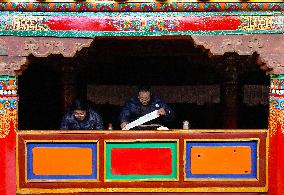
Workers proofread newly made prints at the Dege Sutra Printing House in Dege County of Garze Tibetan Autonomous Prefecture, southwest China's Sichuan Province, Nov. 2, 2024. Built in 1729, the Dege Sutra Printing House preserves in good condition 325,520 woodcut printing plates containing significant Tibetan classics dating back to the 11th century. The majority of the blocks were carved between the 18th and mid-20th centuries. The printing blocks housed at the Dege Sutra Printing House in Sichuan were listed in this May as documentary heritage on the Asia Pacific regional register of UNESCO's Memory of the World (MOW) Programme. Photo by Shen Bohan/Xinhua/ABACAPRESS.COM

  •  
Dege Sutra Printing House - Tibet

Dege Sutra Printing House - Tibet

A worker revises a woodcut printing block at the Dege Sutra Printing House in Dege County of Garze Tibetan Autonomous Prefecture, southwest China's Sichuan Province, Nov. 2, 2024. Built in 1729, the Dege Sutra Printing House preserves in good condition 325,520 woodcut printing plates containing significant Tibetan classics dating back to the 11th century. The majority of the blocks were carved between the 18th and mid-20th centuries. The printing blocks housed at the Dege Sutra Printing House in Sichuan were listed in this May as documentary heritage on the Asia Pacific regional register of UNESCO's Memory of the World (MOW) Programme. Photo by Shen Bohan/Xinhua/ABACAPRESS.COM

  •  
Dege Sutra Printing House - Tibet

Dege Sutra Printing House - Tibet

A worker checks woodcut printing blocks at the Dege Sutra Printing House in Dege County of Garze Tibetan Autonomous Prefecture, southwest China's Sichuan Province, Nov. 2, 2024. Built in 1729, the Dege Sutra Printing House preserves in good condition 325,520 woodcut printing plates containing significant Tibetan classics dating back to the 11th century. The majority of the blocks were carved between the 18th and mid-20th centuries. The printing blocks housed at the Dege Sutra Printing House in Sichuan were listed in this May as documentary heritage on the Asia Pacific regional register of UNESCO's Memory of the World (MOW) Programme. Photo by Shen Bohan/Xinhua/ABACAPRESS.COM

  •  
Dege Sutra Printing House - Tibet

Dege Sutra Printing House - Tibet

Workers print with vintage woodcut printing blocks at the Dege Sutra Printing House in Dege County of Garze Tibetan Autonomous Prefecture, southwest China's Sichuan Province, Nov. 2, 2024. Built in 1729, the Dege Sutra Printing House preserves in good condition 325,520 woodcut printing plates containing significant Tibetan classics dating back to the 11th century. The majority of the blocks were carved between the 18th and mid-20th centuries. The printing blocks housed at the Dege Sutra Printing House in Sichuan were listed in this May as documentary heritage on the Asia Pacific regional register of UNESCO's Memory of the World (MOW) Programme. Photo by Shen Bohan/Xinhua/ABACAPRESS.COM

  •  
Dege Sutra Printing House - Tibet

Dege Sutra Printing House - Tibet

This photo taken on May 16, 2017 shows workers soaking paper for printing outside the Dege Sutra Printing House in Dege County of Garze Tibetan Autonomous Prefecture, southwest China's Sichuan Province. Built in 1729, the Dege Sutra Printing House preserves in good condition 325,520 woodcut printing plates containing significant Tibetan classics dating back to the 11th century. The majority of the blocks were carved between the 18th and mid-20th centuries. The printing blocks housed at the Dege Sutra Printing House in Sichuan were listed in this May as documentary heritage on the Asia Pacific regional register of UNESCO's Memory of the World (MOW) Programme. Photo by Gong Zihua/Xinhua/ABACAPRESS.COM

  •  
Dege Sutra Printing House - Tibet

Dege Sutra Printing House - Tibet

This file photo taken on June 11, 2019 shows workers airing woodcut printing blocks on a roof at the Dege Sutra Printing House in Dege County of Garze Tibetan Autonomous Prefecture, southwest China's Sichuan Province. Built in 1729, the Dege Sutra Printing House preserves in good condition 325,520 woodcut printing plates containing significant Tibetan classics dating back to the 11th century. The majority of the blocks were carved between the 18th and mid-20th centuries. The printing blocks housed at the Dege Sutra Printing House in Sichuan were listed in this May as documentary heritage on the Asia Pacific regional register of UNESCO's Memory of the World (MOW) Programme. Photo by Gong Zihua/Xinhua/ABACAPRESS.COM

  •  
CHINA-UNESCO-DOCUMENTARY HERITAGE-THREE ITEMS-INSCRIBED (CN)

CHINA-UNESCO-DOCUMENTARY HERITAGE-THREE ITEMS-INSCRIBED (CN)

(240509) -- BEIJING, May 9, 2024 (Xinhua) -- This photo taken on Oct. 3, 2021 shows woodcut printing plates at the Dege Sutra Printing House in Dege County of Ganzi Tibetan Autonomous Prefecture, southwest China's Sichuan Province. Three items from China have been listed as documentary heritage on the Asia Pacific regional register of UNESCO's Memory of the World (MOW) Programme, the National Archives Administration of China said Thursday. The listed items include archives relating to traditional teahouses in Chengdu, capital of southwest China's Sichuan Province, genealogical records of the communities of Huizhou in east China's Anhui Province, and printing blocks housed at the Dege Sutra Printing House in Sichuan. The decision was approved at the 10th General Meeting of the Memory of the World Committee for Asia and the Pacific, convened from Tuesday to Wednesday in Ulaanbaatar, Mongolia. (Xinhua/Shen Bohan)

  •  
CHINA-UNESCO-DOCUMENTARY HERITAGE-THREE ITEMS-INSCRIBED (CN)

CHINA-UNESCO-DOCUMENTARY HERITAGE-THREE ITEMS-INSCRIBED (CN)

(240509) -- BEIJING, May 9, 2024 (Xinhua) -- This photo taken on Oct. 3, 2021 shows woodcut printing plates at the Dege Sutra Printing House in Dege County of Ganzi Tibetan Autonomous Prefecture, southwest China's Sichuan Province. Three items from China have been listed as documentary heritage on the Asia Pacific regional register of UNESCO's Memory of the World (MOW) Programme, the National Archives Administration of China said Thursday. The listed items include archives relating to traditional teahouses in Chengdu, capital of southwest China's Sichuan Province, genealogical records of the communities of Huizhou in east China's Anhui Province, and printing blocks housed at the Dege Sutra Printing House in Sichuan. The decision was approved at the 10th General Meeting of the Memory of the World Committee for Asia and the Pacific, convened from Tuesday to Wednesday in Ulaanbaatar, Mongolia. (Xinhua/Shen Bohan)

  •  
CHINA-UNESCO-DOCUMENTARY HERITAGE-THREE ITEMS-INSCRIBED (CN)

CHINA-UNESCO-DOCUMENTARY HERITAGE-THREE ITEMS-INSCRIBED (CN)

(240509) -- BEIJING, May 9, 2024 (Xinhua) -- This photo taken on Oct. 3, 2021 shows workers cleaning woodcut printing plates at the Dege Sutra Printing House in Dege County of Ganzi Tibetan Autonomous Prefecture, southwest China's Sichuan Province. Three items from China have been listed as documentary heritage on the Asia Pacific regional register of UNESCO's Memory of the World (MOW) Programme, the National Archives Administration of China said Thursday. The listed items include archives relating to traditional teahouses in Chengdu, capital of southwest China's Sichuan Province, genealogical records of the communities of Huizhou in east China's Anhui Province, and printing blocks housed at the Dege Sutra Printing House in Sichuan. The decision was approved at the 10th General Meeting of the Memory of the World Committee for Asia and the Pacific, convened from Tuesday to Wednesday in Ulaanbaatar, Mongolia. (Xinhua/Shen Bohan)

  •  
CHINA-UNESCO-DOCUMENTARY HERITAGE-THREE ITEMS-INSCRIBED (CN)

CHINA-UNESCO-DOCUMENTARY HERITAGE-THREE ITEMS-INSCRIBED (CN)

(240509) -- BEIJING, May 9, 2024 (Xinhua) -- This photo taken on Oct. 3, 2021 shows woodcut printing plates at the Dege Sutra Printing House in Dege County of Ganzi Tibetan Autonomous Prefecture, southwest China's Sichuan Province. Three items from China have been listed as documentary heritage on the Asia Pacific regional register of UNESCO's Memory of the World (MOW) Programme, the National Archives Administration of China said Thursday. The listed items include archives relating to traditional teahouses in Chengdu, capital of southwest China's Sichuan Province, genealogical records of the communities of Huizhou in east China's Anhui Province, and printing blocks housed at the Dege Sutra Printing House in Sichuan. The decision was approved at the 10th General Meeting of the Memory of the World Committee for Asia and the Pacific, convened from Tuesday to Wednesday in Ulaanbaatar, Mongolia. (Xinhua/Shen Bohan)

  •  
ITALY-FLORENCE-CRAFTS FAIR-CHINESE HANDICRAFTS

ITALY-FLORENCE-CRAFTS FAIR-CHINESE HANDICRAFTS

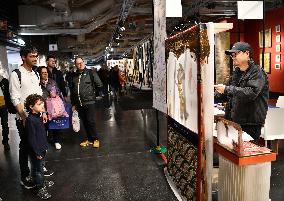
(230429) -- FLORENCE, April 29, 2023 (Xinhua) -- Zhong Wen (1st R), a Chinese exhibitor and artisan of woodcut painting, performs a shadow puppetry play at the exhibition area of Chinese handicrafts during the Florence International Crafts Fair in Florence, Italy, April 25, 2023. TO GO WITH "Feature: Chinese handicrafts dazzle at Italian int'l fair" (Xinhua/Jin Mamengni)

  •  
CHINA-ANHUI-WOODCUT NEW YEAR PAINTING-INHERITOR (CN)

CHINA-ANHUI-WOODCUT NEW YEAR PAINTING-INHERITOR (CN)

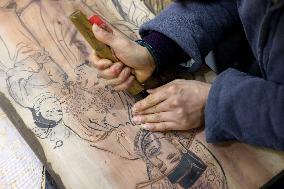
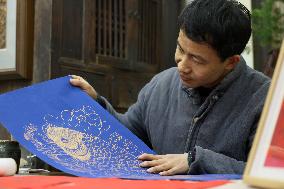
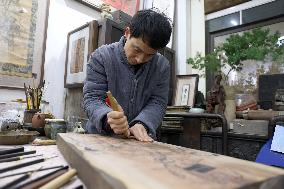
(240208) -- HEFEI, Feb. 8, 2024 (Xinhua) -- Tong Min makes a woodcut at a studio in Hefei, east China's Anhui Province, Feb. 4, 2024. Tongshouji woodcut New Year Paining, a provincial-level intangible cultural heritage in Anhui Province, has a history of over 100 years. As the fourth generation inheritor of the Tongshouji woodcut New Year painting, Tong Min has put a modern twist to the traditional artistic style in his creation. (Photo by Xie Chen/Xinhua)

  •  
CHINA-ANHUI-WOODCUT NEW YEAR PAINTING-INHERITOR (CN)

CHINA-ANHUI-WOODCUT NEW YEAR PAINTING-INHERITOR (CN)

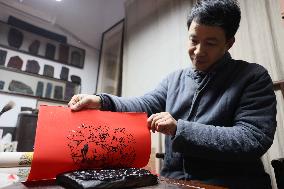
(240208) -- HEFEI, Feb. 8, 2024 (Xinhua) -- Tong Min looks at a copy of woodcut New Year painting at a studio in Hefei, east China's Anhui Province, Feb. 4, 2024. Tongshouji woodcut New Year Paining, a provincial-level intangible cultural heritage in Anhui Province, has a history of over 100 years. As the fourth generation inheritor of the Tongshouji woodcut New Year painting, Tong Min has put a modern twist to the traditional artistic style in his creation. (Xinhua/Cao Li)

  •  
CHINA-ANHUI-WOODCUT NEW YEAR PAINTING-INHERITOR (CN)

CHINA-ANHUI-WOODCUT NEW YEAR PAINTING-INHERITOR (CN)

(240208) -- HEFEI, Feb. 8, 2024 (Xinhua) -- Tong Min looks at a copy of woodcut New Year painting at a studio in Hefei, east China's Anhui Province, Feb. 4, 2024. Tongshouji woodcut New Year Paining, a provincial-level intangible cultural heritage in Anhui Province, has a history of over 100 years. As the fourth generation inheritor of the Tongshouji woodcut New Year painting, Tong Min has put a modern twist to the traditional artistic style in his creation. (Photo by Xie Chen/Xinhua)

  •  
CHINA-ANHUI-WOODCUT NEW YEAR PAINTING-INHERITOR (CN)

CHINA-ANHUI-WOODCUT NEW YEAR PAINTING-INHERITOR (CN)

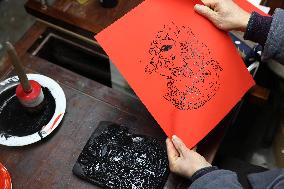
(240208) -- HEFEI, Feb. 8, 2024 (Xinhua) -- Tong Min makes a woodcut at a studio in Hefei, east China's Anhui Province, Feb. 4, 2024. Tongshouji woodcut New Year Paining, a provincial-level intangible cultural heritage in Anhui Province, has a history of over 100 years. As the fourth generation inheritor of the Tongshouji woodcut New Year painting, Tong Min has put a modern twist to the traditional artistic style in his creation. (Xinhua/Cao Li)

  •  
CHINA-ANHUI-WOODCUT NEW YEAR PAINTING-INHERITOR (CN)

CHINA-ANHUI-WOODCUT NEW YEAR PAINTING-INHERITOR (CN)

(240208) -- HEFEI, Feb. 8, 2024 (Xinhua) -- Tong Min makes a copy of woodcut New Year painting at a studio in Hefei, east China's Anhui Province, Feb. 4, 2024. Tongshouji woodcut New Year Paining, a provincial-level intangible cultural heritage in Anhui Province, has a history of over 100 years. As the fourth generation inheritor of the Tongshouji woodcut New Year painting, Tong Min has put a modern twist to the traditional artistic style in his creation. (Photo by Xie Chen/Xinhua)

  •  

Chinese embassy in Tunisia holds cultural show to celebrate Spring Festival

STORY: Chinese embassy in Tunisia holds cultural show to celebrate Spring Festival SHOOTING TIME: Jan. 20, 2024 DATELINE: Jan. 21, 2024 LENGTH: 0:03:14 LOCATION: Tunis CATEGORY: CULTURE SHOTLIST: 1. various of Tunis 2. various of display of China's intangible cultural heritage 3. various of audience admission 4. various of concert performance STORYLINE: The Chinese Embassy in Tunisia held a cultural show on Saturday evening to celebrate the Chinese New Year at the City of Culture in Tunis, capital of Tunisia. The venue was adorned with Chinese intangible cultural heritages such as papercuts and woodcut paintings. An artistic troupe from China’s Shaanxi province performed a musical show that showcased traditional Chinese instruments such as drums, sheng, erhu, guzheng, and pipa. The event was attended by Chinese Ambassador to Tunisia Wan Li, Tunisian political and artistic figures, and other ambassadors to Tunisia. Xinhua News Agency correspondents reporting from Tunis. (XHTV)

  •  
ITALY-FLORENCE-CRAFTS FAIR-CHINESE HANDICRAFTS

ITALY-FLORENCE-CRAFTS FAIR-CHINESE HANDICRAFTS

(230429) -- FLORENCE, April 29, 2023 (Xinhua) -- Zhong Wen (1st R), a Chinese exhibitor and artisan of woodcut painting, performs a shadow puppetry play at the exhibition area of Chinese handicrafts during the Florence International Crafts Fair in Florence, Italy, April 25, 2023. TO GO WITH "Feature: Chinese handicrafts dazzle at Italian int'l fair" (Xinhua/Jin Mamengni)

  •  
XINHUA-PICTURES OF THE YEAR 2022-CHINA NEWS

XINHUA-PICTURES OF THE YEAR 2022-CHINA NEWS

(230109) -- BEIJING, Jan. 9, 2023 (Xinhua) -- Artist Yin Dongxiang (L) and her daughter Xiao Yang make copies of nianhua, a type of centuries-old Chinese woodcut New Year picture, at a workshop in Tantou Township of Longhui County, Shaoyang, central China's Hunan Province, Jan. 21, 2022. (Xinhua/Chen Sihan)

  •  
Woodcut prints exhibited at art museum in northern Japan

Woodcut prints exhibited at art museum in northern Japan

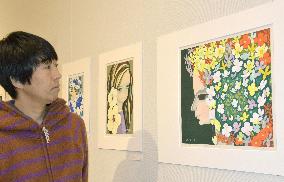
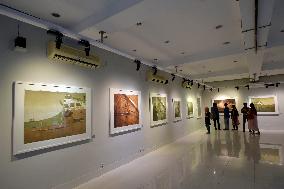
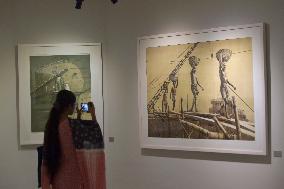
AKITA, Japan - Woodblock prints by the late artist Shuzo Ikeda are exhibited at the Akita Prefectural Museum of Art in Akita in his native prefecture, northeastern Japan, on Oct. 20, 2014. On the left is Satoshi Fujimoto, an editor who published a collection of Ikeda's artwork last year.

  •  

Young Bangladeshi artist showcases magnificent Chinese woodcut art

STORY: Young Bangladeshi artist showcases magnificent Chinese woodcut art DATELINE: Dec. 8, 2022 LENGTH: 00:04:14 LOCATION: Dhaka CATEGORY: SOCIETY/CULTURE SHOTLIST: 1. various of art lovers visiting the exhibition 2. SOUNDBTIE 1 (Bengali): MD MEHDI HASAN HRIDAY, Student 3. SOUNDBTIE 2 (Bengali): KHAIDIM SINTHI, Student 4. SOUNDBTIE 3 (Bengali): ABDULLAH AL BASHIR, Artist 5. various of Abdullah Al Bashir being in China and working STORYLINE: Abdullah Al Bashir is one of Bangladesh's most internationally-acclaimed young artists. His solo exhibition, titled "Evolution", is now underway in Bangladesh's capital Dhaka, showcasing magnificent Chinese woodcut art. The exhibition is displaying magnificent woodcuts on paper, the earliest form of Chinese printing which uses blocks cut from wood. Bashir, who went to Yunnan Arts University in China for higher education with a scholarship, received the "All Media Best Award" for his woodcut print in 2020. The talented young artist told Xinhua recently t

  •  
BANGLADESH-DHAKA-WOODCUT-PAINTING-EXHIBITION

BANGLADESH-DHAKA-WOODCUT-PAINTING-EXHIBITION

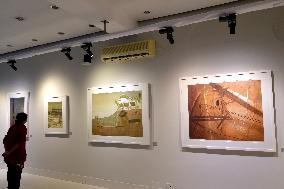
(221208) -- DHAKA, Dec. 8, 2022 (Xinhua) -- A visitor views an art exhibition showcasing magnificent woodcuts on paper, the earliest form of Chinese printing which uses blocks cut from wood, in Dhaka, Bangladesh on Dec. 5, 2022. TO GO WITH "Feature: Young Bangladeshi artist showcases magnificent Chinese woodcut art" (Xinhua)

  •  
BANGLADESH-DHAKA-WOODCUT-PAINTING-EXHIBITION

BANGLADESH-DHAKA-WOODCUT-PAINTING-EXHIBITION

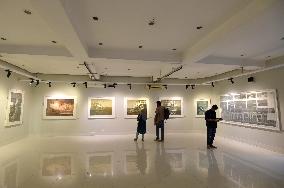
(221208) -- DHAKA, Dec. 8, 2022 (Xinhua) -- Visitors view an art exhibition showcasing magnificent woodcuts on paper, the earliest form of Chinese printing which uses blocks cut from wood, in Dhaka, Bangladesh on Dec. 5, 2022. TO GO WITH "Feature: Young Bangladeshi artist showcases magnificent Chinese woodcut art" (Xinhua)

  •  
BANGLADESH-DHAKA-WOODCUT-PAINTING-EXHIBITION

BANGLADESH-DHAKA-WOODCUT-PAINTING-EXHIBITION

(221208) -- DHAKA, Dec. 8, 2022 (Xinhua) -- Visitors view an art exhibition showcasing magnificent woodcuts on paper, the earliest form of Chinese printing which uses blocks cut from wood, in Dhaka, Bangladesh on Dec. 5, 2022. TO GO WITH "Feature: Young Bangladeshi artist showcases magnificent Chinese woodcut art" (Xinhua)

  •  
BANGLADESH-DHAKA-WOODCUT-PAINTING-EXHIBITION

BANGLADESH-DHAKA-WOODCUT-PAINTING-EXHIBITION

(221208) -- DHAKA, Dec. 8, 2022 (Xinhua) -- A visitor takes photos of art works during an art exhibition showcasing magnificent woodcuts on paper, the earliest form of Chinese printing which uses blocks cut from wood, in Dhaka, Bangladesh on Dec. 5, 2022. TO GO WITH "Feature: Young Bangladeshi artist showcases magnificent Chinese woodcut art" (Xinhua)

  •  
Hiroshige - 53 Stations of the Tokaido - Print 32

Hiroshige - 53 Stations of the Tokaido - Print 32

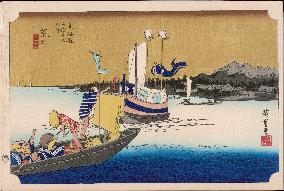
32 Arai - A large ferry boat, with an awning round it, taking a daimyo across from Maisaka, followed by a smaller boat with his retainers. A high range of hills on the further shore; golden sky. Travellers made the journey from Maisaka to Arai Station by ferryboat. On the shore was a government barrier station for the inspection of travellers. The compound remains largely intact even today. Utagawa Hiroshige (1797 - 1858). The Fifty-Three Stations of the Tokaido - Hoeido edition (1831-4) Date: 1831 - 1834

  •  
Hiroshige - 53 Stations of the Tokaido - Print 55

Hiroshige - 53 Stations of the Tokaido - Print 55

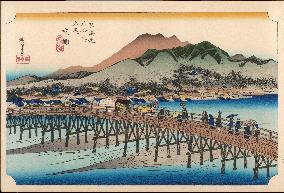
55 Kyoto - In the foreground the "long" bridge over the Kamo River, and people crossing over, with the town beyond, behind which rise hills overlooking it, the most distant printed from graded colourblock only. While decending to Kyoto, travellers could enjoy a panoramic view of the elegant imperial capital from the mountain pass and undoubtedly felt joy and relief at seeing the final destination of their journey from Edo. In those days it was the wish of every Japanese to see Kyoto once in his life.Utagawa Hiroshige (1797 - 1858). The Fifty-Three Stations of the Tokaido - Hoeido edition (1831-4) Date: 1831 - 1834

  •  
Hiroshige - 53 Stations of the Tokaido - Print 54

Hiroshige - 53 Stations of the Tokaido - Print 54

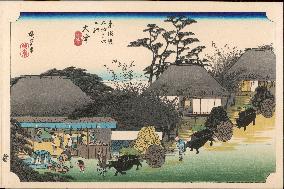
54 Otsu - Three bullock-carts passing down the main street of the village, and an open tea-house on the left. This station located on the south-western shore of Lake Biwa was the last station on the Tokaido Highway. Being close to Kyoto, there were many popularly known shrines and temples in its vicinity. Utagawa Hiroshige (1797 - 1858). The Fifty-Three Stations of the Tokaido - Hoeido edition (1831-4) Date: 1831 - 1834

  •  
Hiroshige - 53 Stations of the Tokaido - Print 31

Hiroshige - 53 Stations of the Tokaido - Print 31

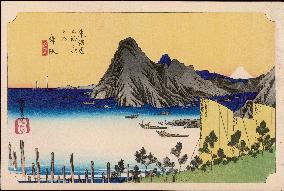
31 Maisaka - View of Imaki Point jutting out into the sea, and a white Fuji (without outline) in the distance. This station was a fishing port lying on the south-eastern edge of Lake Hamana. The Lake Hamana and the Pacific Ocean meet at this point and travellers had to cross this mouth of the lake by boats. Utagawa Hiroshige (1797 - 1858). The Fifty-Three Stations of the Tokaido - Hoeido edition (1831-4) Date: 1831 - 1834

  •  
Hiroshige - 53 Stations of the Tokaido - Print 53

Hiroshige - 53 Stations of the Tokaido - Print 53

53 Kusatsu - View of a rest-house on for coolies, and horses on the road; coolies passing in foreground with a kago and a covered palanquin. The Nakasendo, another large highway which ran through the mountainous region between Edo and Kyoto joined the Tokaido at this station to form a single highway for the remainder of the highway to Kyoto. Utagawa Hiroshige (1797 - 1858). The Fifty-Three Stations of the Tokaido - Hoeido edition (1831-4) Date: 1831 - 1834

  •  
Hiroshige - 53 Stations of the Tokaido - Title Page

Hiroshige - 53 Stations of the Tokaido - Title Page

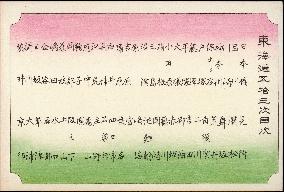
The Title Page with Japanese Script - Utagawa Hiroshige (1797 - 1858). The Fifty-Three Stations of the Tokaido - Hoeido edition (1831-4) Date: 1831 - 1834

  •  
Hiroshige - 53 Stations of the Tokaido - Print 51

Hiroshige - 53 Stations of the Tokaido - Print 51

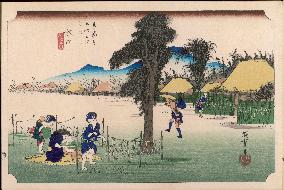
51 Minakuchi - A solitary traveller walking through the village, where women are peeling and drying gourds; in the backgound a range of hills, printed in colour-block only. This station located in a desolate rural area was famous for its production of dried gourd shavings for use on Japanese dishes. Women are busy making them: one is shaving a gourd, one is helping the shavers, and one is drying the shaved gourd on a rope. Utagawa Hiroshige (1797 - 1858). The Fifty-Three Stations of the Tokaido - Hoeido edition (1831-4) Date: 1831 - 1834

  •  
Hiroshige - 53 Stations of the Tokaido - Print 48

Hiroshige - 53 Stations of the Tokaido - Print 48

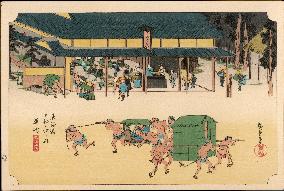
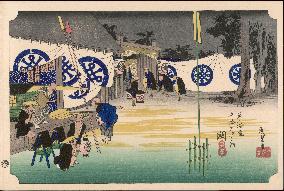
48 Seki - View outside a resthouse in the early morning, where a daimyo is stopping, the retainers preparing, by the aid of lanterns, to proceed on the journey. Each station was required to maintain lodging houses for travellers. The inn shown is one for upper class travellers such as Shogunate officials and feudal lords. Retinue are making preparations for a feudal lord to leave from the lodging house. Utagawa Hiroshige (1797 - 1858). The Fifty-Three Stations of the Tokaido - Hoeido edition (1831-4) Date: 1831 - 1834

  •  
Hiroshige - 53 Stations of the Tokaido - Print 49

Hiroshige - 53 Stations of the Tokaido - Print 49

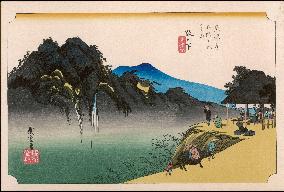
49 Saka-no-shita - Travellers resting at an open teahouse, looking across a ravine to the rocky heights opposite; blue hills beyond, in colour blocks only. In olden times, the beauty of the rugged mountain ranges in this area attracted many visitors from Kyoto. Travellers enjoyed the spectacular view of the mountain from a teahouse located on the mountain pass. Utagawa Hiroshige (1797 - 1858). The Fifty-Three Stations of the Tokaido - Hoeido edition (1831-4) Date: 1831 - 1834

  •  
Hiroshige - 53 Stations of the Tokaido - Print 42

Hiroshige - 53 Stations of the Tokaido - Print 42

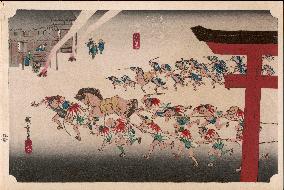
42 Miya - Two gangs of men and horse dragging a festival car (not shown) past the entrance to Miya Temple on a f괥 day. The name Miya literally means "shrine", and is a shortened word denoting the Atsuta Shrine. It is one of the most important shrines in the country because it holds one of the three divine symbols of the Japanese imperial throne. Now Nagoya City has grown around the shrine to become the third largest metropolis in Japan. Utagawa Hiroshige (1797 - 1858). The Fifty-Three Stations of the Tokaido - Hoeido edition (1831-4) Date: 1831 - 1834

  •  
Hiroshige - 53 Stations of the Tokaido - Print 44

Hiroshige - 53 Stations of the Tokaido - Print 44

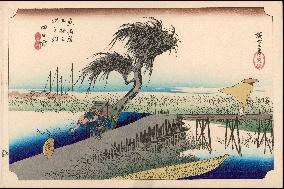
44 Yokkaichi - The hurricane. A man racing after his hat, bowled along by the wind, and another crossing a small bridge over a stream, his coat blown about him. Yokkaichi Station was not only a port, but also a thriving market town. The name Yokkaichi literally means 'fourth day market' and is derived from the traditional market held on the fourth day of each month at this town.Travellers had to cross a series of tiny bridge built over the small rivers flowing through low level land along the seashore. Utagawa Hiroshige (1797 - 1858). The Fifty-Three Stations of the Tokaido - Hoeido edition (1831-4) Date: 1831 - 1834

  •  
Hiroshige - 53 Stations of the Tokaido - Print 45

Hiroshige - 53 Stations of the Tokaido - Print 45

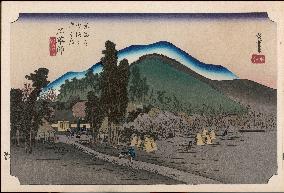
45 Ishiyakushi - A temple in a grove of trees on the left and the village on the right; behind, a high range of hills, printed from colour blocks. This station developed around an old temple located in peaceful and quiet country surroundings. In the temple, Ishiyakushi, a stone image of Buddha Yakushi was enshrined and it was frequented by many worshippers. Utagawa Hiroshige (1797 - 1858). The Fifty-Three Stations of the Tokaido - Hoeido edition (1831-4) Date: 1831 - 1834

  •  
Hiroshige - 53 Stations of the Tokaido - Print 41

Hiroshige - 53 Stations of the Tokaido - Print 41

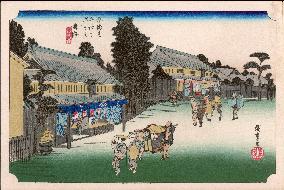
41 Narumi - A woman carried in a kago and two others walking in front, followed by a man on horseback and two attendants, passing two large open shops in the main street, where dyed cloths are sold. On the fascia over the front of the nearer shop is the monogram Hiro in the centre, and that of the publisher, Take-no-Uchi, each side of it. This station and the nearby town of Arimatsu are both famous for the production of tie-dyed fabrics which were suitable for making yukata, the kimono worn in summer and after a bath. Utagawa Hiroshige (1797 - 1858). The Fifty-Three Stations of the Tokaido - Hoeido edition (1831-4) Date: 1831 - 1834

  •  
Hiroshige - 53 Stations of the Tokaido - Print 52

Hiroshige - 53 Stations of the Tokaido - Print 52

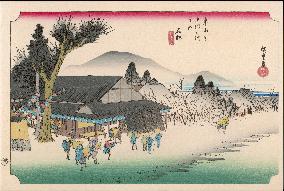
52 Ishibe - View of a tea-house on left, under a large tree, and travellers watching a man dancing; hills in background from graded colour-block, the lower part in mist. This station was one of the most desolate stations on the highway. The road-side restaurant offered travellers rice wine, rice boiled with leafy vegetables, and baked bean-curd coated with bean paste. Utagawa Hiroshige (1797 - 1858). The Fifty-Three Stations of the Tokaido - Hoeido edition (1831-4) Date: 1831 - 1834

  •  
Hiroshige - 53 Stations of the Tokaido - Print 47

Hiroshige - 53 Stations of the Tokaido - Print 47

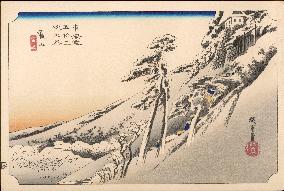
47 Kameyama - Travellers ascending a steep hillside, under deep snow, to the entrance to the castle of Kameyama. This station developed around a castle town. The keep and gate of Kameyama Castle on a hill towers over the village. And a procession of a feudal lord is ascending the hill. Utagawa Hiroshige (1797 - 1858). The Fifty-Three Stations of the Tokaido - Hoeido edition (1831-4) Date: 1831 - 1834

  •  
Hiroshige - 53 Stations of the Tokaido - Print 46

Hiroshige - 53 Stations of the Tokaido - Print 46

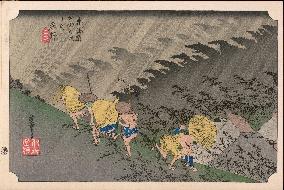
46 Shono - Rainstorm in the mountains; coolies carrying a kago, with a straw coat thrown over it, up the hill, and two others, one with an umbrella, rushing down. This plate depicts a group of travellers caught in a sudden summer thunderstorm and hurrying towards shelter. Utagawa Hiroshige (1797 - 1858). The Fifty-Three Stations of the Tokaido - Hoeido edition (1831-4) Date: 1831 - 1834

  •  
Hiroshige - 53 Stations of the Tokaido - Print 43

Hiroshige - 53 Stations of the Tokaido - Print 43

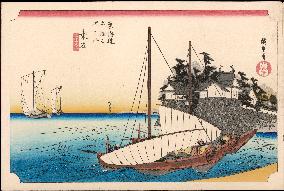
43 Kuwana - Two large junks moored at the mouth of the Kiso River, and others sailing away to sea. To avoid crossing the numerous rivers flowing inland between Miya and Kuwana, travellers made their journey by boat. The boat trip was reputed to have been enjoyable. Utagawa Hiroshige (1797 - 1858). The Fifty-Three Stations of the Tokaido - Hoeido edition (1831-4) Date: 1831 - 1834

  • Main
  • Top
  • Editorial
  • Creative
  • About Us
  • About ILG
  • Terms of use
  • Company
  • BEHIND
  • Price List
  • Single Plan
  • Monthly Plan
  • Services
  • Shooting
  • Rights Clearance
  • Support
  • FAQ
  • How To Buy
  • Contact Us
  • Become a Partner

© KYODO NEWS IMAGES INC

All Rights Reserved.

  • Editorial
  • Olympics
  • News
  • Sports
  • Japan
  • Tech
  • Royal
  • Disaster
  • NorthKorea
  • Old Japan
  • SNS
  • Creative
  • Food
  • Japan
  • Landscape
  • Animal
  • Popular
  • #Ukraine
  • #Russia
  • #coronavirus
  • #N. Korea
  • #China
  • #Thailand
  • #Ukraine
  • #Russia
  • #coronavirus
  • #N. Korea
  • #China
  • #Thailand
  • Food
  • Japan
  • Landscape
  • Animal
  • Olympics
  • News
  • Sports
  • Japan
  • Tech
  • Royal
  • Disaster
  • NorthKorea
  • Old Japan
  • SNS