•  
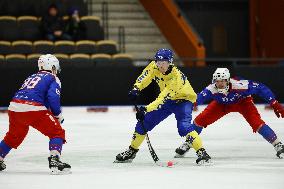
BANDY WORLD CHAMPIONSHIP 2025 SEMIFINAL SWEDEN - USA

BANDY WORLD CHAMPIONSHIP 2025 SEMIFINAL SWEDEN - USA

Sweden's Oscar Wikblad scores 17-0 after getting past USA's Porter Haney and Orion Olse during Saturday's semi-final in the men's bandy world championship between Sweden and USA at Sparbanken Lidköping Arena.Photo: Adam Ihse / TT / Code 9200

  •  
BANDY WORLD CHAMPIONSHIP 2025 FINLAND-HUNGARY

BANDY WORLD CHAMPIONSHIP 2025 FINLAND-HUNGARY

LIDKÖPING, SWEDEN 20250326Finland's goalkeeper Isak Skog with his teammates after Finland beat Hungary with 17-0 during the Men's 2025 FIB World Championship at Sparbanken Lidkoping Arena, in Lidkoping, Sweden, on March 26, 2025.Photo: Adam Ihse / TT / Code 9200

  •  
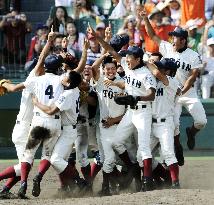
Osaka Toin trounces Tokoha to win high school baseball c'ship

Osaka Toin trounces Tokoha to win high school baseball c'ship

NISHINOMIYA, Japan - Members of Osaka Prefecture's Osaka Toin baseball team rejoice after battering Tokoha Gakuen Kikugawa of Shizuoka Prefecture in a 17-0 victory to claim Japan's national high school baseball championship on Aug. 18.

  •  
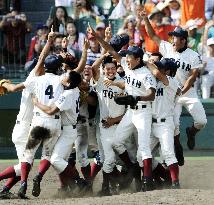
Osaka Toin trounces Tokoha to win high school baseball c'ship

Osaka Toin trounces Tokoha to win high school baseball c'ship

NISHINOMIYA, Japan - Members of Osaka Prefecture's Osaka Toin baseball team rejoice after battering Tokoha Gakuen Kikugawa of Shizuoka Prefecture in a 17-0 victory to claim Japan's national high school baseball championship on Aug. 18. (Kyodo)

  •  
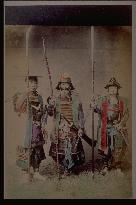
Costume of generals in the age of civil wars

Costume of generals in the age of civil wars

Three men dressed in full armour stand in a line and look toward the camera. The man on the left wears a hat and holds a halberd in his right hand. The man in the centre wears a helmet and holds a spear in his right hand and an arrow in his left. The man to the right wears a jingasa and holds a spear in his right hand.==Date:unknown, Place:unknown, Photo:unknown, (Credit:Nagasaki University Library/Kyodo News Images) [Cabinet Number15‐17‐0]

  •  
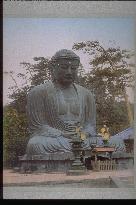
Daibutsu (the Great Buddha) of Kamakura

Daibutsu (the Great Buddha) of Kamakura

The Daibutsu is the main Buddha at the Kotokuin and used to be inside a building called the Daibutsuden. It was originally a wooden statue, but in Azuma Kagami (historical record of the Kamakura Shogunate), there is mention of starting to mold the gold and copper Shakanyorai Buddha (actually Amida statue) in 1252 in Fukasawa.==Date:unknown, Place:Kamakura, Photo:Ogawa Kazumasa, (Credit:Nagasaki University Library/Kyodo News Images) [Cabinet Number10‐17‐0]

  •  
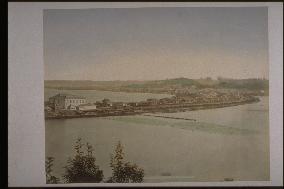
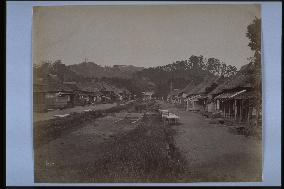
Railway premises around takashimacho

Railway premises around takashimacho

The caption reads railway to Kanagawa from Yokohama in English, but it is the railway on reclaimed land seen from the Kanagawa side. Takashima Kisaemon, who was engaged in the sale of lumber, carved the mountain and completed the railroad. The right is Hiranuma and the central rear is Yokohama city.==Date:unknown, Place:Yokohama, Photo:Kusakabe Kinbei, (Credit:Nagasaki University Library/Kyodo News Images) [Cabinet Number3‐17‐0]

  •  
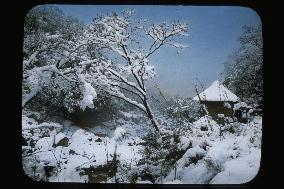
A snowscape in Hakone

A snowscape in Hakone

It happens once in a while there is a lot of snow from February to March at Hakone. Depending on the altitude the amount of snowfall is evidently different. There is a snowbelt around the altitude of 300m and 500m and below that line, the snow hardly accumulates. Therefore, this must be higher than Ohiradai and definately not Yumoto or Tonosawa. However, it is difficult to determine the exact location.==Date:unknown, Place:Hakone, Photo:unknown, (Credit:Nagasaki University Library/Kyodo News Images) [Cabinet Number98‐17‐0]

  •  
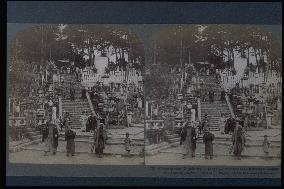
Stone steps of Kurodani Konkai Komyoji Temple

Stone steps of Kurodani Konkai Komyoji Temple

Stereograph depicting the stairs of Kurodani Komyoji Temple, taken from the stone bridge Gokuraku-bashi. Gravestones flank both sides of the stairs. Worshippers who seem to have finished praying are coming down the stairs. Monju Pagoda rises behind the trees above the stairs. The wooden signboard on the right says Gobyo (Mausoleum) . Taken in 1904.==Date:1904, Place:Kyoto, Photo:Underwood, (Credit:Nagasaki University Library/Kyodo News Images) [Cabinet Number97‐17‐0]

  •  
A geiko playing the tsuzumi (a traditional drum)

A geiko playing the tsuzumi (a traditional drum)

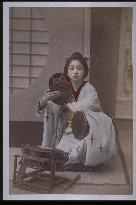
A woman shoulders a tsutsumi (hand-held drum). She holds a tuning string in her left hand and strikes the drum with the right hand. She is also holding a drum on her left knee. This drum is also struck with the right hand.==Date:unknown, Place:unknown, Photo:unknown, (Credit:Nagasaki University Library/Kyodo News Images) [Cabinet Number96‐17‐0]

  •  
Rowing women

Rowing women

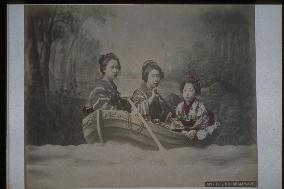
People enjoy a boat ride. The two women on the left are wearing kimono of different colors with splashed patterns. The woman on the right has her hair in Shimada style with a red cloth in the bangs. This is a hairstyle called yakko shimada that was popular among young women aged 13 to 17. The size of the boat and setting suggest that this photograph was taken in a studio.==Date:unknown, Place:unknown, Photo:A. Farsari, (Credit:Nagasaki University Library/Kyodo News Images) [Cabinet Number95‐17‐0]

  •  
Women standing hand in hand

Women standing hand in hand

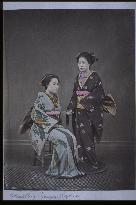
The English title reads Wealthy Young Ladies. The one piece maruobi sashes stand out. The cotton hems exude a sense of elegance. They are probably women of the entertainment industry.==Date:unknown, Place:unknown, Photo:Usui Shuzaburo, (Credit:Nagasaki University Library/Kyodo News Images) [Cabinet Number94‐17‐0]

  •  
Odawara

Odawara

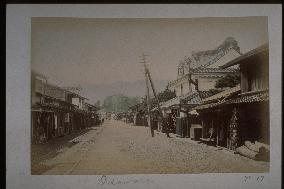
The street in the centre is the present-day National Route No. 1 leading to Hakone. The Odawara Basha (horse drawn carriage) Railway became electric in 1900. The telegraph lines that had started operation in 1872 between Tokyo and Nagasaki as well as the power lines that had started operation in 1900 can be seen. The building with the sign Uirau was a shop famous for medicine and sweets that opened during Soun Hojo's reign. The shop is also mentioned in the kabuki play Gero-uri.==Date:unknown, Place:Odawara, Photo:unknown, (Credit:Nagasaki University Library/Kyodo News Images) [Cabinet Number92‐17‐0]

  •  
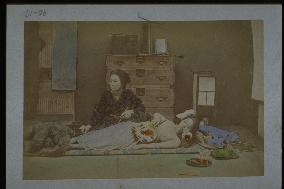
A woman in her night clothes

A woman in her night clothes

A woman is lying half-naked, cooling herself with a fan. The woman behind her is smoking a long kiseru pipe. There is a paulownia chest behind them and a lamp by the head of the woman lying down.==Date:unknown, Place:unknown, Photo:unknown, (Credit:Nagasaki University Library/Kyodo News Images) [Cabinet Number90‐17‐0]

  •  
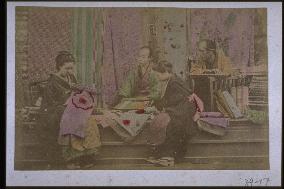
A mercer

A mercer

A shop attendant is showing woven fabrics. Bolts of fabric are visible in the back, and a man is using an abacus. A brush is on his left ear, probably to write figures in his account book.==Date:unknown, Place:unknown, Photo:unknown, (Credit:Nagasaki University Library/Kyodo News Images) [Cabinet Number89‐17‐0]

  •  
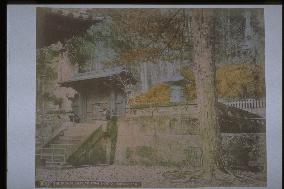
Inukimon Gate and the treasure tower at the Okusha,Toshogu Shrine,Nikko

Inukimon Gate and the treasure tower at the Okusha,Toshogu Shrine,Nikko

The Okusha (inner shrine) at Nikko Toshogu contains the tomb of Tokugawa Ieyasu. Above the stone steps is Inuki Gate, behind which the pagoda containing the tomb is visible. Inukimon (Cast Gate) is thus named because its pillars and beams were cast from one mold. The stone pagoda was rebuilt in Chinese-style bronze around the time of fifth shogun Tsunayoshi.==Date:unknown, Place:Nikko, Photo:unknown, (Credit:Nagasaki University Library/Kyodo News Images) [Cabinet Number88‐17‐0]

  •  
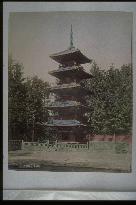
The five-story pagoda,Toshogu Shrine,Nikko

The five-story pagoda,Toshogu Shrine,Nikko

The five-story pagoda at Nikko Toshogu was built with donations from Sakai Tadakatsu, the feudal lord of the Obama Domain. Destroyed by fire in 1815, it was reconstructed by Sakai Tadayuki in 1818. It is approximately 36m tall. The first story is decorated with the twelve signs of the Chinese Zodiac. The torii gate and Omote-sando approach are located to the left.==Date:unknown, Place:Nikko, Photo:unknown, (Credit:Nagasaki University Library/Kyodo News Images) [Cabinet Number87‐17‐0]

  •  
Matsushima

Matsushima

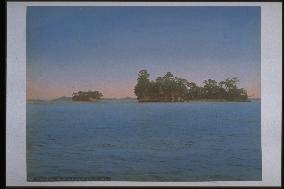
The island on the right is Hikidojima and that on the left, Rakanjima, both situated near Fukuurajima Island. Katsurajima and Ishihamajima of the Urato Island group of Shiogama City can be seen in the background. This is the site of a shell mound dating from theJomon Period.==Date:unknown, Place:Matsushima, Photo:unknown, (Credit:Nagasaki University Library/Kyodo News Images) [Cabinet Number86‐17‐0]

  •  
A lotus pond at Tsurugaoka Hachimangu Shrine

A lotus pond at Tsurugaoka Hachimangu Shrine

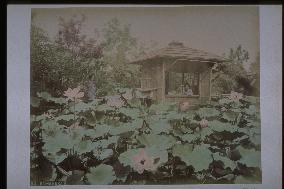
There is a delicate-looking hut in the middle of the pond brimming with lotus leaves and flowers. Aside from the label B6 KAMAKURA at the bottom, there is little in the photograph to prove that this is indeed the pond at Tsurugaoka Hachimangu Shrine.==Date:unknown, Place:Kamakura, Photo:unknown, (Credit:Nagasaki University Library/Kyodo News Images) [Cabinet Number85‐17‐0]

  •  
Dancing children with shaved heads

Dancing children with shaved heads

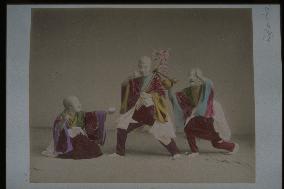
Children are wearing bald wigs and strange costumes. The boy in the centre is holding a cherry twig with a gourd attached by string. They are dancing together happily, with humourous expressions on their faces.==Date:unknown, Place:unknown, Photo:unknown, (Credit:Nagasaki University Library/Kyodo News Images) [Cabinet Number83‐17‐0]

  •  
Tsurugaoka Hachimangu Shrine

Tsurugaoka Hachimangu Shrine

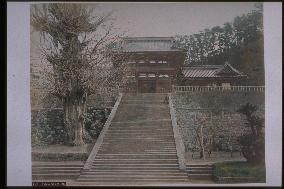
Labeled L17 HACHIMAN(B), the photograph depicts the Jogu Romon (upper shrine gate). The tablet on the gate reads Hachiman-gu. Since the view from the bottom of the stairs is similar to that in a photograph taken in 1893 and no artillery monument can be seen, this photograph is thought to have been taken between 1887 and 1892.==Date:unknown, Place:Kamakura, Photo:A. Farsari, (Credit:Nagasaki University Library/Kyodo News Images) [Cabinet Number82‐17‐0]

  •  
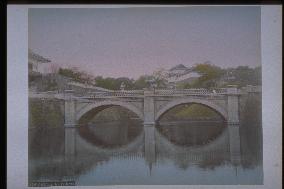
Niju-bashi Bridge,the Imperial Palace

Niju-bashi Bridge,the Imperial Palace

The gate on the left, called Nishinomaru Ote-mon during the Edo Period, became the main gate of the Imperial Palace in 1889 after the construction of the new palace the previous year. The first gate, Korai-mon, in front of the main gate was later removed and only the Watari Yagura-mon exists today. Mid-Meiji Period.==Date:unknown, Place:Tokyo, Photo:A. Farsari, (Credit:Nagasaki University Library/Kyodo News Images) [Cabinet Number81‐17‐0]

  •  
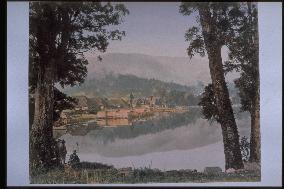
Lake Ashi

Lake Ashi

This is the post town of Hakone, with Lake Ashinoko, as seen from what was once Hakone barrier station. As the power lines installed in 1873 from Tokyo to Nagasaki are visible, this photo must have been taken after that. The thatched roofs of honjin are seen. The round, wooded mountain is Mt. Hatabiki. Behind it is Mt. Kurakake which is a part of the outer mountain range of Hakone. A child is looking at the lake.==Date:unknown, Place:Hakone, Photo:Tamamura Kozaburo, (Credit:Nagasaki University Library/Kyodo News Images) [Cabinet Number80‐17‐0]

  •  
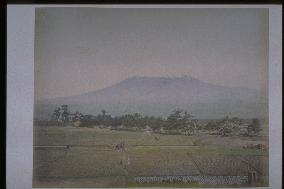
The Tokaido Road and Mt. Fuji

The Tokaido Road and Mt. Fuji

Northern view of Mt. Fuji from the sand dune of Suzukawa in Fuji City. The pine trees crossing horizontally in the centre of the photograph mark the Tokaido Highway. Kawai Bridge lies between the two tall pine trees on the left and the thatched-roof house. Rice paddies stretch between the dune and the highway. The presence of train tracks indicate that this photograph was taken after the opening of the Tokaido Line in 1890.==Date:unknown, Place:Shizuoka, Photo:unknown, (Credit:Nagasaki University Library/Kyodo News Images) [Cabinet Number79‐17‐0]

  •  
Lake Ashi

Lake Ashi

This is the post town of Hakone as seen from what was once the Hakone barrier station. The buildings on the banks of Lake Ashinoko are part of the thatched roofed building complex, the honjin. The large structures with thatched roofs to the right are officially appointed inns (Honjin). Feudal lords stayed or rested here during the Sankinkoutai (A bi-annual period of madatory alternate residence in Edo for feudal lords, known as Daimyo). The mountain in the background is Mt. Kurakake. There appear to be craftsmen looking at the lake in the foreground.==Date:unknown, Place:Hakone, Photo:R. Stillfried, (Credit:Nagasaki University Library/Kyodo News Images) [Cabinet Number77‐17‐0]

  •  
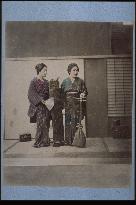
Women holding kotos and shamisens

Women holding kotos and shamisens

These two women exude health and uninhibited spirit in their simple kimono. The viewer senses a natural, gentle inner beauty and warmth.==Date:unknown, Place:unknown, Photo:R. Stillfried, (Credit:Nagasaki University Library/Kyodo News Images) [Cabinet Number76‐17‐0]

  •  
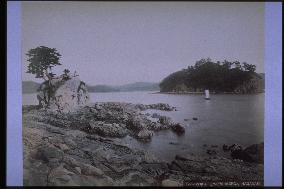
Takahoko Island

Takahoko Island

This is Takahoko Island taken around 1887 from the vicinity of present-day Kaminoshima Church. Also known as Pappenberg, Takahoko was famous abroad as the site of Christian martyrdoms in the 17th century.==Date:unknown, Place:Nagasaki, Photo:unknown, (Credit:Nagasaki University Library/Kyodo News Images) [Cabinet Number75‐17‐0]

  •  
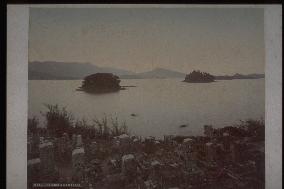
Takahoko Island

Takahoko Island

Hand-tinted photograph taken from Kaminoshima around 1887. Also known as Pappenberg, Takahoko was famous abroad as the site of Christian martyrdoms in the 17th century. Located at the entrance to Nagasaki Harbour, it was the subject of many photographs.==Date:unknown, Place:Nagasaki, Photo:unknown, (Credit:Nagasaki University Library/Kyodo News Images) [Cabinet Number73‐17‐0]

  •  
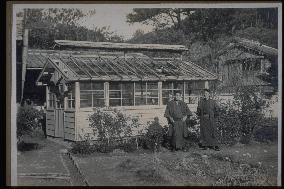
A greenhouse and men

A greenhouse and men

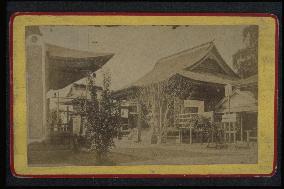
This could be an agricultural experiment station or a green house in a herb garden. The wooden building is newly painted white and has glass windows. The two men are probably researchers or maintenance men. From their clothes these same to be on their day off.==Date:unknown, Place:Nagasaki, Photo:unknown, (Credit:Nagasaki University Library/Kyodo News Images) [Cabinet Number72‐17‐0]

  •  
Fujin-do,Mt. Maya

Fujin-do,Mt. Maya

Mayasan Toritenjoji Temple. The building in the centre is Bujin-do, which houses a statue of Mayabunin (the mother of Buddha) brought from Tang Dynasty China by the Japanese priest Kobodaishi in the early ninth century. The same photograph was carried in a Kobe guidebook published in 1897, and a lithograph apparently copied from it appeared in another guidebook published in 1893. Thus, it was probably taken in the mid-Meiji Period.==Date:unknown, Place:Kobe, Photo:unknown, (Credit:Nagasaki University Library/Kyodo News Images) [Cabinet Number71‐17‐0]

  •  
The grave of a foreign navy engineer

The grave of a foreign navy engineer

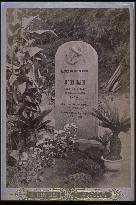
Gravestone of Albert Baker, a sailor on the British cruiser Grafton. The inscription shows that he died on December 25, 1896 at the age of 21. Although this is probably the Yokohama International Cemetery, the gravestone cannot be found today. This photograph was taken by Kusakabe Kinbei, a prominent Yokohama commercial photographer of the time.==Date:unknown, Place:Yokohama, Photo:Kusakabe Kinbei, (Credit:Nagasaki University Library/Kyodo News Images) [Cabinet Number69‐17‐0]

  •  
An old farmer carrying a bale of straw

An old farmer carrying a bale of straw

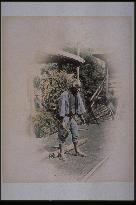
An old man is carrying ears of rice in a basket on his back. He has a sickle in his right hand and a rake in the other. Ears of rice were usually not carried as shown here but were bundled together and carried on a pole.==Date:unknown, Place:unknown, Photo:Tamamura Kozaburo, (Credit:Nagasaki University Library/Kyodo News Images) [Cabinet Number68‐17‐0]

  •  
Suwa Shrine

Suwa Shrine

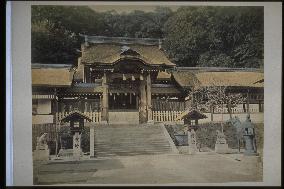
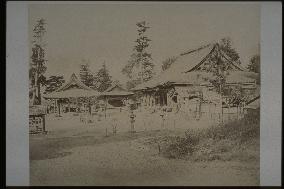
The hall of worship at Suwa Shinto Shrine. Nagasaki's most prominent shrine, Suwa Shinto Shrine is famous for its autumn Kunchi Festival, and it is introduced in photographs taken at the beginning of the Meiji Period and in many hand-tinted picture postcards.==Date:unknown, Place:Nagasaki, Photo:unknown, (Credit:Nagasaki University Library/Kyodo News Images) [Cabinet Number66‐17‐0]

  •  
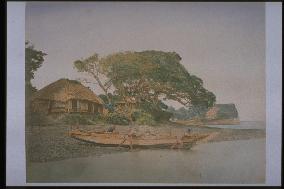
Honmoku coast

Honmoku coast

Seashore near Honmoku Juniten Shrine. A road to Honmoku and Negishi was built for foreigners in 1864 and allowed visitors to walk to the shrine, famous for its beautiful scenery, along the foot of the hill. Juniten Shinto Shrine, the guardian shrine of Honmoku Hongo Village, was later renamed Honmoku Shinto Shrine and still exists today.==Date:unknown, Place:Yokohama, Photo:unknown, (Credit:Nagasaki University Library/Kyodo News Images) [Cabinet Number64‐17‐0]

  •  
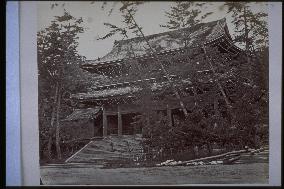
The Sanmon Gate of Chion-in Temple

The Sanmon Gate of Chion-in Temple

The Sanmon Gate of Chion-in Temple is viewed from the southwest. The tall pine trees south of the gate are slanted due to the wind, and pine logs are scattered about underneath. This is the largest gate of its kind in Japan, with five bays and three entrances. Built in two-story irimoya style, it has a tiled roof and was erected in 1619 by the second shogun Tokugawa Ietada.==Date:unknown, Place:Kyoto, Photo:R. Stillfried, (Credit:Nagasaki University Library/Kyodo News Images) [Cabinet Number63‐17‐0]

  •  
Higashi Honganji Temple

Higashi Honganji Temple

Yasaka Shrine is seen from the east, facing west. The main hall is on the right and the worship hall on the left. The main hall, rebuilt by the fourth shogun Tokugawa Ietsuna in 1654, is modeled after the Shishinden. Built in single-story irimoya style with a cedar-bark roof, the front is about 12m and the sides about 11m wide. The deity Susano-no-mikoto is worshipped in the central chamber, Kushiinadahime-no-mikoto in the eastern chamber, and Hachiojishin in the western chamber. Taken by F. Beato.==Date:unknown, Place:Kyoto, Photo:F. Beato, (Credit:Nagasaki University Library/Kyodo News Images) [Cabinet Number62‐17‐0]

  •  
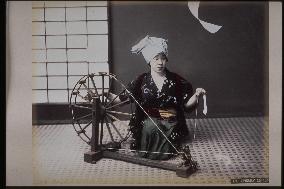
Spinning

Spinning

A woman with a hair cover in anesan-kaburi style is spinning thread on a spinning wheel. The shoji screens suggest that it is a workshop. A mat is spread on the tatami floor, but the seams are not visible.==Date:Middle Meiji (1883-1897), Place:unknown, Photo:unknown, (Credit:Nagasaki University Library/Kyodo News Images) [Cabinet Number61‐17‐0]

  •  
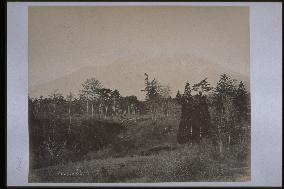
Mt. Fuji seen from Subashiri

Mt. Fuji seen from Subashiri

Distant view of Mt. Fuji from Subashiri in Oyama-machi. The size of Mt. Fuji and the fact that Mt. Hoei is visible on the right makes it possible to determine the place where the photograph was taken. Subashiri lies at the entrance of a mountain-climbing path. This photograph was probably taken somewhere along the path. The inscription indicates that this is the work of Felix Beato.==Date:unknown, Place:Shizuoka, Photo:F. Beato, (Credit:Nagasaki University Library/Kyodo News Images) [Cabinet Number78‐17‐0]

  •  
Tonosawa Spa

Tonosawa Spa

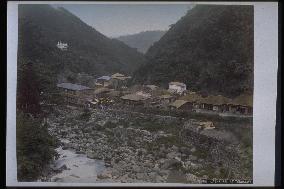
The town of Tonosawa Spa along Hayakawa River. The large building on the left is the old Fukuzumiro before it was lost in the disastrous flood of 1910. The mountain on the right is Yusaka. The one on the left is Tonomine. The white building on the hillside was summer cottages of Russian Orthodox Church of Japan constructed around 1880. A small hill underneath is Mt. Shouri which Zhu Shun Shui (a Chinese scholor during 1600s) praized as exceling to Mt. Li in China. He named it Shorizan (lit. Exceling to Mt. Rei ).==Date:unknown, Place:Hakone, Photo:unknown, (Credit:Nagasaki University Library/Kyodo News Images) [Cabinet Number59‐17‐0]

  •  
The entrance to the Belle Vue Hotel in Minamiyamate (Nagasaki)

The entrance to the Belle Vue Hotel in Minamiyamate (Nagasaki)

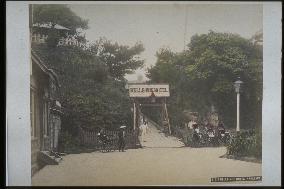
The entrance to the Belle Vue Hotel (site of present-ANA Hotel Gloverhill) in the Oura foreign settlement. This hotel, which opened in 1863, is one of the oldest in Japan. The photograph was taken in the mid-Meiji Period. Foreigners were the main guests because of its location. The rickshaws, street lamps, observation deck in the upper left, and the French-language hotel sign evoke the atmosphere of the time.==Date:unknown, Place:Nagasaki, Photo:unknown, (Credit:Nagasaki University Library/Kyodo News Images) [Cabinet Number58‐17‐0]

  •  
Dotonbori Lane

Dotonbori Lane

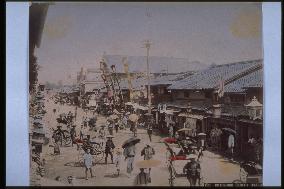
The large building in the centre is Benten-za, a theatre renovated in 1876 and again in 1894. This photograph depicts the building after renovations in 1876 and is therefore thought to have been taken in the second decade of the Meiji Period (1877-1887).==Date:unknown, Place:Osaka, Photo:unknown, (Credit:Nagasaki University Library/Kyodo News Images) [Cabinet Number57‐17‐0]

  •  
An entrance to Mt. Suwa

An entrance to Mt. Suwa

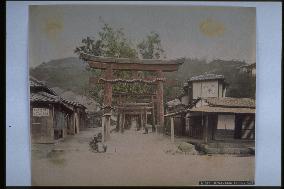
Torii gates on the approach to Suwa Shinto Shrine. This was the foremost Shinto shrine of the area since ancient times, and Mt. Suwa, visible to the right (east), was named after it. The shrine compound was designated as a park in 1873, and a hot spring said to have been discovered by an Englishman opened nearby. The sign advertising Needles, Hair Dressing, Hair Oil indicates that this is a general store as well as a hair salon.==Date:unknown, Place:Kobe, Photo:unknown, (Credit:Nagasaki University Library/Kyodo News Images) [Cabinet Number56‐17‐0]

  •  
Approach to Tsurugaoka Hachimangu Shrine

Approach to Tsurugaoka Hachimangu Shrine

Tsurugaoka Hachimangu and San-no-Torii(The 3rd torii gate) is located behind. The road extended toward shrine is Dankazura.==Date:unknown, Place:Kamakura, Photo:unknown, (Credit:Nagasaki University Library/Kyodo News Images) [Cabinet Number55‐17‐0]

  •  
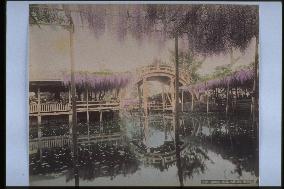
A wisteria trellis at Kameido Shrine

A wisteria trellis at Kameido Shrine

Taiko-bashi (Sori-bashi) and wisteria blossoms around 1897. View from the west side of Shinji Pond located to the left of the front entrance of the shrine. This is the bridge in photograph #4832, only viewed from the left. The bridge was designed to form a circle when viewed along with its reflection in the pond.==Date:unknown, Place:Tokyo, Photo:unknown, (Credit:Nagasaki University Library/Kyodo News Images) [Cabinet Number53‐17‐0]

  •  
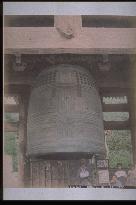
The Great Bell,Chion-in Temple

The Great Bell,Chion-in Temple

The big temple bell of Chion-in is viewed from west of the bell tower, facing east. A vendor is selling tinted framed photographs under the bell. Standing around him are young tourists. Also called Yoshimizu's Bell, this is the largest bronze bell cast at Sanjo-Kamanza foundry. It is 5.4m high, 2.7m in diameter, 29cm thick, and weighs 7.5 tons.==Date:unknown, Place:Kyoto, Photo:unknown, (Credit:Nagasaki University Library/Kyodo News Images) [Cabinet Number52‐17‐0]

  •  
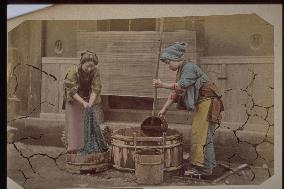
Scooping water

Scooping water

One woman is washing clothes while the other is drawing water. The colouring has been applied very skillfully. The fact that the camera is slightly out of focus indicates that the women were really engaged in work.==Date:unknown, Place:unknown, Photo:unknown, (Credit:Nagasaki University Library/Kyodo News Images) [Cabinet Number51‐17‐0]

  •  
Children baby-sitting

Children baby-sitting

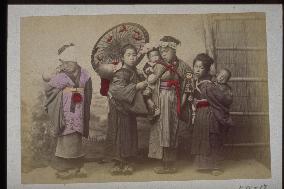
The girl on the left is wearing a jacket used to cover a child carried on the back. The children are wearing hand towels over their heads in a typical babysitting style. Children charged to look after the young were either older siblings or children from poor rural families sent out to work.==Date:unknown, Place:unknown, Photo:unknown, (Credit:Nagasaki University Library/Kyodo News Images) [Cabinet Number50‐17‐0]

  •  
Women performing ozashiki dance

Women performing ozashiki dance

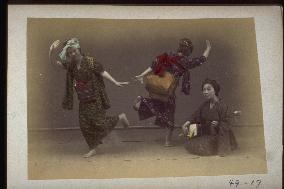
One woman is wearing a hachimaki (head towel). Three women are dancing to the music of a shamisen (three-stringed lute), their sleeves tied up with cords and their legs lifted high. This is a playful, not traditional and refined, dance.==Date:unknown, Place:unknown, Photo:unknown, (Credit:Nagasaki University Library/Kyodo News Images) [Cabinet Number49‐17‐0]

  •  
Dancing geikos wearing sashes

Dancing geikos wearing sashes

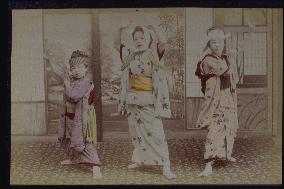
Three women in kimono with pulled-up sleeves are performing a dance dressed as men in a zashiki guest room looking over a Japanese garden. Whether they are professional dancers is uncertain, but the dance does not seem to be a traditional performance.==Date:unknown, Place:unknown, Photo:Tamamura Kozaburo, (Credit:Nagasaki University Library/Kyodo News Images) [Cabinet Number48‐17‐0]

  •  
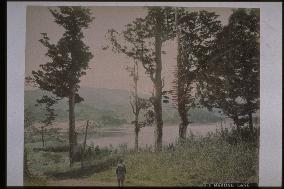
The approach to Hakone Shrine

The approach to Hakone Shrine

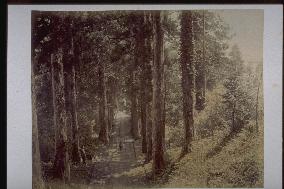
This is the shrine approach going down toward Lake Ashinoko viewed from the main building of Hakone Shrine. There are many cedar trees in the area just as the cedars line along the approach as well as Yatateno-sugi and Anzan-sugi in the shrine precincts and Sakasa-sugi by the Lake Ashinoko. The late afternoon sun is hitting the approach. Two workers are visible.==Date:unknown, Place:Hakone, Photo:unknown, (Credit:Nagasaki University Library/Kyodo News Images) [Cabinet Number47‐17‐0]

  • Main
  • Top
  • Editorial
  • Creative
  • About Us
  • About ILG
  • Terms of use
  • Company
  • BEHIND
  • Price List
  • Single Plan
  • Monthly Plan
  • Services
  • Shooting
  • Rights Clearance
  • Support
  • FAQ
  • How To Buy
  • Contact Us
  • Become a Partner

© KYODO NEWS IMAGES INC

All Rights Reserved.

  • Editorial
  • Olympics
  • News
  • Sports
  • Japan
  • Tech
  • Royal
  • Disaster
  • NorthKorea
  • Old Japan
  • SNS
  • Creative
  • Food
  • Japan
  • Landscape
  • Animal
  • Popular
  • #Ukraine
  • #Russia
  • #coronavirus
  • #N. Korea
  • #China
  • #Thailand
  • #Ukraine
  • #Russia
  • #coronavirus
  • #N. Korea
  • #China
  • #Thailand
  • Food
  • Japan
  • Landscape
  • Animal
  • Olympics
  • News
  • Sports
  • Japan
  • Tech
  • Royal
  • Disaster
  • NorthKorea
  • Old Japan
  • SNS