•  
Cleaning of great Buddha statue

Cleaning of great Buddha statue

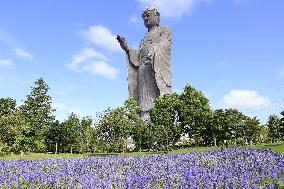
Photo taken on Sept. 12, 2022, shows the Ushiku Daibutsu great Buddha statue in the Ibaraki Prefecture city of Ushiku, eastern Japan. An annual major cleaning was carried out of the 120-meter-high statue the same day.

  •  
Cleaning of great Buddha statue

Cleaning of great Buddha statue

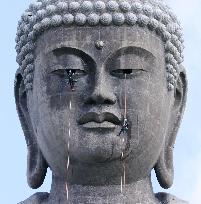
An annual major cleaning is carried out of the 120-meter-high Ushiku Daibutsu great Buddha statue in the Ibaraki Prefecture city of Ushiku, eastern Japan, on Sept. 12, 2022.

  •  
Cleaning of great Buddha statue

Cleaning of great Buddha statue

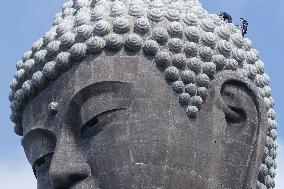
An annual major cleaning is carried out of the 120-meter-high Ushiku Daibutsu great Buddha statue in the Ibaraki Prefecture city of Ushiku, eastern Japan, on Sept. 12, 2022.

  •  

LARGEST STONE BUDDHA UNVEILED

LARGEST STONE BUDDHA UNVEILED==Date:June, 1969, Place:,JAPAN, (Credit:INTERNATIONAL MOTION PICTURE/Kyodo News Images)

  •  
Tokyo Olympic torch relay

Tokyo Olympic torch relay

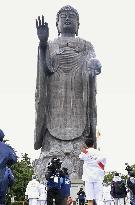
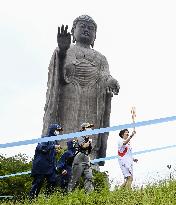
A Tokyo Olympic torch relay participant runs in front of the Ushiku Daibutsu great Buddha statue in the Ibaraki Prefecture city of Ushiku on July 5, 2021.

  •  
Tokyo Olympic torch relay

Tokyo Olympic torch relay

A Tokyo Olympic torch relay participant runs in front of the Ushiku Daibutsu great Buddha statue in the Ibaraki Prefecture city of Ushiku on July 5, 2021.

  •  
Daibutsu (the Great Buddha) of Kamakura

Daibutsu (the Great Buddha) of Kamakura

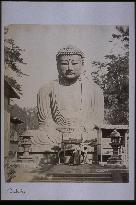
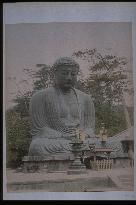
The Daibutsu is the main Buddha at the Kotokuin and used to be inside a building called the Daibutsuden. It was originally a wooden statue, but in Azuma Kagami (historical record of the Kamakura Shogunate), there is mention of starting to mold the gold and copper Shakanyorai Buddha (actually Amida statue) in 1252 in Fukasawa.==Date:unknown, Place:Kamakura, Photo:Ogawa Kazumasa, (Credit:Nagasaki University Library/Kyodo News Images) [Cabinet Number10‐17‐0]

  •  
Daibutsu (the Great Buddha) of Kamakura

Daibutsu (the Great Buddha) of Kamakura

The Daibutsu (Great Buddha) is the main Buddha of the Kotokuin (Daiisan Kotokuin Josenji). The statue was initially enshrined in a hall like the Daibutsu in Nara. Old records show that the priest Joko of Toe planned the construction of the Buddha in 1236, the year that Hojo Yasutoki was Shikken (regent).==Date:unknown, Place:Kamakura, Photo:Kusakabe Kinbei, (Credit:Nagasaki University Library/Kyodo News Images) [Cabinet Number4‐26‐0]

  •  
Daibutsu (the Great Buddha) of Kamakura

Daibutsu (the Great Buddha) of Kamakura

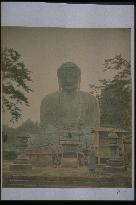
The Great Buddha of Kamakura is a seated Amitabha Buddha (Amida Nyorai) made of bronze. Designated as a National Treasure in 1897, it is the main object of worship at Kohtokuin Shojosenji Temple. Historic documents state that work began on a gilt statue of Shaka Nyorai Buddha about 13.5 meters in height in the year 1252. It is not known when it became a statue of Amida Buddha. The exact date of the photograph is unknown.==Date:1904, Place:Kamakura, Photo:unknown, (Credit:Nagasaki University Library/Kyodo News Images) [Cabinet Number98‐4‐0]

  •  
Daibutsu (the Great Buddha) of Kamakura

Daibutsu (the Great Buddha) of Kamakura

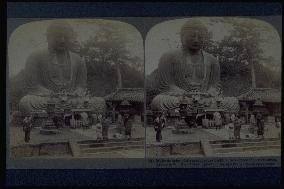
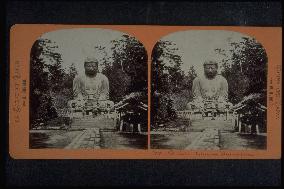
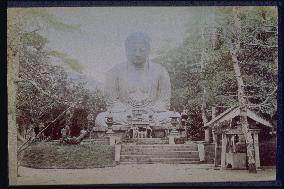
The bronze lanterns on both sides of the statue were donated in January 1712 and still exist today. Behind them are the two stones presumed to be foundations of the former Great Buddha building. The label under the caption on the lower right border of the stereograph reads Copyright 1904 by Underwood & Underwood, indicating that the photograph was taken around 1904.==Date:1904, Place:Kamakura, Photo:Underwood, (Credit:Nagasaki University Library/Kyodo News Images) [Cabinet Number97‐86‐0]

  •  
Daibutsu (the Great Buddha) of Kamakura

Daibutsu (the Great Buddha) of Kamakura

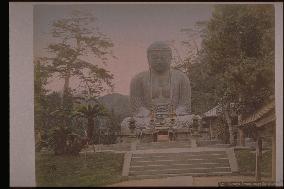
The words STILLFRIED(?) C. 1875 are visible on the mount. This photograph is said to have been taken by Stillfried around 1875, but the presence of the same temporary shack as that in photograph #2748 and the signboard on the left reading Names of Donors for Reconstruction Work suggest that it was taken a little later, probably the second decade of the Meiji Period.==Date:about 1875, Place:Kamakura, Photo:R. Stillfried, (Credit:Nagasaki University Library/Kyodo News Images) [Cabinet Number96‐70‐0]

  •  
Daibutsu (the Great Buddha),Ueno

Daibutsu (the Great Buddha),Ueno

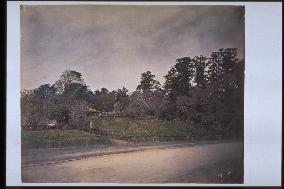
The Great Buddha at Daibutsuyama, Ueno Shinobazugaoka. The lack of temple housing indicates that the photograph was taken after 1873, probably around 1882 in view of the fact that the photographer is Usui Shuzaburo. The path in front of the Buddha to the left leads to Ueno Seiyoken Restaurant, which opened in April 1873 as the second location of Tsukiji Seiyoken of Kyobashi Unemecho. A sign saying Seiyoken Annex is visible to the left of the path. The street in the foreground is Kuromon Dori (Black Gate Street). The grove on the right is Toshogu-no-Mori.==Date:unknown, Place:Tokyo, Photo:Usui Shuzaburo, (Credit:Nagasaki University Library/Kyodo News Images) [Cabinet Number94‐47‐0]

  •  
Daibutsu (the Great Buddha) of Kamakura

Daibutsu (the Great Buddha) of Kamakura

The photograph bears the inscription One Hundred Nineteen 119. There are no bronze lotus petals. The building on the right side of the statue is probably the same as that in photograph #3997. The sharply-raking finials on the two bronze lanterns in front of the statue indicate that this photograph was taken at the beginning of the Meiji Period, but there seems to be a slight time difference from photograph #3997.==Date:unknown, Place:Kamakura, Photo:Usui Shuzaburo, (Credit:Nagasaki University Library/Kyodo News Images) [Cabinet Number94‐10‐0]

  •  
Daibutsu (the Great Buddha) of Kamakura

Daibutsu (the Great Buddha) of Kamakura

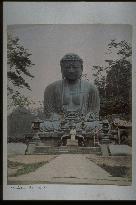
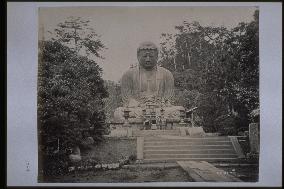
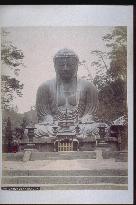
The two large flat stones in front of the statue may be the foundation stones of the former temple building. Recent excavations revealed several foundation bases, evidence that the former temple building had a north-south length of about 42.5 meters and an east-west width of 44 meters. The exact date of this photograph is unknown. The Great Buddha is an object of worship and climbing upon it is prohibited today.==Date:unknown, Place:Kamakura, Photo:unknown, (Credit:Nagasaki University Library/Kyodo News Images) [Cabinet Number93‐37‐0]

  •  
Daibutsu (the Great Buddha),Hyogo

Daibutsu (the Great Buddha),Hyogo

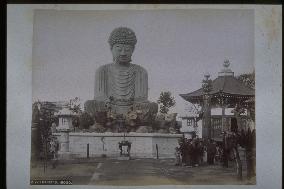
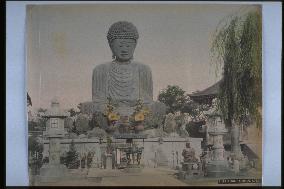
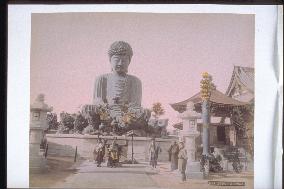
The Great Buddha (Vairocana Buddha) of Nofukuji Temple, unveiled on March 15, 1891, was a bronze statue measuring 11.5 m in height and weighing 11 tons. In May 1945, the statue was removed and donated in response to a wartime metal collection order. The pedestal remained empty until May 1991 when, almost half a century later, a Great Buddha, larger than the original, was built here.==Date:unknown, Place:Kobe, Photo:unknown, (Credit:Nagasaki University Library/Kyodo News Images) [Cabinet Number93‐31‐0]

  •  
Daibutsu (the Great Buddha) of Kamakura

Daibutsu (the Great Buddha) of Kamakura

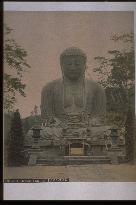
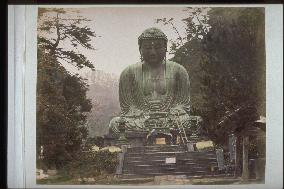
The exact date of the photograph is unknown. The only historical information about the former Great Buddha Hall is that it collapsed twice, once in 1334 and again in 1369. Since there is no record of reconstruction after the earthquake of 1498, it is like that the statue has been exposed outdoors since that time. The Great Buddha is an object of worship and climbing upon it is prohibited today.==Date:unknown, Place:Kamakura, Photo:unknown, (Credit:Nagasaki University Library/Kyodo News Images) [Cabinet Number92‐15‐0]

  •  
Daibutsu (the Great Buddha) of Kamakura

Daibutsu (the Great Buddha) of Kamakura

The photograph was probably taken around the same time as photograph #2748. Kotokuin Temple began to collect donations for the reconstruction of the temple in 1879. However, a change in public opinion caused the plan to be suspended in 1889. It is documented that the donated money was later used to enlarge the temple grounds, to plant trees, and to build rest areas. The Great Buddha is an object of worship and climbing upon it is prohibited today.==Date:unknown, Place:Kamakura, Photo:unknown, (Credit:Nagasaki University Library/Kyodo News Images) [Cabinet Number90‐28‐0]

  •  
Daibutsu (the Great Buddha) of Kamakura

Daibutsu (the Great Buddha) of Kamakura

The photograph is entitled Daibutzu Kamakura. The bronze lotus petals are visible, but the building on the right of the Buddha is more dilapidated than it appears in photograph #2747. Therefore, this photograph was probably taken later than photograph #2747, in the early part of the Meiji Period. It is recorded that these petals were made in 1736. The Great Buddha is an object of worship and climbing upon it is prohibited today.==Date:unknown, Place:Kamakura, Photo:unknown, (Credit:Nagasaki University Library/Kyodo News Images) [Cabinet Number87‐30‐0]

  •  
Daibutsu (the Great Buddha) of Kamakura

Daibutsu (the Great Buddha) of Kamakura

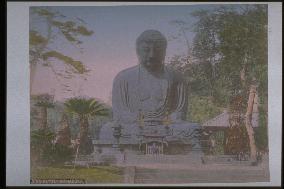
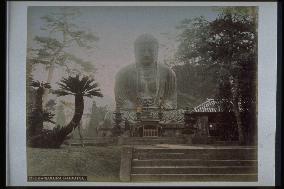
The photograph is labeled 9 DAIBUTSU, KAMAKURA. The two flat rocks in front of the statue could be foundation stones of the former building. A simple structure with a thatched roof is visible behind the cycad tree to the left of the statue. The exact date is not known.==Date:unknown, Place:Kamakura, Photo:unknown, (Credit:Nagasaki University Library/Kyodo News Images) [Cabinet Number86‐9‐0]

  •  
Daibutsu (the Great Buddha) of Kamakura

Daibutsu (the Great Buddha) of Kamakura

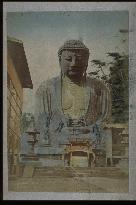
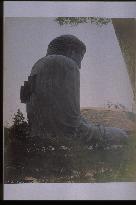
The photograph is labeled L22 DAI BUTSU(SIDE). The thatched roof in the background is that of the kuri (priests' quarters). There are doors (still extant) in the Buddha's back. It is reported that these doors were donated by the subtemples of Kenchoji Temple in 1736. The exact date of this photograph is unknown.==Date:unknown, Place:Kamakura, Photo:A. Farsari, (Credit:Nagasaki University Library/Kyodo News Images) [Cabinet Number82‐19‐0]

  •  
Daibutsu (the Great Buddha) of Kamakura

Daibutsu (the Great Buddha) of Kamakura

The photograph is labeled L19 DAIBUTSU (A). The building to the right side of the statue is the same as that in photograph #3375, and there are three large flat stones at the lower left side of the statue. Also, there are roof tiles piled up under the bronze altar placed in front of the pedestal. The Great Buddha is an object of worship and climbing upon it is prohibited today.==Date:unknown, Place:Kamakura, Photo:A. Farsari, (Credit:Nagasaki University Library/Kyodo News Images) [Cabinet Number82‐18‐0]

  •  
Daibutsu (the Great Buddha) of Kamakura

Daibutsu (the Great Buddha) of Kamakura

The photograph is labeled No.534 DAIBUTSU AT KAMAKURA. The exact date is unknown. People are standing in the cupped hands of the statue and other spots. The palm of the statue is large, possibly about 3.8 square meters. The Great Buddha is an object of worship and climbing upon it is prohibited today.==Date:unknown, Place:Kamakura, Photo:Tamamura Kozaburo, (Credit:Nagasaki University Library/Kyodo News Images) [Cabinet Number80‐18‐0]

  •  
Daibutsu (the Great Buddha) of Kamakura

Daibutsu (the Great Buddha) of Kamakura

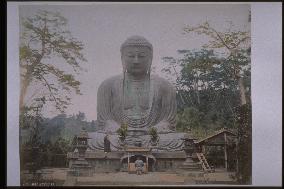
Two bronze lotus petals (four existing today) are visible on the front of the pedestal, and a simple building stands on the right. There are large flat stones in front of the lotus petals to both the left and right. The fact that the petals are intact and the accompanying structure is different indicates that this photograph was taken later than the beginning of the Meiji Period when photograph #4464 was apparently taken. The Great Buddha is an object of worship and climbing upon it is prohibited today.==Date:unknown, Place:Kamakura, Photo:R. Stillfried, (Credit:Nagasaki University Library/Kyodo News Images) [Cabinet Number78‐15‐0]

  •  
Daibutsu (the Great Buddha) of Kamakura

Daibutsu (the Great Buddha) of Kamakura

This stereograph entitled No.301 Daibuts-Statue in Kamakura is thought to have been taken in the beginning of the Meiji Period because there are bronze lotus petals in front of the statue. The stone paved approach is the same as that in photograph #5372. The monument in the photograph, which carries the inscription Donated Stone Pavement was made in 1780, so it is likely that this stone pavement was laid at the same time.==Date:unknown, Place:Kamakura, Photo:Wilhelm Burger, (Credit:Nagasaki University Library/Kyodo News Images) [Cabinet Number70‐22‐0]

  •  
Daibutsu (the Great Buddha) of Kamakura

Daibutsu (the Great Buddha) of Kamakura

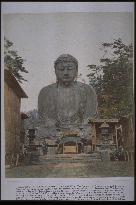
The photograph was probably taken at the beginning of the Meiji Period. There are two large flat stones in front of the pedestal, and the same simple building as that in photograph #3997 is visible to the right of the statue. However, the lack of bronze lotus petals indicates that it was taken at a slightly later date. The Great Buddha is an object of worship and climbing upon it is prohibited today.==Date:unknown, Place:Kamakura, Photo:unknown, (Credit:Nagasaki University Library/Kyodo News Images) [Cabinet Number69‐44‐0]

  •  
Daibutsu (the Great Buddha) of Kamakura

Daibutsu (the Great Buddha) of Kamakura

Like photographs #2748 and #3132, this is thought to have been taken between 1877 and 1887 when the reconstruction of the building was underway. However, no donors' signboards are visible. Also, there is a temporary shack on the lower right of the statue, but it is empty. This photograph may have been taken by Usui Shuzaburo (a 19th-century photographer in Yokohama). The Great Buddha is an object of worship and climbing upon it is prohibited today.==Date:unknown, Place:Kamakura, Photo:Usui Shuzaburo?, (Credit:Nagasaki University Library/Kyodo News Images) [Cabinet Number65‐6‐0]

  •  
Daibutsu (the Great Buddha) of Kamakura

Daibutsu (the Great Buddha) of Kamakura

The photograph was probably taken around the same time as photograph #2748, i.e. the first decade of the Meiji Period. It is thought to have been taken by Stillfried. Three signboards stand on both sides of the paved stone approach, one saying, The names of donors for the reconstruction work. There are many roof tiles piled under the floor of the shack on the right and a few placed on the floor. These tiles may have been donated for the reconstruction.==Date:unknown, Place:Kamakura, Photo:unknown, (Credit:Nagasaki University Library/Kyodo News Images) [Cabinet Number64‐30‐0]

  •  
Daibutsu (the Great Buddha) of Kamakura

Daibutsu (the Great Buddha) of Kamakura

The photograph is entitled JP Daibutzu of Kamacura / Japanese Buddha/ . There are sharply raking finials protruding from the caps of the bronze lanterns, which no longer exist. The photographer is thought to be Felix Beato. Beato's travel records suggest that it was taken at the end of the Edo or the beginning of the Meiji Period. The Great Buddha is an object of worship and climbing upon it is prohibited today.==Date:unknown, Place:Kamakura, Photo:F. Beato, (Credit:Nagasaki University Library/Kyodo News Images) [Cabinet Number62‐13‐0]

  •  
Daibutsu (the Great Buddha) of Kamakura

Daibutsu (the Great Buddha) of Kamakura

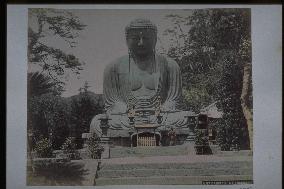
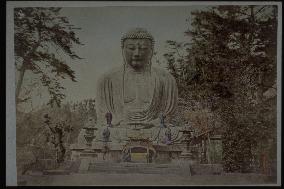
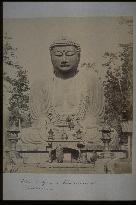
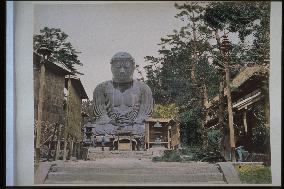
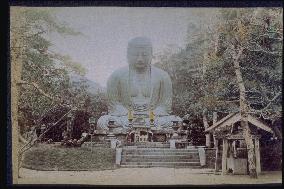
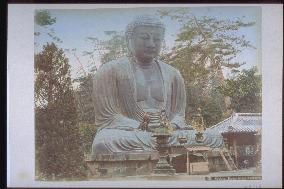
A pine forest surrounds the Great Buddha in Kamakura. There are large flat rocks in front of the statue. The stone cleansing basin at the lower right was donated in 1749. There are no bronze lotus petals. The exact date of the photograph is unknown.==Date:unknown, Place:Kamakura, Photo:unknown, (Credit:Nagasaki University Library/Kyodo News Images) [Cabinet Number61‐19‐0]

  •  
Daibutsu (the Great Buddha) of Kamakura

Daibutsu (the Great Buddha) of Kamakura

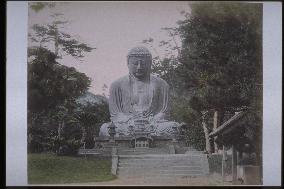
There is a thatched-roof building at the back right of the statue. The same building is evident in the photograph album entitled Kakuchi Meisho ( Famous Places Here and There ) printed in 1893 for the Abe Family, former lords of the Fukuyama Clan. Therefore, it is assumed that this photograph was taken after that date.==Date:unknown, Place:Kamakura, Photo:unknown, (Credit:Nagasaki University Library/Kyodo News Images) [Cabinet Number59‐56‐2]

  •  
Daibutsu or the Great Buddha,Nara

Daibutsu or the Great Buddha,Nara

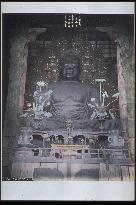
Looking up the Great Buddha in the Todaiji Temple from alsmost the same location as catalogue #2683. There are no stairs in front of the Buddha in #2683, but there are in this photo. Theses are called kizahashi and used at the various ceremonies.==Date:unknown, Place:Nara, Photo:unknown, (Credit:Nagasaki University Library/Kyodo News Images) [Cabinet Number59‐11‐2]

  •  
Daibutsu (the Great Buddha),Hyogo

Daibutsu (the Great Buddha),Hyogo

The Great Buddha of Nofukuji Temple (present-day Hyogo Ward) taken in the latter half of the Meiji Period. This is an important Tendai Sect temple and is a place remembered in connection with Taira Kiyomori, who traded with Sung Dynasty China in the latter part of the Heian Period. After the opening of the port of Kobe, Christianity gained popularity. This statue of Vairocana Buddha was unveiled on March 15, 1891 as part of an effort to revive Buddhism. The statue attracted people to the faith and gained fame among foreigners as well.==Date:unknown, Place:Kobe, Photo:unknown, (Credit:Nagasaki University Library/Kyodo News Images) [Cabinet Number56‐18‐0]

  •  
Daibutsu (the Great Buddha) of Kamakura

Daibutsu (the Great Buddha) of Kamakura

The date of the photograph is unknown. The large flat stones in front of the statue may be the former foundation stones. A document from the mid-Edo Period states that 60 foundation stones lined the perimeter of the statue, about 38 meters on the north and south sides and about 45 on the east and west. The Great Buddha is an object of worship and climbing upon it is prohibited today.==Date:unknown, Place:Kamakura, Photo:unknown, (Credit:Nagasaki University Library/Kyodo News Images) [Cabinet Number55‐25‐0]

  •  
Daibutsu (the Great Buddha) of Kamakura

Daibutsu (the Great Buddha) of Kamakura

There are gas lights to the right and left sides and the kuri (rectory) on the right. Kotokuin Temple began to collect donations after receiving government permission to rebuild the Great Buddha Hall in 1879. The three signboards on the left may be lists of the names of donors. There is a shack to the lower right of the statue. Since another photograph shows roof tiles piled up here, this spot may have been a booth for the donation of roof tiles as part of the reconstruction project.==Date:unknown, Place:Kamakura, Photo:unknown, (Credit:Nagasaki University Library/Kyodo News Images) [Cabinet Number55‐21‐0]

  •  
Daibutsu (the Great Buddha) of Kamakura

Daibutsu (the Great Buddha) of Kamakura

Bronze lotus petals (four existing today) are visible at the front of the pedestal of the Great Buddha. The building with a thatched roof on the right and the sharply raking finials on the cap of the lantern in the foreground are the same as those depicted in a photograph in the May 30th, 1870 issue of The Far East, indicating that it was taken around the same time. The Great Buddha is an object of worship and climbing upon it is prohibited today.==Date:unknown, Place:Kamakura, Photo:unknown, (Credit:Nagasaki University Library/Kyodo News Images) [Cabinet Number55‐20‐0]

  •  
Daibutsu or the Great Buddha,Nara

Daibutsu or the Great Buddha,Nara

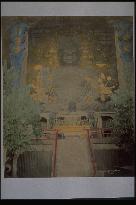
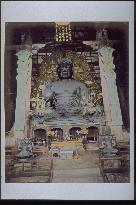
Looking up the Great Buddha in the Todaiji Temple capturing almost its entirety. Compared to the catalogue #2920, this is the usual state of the interior of the hall as there are no stairs. Normally people goes up and down from the side of the Buddha. The ceiling is also captured in the photo.==Date:unknown, Place:Nara, Photo:unknown, (Credit:Nagasaki University Library/Kyodo News Images) [Cabinet Number54‐12‐2]

  •  
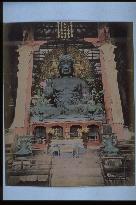
Daibutsu (the Gtreat Buddha) at Todaiji Temple

Daibutsu (the Gtreat Buddha) at Todaiji Temple

Daibutsu (the Gtreat Buddha) at Todaiji Temple==Date:unknown, Place:Nara, Photo:unknown, (Credit:Nagasaki University Library/Kyodo News Images)

  •  
Daibutsu-den (the Great Buddha Hall),Todaiji Temple

Daibutsu-den (the Great Buddha Hall),Todaiji Temple

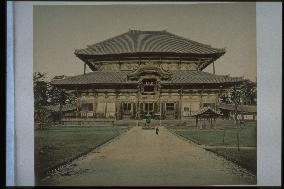
This photo was taken before the restoration of the Great Buddha Hall in the Meiji Period because the eaves are waving. Since the present-day Buddha Hall was constructed in 1709, it had been almost two hundred years until the large restoration in the end of the Meiji Period. Due to the large structure, the roofs were deformed, and hence, it was dismantled and restored.==Date:unknown, Place:Nara, Photo:unknown, (Credit:Nagasaki University Library/Kyodo News Images) [Cabinet Number54‐12‐0]

  •  
Daibutsu (the Great Buddha),Ueno

Daibutsu (the Great Buddha),Ueno

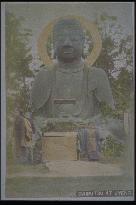
The Great Buddha was located on a hill to the left of Ueno Seiyoken Restaurant and attracted many visitors during the cherry blossom season. However, the head of the Buddha fell off in the Great Kanto Earthquake of 1923. The body was donated to the military to make (of all things) weapons during World War II. On the 50th anniversary of the earthquake, a pagoda was built at the site of the former Great Buddha, and the head of the Buddha, which had been kept at Kaneiji Temple, was installed in a monument south of the pagoda. Probably taken around 1878.==Date:unknown, Place:Tokyo, Photo:unknown, (Credit:Nagasaki University Library/Kyodo News Images) [Cabinet Number53‐48‐0]

  •  
Daibutsu (the Great Buddha),Ueno

Daibutsu (the Great Buddha),Ueno

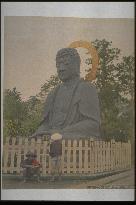
The Great Buddha of Ueno is said not to have been as handsome as its counterpart in Kamakura, but it looks quite good from this angle. Here it still has the halo behind its head. It is not clear when the halo was removed, although it is gone in a postcard from 1912. Thus, it could have been removed at the end of the Meiji Period. Probably taken between 1892 and 1897. The same as photograph #2618.==Date:unknown, Place:Tokyo, Photo:unknown, (Credit:Nagasaki University Library/Kyodo News Images) [Cabinet Number53‐34‐2]

  •  
Daibutsu (the Great Buddha),Ueno

Daibutsu (the Great Buddha),Ueno

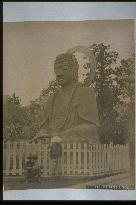
There was once a Great Buddha on the hill at Ueno. It is said that Hori Tangonokami Naoyori built it at Shinobugaoka in 1631. The Buddhist monk Joun later cast it in bronze, but it was destroyed by fire in 1841. A new Buddha and temple housing were constructed in 1843. It is said that the temple housing was removed in 1873, which explains why the Buddha is exposed in this photograph. Probably taken between 1892 and 1897.==Date:unknown, Place:Tokyo, Photo:unknown, (Credit:Nagasaki University Library/Kyodo News Images) [Cabinet Number53‐7‐0]

  •  
Daibutsu (the Great Buddha) of Kamakura

Daibutsu (the Great Buddha) of Kamakura

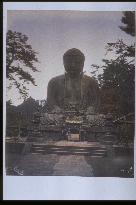
This is the same photograph as #2252. Two flat rocks are placed in front of the pedestal. A map of the temple grounds dated 1899 shows four stones placed at the corners surrounding the statue, suggesting that the foundation stones of the former Great Buddha hall were still in their original locations. A total of 59 such stones still remain in the present-day temple grounds.==Date:unknown, Place:Kamakura, Photo:Tamamura Kozaburo, (Credit:Nagasaki University Library/Kyodo News Images) [Cabinet Number48‐137‐0]

  •  
Daibutsu (the Great Buddha) of Kamakura

Daibutsu (the Great Buddha) of Kamakura

The stone cleansing basin in the foreground was donated in 1749. At present it is situated at the entrance of the temple grounds along with its roof. There are two flat rocks placed in front of the statue. The symmetrical position of these rocks suggests that they were used as foundation stones for the former Great Buddha Hall. This photograph is included in the Tamamura Kozaburo (1856-?) Photograph Collection. The date of the photograph is not known.==Date:unknown, Place:Kamakura, Photo:Tamamura Kozaburo, (Credit:Nagasaki University Library/Kyodo News Images) [Cabinet Number48‐105‐0]

  •  
Daibutsu (the Great Buddha) of Kamakura

Daibutsu (the Great Buddha) of Kamakura

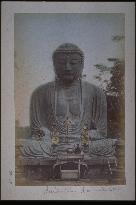
The photograph is labeled 42 DAIBUTSU KAMAKURA. The exact date is unknown. The weight of the Great Buddha (Daibutsu) is 122 tons. According to the latest digital measurements, the height (from the top of the statue to the ground) is 11.310 m, and the length from the top of the head to the jaw is 3.678 m. The Great Buddha is an object of worship and climbing upon it is prohibited today.==Date:unknown, Place:Kamakura, Photo:unknown, (Credit:Nagasaki University Library/Kyodo News Images) [Cabinet Number47‐9‐0]

  •  
Daibutsu or the Great Buddha,Nara

Daibutsu or the Great Buddha,Nara

Said to be built by Master Daibutsu maker Kokujuren Kimimaro and Master Caster Takaichi Renshinkoku etc. It was recast following fires in wars, the body during the Kamakura era, and the head in the Edo era. See picture numbered 27-3.==Date:unknown, Place:Nara, Photo:unknown, (Credit:Nagasaki University Library/Kyodo News Images) [Cabinet Number42‐31‐0]

  •  
Daibutsu (the Great Buddha),Hyogo

Daibutsu (the Great Buddha),Hyogo

Nanjo Sobe, a rich man of Kobe built this within the Nofukuji compounds in 1889. The consecration ceremony was conducted on 1891, and it became popular as the Daibutsu of Hyogo. Many photos exist of this, but the date of the photo is unknown.==Date:unknown, Place:Kobe, Photo:unknown, (Credit:Nagasaki University Library/Kyodo News Images) [Cabinet Number42‐6‐0]

  •  
Daibutsu (the Great Buddha) of Kamakura

Daibutsu (the Great Buddha) of Kamakura

The facade of the Daibutsu in Kamakura. A ladder is placed to the right arm of the Daibutsu.==Date:unknown, Place:Kamakura, Photo:Suzuki Shin-ichi, (Credit:Nagasaki University Library/Kyodo News Images) [Cabinet Number41‐13‐0]

  •  
Daibutsu (the Great Buddha) of Kamakura

Daibutsu (the Great Buddha) of Kamakura

The Daibutsu in Kamakura from the left diagonal position. A ladder is placed on the canopy, and a man sits on the left hand of the Daibutsu.The Great Buddha is an object of worship and climbing upon it is prohibited today.==Date:unknown, Place:Kamakura, Photo:Kusakabe Kinbei, (Credit:Nagasaki University Library/Kyodo News Images) [Cabinet Number40‐13‐0]

  •  
Daibutsu (the Great Buddha) of Kamakura

Daibutsu (the Great Buddha) of Kamakura

The Daibutsu of Kamakura from the front. A man with a top-knot stands to the right of the lantern facing sideways and other men with top-knots sit facing the front on the crossed legs of the Daibutsu and on the left knee. Same as the photo numbered 36-13, but the left, bottom and top have been trimmed.The Great Buddha is an object of worship and climbing upon it is prohibited today.==Date:unknown, Place:Kamakura, Photo:F. Beato, (Credit:Nagasaki University Library/Kyodo News Images) [Cabinet Number36‐13‐0]

  •  
Chumon Gate, Todaiji Temple

Chumon Gate, Todaiji Temple

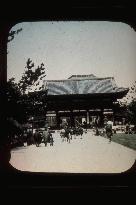
In front of the Chumon Gate, Todaiji Temple, Nara.It was shot from Nandaimon Gate, and you'll see the Daibutsu-den's roof over the gate.The walking people toward the gate are lively and evoke a festive atomosphere.\r\n==Date:unknown, Place:Nara, Photo:unknown, (Credit:Nagasaki University Library/Kyodo News Images) [Cabinet Number31‐9‐0]

  • Main
  • Top
  • Editorial
  • Creative
  • About Us
  • About ILG
  • Terms of use
  • Company
  • BEHIND
  • Price List
  • Single Plan
  • Monthly Plan
  • Services
  • Shooting
  • Rights Clearance
  • Support
  • FAQ
  • How To Buy
  • Contact Us
  • Become a Partner

© KYODO NEWS IMAGES INC

All Rights Reserved.

  • Editorial
  • Olympics
  • News
  • Sports
  • Japan
  • Tech
  • Royal
  • Disaster
  • NorthKorea
  • Old Japan
  • SNS
  • Creative
  • Food
  • Japan
  • Landscape
  • Animal
  • Popular
  • #Ukraine
  • #Thailand
  • #coronavirus
  • #N. Korea
  • #Russia
  • #China
  • #Ukraine
  • #Thailand
  • #coronavirus
  • #N. Korea
  • #Russia
  • #China
  • Food
  • Japan
  • Landscape
  • Animal
  • Olympics
  • News
  • Sports
  • Japan
  • Tech
  • Royal
  • Disaster
  • NorthKorea
  • Old Japan
  • SNS