•  
16th-century shogun Hideyoshi's letter unveiled

16th-century shogun Hideyoshi's letter unveiled

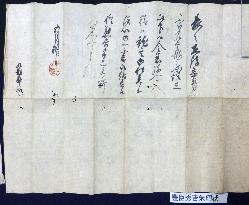
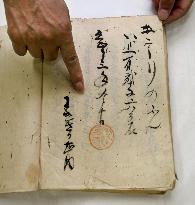
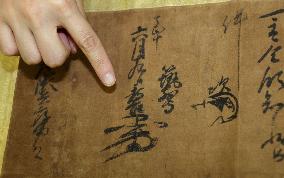
KOBE, Japan - Kobe University in western Japan releases on Dec. 8, 2014, a sealed letter sent by 16th-century shogun Toyotomi Hideyoshi to a clan leader in Toba, Mie Prefecture, to thank him for his assistance in Hideyoshi's aggression of the Korean Peninsula.

  •  
Letters by medieval warlords Nobunaga, Hideyoshi found

Letters by medieval warlords Nobunaga, Hideyoshi found

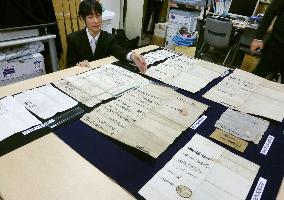
KOBE, Japan - Kobe University in western Japan unveils on Dec. 8, 2014, sealed letters sent by warlords Oda Nobunaga and Toyotomi Hideyoshi to a clan in Toba, Mie Prefecture, in the 16th century. A woman in her 40s in Kobe had kept the letters after inheriting them from her grandfather, and asked the university to use them for research.

  •  
Kagawa wins silver in karate over-84 kg class

Kagawa wins silver in karate over-84 kg class

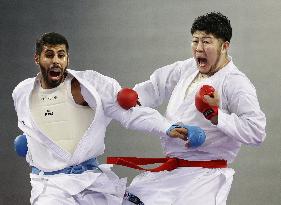
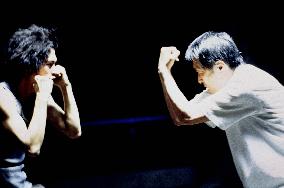
INCHEON, South Korea - Japan's Hideyoshi Kagawa (R) faces off against Kuwait's Rasheed F M F S Almutairi in the final of the men's karate over-84 kilogram class at the Asian Games in Incheon, South Korea, on Oct. 4, 2014. Almutairi beat Kagawa to win gold.

  •  
Research Whaling team speaks on research results

Research Whaling team speaks on research results

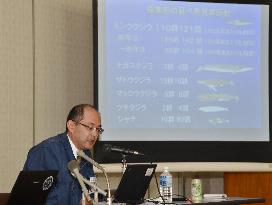
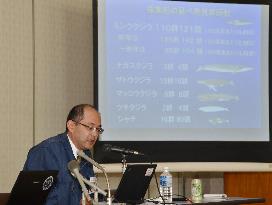
KUSHIRO, Japan - Hideyoshi Yoshida of a Japanese research whaling team speaks about the outcome of its research in waters off Kushiro in the northernmost Japanese prefecture of Hokkaido in Kushiro on Sept. 30, 2014.

  •  
Koriyama Castle found to have had tower 15-20m high

Koriyama Castle found to have had tower 15-20m high

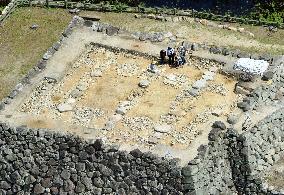
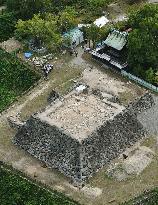
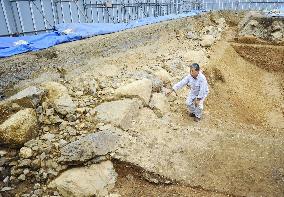
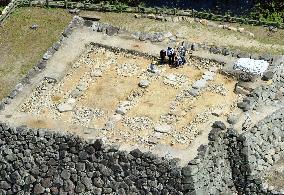
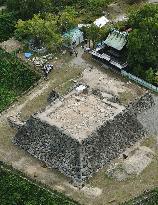
OSAKA, Japan - The foundation stones of Koriyama Castle's main keep in Yamatokoriyama, Nara Prefecture, are seen on Sept. 12, 2014. The city's education board announced the same day that the castle, used as the residence of Toyotomi Hidenaga (1540-1591), younger brother of Japanese feudal warlord Toyotomi Hideyoshi, had a castle tower as high as 15 to 20 meters.

  •  
Findings suggest keep 15-20m tall at Koriyama Castle

Findings suggest keep 15-20m tall at Koriyama Castle

OSAKA, Japan - Foundation stones that supported the keep of Koriyama Castle in Yamatokoriyama, Nara Prefecture, are seen on Sept. 12, 2014. New findings suggest that the keep was 15 to 20 meters tall. Toyotomi Hidenaga (1540-1591), younger brother of Japanese feudal warlord Toyotomi Hideyoshi, used the castle as his residence.

  •  
Gold leaf left in fragment of tile found at Koriyama Castle

Gold leaf left in fragment of tile found at Koriyama Castle

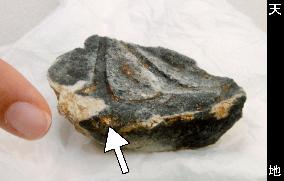
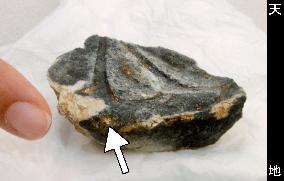
NARA, Japan - Gold leaf is seen left, as indicated by an arrow, in this photo taken on Sept. 12, 2014, in a fragment of tile unearthed at Koriyama Castle in Yamatokoriyama, Nara Prefecture. Toyotomi Hidenaga (1540-1591), younger brother of Japanese feudal warlord Toyotomi Hideyoshi, used the castle as his residence.

  •  
Hideyoshi's golden tea room reproduced at Kansai airport

Hideyoshi's golden tea room reproduced at Kansai airport

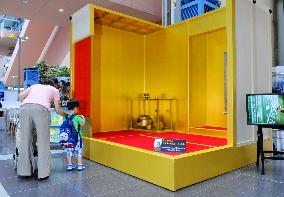
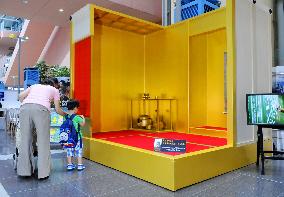
OSAKA, Japan - An exhibition of a reproduced model of a golden tea room believed to have been made by Japanese feudal lord Toyotomi Hideyoshi started at Kansai International Airport in Osaka Prefecture, western Japan, on Aug. 7. 2014.

  •  
Medieval warlord Hideyoshi's handwriting found

Medieval warlord Hideyoshi's handwriting found

TATSUNO, Japan - A newly discovered document bearing the handwriting and red seal of 16th-century warlord Toyotomi Hideyoshi is displayed at a municipal history museum in Tatsuno, Hyogo Prefecture, western Japan, on July 16, 2014.

  •  
Hideyoshi's battle surcoat shown at Kyoto temple

Hideyoshi's battle surcoat shown at Kyoto temple

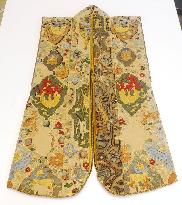
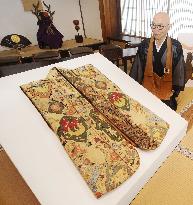
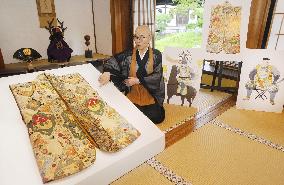
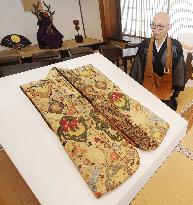
KYOTO, Japan - A repaired battle surcoat said to have been worn by Toyotomi Hideyoshi, a powerful warlord in the 16th century, is shown to the press at Kodaiji, a Buddhist temple in Kyoto City, on July 9, 2014.

  •  
Hideyoshi's surcoat shown to press before exhibition

Hideyoshi's surcoat shown to press before exhibition

KYOTO, Japan - A restored battle surcoat believed to have been worn by Toyotomi Hideyoshi, a powerful warlord in the 16th century, is disclosed to the press at Kodaiji, a Buddhist temple in Kyoto City, on July 9, 2014. The coat will be displayed at the Kodaiji Sho Museum from July 20 to Aug. 3 in the western Japanese city.

  •  
Hideyoshi's surcoat shown to press before exhibition

Hideyoshi's surcoat shown to press before exhibition

KYOTO, Japan - A restored battle surcoat believed to have been worn by Toyotomi Hideyoshi, a powerful warlord in the 16th century, is disclosed to the press at Kodaiji, a Buddhist temple in Kyoto City, on July 9, 2014. The coat will be displayed at the Kodaiji Sho Museum from July 20 to Aug. 3 in the western Japanese city.

  •  
Important cultural property reproduced

Important cultural property reproduced

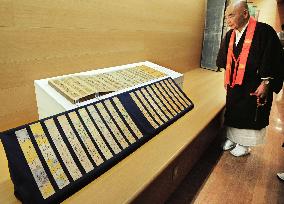
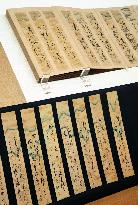
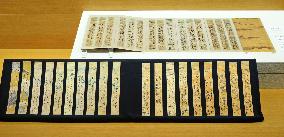
KYOTO, Japan - Replicas of "Daigo Hanami Tanzaku" (below), a collection of waka, Japanese traditional poems, written at a feast held by Toyotomi Hideyoshi in 1598, are shown at Daigoji, a World Heritage temple in Kyoto City, on June 3, 2014. Fuji Xerox Co. reproduced the collection.

  •  
Important cultural property reproduced

Important cultural property reproduced

KYOTO, Japan - Replicas of "Daigo Hanami Tanzaku" (below), a collection of waka, Japanese traditional poems, written at a feast held by Toyotomi Hideyoshi in 1598, are shown at Daigoji, a World Heritage temple in Kyoto City, on June 3, 2014. Fuji Xerox Co. reproduced the collection. Shown above is the original work, a national important cultural property.

  •  
'Daigo Hanami Tanzaku' reproduced

'Daigo Hanami Tanzaku' reproduced

KYOTO, Japan - Replicas of "Daigo Hanami Tanzaku" (below), a collection of waka, Japanese traditional poems, written at a feast held by Toyotomi Hideyoshi in 1598 in Daigoji Temple in Kyoto, are shown at the World Heritage temple on June 3, 2014. Fuji Xerox Co. reproduced the collection. Shown above is the original work, a national important cultural property.

  •  
5 elderly bee hunters contributing to field over 5 decades

5 elderly bee hunters contributing to field over 5 decades

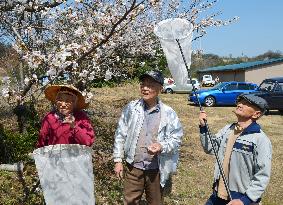
FUKUI, Japan - (From L) Chizuko Nozaka, Tadao Murota and Hideyoshi Kurokawa gather near Lake Kitagata in Awara, northern Fukui Prefecture, on April 5, 2013, to collect bees as part of their research into the insect's habitat. Including the three, five people now in their 70s to 90s have been chasing and collecting bees for more than half a century since the 1950s.

  •  
Ceremony held for Japan's 8th contingent of troops for Iraq

Ceremony held for Japan's 8th contingent of troops for Iraq

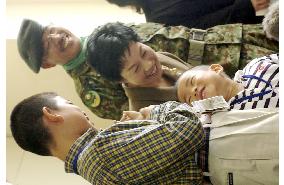
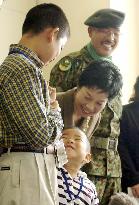
KUMAMOTO, Japan - Ground Self-Defense Force Maj. Hideyoshi Haraoka, a member of Japan's eighth GSDF contingent to be sent to Iraq for reconstruction assistance, smilingly watches as his family members talk to each other during a ceremony held at a garrison in the southwestern Japanese city of Kumamoto to deliver a unit flag to his unit on Oct. 22. The first batch of the 500-member contingent, mostly drawn from units in Kumamoto, Miyazaki and Kagoshima prefectures, is scheduled to leave for Iraq later in the day.

  •  
Yasukuni Shrine returns monument to Korean people

Yasukuni Shrine returns monument to Korean people

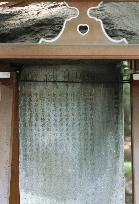
TOKYO, Japan - The Bukgwandaecheopbi monument at Yasukuni Shrine in Tokyo, which was built in memory of Korean Admiral Li Sun Sin who fought against Japanese expeditions launched by warlord Toyotomi Hideyoshi (1537-1598) to conquer Korea in the late 1590s, was returned to South Korea on Oct. 12. The monument had been kept at the shrine after Japanese forces brought it to Japan during the 1904-1905 Russo-Japanese War.

  •  
Yasukuni Shrine returns monument to Korean people

Yasukuni Shrine returns monument to Korean people

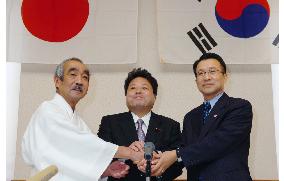
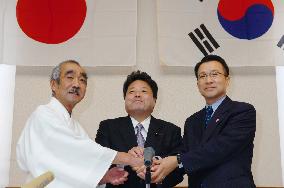
TOKYO, Japan - Toshiaki Nambu (L), priest at Yasukuni Shrine, Chu Gyu HO (C), minister at the South Korean Embassy, and Keishiro Fukushima, parliamentary secretary at the Foreign Ministry, join hands at Yasukuni Shrine in Tokyo on Oct. 12 during a ceremony to return an 18th-century Korean stone monument to South Korea. The Bukgwandaecheopbi monument was built in memory of Korean Admiral Li Sun Sin who fought against Japanese expeditions launched by warlord Toyotomi Hideyoshi (1537-1598) to conquer Korea in the late 1590s, and had been kept at the shrine since Japanese forces brought it to Japan during the 1904-1905 Russo-Japanese War.

  •  
(8)Five candidates vie for Nagano governor post

(8)Five candidates vie for Nagano governor post

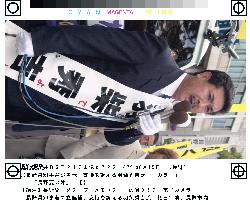
NAGANO, Japan - Hideyoshi Hashiba addresses voters during his Nagano gubernatorial election campaign in the city of Nagano on Aug. 15.

  •  
(1)Five candidates vie for Nagano governor post

(1)Five candidates vie for Nagano governor post

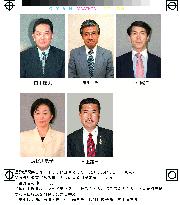
NAGANO, Japan - Former Nagano Gov. Yasuo Tanaka (upper L), ousted from office by the prefectural assembly in July, and four challengers filed their candidacies on Aug. 15 to run in the Sept. 1 gubernatorial election. Tanaka's four opponents are Shu Ichikawa (upper C), Chozo Nakagawa (upper R), Keiko Hasegawa (lower L) and Hideyoshi Hashiba (lower R). They all run as independents.

  •  
Ceremony held for Japan's 8th contingent of troops for Iraq

Ceremony held for Japan's 8th contingent of troops for Iraq

KUMAMOTO, Japan - Ground Self-Defense Force Maj. Hideyoshi Haraoka, a member of Japan's eighth GSDF contingent to be sent to Iraq for reconstruction assistance, smilingly watches as his family members talk to each other during a ceremony held at a garrison in the southwestern Japanese city of Kumamoto to deliver a unit flag to his unit on Oct. 22. The first batch of the 500-member contingent, mostly drawn from units in Kumamoto, Miyazaki and Kagoshima prefectures, is scheduled to leave for Iraq later in the day. (Kyodo)

  •  
Go (2001)

Go (2001)

Yosuke Kubosuka, Tsutomu Yamazaki Characters: ,Hideyoshi (father of Sugihara) Film: Go (2001) 20 October 2001 Date: 20 October 2001

  •  
HYDEYOSHI IN POWER

HYDEYOSHI IN POWER

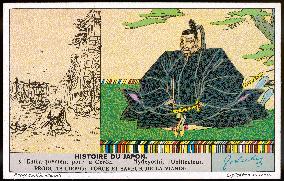
Prince Hideyoshi, acting for the Emperor, defeats the warlords one by one and unites the country : he embarks on the conquest of Korea, but dies before final success. Date: 1580s

  •  
Gold-plated roof tiles seen as ruins of feudal warlord's castle

Gold-plated roof tiles seen as ruins of feudal warlord's castle

Fragments of gold-plated roof tiles and other pieces of stone walls believed to be part of the original Fushimi Castle, also known as Shigetsu Castle, are shown to the press in Kyoto, western Japan, on June 18, 2015, after being discovered at a residential construction site in the ancient capital's Fushimi Ward. The castle was built under the orders of feudal warlord Toyotomi Hideyoshi in 1592 but was soon destroyed by an earthquake. Neither remnants nor records of its location had been found until now. (Kyodo) ==Kyodo

  •  
Gold-plated roof tiles apparent ruins of feudal warlord's castle

Gold-plated roof tiles apparent ruins of feudal warlord's castle

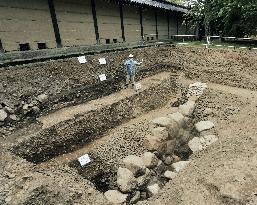
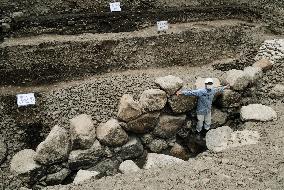
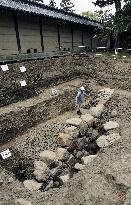
Ruins believed to be those of stone walls and a moat of the original Fushimi Castle, also known as Shigetsu Castle, are shown to the press in Kyoto, western Japan, on June 18, 2015, after being discovered at a housing construction site in the ancient capital's Fushimi Ward. The castle was built under the orders of feudal warlord Toyotomi Hideyoshi in 1592 but was soon destroyed by an earthquake. Neither remnants nor records of its location had been found until now. (Kyodo) ==Kyodo

  •  
Kyoto temple picks characters of feudal warlord Toyotomi, his wife

Kyoto temple picks characters of feudal warlord Toyotomi, his wife

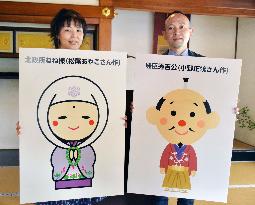
Illustrator Masato Ono (R) and housewife Ayako Matsuo hold their works of legendary feudal warlord Toyotomi Hideyoshi and his wife Nene at Kodaiji temple in Kyoto, western Japan, on May 18, 2015. The temple, established by Nene to honor her husband in 1606, had sought illustrations of their characters from the public. (Kyodo) ==Kyodo

  •  
Feudal leader Hideyoshi's letter of 1582 donated to castle museum

Feudal leader Hideyoshi's letter of 1582 donated to castle museum

A letter bearing the handwritten signature in June 1582 of warlord Hashiba Hideyoshi, who later became feudal ruler Toyotomi Hideyoshi, to thank a retainer is shown to the press at the Nagahama Castle Historical Museum in Nagahama, Shiga Prefecture, western Japan, on Oct. 29, 2015. A descendant of the retainer, Hirose Hyogonosuke, donated the letter to the museum in September. The letter expressed gratitude to Hirose for helping to evacuate his wife Nene and other Hashiba family members from their residence in Nagahama Castle on the occasion of an attempted coup d'etat at Kyoto's Honno-ji Temple. (Kyodo) ==Kyodo

  •  
Yasukuni Shrine returns monument to Korean people

Yasukuni Shrine returns monument to Korean people

TOKYO, Japan - The Bukgwandaecheopbi monument at Yasukuni Shrine in Tokyo, which was built in memory of Korean Admiral Li Sun Sin who fought against Japanese expeditions launched by warlord Toyotomi Hideyoshi (1537-1598) to conquer Korea in the late 1590s, was returned to South Korea on Oct. 12. The monument had been kept at the shrine after Japanese forces brought it to Japan during the 1904-1905 Russo-Japanese War. (Kyodo)

  •  
Yasukuni Shrine returns monument to Korean people

Yasukuni Shrine returns monument to Korean people

TOKYO, Japan - Toshiaki Nambu (L), priest at Yasukuni Shrine, Chu Gyu HO (C), minister at the South Korean Embassy, and Keishiro Fukushima, parliamentary secretary at the Foreign Ministry, join hands at Yasukuni Shrine in Tokyo on Oct. 12 during a ceremony to return an 18th-century Korean stone monument to South Korea. The Bukgwandaecheopbi monument was built in memory of Korean Admiral Li Sun Sin who fought against Japanese expeditions launched by warlord Toyotomi Hideyoshi (1537-1598) to conquer Korea in the late 1590s, and had been kept at the shrine since Japanese forces brought it to Japan during the 1904-1905 Russo-Japanese War. (Kyodo)

  •  
Himeji Castle

Himeji Castle

Himeji Castle (Himeji City, Hyogo Prefecture, National Treasure, also know as Shirasagi [White Heron] Castle) is viewed from the southeast. Mid-Meiji Period. This five-level seven-story donjon was built after the old three-story donjon built by Toyotomi Hideyoshi was demolished. Himeji Castle showcases the spectacular architecture of a modern Japanese castle It became Japan's first World Heritage Site in 1993.==Date:unknown, Place:Himeji, Photo:unknown, (Credit:Nagasaki University Library/Kyodo News Images) [Cabinet Number93‐35‐0]

  •  
Miyajima Island,Aki

Miyajima Island,Aki

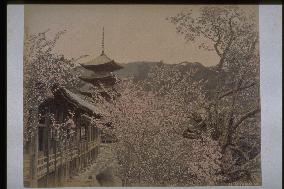
The five-story pagoda is viewed from Toyokuni Shrine (Senjokaku, or One Thousand Mat Hall ) on Tonooka Hill on the east side of Itsukushima Shinto Shrine. Senjokaku Hall was built in 1587 by Toyotomi Hideyoshi for the monthly Buddhist rite of reading of the Senbukyo sutra. The magnificent hall was built in irimoya architectural style with a tiled roof. The cross beams span about 27.27m and the parallel beams about 14.5m.==Date:unknown, Place:Miyajima, Photo:unknown, (Credit:Nagasaki University Library/Kyodo News Images) [Cabinet Number85‐30‐0]

  •  
Fushimi Shrine

Fushimi Shrine

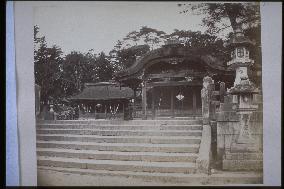
The main hall of Fushimi Inari Shrine is viewed from the bottom of the stairs on the east side of the offertory shrine. A nocturnal stone lantern is visible on the right. The main hall was built in 1494 and repaired by Toyotomi Hideyoshi in 1589. The karahafu-style building in the centre was added in 1694. The shrine is of gokensharyu construction with cedar-tiled roof. The Gonden is visible in the background to the left.==Date:unknown, Place:Kyoto, Photo:R. Stillfried, (Credit:Nagasaki University Library/Kyodo News Images) [Cabinet Number63‐5‐0]

  •  
Osaka Castle

Osaka Castle

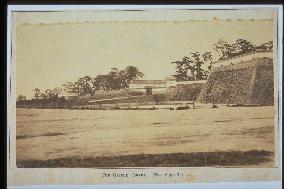
Osaka Castle, which was built by Hideyoshi where the Ishiyama Honganji Temple once stood, was destroyed by fire during the Osaka Summer Battle. After restoration by Tokugawa Hidetada, the castle tower was destroyed again by lightning. The present castle tower was rebuilt in 1931.==Date:unknown, Place:Osaka, Photo:unknown, (Credit:Nagasaki University Library/Kyodo News Images) [Cabinet Number23‐21‐0]

  •  
Sixth turret at the outside moat of osakajo castle

Sixth turret at the outside moat of osakajo castle

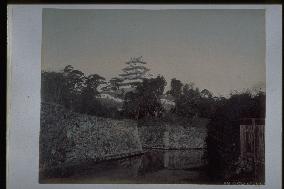
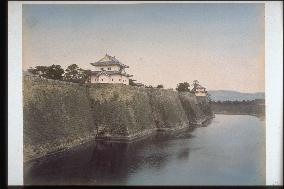
The inner moat and sixth turret facing the outer moat of Osaka castle. The present remains of Osaka castle including the motif of this photo are all from the Edo period, nothing remains from the days of Toyotomi Hideyoshi.==Date:unknown, Place:Osaka, Photo:Ogawa Kazumasa, (Credit:Nagasaki University Library/Kyodo News Images) [Cabinet Number7‐34‐0]

  •  
Research Whaling team speaks on research results

Research Whaling team speaks on research results

KUSHIRO, Japan - Hideyoshi Yoshida of a Japanese research whaling team speaks about the outcome of its research in waters off Kushiro in the northernmost Japanese prefecture of Hokkaido in Kushiro on Sept. 30, 2014. (Kyodo)

  •  
Koriyama Castle found to have had tower 15-20m high

Koriyama Castle found to have had tower 15-20m high

OSAKA, Japan - The foundation stones of Koriyama Castle's main keep in Yamatokoriyama, Nara Prefecture, are seen on Sept. 12, 2014. The city's education board announced the same day that the castle, used as the residence of Toyotomi Hidenaga (1540-1591), younger brother of Japanese feudal warlord Toyotomi Hideyoshi, had a castle tower as high as 15 to 20 meters. (Kyodo)

  •  
Gold leaf left in fragment of tile found at Koriyama Castle

Gold leaf left in fragment of tile found at Koriyama Castle

NARA, Japan - Gold leaf is seen left, as indicated by an arrow, in this photo taken on Sept. 12, 2014, in a fragment of tile unearthed at Koriyama Castle in Yamatokoriyama, Nara Prefecture. Toyotomi Hidenaga (1540-1591), younger brother of Japanese feudal warlord Toyotomi Hideyoshi, used the castle as his residence. (Kyodo)

  •  
Findings suggest keep 15-20m tall at Koriyama Castle

Findings suggest keep 15-20m tall at Koriyama Castle

OSAKA, Japan - Foundation stones that supported the keep of Koriyama Castle in Yamatokoriyama, Nara Prefecture, are seen on Sept. 12, 2014. New findings suggest that the keep was 15 to 20 meters tall. Toyotomi Hidenaga (1540-1591), younger brother of Japanese feudal warlord Toyotomi Hideyoshi, used the castle as his residence. (Kyodo)

  •  
Hideyoshi's golden tea room reproduced at Kansai airport

Hideyoshi's golden tea room reproduced at Kansai airport

OSAKA, Japan - An exhibition of a reproduced model of a golden tea room believed to have been made by Japanese feudal lord Toyotomi Hideyoshi started at Kansai International Airport in Osaka Prefecture, western Japan, on Aug. 7. 2014. (Kyodo)

  •  
Hideyoshi's surcoat shown to press before exhibition

Hideyoshi's surcoat shown to press before exhibition

KYOTO, Japan - A restored battle surcoat believed to have been worn by Toyotomi Hideyoshi, a powerful warlord in the 16th century, is disclosed to the press at Kodaiji, a Buddhist temple in Kyoto City, on July 9, 2014. The coat will be displayed at the Kodaiji Sho Museum from July 20 to Aug. 3 in the western Japanese city. (Kyodo)

  •  
The Great Bell, Hokoji Temple

The Great Bell, Hokoji Temple

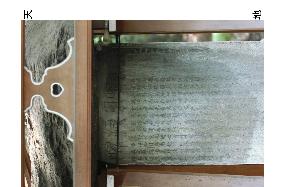
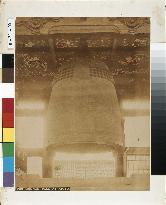
Hoko-ji temple was established by Hideyoshi Toyotomi (Shogun) in Higashiyama-ku,Kyoto-city and was imitated Nara Todai-ji Daibutsu-den. There was a great statue of Buddha, 20 meters in height, several earthquakes and thunderbolts had wreaked havoc on it. And also Daibutsu-den (the Hall of\r\nthe Great Buddha) had lost by fire in 1973. There is the Bonsho (a buddhist temple bell) inscribed Kokka Anko (May the State be peaceful and prosperous) and Kunshin Horaku (May the lord and\r\nvassal be rich and delight) in the precincts. It was the biginning of Osaka no Jin (the Siege of Osaka) and is designated as a National Important Cultural Property today.==Date:unknown, Place:Kyoto, Photo:unknown, (Credit:Nagasaki University Library/Kyodo News Images) [Cabinet Number106‐32‐0]

  •  
Life-size Toyotomi Hideyoshi statue

Life-size Toyotomi Hideyoshi statue

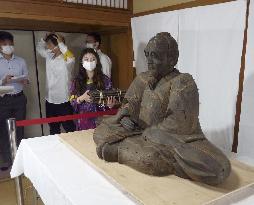
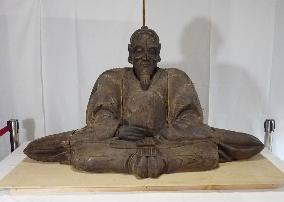
Photo taken May 20, 2020, shows a life-size statue of 16th-century Japanese warlord Toyotomi Hideyoshi in Osaka. The statue, one of the largest, was found at Omiya Shrine in the city. (Kyodo) ==Kyodo

  •  
Life-size Toyotomi Hideyoshi statue

Life-size Toyotomi Hideyoshi statue

Photo taken May 20, 2020, shows a life-size statue of 16th-century Japanese warlord Toyotomi Hideyoshi in Osaka. The statue, one of the largest, was found at Omiya Shrine in the city. (Kyodo) ==Kyodo

  •  
Toyotomi Hideyoshi's last castle

Toyotomi Hideyoshi's last castle

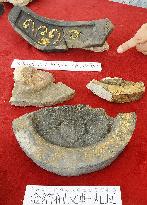
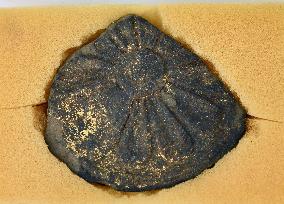
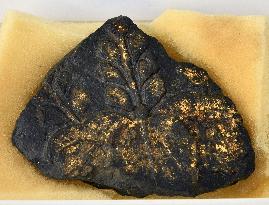
Photo taken May 12, 2020, shows a tile believed to be part of the last castle built by Japanese warlord Toyotomi Hideyoshi in Kyoto. (Kyodo) ==Kyodo

  •  
Toyotomi Hideyoshi's last castle

Toyotomi Hideyoshi's last castle

Photo taken May 12, 2020, shows a tile believed to be part of the last castle built by Japanese warlord Toyotomi Hideyoshi in Kyoto. (Kyodo) ==Kyodo

  •  
Toyotomi Hideyoshi's last castle

Toyotomi Hideyoshi's last castle

Photo taken May 12, 2020, shows stones believed to be part of the last castle built by Japanese warlord Toyotomi Hideyoshi in Kyoto. (Kyodo) ==Kyodo

  •  
Toyotomi Hideyoshi's last castle

Toyotomi Hideyoshi's last castle

Photo taken May 12, 2020, shows stones believed to be part of the last castle built by Japanese warlord Toyotomi Hideyoshi in Kyoto. (Kyodo) ==Kyodo

  •  
Toyotomi Hideyoshi's last castle

Toyotomi Hideyoshi's last castle

Photo taken May 12, 2020, shows stones believed to be part of the last castle built by Japanese warlord Toyotomi Hideyoshi in Kyoto. (Kyodo) ==Kyodo

  •  
Pope Francis in Japan

Pope Francis in Japan

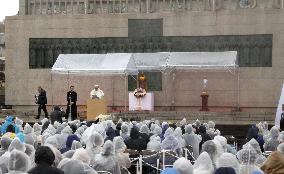
Pope Francis speaks at Nishizaka Park in Nagasaki, Japan, on Nov. 24, 2019. A monument stands in the park to commemorate the 26 Christians executed in the late 16th century in anti-Christian campaigns led by the warlord Toyotomi Hideyoshi. (Kyodo) ==Kyodo

  • Main
  • Top
  • Editorial
  • Creative
  • About Us
  • About ILG
  • Terms of use
  • Company
  • BEHIND
  • Price List
  • Single Plan
  • Monthly Plan
  • Services
  • Shooting
  • Rights Clearance
  • Support
  • FAQ
  • How To Buy
  • Contact Us
  • Become a Partner

© KYODO NEWS IMAGES INC

All Rights Reserved.

  • Editorial
  • Olympics
  • News
  • Sports
  • Japan
  • Tech
  • Royal
  • Disaster
  • NorthKorea
  • Old Japan
  • SNS
  • Creative
  • Food
  • Japan
  • Landscape
  • Animal
  • Popular
  • #Ukraine
  • #China
  • #coronavirus
  • #N. Korea
  • #Thailand
  • #Russia
  • #Ukraine
  • #China
  • #coronavirus
  • #N. Korea
  • #Thailand
  • #Russia
  • Food
  • Japan
  • Landscape
  • Animal
  • Olympics
  • News
  • Sports
  • Japan
  • Tech
  • Royal
  • Disaster
  • NorthKorea
  • Old Japan
  • SNS