•  
'Tale of Genji' manuscripts discovered at temple

'Tale of Genji' manuscripts discovered at temple

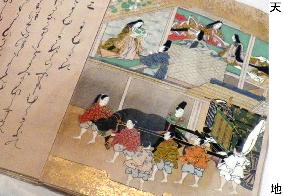
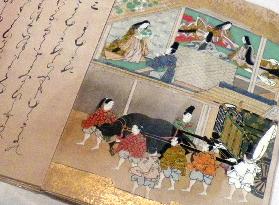
OTSU, Japan - This photo shows one of a set of 54 manuscripts of ''Genji Kokagami,'' a summary of the ancient Japanese novel ''The Tale of Genji.'' The manuscripts, which date back to the 17th century, were recently found at Ishiyamadera Temple in Otsu, Shiga Prefecture. Murasaki Shikibu, who lived in the 10th-11th century, is believed to have worked on the plot of her novel at the temple.

  •  
'Tale of Genji' manuscripts discovered at temple

'Tale of Genji' manuscripts discovered at temple

OTSU, Japan - This photo shows one of a set of 54 manuscripts of ''Genji Kokagami,'' a summary of the ancient Japanese novel ''The Tale of Genji.'' The manuscripts, which date back to the 17th century, were recently found at Ishiyamadera Temple in Otsu, Shiga Prefecture. Murasaki Shikibu, who lived in the 10th-11th century, is believed to have worked on the plot of her novel at the temple. (Kyodo)

  •  
Lake Biwa seen from Ishiyama

Lake Biwa seen from Ishiyama

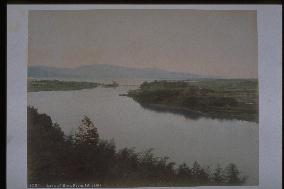
View of Seta River from Tsukimi-tei at Ishiyamadera Temple, with Lake Biwa and the Hira Mountain Range in the distance. The bridge in the centre is Seta-no-Karahashi, formerly the only bridge spanning Seta River and an important transportation route in ancient times. At present there are many bridges over the river.==Date:unknown, Place:Shiga, Photo:Tamamura Kozaburo, (Credit:Nagasaki University Library/Kyodo News Images) [Cabinet Number79‐14‐0]

  •  
Ishiyama,Laka Biwa

Ishiyama,Laka Biwa

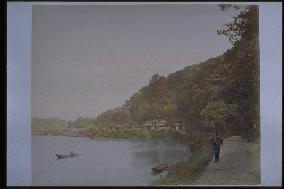
Inns on the approach to Ishiyamadera. Visitors passed along this road in large numbers to the temple, which is located at the hill protruding in the centre. The neighbourhood was called Katahara-machi (One Side Field Town) because buildings were erected on only one side of the road. This is the view looking south from the area of present-day Ishiyamadera Station on the Keihan Dentetsu Line.==Date:unknown, Place:Otsu, Photo:R. Stillfried, (Credit:Nagasaki University Library/Kyodo News Images) [Cabinet Number77‐19‐0]

  •  
Ishiyamadera Temple

Ishiyamadera Temple

The precincts of Ishiyamadera Temple seen from the front of the Main Hall . During the Heian Period, aristocratic women worshipped at the temple, and in later years it attracted many commoners as the 13th temple in the circuit of the 33 Holy Kannon temple of Western Japan. The Main Hall, just behind the tile-roofed Rennyodo, burned to the ground in 1096 and was later rebuilt.==Date:unknown, Place:Shiga, Photo:unknown, (Credit:Nagasaki University Library/Kyodo News Images) [Cabinet Number71‐42‐0]

  •  
Ishiyamadera Temple

Ishiyamadera Temple

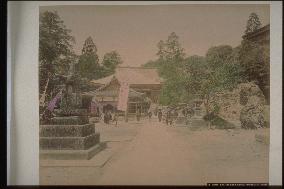
The precincts of Ishiyamadera Temple. During the Heian Period (794-1192), the temple was popular among ladies of the aristocracy. It was designated later as the 13th temple in the circuit of 33 Holy Kannon Temples of Western Japan and gained popularity among commoners. The photograph emphasizes the jagged wollastonite rocks after which the temple is named ( Ishiyama means stone mountain ).==Date:unknown, Place:Shiga, Photo:unknown, (Credit:Nagasaki University Library/Kyodo News Images) [Cabinet Number71‐35‐0]

  •  
Ishiyamadera Temple

Ishiyamadera Temple

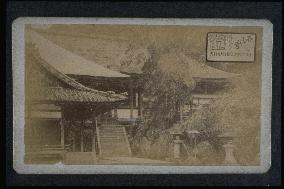
Ishiyamadera Temple==Date:unknown, Place:Shiga, Photo:F. Beato, (Credit:Nagasaki University Library/Kyodo News Images)

  •  
A view of Lake Biwa from Ishiyamadera Temple

A view of Lake Biwa from Ishiyamadera Temple

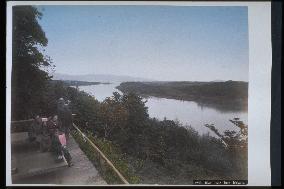
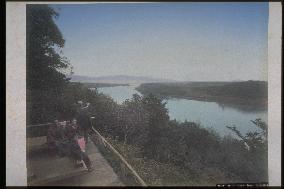
View of Seta River from Tsukimi-tei at Ishiyamadera Temple. During the Heian Period, aristocratic women worshipped at the temple, and in later years it attracted many commoners as the 13th temple in the circuit of 33 Holy Kannon Temples of Western Japan. One of the Eight Scenes of Oumi, it was referred to as Ishiyama-no-Shugetsu (Autumn Moon at Ishiyama Temple). This image appears on postcards and in various photographs.==Date:unknown, Place:Shiga, Photo:unknown, (Credit:Nagasaki University Library/Kyodo News Images) [Cabinet Number59‐23‐0]

  •  
A view of Lake Biwa from Ishiyamadera Temple

A view of Lake Biwa from Ishiyamadera Temple

View of Seta River from Tsukimi-tei at Ishiyamadera Temple. During the Heian Period, aristocratic women worshipped at the temple, and in later years it attracted many commoners as the 13th temple in the circuit of 33 Holy Kannon Temples of Western Japan. One of the Eight Scenes of Oumi, it was referred to as Ishiyama-no-Shugetsu (Autumn Moon at Ishiyama Temple). This image appears on postcards and in various photographs.==Date:unknown, Place:Shiga, Photo:unknown, (Credit:Nagasaki University Library/Kyodo News Images) [Cabinet Number52‐18‐0]

  •  
Ishiyamadera Temple

Ishiyamadera Temple

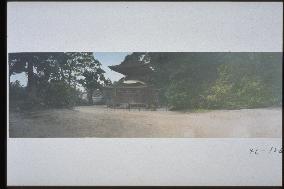
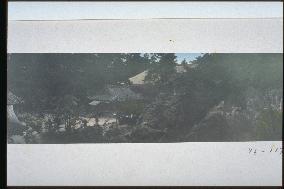
The precincts of Ishiyamadera Temple. During the Heian Period (794-1192), the temple was popular among ladies of the aristocracy. It was designated later as the 13th temple in the circuit of 33 Holy Kannon Temples of Western Japan and gained popularity among commoners. The buildings visible in the background are the Main Hall and Rennyodo. The photograph emphasizes the jagged wollastonite rocks after which the temple is named ( Ishiyama means stone mountain ).==Date:unknown, Place:Shiga, Photo:Tamamura Kozaburo, (Credit:Nagasaki University Library/Kyodo News Images) [Cabinet Number48‐116‐0]

  •  
Tahoto (two-storied pagoda), Ishiyamadera Temple

Tahoto (two-storied pagoda), Ishiyamadera Temple

Tahoto (two-storied pagoda), Ishiyamadera Temple==Date:unknown, Place:Shiga, Photo:unknown, (Credit:Nagasaki University Library/Kyodo News Images)

  •  
The precincts of Ishiyamadera Temple

The precincts of Ishiyamadera Temple

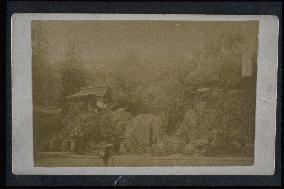
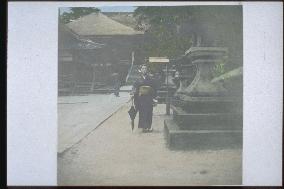
Probably a commemorative photo within the temple compounds. People in the back look towards the camera because photos were still rare at the time. The same woman is seen in the photo numbered 46-131.==Date:unknown, Place:Shiga, Photo:unknown, (Credit:Nagasaki University Library/Kyodo News Images) [Cabinet Number46‐125‐0]

  •  
Ishiyamadera Temple(2)

Ishiyamadera Temple(2)

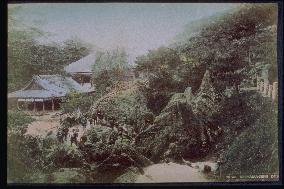
View of the Main Hall and Ren'nyo-do of Ishiyamadera Temple from the exposed slope located on the south side of Taho-do Pagoda. Sanjuhassha (Shinto Shrine), partially hidden by trees, is partially visible on the right. The main hall was built in 1602 in the yosemune (hipped-roof) style with a cedar bark shingled roof.==Date:unknown, Place:Shiga, Photo:unknown, (Credit:Nagasaki University Library/Kyodo News Images) [Cabinet Number46‐117‐0]

  •  
The precincts of Ishiyamadera Temple

The precincts of Ishiyamadera Temple

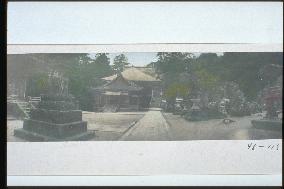
The Main Hall, Ren'nyo-do, of Ishiyama Temple, looking west from the approach south of Tahodo Pagoda. The approach is paved with stones and has stone lanterns on the north side. An exposed limestone slope is visible to the right of the stone lanterns. Built in 1602, the main hall is a yosemune (hipped roof) style building with hiwadabuki (cedar bark shingle) roof.==Date:unknown, Place:Shiga, Photo:unknown, (Credit:Nagasaki University Library/Kyodo News Images) [Cabinet Number46‐115‐0]

  •  
A tea house in Ishiyamadera Temple grounds

A tea house in Ishiyamadera Temple grounds

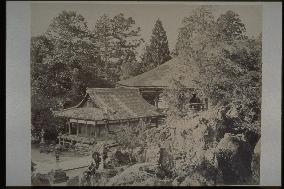
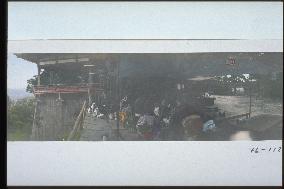
This photograph captures the lively atmosphere of a teahouse in the Ishiyamadera temple grounds. Benches are placed under the roof, where women are having a good time eating and drinking. There are dogs and children as well. The hillside location provides a good view. The terrace on the left is Tsukimitei. Tobacco trays are placed on the benches. Tahoto(two-storied pagoda) is partially visible on the far right.==Date:unknown, Place:Shiga, Photo:unknown, (Credit:Nagasaki University Library/Kyodo News Images) [Cabinet Number46‐118‐0]

  •  
Ishiyamadera Temple

Ishiyamadera Temple

The rock to the fore is exposed wollastonite. This can be seen all over the temple compounds, and the name Ishiyamadera (Stone Mountain Temple) originates from this. It is designated as a precious natural asset. Said to be the place where Murasaki Shikibu wrote the Tale of Genji , the temple has a Genji Room.==Date:unknown, Place:Shiga, Photo:unknown, (Credit:Nagasaki University Library/Kyodo News Images) [Cabinet Number24‐2‐0]

  •  
Ishiyamadera Temple

Ishiyamadera Temple

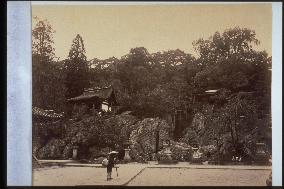
The Ishiyama temple in Otsu city. The founder is Todaiji Ryoben. It used to be a training place of the Kegon Sect and a subtemple of Todaiji, but later it changed to the Shingon Sect. It is the 13th fudasho (a temple where amulets are distributed to pilgrims) of the 33 pilgrimages of western Japan. Also the autumn moon of Ishiyama is one of the 8 scenic spots of Omi. The Mikagedo, seen from the grounds, is shaped in a square and the roof is in thatched a single layer of cypress bark. To the right are exposed clumps of quartzite, which was worshipped as an ancient spiritual stone. To the right and left are stone towers.==Date:unknown, Place:Shiga, Photo:A. Farsari, (Credit:Nagasaki University Library/Kyodo News Images) [Cabinet Number18‐2‐0]

  • Main
  • Top
  • Editorial
  • Creative
  • About Us
  • About ILG
  • Terms of use
  • Company
  • BEHIND
  • Price List
  • Single Plan
  • Monthly Plan
  • Services
  • Shooting
  • Rights Clearance
  • Support
  • FAQ
  • How To Buy
  • Contact Us
  • Become a Partner

© KYODO NEWS IMAGES INC

All Rights Reserved.

  • Editorial
  • Olympics
  • News
  • Sports
  • Japan
  • Tech
  • Royal
  • Disaster
  • NorthKorea
  • Old Japan
  • SNS
  • Creative
  • Food
  • Japan
  • Landscape
  • Animal
  • Popular
  • #Ukraine
  • #Russia
  • #coronavirus
  • #N. Korea
  • #Thailand
  • #China
  • #Ukraine
  • #Russia
  • #coronavirus
  • #N. Korea
  • #Thailand
  • #China
  • Food
  • Japan
  • Landscape
  • Animal
  • Olympics
  • News
  • Sports
  • Japan
  • Tech
  • Royal
  • Disaster
  • NorthKorea
  • Old Japan
  • SNS