•  

US: Flash Flood Warning Issued For Tucson Area

Heavy rain hit Tucson and parts of Pima County, Arizona, on Saturday, June 22, placed the area under a flash flood warning. Storms were expected to last through the weekend.

  •  
MOGI

MOGI

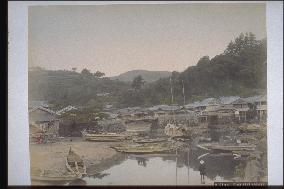
The mouth of the Wakana River. The bridge is the Wakana Bridge. The big building to the rear of the river is the Mogi town office, and boats in the center are cargo boats used for short distances, called Isabasen .==Date:Middle Meiji, Place:Nagasaki, Photo:Ogawa Kazumasa, (Credit:Nagasaki University Library/Kyodo News Images) [Cabinet Number8‐10‐0]

  •  
Cherry trees by the Edo River

Cherry trees by the Edo River

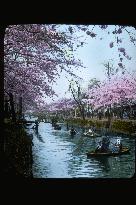
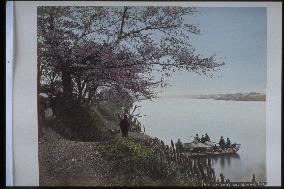
The Kanda Josui (waterway) stretching from around Sekiguchidai in Koishikawa and Iida Bridge was called Edo River (different from the tributary of Tonegawa). It is said that cherry trees were planted here in 1884, but despite its shallow history, the area became a famous cherry blossom viewing site called the new Koganei by the end of Meiji Period. Several boat houses provided lodgings and rented out small boats of this kind. It was a refined pleasure to view the cherry blossoms from the boat. This is a magic lantern slide made around 1897.==Date:unknown, Place:Tokyo, Photo:unknown, (Credit:Nagasaki University Library/Kyodo News Images) [Cabinet Number98‐35‐0]

  •  
A fishing boat returning at sunset

A fishing boat returning at sunset

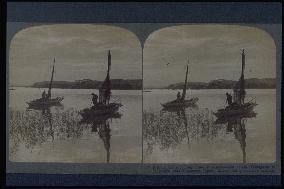
This is the mouth of the Rokugo River. This stereograph was sold in 1904 by Underwood & Underwood Co. The caption on the back reports that many Japanese artists like to draw this landscape and that so many people visit the area on festival days that the railway had to schedule a special train service.==Date:1904, Place:Tamagawa, Photo:Underwood, (Credit:Nagasaki University Library/Kyodo News Images) [Cabinet Number97‐90‐0]

  •  
A cargo boat on the Nihonbashi River

A cargo boat on the Nihonbashi River

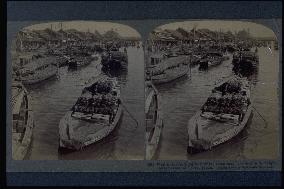
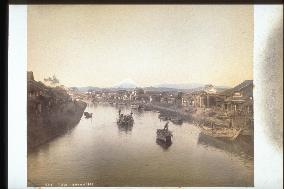
View of Nihonbashi River looking west, taken from Nihonbashi Bridge. The river is busy with cargo boats. Mt. Fuji was visible from this spot on clear days. The left side of the river is Nishi-gashi (west riverside), and the bridge visible in the far right is Nishi (West) Bridge. This was a transitional period when land transportation was replacing water transportation, but at this time the canal still played a major role in transporting goods. This stereograph was published in 1904 in a book-shaped case.==Date:1904, Place:Tokyo, Photo:Underwood, (Credit:Nagasaki University Library/Kyodo News Images) [Cabinet Number97‐78‐0]

  •  
A leisure boat on the Sumida River

A leisure boat on the Sumida River

This same photograph was carried in a special issue of Asahi Graph published by Tokyo Asahi Newspaper in 1925 to commemorate the centennial of photography in Japan, under the heading Boat Outing on Tokyo Sumida River with Uchida Kuichi around 1874. The caption says that the man leaning on the railing in the centre is Uchida Kuichi and that the photograph belongs to Hirata Kenichi. The fashion-conscious Uchida usually wore Western-style clothes in photographs, so this is a rare shot of him wearing a kimono.==Date:unknown, Place:Tokyo, Photo:unknown, (Credit:Nagasaki University Library/Kyodo News Images) [Cabinet Number94‐20‐0]

  •  
Yaomatsu Restaurant, Mukojima

Yaomatsu Restaurant, Mukojima

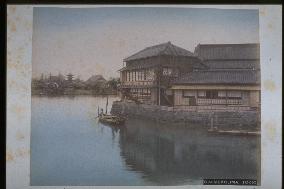
Yaomatsu-ro Restaurant seen from Makura Bridge at confluence of the Gennomori and Sumida rivers. The restaurant was opened in April 1870 as a branch of Yaomatsu located at Suijin-no-Mori. Customers drank sake while enjoying the view of boats crossing the Sumida River and Sensoji Temple across the river, and Yaomatsu-ro gained popularity as an early waterfront restaurant. Taken between 1887 and 1897. Same as photograph #2104.==Date:unknown, Place:Tokyo, Photo:unknown, (Credit:Nagasaki University Library/Kyodo News Images) [Cabinet Number93‐14‐0]

  •  
A leisure boat on the Sumida River

A leisure boat on the Sumida River

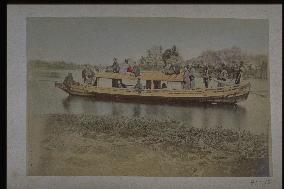
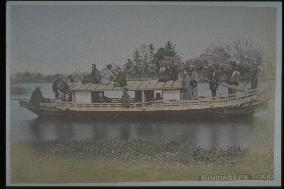
Scene of entertainment in a boat on Sumida River. People used these boats to enjoy the cherry blossoms, visit famous historical places along the river, and to drink sake at restaurants. The flow of the river, controlled by embankments on both sides, was gentle enough to let people relax on the roof of the boats. This is probably impossible today, because the riverbanks have been reinforced with concrete and the flow is no longer gentle.==Date:unknown, Place:Tokyo, Photo:unknown, (Credit:Nagasaki University Library/Kyodo News Images) [Cabinet Number91‐15‐0]

  •  
A leisure boat on the Sumida River

A leisure boat on the Sumida River

Roofed boat taken at the bank of Imado River in front of Yumei-ro where Sanya-bori (moat) merges with Sumida River. The water is too shallow to allow the boat to float, which explains why the photograph is so sharp. In the rear is Mukojima, site of Ushijima Shinto Shrine and Chomeiji Temple. Found in the collection of Uchida Kuichi preserved at Nagasaki Municipal Museum, this photograph was verified to have been taken by Uchida in 1872. This is one of the copies later made and sold.==Date:unknown, Place:Tokyo, Photo:Uchida Kuichi, (Credit:Nagasaki University Library/Kyodo News Images) [Cabinet Number90‐25‐0]

  •  
Lake Chuzenji

Lake Chuzenji

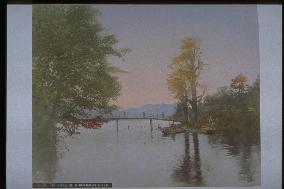
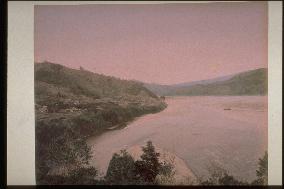
Ojiri River flows from Lake Chuzenji. Ojiri Bridge is visible in the centre. The lake is behind the bridge. The river flows in the foreground, reaches Kegon Falls, and turns into Daiya River. Chugushi is located to the right of the bridge and Utagahama beach to the left.==Date:unknown, Place:Nikko, Photo:unknown, (Credit:Nagasaki University Library/Kyodo News Images) [Cabinet Number88‐25‐0]

  •  
The ferries,Mukojima

The ferries,Mukojima

This same photograph was carried in Nihon no Meisho (Beautiful Places of Japan) published by Shiden Hensansho in 1900 under the title, Entertainment on a Boat at Sumida River, and also under the title Boat Play in Tokyo F?kei (Tokyo Scenery) published by Ogawa Kazumasa in 1911. This photograph resembles two photographs taken by Uchida Kuichi, but it is probably an Ogawa Kazumasa photograph taken around 1897. Says Ogawa in the caption to his photograph, Since ancient times, the boat outing on Sumida River has been the most sophisticated of all pleasures.==Date:unknown, Place:Tokyo, Photo:unknown, (Credit:Nagasaki University Library/Kyodo News Images) [Cabinet Number87‐7‐0]

  •  
Ferryboats

Ferryboats

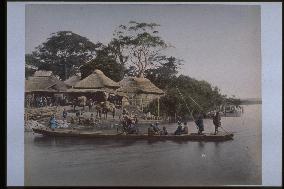
A ferry boat carrying nine men is about to leave the river shore. A jinrikisha is on the ferry as well. Lumber, two loaded horses, and many people are visible on the shore. Four straw thatched houses are visible in the background.==Date:unknown, Place:unknown, Photo:R. Stillfried, (Credit:Nagasaki University Library/Kyodo News Images) [Cabinet Number77‐44‐0]

  •  
Ishiyama,Laka Biwa

Ishiyama,Laka Biwa

Inns on the approach to Ishiyamadera. Visitors passed along this road in large numbers to the temple, which is located at the hill protruding in the centre. The neighbourhood was called Katahara-machi (One Side Field Town) because buildings were erected on only one side of the road. This is the view looking south from the area of present-day Ishiyamadera Station on the Keihan Dentetsu Line.==Date:unknown, Place:Otsu, Photo:R. Stillfried, (Credit:Nagasaki University Library/Kyodo News Images) [Cabinet Number77‐19‐0]

  •  
A leisure boat on the Sumida River

A leisure boat on the Sumida River

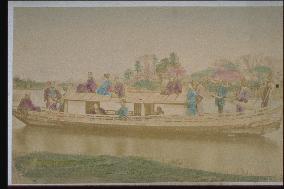
This same photograph can be found in the memorial photograph album of Charles Appleton Longfellow, first son of the famous American poet Henry Wadsworth Longfellow who lived in Japan from 1871 to 1873. Charles may have asked Uchida Kuichi to take this shot, and it could be Charles wearing a kimono and looking out from between the shoji screens. The woman second from the left is Okiku, owner of the restaurant Yumei-ro at Sanyabori, and the other women are Charles' favourite geisha. The roofed boat probably belongs to Yumei-ro.==Date:about 1872, Place:Tokyo, Photo:Uchida Kuichi, (Credit:Nagasaki University Library/Kyodo News Images) [Cabinet Number53‐50‐0]

  •  
The ferries,Mukojima

The ferries,Mukojima

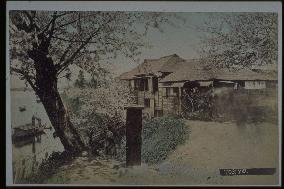
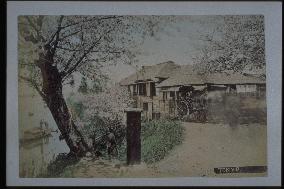
The square pillar in the centre foreground is a mail box. Made of pine and painted black, mail boxes were placed on the streets of Japan for the first time in 1872. Foundation stones were placed under the mail boxes starting in 1887, so the mail box in this photograph was taken after 1887. Same as photograph #2657.==Date:unknown, Place:Tokyo, Photo:unknown, (Credit:Nagasaki University Library/Kyodo News Images) [Cabinet Number53‐49‐0]

  •  
The ferries,Mukojima

The ferries,Mukojima

The area in front of Chomeiji Temple was called Kototoi-no-Oka. In 1869, Kototoi-tei opened and its Kototoi dumplings became a Mukojima specialty along with the cherry rice cakes of Chomeiji Temple. The shop curtain on the right seems to say Kototoi dango (dumplings), indicating that this is Kototoi-tei. Kototoi dumplings are still a local specialty at Mukojima. Taken in the mid-Meiji Period. Same as photograph #2664.==Date:unknown, Place:Tokyo, Photo:unknown, (Credit:Nagasaki University Library/Kyodo News Images) [Cabinet Number53‐43‐0]

  •  
A leisure boat on the Sumida River

A leisure boat on the Sumida River

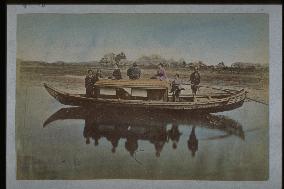
Like photographs #2665 and #4543, this was taken at the bank of Imado River in front of Yumei-ro at the mouth of Sanya-bori. Ushijima Shinto Shrine, also called Ushi-no-Gozen (presently located at Mukojima 1-chome, downstream) and Choumeiji Temple are amid the tall trees at the rear. The person leaning on the handrail in the centre may be Uchida Kuichi. If so, this photograph was probably taken by his apprentice. The photograph was sold after being trimmed and tinted.==Date:unknown, Place:Tokyo, Photo:unknown, (Credit:Nagasaki University Library/Kyodo News Images) [Cabinet Number53‐44‐0]

  •  
Ferries,the Sumida River

Ferries,the Sumida River

Probably the ferry dock called Takeya-no-Watashi at Mukojima. Another photograph taken downstream shows these people at the same time. Stone steps descend to the river from where the man is standing in the centre, and the ferry dock called Terashima-no-Watashi is visible upstream. However, the boat depicted here is not a ferry but a yanebune (roofed boat) used for entertainment. This is one of the photographs in the album sold at Kinpei Photograph Studio, indicating that it was taken by Kusakabe Kinbei in the early Meiji Period.==Date:unknown, Place:Tokyo, Photo:unknown, (Credit:Nagasaki University Library/Kyodo News Images) [Cabinet Number53‐31‐0]

  •  
Winter scenery at Sanyabori

Winter scenery at Sanyabori

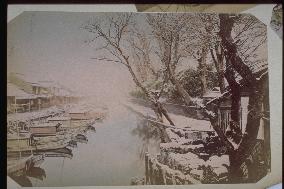
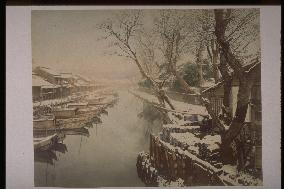
Sanya Moat looking upstream from Imadobashi, the bridge furthermost downstream on the moat. Until the mid-Meiji Period, this area was a pleasure quarter with restaurants and geisha houses. The Choki-bune (boats) that ferried customers to the Yoshiwara pleasure quarter used to pass here, and thus going to Sanya became a synonym for going to Yoshiwara. Nine bridges spanned Sanya Moat, but they were all later removed as part of land reclamation projects. The site is now Sanyabori Park. This photograph was taken in 1868 by Uchida Kuichi.==Date:unknown, Place:Tokyo, Photo:unknown, (Credit:Nagasaki University Library/Kyodo News Images) [Cabinet Number51‐34‐0]

  •  
Yaomatsu Restaurant, Mukojima

Yaomatsu Restaurant, Mukojima

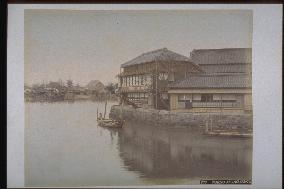
Yaomatsu Restaurant on the right was opened in a refurbished boat shed formerly owned by the Tokugawa family of Mito. The water in front is probably Gennomori River, seen from Makura Bridge. There was a ferry stop at the end of the bridge called Yamanoshuku-no-Watashi (Makurabashi-no-Watashi) for passage to Asakusa on the other side of the river. The five-story pagoda Kan'non-do Hall and the Nio Gate of Sensoji Temple are visible. The Ryounkaku built in 1890 is visible to the left of the pagoda, indicating that the photograph was taken after that year.==Date:unknown, Place:Tokyo, Photo:unknown, (Credit:Nagasaki University Library/Kyodo News Images) [Cabinet Number47‐7‐0]

  •  
Isaba-sen and benzai-sen,transport ships,in oura NAGASAKI

Isaba-sen and benzai-sen,transport ships,in oura NAGASAKI

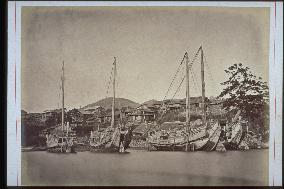
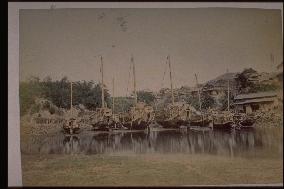
Large and middle-sized Benzai boats and Isaba boats at Oura, Nagasaki. The two at the right are relatively large Benzai boats built in the Kansai style of about 1000 koku , and the one in the center is a middle size of about 500 koku. The one to the left, which is small and has a different form, is probably the Isaba boat that was popular in the Kansai area for travel over short distances.==Date:1877, Place:Nagasaki, Photo:unknown, (Credit:Nagasaki University Library/Kyodo News Images) [Cabinet Number21‐18‐0]

  •  
Rengeiwa rock at hozugawa river

Rengeiwa rock at hozugawa river

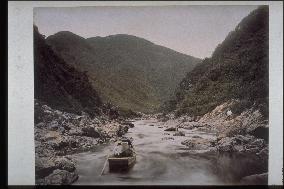
Hozu River flows rather slowly. Rocks appear on both banks. The cliff to the right is very steep. A boat man takes the helm of a boat and a person sits in the center.==Date:unknown, Place:Kyoto, Photo:unknown, (Credit:Nagasaki University Library/Kyodo News Images) [Cabinet Number19‐17‐0]

  •  
Hozu River

Hozu River

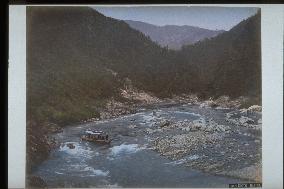
A boat drifts on a gentle river with relatively few rocks showing on the surface of the water. The helmsman holds his pole sitting, the man in the center holds an umbrella, and the person at the bow holds a fishing rod. Poles line the bank of the river, and mountains rise sharply nearby.==Date:unknown, Place:Kyoto, Photo:unknown, (Credit:Nagasaki University Library/Kyodo News Images) [Cabinet Number19‐11‐0]

  •  
Boatman

Boatman

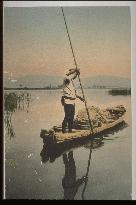
A man takes the helm of a boaton a lake or wide river. The boat has a pail with some grass in it and a hat on top of it.==Date:unknown, Place:unknown, Photo:unknown, (Credit:Nagasaki University Library/Kyodo News Images) [Cabinet Number18‐34‐0]

  •  
Ferry boat

Ferry boat

The English caotion reads, Ferry boat. In this scene of a ferry boat ride, the helmsman rows with a pole and the passengers wear traveling gear and prepare to land. The river is not very wide, but the flow is rapid. The boat connected to a pole in the river suggests that this is a dramatized photo.==Date:unknown, Place:unknown, Photo:unknown, (Credit:Nagasaki University Library/Kyodo News Images) [Cabinet Number18‐13‐0]

  •  
FUJIGAWA river

FUJIGAWA river

A river flowing to the west of Mt. Fuji. The source is Yamanashi River of Kofu (starting from Yatsugatake and Komagatake) and Fuefuki River. The oars used on this river were flat, and shallow boats were designed according to sea gauge. A pole and a net were used to propel the boat when going downstream and upstream, respectively.==Date:unknown, Place:Shizuoka, Photo:unknown, (Credit:Nagasaki University Library/Kyodo News Images) [Cabinet Number18‐6‐0]

  •  
Canal and houses at the back of YOKOHAMA

Canal and houses at the back of YOKOHAMA

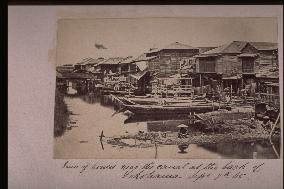
Written September 7, 1865 by Beato. In the distance to the left are the characters Within the Iwakame house . It is probably a brothel in Minatozaki-cho of Otaya Shinden Numachi at the back of the foreign settlement in Yokohama. It was destroyed in the fire of 1866 and moved to the Yoshida Shinden (presently the Shinyoshiwara Nakano-cho) the following year.==Date:1866, Place:Yokohama, Photo:F. Beato, (Credit:Nagasaki University Library/Kyodo News Images) [Cabinet Number17‐8‐0]

  •  
A small boat going down the river

A small boat going down the river

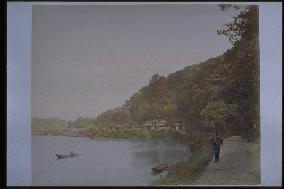
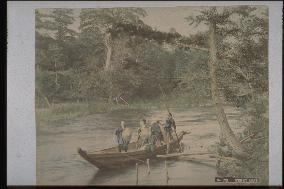
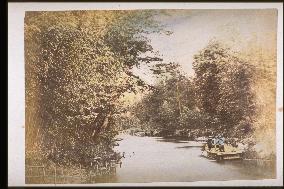
A boat goes down stream on a river with trees growing on both banks. The water flow is abundant, and two men ply the boat with poles. They both wear trousers and hats, so it is a photo taken after the middle Meiji era.==Date:unknown, Place:unknown, Photo:unknown, (Credit:Nagasaki University Library/Kyodo News Images) [Cabinet Number16‐30‐0]

  •  
A yakatabune (a leisure boat)

A yakatabune (a leisure boat)

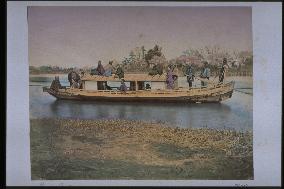
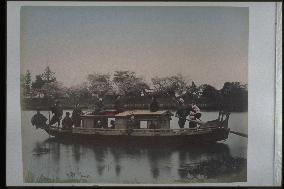
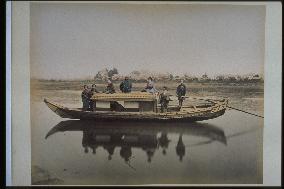
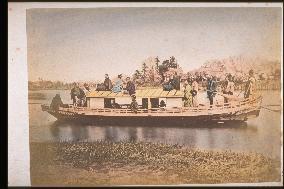
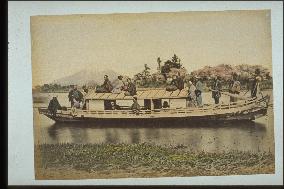
Same as the photo numbered 12-28. Many people ride a houseboat going on a river. Two helmsmen row the boat and the other twelve seem to be passengers. The women and men pose in different places. This is probably a dramatized photo of a boat picnic or a ferryboat.==Date:unknown, Place:unknown, Photo:unknown, (Credit:Nagasaki University Library/Kyodo News Images) [Cabinet Number16‐28‐0]

  •  
Isaba-sen and benzai-sen,transport ships,in oura NAGASAKI

Isaba-sen and benzai-sen,transport ships,in oura NAGASAKI

Boats anchored at Oura in Nagasaki. The boat in the centre looks rather large, while the second from the left is a middle size boat. These were called Benzai boats . The small boat to the left is the Isaba boat seen often in the Kansai area.==Date:unknown, Place:Nagasaki, Photo:unknown, (Credit:Nagasaki University Library/Kyodo News Images) [Cabinet Number15‐36‐0]

  •  
A yakatabune (a leisure boat)

A yakatabune (a leisure boat)

The same as the photo numbered 12-28. Many people are riding this river-going houseboat and two helmsmen take the scaffold. The other twelve people are probably passengers. Each passenger poses differently. It is probably a dramatized photo of a boat picnic or a ferryboat.==Date:unknown, Place:unknown, Photo:unknown, (Credit:Nagasaki University Library/Kyodo News Images) [Cabinet Number13‐18‐0]

  •  
A yakatabune (a leisure boat)

A yakatabune (a leisure boat)

People aboard a houseboat moving along a river. Two helmsmen take the scaffold. The other twelve are probably passengers. Since the women and men take different poses, this it is probably a dramatized photo of a river picnic or ferryboat.==Date:unknown, Place:unknown, Photo:unknown, (Credit:Nagasaki University Library/Kyodo News Images) [Cabinet Number12‐28‐0]

  •  
The Katsura River

The Katsura River

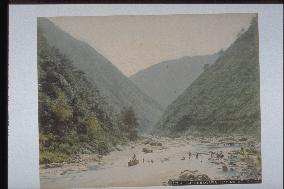
Katsura River flows between steep mountains descending on both sides. A boat is seen in the centre, and some people are seen playing in the shallow part of the river.==Date:unknown, Place:Kyoto, Photo:unknown, (Credit:Nagasaki University Library/Kyodo News Images) [Cabinet Number11‐39‐0]

  •  
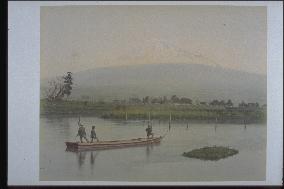
Mt. Fuji seen from Numakawa,Tagonoura

Mt. Fuji seen from Numakawa,Tagonoura

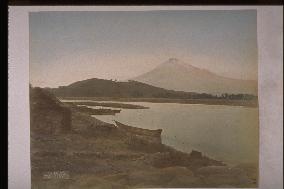
A sand delta developed on the north bank of Suruga Bay with the sand carried by the Fuji River and Kano River. A lagoon was formed, and further sand accumulation created the peculiar Ukishimagahara. The boat in the photo is a flat bottom river boat. The river boats had a simple structure with boards stuck together in the shape of boxes.==Date:unknown, Place:Shizuoka, Photo:unknown, (Credit:Nagasaki University Library/Kyodo News Images) [Cabinet Number11‐28‐0]

  •  
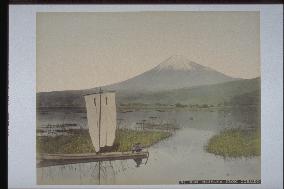
Mt. Fuji seen from Kashiwabara

Mt. Fuji seen from Kashiwabara

Kashiwabara is located on the left bank of the mouth of Katsumata River, which pours into Suruga Bay. This may be the low wetlands near the mouth of the river. A sailing boat can be seen to the left and Mt. Fuji in the centre. The cameraman may have taken the photo from a boat. In the Morse Collection at the Salem Peabody Museum, there is a photo which is believed to be developed from the same negative as this photo. ( Japan as seen by Morse , published by Shogakkan).==Date:unknown, Place:Shizuoka, Photo:Tamamura Kozaburo, (Credit:Nagasaki University Library/Kyodo News Images) [Cabinet Number11‐29‐0]

  •  
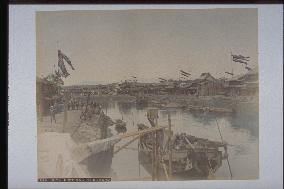
Carp streamers along YOKOHAMA canal

Carp streamers along YOKOHAMA canal

The caption reads Boy's festival, Yokohama in English.Carp streamers in May. There are similar scenes in the Yokohama photos. The Japanese boat has an interesting structure.==Date:unknown, Place:Yokohama, Photo:Tamamura Kozaburo, (Credit:Nagasaki University Library/Kyodo News Images) [Cabinet Number11‐23‐0]

  •  
Mt. Fuji seen from Yokohama

Mt. Fuji seen from Yokohama

The caption reads Fuji, Yokohama in English. This may be the Nakamura River in Yokohama. Mt. Fuji can be seen in the distance. Japanese boats carry cargo towards the sea on the Nakamura River.==Date:unknown, Place:Yokohama, Photo:Ogawa Kazumasa, (Credit:Nagasaki University Library/Kyodo News Images) [Cabinet Number9‐1‐0]

  •  
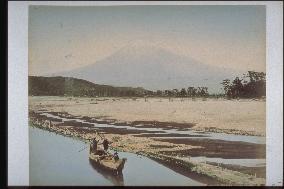
FUJIGAWA river and Mt. FUJI from iwabuchi,tokaido

FUJIGAWA river and Mt. FUJI from iwabuchi,tokaido

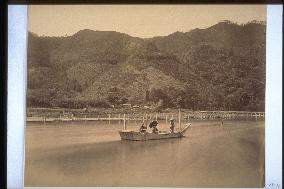
Iwabuchi was a Bakufu territory located on the left bank of Fuji River. In the foreground is a boat which may have been used to cross the Fuji River. From1603 the role of commuter boats was designated, and 10 boatmen administered the commuter boats. A wooden bridge can be seen in the distance.==Date:unknown, Place:Shizuoka, Photo:Ogawa Kazumasa, (Credit:Nagasaki University Library/Kyodo News Images) [Cabinet Number7‐25‐0]

  •  
Going down the Hozu River

Going down the Hozu River

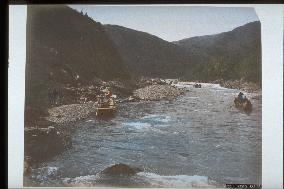
A photo of three boats coming downstream, taken further downstream on a shallow river with rocks showing from the bottom.==Date:unknown, Place:Kyoto, Photo:Ogawa Kazumasa, (Credit:Nagasaki University Library/Kyodo News Images) [Cabinet Number5‐45‐0]

  •  
Mt. Fuji seen from the Fuji River

Mt. Fuji seen from the Fuji River

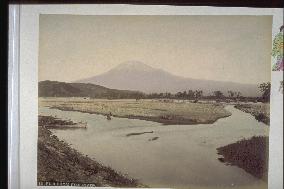
Fuji River, which is known as one of the three fastest rivers in Japan, has many branches and has troubled travelers from the early days. A wooden bridge stands on the other side of the inner island (should be confirmed). A boat might have been necessary to cross the river.==Date:unknown, Place:Shizuoka, Photo:Ogawa Kazumasa, (Credit:Nagasaki University Library/Kyodo News Images) [Cabinet Number5‐29‐0]

  •  
Mt. Fuji seen from the Fuji River

Mt. Fuji seen from the Fuji River

Fuji River, which at present runs through Shizuoka, Nagano and Yamanashi prefectures is known to be one of the three fastest rivers in Japan and a difficult route for transport since olden times. Maritime transport on the Fuji River, which thrived during the Edo Period, connected Iwabuchi near the mouth of the river with the banks of Akisawa in Kai, Aoyagi and Kurosawa.==Date:unknown, Place:Shizuoka, Photo:Kusakabe Kinbei, (Credit:Nagasaki University Library/Kyodo News Images) [Cabinet Number3‐44‐0]

  •  
Asakusa sanyabori canal

Asakusa sanyabori canal

The same photo as the one numbered 14-35, showing a canal leading to Negishi from Asakusa and Imado. Many passengers took boats along the Sumida River to visit the red-light district of Yoshiwara. The chokibune boats were not roofed and so must have been different from those shown in this photo. The cottages on the left may be boat houses. Most of the canals ware filled in when the Yoshiwara district was abolished in 1958.==Date:unknown, Place:Tokyo, Photo:Kusakabe Kinbei, (Credit:Nagasaki University Library/Kyodo News Images) [Cabinet Number3‐26‐0]

  •  
Going down the Hozu River

Going down the Hozu River

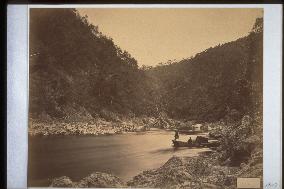
When the river bends, one side is sandy beach and the other is steep mountain. The photo shows a boat with a simple roof coming downstream, taken from further down the river. The boatsman takes the helm at the head of the boat.==Date:unknown, Place:Kyoto, Photo:Kusakabe Kinbei, (Credit:Nagasaki University Library/Kyodo News Images) [Cabinet Number2‐10‐0]

  •  
Going down the Hozu River

Going down the Hozu River

A photo showing several boats coming downstream in a sequence in the wider part of the river. One boat runs aground to the left on the dry riverbed.==Date:unknown, Place:Kyoto, Photo:Kusakabe Kinbei, (Credit:Nagasaki University Library/Kyodo News Images) [Cabinet Number2‐11‐0]

  •  
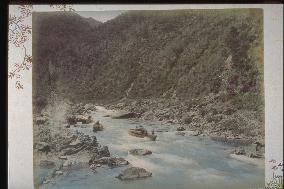
Hozu River

Hozu River

Hozugawa kudari (going downstream on the river Hozu) is a 16 km downstream course from Nishizume to the Togetsu Bridge. Originally this route was used to transport lumber from Tanba in the form of rafts but was frought with difficulty due to the rapids and exposed rocks. Sumikura Ryoi made transportation by shallow boats possible in 1606 by removing the greater rocks.From the end of the Meiji to the Taisho era, the Hozugawa downstream course was popularized for tourism, and former workers on the lumber rafts became boatmen. In the photo, the boatman is wearing a sedge hat and holding the helm at the rear of the boat.==Date:unknown, Place:Kyoto, Photo:Kusakabe Kinbei, (Credit:Nagasaki University Library/Kyodo News Images) [Cabinet Number1‐38‐0]

  •  
Mt. Fuji seen from Numakawa,Tagonoura

Mt. Fuji seen from Numakawa,Tagonoura

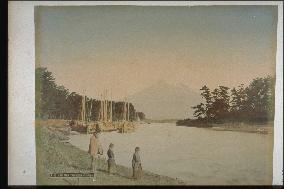
The Numa River belongs to the Fuji River system which runs along the west of Ukishimagahara to the north banks of Suruga Bay. The anchored boats may be Japanese-style boats or Bezai boats of the time. Fuji River, with its abundant water, was an important means of maritime transport, connecting the Kofu Basin and Tokai area.==Date:unknown, Place:Shizuoka, Photo:Kusakabe Kinbei, (Credit:Nagasaki University Library/Kyodo News Images) [Cabinet Number1‐40‐0]

  • Main
  • Top
  • Editorial
  • Creative
  • About Us
  • About ILG
  • Terms of use
  • Company
  • BEHIND
  • Price List
  • Single Plan
  • Monthly Plan
  • Services
  • Shooting
  • Rights Clearance
  • Support
  • FAQ
  • How To Buy
  • Contact Us
  • Become a Partner

© KYODO NEWS IMAGES INC

All Rights Reserved.

  • Editorial
  • Olympics
  • News
  • Sports
  • Japan
  • Tech
  • Royal
  • Disaster
  • NorthKorea
  • Old Japan
  • SNS
  • Creative
  • Food
  • Japan
  • Landscape
  • Animal
  • Popular
  • #Ukraine
  • #Thailand
  • #coronavirus
  • #N. Korea
  • #China
  • #Russia
  • #Ukraine
  • #Thailand
  • #coronavirus
  • #N. Korea
  • #China
  • #Russia
  • Food
  • Japan
  • Landscape
  • Animal
  • Olympics
  • News
  • Sports
  • Japan
  • Tech
  • Royal
  • Disaster
  • NorthKorea
  • Old Japan
  • SNS