•  
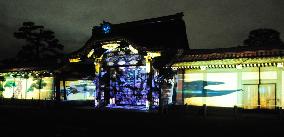
Colorful images illuminate Nijo Castle gate in Kyoto

Colorful images illuminate Nijo Castle gate in Kyoto

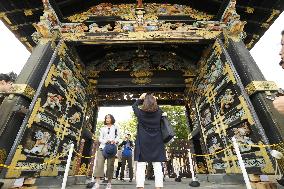
Colorful images are projected onto the Karamon Gate of Nijo Castle, a World Heritage site, in Kyoto, western Japan, during a press preview on March 19, 2015, before opening to the public from March 20 through April 12. Admission is free for visitors dressed in Japanese kimono, or otherwise 400 yen for adults and 200 yen for elementary to high school students. (Kyodo) ==Kyodo

  •  
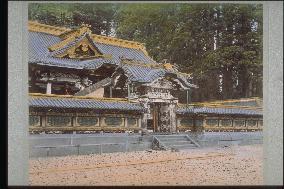
The Karamon Gate,Toshogu Shrine,Nikko

The Karamon Gate,Toshogu Shrine,Nikko

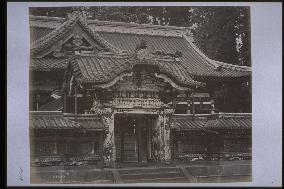
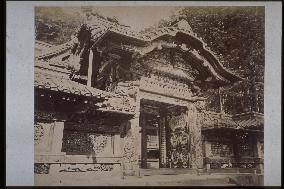
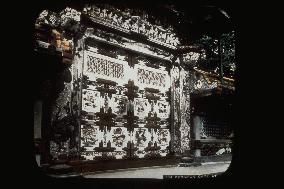
The Kara Gate stands at the front when going through the Yomei Gate of Toshogu. It looks simple with just white and black, but the sculpture of the Chinese sages carved on panels near the ceiling, and the pillars of the gate are covered with elaborate carvings of dragons going upstream and downstream. The see-through walls of the main building are covered with gold, magnificent with copper pheasants in the upper tier and waterfowl in the lower layer.==Date:unknown, Place:Nikko, Photo:Ogawa Kazumasa, (Credit:Nagasaki University Library/Kyodo News Images) [Cabinet Number10‐3‐0]

  •  
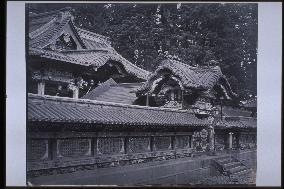
The Karamon Gate,Toshogu Shrine,Nikko

The Karamon Gate,Toshogu Shrine,Nikko

This is Karamon, the main gate of Toshogu Shrine. Only high ranking government officials and feudal lords, who were allowed to meet the shogun directly, could use this gate during the Edo Period. The inscription on the upper portion reads Shuntei Choken-no-gi (Emperor Shun's Morning Greetings). On both sides of the gate, surrounding the main shrine, is a 160m-long carved sukibei (transparent wall). Behind the gate stands the main worship hall.==Date:unknown, Place:Nikko, Photo:unknown, (Credit:Nagasaki University Library/Kyodo News Images) [Cabinet Number96‐108‐0]

  •  
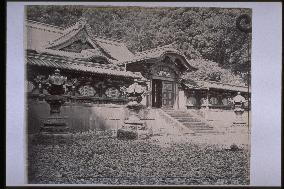
The Karamon Gate,Taiyuin Shrine,Nikko

The Karamon Gate,Taiyuin Shrine,Nikko

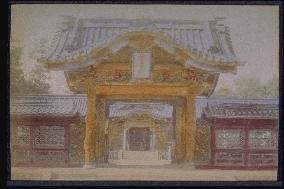
This is Karamon (Chinese Gate) at Taiyuin, the mausoleum of the third shogun Tokugawa Iemitsu. Taiyuin is the posthumous Buddhist name of Iemitsu conferred by Emperor Gokomyo. The gates at Taiyuin are Niomon, then Nitenmon, then Yashamon, and finally Karamon. Karamon is 3m tall and has a 1.8-meter wide facade. It is the smallest structure in the precinct. However, the gate is embellished with elaborate craftsmanship, creating a graceful and sophisticated atmosphere.==Date:unknown, Place:Nikko, Photo:unknown, (Credit:Nagasaki University Library/Kyodo News Images) [Cabinet Number96‐99‐0]

  •  
The Tomon Gate of Nishi Honganji Temple

The Tomon Gate of Nishi Honganji Temple

The Karamon Gate of Nishihonganji Temple is seen from the southeast, facing northeast. The four-legged gate facing Kitakoji Street is said to have been moved from Fushimi Castle in the Momoyama Period. The shingled roof is built in karahafu style front and back and in irimoya style left and right. The gate features paneled entrance doors, lintels and frog-leg struts. Carvings of a lion and peony, peacock and pine, kirin and clouds, and dragon and clouds decorate beams. The gate is also called Higuremon and Chokushimon.==Date:unknown, Place:Kyoto, Photo:unknown, (Credit:Nagasaki University Library/Kyodo News Images) [Cabinet Number96‐93‐0]

  •  
Cherry trees along the approach to Toshogu Shrine,Ueno

Cherry trees along the approach to Toshogu Shrine,Ueno

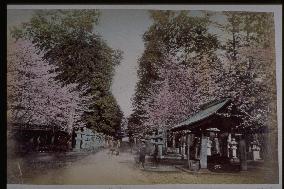
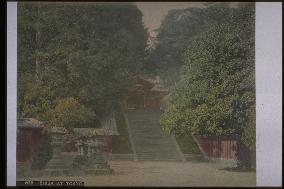
Ueno Toshogu, the shrine to the first shogun Tokugawa Ieyasu, was built in 1627 by Todo Takatora on the grounds of his second residence. This is a view of the Omote Sando shrine approach from the Karamon. The stone lanterns were donated by various feudal lords. The torii gate visible in the background was donated by Sakaida Tadayo, lord of Umayabashi Castle in Joshu (present-day Gunma Prefecture) in 1633. Later buried for unknown reasons, the torii was unearthed by Sakaida's grandson Sakai Tadatomo in 1734. It survived the Great Kanto Earthquake of 1923 and still stands today.==Date:unknown, Place:Tokyo, Photo:unknown, (Credit:Nagasaki University Library/Kyodo News Images) [Cabinet Number92‐6‐0]

  •  
The Karamon Gate,Toshogu Shrine,Nikko

The Karamon Gate,Toshogu Shrine,Nikko

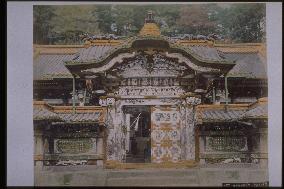
This is the main gate at Toshogu Shinto Shrine. Only high ranking government officials and feudal lords, who were allowed to meet the shogun directly, could use this gate during the Edo Period. The inscription on the upper portion reads Shuntei Choken-no-gi (Emperor Shun's Morning Greetings). On both sides of the gate, surrounding the main shrine, is a 160m-long carved sukibei (transparent wall).==Date:unknown, Place:Nikko, Photo:unknown, (Credit:Nagasaki University Library/Kyodo News Images) [Cabinet Number91‐22‐0]

  •  
The Karamon Gate,Taiyuin Shrine,Nikko

The Karamon Gate,Taiyuin Shrine,Nikko

This is Karamon (Chinese Gate) at Taiyuin, the mausoleum of the third shogun Tokugawa Iemitsu. Taiyuin is the posthumous Buddhist name of Iemitsu conferred by Emperor Gokomyo. The gates at Taiyuin are Niomon, then Nitenmon, then Yashamon, and finally Karamon. Karamon is 3m tall and has a 1.8-meter wide facade. It is the smallest structure in the precinct. However, the gate is embellished with elaborate craftsmanship, creating a graceful and sophisticated atmosphere.==Date:unknown, Place:Nikko, Photo:unknown, (Credit:Nagasaki University Library/Kyodo News Images) [Cabinet Number90‐41‐0]

  •  
Near the Nino-torii (the second gate),Toshogu Shrine,Nikko

Near the Nino-torii (the second gate),Toshogu Shrine,Nikko

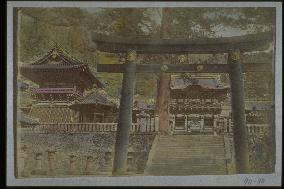
Yomei Gate is seen through Karagane Torii, next to Omizuya in the precincts of Toshogu. The first bronze torii gate in Japan, Karagane Torii was built by the third shogun Tokugawa Iemitsu. The building on the left is the Drum Tower, and to the right of it is the building where hanging lanterns are kept. Karamon is partially visible through Yomei Gate.==Date:unknown, Place:Nikko, Photo:unknown, (Credit:Nagasaki University Library/Kyodo News Images) [Cabinet Number90‐38‐0]

  •  
The Karamon Gate,Toshogu Shrine,Nikko

The Karamon Gate,Toshogu Shrine,Nikko

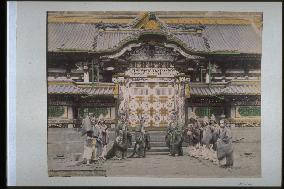
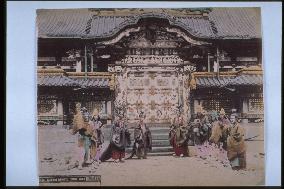
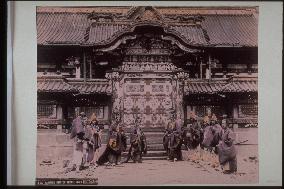
Karamon is the main gate of Toshogu Shinto Shrine. Only high ranking government officials and feudal lords, who were allowed to meet the shogun directly, could use this gate during the Edo Period. The gate was painted white with kofun and embellished with carvings of dragons. The inscription on the upper portion reads Shuntei Choken-no-gi (Emperor Shun's Morning Greetings) and consists of 27 figures carved from one zelkova tree in four rows. The people in front of the gate are wearing the costumes of the Toshogu Festival.==Date:unknown, Place:Nikko, Photo:unknown, (Credit:Nagasaki University Library/Kyodo News Images) [Cabinet Number87‐20‐0]

  •  
The Karamon Gate,Toshogu Shrine,Nikko

The Karamon Gate,Toshogu Shrine,Nikko

This is the main gate at Toshogu Shinto Shrine. Only high ranking government officials and feudal lords, who were allowed to meet the shogun directly, could use this gate during the Edo Period. The inscription on the upper portion reads Shuntei Choken-no-gi (Emperor Shun's Morning Greetings). On both sides of the gate, surrounding the main shrine, is a 160m-long carved sukibei (transparent wall).==Date:unknown, Place:Nikko, Photo:A. Farsari, (Credit:Nagasaki University Library/Kyodo News Images) [Cabinet Number82‐38‐0]

  •  
The Karamon Gate,Toshogu Shrine,Nikko

The Karamon Gate,Toshogu Shrine,Nikko

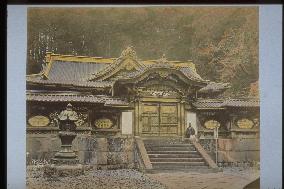
Karamon is the official gate to the main shrine at Toshogu. Only high ranking government officials and feudal lords, who were allowed to meet the shogun directly, could use this gate during the Edo Period. The carvings on the upper portion of the gate read Shuntei Choken-no-gi ( Emperor Shun's Morning Greetings). Someone is standing inside the gate. The building behind it is the Hall of Worship.==Date:unknown, Place:Nikko, Photo:A. Farsari, (Credit:Nagasaki University Library/Kyodo News Images) [Cabinet Number82‐39‐0]

  •  
The curtain gate to the tomb in Bunsho-in,Zojoji Temple,Shiba

The curtain gate to the tomb in Bunsho-in,Zojoji Temple,Shiba

The Shikiri Gate dividing the Hall of Worship and the inner shrine at Bunshoin Mausoleum is seen from the Hall of Worship. This is Mukaikaramon, a four-legged gate with one opening and a copper-tiled roof. A fence stretched to both sides of the gate, connecting the corridors of Karamon Gate to the Hall of Worship. The fence stretches about 140 metres around the main hall and the Hall of Worship.==Date:unknown, Place:Tokyo, Photo:A. Farsari, (Credit:Nagasaki University Library/Kyodo News Images) [Cabinet Number82‐30‐0]

  •  
The Karamon Gate,Toshogu Shrine,Nikko

The Karamon Gate,Toshogu Shrine,Nikko

This is the main gate at Toshogu Shinto Shrine. Only high ranking government officials and feudal lords, who were allowed to meet the shogun directly, could use this gate during the Edo Period. The inscription on the upper portion reads Shuntei Choken-no-gi (Emperor Shun's Morning Greetings). On both sides of the gate, surrounding the main shrine, is a 160m-long carved sukibei (transparent wall).==Date:unknown, Place:Nikko, Photo:Tamamura Kozaburo, (Credit:Nagasaki University Library/Kyodo News Images) [Cabinet Number80‐44‐0]

  •  
The middle gate to Haiden (sanctuary) of the Okuno-in of Bunsho-in,Zojoji Temple,Shiba

The middle gate to Haiden (sanctuary) of the Okuno-in of Bunsho-in,Zojoji Temple,Shiba

The stone stairs and Karamon Gate leading to the inner shrine of Yushoin Mausoleum are viewed from just inside Shikiri Gate (#4162). After that, a visitor sees the Hall of Worship, then the stairs and bronze lanterns visible in #2641, and then the pagoda in the interior.==Date:unknown, Place:Tokyo, Photo:Tamamura Kozaburo, (Credit:Nagasaki University Library/Kyodo News Images) [Cabinet Number80‐32‐0]

  •  
The Chokugaku-mon Gate (with Emperor's framed calligraphy) seen from the middle gate of Yusho-in,Zojoji Temple,Shiba

The Chokugaku-mon Gate (with Emperor's framed calligraphy) seen from the middle gate of Yusho-in,Zojoji Temple,Shiba

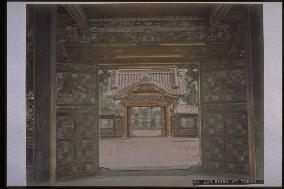
This is a view of the Karamon Gate at the Hall of Worship in the mausoleum from the inside. The area in front of the pillars on both sides is the front corridor. This photograph portrays some of the splendid interior decoration of the mausoleum. The stone lanterns donated by feudal lords stand solemnly outside the Chokugaku Gate in the centre.==Date:unknown, Place:Tokyo, Photo:unknown, (Credit:Nagasaki University Library/Kyodo News Images) [Cabinet Number80‐31‐0]

  •  
The Karamon Gate,Toshogu Shrine,Nikko

The Karamon Gate,Toshogu Shrine,Nikko

This is the main gate at Toshogu Shinto Shrine. Only high ranking government officials and feudal lords, who were allowed to meet the shogun directly, could use this gate during the Edo Period. The gate was painted white with kofun and embellished with parquetry, rosewood, and ebony carvings of dragons. The inscription on the upper portion reads Shuntei Choken-no-gi (Emperor Shun's Morning Greetings) and consists of 27 figures carved from one zelkova tree in four rows.==Date:unknown, Place:Nikko, Photo:R. Stillfried, (Credit:Nagasaki University Library/Kyodo News Images) [Cabinet Number78‐38‐0]

  •  
Sacred Fountain (Suibansha),Zojiji Temple,Shiba

Sacred Fountain (Suibansha),Zojiji Temple,Shiba

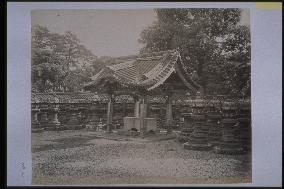
The Mizuya (water basin) in front of Yushoin Mausoleum is viewed from the Karamon (Chinese style) Gate. It is located on the left beyond Chokugaku Gate. There is a well to the right of the area depicted in the photograph. The many copper lanterns donated by feudal lords reveal the shogun's power.==Date:unknown, Place:Tokyo, Photo:R. Stillfried, (Credit:Nagasaki University Library/Kyodo News Images) [Cabinet Number78‐26‐0]

  •  
The Karamon Gate and the haiden (sanctuary),Toshogu Shrine,Nikko

The Karamon Gate and the haiden (sanctuary),Toshogu Shrine,Nikko

These structures are the Karamon Gate and the Hall of Worship at Taiyuin, the tomb of the third shogun Tokugawa Iemitsu. Taiyuin is Iemitsu's posthumous name conferred by Emperor Gokomyo. The gate is three meters tall and 1.8 meters wide. Although the smallest, it is the most delicate and elegant gate at Taiyuin. The Hall of Worship is 64 tatami mats in area.==Date:unknown, Place:Nikko, Photo:unknown, (Credit:Nagasaki University Library/Kyodo News Images) [Cabinet Number71‐34‐0]

  •  
The Karamon Gate and the haiden (sanctuary),Toshogu Shrine,Nikko

The Karamon Gate and the haiden (sanctuary),Toshogu Shrine,Nikko

This is the main gate at Toshogu Shinto Shrine. Only high ranking government officials and feudal lords, who were allowed to meet the shogun directly, could use this gate during the Edo Period. The inscription on the upper portion reads Shuntei Choken-no-gi (Emperor Shun's Morning Greetings). On both sides of the gate, surrounding the main shrine, is a 160m-long carved sukibei (transparent wall).==Date:unknown, Place:Nikko, Photo:unknown, (Credit:Nagasaki University Library/Kyodo News Images) [Cabinet Number71‐7‐0]

  •  
The Karamon Gate,Toshogu Shrine,Nikko

The Karamon Gate,Toshogu Shrine,Nikko

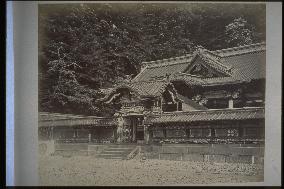
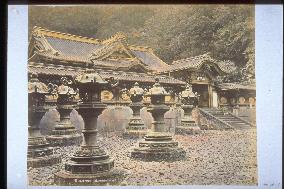
The shrine precincts are viewed from in front of the Shinyosha. Karamon is on the left. Kitodan (Goma-do) is in the centre back. The building on the right, Kaguraden, is the site of kagura (divine dances) by young women. The famous Nemurineko (sleeping cat) carving can be seen at the entrance of the corridor between Kitoden and Kaguraden. Behind the corridor is the approach (stairway) to the inner shrine.==Date:unknown, Place:Nikko, Photo:Ogawa Kazumasa, (Credit:Nagasaki University Library/Kyodo News Images) [Cabinet Number67‐38‐2]

  •  
The Karamon Gate and the haiden (sanctuary),Toshogu Shrine,Nikko

The Karamon Gate and the haiden (sanctuary),Toshogu Shrine,Nikko

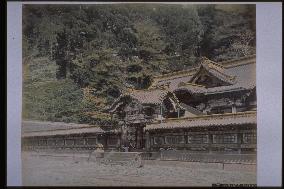
Karamon Gate (right) and the Hall of Worship are viewed from inside the inner precincts of Toshogu, which are surrounded by sukibei walls of 160m in length. During the Edo Period, the gate was used only by high-ranking government officials and feudal lords granted permission to meet the shogun directly. This is a rare photograph capturing the inside view of Karamon.==Date:unknown, Place:Nikko, Photo:Usui Shuzaburo?, (Credit:Nagasaki University Library/Kyodo News Images) [Cabinet Number65‐29‐0]

  •  
The Karamon Gate,Toshogu Shrine,Nikko

The Karamon Gate,Toshogu Shrine,Nikko

This is the main gate at Toshogu Shinto Shrine. Only high ranking government officials and feudal lords, who were allowed to meet the shogun directly, could use this gate during the Edo Period. The gate was painted white with kofun and embellished with parquetry, rosewood, and ebony carvings of dragons. The inscription on the upper portion reads Shuntei Choken-no-gi (Emperor Shun's Morning Greetings) and consists of 27 figures carved from one zelkova tree in four rows.==Date:unknown, Place:Nikko, Photo:Usui Shuzaburo?, (Credit:Nagasaki University Library/Kyodo News Images) [Cabinet Number65‐28‐0]

  •  
The precincts of Zojoji Temple,Shiba

The precincts of Zojoji Temple,Shiba

The stone stairs and Karamon Gate leading to the Okuin Hall of Worship at Bunshoin Mausoleum are viewed from a point just beyond Shikiri Gate. The copper lanterns on the left were donated by feudal lords. Engraved on the lanterns are the words In front of Bunshoin, October 24, 1712. This is the date of the death of 6th Shogun Tokugawa Ienobu.==Date:unknown, Place:Tokyo, Photo:unknown, (Credit:Nagasaki University Library/Kyodo News Images) [Cabinet Number64‐1‐0]

  •  
The Karamon Gate and the haiden (sanctuary),Toshogu Shrine,Nikko

The Karamon Gate and the haiden (sanctuary),Toshogu Shrine,Nikko

This is the main gate at Toshogu Shinto Shrine. Only high ranking government officials and feudal lords, who were allowed to meet the shogun directly, could use this gate during the Edo Period. The inscription on the upper portion reads Shuntei Choken-no-gi (Emperor Shun's Morning Greetings). On both sides of the gate, surrounding the main shrine, is a 160m-long carved sukibei (transparent wall).==Date:unknown, Place:Nikko, Photo:F. Beato, (Credit:Nagasaki University Library/Kyodo News Images) [Cabinet Number62‐7‐0]

  •  
Rokuharamitsuji Temple

Rokuharamitsuji Temple

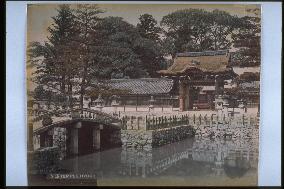
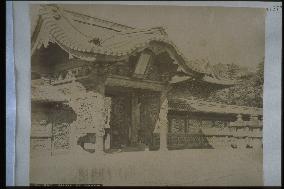
The Karamon Gate of Rokuson-o Shinto Shrine is seen facing east from the northeastern side of the Shinryu Pond. This shrine was rebuilt by Nankokushonin of Henjoshinin with the help of the Tokugawa Shogunate in 1702 and completed in 1707. It enshrines Rokuson-o (Minamoto Tsunemoto, a descendent of the Genji clan. The shape of the stone fence surrounding the pond indicates that this photograph was taken before 1911.==Date:unknown, Place:Kyoto, Photo:unknown, (Credit:Nagasaki University Library/Kyodo News Images) [Cabinet Number56‐20‐0]

  •  
The Karamon Gate,Toshogu Shrine,Nikko

The Karamon Gate,Toshogu Shrine,Nikko

This is the main gate at Toshogu Shinto Shrine. Only high ranking government officials and feudal lords, who were allowed to meet the shogun directly, could use this gate during the Edo Period. The gate was painted white with kofun and embellished with parquetry, rosewood, and ebony carvings of dragons. The inscription on the upper portion reads Shuntei Choken-no-gi (Emperor Shun's Morning Greetings) and consists of 27 figures carved from one zelkova tree in four rows.==Date:unknown, Place:Nikko, Photo:unknown, (Credit:Nagasaki University Library/Kyodo News Images) [Cabinet Number54‐45‐0]

  •  
The Karamon Gate,Toshogu Shrine,Nikko

The Karamon Gate,Toshogu Shrine,Nikko

This is the main gate at Toshogu Shinto Shrine. Only high ranking government officials and feudal lords, who were allowed to meet the shogun directly, could use this gate during the Edo Period. The inscription on the upper portion reads Shuntei Choken-no-gi (Emperor Shun's Morning Greetings). On both sides of the gate, surrounding the main shrine, is a 160m-long carved sukibei (transparent wall).==Date:unknown, Place:Nikko, Photo:unknown, (Credit:Nagasaki University Library/Kyodo News Images) [Cabinet Number54‐35‐0]

  •  
The Karamon Gate,Toshogu Shrine,Nikko

The Karamon Gate,Toshogu Shrine,Nikko

Karamon, the main gate at Toshogu, was used only by high-ranking government officials and feudal lords granted permission to meet the shogun directly. The gate was covered in white kofun paint, and its pillars were embellished with engravings of dragons. The upper portion of the gate has an inscription reading Shuntei Choken-no-gi (Emperor Shun's Morning Greetings) and features 27 figures in four rows carved from one zelkova tree.==Date:unknown, Place:Nikko, Photo:unknown, (Credit:Nagasaki University Library/Kyodo News Images) [Cabinet Number54‐31‐0]

  •  
The Karamon Gate,Toshogu Shrine,Nikko

The Karamon Gate,Toshogu Shrine,Nikko

This is the main gate at Toshogu Shinto Shrine. Only high ranking government officials and feudal lords, who were allowed to meet the shogun directly, could use this gate during the Edo Period. The gate was painted white with kofun and embellished with parquetry, rosewood, and ebony carvings of dragons. The inscription on the upper portion reads Shuntei Choken-no-gi (Emperor Shun's Morning Greetings) and consists of 27 figures carved from one zelkova tree in four rows.==Date:unknown, Place:Nikko, Photo:unknown, (Credit:Nagasaki University Library/Kyodo News Images) [Cabinet Number54‐23‐0]

  •  
The Karamon Gate,Toshogu Shrine,Nikko

The Karamon Gate,Toshogu Shrine,Nikko

Karamon is the main gate of Toshogu Shinto Shrine. Only high ranking government officials and feudal lords, who were allowed to meet the shogun directly, could use this gate during the Edo Period. The gate was painted white with kofun and embellished with carvings of dragons. The inscription on the upper portion reads Shuntei Choken-no-gi (Emperor Shun's Morning Greetings) and consists of 27 figures carved from one zelkova tree in four rows. The people in front of the gate are wearing the costumes of the Toshogu Festival.==Date:unknown, Place:Nikko, Photo:unknown, (Credit:Nagasaki University Library/Kyodo News Images) [Cabinet Number54‐2‐0]

  •  
The Chokugaku-mon Gate of Yusho-in Reibyo, Zojoji Temple, Shiba

The Chokugaku-mon Gate of Yusho-in Reibyo, Zojoji Temple, Shiba

Chokugakumon is a four-legged gate built in the kirizuma (gabled roof) style with karahafu (undulating bargeboard) in front and back, and a copper roof. The roof visible in the back is that of the bell tower. A see-through fence is built on both sides of the gate. The fence surrounds the front precinct of the Hall of Worship and connects to the right and left corridors of Karamon Gate. It is approximately 190 metres long.==Date:unknown, Place:Tokyo, Photo:unknown, (Credit:Nagasaki University Library/Kyodo News Images) [Cabinet Number53‐8‐0]

  •  
The Karamon Gate,Toshogu Shrine,Nikko

The Karamon Gate,Toshogu Shrine,Nikko

Karamon is the official gate to the main shrine at Toshogu. Only high ranking government officials and feudal lords, who were allowed to meet the shogun directly, could use this gate during the Edo Period. The carvings on the upper portion of the gate read Shuntei Choken-no-gi ( Emperor Shun's Morning Greetings). Someone is standing inside the gate. The building behind it is the Hall of Worship.==Date:unknown, Place:Nikko, Photo:unknown, (Credit:Nagasaki University Library/Kyodo News Images) [Cabinet Number50‐38‐0]

  •  
The Karamon Gate and the haiden (sanctuary),Toshogu Shrine,Nikko

The Karamon Gate and the haiden (sanctuary),Toshogu Shrine,Nikko

Karamon, the main gate of Toshogu, and the Hall of Worship are seen on the right. During the Edo Period, the gate was used only by high-ranking government officials and feudal lords granted permission to meet the shogun directly. The plaque on the upper portion of the gate reads Shuntei Choken-no-gi (Emperor Shun's Morning Greetings). The 160m sukibei wall is decorated with carvings and runs along both sides of Karamon, surrounding the main shrine.==Date:unknown, Place:Nikko, Photo:unknown, (Credit:Nagasaki University Library/Kyodo News Images) [Cabinet Number50‐28‐0]

  •  
The Chokugaku-mon Gate of Yusho-in Reibyo, Zojoji Temple, Shiba

The Chokugaku-mon Gate of Yusho-in Reibyo, Zojoji Temple, Shiba

This was taken from a direction exactly opposite that of #4163 and #4712. This photograph reveals the classic style of the Tokugawa mausoleum, with the Chokugakumon and Karamon gates and corridors to the right and left, the Hall of Worship, the connecting room, and the main hall arranged in a straight line.==Date:unknown, Place:Tokyo, Photo:Tamamura Kozaburo, (Credit:Nagasaki University Library/Kyodo News Images) [Cabinet Number48‐57‐0]

  •  
Nitenmon gate of nikko daishuin's burial ground

Nitenmon gate of nikko daishuin's burial ground

The Yashamon Gate stands in front of the Karamon Gate, the entrance to the main hall of the Taiyuan Mausoleum where Tokugawa Iemitsu was buried. There are statues of demons (yasha) on both sides of the gate covered with peony flower carvings. This photo captures the back view of the gate as seen from the worship hall.==Date:unknown, Place:Nikko, Photo:unknown, (Credit:Nagasaki University Library/Kyodo News Images) [Cabinet Number37‐40‐0]

  •  
The Karamon Gate,Toshogu Shrine,Nikko

The Karamon Gate,Toshogu Shrine,Nikko

The Kara Gate is at the front when going through the Yomei Gate at Toshogu. It looks simple with only black and white used, but the statues of Chinese saints carved in the girders and the climbing and descending dragons cover the pillars to the right and left. A see-through fence with vertically crossing lattice surrounds the main building.==Date:unknown, Place:Nikko, Photo:unknown, (Credit:Nagasaki University Library/Kyodo News Images) [Cabinet Number31‐64‐0]

  •  
The Karamon Gate,Toshogu Shrine,Nikko

The Karamon Gate,Toshogu Shrine,Nikko

The Kara Gate is at the front when going through the Yomei Gate at Toshogu. It looks simple with only black and white used, but the statues of Chinese saints carved in the girders and the climbing and descending dragons cover the pillars to the right and left. A see-through fence with vertically crossing lattice surrounds the main building.==Date:unknown, Place:Nikko, Photo:unknown, (Credit:Nagasaki University Library/Kyodo News Images) [Cabinet Number31‐47‐0]

  •  
Karamon gate of inner building of nikko toshogu shrine

Karamon gate of inner building of nikko toshogu shrine

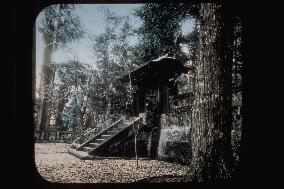
The tomb place of Tokugawa Ieyasu, Okusha of Nikko Toshogu is located in a grove of old cedar trees. A stone fence with girders surrounds the tomb, and a molded bronze gate stands at the entrance flanked by Korean dogs.==Date:unknown, Place:Nikko, Photo:unknown, (Credit:Nagasaki University Library/Kyodo News Images) [Cabinet Number31‐19‐0]

  •  
Yomeimon gate from karamon gate of nikko toshogu shrine

Yomeimon gate from karamon gate of nikko toshogu shrine

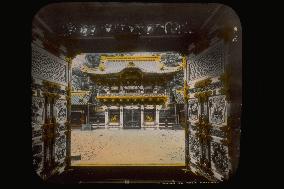
A view of the back of the Yomei Gate from the Toshogu Hall of Worship. The Kara Gate consists of yosegizaiku (wooden mosaic). The pillars have statues carved with Chinese saints. Korean dogs are placed at the back of the Yomei Gate on both sides.==Date:unknown, Place:Nikko, Photo:unknown, (Credit:Nagasaki University Library/Kyodo News Images) [Cabinet Number31‐10‐0]

  •  
The Karamon Gate,Taiyuin Shrine,Nikko

The Karamon Gate,Taiyuin Shrine,Nikko

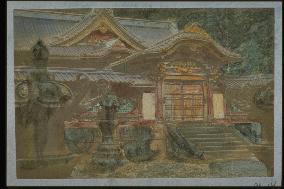
The Kara Gate of the Daiyuin, which is the tomb of Tokugawa Iemitsu, is the entrance to the main building. Under the barge are a male and a female cranes carved with a white dragon carved on the girders. The golden door opens to the hall of worship. Lanterns donated by the three Tokugawa families and other lords stand in front of the fence by the Kara Gate.==Date:unknown, Place:Nikko, Photo:unknown, (Credit:Nagasaki University Library/Kyodo News Images) [Cabinet Number26‐37‐0]

  •  
The Karamon Gate,Taiyuin Shrine,Nikko

The Karamon Gate,Taiyuin Shrine,Nikko

The Kara Gate is the entrance gate of the main building of tomb of Tokugawa Iemitsu, the Daiyuin. A male crane and a female crane are seen under the barge, and a white dragon is carved in the girders. In front of the fence from the Kara Gate are lanterns donated by the three Tokugawa families, and other lords.==Date:unknown, Place:Nikko, Photo:unknown, (Credit:Nagasaki University Library/Kyodo News Images) [Cabinet Number26‐3‐0]

  •  
The Karamon Gate,Toshogu Shrine,Nikko

The Karamon Gate,Toshogu Shrine,Nikko

The Kara gate stands when going through the Yomei Gate of the Toshogu. Toshogu Gakujin in full dress stand in front of the Kara gate. The English inscription of Iemitsu temple is wrong.==Date:unknown, Place:Nikko, Photo:unknown, (Credit:Nagasaki University Library/Kyodo News Images) [Cabinet Number24‐12‐0]

  •  
The open-work wall beside karamon gate of nikko toshogu shrine

The open-work wall beside karamon gate of nikko toshogu shrine

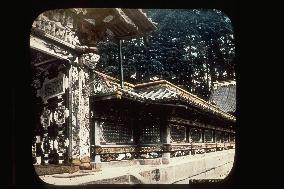
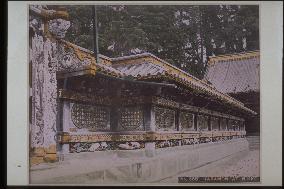
The Kara Gate stands inside the Yomei Gate at Toshogu. The see-through crossed walls surrounding the main building in laid with gold has quails on the upper layer and water fowl carved in the lower layer. On the left and right pillars are carvings of climbing and descending dragons.==Date:unknown, Place:Nikko, Photo:unknown, (Credit:Nagasaki University Library/Kyodo News Images) [Cabinet Number24‐13‐0]

  •  
Main building of Otani School

Main building of Otani School

The Karamon Gate and main hall of Chion-in Temple are viewed from the southwest, facing northeast. Pines and other garden trees grow in front of the gate. The four-legged irimoya style gate has a hiwadabuki roof. The main is built in one-story irimoya style with hiwadabuki roof; its girder and cross beams are about 16.3m and 11m in length. Both buildings were built in 1641. Mt. Kacho is visible in the background.==Date:unknown, Place:Kyoto, Photo:unknown, (Credit:Nagasaki University Library/Kyodo News Images) [Cabinet Number46‐94‐0]

  •  
The Karamon Gate,Taiyuin Shrine,Nikko

The Karamon Gate,Taiyuin Shrine,Nikko

The Kara Gate of Daiyuin, tomb of Tokugawa Ieyasu, is the entrance to the main building. Under the gable are two cranes, one male and the other female, and on the square division are white dragons. The see-through wall connecting with the Kara Gate has carvings of pines, bamboo, plum and pigeons in the upper tier. Through the golden gate is the hall of worship. Lanterns donated by the three Tokugawa families and other lords stand in a row.==Date:unknown, Place:Nikko, Photo:unknown, (Credit:Nagasaki University Library/Kyodo News Images) [Cabinet Number12‐17‐0]

  •  
The Karamon Gate,Toshogu Shrine,Nikko

The Karamon Gate,Toshogu Shrine,Nikko

The Kara Gate stands in front after going through the Yomei Gate of Toshogu. Although it looks simple with only white and black colours used, it has statues of Chinese sages carved in the transom and other intricate carvings of dragons going upstream and downstream on the pillars of the gate. It is magnificent with its gold inlay on the see-through walls, which have copper pheasants carved in the upper tier and waterfowl in the lower tier.==Date:unknown, Place:Nikko, Photo:Ogawa Kazumasa, (Credit:Nagasaki University Library/Kyodo News Images) [Cabinet Number8‐44‐0]

  •  
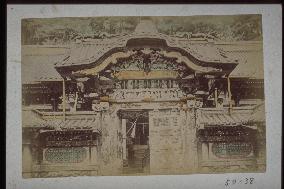
The Karamon Gate, Toshogu Shrine, Nikko

The Karamon Gate, Toshogu Shrine, Nikko

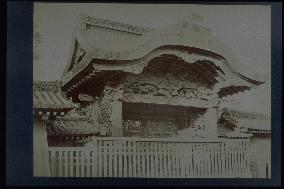
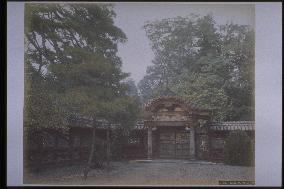
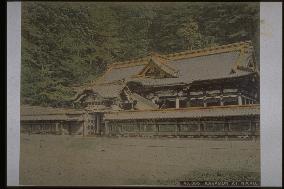
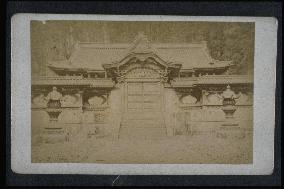
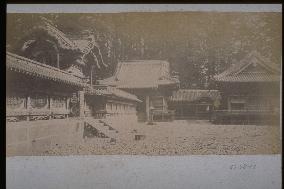
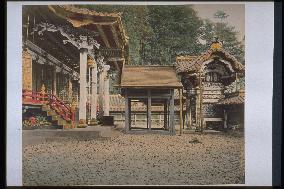
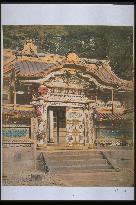
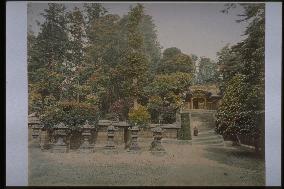
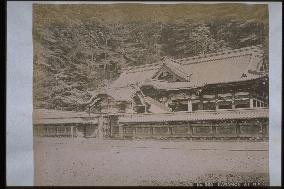
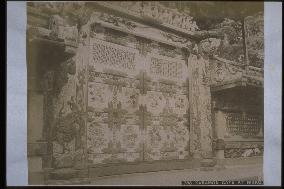
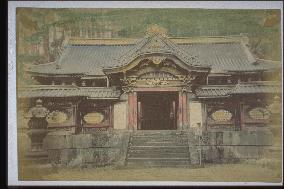
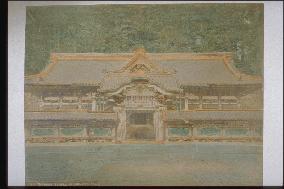
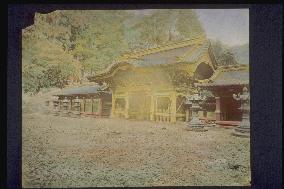
The Karamon Gate, Toshogu Shrine, Nikko ==Date:Early Meiji, Place:Nikko, Photo:unknown, (Credit:Nagasaki University Library/Kyodo News Images)

  •  
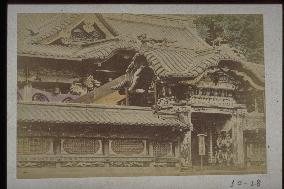
The Karamon Gate, Toshogu Shrine, Nikko

The Karamon Gate, Toshogu Shrine, Nikko

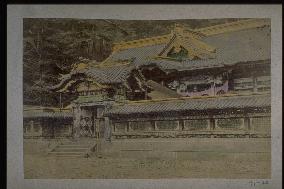
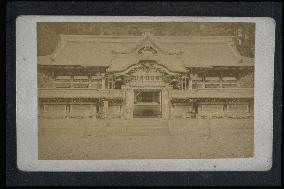
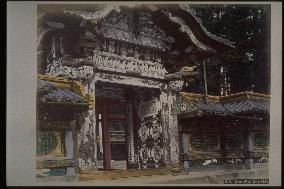
The Karamon Gate, Toshogu Shrine, Nikko ==Date:Early Meiji, Place:Nikko, Photo:unknown, (Credit:Nagasaki University Library/Kyodo News Images)

  •  
National treasure Karamon gate opens for 1st time in 34 years

National treasure Karamon gate opens for 1st time in 34 years

The Karamon, a gate with decorative carvings designated as a national treasure, is opened for the first time since 1983 at the Nishi Honganji temple in Kyoto on May 21, 2017, in a special one-day event. The Karamon, literally meaning "Chinese gate," stands 8.7 meters tall and was built in the late 16th century, according to the temple. (Kyodo) ==Kyodo

  • Main
  • Top
  • Editorial
  • Creative
  • About Us
  • About ILG
  • Terms of use
  • Company
  • BEHIND
  • Price List
  • Single Plan
  • Monthly Plan
  • Services
  • Shooting
  • Rights Clearance
  • Support
  • FAQ
  • How To Buy
  • Contact Us
  • Become a Partner

© KYODO NEWS IMAGES INC

All Rights Reserved.

  • Editorial
  • Olympics
  • News
  • Sports
  • Japan
  • Tech
  • Royal
  • Disaster
  • NorthKorea
  • Old Japan
  • SNS
  • Creative
  • Food
  • Japan
  • Landscape
  • Animal
  • Popular
  • #Ukraine
  • #China
  • #coronavirus
  • #N. Korea
  • #Thailand
  • #Russia
  • #Ukraine
  • #China
  • #coronavirus
  • #N. Korea
  • #Thailand
  • #Russia
  • Food
  • Japan
  • Landscape
  • Animal
  • Olympics
  • News
  • Sports
  • Japan
  • Tech
  • Royal
  • Disaster
  • NorthKorea
  • Old Japan
  • SNS