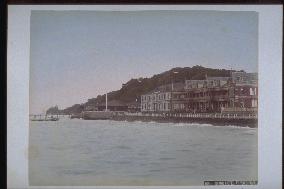
•  
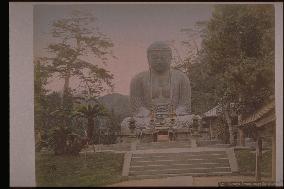
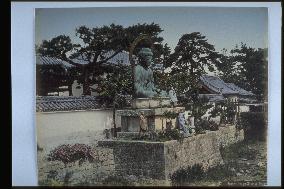
Daibutsu (the Great Buddha) of Kamakura

Daibutsu (the Great Buddha) of Kamakura

The Daibutsu (Great Buddha) is the main Buddha of the Kotokuin (Daiisan Kotokuin Josenji). The statue was initially enshrined in a hall like the Daibutsu in Nara. Old records show that the priest Joko of Toe planned the construction of the Buddha in 1236, the year that Hojo Yasutoki was Shikken (regent).==Date:unknown, Place:Kamakura, Photo:Kusakabe Kinbei, (Credit:Nagasaki University Library/Kyodo News Images) [Cabinet Number4‐26‐0]

  •  
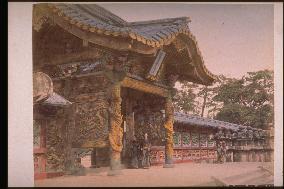
The Chokugaku-mon Gate of Yusho-in Reibyo, Zojoji Temple, Shiba

The Chokugaku-mon Gate of Yusho-in Reibyo, Zojoji Temple, Shiba

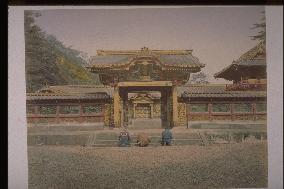
The tomb of the Seventh Shogun Ietsugu which was located to the north of Bunshoin. The Chokugaku Gate had bronze roof tiles and was cornered with Chinese-style bargeboards, and the sides have Chinese-style gates with four legs in chidori bargeboards. Dragon carvings can be observed on the pillars. The size of the gates can be seen from comparison with the two women standing in the centre of the photo.==Date:unknown, Place:Tokyo, Photo:Kusakabe Kinbei, (Credit:Nagasaki University Library/Kyodo News Images) [Cabinet Number4‐1‐0]

  •  
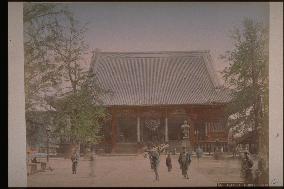
Main building of Sensoji Temple

Main building of Sensoji Temple

The facade of the main building of Sensoji Temple photographed from the Nio Gate. Since the people standing in the centre looking this way are holding spears, they may be boatmen on the Sumida River. The building was destroyed by fire during the war and was rebuilt in 1958.==Date:unknown, Place:Tokyo, Photo:Kusakabe Kinbei, (Credit:Nagasaki University Library/Kyodo News Images) [Cabinet Number4‐12‐0]

  •  
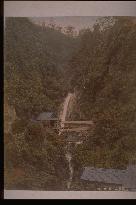
Nunobiki Falls

Nunobiki Falls

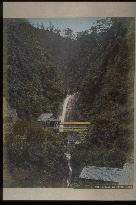
The Mendaki (also Metaki) Falls at the lowest part of Nunobiki Falls and the Kanbo Bridge.==Date:unknown, Place:Kobe, Photo:Kusakabe Kinbei, (Credit:Nagasaki University Library/Kyodo News Images) [Cabinet Number4‐27‐0]

  •  
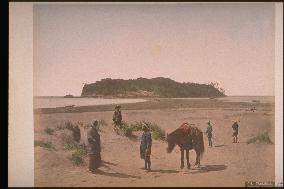
Enoshima Island

Enoshima Island

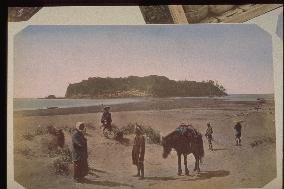
Enoshima is written with different Chinese characters all describing the beauty of the island. It is an island with a perimeter of 2.2 km, and the northern part is connected to the mainland during low tide by a sandy beach. Three men stand to the back of the man pulling his horse, and a person in the left corner with a towel over his head stands talking with the man.==Date:unknown, Place:Enoshima, Photo:Kusakabe Kinbei, (Credit:Nagasaki University Library/Kyodo News Images) [Cabinet Number4‐14‐0]

  •  
Daimyo street near west gate of imperial palace

Daimyo street near west gate of imperial palace

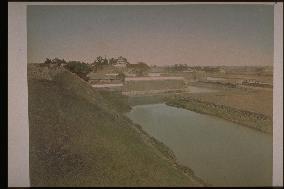
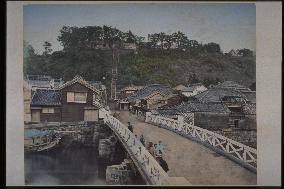
A residence of a daimyo (lord) can be seen across the moat. There were three kinds of residences for daimyo in Edo: the Kami Yashiki, Naka Yashiki and Shimo Yashiki. The residence adjoining Edo castle is a Kami Yashiki.==Date:unknown, Place:Tokyo, Photo:Kusakabe Kinbei, (Credit:Nagasaki University Library/Kyodo News Images) [Cabinet Number4‐8‐0]

  •  
Chumon,the middle gate,of yushoin's burial ground at shiba zojoji temple

Chumon,the middle gate,of yushoin's burial ground at shiba zojoji temple

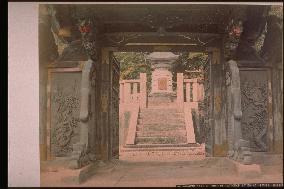
The English caption reads Bronze gate and tomb of Ietsugu. The Seventh Shogun Ietsugu was the son of Ienobu. He became Shogun at the age of five and died of an illness at the age of eight. His tomb was built next to the tomb of his father in Bunshoin.==Date:unknown, Place:Tokyo, Photo:Kusakabe Kinbei, (Credit:Nagasaki University Library/Kyodo News Images) [Cabinet Number4‐3‐0]

  •  
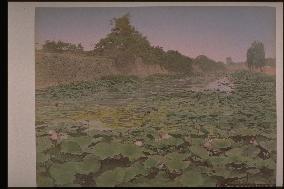
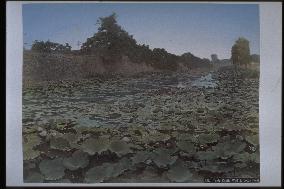
The lotus moat of the Imperial Palace

The lotus moat of the Imperial Palace

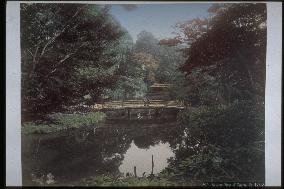
The lotus lake moat which separates the main building and Mt.Momiji. Lotus leaves cover the water surface almost completely hiding the water. Some pink flowers are seen here and there.==Date:unknown, Place:Tokyo, Photo:Kusakabe Kinbei, (Credit:Nagasaki University Library/Kyodo News Images) [Cabinet Number4‐5‐0]

  •  
Basins of bunshoin's burial ground at shiba zojoji temple

Basins of bunshoin's burial ground at shiba zojoji temple

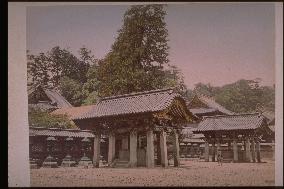
Two water basins to purify hands before worship. The pillar and roof of the structures protecting the basins from rain and dew are lavishly built. The magnificent size can be observed from comparison with men standing under the building.==Date:unknown, Place:Tokyo, Photo:Kusakabe Kinbei, (Credit:Nagasaki University Library/Kyodo News Images) [Cabinet Number4‐2‐0]

  •  
The Chokugaku-mon Gate of Bunsho-in Reibyo, Zojoji Temple, Shiba

The Chokugaku-mon Gate of Bunsho-in Reibyo, Zojoji Temple, Shiba

The same photographic structure as the picture numbered 12-5. However, this photo is far more clear.==Date:unknown, Place:Tokyo, Photo:Kusakabe Kinbei, (Credit:Nagasaki University Library/Kyodo News Images) [Cabinet Number3‐22‐0]

  •  
Ueno Park

Ueno Park

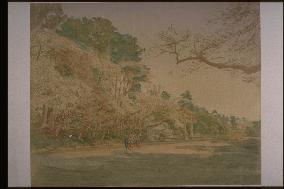
Rickshaws gathered when the cherry blossoms were in season, and many people came to see the famous blossoms in Ueno Park.==Date:unknown, Place:Tokyo, Photo:Kusakabe Kinbei, (Credit:Nagasaki University Library/Kyodo News Images) [Cabinet Number3‐27‐0]

  •  
The curtain gate to the tomb in Bunsho-in,Zojoji Temple,Shiba

The curtain gate to the tomb in Bunsho-in,Zojoji Temple,Shiba

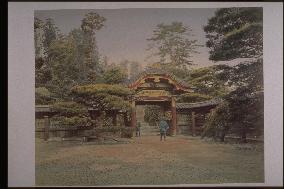
The caption reads temple in Shiba of Tokyo in English, but this is the Shikiri Gate of the Bunshoin (enshrining the tomb of the 6th Shogun Ienori) within the premises of Zojoji Temple in Shiba. The atmosphere at the entrance of the tomb can be observed. The guard still wears a mage (hair worn by men in a pony tail).==Date:unknown, Place:Tokyo, Photo:Kusakabe Kinbei, (Credit:Nagasaki University Library/Kyodo News Images) [Cabinet Number3‐23‐0]

  •  
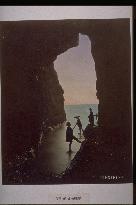
The cave on Enoshima Island

The cave on Enoshima Island

The cave in Enoshima can no longer be entered. Three people are seen in the photo. The person in the centre holding the helm may be a guiding boatsman.==Date:unknown, Place:Enoshima, Photo:Kusakabe Kinbei, (Credit:Nagasaki University Library/Kyodo News Images) [Cabinet Number3‐20‐0]

  •  
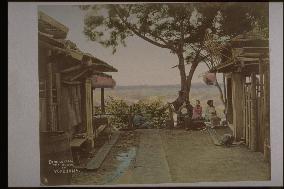
A teahouse above the hundred steps of Motomachi,Yokohama

A teahouse above the hundred steps of Motomachi,Yokohama

The caption reads Sengenyama, tea house in Yokohama in English. This is a photo of the tea house of Honmura on the hundred stone steps to Mt.Sengen, next to the foreign settlement in Yokohama. The tea houses on the right and left are decorated with lanterns, and young women with fans are cooling themselves at dusk.==Date:unknown, Place:Yokohama, Photo:Kusakabe Kinbei, (Credit:Nagasaki University Library/Kyodo News Images) [Cabinet Number3‐9‐0]

  •  
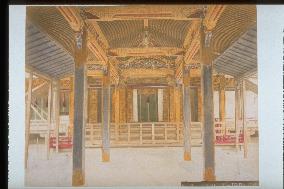
Inside of yushoin's burial ground at shiba zojoji temple

Inside of yushoin's burial ground at shiba zojoji temple

The caption reads Inside of Shiba temple, Tokyo in English. This is a photo of the inner worship hall of the Yushoin, which enshrines the tomb of the seventh Tokugawa Shogun Ietsugu, within the premises of Zojoji Temple in Shiba. The dazzling glamour of the interior destroyed during the Great Kanto Earthquake can be observed.==Date:unknown, Place:Tokyo, Photo:Kusakabe Kinbei, (Credit:Nagasaki University Library/Kyodo News Images) [Cabinet Number2‐32‐0]

  •  
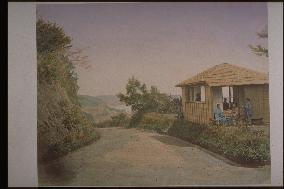
Teahouse at fudozaka slope

Teahouse at fudozaka slope

The caption reads A house at Mississippi Bay, near Yokohama in English. This is a tea house on the Fudosaka, a strolling route leading to Mississippi Bay (Negishi Bay). Several women are resting, and a child brings some tea.==Date:unknown, Place:Yokohama, Photo:Kusakabe Kinbei, (Credit:Nagasaki University Library/Kyodo News Images) [Cabinet Number3‐15‐0]

  •  
Rice planting

Rice planting

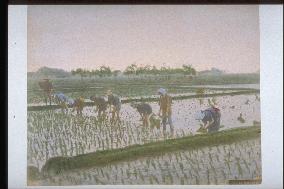
Seven men and women stand in a line to plant rice. The second from left and far right are women, wearing towels in anesama style with their kimono sleeves tucked with cords. The men wear towels over their heads, tied at the nose or sashes tied around the forehead. On the other side of the paddy field is a man wearing a straw hat and carrying a balancing pole with the seedlings, watching the planting.==Date:unknown, Place:unknown, Photo:Kusakabe Kinbei, (Credit:Nagasaki University Library/Kyodo News Images) [Cabinet Number2‐44‐0]

  •  
Entire view of nikko hachi-ishi

Entire view of nikko hachi-ishi

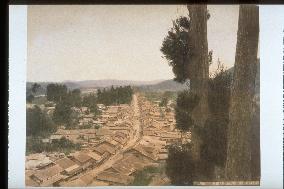
Nikko Hachiishi is shown from the middle of the mountain located to the west of Kannonji. Nikko Kaido bends near Kannonji and the present Nikko town hall, leading to leading to Shinkyo Bridge at the entrance of Nikkoshaji.==Date:unknown, Place:Nikko, Photo:Kusakabe Kinbei, (Credit:Nagasaki University Library/Kyodo News Images) [Cabinet Number2‐34‐0]

  •  
Railway premises around takashimacho

Railway premises around takashimacho

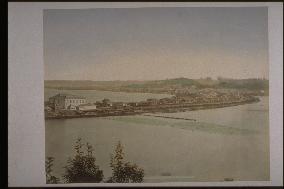
The caption reads railway to Kanagawa from Yokohama in English, but it is the railway on reclaimed land seen from the Kanagawa side. Takashima Kisaemon, who was engaged in the sale of lumber, carved the mountain and completed the railroad. The right is Hiranuma and the central rear is Yokohama city.==Date:unknown, Place:Yokohama, Photo:Kusakabe Kinbei, (Credit:Nagasaki University Library/Kyodo News Images) [Cabinet Number3‐17‐0]

  •  
Todaiji temple

Todaiji temple

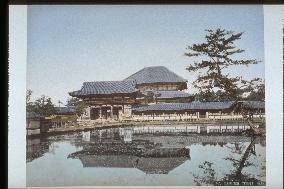
The middle gate seen from Kagami Pond. The Buddha Hall is seen across the corridor. The hall and the surrounding corridor and middle gate were destroyed by fire during wars in the Chisho and Eiroku eras, but were rebuilt in the 18th century.==Date:unknown, Place:Nara, Photo:Kusakabe Kinbei, (Credit:Nagasaki University Library/Kyodo News Images) [Cabinet Number2‐23‐0]

  •  
Lake Biwa seen from Miidera Temple

Lake Biwa seen from Miidera Temple

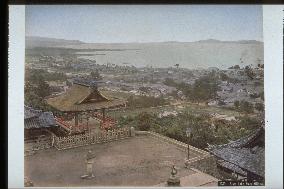
Onjoji Temple in Otsu. The name Mii originates from the spiritual waters in the well called Akai . It is located on a scenic spot at the middle of Mt.Nagara. The view from the Kannondo Hall is especially famous. To the left is the main building, and there is a platform in the centre. Lake Biwa can be seen in the distance.==Date:unknown, Place:Otsu, Photo:Kusakabe Kinbei, (Credit:Nagasaki University Library/Kyodo News Images) [Cabinet Number2‐25‐0]

  •  
NIJOJO CASTLE

NIJOJO CASTLE

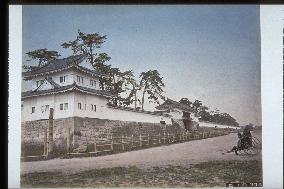
Nijo Castle at Horikawa and Nijo Dori in the Chukyo district of Kyoto. The east gate is seen from the south east corner turret. The construction of Nijo Castle, which was used by the Shogun during his stay in Kyoto, was started in 1602 and was completed four years later. The east gate has a series of windows about 9 meters in width, and the window lattice work is covered by steel boards. Steel pieces also line the pillars and doors. Windows with lattice work line the white walls of the southeast corner turrets. A rickshaw can be seen on the right.==Date:unknown, Place:Kyoto, Photo:Kusakabe Kinbei, (Credit:Nagasaki University Library/Kyodo News Images) [Cabinet Number2‐18‐0]

  •  
The Kannai foreign settlement seen from the hundred steps of Motomachi,Yokohama

The Kannai foreign settlement seen from the hundred steps of Motomachi,Yokohama

The Kannai foreign settlement seen from the hundred steps of Motomachi,Yokohama==Date:unknown, Place:Yokohama, Photo:Kusakabe Kinbei, (Credit:Nagasaki University Library/Kyodo News Images)

  •  
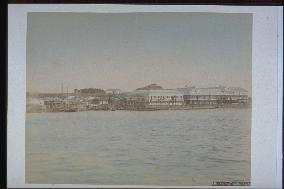
The Yokohama Customs Inspection office and the main pier

The Yokohama Customs Inspection office and the main pier

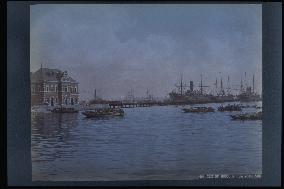
Panoramic view of the great pier from the waterfront. A symbol of Yokohama Harbour, the 19-meter-wide, 730-meter-long pier was built as part of the first port construction project started in 1889 and completed in 1894. The building on the left is the Customs Supervision Department built the same year.==Date:unknown, Place:Yokohama, Photo:Kusakabe Kinbei, (Credit:Nagasaki University Library/Kyodo News Images) [Cabinet Number96‐88‐0]

  •  
Yamate Park

Yamate Park

View from the Motomachi Hyakudan. The neighbourhood beyond the Horikawa Waterway is the Yamashita Settlement. The Yakushi-do of Zotokuin Temple is at the right edge and the large two-story Western-style building in the far left is the new Grand Hotel. Probably taken around 1897.==Date:about 1885, Place:Yokohama, Photo:Kusakabe Kinbei, (Credit:Nagasaki University Library/Kyodo News Images) [Cabinet Number96‐89‐0]

  •  
The entrance to Mt. Nunobiki

The entrance to Mt. Nunobiki

The start of the trail to Nunobiki Falls taken in mid-Meiji Period. The hill on the right is Mt. Isago. Ikuta River runs between the two hills. The Medaki (Female Waterfall) is located at the top of the path to the left. This is the same as photograph #2821, only tinted differently. The composition featuring people posing in the midst of famous scenery as if for a commemorative photograph is typical of Kusakabe Kinbei.==Date:about 1885, Place:Kobe, Photo:Kusakabe Kinbei, (Credit:Nagasaki University Library/Kyodo News Images) [Cabinet Number96‐68‐0]

  •  
Women on jinrikishas

Women on jinrikishas

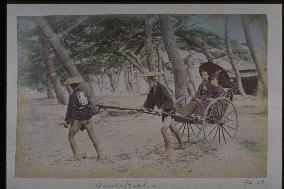
Two kimono-clad women are riding a jinrikisha (rickshaw). One of them is holding an umbrella. The rickshaw man wears a straw hat, a hanten coat, long underwear and straw sandals. The rickshaw man pulling on the left is wearing a loincloth. Many pine trees are visible in the background. This seems to have been taken on a beach.==Date:unknown, Place:Kanagawa, Photo:Kusakabe Kinbei, (Credit:Nagasaki University Library/Kyodo News Images) [Cabinet Number92‐42‐0]

  •  
The Two Venerable Images of Buddha,Sensoji Temple

The Two Venerable Images of Buddha,Sensoji Temple

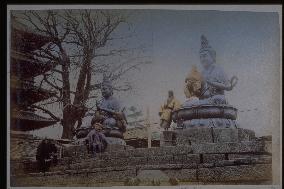
This is exactly the same as photograph #385 sold by the Kinbei Studio, which means that it was probably taken by Kusakabe Kinbei. Six children are playing near the Buddha statues. Other photographs show people sitting on the lotus bases, suggesting that these statues were a familiar and approachable presence to the common people. The tree in the background is a gingko tree said to be about 700 years old. The tree was designated as a Natural Asset of the City of Tokyo in 1930. Probably taken in the second decade of the Meiji Period (1878-1888).==Date:unknown, Place:Tokyo, Photo:unknown, (Credit:Nagasaki University Library/Kyodo News Images) [Cabinet Number92‐8‐0]

  •  
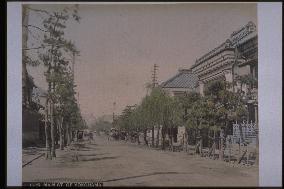
The main street of the Yokohama foreign settlement

The main street of the Yokohama foreign settlement

The main street of the Yokohama foreign settlement==Date:unknown, Place:Yokohama, Photo:Kusakabe Kinbei, (Credit:Nagasaki University Library/Kyodo News Images)

  •  
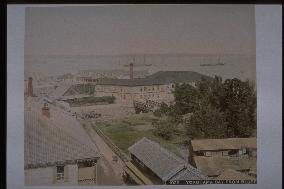
The Yokohama foreign settlement seen over a cliff

The Yokohama foreign settlement seen over a cliff

The Yokohama foreign settlement seen over a cliff==Date:unknown, Place:Yokohama, Photo:Kusakabe Kinbei, (Credit:Nagasaki University Library/Kyodo News Images)

  •  
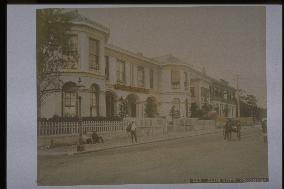
Yokohama Club Hotel

Yokohama Club Hotel

Yokohama Club Hotel==Date:unknown, Place:Yokohama, Photo:Kusakabe Kinbei, (Credit:Nagasaki University Library/Kyodo News Images)

  •  
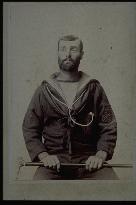
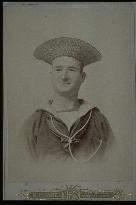
Portrait of a foreign sailor

Portrait of a foreign sailor

Portrait of a foreign sailor==Date:unknown, Place:Yokohama, Photo:Kusakabe Kinbei, (Credit:Nagasaki University Library/Kyodo News Images)

  •  
Portrait of a foreign young man

Portrait of a foreign young man

Portrait of a foreign young man==Date:unknown, Place:Yokohama, Photo:Kusakabe Kinbei, (Credit:Nagasaki University Library/Kyodo News Images)

  •  
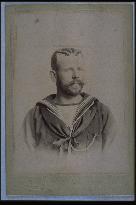
Portrait of a foreign sailor

Portrait of a foreign sailor

Portrait of a foreign sailor==Date:unknown, Place:Yokohama, Photo:Kusakabe Kinbei, (Credit:Nagasaki University Library/Kyodo News Images)

  •  
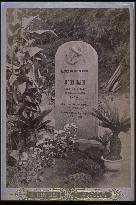
The grave of a foreign navy engineer

The grave of a foreign navy engineer

Gravestone of Albert Baker, a sailor on the British cruiser Grafton. The inscription shows that he died on December 25, 1896 at the age of 21. Although this is probably the Yokohama International Cemetery, the gravestone cannot be found today. This photograph was taken by Kusakabe Kinbei, a prominent Yokohama commercial photographer of the time.==Date:unknown, Place:Yokohama, Photo:Kusakabe Kinbei, (Credit:Nagasaki University Library/Kyodo News Images) [Cabinet Number69‐17‐0]

  •  
The lotus moat of the Imperial Palace

The lotus moat of the Imperial Palace

Hasuike (Lotus Pond) Moat between Honmaru and Koyozan. The height of the stone wall on the left indicates that the Honmaru Palace is on that side and therefore that this is a view of Hasuike-mon looking southeast from Shita-mon at Koyozan. Taken by Kusakabe Kinbei, probably between 1877 and 1887 (second decade of the Meiji Period).==Date:unknown, Place:Tokyo, Photo:unknown, (Credit:Nagasaki University Library/Kyodo News Images) [Cabinet Number59‐14‐0]

  •  
Shinkoji Temple

Shinkoji Temple

The Great Buddha at Shinkoji Temple in the mid-Meiji Period. Like #2821 (Entrance to Mt. Nunobiki), #4893 (Entrance to Mt. Nunobiki) and #2814 (Nunobiki Medaki), this photograph was taken and sold by the Yokohama photographer Kusakabe Kinbei. One of Kusakabe's masterpieces, it caters to the foreigners' taste for the exotic in its deep perspective and balanced composition with Japanese buildings and Buddhist priests posing in front of the Great Buddha.==Date:unknown, Place:Kobe, Photo:unknown, (Credit:Nagasaki University Library/Kyodo News Images) [Cabinet Number56‐30‐0]

  •  
The entrance to Mt. Nunobiki

The entrance to Mt. Nunobiki

The entrance to Nunobiki Falls in the mid-Meiji Period. The path leads to Medaki (Female Waterfall) and Odaki (Male Waterfall). This is the current location of Shin Kobe Station (Sanyo Shinkansen Line) and New Kobe Oriental Hotel. This photograph was taken by the Yokohama photographer Kusakabe Kinbei. The number 1207 is visible on the lower left. The photograph from the original plate bore the caption 1207 NUNOBUKI YAMA KOBE. This is the same as photograph #4893.==Date:unknown, Place:Kobe, Photo:unknown, (Credit:Nagasaki University Library/Kyodo News Images) [Cabinet Number56‐27‐0]

  •  
Nunobiki Falls

Nunobiki Falls

This is Medaki Waterfall of Nunobiki. This photograph is assumed to have been taken in Mid-Meiji Period around the same time as the photograph #2827 and #4240, as the wooden bridge which surrounds the river and the teahouse were already built. As the caption at the lower right says '1208. METAKI WATERFALL KOBE', this photograph was taken and sold by the photographer Kinbei Kusakabe of Yokohama.==Date:unknown, Place:Kobe, Photo:unknown, (Credit:Nagasaki University Library/Kyodo News Images) [Cabinet Number56‐21‐0]

  •  
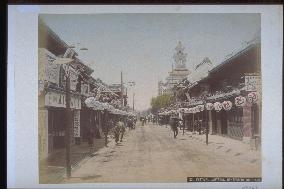
The theatre district in Isezaki-cho

The theatre district in Isezaki-cho

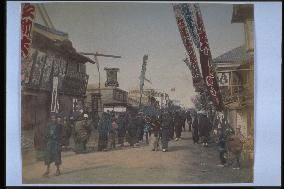
The area between Isezaki-cho and Nigiwai-cho, which prospered from the second decade of the Meiji Period, had many theatres, teahouses and restaurants. This photograph captures the lively atmosphere of the street before the fire of 1899. This is the vicinity of Isami-za in Matsugae-cho (present-day Isezaki-cho 2-chome), taken between 1887 and 1897.==Date:1887-1896, Place:Yokohama, Photo:Kusakabe Kinbei, (Credit:Nagasaki University Library/Kyodo News Images) [Cabinet Number55‐52‐0]

  •  
The hundred steps of Motomachi and Maeda-bashi Bridge,Yokohama

The hundred steps of Motomachi and Maeda-bashi Bridge,Yokohama

The hundred steps of Motomachi and Maeda-bashi Bridge,Yokohama==Date:unknown, Place:Yokohama, Photo:Kusakabe Kinbei, (Credit:Nagasaki University Library/Kyodo News Images)

  •  
Ferries,the Sumida River

Ferries,the Sumida River

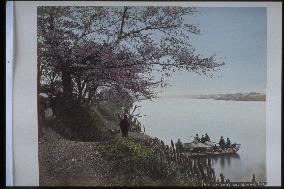
Probably the ferry dock called Takeya-no-Watashi at Mukojima. Another photograph taken downstream shows these people at the same time. Stone steps descend to the river from where the man is standing in the centre, and the ferry dock called Terashima-no-Watashi is visible upstream. However, the boat depicted here is not a ferry but a yanebune (roofed boat) used for entertainment. This is one of the photographs in the album sold at Kinpei Photograph Studio, indicating that it was taken by Kusakabe Kinbei in the early Meiji Period.==Date:unknown, Place:Tokyo, Photo:unknown, (Credit:Nagasaki University Library/Kyodo News Images) [Cabinet Number53‐31‐0]

  •  
Autumn tints of Takinogawa, Oji

Autumn tints of Takinogawa, Oji

The photographs of Takinogawa taken during the Meiji Period capture the beauty of the autumn colours. However, after World War II, the development of the residential areas changed the area upstream. The river banks were covered with concrete and the river started to smell due to waste water from houses. The local people launched a movement to protect the river, and finally the government built the Otonashi River Shinsui (Water Friendly) Park in 1985. Spring water is mixed with the natural flow and filtered. Thus, clean water is circulated in certain areas. Depicting the area under present-day Otonashi Bridge, this photograph was taken by Kusakabe Kinbei between 1877 and 1887 (second decade of the Meiji Period).==Date:unknown, Place:Tokyo, Photo:Kusakabe Kinbei, (Credit:Nagasaki University Library/Kyodo News Images) [Cabinet Number53‐32‐0]

  •  
A basket vendor

A basket vendor

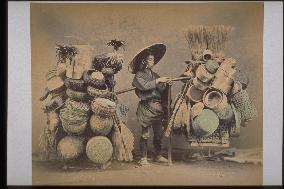
This peddler wears a bamboo hat, a kimono with hems pulled up, gaiters, socks, and straw sandals. He selling mainly portable bamboo baskets, but he is carrying other products such as sieve baskets, brooms and feather dusters.==Date:unknown, Place:unknown, Photo:Kusakabe Kinbei, (Credit:Nagasaki University Library/Kyodo News Images) [Cabinet Number51‐155‐0]

  •  
Enoshima Island

Enoshima Island

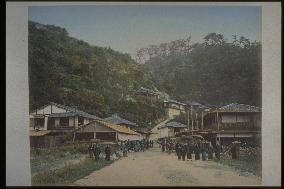
The same photograph at the Yokohama Archives of History indicates that this was taken by Kusabe Kinbei (1841-1934). It was shot from Katase and shows inns and a fishing village on Enoshima. The small island on the left is Shotenjima. In 1923, the Great Kanto Earthquake caused the land surrounding the island to rise and connected the island to Enoshima.==Date:unknown, Place:Enoshima, Photo:unknown, (Credit:Nagasaki University Library/Kyodo News Images) [Cabinet Number51‐49‐0]

  •  
The city of Yokohama

The city of Yokohama

Caption reads In Kanagawa. The location is unknown.==Date:unknown, Place:Yokohama, Photo:Kusakabe Kinbei, (Credit:Nagasaki University Library/Kyodo News Images) [Cabinet Number43‐28‐0]

  •  
Benten-dori Street

Benten-dori Street

Bentendori is parallel to Motomachi dori, two streets away. The photo is a view of the 3 chome to the 4 chome of Bentendori. The main spot of the Bentendori is the clock tower in the center of Kawakita Naozo Shoten.==Date:unknown, Place:Yokohama, Photo:Kusakabe Kinbei, (Credit:Nagasaki University Library/Kyodo News Images) [Cabinet Number43‐25‐0]

  •  
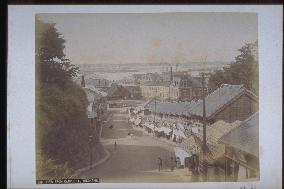
Kannai foreign settlement from Yamate Yatozaka slope

Kannai foreign settlement from Yamate Yatozaka slope

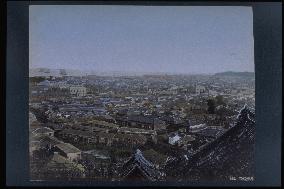
The Kannai settlement seen from the midway of Yamate Yatosaka. The huge modern buildings of the foreign settlement, and the Japanese houses of Motomachi can be compared. The center of the photo is Yokohama harbour.==Date:unknown, Place:Yokohama, Photo:Kusakabe Kinbei, (Credit:Nagasaki University Library/Kyodo News Images) [Cabinet Number43‐21‐0]

  •  
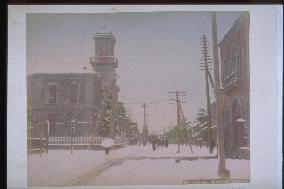
Honmachi-dori Avenue,Yokohama

Honmachi-dori Avenue,Yokohama

A photo of the snow scene in Motomachi of Yokohama. The clock tower is that of the Yokohama city office (built in 1874), and the building to the right in the fore is the postal and telecommunications office where the Yokohama city office comes later.==Date:unknown, Place:Yokohama, Photo:Kusakabe Kinbei, (Credit:Nagasaki University Library/Kyodo News Images) [Cabinet Number43‐24‐0]

  •  
Grand Hotel

Grand Hotel

A view of the direction from the Bluff and the east corner of the Band. The Grand Hotel has the old building opened in 1873 and the new building numbered 18 and 19. This building was designed by the architect Salda of the French settlement, and was opened in 1887.==Date:unknown, Place:Yokohama, Photo:Kusakabe Kinbei, (Credit:Nagasaki University Library/Kyodo News Images) [Cabinet Number43‐20‐0]

  • Main
  • Top
  • Editorial
  • Creative
  • About Us
  • About ILG
  • Terms of use
  • Company
  • BEHIND
  • Price List
  • Single Plan
  • Monthly Plan
  • Services
  • Shooting
  • Rights Clearance
  • Support
  • FAQ
  • How To Buy
  • Contact Us
  • Become a Partner

© KYODO NEWS IMAGES INC

All Rights Reserved.

  • Editorial
  • Olympics
  • News
  • Sports
  • Japan
  • Tech
  • Royal
  • Disaster
  • NorthKorea
  • Old Japan
  • SNS
  • Creative
  • Food
  • Japan
  • Landscape
  • Animal
  • Popular
  • #Ukraine
  • #Russia
  • #coronavirus
  • #N. Korea
  • #China
  • #Thailand
  • #Ukraine
  • #Russia
  • #coronavirus
  • #N. Korea
  • #China
  • #Thailand
  • Food
  • Japan
  • Landscape
  • Animal
  • Olympics
  • News
  • Sports
  • Japan
  • Tech
  • Royal
  • Disaster
  • NorthKorea
  • Old Japan
  • SNS