•  
Watermelon Farm - China

Watermelon Farm - China

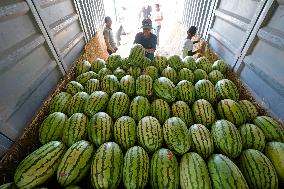
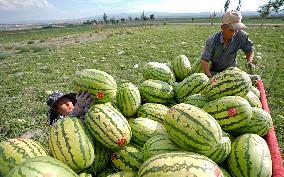
Retailers load Xisha watermelons onto a truck in Xingren Town of Shapotou District, Zhongwei City, northwest China's Ningxia Hui Autonomous Region, July 20, 2025. The Xisha watermelon is a watermelon variety cultivated on calcareous soil covered with stone gravels. It is known for its large size, crisp and juicy flesh, as well as rich sweetness. The fruit is often hailed as the "green gem of the Gobi Desert" owing to its great economic value. Zhongwei City, a major producer of Xisha watermelons, has recorded a planting area of 469,500 mu (31,300 hectares) this year, with an expected output of 1.15 million tonnes. Photo by Wang Peng/Xinhua/ABACAPRESS.COM

  •  
Watermelon Farm - China

Watermelon Farm - China

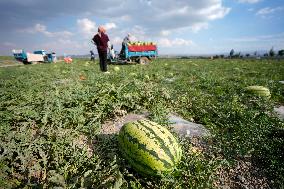
Farmers pick Xisha watermelons in Xingren Town of Shapotou District, Zhongwei City, northwest China's Ningxia Hui Autonomous Region, July 20, 2025. The Xisha watermelon is a watermelon variety cultivated on calcareous soil covered with stone gravels. It is known for its large size, crisp and juicy flesh, as well as rich sweetness. The fruit is often hailed as the "green gem of the Gobi Desert" owing to its great economic value. Zhongwei City, a major producer of Xisha watermelons, has recorded a planting area of 469,500 mu (31,300 hectares) this year, with an expected output of 1.15 million tonnes. Photo by Wang Peng/Xinhua/ABACAPRESS.COM

  •  
Watermelon Farm - China

Watermelon Farm - China

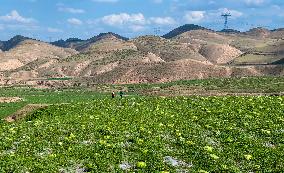
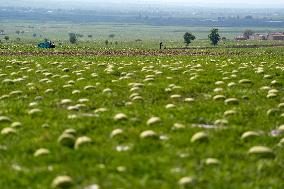
Farmers work in a Xisha watermelon field in Xiangshan Village of Shapotou District, Zhongwei City, northwest China's Ningxia Hui Autonomous Region, July 20, 2025. The Xisha watermelon is a watermelon variety cultivated on calcareous soil covered with stone gravels. It is known for its large size, crisp and juicy flesh, as well as rich sweetness. The fruit is often hailed as the "green gem of the Gobi Desert" owing to its great economic value. Zhongwei City, a major producer of Xisha watermelons, has recorded a planting area of 469,500 mu (31,300 hectares) this year, with an expected output of 1.15 million tonnes. Photo by Wang Peng/Xinhua/ABACAPRESS.COM

  •  
Watermelon Farm - China

Watermelon Farm - China

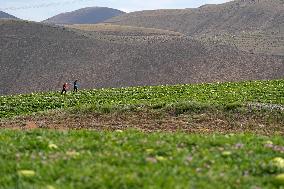
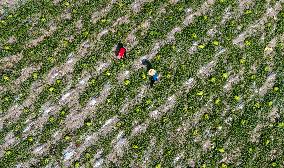
A drone photo taken on July 20, 2025 shows farmers working in a Xisha watermelon field in Xiangshan Township of Shapotou District, Zhongwei City, northwest China's Ningxia Hui Autonomous Region. The Xisha watermelon is a watermelon variety cultivated on calcareous soil covered with stone gravels. It is known for its large size, crisp and juicy flesh, as well as rich sweetness. The fruit is often hailed as the "green gem of the Gobi Desert" owing to its great economic value. Zhongwei City, a major producer of Xisha watermelons, has recorded a planting area of 469,500 mu (31,300 hectares) this year, with an expected output of 1.15 million tonnes. Photo by Wang Peng/Xinhua/ABACAPRESS.COM

  •  
Watermelon Farm - China

Watermelon Farm - China

An aerial drone photo taken on July 20, 2025 shows farmers working in a Xisha watermelon field in Xiangshan Township of Shapotou District, Zhongwei City, northwest China's Ningxia Hui Autonomous Region. The Xisha watermelon is a watermelon variety cultivated on calcareous soil covered with stone gravels. It is known for its large size, crisp and juicy flesh, as well as rich sweetness. The fruit is often hailed as the "green gem of the Gobi Desert" owing to its great economic value. Zhongwei City, a major producer of Xisha watermelons, has recorded a planting area of 469,500 mu (31,300 hectares) this year, with an expected output of 1.15 million tonnes. Photo by Wang Peng/Xinhua/ABACAPRESS.COM

  •  
Watermelon Farm - China

Watermelon Farm - China

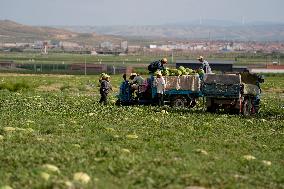
Farmers pick and transport Xisha watermelons in Xingren Town of Shapotou District, Zhongwei City, northwest China's Ningxia Hui Autonomous Region, July 20, 2025. The Xisha watermelon is a watermelon variety cultivated on calcareous soil covered with stone gravels. It is known for its large size, crisp and juicy flesh, as well as rich sweetness. The fruit is often hailed as the "green gem of the Gobi Desert" owing to its great economic value. Zhongwei City, a major producer of Xisha watermelons, has recorded a planting area of 469,500 mu (31,300 hectares) this year, with an expected output of 1.15 million tonnes. Photo by Wang Peng/Xinhua/ABACAPRESS.COM

  •  
Watermelon Farm - China

Watermelon Farm - China

Farmers pick and transport Xisha watermelons in Xingren Town of Shapotou District, Zhongwei City, northwest China's Ningxia Hui Autonomous Region, July 20, 2025. The Xisha watermelon is a watermelon variety cultivated on calcareous soil covered with stone gravels. It is known for its large size, crisp and juicy flesh, as well as rich sweetness. The fruit is often hailed as the "green gem of the Gobi Desert" owing to its great economic value. Zhongwei City, a major producer of Xisha watermelons, has recorded a planting area of 469,500 mu (31,300 hectares) this year, with an expected output of 1.15 million tonnes. Photo by Wang Peng/Xinhua/ABACAPRESS.COM

  •  
Watermelon Farm - China

Watermelon Farm - China

Farmers pick and transport Xisha watermelons in Xingren Town of Shapotou District, Zhongwei City, northwest China's Ningxia Hui Autonomous Region, July 20, 2025. The Xisha watermelon is a watermelon variety cultivated on calcareous soil covered with stone gravels. It is known for its large size, crisp and juicy flesh, as well as rich sweetness. The fruit is often hailed as the "green gem of the Gobi Desert" owing to its great economic value. Zhongwei City, a major producer of Xisha watermelons, has recorded a planting area of 469,500 mu (31,300 hectares) this year, with an expected output of 1.15 million tonnes. Photo by Wang Peng/Xinhua/ABACAPRESS.COM

  •  
Watermelon Farm - China

Watermelon Farm - China

Farmers work in a Xisha watermelon field in Xingren Township of Shapotou District, Zhongwei City, northwest China's Ningxia Hui Autonomous Region, July 20, 2025. The Xisha watermelon is a watermelon variety cultivated on calcareous soil covered with stone gravels. It is known for its large size, crisp and juicy flesh, as well as rich sweetness. The fruit is often hailed as the "green gem of the Gobi Desert" owing to its great economic value. Zhongwei City, a major producer of Xisha watermelons, has recorded a planting area of 469,500 mu (31,300 hectares) this year, with an expected output of 1.15 million tonnes. Photo by Wang Peng/Xinhua/ABACAPRESS.COM

  •  
Fires Rage Across US West

Fires Rage Across US West

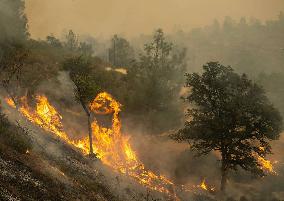
NO FILM, NO VIDEO, NO TV, NO DOCUMENTARY - Flames from the Park fire climb an embankment northeast of Red Bluff in Tehama County, Calif., on Saturday, July 27, 2024. The 357,341-acre blaze was 12% contained Monday, owing largely to a brief break in hot, dry weather conditions, according to the California Department of Forestry and Fire Protection. Photo by Jose Luis Villegas/The Sacramento Bee/TNS/ABACAPRES.SCOM

  •  

Pakistani expat explores UHV transmission project in E China

STORY: Pakistani expat explores UHV transmission project in E China SHOOTING DATE: Nov. 10, 2023 DATELINE: Feb. 28, 2024 LENGTH: 00:02:07 LOCATION: SUZHOU, China CATEGORY: SOCIETY/ENERGY SHOTLIST: 1. various of Yulan visiting the project 2. SOUNDBITE 1 (English): YULAN, Student of Silk Road School of Renmin University of China 3. SOUNDBITE 2 (English): ZHU HAIFENG, Senior engineer of the State Grid Corporation of Suzhou STORYLINE: SOUNDBITE 1 (English): YULAN, Student of Silk Road School of Renmin University of China "This is a video my friend sent me while taking the Lahore Orange Line Metro. Owing to the consistent energy supply under the China-Pakistan Economic Corridor (CPEC) energy projects, the metro line is able to run efficiently across the city of Lahore. But what many Chinese people are not aware of is that in the past Pakistan has been facing power shortages with power outages occurring every summer. In September of 2021, Pakistan's first high-voltage direct current transmission project, the ±6

  •  

China's success owing to opening up to world: Turkish analyst

STORY: China's success owing to opening up to world: Turkish analyst SHOOTING TIME: Dec. 11, 2023 DATELINE: Dec. 16, 2023 LENGTH: 00:00:42 LOCATION: ISTANBUL, Türkiye CATEGORY: ECONOMY SHOTLIST: 1. various of Istanbul 2. various of China-related footage 3. SOUNDBITE (Turkish): SANT MANUKYAN, Turkish analyst with Is Yatirim STORYLINE: A Turkish analyst with Is Yatirim, the investment banking arm of Isbank Group in Istanbul, has said that China's success is brought about by its opening up to the world. SOUNDBITE (Turkish): SANT MANUKYAN, Turkish analyst with Is Yatirim "When we look at China's success, we could see that it has industrialized very quickly. The success comes with China's integration into the world. It is a success brought about by opening up to the whole world. China has made the laws much more open to investors and attracted enormous foreign investment. They then used the foreign investment for their own professionalization." Xinhua News Agency correspondents reporting from Istanbul, Türkiy

  •  

Restrictions lifted as air quality improves in Indian capital

STORY: Restrictions lifted as air quality improves in Indian capital SHOOTING TIME: Nov. 29, 2023 DATELINE: Nov. 30, 2023 LENGTH: 00:01:15 LOCATION: New Delhi CATEGORY: ENVIRONMENT SHOTLIST: 1. various of India gate 2. various of traffic STORYLINE: Indian capital experienced a notable improvement in air quality on Wednesday owing to light rainfall and increased wind speeds. The Air Quality Index (AQI) dropped from 365 on Tuesday at 8 a.m. to 258 by Wednesday at 9 a.m. The authorities revoked the Stage III restrictions under the Graded Response Action Plan (GRAP) across the entire National Capital Region (NCR), which resulted in the relaxation of bans on specific types of vehicles in Delhi, and nearby surrounding areas of Gurugram, Faridabad, Ghaziabad, and Gautam Budh Nagar. Earlier actions, initiated by the government on Nov. 2, involved halting various pollution-causing activities, such as construction and mining. However, with these restrictions now lifted, there might be a restart of these activities

  •  
Saffron Harvest Season - India

Saffron Harvest Season - India

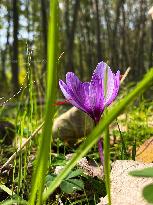
flowers in a farm in Pampore, 20 km (13 miles) south of Srinagar the summer capital of Indian administered Kashmir, India. The production of Saffron, the precious spice owing to vast acreage, is falling rapidly in Indian Administered Kashmir. Farmers have become concerned at the falling yield of the saffron crop year after year with the changing climatic conditions responsible for a 50 to 60 percent decrease in the yield for the last two decades. on October 17, 2023 in Kashimir, India. Photo by Umer Qadir/Eyepix Group/ABACAPRESS.COM

  •  
Saffron Harvest Season - India

Saffron Harvest Season - India

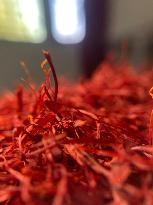
flowers in a farm in Pampore, 20 km (13 miles) south of Srinagar the summer capital of Indian administered Kashmir, India. The production of Saffron, the precious spice owing to vast acreage, is falling rapidly in Indian Administered Kashmir. Farmers have become concerned at the falling yield of the saffron crop year after year with the changing climatic conditions responsible for a 50 to 60 percent decrease in the yield for the last two decades. on October 17, 2023 in Kashimir, India. Photo by Umer Qadir/Eyepix Group/ABACAPRESS.COM

  •  
Saffron Harvest Season - India

Saffron Harvest Season - India

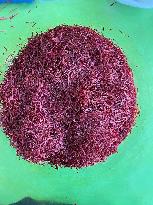
flowers in a farm in Pampore, 20 km (13 miles) south of Srinagar the summer capital of Indian administered Kashmir, India. The production of Saffron, the precious spice owing to vast acreage, is falling rapidly in Indian Administered Kashmir. Farmers have become concerned at the falling yield of the saffron crop year after year with the changing climatic conditions responsible for a 50 to 60 percent decrease in the yield for the last two decades. on October 17, 2023 in Kashimir, India. Photo by Umer Qadir/Eyepix Group/ABACAPRESS.COM

  •  
Saffron Harvest Season - India

Saffron Harvest Season - India

flowers in a farm in Pampore, 20 km (13 miles) south of Srinagar the summer capital of Indian administered Kashmir, India. The production of Saffron, the precious spice owing to vast acreage, is falling rapidly in Indian Administered Kashmir. Farmers have become concerned at the falling yield of the saffron crop year after year with the changing climatic conditions responsible for a 50 to 60 percent decrease in the yield for the last two decades. on October 17, 2023 in Kashimir, India. Photo by Umer Qadir/Eyepix Group/ABACAPRESS.COM

  •  
Saffron Harvest Season - India

Saffron Harvest Season - India

flowers in a farm in Pampore, 20 km (13 miles) south of Srinagar the summer capital of Indian administered Kashmir, India. The production of Saffron, the precious spice owing to vast acreage, is falling rapidly in Indian Administered Kashmir. Farmers have become concerned at the falling yield of the saffron crop year after year with the changing climatic conditions responsible for a 50 to 60 percent decrease in the yield for the last two decades. on October 17, 2023 in Kashimir, India. Photo by Umer Qadir/Eyepix Group/ABACAPRESS.COM

  •  

Int'l plastics, rubber, machinery exhibition kicks off in Iran

STORY: Int'l plastics, rubber, machinery exhibition kicks off in Iran DATELINE: Sept. 22, 2023 LENGTH: 00:01:30 LOCATION: Tehran CATEGORY: SOCIETY SHOTLIST: 1. various of the exhibition STORYLINE: The 17th International Exhibition of Plastics, Rubber, Machinery and Equipment kicked off in the Iranian capital of Tehran on Sunday. The opening ceremony was attended by Oil Minister Javad Owji and his deputies, lawmakers as well as foreign ambassadors in Tehran. A total of 560 domestic firms as well as 210 foreign companies have taken part in the event, according to a report published on the exhibition's website. Speaking at the opening ceremony, the oil minister said the petrochemical sector is a key industry of the country, which generated 16 billion U.S. dollars in export revenues in the previous Iranian calendar year which ended on March 20. He stressed that "the petrochemical sector "cannot be sanctioned" owing to the rising global demand for the industry's upstream and downstream products. Iran's pet

  •  
(EnchantingGuangxi)CHINA-GUANGXI-MIAO ETHNIC GROUP-TRADITIONAL COSTUME (CN)

(EnchantingGuangxi)CHINA-GUANGXI-MIAO ETHNIC GROUP-TRADITIONAL COSTUME (CN)

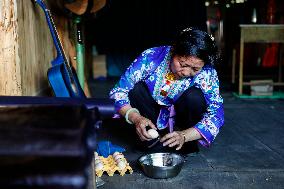
(230903) -- RONGSHUI, Sept. 3, 2023 (Xinhua) -- Wu Meiqiu applies egg white on a piece of "Liang Bu" in Wuying Village on the border between south China's Guangxi Zhuang Autonomous Region and southwest China's Guizhou Province, on Aug. 31, 2023. Wuying Village is a Miao ethnic group hamlet that nestles snugly in the towering mountains stretching across the border between Guangxi and Guizhou. "Liang Bu", named for its glistening appearance, is a kind of traditional hand-made cloth of Miao ethnic group. Women of Miao ethnic group in Wuying plant woad in spring and harvest it in fall. They soak woad in water for days before mixing it with materials such as lime, to make the dye for "Liang Bu". It usually takes months to make a piece of "Liang Bu" after repeated process of dip-dyeing, drying, pounding, applying egg white and steaming. The cloth gradually becomes glistening owing to tens of thousands of poundings by villagers with traditional wooden hammers. After cutting, sewing, embroidery and ironing, a

  •  
(EnchantingGuangxi)CHINA-GUANGXI-MIAO ETHNIC GROUP-TRADITIONAL COSTUME (CN)

(EnchantingGuangxi)CHINA-GUANGXI-MIAO ETHNIC GROUP-TRADITIONAL COSTUME (CN)

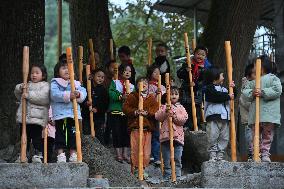
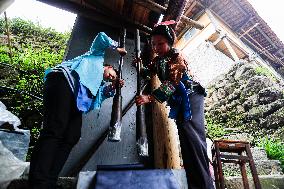
(230903) -- RONGSHUI, Sept. 3, 2023 (Xinhua) -- Children learn to use the traditional "Liang Bu" hammers in Wuying Village on the border between south China's Guangxi Zhuang Autonomous Region and southwest China's Guizhou Province, on Nov. 14, 2022. Wuying Village is a Miao ethnic group hamlet that nestles snugly in the towering mountains stretching across the border between Guangxi and Guizhou. "Liang Bu", named for its glistening appearance, is a kind of traditional hand-made cloth of Miao ethnic group. Women of Miao ethnic group in Wuying plant woad in spring and harvest it in fall. They soak woad in water for days before mixing it with materials such as lime, to make the dye for "Liang Bu". It usually takes months to make a piece of "Liang Bu" after repeated process of dip-dyeing, drying, pounding, applying egg white and steaming. The cloth gradually becomes glistening owing to tens of thousands of poundings by villagers with traditional wooden hammers. After cutting, sewing, embroidery and ironin

  •  
(EnchantingGuangxi)CHINA-GUANGXI-MIAO ETHNIC GROUP-TRADITIONAL COSTUME (CN)

(EnchantingGuangxi)CHINA-GUANGXI-MIAO ETHNIC GROUP-TRADITIONAL COSTUME (CN)

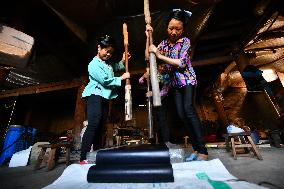
(230903) -- RONGSHUI, Sept. 3, 2023 (Xinhua) -- Wei Meili (R) pounds the cloth with the traditional "Liang Bu" hammer in Wuying Village on the border between south China's Guangxi Zhuang Autonomous Region and southwest China's Guizhou Province, on Sept. 2, 2020. Wuying Village is a Miao ethnic group hamlet that nestles snugly in the towering mountains stretching across the border between Guangxi and Guizhou. "Liang Bu", named for its glistening appearance, is a kind of traditional hand-made cloth of Miao ethnic group. Women of Miao ethnic group in Wuying plant woad in spring and harvest it in fall. They soak woad in water for days before mixing it with materials such as lime, to make the dye for "Liang Bu". It usually takes months to make a piece of "Liang Bu" after repeated process of dip-dyeing, drying, pounding, applying egg white and steaming. The cloth gradually becomes glistening owing to tens of thousands of poundings by villagers with traditional wooden hammers. After cutting, sewing, embroide

  •  
(EnchantingGuangxi)CHINA-GUANGXI-MIAO ETHNIC GROUP-TRADITIONAL COSTUME (CN)

(EnchantingGuangxi)CHINA-GUANGXI-MIAO ETHNIC GROUP-TRADITIONAL COSTUME (CN)

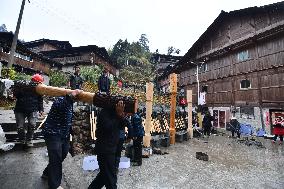
(230903) -- RONGSHUI, Sept. 3, 2023 (Xinhua) -- Villagers install large "Liang Bu" hammers at a square in Wuying Village on the border between south China's Guangxi Zhuang Autonomous Region and southwest China's Guizhou Province, on Nov. 19, 2022. Wuying Village is a Miao ethnic group hamlet that nestles snugly in the towering mountains stretching across the border between Guangxi and Guizhou. "Liang Bu", named for its glistening appearance, is a kind of traditional hand-made cloth of Miao ethnic group. Women of Miao ethnic group in Wuying plant woad in spring and harvest it in fall. They soak woad in water for days before mixing it with materials such as lime, to make the dye for "Liang Bu". It usually takes months to make a piece of "Liang Bu" after repeated process of dip-dyeing, drying, pounding, applying egg white and steaming. The cloth gradually becomes glistening owing to tens of thousands of poundings by villagers with traditional wooden hammers. After cutting, sewing, embroidery and ironing,

  •  
(EnchantingGuangxi)CHINA-GUANGXI-MIAO ETHNIC GROUP-TRADITIONAL COSTUME (CN)

(EnchantingGuangxi)CHINA-GUANGXI-MIAO ETHNIC GROUP-TRADITIONAL COSTUME (CN)

(230903) -- RONGSHUI, Sept. 3, 2023 (Xinhua) -- Wei Meili (R) applies egg white on a piece of "Liang Bu" in Wuying Village on the border between south China's Guangxi Zhuang Autonomous Region and southwest China's Guizhou Province, on Sept. 2, 2020. Wuying Village is a Miao ethnic group hamlet that nestles snugly in the towering mountains stretching across the border between Guangxi and Guizhou. "Liang Bu", named for its glistening appearance, is a kind of traditional hand-made cloth of Miao ethnic group. Women of Miao ethnic group in Wuying plant woad in spring and harvest it in fall. They soak woad in water for days before mixing it with materials such as lime, to make the dye for "Liang Bu". It usually takes months to make a piece of "Liang Bu" after repeated process of dip-dyeing, drying, pounding, applying egg white and steaming. The cloth gradually becomes glistening owing to tens of thousands of poundings by villagers with traditional wooden hammers. After cutting, sewing, embroidery and ironin

  •  
(EnchantingGuangxi)CHINA-GUANGXI-MIAO ETHNIC GROUP-TRADITIONAL COSTUME (CN)

(EnchantingGuangxi)CHINA-GUANGXI-MIAO ETHNIC GROUP-TRADITIONAL COSTUME (CN)

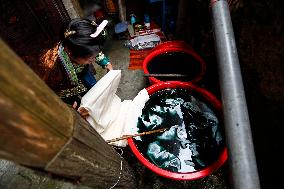
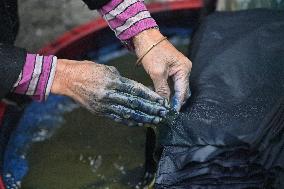
(230903) -- RONGSHUI, Sept. 3, 2023 (Xinhua) -- Liang Zuying dyes the white cloth in Wuying Village on the border between south China's Guangxi Zhuang Autonomous Region and southwest China's Guizhou Province, on Aug. 31, 2023. Wuying Village is a Miao ethnic group hamlet that nestles snugly in the towering mountains stretching across the border between Guangxi and Guizhou. "Liang Bu", named for its glistening appearance, is a kind of traditional hand-made cloth of Miao ethnic group. Women of Miao ethnic group in Wuying plant woad in spring and harvest it in fall. They soak woad in water for days before mixing it with materials such as lime, to make the dye for "Liang Bu". It usually takes months to make a piece of "Liang Bu" after repeated process of dip-dyeing, drying, pounding, applying egg white and steaming. The cloth gradually becomes glistening owing to tens of thousands of poundings by villagers with traditional wooden hammers. After cutting, sewing, embroidery and ironing, a set of glossy "Lia

  •  
(EnchantingGuangxi)CHINA-GUANGXI-MIAO ETHNIC GROUP-TRADITIONAL COSTUME (CN)

(EnchantingGuangxi)CHINA-GUANGXI-MIAO ETHNIC GROUP-TRADITIONAL COSTUME (CN)

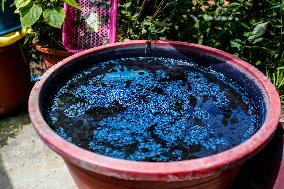
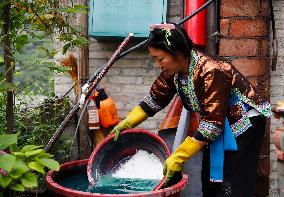
(230903) -- RONGSHUI, Sept. 3, 2023 (Xinhua) -- This photo shows the water after soaking woad in it for three days in Wuying Village on the border between south China's Guangxi Zhuang Autonomous Region and southwest China's Guizhou Province, on Aug. 31, 2023. Wuying Village is a Miao ethnic group hamlet that nestles snugly in the towering mountains stretching across the border between Guangxi and Guizhou. "Liang Bu", named for its glistening appearance, is a kind of traditional hand-made cloth of Miao ethnic group. Women of Miao ethnic group in Wuying plant woad in spring and harvest it in fall. They soak woad in water for days before mixing it with materials such as lime, to make the dye for "Liang Bu". It usually takes months to make a piece of "Liang Bu" after repeated process of dip-dyeing, drying, pounding, applying egg white and steaming. The cloth gradually becomes glistening owing to tens of thousands of poundings by villagers with traditional wooden hammers. After cutting, sewing, embroidery

  •  
(EnchantingGuangxi)CHINA-GUANGXI-MIAO ETHNIC GROUP-TRADITIONAL COSTUME (CN)

(EnchantingGuangxi)CHINA-GUANGXI-MIAO ETHNIC GROUP-TRADITIONAL COSTUME (CN)

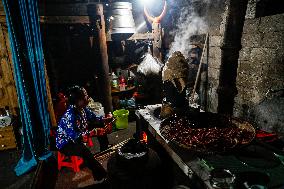
(230903) -- RONGSHUI, Sept. 3, 2023 (Xinhua) -- Liang Zuying steams the cloth in Wuying Village on the border between south China's Guangxi Zhuang Autonomous Region and southwest China's Guizhou Province, on Aug. 30, 2023. Wuying Village is a Miao ethnic group hamlet that nestles snugly in the towering mountains stretching across the border between Guangxi and Guizhou. "Liang Bu", named for its glistening appearance, is a kind of traditional hand-made cloth of Miao ethnic group. Women of Miao ethnic group in Wuying plant woad in spring and harvest it in fall. They soak woad in water for days before mixing it with materials such as lime, to make the dye for "Liang Bu". It usually takes months to make a piece of "Liang Bu" after repeated process of dip-dyeing, drying, pounding, applying egg white and steaming. The cloth gradually becomes glistening owing to tens of thousands of poundings by villagers with traditional wooden hammers. After cutting, sewing, embroidery and ironing, a set of glossy "Liang B

  •  
(EnchantingGuangxi)CHINA-GUANGXI-MIAO ETHNIC GROUP-TRADITIONAL COSTUME (CN)

(EnchantingGuangxi)CHINA-GUANGXI-MIAO ETHNIC GROUP-TRADITIONAL COSTUME (CN)

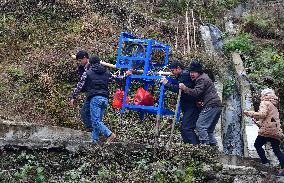
(230903) -- RONGSHUI, Sept. 3, 2023 (Xinhua) -- Villagers carry machines for making "Liang Bu" in Wuying Village on the border between south China's Guangxi Zhuang Autonomous Region and southwest China's Guizhou Province, on Dec. 31, 2021. The machines were donated by the women's federation and the association of women entrepreneurs of Liuzhou. Wuying Village is a Miao ethnic group hamlet that nestles snugly in the towering mountains stretching across the border between Guangxi and Guizhou. "Liang Bu", named for its glistening appearance, is a kind of traditional hand-made cloth of Miao ethnic group. Women of Miao ethnic group in Wuying plant woad in spring and harvest it in fall. They soak woad in water for days before mixing it with materials such as lime, to make the dye for "Liang Bu". It usually takes months to make a piece of "Liang Bu" after repeated process of dip-dyeing, drying, pounding, applying egg white and steaming. The cloth gradually becomes glistening owing to tens of thousands of pou

  •  
(EnchantingGuangxi)CHINA-GUANGXI-MIAO ETHNIC GROUP-TRADITIONAL COSTUME (CN)

(EnchantingGuangxi)CHINA-GUANGXI-MIAO ETHNIC GROUP-TRADITIONAL COSTUME (CN)

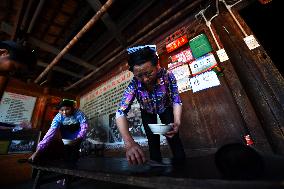
(230903) -- RONGSHUI, Sept. 3, 2023 (Xinhua) -- Pan Huami dyes the cloth in Wuying Village on the border between south China's Guangxi Zhuang Autonomous Region and southwest China's Guizhou Province, on Sept. 2, 2023. Wuying Village is a Miao ethnic group hamlet that nestles snugly in the towering mountains stretching across the border between Guangxi and Guizhou. "Liang Bu", named for its glistening appearance, is a kind of traditional hand-made cloth of Miao ethnic group. Women of Miao ethnic group in Wuying plant woad in spring and harvest it in fall. They soak woad in water for days before mixing it with materials such as lime, to make the dye for "Liang Bu". It usually takes months to make a piece of "Liang Bu" after repeated process of dip-dyeing, drying, pounding, applying egg white and steaming. The cloth gradually becomes glistening owing to tens of thousands of poundings by villagers with traditional wooden hammers. After cutting, sewing, embroidery and ironing, a set of glossy "Liang Bu" cl

  •  
(EnchantingGuangxi)CHINA-GUANGXI-MIAO ETHNIC GROUP-TRADITIONAL COSTUME (CN)

(EnchantingGuangxi)CHINA-GUANGXI-MIAO ETHNIC GROUP-TRADITIONAL COSTUME (CN)

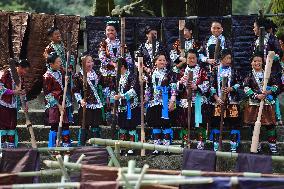
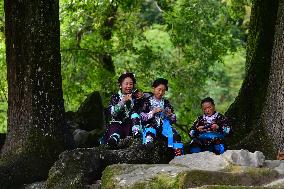
(230903) -- RONGSHUI, Sept. 3, 2023 (Xinhua) -- Liang Zuying (3rd L, front) displays "Liang Bu" and traditional costumes with other locals during a "Liang Bu" cultural festival in Wuying Village on the border between south China's Guangxi Zhuang Autonomous Region and southwest China's Guizhou Province, on Oct. 25, 2020. Wuying Village is a Miao ethnic group hamlet that nestles snugly in the towering mountains stretching across the border between Guangxi and Guizhou. "Liang Bu", named for its glistening appearance, is a kind of traditional hand-made cloth of Miao ethnic group. Women of Miao ethnic group in Wuying plant woad in spring and harvest it in fall. They soak woad in water for days before mixing it with materials such as lime, to make the dye for "Liang Bu". It usually takes months to make a piece of "Liang Bu" after repeated process of dip-dyeing, drying, pounding, applying egg white and steaming. The cloth gradually becomes glistening owing to tens of thousands of poundings by villagers with

  •  
(EnchantingGuangxi)CHINA-GUANGXI-MIAO ETHNIC GROUP-TRADITIONAL COSTUME (CN)

(EnchantingGuangxi)CHINA-GUANGXI-MIAO ETHNIC GROUP-TRADITIONAL COSTUME (CN)

(230903) -- RONGSHUI, Sept. 3, 2023 (Xinhua) -- Children watch the making of "Liang Bu" in Wuying Village on the border between south China's Guangxi Zhuang Autonomous Region and southwest China's Guizhou Province, on Sept. 7, 2022. Wuying Village is a Miao ethnic group hamlet that nestles snugly in the towering mountains stretching across the border between Guangxi and Guizhou. "Liang Bu", named for its glistening appearance, is a kind of traditional hand-made cloth of Miao ethnic group. Women of Miao ethnic group in Wuying plant woad in spring and harvest it in fall. They soak woad in water for days before mixing it with materials such as lime, to make the dye for "Liang Bu". It usually takes months to make a piece of "Liang Bu" after repeated process of dip-dyeing, drying, pounding, applying egg white and steaming. The cloth gradually becomes glistening owing to tens of thousands of poundings by villagers with traditional wooden hammers. After cutting, sewing, embroidery and ironing, a set of gloss

  •  
(EnchantingGuangxi)CHINA-GUANGXI-MIAO ETHNIC GROUP-TRADITIONAL COSTUME (CN)

(EnchantingGuangxi)CHINA-GUANGXI-MIAO ETHNIC GROUP-TRADITIONAL COSTUME (CN)

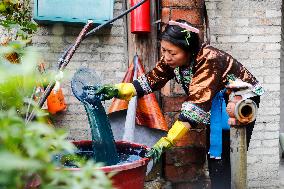
(230903) -- RONGSHUI, Sept. 3, 2023 (Xinhua) -- Liang Zuying adds lime into the water with woad soaked to make the dye in Wuying Village on the border between south China's Guangxi Zhuang Autonomous Region and southwest China's Guizhou Province, on Aug. 31, 2023. Wuying Village is a Miao ethnic group hamlet that nestles snugly in the towering mountains stretching across the border between Guangxi and Guizhou. "Liang Bu", named for its glistening appearance, is a kind of traditional hand-made cloth of Miao ethnic group. Women of Miao ethnic group in Wuying plant woad in spring and harvest it in fall. They soak woad in water for days before mixing it with materials such as lime, to make the dye for "Liang Bu". It usually takes months to make a piece of "Liang Bu" after repeated process of dip-dyeing, drying, pounding, applying egg white and steaming. The cloth gradually becomes glistening owing to tens of thousands of poundings by villagers with traditional wooden hammers. After cutting, sewing, embroid

  •  
(EnchantingGuangxi)CHINA-GUANGXI-MIAO ETHNIC GROUP-TRADITIONAL COSTUME (CN)

(EnchantingGuangxi)CHINA-GUANGXI-MIAO ETHNIC GROUP-TRADITIONAL COSTUME (CN)

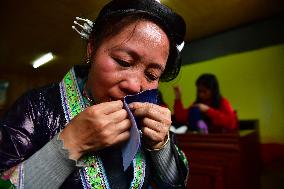
(230903) -- RONGSHUI, Sept. 3, 2023 (Xinhua) -- Liang Zuying makes embroidery in Wuying Village on the border between south China's Guangxi Zhuang Autonomous Region and southwest China's Guizhou Province, on Oct. 19, 2019. Wuying Village is a Miao ethnic group hamlet that nestles snugly in the towering mountains stretching across the border between Guangxi and Guizhou. "Liang Bu", named for its glistening appearance, is a kind of traditional hand-made cloth of Miao ethnic group. Women of Miao ethnic group in Wuying plant woad in spring and harvest it in fall. They soak woad in water for days before mixing it with materials such as lime, to make the dye for "Liang Bu". It usually takes months to make a piece of "Liang Bu" after repeated process of dip-dyeing, drying, pounding, applying egg white and steaming. The cloth gradually becomes glistening owing to tens of thousands of poundings by villagers with traditional wooden hammers. After cutting, sewing, embroidery and ironing, a set of glossy "Liang B

  •  
(EnchantingGuangxi)CHINA-GUANGXI-MIAO ETHNIC GROUP-TRADITIONAL COSTUME (CN)

(EnchantingGuangxi)CHINA-GUANGXI-MIAO ETHNIC GROUP-TRADITIONAL COSTUME (CN)

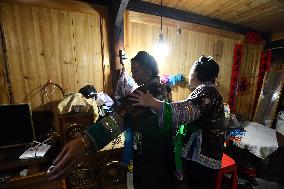
(230903) -- RONGSHUI, Sept. 3, 2023 (Xinhua) -- Wu Meiqiu (R) takes Liang Zuying's measurement for making "Liang Bu" costumes in Wuying Village on the border between south China's Guangxi Zhuang Autonomous Region and southwest China's Guizhou Province, on Aug. 31, 2023. Wuying Village is a Miao ethnic group hamlet that nestles snugly in the towering mountains stretching across the border between Guangxi and Guizhou. "Liang Bu", named for its glistening appearance, is a kind of traditional hand-made cloth of Miao ethnic group. Women of Miao ethnic group in Wuying plant woad in spring and harvest it in fall. They soak woad in water for days before mixing it with materials such as lime, to make the dye for "Liang Bu". It usually takes months to make a piece of "Liang Bu" after repeated process of dip-dyeing, drying, pounding, applying egg white and steaming. The cloth gradually becomes glistening owing to tens of thousands of poundings by villagers with traditional wooden hammers. After cutting, sewing,

  •  
(EnchantingGuangxi)CHINA-GUANGXI-MIAO ETHNIC GROUP-TRADITIONAL COSTUME (CN)

(EnchantingGuangxi)CHINA-GUANGXI-MIAO ETHNIC GROUP-TRADITIONAL COSTUME (CN)

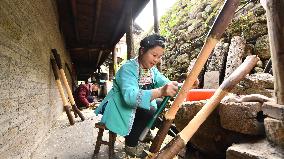
(230903) -- RONGSHUI, Sept. 3, 2023 (Xinhua) -- Liang Zuying (R) pounds the cloth with the traditional "Liang Bu" hammer in Wuying Village on the border between south China's Guangxi Zhuang Autonomous Region and southwest China's Guizhou Province, on Aug. 31, 2023. Wuying Village is a Miao ethnic group hamlet that nestles snugly in the towering mountains stretching across the border between Guangxi and Guizhou. "Liang Bu", named for its glistening appearance, is a kind of traditional hand-made cloth of Miao ethnic group. Women of Miao ethnic group in Wuying plant woad in spring and harvest it in fall. They soak woad in water for days before mixing it with materials such as lime, to make the dye for "Liang Bu". It usually takes months to make a piece of "Liang Bu" after repeated process of dip-dyeing, drying, pounding, applying egg white and steaming. The cloth gradually becomes glistening owing to tens of thousands of poundings by villagers with traditional wooden hammers. After cutting, sewing, embro

  •  
(EnchantingGuangxi)CHINA-GUANGXI-MIAO ETHNIC GROUP-TRADITIONAL COSTUME (CN)

(EnchantingGuangxi)CHINA-GUANGXI-MIAO ETHNIC GROUP-TRADITIONAL COSTUME (CN)

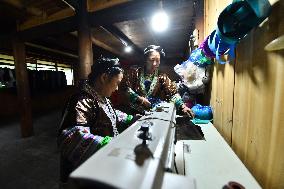
(230903) -- RONGSHUI, Sept. 3, 2023 (Xinhua) -- Liang Zuying (R) and Wu Meiqiu sew "Liang Bu" costumes in Wuying Village on the border between south China's Guangxi Zhuang Autonomous Region and southwest China's Guizhou Province, on Aug. 31, 2023. Wuying Village is a Miao ethnic group hamlet that nestles snugly in the towering mountains stretching across the border between Guangxi and Guizhou. "Liang Bu", named for its glistening appearance, is a kind of traditional hand-made cloth of Miao ethnic group. Women of Miao ethnic group in Wuying plant woad in spring and harvest it in fall. They soak woad in water for days before mixing it with materials such as lime, to make the dye for "Liang Bu". It usually takes months to make a piece of "Liang Bu" after repeated process of dip-dyeing, drying, pounding, applying egg white and steaming. The cloth gradually becomes glistening owing to tens of thousands of poundings by villagers with traditional wooden hammers. After cutting, sewing, embroidery and ironing,

  •  
(EnchantingGuangxi)CHINA-GUANGXI-MIAO ETHNIC GROUP-TRADITIONAL COSTUME (CN)

(EnchantingGuangxi)CHINA-GUANGXI-MIAO ETHNIC GROUP-TRADITIONAL COSTUME (CN)

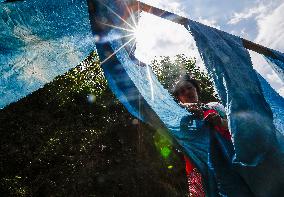
(230903) -- RONGSHUI, Sept. 3, 2023 (Xinhua) -- Liang Zuying dries the cloth after dip-dyeing in Wuying Village on the border between south China's Guangxi Zhuang Autonomous Region and southwest China's Guizhou Province, on Aug. 31, 2023. Wuying Village is a Miao ethnic group hamlet that nestles snugly in the towering mountains stretching across the border between Guangxi and Guizhou. "Liang Bu", named for its glistening appearance, is a kind of traditional hand-made cloth of Miao ethnic group. Women of Miao ethnic group in Wuying plant woad in spring and harvest it in fall. They soak woad in water for days before mixing it with materials such as lime, to make the dye for "Liang Bu". It usually takes months to make a piece of "Liang Bu" after repeated process of dip-dyeing, drying, pounding, applying egg white and steaming. The cloth gradually becomes glistening owing to tens of thousands of poundings by villagers with traditional wooden hammers. After cutting, sewing, embroidery and ironing, a set of

  •  
(EnchantingGuangxi)CHINA-GUANGXI-MIAO ETHNIC GROUP-TRADITIONAL COSTUME (CN)

(EnchantingGuangxi)CHINA-GUANGXI-MIAO ETHNIC GROUP-TRADITIONAL COSTUME (CN)

(230903) -- RONGSHUI, Sept. 3, 2023 (Xinhua) -- Pan Meimei and her husband make the traditional "Liang Bu" hammers in Wuying Village on the border between south China's Guangxi Zhuang Autonomous Region and southwest China's Guizhou Province, on Jan. 15, 2023. Wuying Village is a Miao ethnic group hamlet that nestles snugly in the towering mountains stretching across the border between Guangxi and Guizhou. "Liang Bu", named for its glistening appearance, is a kind of traditional hand-made cloth of Miao ethnic group. Women of Miao ethnic group in Wuying plant woad in spring and harvest it in fall. They soak woad in water for days before mixing it with materials such as lime, to make the dye for "Liang Bu". It usually takes months to make a piece of "Liang Bu" after repeated process of dip-dyeing, drying, pounding, applying egg white and steaming. The cloth gradually becomes glistening owing to tens of thousands of poundings by villagers with traditional wooden hammers. After cutting, sewing, embroidery

  •  
(EnchantingGuangxi)CHINA-GUANGXI-MIAO ETHNIC GROUP-TRADITIONAL COSTUME (CN)

(EnchantingGuangxi)CHINA-GUANGXI-MIAO ETHNIC GROUP-TRADITIONAL COSTUME (CN)

(230903) -- RONGSHUI, Sept. 3, 2023 (Xinhua) -- Liang Zuying dries the cloth after dip-dyeing in Wuying Village on the border between south China's Guangxi Zhuang Autonomous Region and southwest China's Guizhou Province, on Aug. 31, 2023. Wuying Village is a Miao ethnic group hamlet that nestles snugly in the towering mountains stretching across the border between Guangxi and Guizhou. "Liang Bu", named for its glistening appearance, is a kind of traditional hand-made cloth of Miao ethnic group. Women of Miao ethnic group in Wuying plant woad in spring and harvest it in fall. They soak woad in water for days before mixing it with materials such as lime, to make the dye for "Liang Bu". It usually takes months to make a piece of "Liang Bu" after repeated process of dip-dyeing, drying, pounding, applying egg white and steaming. The cloth gradually becomes glistening owing to tens of thousands of poundings by villagers with traditional wooden hammers. After cutting, sewing, embroidery and ironing, a set of

  •  
(EnchantingGuangxi)CHINA-GUANGXI-MIAO ETHNIC GROUP-TRADITIONAL COSTUME (CN)

(EnchantingGuangxi)CHINA-GUANGXI-MIAO ETHNIC GROUP-TRADITIONAL COSTUME (CN)

(230903) -- RONGSHUI, Sept. 3, 2023 (Xinhua) -- Liang Zuying takes egg white for applying on the cloth in Wuying Village on the border between south China's Guangxi Zhuang Autonomous Region and southwest China's Guizhou Province, on Aug. 30, 2023. Wuying Village is a Miao ethnic group hamlet that nestles snugly in the towering mountains stretching across the border between Guangxi and Guizhou. "Liang Bu", named for its glistening appearance, is a kind of traditional hand-made cloth of Miao ethnic group. Women of Miao ethnic group in Wuying plant woad in spring and harvest it in fall. They soak woad in water for days before mixing it with materials such as lime, to make the dye for "Liang Bu". It usually takes months to make a piece of "Liang Bu" after repeated process of dip-dyeing, drying, pounding, applying egg white and steaming. The cloth gradually becomes glistening owing to tens of thousands of poundings by villagers with traditional wooden hammers. After cutting, sewing, embroidery and ironing,

  •  
(EnchantingGuangxi)CHINA-GUANGXI-MIAO ETHNIC GROUP-TRADITIONAL COSTUME (CN)

(EnchantingGuangxi)CHINA-GUANGXI-MIAO ETHNIC GROUP-TRADITIONAL COSTUME (CN)

(230903) -- RONGSHUI, Sept. 3, 2023 (Xinhua) -- Liang Zuying (1st L) displays "Liang Bu" and traditional costumes with other locals during a "Liang Bu" cultural festival in Wuying Village on the border between south China's Guangxi Zhuang Autonomous Region and southwest China's Guizhou Province, on Oct. 25, 2020. Wuying Village is a Miao ethnic group hamlet that nestles snugly in the towering mountains stretching across the border between Guangxi and Guizhou. "Liang Bu", named for its glistening appearance, is a kind of traditional hand-made cloth of Miao ethnic group. Women of Miao ethnic group in Wuying plant woad in spring and harvest it in fall. They soak woad in water for days before mixing it with materials such as lime, to make the dye for "Liang Bu". It usually takes months to make a piece of "Liang Bu" after repeated process of dip-dyeing, drying, pounding, applying egg white and steaming. The cloth gradually becomes glistening owing to tens of thousands of poundings by villagers with traditi

  •  
(EnchantingGuangxi)CHINA-GUANGXI-MIAO ETHNIC GROUP-TRADITIONAL COSTUME (CN)

(EnchantingGuangxi)CHINA-GUANGXI-MIAO ETHNIC GROUP-TRADITIONAL COSTUME (CN)

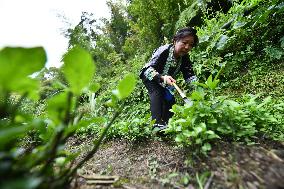
(230903) -- RONGSHUI, Sept. 3, 2023 (Xinhua) -- Liang Zuying harvests the woad on a mountain in Wuying Village on the border between south China's Guangxi Zhuang Autonomous Region and southwest China's Guizhou Province, on Aug. 29, 2023. Wuying Village is a Miao ethnic group hamlet that nestles snugly in the towering mountains stretching across the border between Guangxi and Guizhou. "Liang Bu", named for its glistening appearance, is a kind of traditional hand-made cloth of Miao ethnic group. Women of Miao ethnic group in Wuying plant woad in spring and harvest it in fall. They soak woad in water for days before mixing it with materials such as lime, to make the dye for "Liang Bu". It usually takes months to make a piece of "Liang Bu" after repeated process of dip-dyeing, drying, pounding, applying egg white and steaming. The cloth gradually becomes glistening owing to tens of thousands of poundings by villagers with traditional wooden hammers. After cutting, sewing, embroidery and ironing, a set of

  •  
(EnchantingGuangxi)CHINA-GUANGXI-MIAO ETHNIC GROUP-TRADITIONAL COSTUME (CN)

(EnchantingGuangxi)CHINA-GUANGXI-MIAO ETHNIC GROUP-TRADITIONAL COSTUME (CN)

(230903) -- RONGSHUI, Sept. 3, 2023 (Xinhua) -- Liang Zuying adds lime into the water with woad soaked to make the dye in Wuying Village on the border between south China's Guangxi Zhuang Autonomous Region and southwest China's Guizhou Province, on Aug. 31, 2023. Wuying Village is a Miao ethnic group hamlet that nestles snugly in the towering mountains stretching across the border between Guangxi and Guizhou. "Liang Bu", named for its glistening appearance, is a kind of traditional hand-made cloth of Miao ethnic group. Women of Miao ethnic group in Wuying plant woad in spring and harvest it in fall. They soak woad in water for days before mixing it with materials such as lime, to make the dye for "Liang Bu". It usually takes months to make a piece of "Liang Bu" after repeated process of dip-dyeing, drying, pounding, applying egg white and steaming. The cloth gradually becomes glistening owing to tens of thousands of poundings by villagers with traditional wooden hammers. After cutting, sewing, embroid

  •  
(EnchantingGuangxi)CHINA-GUANGXI-MIAO ETHNIC GROUP-TRADITIONAL COSTUME (CN)

(EnchantingGuangxi)CHINA-GUANGXI-MIAO ETHNIC GROUP-TRADITIONAL COSTUME (CN)

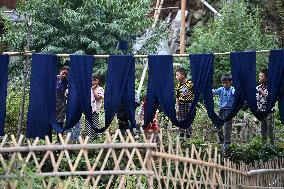
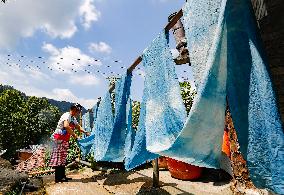
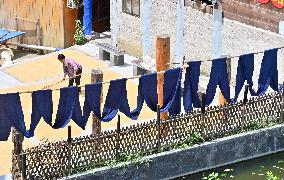
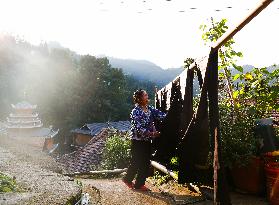
(230903) -- RONGSHUI, Sept. 3, 2023 (Xinhua) -- Pieces of "Liang Bu" are dried at a square in Wuying Village on the border between south China's Guangxi Zhuang Autonomous Region and southwest China's Guizhou Province, on Sept. 2, 2023. Wuying Village is a Miao ethnic group hamlet that nestles snugly in the towering mountains stretching across the border between Guangxi and Guizhou. "Liang Bu", named for its glistening appearance, is a kind of traditional hand-made cloth of Miao ethnic group. Women of Miao ethnic group in Wuying plant woad in spring and harvest it in fall. They soak woad in water for days before mixing it with materials such as lime, to make the dye for "Liang Bu". It usually takes months to make a piece of "Liang Bu" after repeated process of dip-dyeing, drying, pounding, applying egg white and steaming. The cloth gradually becomes glistening owing to tens of thousands of poundings by villagers with traditional wooden hammers. After cutting, sewing, embroidery and ironing, a set of gl

  •  
(EnchantingGuangxi)CHINA-GUANGXI-MIAO ETHNIC GROUP-TRADITIONAL COSTUME (CN)

(EnchantingGuangxi)CHINA-GUANGXI-MIAO ETHNIC GROUP-TRADITIONAL COSTUME (CN)

(230903) -- RONGSHUI, Sept. 3, 2023 (Xinhua) -- Liang Zuying dries the unfinished "Liang Bu" in Wuying Village on the border between south China's Guangxi Zhuang Autonomous Region and southwest China's Guizhou Province, on Aug. 30, 2023. Wuying Village is a Miao ethnic group hamlet that nestles snugly in the towering mountains stretching across the border between Guangxi and Guizhou. "Liang Bu", named for its glistening appearance, is a kind of traditional hand-made cloth of Miao ethnic group. Women of Miao ethnic group in Wuying plant woad in spring and harvest it in fall. They soak woad in water for days before mixing it with materials such as lime, to make the dye for "Liang Bu". It usually takes months to make a piece of "Liang Bu" after repeated process of dip-dyeing, drying, pounding, applying egg white and steaming. The cloth gradually becomes glistening owing to tens of thousands of poundings by villagers with traditional wooden hammers. After cutting, sewing, embroidery and ironing, a set of

  •  
(EnchantingGuangxi)CHINA-GUANGXI-MIAO ETHNIC GROUP-TRADITIONAL COSTUME (CN)

(EnchantingGuangxi)CHINA-GUANGXI-MIAO ETHNIC GROUP-TRADITIONAL COSTUME (CN)

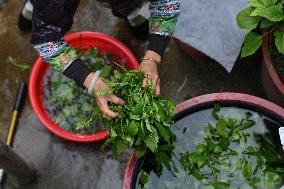
(230903) -- RONGSHUI, Sept. 3, 2023 (Xinhua) -- Liang Zuying soaks the newly harvested woad in water in Wuying Village on the border between south China's Guangxi Zhuang Autonomous Region and southwest China's Guizhou Province, on Aug. 29, 2023. Wuying Village is a Miao ethnic group hamlet that nestles snugly in the towering mountains stretching across the border between Guangxi and Guizhou. "Liang Bu", named for its glistening appearance, is a kind of traditional hand-made cloth of Miao ethnic group. Women of Miao ethnic group in Wuying plant woad in spring and harvest it in fall. They soak woad in water for days before mixing it with materials such as lime, to make the dye for "Liang Bu". It usually takes months to make a piece of "Liang Bu" after repeated process of dip-dyeing, drying, pounding, applying egg white and steaming. The cloth gradually becomes glistening owing to tens of thousands of poundings by villagers with traditional wooden hammers. After cutting, sewing, embroidery and ironing, a

  •  
(EnchantingGuangxi)CHINA-GUANGXI-MIAO ETHNIC GROUP-TRADITIONAL COSTUME (CN)

(EnchantingGuangxi)CHINA-GUANGXI-MIAO ETHNIC GROUP-TRADITIONAL COSTUME (CN)

(230903) -- RONGSHUI, Sept. 3, 2023 (Xinhua) -- Liang Zuying (1st L) makes embroidery in Wuying Village on the border between south China's Guangxi Zhuang Autonomous Region and southwest China's Guizhou Province, on Oct. 18, 2019. Wuying Village is a Miao ethnic group hamlet that nestles snugly in the towering mountains stretching across the border between Guangxi and Guizhou. "Liang Bu", named for its glistening appearance, is a kind of traditional hand-made cloth of Miao ethnic group. Women of Miao ethnic group in Wuying plant woad in spring and harvest it in fall. They soak woad in water for days before mixing it with materials such as lime, to make the dye for "Liang Bu". It usually takes months to make a piece of "Liang Bu" after repeated process of dip-dyeing, drying, pounding, applying egg white and steaming. The cloth gradually becomes glistening owing to tens of thousands of poundings by villagers with traditional wooden hammers. After cutting, sewing, embroidery and ironing, a set of glossy

  •  

Naked carp migrating upstream to spawn in NW China

STORY: Naked carp migrating upstream to spawn in NW China DATELINE: July 18, 2023 LENGTH: 00:00:31 LOCATION: XINING, China CATEGORY: ENVIRONMENT SHOTLIST: 1. various of naked carp STORYLINE: Naked carp are migrating upstream in an inflowing river of Qinghai Lake in northwest China's Qinghai Province. The naked carp, known as "Huangyu" in China, is endemic to Qinghai Lake, the largest saline lake and inland lake in China. The fish is not only critical to the existence of local bird species, but also to the ecological balance of the highland lake. The population of the species once declined sharply owing to overfishing. In order to protect the species and restore the environment, the province banned naked carp fishing in Qinghai Lake and in nearby rivers in 2003. Xinhua News Agency correspondents reporting from Xining, China. (XHTV)

  •  

Tomato prices skyrocket in India due to incessant rains

STORY: Tomato prices skyrocket in India due to incessant rains DATELINE: June 29, 2023 LENGTH: 00:01:37 LOCATION: New Delhi CATEGORY: SOCIETY SHOTLIST: 1. various of the India gate 2. various of rainfall 3. various of agricultural land 4. various of the vegetable market 5. various of tomatoes 6. various of people buying tomatoes STORYLINE: Tomato prices have shot up at least three to four times in India over the past one week, from 30 Indian Rupees (36 U.S. cents) to around 120 Indian Rupees (1.46 U.S. dollars) per kilogram, owing to loss of crops caused by heavy rains in several parts of the country. In Delhi and surrounding areas, tomatoes were available at 100-120 Indian Rupees (1.22-1.46 dollars) per kilogram, while in the financial capital Mumbai they were sold for around 80 Indian Rupees (97 cents) per kilogram, in western city of Kolkata for 75 Indian Rupees (91 cents) per kilogram, and in southern city of Chennai for around 70 Indian Rupees (85 cents) per kilogram. A top government official has r

  •  
Soulages Museum - Rodez

Soulages Museum - Rodez

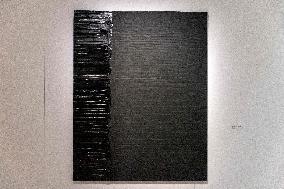
A view of the Soulages museum on June 25, 2023 in Rodez, France. Pierre Soulages (December 24,1919 – October 25, 2022) was a French painter, printmaker, and sculptor. His works are held by leading museums of the world, and there is a museum dedicated to his art in his hometown of Rodez. Soulages is known as "the painter of black", owing to his interest in the colour "both as a colour and a non-colour. When light is reflected on black, it transforms and transmutes it. It opens a mental field all its own." He saw light as a work material; striations of the black surface of his paintings enable him to reflect light, allowing the black to come out of darkness and into brightness, thus becoming a luminous colour.Soulages produced 104 stained-glass windows for the Romanesque architecture of the Abbey Church of Sainte-Foy in Conques from 1987 to 1994. He received international awards, and the Louvre in Paris held a retrospective of his works on the occasion of his centenary Photo by Denis Prezat/ABACAPRESS.COM

  • Main
  • Top
  • Editorial
  • Creative
  • About Us
  • About ILG
  • Terms of use
  • Company
  • BEHIND
  • Price List
  • Single Plan
  • Monthly Plan
  • Services
  • Shooting
  • Rights Clearance
  • Support
  • FAQ
  • How To Buy
  • Contact Us
  • Become a Partner

© KYODO NEWS IMAGES INC

All Rights Reserved.

  • Editorial
  • Olympics
  • News
  • Sports
  • Japan
  • Tech
  • Royal
  • Disaster
  • NorthKorea
  • Old Japan
  • SNS
  • Creative
  • Food
  • Japan
  • Landscape
  • Animal
  • Popular
  • #Ukraine
  • #Russia
  • #coronavirus
  • #N. Korea
  • #Thailand
  • #China
  • #Ukraine
  • #Russia
  • #coronavirus
  • #N. Korea
  • #Thailand
  • #China
  • Food
  • Japan
  • Landscape
  • Animal
  • Olympics
  • News
  • Sports
  • Japan
  • Tech
  • Royal
  • Disaster
  • NorthKorea
  • Old Japan
  • SNS