•  
Illustration - Brittany

Illustration - Brittany

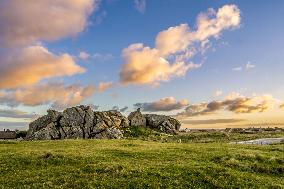
FRANCE BRITTANY. FINISTERE (29). KERLOUAN. MENEHAM. THIS ?STONE-ROOFED HOUSE? WAS PART OF A COASTAL DEFENCE SYSTEM SET UP IN THE 17TH CENTURY BY VAUBAN. THIS SYSTEM COMPRISED AN UNBROKEN CHAIN OF LOOKOUT POSTS (NOW KNOWN AS ?MAISONS DES DOUANIERS?) LINKED TOGETHER TO PROTECT THE COASTLINE FROM ENEMY ATTACKS, PARTICULARLY ENGLISH RAIDS. Photo by Vincent Schneider/Only France/ABACAPRESS.COM

  •  
CHINA-BEIJING-HONG KONG-TOUR GROUP (CN)

CHINA-BEIJING-HONG KONG-TOUR GROUP (CN)

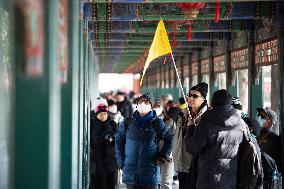
(230207) -- BEIJING, Feb. 7, 2023 (Xinhua) -- Elderly tourists from Hong Kong visit the Long Corridor, a roofed walkway, in the Summer Palace in Beijing, capital of China, Feb. 7, 2023. With an average age of over 65, a group of elderly tourists from Hong Kong arrived in Beijing on Monday, becoming the first Hong Kong tour group to Beijing after lifting of restrictions on travel between the Chinese mainland and Hong Kong and Macao special administrative regions (SARs). (Xinhua/Chen Zhonghao)

  •  
Site of G-8 summit

Site of G-8 summit

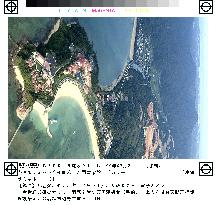
NAHA, Japan - Photo taken from a Kyodo News helicopter shows the site of the three-day Group of Eight (G-8) summit beginning July 21. Summit leaders will meet in one of the red-roofed buildings located on the tip of the peninsula.

  •  
Lucky Me film (1954)

Lucky Me film (1954)

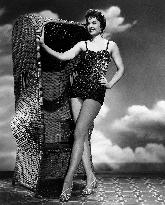
Martha Hyer Characters: Lorraine Thayer Film: Lucky Me (USA 1954) Director: Jack Donohue 09 April 1954 Date: 09-Apr-54

  •  
Nepal quake survivor gets tin-roofed shelter

Nepal quake survivor gets tin-roofed shelter

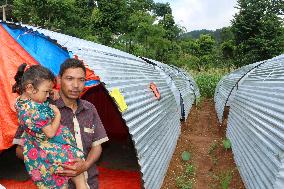
A Nepalese man and his daughter stand in front of a tin-roofed shelter in Chautara, northeastern Nepal, on June 24, 2015, which they received from a nongovernmental organization after the devastating earthquake in April. (Kyodo) ==Kyodo

  •  
Prequake Tomioka townscape recreated in model

Prequake Tomioka townscape recreated in model

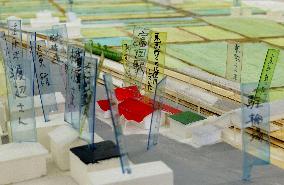
The miniature model of Tomioka Town in Fukushima Prefecture, an image before the 2011 quake recreated based on memories of evacuating residents, is shown in Iwaki in the prefecture on June 4, 2015. The red-roofed East Japan Railway Co.'s Tomioka Station is seen in the middle. All residents of the northeastern Japanese town continue their evacuation after the nuclear disaster at the Fukushima Daiichi nuclear plant. (Kyodo) ==Kyodo

  •  
Japanese cypress bark-roofed Ukigumo shrine

Japanese cypress bark-roofed Ukigumo shrine

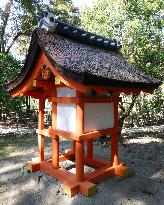
Photo taken on Feb. 16, 2015, shows the new roof covered with Japanese cypress bark collected in a planted forest adjacent to the Kasugayama Primeval Forest, a World Heritage Site, at Kasugataisha's Ukigumo shrine in Nara, western Japan. (Kyodo) ==Kyodo

  •  
FEATURE: Removal of pro-nuclear signs in Fukushima town irks slogan maker

FEATURE: Removal of pro-nuclear signs in Fukushima town irks slogan maker

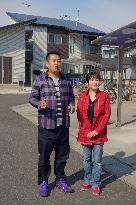
Yuji Onuma (L), 39, and his wife Serina, 40, nuclear accident evacuees from the town of Futaba in Fukushima Prefecture, stand in front of their new home, roofed with solar panels, in Koga, Ibaraki Prefecture, on Feb. 9, 2016. (Kyodo) ==Kyodo

  •  
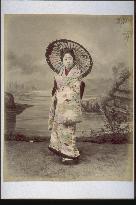
Geisha holding an umbrella

Geisha holding an umbrella

A girl in a kimono and hair done in Japanese style takes a walk in the suburbs holding a parasol. The background is a curtain with a lake and thatch-roofed houses in the distance. (dramatized photograph)==Date:unknown, Place:unknown, Photo:Ogawa Kazumasa, (Credit:Nagasaki University Library/Kyodo News Images) [Cabinet Number6‐33‐0]

  •  
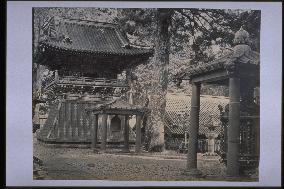
The bell tower,Toshogu Shrine,Nikko

The bell tower,Toshogu Shrine,Nikko

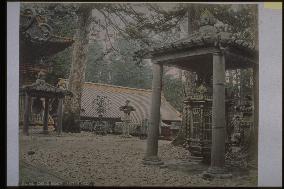
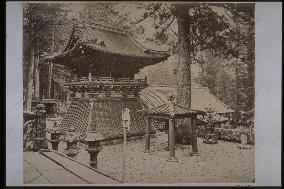
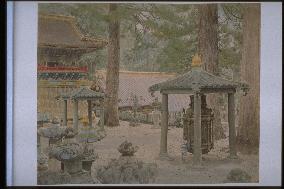
The building on the left is the Bell Tower located in front of Yomei Gate at Nikko Toshogu Shrine. The roofed structure with four pillars houses the Korean Bell. There is a stand-type lotus lantern to the right of the bell. At the far right is the octagonal revolving lantern presented to Japan by the Netherlands in the Edo Period. The roof of Kamijinko is also visible.==Date:unknown, Place:Nikko, Photo:unknown, (Credit:Nagasaki University Library/Kyodo News Images) [Cabinet Number96‐95‐0]

  •  
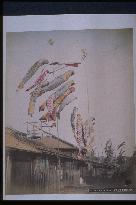
Carp streamers

Carp streamers

The original title of the photograph is Boys Festival at Yokohama . Small one-story houses line the street. Houses with hiwadabuki roofs (roofs covered with layers of cypress shingles) are visible along with tile-roofed houses. This is thought to be a location close to the city centre, but the exact details are not known.==Date:unknown, Place:Yokohama, Photo:unknown, (Credit:Nagasaki University Library/Kyodo News Images) [Cabinet Number96‐82‐0]

  •  
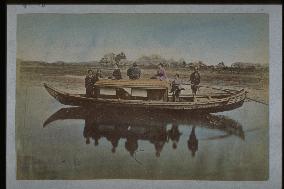
A leisure boat on the Sumida River

A leisure boat on the Sumida River

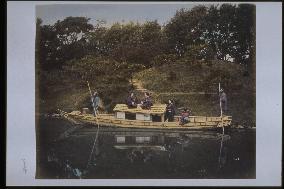
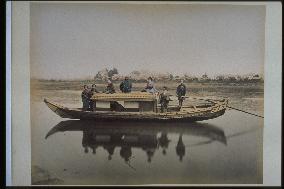
Roofed boat taken at the bank of Imado River in front of Yumei-ro where Sanya-bori (moat) merges with Sumida River. The water is too shallow to allow the boat to float, which explains why the photograph is so sharp. In the rear is Mukojima, site of Ushijima Shinto Shrine and Chomeiji Temple. Found in the collection of Uchida Kuichi preserved at Nagasaki Municipal Museum, this photograph was verified to have been taken by Uchida in 1872. This is one of the copies later made and sold.==Date:unknown, Place:Tokyo, Photo:Uchida Kuichi, (Credit:Nagasaki University Library/Kyodo News Images) [Cabinet Number90‐25‐0]

  •  
The stage of Kiyomizudera Temple,Kyoto

The stage of Kiyomizudera Temple,Kyoto

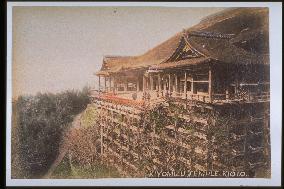
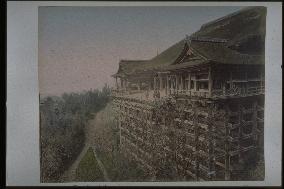
The balcony off the main hall of Kiyomizu Temple seen from Okuno-in, facing west-northwest. There are four people on the balcony. The fallen leaves in the South Garden suggest winter. The balcony was renovated in 1633. The yosemune style building is roofed entirely with hinoki tree bark. Wings flank the west side and the east and west of the south side. The wooden fencing inside the railing is to prevent people from falling. The approach stretches westward to the left through the South Garden.==Date:unknown, Place:Kyoto, Photo:unknown, (Credit:Nagasaki University Library/Kyodo News Images) [Cabinet Number89‐5‐0]

  •  
The three teahouses at Arashiyama

The three teahouses at Arashiyama

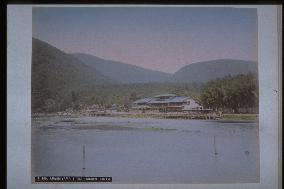
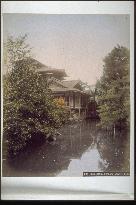
The building in the centre is the Sangenjaya Hata-tei teahouse located at the north end of Togetsu Bridge in Arashiyama. The building consisted of a three-story central portion and two-story wings to the east and west. Roofed terraces were built on both sides to provide scenic views of Arashiyama from the bank of Hozu River.==Date:unknown, Place:Kyoto, Photo:unknown, (Credit:Nagasaki University Library/Kyodo News Images) [Cabinet Number88‐9‐0]

  •  
The stage of Kiyomizudera Temple,Kyoto

The stage of Kiyomizudera Temple,Kyoto

The balcony off the main hall of Kiyomizu Temple seen from Okuno-in, facing west-northwest. There are four people on the balcony. The fallen leaves in the South Garden suggest winter. The balcony was renovated in 1633. The yosemune style building is roofed entirely with hinoki tree bark. Wings flank the west side and the east and west of the south side. The wooden fencing inside the railing is to prevent people from falling. The approach stretches westward to the left through the South Garden.==Date:unknown, Place:Kyoto, Photo:unknown, (Credit:Nagasaki University Library/Kyodo News Images) [Cabinet Number87‐40‐0]

  •  
Mt. Fuji seen from a tea field

Mt. Fuji seen from a tea field

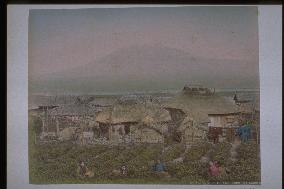
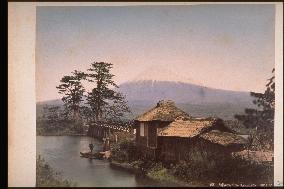
Northern view of Mt. Fuji from the tea field on the sand hill of Suzukawa, Fuji City. The hill ends at the houses with thatched roofs, and the tile-roofed houses of Suzukawa (Motoyoshiwara post town) on the Tokaido Highway are visible in the distance. Ukishimagahara field stretches into the background. The four women in the foreground are picking tea leaves.==Date:unknown, Place:Shizuoka, Photo:A. Farsari, (Credit:Nagasaki University Library/Kyodo News Images) [Cabinet Number81‐24‐0]

  •  
The Dutch Lantern,Toshogu Shrine,Nikko

The Dutch Lantern,Toshogu Shrine,Nikko

This photograph contains the octagonal revolving lantern given to Japan by the Dutch Republic. It is visible on the right, in front of the Yomeimon Gate of the Nikko Toshogu Shinto Shrine. A lotus lantern is standing in the centre back. The building on the left is the Bell Tower. The Korean Bell, which should be hanging in the roofed structure supported by the four pillars, is not visible here. The roof of Kamijinko is visible behind.==Date:unknown, Place:Nikko, Photo:Tamamura Kozaburo, (Credit:Nagasaki University Library/Kyodo News Images) [Cabinet Number80‐41‐0]

  •  
Women on a leisure boat

Women on a leisure boat

The kawabune (river boat) was a means of river transportation. The roofed boats were used as pleasure boats providing entertainment. A person is playing a shamisen lute on the roof, advertising the fact that this kind of entertainment was offered inside the boat.==Date:unknown, Place:unknown, Photo:R. Stillfried, (Credit:Nagasaki University Library/Kyodo News Images) [Cabinet Number78‐85‐0]

  •  
Lake Ashi

Lake Ashi

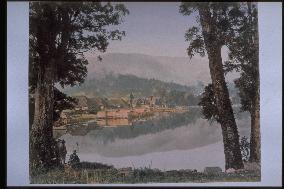
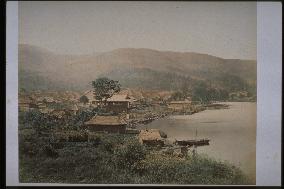
This is the post town of Hakone as seen from what was once the Hakone barrier station. The buildings on the banks of Lake Ashinoko are part of the thatched roofed building complex, the honjin. The large structures with thatched roofs to the right are officially appointed inns (Honjin). Feudal lords stayed or rested here during the Sankinkoutai (A bi-annual period of madatory alternate residence in Edo for feudal lords, known as Daimyo). The mountain in the background is Mt. Kurakake. There appear to be craftsmen looking at the lake in the foreground.==Date:unknown, Place:Hakone, Photo:R. Stillfried, (Credit:Nagasaki University Library/Kyodo News Images) [Cabinet Number77‐17‐0]

  •  
The Sanjinko (three sacred stonehouses) and Nino-torii Gate,Toshogu Shrine,Nikko

The Sanjinko (three sacred stonehouses) and Nino-torii Gate,Toshogu Shrine,Nikko

Kamijinko, built in azekurazukuri (wedge-log) style and visible on the right, stores the costumes and other accessories used in the 1,000 Samurai Procession Festival. The building on the left is the Omizuya (washing place) donated by the Nabeshima Clan. To the right of it stands the Karagane Torii, the first bronze gate in Japan built by the third shogun Tokugawa Iemitsu. The double-roofed building behind it is the Rinzo used to store sutras.==Date:unknown, Place:Nikko, Photo:R. Stillfried, (Credit:Nagasaki University Library/Kyodo News Images) [Cabinet Number77‐10‐0]

  •  
Ishiyamadera Temple

Ishiyamadera Temple

The precincts of Ishiyamadera Temple seen from the front of the Main Hall . During the Heian Period, aristocratic women worshipped at the temple, and in later years it attracted many commoners as the 13th temple in the circuit of the 33 Holy Kannon temple of Western Japan. The Main Hall, just behind the tile-roofed Rennyodo, burned to the ground in 1096 and was later rebuilt.==Date:unknown, Place:Shiga, Photo:unknown, (Credit:Nagasaki University Library/Kyodo News Images) [Cabinet Number71‐42‐0]

  •  
The Dutch Lantern,Toshogu Shrine,Nikko

The Dutch Lantern,Toshogu Shrine,Nikko

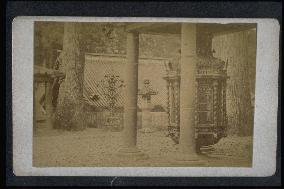
The octagonal revolving lantern was presented to Japan by the Netherlands in the Edo Period. It is visible to the right of Yomei Gate. A lotus lantern is standing in the centre back. The building on the left is the Bell Tower. The Korean Bell, which should be hanging in the roofed structure supported by four pillars, is not visible here.==Date:unknown, Place:Nikko, Photo:unknown, (Credit:Nagasaki University Library/Kyodo News Images) [Cabinet Number71‐33‐0]

  •  
The Dutch Lantern,Toshogu Shrine,Nikko

The Dutch Lantern,Toshogu Shrine,Nikko

The octagonal revolving lantern presented to Japan by the Netherlands is visible on the right in front of Yomei Gate at Nikko Toshogu. The building on the left is the Bell Tower. The Korean Bell is hanging in the roofed structure supported by four pillars. There are stone stairs to the left outside the photograph. Yomei Gate is at the end of the stairs.==Date:unknown, Place:Nikko, Photo:unknown, (Credit:Nagasaki University Library/Kyodo News Images) [Cabinet Number71‐11‐0]

  •  
The bell tower,Toshogu Shrine,Nikko

The bell tower,Toshogu Shrine,Nikko

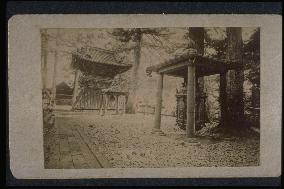
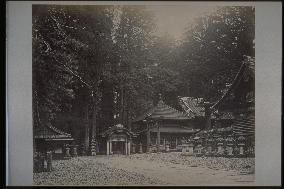
This photograph was taken from directly below Yomei Gate at Nikko Toshogu Shrine. The building on the left is the Bell Tower. The roofed structure with four pillars next to it houses the Korean Bell. There is a stand-type lotus lantern behind it. The roof of Kamijinko is visible behind.==Date:unknown, Place:Nikko, Photo:Ogawa Kazumasa, (Credit:Nagasaki University Library/Kyodo News Images) [Cabinet Number67‐37‐0]

  •  
The Dutch Lantern,Toshogu Shrine,Nikko

The Dutch Lantern,Toshogu Shrine,Nikko

To the right, in front of Yomei Gate of Nikko Toshogu, is the octagonal revolving lantern presented to Japan by the Netherlands in the Edo Period. A lotus lantern is standing in the centre back. The building on the left is the Bell Tower. The Korean Bell, which should be hanging in the roofed structure supported by the four pillars, is not visible here.==Date:unknown, Place:Nikko, Photo:Usui Shuzaburo?, (Credit:Nagasaki University Library/Kyodo News Images) [Cabinet Number65‐26‐0]

  •  
The Hakone post town

The Hakone post town

This photo depicts the post town of Hakone viewed from around the old Hakone check point site. The two-storied house behind the tree in the centre is Hatago Hafuya (present-day Hokone Hotel), an inn for commoners. The huge thatched roofed houses behind are, Kawada Honjin, an officially appointed inn for feudal lords, Koma Honjin, Ishiuchi Honjin, and Amano Heizaemon Honjin. Compared to catalogue # 2945, the backyards of honjins appear to be sticking out to Lake Ashinoko. The mountain behind on the left is Mt. Kurakake and the one in the centre is Hakone Pass.==Date:unknown, Place:Hakone, Photo:unknown, (Credit:Nagasaki University Library/Kyodo News Images) [Cabinet Number64‐46‐0]

  •  
The Sanjinko (three sacred stonehouses) and Nino-torii Gate,Toshogu Shrine,Nikko

The Sanjinko (three sacred stonehouses) and Nino-torii Gate,Toshogu Shrine,Nikko

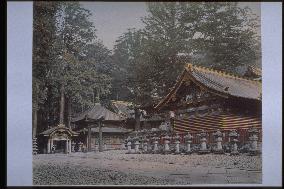
Kamijinko, built in azekurazukuri (wedge-log) style and visible on the right, stores the costumes and other accessories used in the 1,000 Samurai Procession Festival. The building on the left is the Omizuya (washing place) donated by the Nabeshima Clan. To the right of it stands the Karagane Torii, the first bronze gate in Japan built by the third shogun Tokugawa Iemitsu. The double-roofed building behind it is the Rinzo used to store sutras.==Date:unknown, Place:Nikko, Photo:F. Beato, (Credit:Nagasaki University Library/Kyodo News Images) [Cabinet Number62‐6‐0]

  •  
A leisure boat on the Sumida River

A leisure boat on the Sumida River

This same photograph can be found in the memorial photograph album of Charles Appleton Longfellow, first son of the famous American poet Henry Wadsworth Longfellow who lived in Japan from 1871 to 1873. Charles may have asked Uchida Kuichi to take this shot, and it could be Charles wearing a kimono and looking out from between the shoji screens. The woman second from the left is Okiku, owner of the restaurant Yumei-ro at Sanyabori, and the other women are Charles' favourite geisha. The roofed boat probably belongs to Yumei-ro.==Date:about 1872, Place:Tokyo, Photo:Uchida Kuichi, (Credit:Nagasaki University Library/Kyodo News Images) [Cabinet Number53‐50‐0]

  •  
Ferries,the Sumida River

Ferries,the Sumida River

Probably the ferry dock called Takeya-no-Watashi at Mukojima. Another photograph taken downstream shows these people at the same time. Stone steps descend to the river from where the man is standing in the centre, and the ferry dock called Terashima-no-Watashi is visible upstream. However, the boat depicted here is not a ferry but a yanebune (roofed boat) used for entertainment. This is one of the photographs in the album sold at Kinpei Photograph Studio, indicating that it was taken by Kusakabe Kinbei in the early Meiji Period.==Date:unknown, Place:Tokyo, Photo:unknown, (Credit:Nagasaki University Library/Kyodo News Images) [Cabinet Number53‐31‐0]

  •  
Nagoya Castle

Nagoya Castle

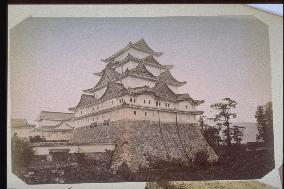
The northern part of the dungeon of Nagoya Castle seen from Ofukemaru. In the centre is the castle tower. The gate on the left is Fumyo-mon. A small tower is visible in the rear of the castle tower. The partially-visible roof could be the tamon-bei (a long, roofed, timber-frame structure built on a stone faced embankment, running between the corners and turrets of a castle). This photograph was probably taken after 1878, when the golden shachi (mythical carp) were returned to the tower top, but before the Nobi Earthquake of 1891.==Date:unknown, Place:Nagoya, Photo:unknown, (Credit:Nagasaki University Library/Kyodo News Images) [Cabinet Number51‐46‐0]

  •  
Oura waterfront street

Oura waterfront street

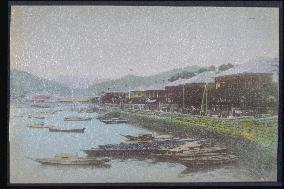
This hand-tinted picture postcard was published between 1890 and 1920. Oura Bund is visible with Dejima in the background. Many rickshaws are parked here. Boats loaded with coal and roofed barges are anchored by the shore. #2275, 5198 and 5199 are made from the same photograph.==Date:unknown, Place:Nagasaki, Photo:Tamamura Kozaburo, (Credit:Nagasaki University Library/Kyodo News Images) [Cabinet Number48‐128‐0]

  •  
The stage of Kiyomizudera Temple,Kyoto

The stage of Kiyomizudera Temple,Kyoto

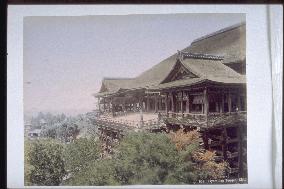
The balcony off the main hall of Kiyomizu Temple seen from Okuno-in, facing west-northwest. There are two people on the balcony. The fallen leaves in the South Garden suggest winter. The balcony was renovated in 1633. The yosemune style building is roofed entirely with hinoki tree bark. Wings flank the west side and the east and west of the south side. The wooden fencing inside the railing is to prevent people from falling. The approach stretches westward to the left through the South Garden.==Date:unknown, Place:Kyoto, Photo:unknown, (Credit:Nagasaki University Library/Kyodo News Images) [Cabinet Number42‐20‐0]

  •  
Hiunkaku at Nishi-Honganji Temple

Hiunkaku at Nishi-Honganji Temple

The northwestern part of Hiunkaku at Nishihonganji Temple is viewed from the north side of the pond in Tekisui Garden. Hiunkaku is said to be a part of a mansion built in the Momoyama Period. It is a three-story, cypress-shingle roofed, palace-style building. The north and south sides are about 25.8m long, the east side about 11.8m and the west side about 12.5m. The first story is built in undulating bargeboard style on the left side, and irimoya style on the right.==Date:unknown, Place:Kyoto, Photo:unknown, (Credit:Nagasaki University Library/Kyodo News Images) [Cabinet Number42‐16‐0]

  •  
Inns at Nakasendo Nagakubo

Inns at Nakasendo Nagakubo

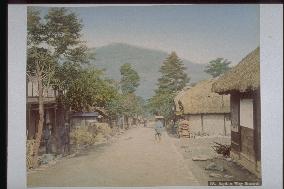
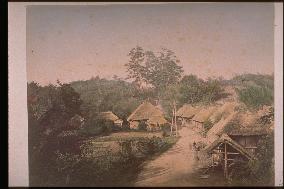
A view of Nagakubo village where Nagakubo juku, one of the jukus on the Nakasendo, was located. Thatched roofed houses line up, and a villager is seen to the left, and a traveler wearing a hat can be seen in the center. Nagakubo village was divided into the old and new town after the flooding in 1631.==Date:unknown, Place:Nagano, Photo:Kusakabe Kinbei, (Credit:Nagasaki University Library/Kyodo News Images) [Cabinet Number38‐46‐0]

  •  
Bridge at iiyama

Bridge at iiyama

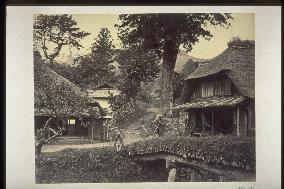
A photo by F. Beato. The bridge in Iiyama over the road from Atsugi to Miyanose. Thatch-roofed houses and wooden bridges are in the picture.==Date:unknown, Place:Kanagawa, Photo:F. Beato, (Credit:Nagasaki University Library/Kyodo News Images) [Cabinet Number36‐12‐0]

  •  
Farm house

Farm house

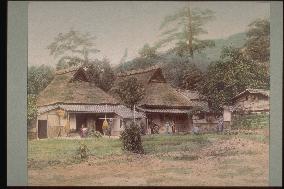
Two thatched-roof farmhouses. Each family is shown in the picture. Laundry is hung to dry in the farmhouse to the left, and the farmhouse to the right has a big cart. To the right rear are two tile-roofed farmhouses.==Date:unknown, Place:unknown, Photo:Ogawa Kazumasa, (Credit:Nagasaki University Library/Kyodo News Images) [Cabinet Number25‐16‐0]

  •  
Arashiyama at hozugawa river

Arashiyama at hozugawa river

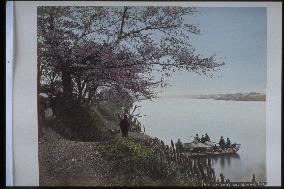
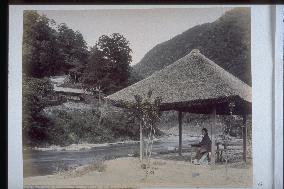
A view of Kunugiya Sozo Shrine from Nakanoshima on the other side of the river. The bargeboard of the shrine can be seen clearly. To the fore of the river, a small thatch-roofed hut is set, with a woman dressed in a kimono sitting on a stand.==Date:unknown, Place:Kyoto, Photo:Ogawa Kazumasa, (Credit:Nagasaki University Library/Kyodo News Images) [Cabinet Number9‐32‐0]

  •  
Honmoku Point seen from the Fudozaka slope

Honmoku Point seen from the Fudozaka slope

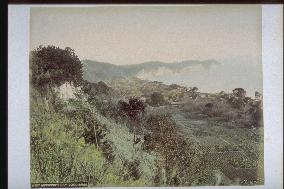
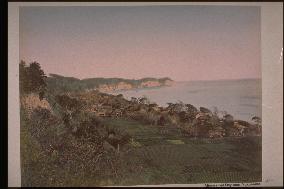
The caption reads Mississippi Bay near Yokohama in English. It is the same as No. 4-22. It is a view of Negishi village from Fudo saka. To the right is Mississippi (Negishi) Bay, and to the distance is Honmoku Cape. In the village are seen thatch-roofed houses and cultivated fields.==Date:unknown, Place:Yokohama, Photo:Ogawa Kazumasa, (Credit:Nagasaki University Library/Kyodo News Images) [Cabinet Number6‐13‐0]

  •  
TOTSUKA

TOTSUKA

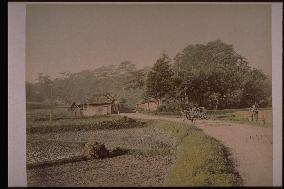
The caption reads Totsuka Tokaido in English. It is a view of Totsuka on the Tokaido Highway. A man holding a container with fertilizer and a rickshaw man are shown in the photo. The background may be a shrine, and thatch-roofed houses are seen in the centre.==Date:unknown, Place:Yokohama, Photo:Kusakabe Kinbei, (Credit:Nagasaki University Library/Kyodo News Images) [Cabinet Number4‐24‐0]

  •  
Honmoku Point seen from the Fudozaka slope

Honmoku Point seen from the Fudozaka slope

The caption reads Mississippi Bay near Yokohama in English. It is a view of Negishi village from Fudosaka. To the right is Mississippi Bay (presently Negishi Bay) with Honmoku Cape in the distance. Thatch-roofed houses and a well-cultivated field can be seen in the village.==Date:unknown, Place:Yokohama, Photo:Kusakabe Kinbei, (Credit:Nagasaki University Library/Kyodo News Images) [Cabinet Number4‐22‐0]

  •  
SAKAIGI

SAKAIGI

The caption reads Sakaigi, Tokaido in English. It is a view of the village in Sakaigi and road along the Tokaido. To the right front is a watering place, and a man is photographed on the road. The houses in the vicinity are all thatch-roofed.==Date:unknown, Place:Yokohama, Photo:Kusakabe Kinbei, (Credit:Nagasaki University Library/Kyodo News Images) [Cabinet Number4‐25‐0]

  •  
Mt. Fuji seen from Kawai-bashi Bridge,Suzukawa

Mt. Fuji seen from Kawai-bashi Bridge,Suzukawa

The former shogunate territory located on the left bank of the River Usui, with the Suzu River facing Suruga Bay. The photo is beautifully structured with Mt.Fuji and a pine boulevard, wooden bridge, thatch-roofed house, boat in the river and boatsman. Another picture of Mt.Fuji with the same features and angle, is introduced on p.69 in the Shashin De Miru Bakumatsu Meiji (The End of the Tokugawa Era and Dawn of Meiji Era in Pictures) edited by Ozawa Kenji, as a photo entitled Mt.Fuji and Fasari Company from the Street .==Date:unknown, Place:Shizuoka, Photo:Mizuno Hanbei, (Credit:Nagasaki University Library/Kyodo News Images) [Cabinet Number4‐20‐0]

  •  
Asakusa sanyabori canal

Asakusa sanyabori canal

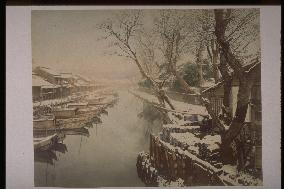
The same photo as the one numbered 14-35, showing a canal leading to Negishi from Asakusa and Imado. Many passengers took boats along the Sumida River to visit the red-light district of Yoshiwara. The chokibune boats were not roofed and so must have been different from those shown in this photo. The cottages on the left may be boat houses. Most of the canals ware filled in when the Yoshiwara district was abolished in 1958.==Date:unknown, Place:Tokyo, Photo:Kusakabe Kinbei, (Credit:Nagasaki University Library/Kyodo News Images) [Cabinet Number3‐26‐0]

  •  
Hozu River

Hozu River

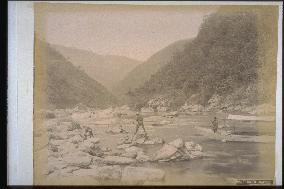
A river in the central part of Kyoto Prefecture. The Oseki River runs from Daihisan in Tabata Hills to Kameoka Basin, the Hozu River between Kameoka Basin and Hozukyo, and the Katsura River between Hozukyo and Yodo River. Hozu means peaceful harbour , but the river is rapid, and rocks frequently appear in the stream. The photo shows a roofed boat going downstream with a man taking the helm at the fore of the boat, and two people walking along the rocks which appear in the river.==Date:unknown, Place:Kyoto, Photo:Kusakabe Kinbei, (Credit:Nagasaki University Library/Kyodo News Images) [Cabinet Number1‐39‐0]

  •  
Yokohama, APEC summit venue

Yokohama, APEC summit venue

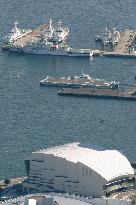
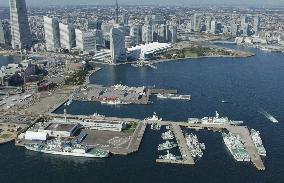
TOKYO, Japan - Japan Coast Guard patrol boats are anchored at piers in Yokohama, south of Tokyo, on Nov. 3, 2010, ahead of a series of meetings of the Asia-Pacific Economic Cooperation forum there. The white-roofed building in the foreground is the Pacifico Yokohama convention center, the venue of the APEC summit. (Kyodo)

  •  
Yokohama, APEC summit venue

Yokohama, APEC summit venue

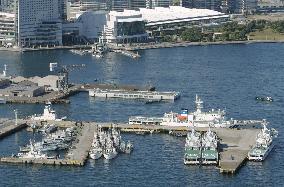
TOKYO, Japan - Japan Coast Guard patrol boats are anchored at piers in Yokohama, south of Tokyo, on Nov. 3, 2010, ahead of a series of meetings of the Asia-Pacific Economic Cooperation forum there. The white-roofed building in the back is the Pacifico Yokohama convention center, the venue of the APEC summit. (Kyodo)

  •  
Yokohama, APEC summit venue

Yokohama, APEC summit venue

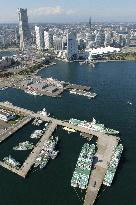
TOKYO, Japan - Japan Coast Guard patrol boats are anchored at piers in Yokohama, south of Tokyo, on Nov. 3, 2010, ahead of a series of meetings of the Asia-Pacific Economic Cooperation forum there. The white-roofed building in the back is the Pacifico Yokohama convention center, the venue of the APEC summit. (Kyodo)

  •  
Yokohama, APEC summit venue

Yokohama, APEC summit venue

TOKYO, Japan - Japan Coast Guard patrol boats are anchored at piers in Yokohama, south of Tokyo, on Nov. 3, 2010, ahead of a series of meetings of the Asia-Pacific Economic Cooperation forum there. The white-roofed building in the back is the Pacifico Yokohama convention center, the venue of the APEC summit. (Kyodo)

  •  
Shinchigura storehouse and Dejima

Shinchigura storehouse and Dejima

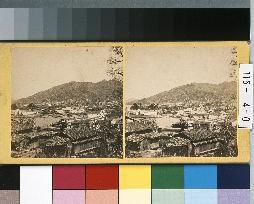
This is a stereo photograph taken from the east part of Junin-machi above Umegasaki and looking over the Chinese warehouses in Shinchi on the right toward Tsuki-machi and Dejima. The two-story, tile-roofed Eighteenth Bank, which was built in 1889, is captured here.==Date:unknown, Place:Nagasaki, Photo:THE FAR EAST?, (Credit:Nagasaki University Library/Kyodo News Images) [Cabinet Number115‐4‐0]

  •  
Three-wheel motorcycle for Japan Post mail delivery

Three-wheel motorcycle for Japan Post mail delivery

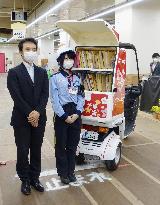
Photo taken in Tokyo on June 15, 2020, shows a three-wheel roofed motorcycle which Japan Post Co. will introduce for mail delivery service on a trial basis within June in some areas, including Hiroshima, western Japan. (Kyodo) ==Kyodo

  • Main
  • Top
  • Editorial
  • Creative
  • About Us
  • About ILG
  • Terms of use
  • Company
  • BEHIND
  • Price List
  • Single Plan
  • Monthly Plan
  • Services
  • Shooting
  • Rights Clearance
  • Support
  • FAQ
  • How To Buy
  • Contact Us
  • Become a Partner

© KYODO NEWS IMAGES INC

All Rights Reserved.

  • Editorial
  • Olympics
  • News
  • Sports
  • Japan
  • Tech
  • Royal
  • Disaster
  • NorthKorea
  • Old Japan
  • SNS
  • Creative
  • Food
  • Japan
  • Landscape
  • Animal
  • Popular
  • #Ukraine
  • #China
  • #coronavirus
  • #N. Korea
  • #Thailand
  • #Russia
  • #Ukraine
  • #China
  • #coronavirus
  • #N. Korea
  • #Thailand
  • #Russia
  • Food
  • Japan
  • Landscape
  • Animal
  • Olympics
  • News
  • Sports
  • Japan
  • Tech
  • Royal
  • Disaster
  • NorthKorea
  • Old Japan
  • SNS