•  
Kyoto's Kinkakuji covered with snow

Kyoto's Kinkakuji covered with snow

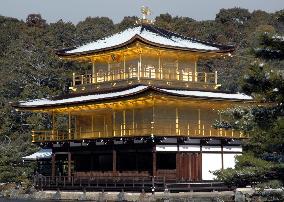
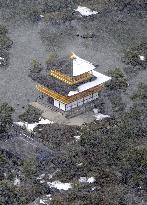
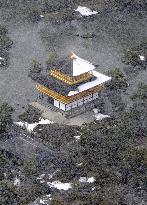
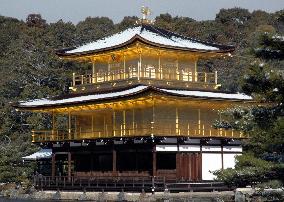
KYOTO, Japan - Kinkakuji (Golden Pavilion), a Zen temple formally known as Rokuonji in Kyoto, is partly covered with snow on Feb. 6, 2010, as a strong winter pressure pattern brought snow to the ancient Japanese capital.

  •  
Kyoto's Kinkakuji covered with snow

Kyoto's Kinkakuji covered with snow

KYOTO, Japan - Kinkakuji (Golden Pavilion), a Zen temple formally known as Rokuonji in Kyoto, is partly covered with snow on Feb. 6, 2010, as a strong winter pressure pattern brought snow to the ancient Japanese capital.

  •  
Kyoto's Kinkakuji covered with snow

Kyoto's Kinkakuji covered with snow

KYOTO, Japan - Kinkakuji (Golden Pavilion), a Zen temple formally known as Rokuonji in Kyoto, is partly covered with snow on Feb. 6, 2010, as a strong winter pressure pattern brought snow to the ancient Japanese capital. (Kyodo)

  •  
Kyoto's Kinkakuji covered with snow

Kyoto's Kinkakuji covered with snow

KYOTO, Japan - Kinkakuji (Golden Pavilion), a Zen temple formally known as Rokuonji in Kyoto, is partly covered with snow on Feb. 6, 2010, as a strong winter pressure pattern brought snow to the ancient Japanese capital. (Kyodo)

  •  
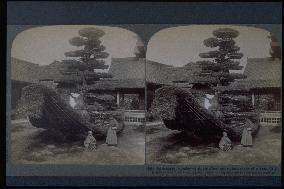
The Land-boat Pine Tree,Kinkakuji Temple

The Land-boat Pine Tree,Kinkakuji Temple

Stereograph of Rikushu-no-matsu (Land Boat Pine) of Rokuonji Temple taken from the west side of the hojo (head priest's quarters), facing west-northwest. It is said that this pine was planted by Yoshimitsu Ashikaga. The branches were formed to look like a boat. On the left is the ohjoin (large study), and the roof of the kuri is visible on the right. Two boys wearing hakama are facing each other. Taken in 1904.==Date:1904, Place:Kyoto, Photo:Underwood, (Credit:Nagasaki University Library/Kyodo News Images) [Cabinet Number97‐41‐0]

  •  
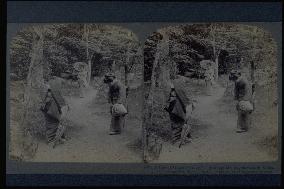
The garden of Kinkakuji Temple

The garden of Kinkakuji Temple

Stereograph depicting two women in kimono on the past to the Rokuonji temple garden. Holding closed Japanese-style parasols, they face each other and bow, exchanging morning greetings. There is another woman further back wearing kimono and holding a parasol. Taken in 1904.==Date:1904, Place:Kyoto, Photo:Underwood, (Credit:Nagasaki University Library/Kyodo News Images) [Cabinet Number97‐40‐0]

  •  
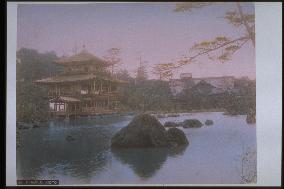
Kinkakuji Temple

Kinkakuji Temple

The Golden Pavilion at Rokuonji Temple seen from the western edge of Kyoko Pond, facing east. The rock in the centre of the pond is Kameyama Rock. In the back is the huge roof of the kuri (the residence of the priests), visible through the shrubbery. The shrubbery on the right is Ashihara Island; the one on the left is Dejima. The temple was built in 1398 but destroyed by arson in 1950. Unlike the reconstructed building of today, the original roof was supported by many columns at each level.==Date:unknown, Place:Kyoto, Photo:unknown, (Credit:Nagasaki University Library/Kyodo News Images) [Cabinet Number86‐12‐0]

  •  
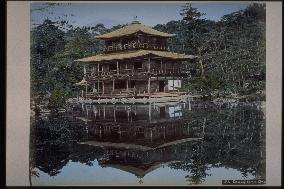
Kinkakuji Temple

Kinkakuji Temple

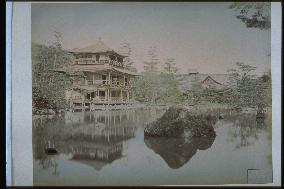
The Golden Pavilion at Rokuonji Temple seen from the eastern edge of Kyoko Pond, facing west-northwest. The shrubbery on the left is Ashihara Island. The temple was built in 1398 but destroyed by arson in 1950. Unlike the reconstructed building of today, the original roof was supported by many columns at each level. Three people enjoy the view of the pond from the first-floor cloister. Pine forest stretches all around. Mt. Momoyama rises in the background.==Date:unknown, Place:Kyoto, Photo:unknown, (Credit:Nagasaki University Library/Kyodo News Images) [Cabinet Number52‐41‐0]

  •  
Kinkakuji Temple

Kinkakuji Temple

The Golden Pavilion at Rokuonji Temple seen from the eastern edge of Kyoko Pond, facing west-northwest. Hosokawa Rock is in the left foreground. The stone wall behind it is part of Ashihara Island. The temple was built in 1398 but destroyed by arson in 1950. Unlike the reconstructed building of today, the original roof was supported by many columns at each level. Two men look at the pond from the second-floor cloister. Pine forest stretches all around. Mt. Momoyama rises in the background.==Date:unknown, Place:Kyoto, Photo:unknown, (Credit:Nagasaki University Library/Kyodo News Images) [Cabinet Number52‐37‐0]

  •  
Kinkakuji Temple

Kinkakuji Temple

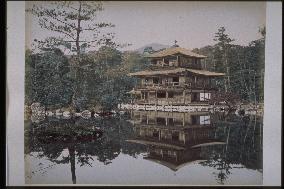
The Golden Pavilion at Rokuonji Temple seen from the western edge of Kyoko Pond, facing east. The rock in the centre of the pond is Kameyama Rock. In the back is the huge roof of the kuri (the residence of the priests), visible through the shrubbery. The shrubbery on the right is Ashihara Island; the one on the left is Dejima. The temple was built in 1398 but destroyed by arson in 1950. Unlike the reconstructed building of today, the original roof was supported by many columns at each level.==Date:unknown, Place:Kyoto, Photo:unknown, (Credit:Nagasaki University Library/Kyodo News Images) [Cabinet Number52‐16‐0]

  •  
The garden of Kinkakuji Temple

The garden of Kinkakuji Temple

The kuri (priests' quarters) at Rokuonji Temple seen from the southwestern edge of Kyoko Pond, facing east-northeast. The huge kirizuma style roof of the kuri is visible behind the pine trees in the middle of the pond. The pond surface is covered with water weeds, and the green is striking. Taken by Tamamura Kozaburo.==Date:unknown, Place:Kyoto, Photo:Tamamura Kozaburo, (Credit:Nagasaki University Library/Kyodo News Images) [Cabinet Number48‐136‐0]

  •  
The garden of Kinkakuji Temple

The garden of Kinkakuji Temple

The kuri (priests' quarters) at Rokuonji Temple seen from the southwestern edge of Kyoko Pond, facing east-northeast. The huge kirizuma style roof of the kuri is visible behind the pine trees in the middle of the pond. The pond surface is covered with water weeds, and the green is striking. Taken by Tamamura Kozaburo.==Date:unknown, Place:Kyoto, Photo:Tamamura Kozaburo, (Credit:Nagasaki University Library/Kyodo News Images) [Cabinet Number48‐107‐0]

  •  
The Land-boat Pine Tree,Kinkakuji Temple

The Land-boat Pine Tree,Kinkakuji Temple

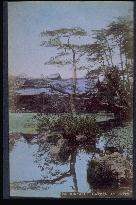
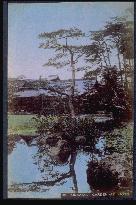
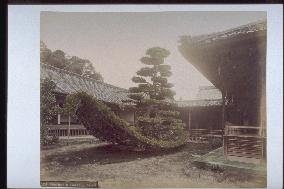
Rikushu-no-matsu (Land Boat Pine) of Rokuonji Temple seen from the west side of the hojo (head priest's quarters), facing west-northwest. It is said that this pine was planted by Ashikaga Yoshimitsu. The branches were formed to look like a sailboat. The bow faces west toward the Western Pure Land of Buddhist lore. The buildings in the right foreground and far left are the hojo and ohjoin (large study), respectively. The roof of the kuri is visible on the far right.==Date:unknown, Place:Kyoto, Photo:unknown, (Credit:Nagasaki University Library/Kyodo News Images) [Cabinet Number42‐13‐0]

  • Main
  • Top
  • Editorial
  • Creative
  • About Us
  • About ILG
  • Terms of use
  • Company
  • BEHIND
  • Price List
  • Single Plan
  • Monthly Plan
  • Services
  • Shooting
  • Rights Clearance
  • Support
  • FAQ
  • How To Buy
  • Contact Us
  • Become a Partner

© KYODO NEWS IMAGES INC

All Rights Reserved.

  • Editorial
  • Olympics
  • News
  • Sports
  • Japan
  • Tech
  • Royal
  • Disaster
  • NorthKorea
  • Old Japan
  • SNS
  • Creative
  • Food
  • Japan
  • Landscape
  • Animal
  • Popular
  • #Ukraine
  • #Russia
  • #coronavirus
  • #N. Korea
  • #Thailand
  • #China
  • #Ukraine
  • #Russia
  • #coronavirus
  • #N. Korea
  • #Thailand
  • #China
  • Food
  • Japan
  • Landscape
  • Animal
  • Olympics
  • News
  • Sports
  • Japan
  • Tech
  • Royal
  • Disaster
  • NorthKorea
  • Old Japan
  • SNS