•  
Hairdressing

Hairdressing

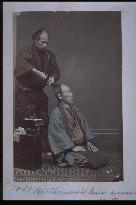
The sakayaki haircut with hair shaved in a half-circle from the forehead to the crown was popular among the common people of the Edo Period. Men went to a barber to have their sideburns and sakayaki shaved and the remaining hair arranged in a mage topknot.==Date:unknown, Place:unknown, Photo:Usui Shuzaburo, (Credit:Nagasaki University Library/Kyodo News Images) [Cabinet Number94‐48‐0]

  •  
A woman carrying a child on her back

A woman carrying a child on her back

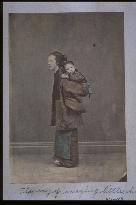
The woman with a child on her back is wearing a hanten (half-coat), a garment worn commonly by both men and women from the Edo Period. She is also wearing an apron so that her kimono will not get dirty.==Date:unknown, Place:unknown, Photo:Usui Shuzaburo, (Credit:Nagasaki University Library/Kyodo News Images) [Cabinet Number94‐49‐0]

  •  
Daibutsu (the Great Buddha),Ueno

Daibutsu (the Great Buddha),Ueno

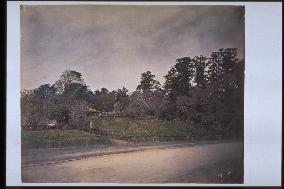
The Great Buddha at Daibutsuyama, Ueno Shinobazugaoka. The lack of temple housing indicates that the photograph was taken after 1873, probably around 1882 in view of the fact that the photographer is Usui Shuzaburo. The path in front of the Buddha to the left leads to Ueno Seiyoken Restaurant, which opened in April 1873 as the second location of Tsukiji Seiyoken of Kyobashi Unemecho. A sign saying Seiyoken Annex is visible to the left of the path. The street in the foreground is Kuromon Dori (Black Gate Street). The grove on the right is Toshogu-no-Mori.==Date:unknown, Place:Tokyo, Photo:Usui Shuzaburo, (Credit:Nagasaki University Library/Kyodo News Images) [Cabinet Number94‐47‐0]

  •  
Kendo

Kendo

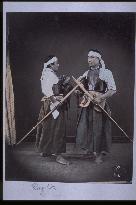
Kendo is one of the Japanese martial arts. The participants wear protectors and use a bamboo sword. They try to strike the opponent on the head, the right hand or the torso. A tare is worn on the waist during practice.==Date:unknown, Place:unknown, Photo:Usui Shuzaburo, (Credit:Nagasaki University Library/Kyodo News Images) [Cabinet Number94‐45‐0]

  •  
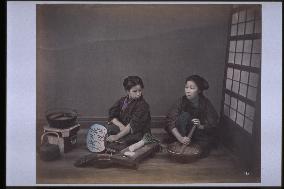
Women preparing for a meal

Women preparing for a meal

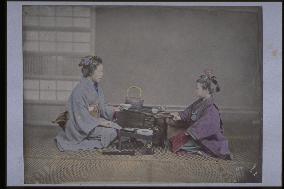
The woman on the left is stoking a fire in a clay charcoal stove. The woman on the right is grinding something in a mortar with a pestle, her right knee raised. An iron pot is placed near the cutting board, and pieces of cut radish are visible.==Date:unknown, Place:unknown, Photo:Usui Shuzaburo, (Credit:Nagasaki University Library/Kyodo News Images) [Cabinet Number94‐46‐0]

  •  
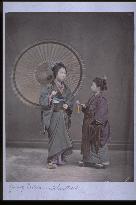
Women holding umbrellas

Women holding umbrellas

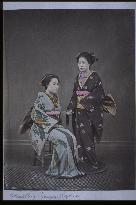
The woman on the left is holding a bangasa umbrella and wearing a long kimono with a black collar. The girl on the right is wearing a haori half-coat with an apron. She is holding a small umbrella in her left hand and a flower hair pin in her right hand.==Date:unknown, Place:unknown, Photo:Usui Shuzaburo, (Credit:Nagasaki University Library/Kyodo News Images) [Cabinet Number94‐42‐0]

  •  
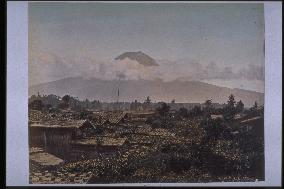
Mt. Fuji seen from Fuji Yoshida

Mt. Fuji seen from Fuji Yoshida

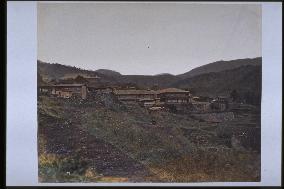
Mt. Fuji seen from Fuji Yoshida==Date:unknown, Place:Yamanashi, Photo:Usui Shuzaburo, (Credit:Nagasaki University Library/Kyodo News Images)

  •  
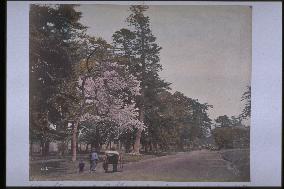
Cherry trees at Ueno Park

Cherry trees at Ueno Park

The street running between Kuromon Street in Ueno Park and present-day JR Ueno Station is viewed from the south. On the right corner is Ryoun'in, a subsidiary of Kaneiji Temple, site of present-day National Museum of Western Art. The woman holding up the bottom of her kimono may be the mother of the young child.==Date:unknown, Place:Tokyo, Photo:Usui Shuzaburo, (Credit:Nagasaki University Library/Kyodo News Images) [Cabinet Number94‐40‐0]

  •  
Miyanoshita Spa

Miyanoshita Spa

The building on the far left is Fujiya Hotel at the time of their grand opening. It was built in 1878 and was standing until December, 1883 when it was lost in a fire. The building to the right is Naraya Ryokan (inn) which was rebuilt after a fire of 1874. This photo is probably taken around the same time as that of catalogue #3313.==Date:unknown, Place:Hakone, Photo:Usui Shuzaburo, (Credit:Nagasaki University Library/Kyodo News Images) [Cabinet Number94‐43‐0]

  •  
A geta clog craftsman

A geta clog craftsman

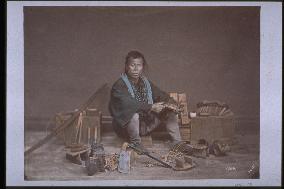
This craftsman walks around the city offering his services in repairing wooden geta clogs, supports for clogs, and thongs. He carries his tools, like a hatchet, plane, and chisels, in a tool box hanging from a balancing pole. His hair is combed in typical craftsman's style, and he wears a hanten coat, gaiters and straw sandals. This is a studio photograph.==Date:unknown, Place:unknown, Photo:Usui Shuzaburo, (Credit:Nagasaki University Library/Kyodo News Images) [Cabinet Number94‐38‐0]

  •  
A tattooed man

A tattooed man

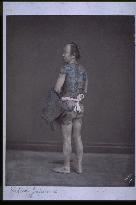
This is a photograph of a tattooed man from the album by Usui Shuzaburo. The tattoo design seems to have been painted over the original design because it is the same pattern as the clothes the subject is holding. It is not clear whether the tattoo design shown is identical to the original design.==Date:unknown, Place:unknown, Photo:Usui Shuzaburo, (Credit:Nagasaki University Library/Kyodo News Images) [Cabinet Number94‐41‐0]

  •  
Matsuzakaya Inn at the Ashinoyu Spa

Matsuzakaya Inn at the Ashinoyu Spa

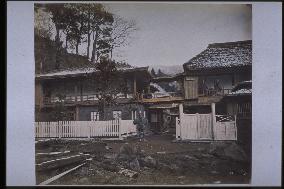
Matsuzakaya Inn at the Ashinoyu Spa==Date:unknown, Place:Hakone, Photo:Usui Shuzaburo, (Credit:Nagasaki University Library/Kyodo News Images)

  •  
The Chokugaku-mon Gate of Yusho-in Reibyo, Zojoji Temple, Shiba

The Chokugaku-mon Gate of Yusho-in Reibyo, Zojoji Temple, Shiba

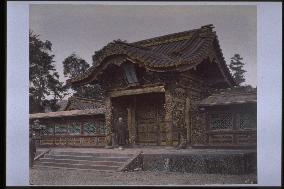
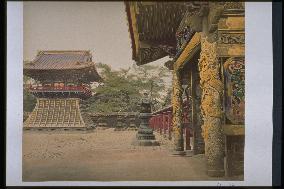
Chokugaku Gate is viewed from the northeast, outside Yushoin Mausoleum. Dragons are engraved on the gateposts. Many photographs were taken of these dragons because of their excellent craftsmanship, and many still remain. A Buddhist priest is posing in front of the gate to add to a solemn atmosphere.==Date:unknown, Place:Tokyo, Photo:Usui Shuzaburo, (Credit:Nagasaki University Library/Kyodo News Images) [Cabinet Number94‐35‐0]

  •  
A woman holding a shamisen

A woman holding a shamisen

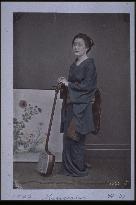
The caption says musician. This woman is actually a singer standing with a shamisen lute in front of a partition with plant illustrations.==Date:unknown, Place:unknown, Photo:Usui Shuzaburo, (Credit:Nagasaki University Library/Kyodo News Images) [Cabinet Number94‐37‐0]

  •  
Portrait of a woman sitting in a chair

Portrait of a woman sitting in a chair

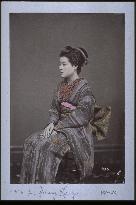
Portrait of a woman sitting in a chair==Date:unknown, Place:unknown, Photo:Usui Shuzaburo, (Credit:Nagasaki University Library/Kyodo News Images)

  •  
A teahouse and a jinrikisha,Tokaido Road

A teahouse and a jinrikisha,Tokaido Road

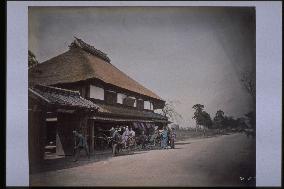
A teahouse and a jinrikisha,Tokaido Road==Date:unknown, Place:unknown, Photo:Usui Shuzaburo, (Credit:Nagasaki University Library/Kyodo News Images)

  •  
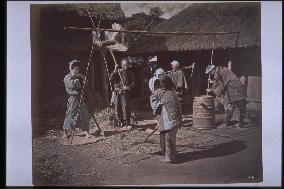
A scene of threshing

A scene of threshing

Four women and men take turns pounding grains spread on a straw mat to remove husks. The tool is called a donji. A mill visible on the right was used to remove the skin from threshed rice.==Date:unknown, Place:unknown, Photo:Usui Shuzaburo, (Credit:Nagasaki University Library/Kyodo News Images) [Cabinet Number94‐33‐0]

  •  
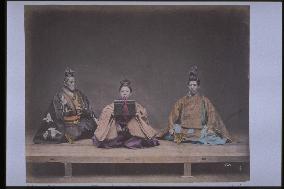
Actors in court-noble attire

Actors in court-noble attire

Three people wear ori-eboshi hats. The man on the right wears an hitatare (bib), part of formal court dress. This is probably a coming-of-age rite for the boy in the middle. The man on the left holding a fan is probably the boy's father. Old photographs whisper many stories.==Date:unknown, Place:unknown, Photo:Usui Shuzaburo, (Credit:Nagasaki University Library/Kyodo News Images) [Cabinet Number94‐31‐0]

  •  
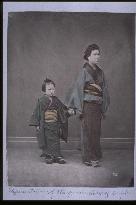
A mother and her daughter standing hand in hand

A mother and her daughter standing hand in hand

The English title reads Mother and Daughter of the Poorer Class. The mother's sash seems to be a patchwork made from clothing scraps. This is a studio photograph. A base of a body supporter is visible behind the child.==Date:unknown, Place:unknown, Photo:Usui Shuzaburo, (Credit:Nagasaki University Library/Kyodo News Images) [Cabinet Number94‐32‐0]

  •  
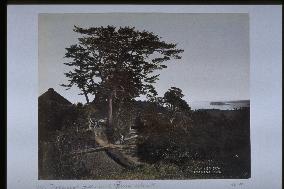
Nokendo

Nokendo

Nokendo was known as the best place to view the eight famous scenes of Kanagawa, but the scenery was gradually spoiled after the reclamation of Deiki Shinden from the sea, and the focus of popularity shifted to Kyurantei. The Nokendo temple buildings were lost in a fire in 1871, and presently only the stone monument remains.==Date:unknown, Place:Yokohama, Photo:Usui Shuzaburo, (Credit:Nagasaki University Library/Kyodo News Images) [Cabinet Number94‐30‐0]

  •  
A soldier in armour

A soldier in armour

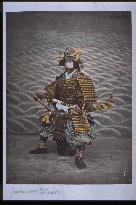
The domaru (torso guard) was used by samurai from the mid-Kamakura Period. The man strikes a stately pose in his kabuto war helmet, shoulder protectors, hitatare frontal armour and war shoes. By this time, however, armour was little more than an object for decoration.==Date:unknown, Place:unknown, Photo:Usui Shuzaburo, (Credit:Nagasaki University Library/Kyodo News Images) [Cabinet Number94‐28‐0]

  •  
Rice planting

Rice planting

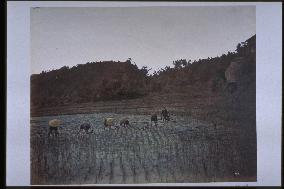
Rice planting==Date:unknown, Place:unknown, Photo:Usui Shuzaburo, (Credit:Nagasaki University Library/Kyodo News Images)

  •  
A mercer

A mercer

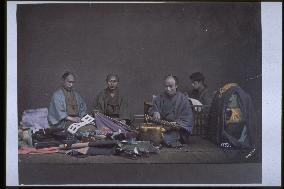
The man in the far right corner seems to be writing in an account book. Men holding an abacus, ruler, and textile samples are in front of the accountant. This does not seem to be a fabric shop. The men are probably travelling salesmen taking orders from customers. A large bundle with products is visible on the right side.==Date:unknown, Place:unknown, Photo:Usui Shuzaburo, (Credit:Nagasaki University Library/Kyodo News Images) [Cabinet Number94‐27‐0]

  •  
Women washing clothes

Women washing clothes

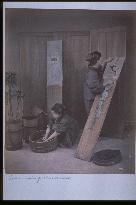
The women are pulling apart soiled kimono, hand-washing the pieces, and then stretching them over a plank (a process called araihari ). Once these are dry, they are made into kimono again. This kind of drying process was applied not only to kimono but also to bedding and other sleeping items.==Date:unknown, Place:unknown, Photo:Usui Shuzaburo, (Credit:Nagasaki University Library/Kyodo News Images) [Cabinet Number94‐25‐0]

  •  
A mother and her daughter holding shamisens

A mother and her daughter holding shamisens

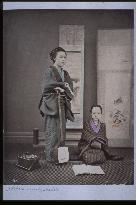
A mother is holding a shamisen lute vertically in one hand and a plectrum in the other. Her daughter is sitting with her hands inside her sleeves. A lesson book is open, and a tobacco tray lies on the mat. A scroll is hanging on the wall behind. The setting is artificial.==Date:unknown, Place:unknown, Photo:Usui Shuzaburo, (Credit:Nagasaki University Library/Kyodo News Images) [Cabinet Number94‐26‐0]

  •  
The Osaka Garrison (Division 4)

The Osaka Garrison (Division 4)

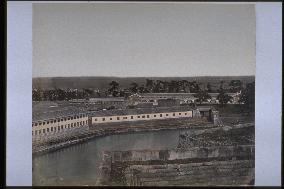
The Osaka Garrison (Division 4)==Date:unknown, Place:Osaka, Photo:Usui Shuzaburo, (Credit:Nagasaki University Library/Kyodo News Images)

  •  
Girls in attire for a trip

Girls in attire for a trip

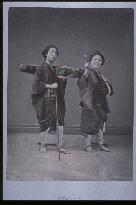
Two women wear gaiters and straw sandals and carry luggage in the manner of Edo Period travellers, but it is unlikely that two women would travel alone. They perhaps posed for the photograph as two women from a travelling entertainment group.==Date:unknown, Place:unknown, Photo:Usui Shuzaburo, (Credit:Nagasaki University Library/Kyodo News Images) [Cabinet Number94‐23‐0]

  •  
A priest

A priest

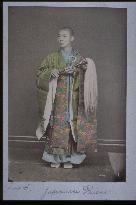
This is a photograph from an album by Usui Shuzaburo. The caption written in pencil says, Japanese Priest. The priest is wearing a kesa robe with white tabi socks and is holding a hossu brush.==Date:unknown, Place:unknown, Photo:Usui Shuzaburo, (Credit:Nagasaki University Library/Kyodo News Images) [Cabinet Number94‐22‐0]

  •  
Dancing women

Dancing women

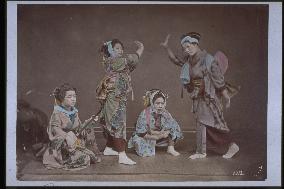
All of the dancers and musicians wear head towels. The dancers have the sleeves of their kimono pulled up with cords. The woman on the right has a fan inserted in the sash at her back. This is a scene of dancing at a festival.==Date:unknown, Place:unknown, Photo:Usui Shuzaburo, (Credit:Nagasaki University Library/Kyodo News Images) [Cabinet Number94‐18‐0]

  •  
The Great Bell, Hokoji Temple

The Great Bell, Hokoji Temple

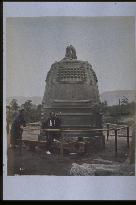
The big bell of Hokoji Temple placed on stone blocks is viewed from the east. A wooden fence surrounds the bell, and two men are standing nearby. The Nishiyama mountains are faintly visible in the background. The big bell was made at the time of the reconstruction of the temple by Toyotomi Hideyori in 1614. It is said to have been 4.5m high, 2.8m in diameter, 28cm thick and about 8.3 tons in weight. This was taken by photographer Usui Shuzaburo of Yokohama sometime before July 1882.==Date:unknown, Place:Kyoto, Photo:Usui Shuzaburo, (Credit:Nagasaki University Library/Kyodo News Images) [Cabinet Number94‐19‐0]

  •  
Hairdressing

Hairdressing

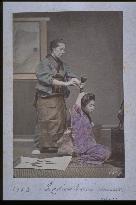
A woman is having her hair done by a hairdresser. Professional hairdressers for women started to emerge in the latter half of the Edo Period. By this time, women's hair styles were becoming very complicated and the services of professional hairdressers in increasing demand.==Date:unknown, Place:unknown, Photo:Usui Shuzaburo, (Credit:Nagasaki University Library/Kyodo News Images) [Cabinet Number94‐21‐0]

  •  
Female street singers

Female street singers

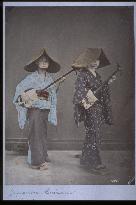
Although entitled Japanese Singers, this staged scene actually shows torioi (bird chasing) strolling musicians. Originally part of celebratory ritual, torioi eventually turned into a custom called Kadozuke-gei. The torioi were strolling female musicians wearing distinctive amigasa hats and playing the shamisen. They went from door to door playing music and expressing good wishes for a small charge.==Date:unknown, Place:unknown, Photo:Usui Shuzaburo, (Credit:Nagasaki University Library/Kyodo News Images) [Cabinet Number94‐14‐0]

  •  
Women standing hand in hand

Women standing hand in hand

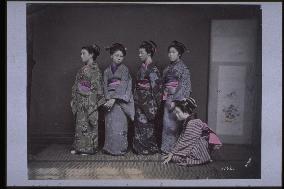
The English title reads Wealthy Young Ladies. The one piece maruobi sashes stand out. The cotton hems exude a sense of elegance. They are probably women of the entertainment industry.==Date:unknown, Place:unknown, Photo:Usui Shuzaburo, (Credit:Nagasaki University Library/Kyodo News Images) [Cabinet Number94‐17‐0]

  •  
Kondo of Shitennoji Temple

Kondo of Shitennoji Temple

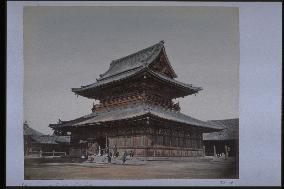
The overall view of the Golden Hall, the main building at Shitenoji Temple.==Date:unknown, Place:Osaka, Photo:Usui Shuzaburo, (Credit:Nagasaki University Library/Kyodo News Images) [Cabinet Number94‐15‐0]

  •  
Harvesting rice

Harvesting rice

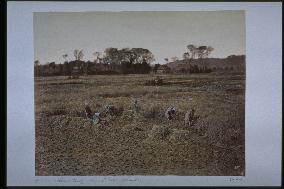
Harvesting rice==Date:unknown, Place:unknown, Photo:Usui Shuzaburo, (Credit:Nagasaki University Library/Kyodo News Images)

  •  
A basket vendor

A basket vendor

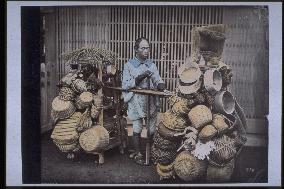
A basket peddler wears gaiters, black socks, sandals, and a kimono with a collar and hems pulled up. He is carrying merchandise on a balancing pole. These include sieve baskets, crate baskets, noodle-draining baskets, woven bamboo baskets and small brooms.==Date:unknown, Place:unknown, Photo:Usui Shuzaburo, (Credit:Nagasaki University Library/Kyodo News Images) [Cabinet Number94‐13‐0]

  •  
Women waiting for their turn

Women waiting for their turn

This hairstyle, called tenjinmage, was popular from the end of the Edo Period to the Meiji Period. The hair is arranged in an ordinary fashion, and the style of dress suggests that the women are novice workers beginning to learn their trade.==Date:unknown, Place:unknown, Photo:Usui Shuzaburo, (Credit:Nagasaki University Library/Kyodo News Images) [Cabinet Number94‐9‐0]

  •  
Urami Falls,Nikko

Urami Falls,Nikko

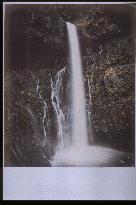
Located on Arasawa River, a tributary of Daiya River, Urami Falls is one of the three famous waterfalls of Nikko along with Kegon Falls and Kirifuri Falls. The road leading to the back of the falls, where Fudomyo'o is enshrined, was destroyed by the flood of 1902. The poet Matsuo Basho, who visited the area in 1689, composed the following haiku: Early summer, resting under the falls, a little while.==Date:unknown, Place:Nikko, Photo:Usui Shuzaburo, (Credit:Nagasaki University Library/Kyodo News Images) [Cabinet Number94‐12‐0]

  •  
Daibutsu (the Great Buddha) of Kamakura

Daibutsu (the Great Buddha) of Kamakura

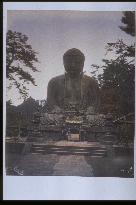
The photograph bears the inscription One Hundred Nineteen 119. There are no bronze lotus petals. The building on the right side of the statue is probably the same as that in photograph #3997. The sharply-raking finials on the two bronze lanterns in front of the statue indicate that this photograph was taken at the beginning of the Meiji Period, but there seems to be a slight time difference from photograph #3997.==Date:unknown, Place:Kamakura, Photo:Usui Shuzaburo, (Credit:Nagasaki University Library/Kyodo News Images) [Cabinet Number94‐10‐0]

  •  
Oirans (courtesans) and palanquins

Oirans (courtesans) and palanquins

An oiran (courtesan) walking in formal style with attendants was called an oiran procession. The procession included a novice courtesan, child attendant and chaperone as well as male attendants carrying bed items, a shamisen lute and drums.==Date:unknown, Place:unknown, Photo:Usui Shuzaburo, (Credit:Nagasaki University Library/Kyodo News Images) [Cabinet Number94‐11‐0]

  •  
A garden and a geiko

A garden and a geiko

A garden and a geiko==Date:unknown, Place:unknown, Photo:Usui Shuzaburo, (Credit:Nagasaki University Library/Kyodo News Images)

  •  
Dancing women

Dancing women

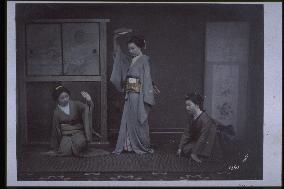
A scene from a Kabuki drama entitled Kagamiyama Zori Uchi is portrayed. The woman in the centre holding a sandal is called Tsubone Iwafuji, while the women on the left and right are the middle-aged Onoue and Iwafuji's maid Koshimoto.==Date:unknown, Place:unknown, Photo:Usui Shuzaburo, (Credit:Nagasaki University Library/Kyodo News Images) [Cabinet Number94‐5‐0]

  •  
Toshogu Shrine,Nikko

Toshogu Shrine,Nikko

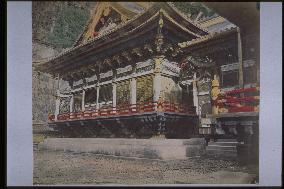
The buildings of Nikko Toshogu are seen from the west. The main shrine is in the centre. The part one level lower than the main shrine is the Ishi-no-ma (Stone Room). The Hall of Worship is partially visible on the far right. Behind the stone walls in the background is the Okusha (inner shrine) containing the tomb of Tokugawa Ieyasu. Carvings of tapirs are visible above the doors of the main hall.==Date:unknown, Place:Nikko, Photo:Usui Shuzaburo, (Credit:Nagasaki University Library/Kyodo News Images) [Cabinet Number94‐3‐0]

  •  
A box brazier and a girl

A box brazier and a girl

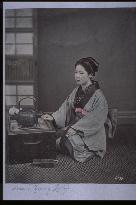
A young woman is sitting in front of a brazier holding a pair of tongs in her right hand. An iron pot is placed on the brazier. The item in the front is most likely a tobacco tray.==Date:unknown, Place:unknown, Photo:Usui Shuzaburo, (Credit:Nagasaki University Library/Kyodo News Images) [Cabinet Number94‐6‐0]

  •  
Lake Chuzenji

Lake Chuzenji

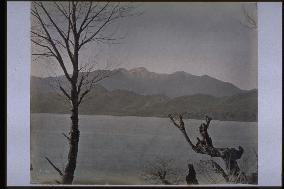
The Shobugahama area is viewed from the southeastern side of Lake Chuzenji. The mountains in the background are Mt. Konsei, Onsengadake, and Mt. Maeshirane. Senjogahara, Idashirogahara and Yumoto Spa lie at the foot of the mountain. Beyond Konsei Pass and on the other side of the mountain is Gunma Prefecture.==Date:unknown, Place:Nikko, Photo:Usui Shuzaburo, (Credit:Nagasaki University Library/Kyodo News Images) [Cabinet Number94‐7‐0]

  •  
Imaichi,the Nikko Road

Imaichi,the Nikko Road

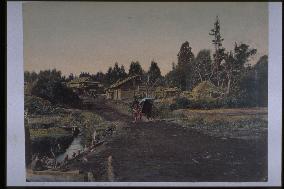
Although said to depict Imaichi on the Nikko Highway, the photograph does show a scene of the cedar-lined highway. Some cedar trees are visible in the centre, but it is difficult to tell whether they are a part of the highway. The rice has already been harvested, and irrigation ditches are visible next to the fields. Deciduous trees stand in the yard of a farm house. A serene farming village scene.==Date:unknown, Place:Nikko, Photo:Usui Shuzaburo, (Credit:Nagasaki University Library/Kyodo News Images) [Cabinet Number94‐4‐0]

  •  
A family celebrating their child

A family celebrating their child

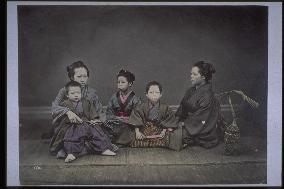
The boys are probably brothers with their older sister. They wear haori coats and hakama trousers. The woman holding the younger brother on her knees is probably the mother and the woman on the right her mother-in-law. A woven bamboo basket containing rice cakes or perhaps chimaki dumplings is nearby. This is probably a photograph to commemorate a Meiji Period Shichi-go-san children's day festival, because the padded clothing indicate early winter.==Date:unknown, Place:unknown, Photo:Usui Shuzaburo, (Credit:Nagasaki University Library/Kyodo News Images) [Cabinet Number94‐2‐0]

  •  
A mother and her daughter having a meal

A mother and her daughter having a meal

The woman with an apron on the right, apparently a maid, is offering the other woman a second helping by extending a tray. A chopstick box is placed on the side of the low meal table, and an iron tea kettle is on the porcelain stove. A teapot and tea cup are also visible.==Date:unknown, Place:unknown, Photo:Usui Shuzaburo, (Credit:Nagasaki University Library/Kyodo News Images) [Cabinet Number94‐1‐0]

  •  
The Hondo (inner sanctuary) of Kuonji Temple,Mt. Minobu

The Hondo (inner sanctuary) of Kuonji Temple,Mt. Minobu

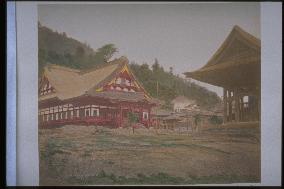
Soshido Seishinkaku at Minobusan Kuonji Temple, headquarters of the Nichiren Sect of Japanese Buddhism. This temple is located in Minobu-machi, Minamikoma-gun, Yamanashi Prefecture. Seishinkaku is the place where a famous statue of Nichiren, the founder of the sect, is located. However, the building erected in the Edo Period was destroyed by fire in 1875. This photograph depicts the new building erected in 1881. The state of the surroundings suggests that it was taken soon after construction.==Date:unknown, Place:Yamanashi, Photo:Usui Shuzaburo?, (Credit:Nagasaki University Library/Kyodo News Images) [Cabinet Number65‐33‐0]

  •  
Shiba Zojoji Temple

Shiba Zojoji Temple

Chokugaku Gate, the main entrance to the mausoleum of the 7th Shogun Tokugawa Ietsugu, and the bell tower are viewed from the south. There are carvings of dragons on the gateposts. The most opulent of the Tokugawa mausoleums at Zojoji Temple, it was the last built exclusively as a mausoleum. Subsequent shoguns were enshrined in existing mausoleums in accordance with the wishes of the 8th Shogun Yoshimune.==Date:unknown, Place:Tokyo, Photo:Usui Shuzaburo?, (Credit:Nagasaki University Library/Kyodo News Images) [Cabinet Number65‐38‐0]

  • Main
  • Top
  • Editorial
  • Creative
  • About Us
  • About ILG
  • Terms of use
  • Company
  • BEHIND
  • Price List
  • Single Plan
  • Monthly Plan
  • Services
  • Shooting
  • Rights Clearance
  • Support
  • FAQ
  • How To Buy
  • Contact Us
  • Become a Partner

© KYODO NEWS IMAGES INC

All Rights Reserved.

  • Editorial
  • Olympics
  • News
  • Sports
  • Japan
  • Tech
  • Royal
  • Disaster
  • NorthKorea
  • Old Japan
  • SNS
  • Creative
  • Food
  • Japan
  • Landscape
  • Animal
  • Popular
  • #Ukraine
  • #Thailand
  • #coronavirus
  • #N. Korea
  • #China
  • #Russia
  • #Ukraine
  • #Thailand
  • #coronavirus
  • #N. Korea
  • #China
  • #Russia
  • Food
  • Japan
  • Landscape
  • Animal
  • Olympics
  • News
  • Sports
  • Japan
  • Tech
  • Royal
  • Disaster
  • NorthKorea
  • Old Japan
  • SNS