•  
Diary written 10 centuries ago

Diary written 10 centuries ago

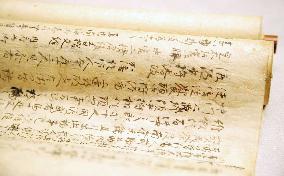
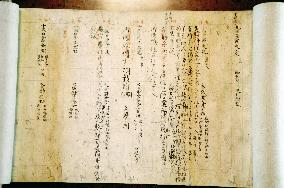
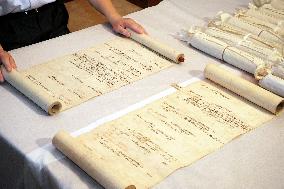
KYOTO, Japan - File photo shows part of a diary written by Japanese regent Fujiwara no Michinaga (966-1027), at Yomei Bunko, a library in Kyoto, on June 19, 2013. Known as "Midokanpakuki," the world's oldest autographic diary left 10 centuries ago has been selected for the UNESCO Memory of the World registry, the Japanese education ministry said the same day.

  •  
Diary written 10 centuries ago

Diary written 10 centuries ago

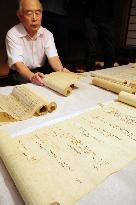
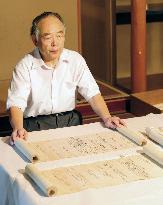
KYOTO, Japan - File photo shows Osamu Nawa, head of the Yomei Bunko library, holding a diary written by Japanese regent Fujiwara no Michinaga (966-1027), in Kyoto on June 19, 2013. Known as "Midokanpakuki," the world's oldest autographic diary left 10 centuries ago has been selected for the UNESCO Memory of the World registry, the Japanese education ministry said the same day.

  •  
Diary written 10 centuries ago

Diary written 10 centuries ago

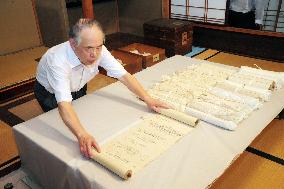
KYOTO, Japan - File photo shows Osamu Nawa, head of the Yomei Bunko library, holding a diary written by Japanese regent Fujiwara no Michinaga (966-1027), in Kyoto on June 19, 2013. Known as "Midokanpakuki," the world's oldest autographic diary left 10 centuries ago has been selected for the UNESCO Memory of the World registry, the Japanese education ministry said the same day.

  •  
Diary written 10 centuries ago

Diary written 10 centuries ago

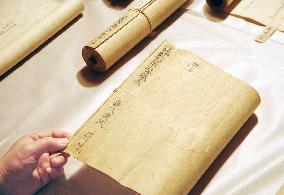
KYOTO, Japan - File photo shows part of a diary written by Japanese regent Fujiwara no Michinaga (966-1027), at Yomei Bunko, a library in Kyoto, on June 14, 2013. Known as "Midokanpakuki," the world's oldest autographic diary left 10 centuries ago has been selected for the UNESCO Memory of the World registry, the Japanese education ministry said June 19, 2013.

  •  
Diary written 10 centuries ago

Diary written 10 centuries ago

KYOTO, Japan - File photo shows part of a diary written by Japanese regent Fujiwara no Michinaga (966-1027), at Yomei Bunko, a library in Kyoto, on June 14, 2013. Known as "Midokanpakuki," the world's oldest autographic diary left 10 centuries ago has been selected for the UNESCO Memory of the World registry, the Japanese education ministry said June 19, 2013.

  •  
Diary written 10 centuries ago

Diary written 10 centuries ago

KYOTO, Japan - File photo shows a diary written by Japanese regent Fujiwara no Michinaga (966-1027), at Yomei Bunko, a library in Kyoto, on June 19, 2013. Known as "Midokanpakuki," the world's oldest autographic diary left 10 centuries ago has been selected for the UNESCO Memory of the World registry, the Japanese education ministry said the same day.

  •  
UNESCO register adds diary written 10 centuries ago

UNESCO register adds diary written 10 centuries ago

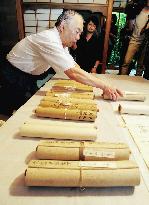
KYOTO, Japan - Osamu Nawa, head of the Yomei Bunko library, holds a diary written by Japanese regent Fujiwara no Michinaga (966-1027), in Kyoto on June 19, 2013. Known as "Midokanpakuki," the world's oldest autographic diary left 10 centuries ago has been selected for the UNESCO Memory of the World registry, the Japanese education ministry said the same day.

  •  
UNESCO register adds diary written 10 centuries ago

UNESCO register adds diary written 10 centuries ago

KYOTO, Japan - Osamu Nawa, head of the Yomei Bunko library, holds a diary written by Japanese regent Fujiwara no Michinaga (966-1027), in Kyoto on June 19, 2013. Known as "Midokanpakuki," the world's oldest autographic diary left 10 centuries ago has been selected for the UNESCO Memory of the World registry, the Japanese education ministry said the same day.

  •  
Prince Shotoku Taishi - son of 31st Emperor Yomei-tenno

Prince Shotoku Taishi - son of 31st Emperor Yomei-tenno

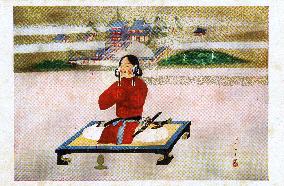
Prince Shotoku (574622) - also known as Prince Umayado or Prince Kamitsumiya - a semi-legendary regent and a politician of the Asuka period in Japan who served under Empress Suiko. The son of Emperor Yomei and his consort, Princess Anahobe no Hashihito, Shotoku commissioned the Shitenno-ji (temple) in Settsu Province (present-day Osaka) after his military victory against the powerful Mononobe clan. The Prince was an ardent Buddhist and is traditionally attributed the authorship of the Sangyo Gisho or "Annotated Commentaries on the Three Sutras". Date: 7th century

  •  
The Karamon Gate,Toshogu Shrine,Nikko

The Karamon Gate,Toshogu Shrine,Nikko

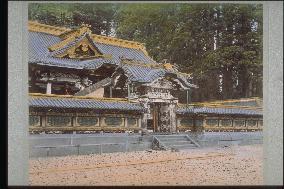
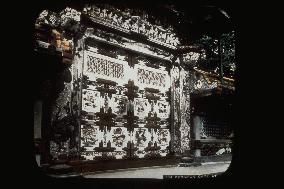
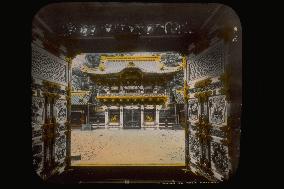
The Kara Gate stands at the front when going through the Yomei Gate of Toshogu. It looks simple with just white and black, but the sculpture of the Chinese sages carved on panels near the ceiling, and the pillars of the gate are covered with elaborate carvings of dragons going upstream and downstream. The see-through walls of the main building are covered with gold, magnificent with copper pheasants in the upper tier and waterfowl in the lower layer.==Date:unknown, Place:Nikko, Photo:Ogawa Kazumasa, (Credit:Nagasaki University Library/Kyodo News Images) [Cabinet Number10‐3‐0]

  •  
The bell tower,Toshogu Shrine,Nikko

The bell tower,Toshogu Shrine,Nikko

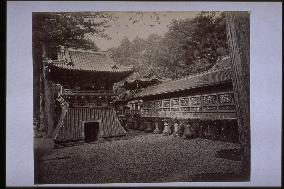
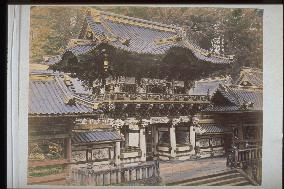
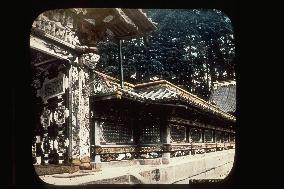
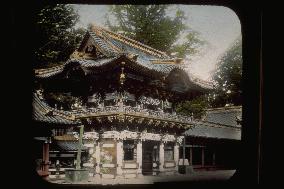
The building on the left, the Bell Tower, is decorated with 78 carvings including depictions of dragons, flying dragons, cranes, kirin (legendary Chinese beast), and waves. The Bell Tower and Drum Tower stand next to each other, and between them is Yomei Gate. The gate is visible in the centre, and the east corridor covered with carvings stretches to the right.==Date:unknown, Place:Nikko, Photo:R. Stillfried, (Credit:Nagasaki University Library/Kyodo News Images) [Cabinet Number96‐102‐0]

  •  
The Yomeimon Gate,Toshogu Shrine,Nikko

The Yomeimon Gate,Toshogu Shrine,Nikko

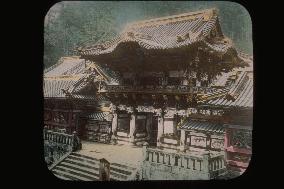
The back of Yomei Gate is seen from the Kitoden (shrine office) area. The symbol of Nikko Toshogu, Yomeimon features craftsmanship and decorative artistic techniques characteristic of the early Edo Period. There are 508 carvings on the gate. It is also called Higurashimon (Evening Falling Gate) because visitors can stand looking at it all day long and still not tire of its beauty.==Date:unknown, Place:Nikko, Photo:unknown, (Credit:Nagasaki University Library/Kyodo News Images) [Cabinet Number96‐98‐0]

  •  
The bell tower,Toshogu Shrine,Nikko

The bell tower,Toshogu Shrine,Nikko

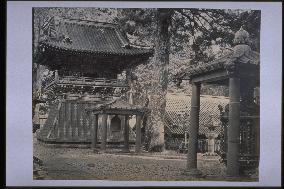
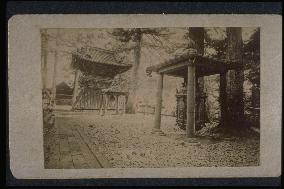
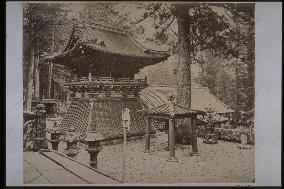
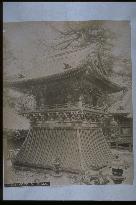
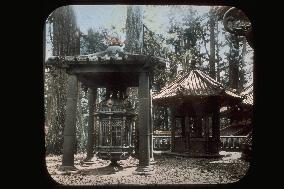
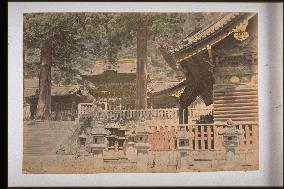
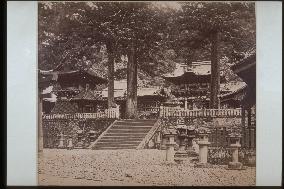
The building on the left is the Bell Tower located in front of Yomei Gate at Nikko Toshogu Shrine. The roofed structure with four pillars houses the Korean Bell. There is a stand-type lotus lantern to the right of the bell. At the far right is the octagonal revolving lantern presented to Japan by the Netherlands in the Edo Period. The roof of Kamijinko is also visible.==Date:unknown, Place:Nikko, Photo:unknown, (Credit:Nagasaki University Library/Kyodo News Images) [Cabinet Number96‐95‐0]

  •  
Near the Nino-torii (the second gate),Toshogu Shrine,Nikko

Near the Nino-torii (the second gate),Toshogu Shrine,Nikko

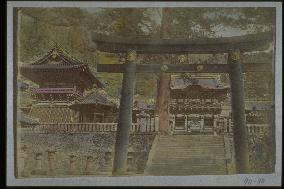
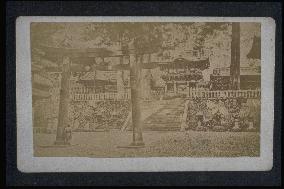
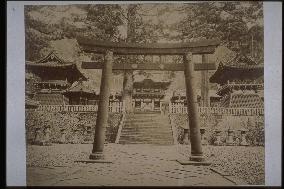
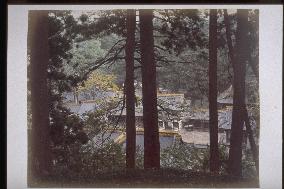
Yomei Gate is seen through Karagane Torii, next to Omizuya in the precincts of Toshogu. The first bronze torii gate in Japan, Karagane Torii was built by the third shogun Tokugawa Iemitsu. The building on the left is the Drum Tower, and to the right of it is the building where hanging lanterns are kept. Karamon is partially visible through Yomei Gate.==Date:unknown, Place:Nikko, Photo:unknown, (Credit:Nagasaki University Library/Kyodo News Images) [Cabinet Number90‐38‐0]

  •  
The Yomeimon Gate seen from the second gate,Toshogu Shrine,Nikko

The Yomeimon Gate seen from the second gate,Toshogu Shrine,Nikko

Karagane Torii is on the left. The Rinzo, a building to store Buddhist sutras, stands to the left behind the gate. The building to the right is the Drum Tower. The small structure to the right was used to store hanging lanterns. The building on the far right is the most famous structure at Nikko Toshogu, the Yomei Gate. The main shrine is behind the gate. Shinto priests are depicted going up the stairs.==Date:unknown, Place:Nikko, Photo:unknown, (Credit:Nagasaki University Library/Kyodo News Images) [Cabinet Number87‐18‐0]

  •  
The bell tower,Toshogu Shrine,Nikko

The bell tower,Toshogu Shrine,Nikko

The Koro (Drum Tower), located to the left of Yomei Gate at Nikko Toshogu, is decorated with 38 carvings including depictions of tortoises, dragons and clouds. Honji-do (Yakushi-do), famous for its meiryu (crying dragon) ceiling painting is visible on the right. The dragon was painted by Kano Eishin Yasunobu, but the entire building was later destroyed by fire and rebuilt. The roof visible on the left is the Rinzo (Kyozo).==Date:unknown, Place:Nikko, Photo:unknown, (Credit:Nagasaki University Library/Kyodo News Images) [Cabinet Number80‐40‐0]

  •  
The approach to Futarayama Shrine

The approach to Futarayama Shrine

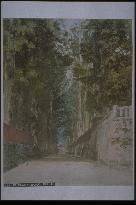
Futarasan Shinto Shrine is seen looking down Kamishin-michi road from the front of the five-story pagoda at Nikko Toshogu Shrine. The torii gate and the main building of Futarasan are visible at the end of the road. Above the embankment walls on the right are the Yomei Gate and other beautiful buildings of Toshogu.==Date:unknown, Place:Nikko, Photo:unknown, (Credit:Nagasaki University Library/Kyodo News Images) [Cabinet Number79‐19‐0]

  •  
The Dutch Lantern,Toshogu Shrine,Nikko

The Dutch Lantern,Toshogu Shrine,Nikko

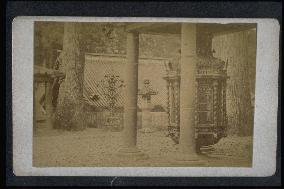
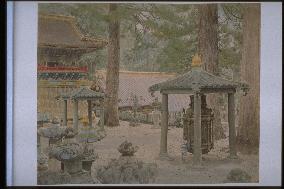
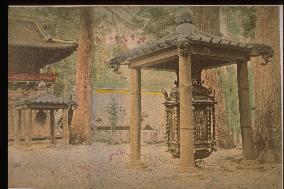
The octagonal revolving lantern was presented to Japan by the Netherlands in the Edo Period. It is visible to the right of Yomei Gate. A lotus lantern is standing in the centre back. The building on the left is the Bell Tower. The Korean Bell, which should be hanging in the roofed structure supported by four pillars, is not visible here.==Date:unknown, Place:Nikko, Photo:unknown, (Credit:Nagasaki University Library/Kyodo News Images) [Cabinet Number71‐33‐0]

  •  
The Dutch Lantern,Toshogu Shrine,Nikko

The Dutch Lantern,Toshogu Shrine,Nikko

The octagonal revolving lantern presented to Japan by the Netherlands is visible on the right in front of Yomei Gate at Nikko Toshogu. The building on the left is the Bell Tower. The Korean Bell is hanging in the roofed structure supported by four pillars. There are stone stairs to the left outside the photograph. Yomei Gate is at the end of the stairs.==Date:unknown, Place:Nikko, Photo:unknown, (Credit:Nagasaki University Library/Kyodo News Images) [Cabinet Number71‐11‐0]

  •  
The Yomeimon Gate seen from the second gate,Toshogu Shrine,Nikko

The Yomeimon Gate seen from the second gate,Toshogu Shrine,Nikko

The six meter-tall Karagane Torii is in the right foreground. The first bronze torii gate in Japan, it was built by third shogun Tokugawa Iemitsu. The Todaihoya, where hanging lanterns are stored, is visible through the gate. At the top of the stairs stands Yomei Gate, the most famous structure at Nikko Toshogu. The main shrine is inside the gate.==Date:unknown, Place:Nikko, Photo:unknown, (Credit:Nagasaki University Library/Kyodo News Images) [Cabinet Number71‐8‐0]

  •  
The bell tower,Toshogu Shrine,Nikko

The bell tower,Toshogu Shrine,Nikko

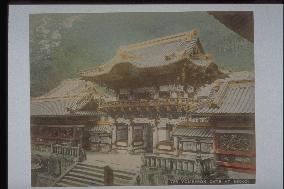
This photograph was taken from directly below Yomei Gate at Nikko Toshogu Shrine. The building on the left is the Bell Tower. The roofed structure with four pillars next to it houses the Korean Bell. There is a stand-type lotus lantern behind it. The roof of Kamijinko is visible behind.==Date:unknown, Place:Nikko, Photo:Ogawa Kazumasa, (Credit:Nagasaki University Library/Kyodo News Images) [Cabinet Number67‐37‐0]

  •  
The Dutch Lantern,Toshogu Shrine,Nikko

The Dutch Lantern,Toshogu Shrine,Nikko

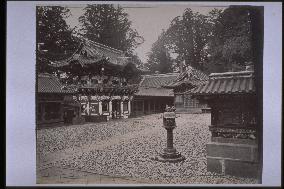
To the right, in front of Yomei Gate of Nikko Toshogu, is the octagonal revolving lantern presented to Japan by the Netherlands in the Edo Period. A lotus lantern is standing in the centre back. The building on the left is the Bell Tower. The Korean Bell, which should be hanging in the roofed structure supported by the four pillars, is not visible here.==Date:unknown, Place:Nikko, Photo:Usui Shuzaburo?, (Credit:Nagasaki University Library/Kyodo News Images) [Cabinet Number65‐26‐0]

  •  
Near the Nino-torii (the second gate),Toshogu Shrine,Nikko

Near the Nino-torii (the second gate),Toshogu Shrine,Nikko

Karagane Torii, built by third shogun Tokugawa Iemitsu, is on the left. Above it is the Drum Tower and a hanging lantern in between. Yomei Gate, the best-known building at Toshogu, is in the centre. The main shrine is behind the gate. The Bell Tower is visible to the right of the gate. Part of Kamijinko is visible on the far right.==Date:unknown, Place:Nikko, Photo:Usui Shuzaburo?, (Credit:Nagasaki University Library/Kyodo News Images) [Cabinet Number65‐12‐0]

  •  
The Yomeimon Gate seen from the second gate,Toshogu Shrine,Nikko

The Yomeimon Gate seen from the second gate,Toshogu Shrine,Nikko

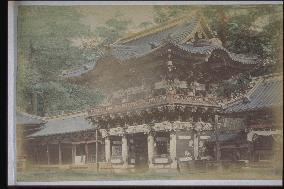
Yomei Gate is seen through Karagane Torii Gate from around Omizuya at Toshogu. The first bronze gate built in Japan, Karagane Torii was built by the third shogun Tokugawa Iemitsu. The building on the left is the Koro (Drum Tower). To the right is a building used to store hanging lanterns. The building on the right is the Bell Tower. Behind Yomei Gate is the main shrine of Nikko Toshogu.==Date:unknown, Place:Nikko, Photo:unknown, (Credit:Nagasaki University Library/Kyodo News Images) [Cabinet Number54‐41‐0]

  •  
The bell tower,Toshogu Shrine,Nikko

The bell tower,Toshogu Shrine,Nikko

The Koro (Drum Tower), located to the left of Yomei Gate at Nikko Toshogu, is decorated with 38 carvings including depictions of tortoises, dragons and clouds. Honji-do (Yakushi-do), famous for its meiryu (crying dragon) ceiling painting is visible on the right. The dragon was painted by Kano Eishin Yasunobu, but the entire building was later destroyed by fire and rebuilt. The roof visible on the left is the Rinzo (Kyozo).==Date:unknown, Place:Nikko, Photo:unknown, (Credit:Nagasaki University Library/Kyodo News Images) [Cabinet Number54‐7‐0]

  •  
Toshogu Shrine,Nikko

Toshogu Shrine,Nikko

This is a view of the Hall of Worship and Yomei Gate seen from the right side of the inner shrine at Nikko Toshogu. The sacred coffin of Tokugawa Ieyasu is placed in the pagoda in the interior. The roof of the Hall of Worship is visible in the foreground. The structure with white pillars right next to the cedars in the centre is Yomei Gate. The building on the far right is Shinyo-sha.==Date:unknown, Place:Nikko, Photo:unknown, (Credit:Nagasaki University Library/Kyodo News Images) [Cabinet Number47‐24‐0]

  •  
The Yomeimon Gate,Toshogu Shrine,Nikko

The Yomeimon Gate,Toshogu Shrine,Nikko

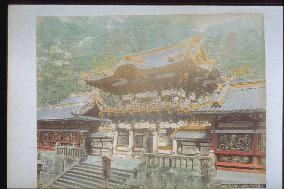
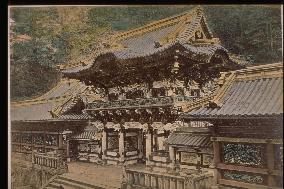
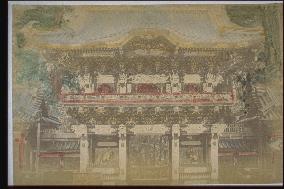
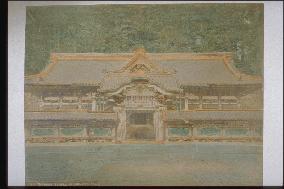
The facade of the Yomei Gate. A panel with the autograph of the Emperor Gosuio is hung in the center, and the upper layer is covered with carvings of dragons and the lower layer us covered with carvings of Chinese lions. The wall to the left and right is placed a statue of Zuishin. The wing moat to the right and left and the corridor connected to it has carvings in brilliant colors.==Date:unknown, Place:Nikko, Photo:Suzuki Shin-ichi, (Credit:Nagasaki University Library/Kyodo News Images) [Cabinet Number41‐3‐0]

  •  
Dutch lantern and bell at Nikko Toshogu Shrine

Dutch lantern and bell at Nikko Toshogu Shrine

Within the compounds in front of the Yomei gate on the Honchido side is the drum tower of skirt wearing style and the turning and hanging lanterns donated by the King of the Netherlands. A person is trying to turn the turning lantern, which has an inverse emblem of the aoi (mallow), so it is also called the turning lantern with the Sakasa mon (inverse emblem). The hanging lantern is placed over the cedar bush to the right corner.==Date:unknown, Place:Nikko, Photo:Suzuki Shin-ichi, (Credit:Nagasaki University Library/Kyodo News Images) [Cabinet Number41‐2‐0]

  •  
The Yomeimon Gate,Toshogu Shrine,Nikko

The Yomeimon Gate,Toshogu Shrine,Nikko

The facade of the Yomei Gate. A panel with the autograph of the Emperor Gosuio is hung in the center, and the upper layer is covered with carvings of dragons and the lower layer is covered with carvings of Chinese lions. The wall to the left and right is placed a statue of Zuishin. The wing moat to the right and left and the corridor connected to it has carvings in brilliant colors.==Date:unknown, Place:Nikko, Photo:Kusakabe Kinbei, (Credit:Nagasaki University Library/Kyodo News Images) [Cabinet Number40‐10‐0]

  •  
The Karamon Gate,Toshogu Shrine,Nikko

The Karamon Gate,Toshogu Shrine,Nikko

The Kara Gate is at the front when going through the Yomei Gate at Toshogu. It looks simple with only black and white used, but the statues of Chinese saints carved in the girders and the climbing and descending dragons cover the pillars to the right and left. A see-through fence with vertically crossing lattice surrounds the main building.==Date:unknown, Place:Nikko, Photo:unknown, (Credit:Nagasaki University Library/Kyodo News Images) [Cabinet Number31‐64‐0]

  •  
The Karamon Gate,Toshogu Shrine,Nikko

The Karamon Gate,Toshogu Shrine,Nikko

The Kara Gate is at the front when going through the Yomei Gate at Toshogu. It looks simple with only black and white used, but the statues of Chinese saints carved in the girders and the climbing and descending dragons cover the pillars to the right and left. A see-through fence with vertically crossing lattice surrounds the main building.==Date:unknown, Place:Nikko, Photo:unknown, (Credit:Nagasaki University Library/Kyodo News Images) [Cabinet Number31‐47‐0]

  •  
The Yomeimon Gate,Toshogu Shrine,Nikko

The Yomeimon Gate,Toshogu Shrine,Nikko

The facade of the Yomei Gate. A panel with calligraphy by Emperor Gosuio is seen in the centre, and the upper part of the gate is covered with dragon carvings, and the lower layer with lion carvings. Statues of auillary deities flank the walls. The colours of the carving in the side wall and surrounding corridor are magnificent.==Date:unknown, Place:Nikko, Photo:unknown, (Credit:Nagasaki University Library/Kyodo News Images) [Cabinet Number31‐29‐0]

  •  
The Dutch Lantern,Toshogu Shrine,Nikko

The Dutch Lantern,Toshogu Shrine,Nikko

The turning and hanging lanterns donated by the Dutch King is placed by the Honchido in front of the Yomei Gate. The Aoi (mallow) emblem is upside down, so it is also called the turning lantern of Sakasa Mon (upside-down emblem). The hanging lantern has a eight-sided hip roof and is covered with a bronze net.==Date:unknown, Place:Nikko, Photo:unknown, (Credit:Nagasaki University Library/Kyodo News Images) [Cabinet Number31‐24‐0]

  •  
The Yomeimon Gate,Toshogu Shrine,Nikko

The Yomeimon Gate,Toshogu Shrine,Nikko

The Yomei Gate from the direction of the Toshogu Kara Gate. The upper layer of the gate is covered with carvings of dragons and the lower layer with lions, supported by twelve white pillars. To the left and right are one-sided carvings of peonies. The corridor leading to the side wall surround the main building.==Date:unknown, Place:Nikko, Photo:unknown, (Credit:Nagasaki University Library/Kyodo News Images) [Cabinet Number31‐18‐0]

  •  
Yomeimon gate from karamon gate of nikko toshogu shrine

Yomeimon gate from karamon gate of nikko toshogu shrine

A view of the back of the Yomei Gate from the Toshogu Hall of Worship. The Kara Gate consists of yosegizaiku (wooden mosaic). The pillars have statues carved with Chinese saints. Korean dogs are placed at the back of the Yomei Gate on both sides.==Date:unknown, Place:Nikko, Photo:unknown, (Credit:Nagasaki University Library/Kyodo News Images) [Cabinet Number31‐10‐0]

  •  
Pricincts of nikko toshogu shrine

Pricincts of nikko toshogu shrine

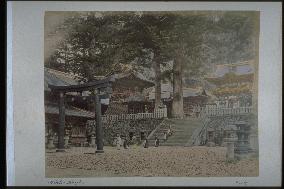
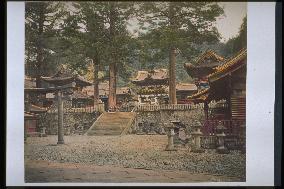
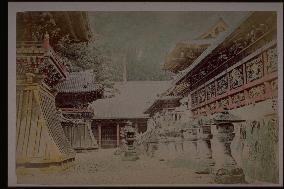
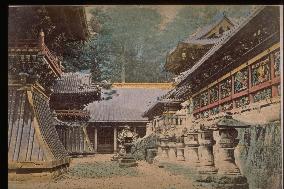
Climbing up the stone steps, visitors arrive in the compounds of the Yomei Gate. To the left is the drum tower, and by that is the hanging lantern and turning lantern donated by the Netherlands. On both sides of the stone steps are the lanterns donated by the Shimazu and Date families. To the corner right is the roof of the Kamijinko.==Date:unknown, Place:Nikko, Photo:[R. Stillfried], (Credit:Nagasaki University Library/Kyodo News Images) [Cabinet Number27‐7‐0]

  •  
The Kamijinko (sacred storehouse),Toshogu Shrine,Nikko

The Kamijinko (sacred storehouse),Toshogu Shrine,Nikko

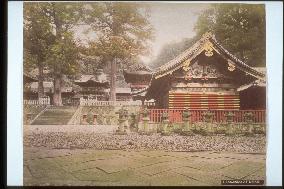
To the left is the Yomei Gate and the Bell Tower, and to the right is the Joshinko. The Joshinko is built in Azekura style with carvings of a white and black elephant roughly sketched by Kano Tanyu. On both sides of the staircase, lanterns donated by feudal lords are placed. The picture is the same as the picture numbered 6-23.==Date:unknown, Place:Nikko, Photo:unknown, (Credit:Nagasaki University Library/Kyodo News Images) [Cabinet Number24‐44‐0]

  •  
The Karamon Gate,Toshogu Shrine,Nikko

The Karamon Gate,Toshogu Shrine,Nikko

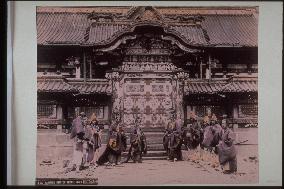
The Kara gate stands when going through the Yomei Gate of the Toshogu. Toshogu Gakujin in full dress stand in front of the Kara gate. The English inscription of Iemitsu temple is wrong.==Date:unknown, Place:Nikko, Photo:unknown, (Credit:Nagasaki University Library/Kyodo News Images) [Cabinet Number24‐12‐0]

  •  
The open-work wall beside karamon gate of nikko toshogu shrine

The open-work wall beside karamon gate of nikko toshogu shrine

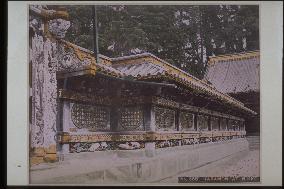
The Kara Gate stands inside the Yomei Gate at Toshogu. The see-through crossed walls surrounding the main building in laid with gold has quails on the upper layer and water fowl carved in the lower layer. On the left and right pillars are carvings of climbing and descending dragons.==Date:unknown, Place:Nikko, Photo:unknown, (Credit:Nagasaki University Library/Kyodo News Images) [Cabinet Number24‐13‐0]

  •  
The Yomeimon Gate,Toshogu Shrine,Nikko

The Yomeimon Gate,Toshogu Shrine,Nikko

The facade of the Yomei gate. A plaque with calligraphy by Emperor Omizuo is placed in the centre, and the upper tier of the gate is covered with carvings of dragons, and the lower tier with Chinese lions. Statues of Zuishin are placed to the right and left of the niche. The walls of the corridor are divided by red-painted pillars, and have flowers and birds in the upper tier and water quails in the lower tier.==Date:unknown, Place:Nikko, Photo:unknown, (Credit:Nagasaki University Library/Kyodo News Images) [Cabinet Number16‐39‐0]

  •  
The Yomeimon Gate,Toshogu Shrine,Nikko

The Yomeimon Gate,Toshogu Shrine,Nikko

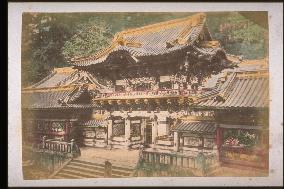
In front of the Yomei gate stand the bell tower and drum tower within the compounds to the left, and the Honjido is to the rear. It was called Honjido because the Yakushinyorai, the honjibutsu (main Buddha of worship) of Tokugawa Ieyasu, was enshrined there, but at present it is called Yakushido. A dragon is painted on the ceiling, and when one claps, the ceiling echoes, so it is called nakiryu (crying dragon). The steps to the Yomei gate and corridor are seen to the right.==Date:unknown, Place:Nikko, Photo:unknown, (Credit:Nagasaki University Library/Kyodo News Images) [Cabinet Number15‐31‐0]

  •  
The Yomeimon Gate,Toshogu Shrine,Nikko

The Yomeimon Gate,Toshogu Shrine,Nikko

The front of the Yomei Gate. There is plaque with calligraphy by Emperor Omizuo in the centre, and the upper tier of the gate is covered with carvings of dragons and the lower tier is covered with Chinese lions. On the left and right walls are statues of Zuishin. The corridor to the right and left are divided by red-painted pillars, with flowers and birds carved in the upper parts and water quail in the lower parts.==Date:unknown, Place:Nikko, Photo:unknown, (Credit:Nagasaki University Library/Kyodo News Images) [Cabinet Number14‐12‐0]

  •  
The Yomeimon Gate,Toshogu Shrine,Nikko

The Yomeimon Gate,Toshogu Shrine,Nikko

In front of the Yomei gate stand the bell tower and the drum tower within the compounds to the left, and the Honjido to the rear. It was called Honjido because the Yakushi nyorai, which was the main Buddha of worship of Tokugawa Ieyasu, was enshrined there, but at present it is called Yakushido. A dragon is painted on the ceiling, and when visitors clap, the sound echoes. The painting is thus called nakiryu (crying dragon). The steps to the Yomei gate and corridor are seen to the right.==Date:unknown, Place:Nikko, Photo:unknown, (Credit:Nagasaki University Library/Kyodo News Images) [Cabinet Number14‐13‐0]

  •  
The Dutch Lantern,Toshogu Shrine,Nikko

The Dutch Lantern,Toshogu Shrine,Nikko

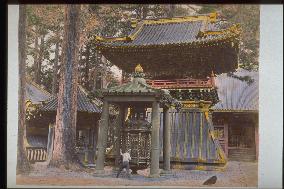
The temple compounds in front of the Yomei Gate from the side of the Honchido. The turning lantern donated by the Dutch King is placed to the right corner, and the lotus lantern donated by the King of Ryukyu is placed in the centre. On the left is a bell donated by the Kinf of Korea. There is a small opening at the top of the bell which looks as if it were eaten by a bug, and so it is called Mushikui kane (bug-eaten bell).==Date:unknown, Place:Nikko, Photo:unknown, (Credit:Nagasaki University Library/Kyodo News Images) [Cabinet Number14‐10‐0]

  •  
The Yomeimon Gate,Toshogu Shrine,Nikko

The Yomeimon Gate,Toshogu Shrine,Nikko

The Yomei Gate seen from the sanshinko. The steel lantern to the right of the staircase was donated by Date Masamune. Above the stairs to the right is the lotus lantern donated by the Netherlands and a bell presented by the King of Korea. The Kamijinko is seen at the right edge built in Azekura style. The eaves have sculptures of a white and black elephant based on the rough draft by Kano Tanyu.==Date:unknown, Place:Nikko, Photo:unknown, (Credit:Nagasaki University Library/Kyodo News Images) [Cabinet Number13‐23‐0]

  •  
The Yomeimon Gate,Toshogu Shrine,Nikko

The Yomeimon Gate,Toshogu Shrine,Nikko

The Yomei Gate from the worship hall side of Toshogu. The upper tier of the gate is covered with dragon carvings and the lower tier with Chinese lion carvings. The peony carvings on the right and left panels are magnificent. To the right and left walls are amainu (lions) and komainu (Korean dogs). On the right edge is a mikoshi hut with a drop curtain.==Date:unknown, Place:Nikko, Photo:unknown, (Credit:Nagasaki University Library/Kyodo News Images) [Cabinet Number12‐7‐0]

  •  
The Yomeimon Gate,Toshogu Shrine,Nikko

The Yomeimon Gate,Toshogu Shrine,Nikko

The Yomei Gate from the worship hall side of Toshogu. The upper tier of the gate is covered with dragon carvings and the lower tier with Chinese lion carvings. It is supported by twelve white pillars. To the right and left walls are Amainu (lions) and Komainu (Korean dogs). One of the inner pillars of the gate has a decorated pattern upside down to avoid bad luck. The colouring is rough.==Date:unknown, Place:Nikko, Photo:unknown, (Credit:Nagasaki University Library/Kyodo News Images) [Cabinet Number12‐3‐0]

  •  
The Yomeimon Gate,Toshogu Shrine,Nikko

The Yomeimon Gate,Toshogu Shrine,Nikko

The front of the Yomei gate. In the centre is a panel with callography by Emperor Omizuo. The upper tier is covered with carved dragons, and the lower tier is covered with sculptures of Chinese lions. The Zuishin statues are placed in the walls to the right and left. The corridors are divided by red-painted pillars, and flowers and birds are carved in the upper panel and waterfowl in the lower panel.==Date:unknown, Place:Nikko, Photo:Tamamura Kozaburo, (Credit:Nagasaki University Library/Kyodo News Images) [Cabinet Number11‐11‐0]

  •  
The Yomeimon Gate,Toshogu Shrine,Nikko

The Yomeimon Gate,Toshogu Shrine,Nikko

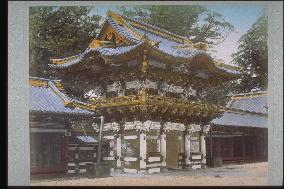
The Yomei Gate from the Hall of Worship at Toshogu. The upper tier of the gate is covered with carved dragons, and the lower tier with carved lions. It is supported by 12 white pillars. The peony carved on the surface of the barge board is magnificent. The walls to the right and left are beautiful. The corridors to the east and west surround the Gohonsha. The roof of the Honchido is seen to the right .==Date:unknown, Place:Nikko, Photo:Ogawa Kazumasa, (Credit:Nagasaki University Library/Kyodo News Images) [Cabinet Number10‐2‐0]

  •  
The Karamon Gate,Toshogu Shrine,Nikko

The Karamon Gate,Toshogu Shrine,Nikko

The Kara Gate stands in front after going through the Yomei Gate of Toshogu. Although it looks simple with only white and black colours used, it has statues of Chinese sages carved in the transom and other intricate carvings of dragons going upstream and downstream on the pillars of the gate. It is magnificent with its gold inlay on the see-through walls, which have copper pheasants carved in the upper tier and waterfowl in the lower tier.==Date:unknown, Place:Nikko, Photo:Ogawa Kazumasa, (Credit:Nagasaki University Library/Kyodo News Images) [Cabinet Number8‐44‐0]

  • Main
  • Top
  • Editorial
  • Creative
  • About Us
  • About ILG
  • Terms of use
  • Company
  • BEHIND
  • Price List
  • Single Plan
  • Monthly Plan
  • Services
  • Shooting
  • Rights Clearance
  • Support
  • FAQ
  • How To Buy
  • Contact Us
  • Become a Partner

© KYODO NEWS IMAGES INC

All Rights Reserved.

  • Editorial
  • Olympics
  • News
  • Sports
  • Japan
  • Tech
  • Royal
  • Disaster
  • NorthKorea
  • Old Japan
  • SNS
  • Creative
  • Food
  • Japan
  • Landscape
  • Animal
  • Popular
  • #Ukraine
  • #Russia
  • #coronavirus
  • #N. Korea
  • #Thailand
  • #China
  • #Ukraine
  • #Russia
  • #coronavirus
  • #N. Korea
  • #Thailand
  • #China
  • Food
  • Japan
  • Landscape
  • Animal
  • Olympics
  • News
  • Sports
  • Japan
  • Tech
  • Royal
  • Disaster
  • NorthKorea
  • Old Japan
  • SNS