•  
Pope Leo XIV Visits Vatican’s Astronomical Observatory - Ital

Pope Leo XIV Visits Vatican’s Astronomical Observatory - Ital

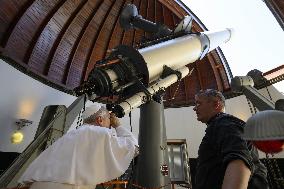
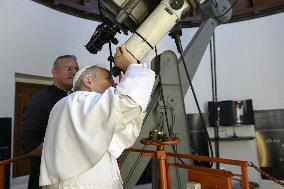
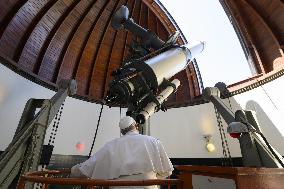
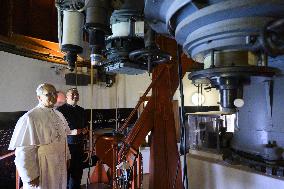
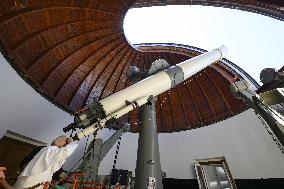
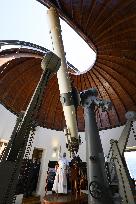
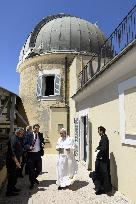
Pope Leo XIV visits the Vatican’s Astronomical Observatory (or Specola Vaticana) in Castel Gandolfo, near Rome, Italy, where he is on holidays on July 20, 2025. The Specola Vaticana can be considered one of the oldest astronomical observatories in the world. Its origins date back to the second half of the 16th century, when Pope Gregory XIII had the Tower of Winds built in the Vatican in 1578, and invited Jesuit astronomers and mathematicians of the Roman College to prepare a reform of the calendar, which had been promulgated in 1582. Since then, with significant continuity, the Holy See has never stopped showing an interest in and supporting astronomical research. Pius XI thus ordered that the Specola be transferred to his summer residence at Castel Gandolfo on the Alban Hills, some 25 kilometres south of Rome. In that environment so rich in history, a modern Observatory was re-founded and entrusted to Jesuits in 1935. It was equipped with three new telescopes and a laboratory for astrophysics, capable of sp

  •  
Pope Leo XIV Visits Vatican’s Astronomical Observatory - Ital

Pope Leo XIV Visits Vatican’s Astronomical Observatory - Ital

Pope Leo XIV visits the Vatican’s Astronomical Observatory (or Specola Vaticana) in Castel Gandolfo, near Rome, Italy, where he is on holidays on July 20, 2025. The Specola Vaticana can be considered one of the oldest astronomical observatories in the world. Its origins date back to the second half of the 16th century, when Pope Gregory XIII had the Tower of Winds built in the Vatican in 1578, and invited Jesuit astronomers and mathematicians of the Roman College to prepare a reform of the calendar, which had been promulgated in 1582. Since then, with significant continuity, the Holy See has never stopped showing an interest in and supporting astronomical research. Pius XI thus ordered that the Specola be transferred to his summer residence at Castel Gandolfo on the Alban Hills, some 25 kilometres south of Rome. In that environment so rich in history, a modern Observatory was re-founded and entrusted to Jesuits in 1935. It was equipped with three new telescopes and a laboratory for astrophysics, capable of sp

  •  
Pope Leo XIV Visits Vatican’s Astronomical Observatory - Ital

Pope Leo XIV Visits Vatican’s Astronomical Observatory - Ital

Pope Leo XIV visits the Vatican’s Astronomical Observatory (or Specola Vaticana) in Castel Gandolfo, near Rome, Italy, where he is on holidays on July 20, 2025. The Specola Vaticana can be considered one of the oldest astronomical observatories in the world. Its origins date back to the second half of the 16th century, when Pope Gregory XIII had the Tower of Winds built in the Vatican in 1578, and invited Jesuit astronomers and mathematicians of the Roman College to prepare a reform of the calendar, which had been promulgated in 1582. Since then, with significant continuity, the Holy See has never stopped showing an interest in and supporting astronomical research. Pius XI thus ordered that the Specola be transferred to his summer residence at Castel Gandolfo on the Alban Hills, some 25 kilometres south of Rome. In that environment so rich in history, a modern Observatory was re-founded and entrusted to Jesuits in 1935. It was equipped with three new telescopes and a laboratory for astrophysics, capable of sp

  •  
Pope Leo XIV Visits Vatican’s Astronomical Observatory - Ital

Pope Leo XIV Visits Vatican’s Astronomical Observatory - Ital

Pope Leo XIV visits the Vatican’s Astronomical Observatory (or Specola Vaticana) in Castel Gandolfo, near Rome, Italy, where he is on holidays on July 20, 2025. The Specola Vaticana can be considered one of the oldest astronomical observatories in the world. Its origins date back to the second half of the 16th century, when Pope Gregory XIII had the Tower of Winds built in the Vatican in 1578, and invited Jesuit astronomers and mathematicians of the Roman College to prepare a reform of the calendar, which had been promulgated in 1582. Since then, with significant continuity, the Holy See has never stopped showing an interest in and supporting astronomical research. Pius XI thus ordered that the Specola be transferred to his summer residence at Castel Gandolfo on the Alban Hills, some 25 kilometres south of Rome. In that environment so rich in history, a modern Observatory was re-founded and entrusted to Jesuits in 1935. It was equipped with three new telescopes and a laboratory for astrophysics, capable of sp

  •  
Pope Leo XIV Visits Vatican’s Astronomical Observatory - Ital

Pope Leo XIV Visits Vatican’s Astronomical Observatory - Ital

Pope Leo XIV visits the Vatican’s Astronomical Observatory (or Specola Vaticana) in Castel Gandolfo, near Rome, Italy, where he is on holidays on July 20, 2025. The Specola Vaticana can be considered one of the oldest astronomical observatories in the world. Its origins date back to the second half of the 16th century, when Pope Gregory XIII had the Tower of Winds built in the Vatican in 1578, and invited Jesuit astronomers and mathematicians of the Roman College to prepare a reform of the calendar, which had been promulgated in 1582. Since then, with significant continuity, the Holy See has never stopped showing an interest in and supporting astronomical research. Pius XI thus ordered that the Specola be transferred to his summer residence at Castel Gandolfo on the Alban Hills, some 25 kilometres south of Rome. In that environment so rich in history, a modern Observatory was re-founded and entrusted to Jesuits in 1935. It was equipped with three new telescopes and a laboratory for astrophysics, capable of sp

  •  
Pope Leo XIV Visits Vatican’s Astronomical Observatory - Ital

Pope Leo XIV Visits Vatican’s Astronomical Observatory - Ital

Pope Leo XIV visits the Vatican’s Astronomical Observatory (or Specola Vaticana) in Castel Gandolfo, near Rome, Italy, where he is on holidays on July 20, 2025. The Specola Vaticana can be considered one of the oldest astronomical observatories in the world. Its origins date back to the second half of the 16th century, when Pope Gregory XIII had the Tower of Winds built in the Vatican in 1578, and invited Jesuit astronomers and mathematicians of the Roman College to prepare a reform of the calendar, which had been promulgated in 1582. Since then, with significant continuity, the Holy See has never stopped showing an interest in and supporting astronomical research. Pius XI thus ordered that the Specola be transferred to his summer residence at Castel Gandolfo on the Alban Hills, some 25 kilometres south of Rome. In that environment so rich in history, a modern Observatory was re-founded and entrusted to Jesuits in 1935. It was equipped with three new telescopes and a laboratory for astrophysics, capable of sp

  •  
Pope Leo XIV Visits Vatican’s Astronomical Observatory - Ital

Pope Leo XIV Visits Vatican’s Astronomical Observatory - Ital

Pope Leo XIV visits the Vatican’s Astronomical Observatory (or Specola Vaticana) in Castel Gandolfo, near Rome, Italy, where he is on holidays on July 20, 2025. The Specola Vaticana can be considered one of the oldest astronomical observatories in the world. Its origins date back to the second half of the 16th century, when Pope Gregory XIII had the Tower of Winds built in the Vatican in 1578, and invited Jesuit astronomers and mathematicians of the Roman College to prepare a reform of the calendar, which had been promulgated in 1582. Since then, with significant continuity, the Holy See has never stopped showing an interest in and supporting astronomical research. Pius XI thus ordered that the Specola be transferred to his summer residence at Castel Gandolfo on the Alban Hills, some 25 kilometres south of Rome. In that environment so rich in history, a modern Observatory was re-founded and entrusted to Jesuits in 1935. It was equipped with three new telescopes and a laboratory for astrophysics, capable of sp

  •  
Pope Leo Receives In Private Audience - Vatican

Pope Leo Receives In Private Audience - Vatican

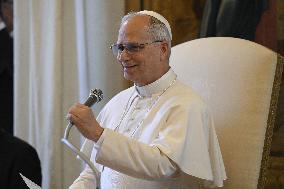
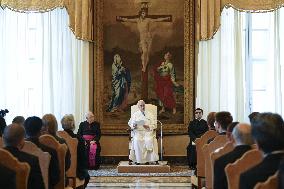
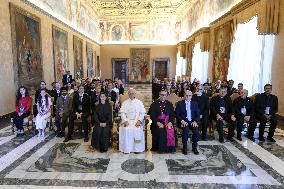
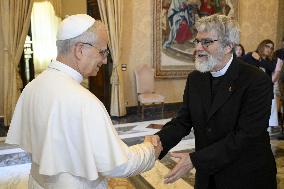
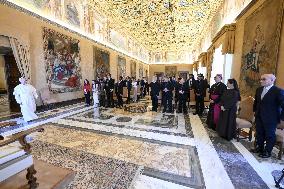
Pope Leo XIV receives in private audience Participants in the Astrophysics Summer School sponsored by the Specola Vaticana at the Vatican, on June 16, 2025. Photo by Vatican Media/CPP/IPA/ABACAPRESS.COM

  •  
Pope Leo Receives In Private Audience - Vatican

Pope Leo Receives In Private Audience - Vatican

Pope Leo XIV receives in private audience Participants in the Astrophysics Summer School sponsored by the Specola Vaticana at the Vatican, on June 16, 2025. Photo by Vatican Media/CPP/IPA/ABACAPRESS.COM

  •  
Pope Leo Receives In Private Audience - Vatican

Pope Leo Receives In Private Audience - Vatican

Pope Leo XIV receives in private audience Participants in the Astrophysics Summer School sponsored by the Specola Vaticana at the Vatican, on June 16, 2025. Photo by Vatican Media/CPP/IPA/ABACAPRESS.COM

  •  
Pope Leo Receives In Private Audience - Vatican

Pope Leo Receives In Private Audience - Vatican

Pope Leo XIV receives in private audience Participants in the Astrophysics Summer School sponsored by the Specola Vaticana at the Vatican, on June 16, 2025. Photo by Vatican Media/CPP/IPA/ABACAPRESS.COM

  •  
Pope Leo Receives In Private Audience - Vatican

Pope Leo Receives In Private Audience - Vatican

Pope Leo XIV receives in private audience Participants in the Astrophysics Summer School sponsored by the Specola Vaticana at the Vatican, on June 16, 2025. Photo by Vatican Media/CPP/IPA/ABACAPRESS.COM

  •  
ITALY-PESCARA-CHINA-FAST TELESCOPE-ASTRONOMICAL COOPERATION-CHINA-EUROPE-NEW PLATFORM

ITALY-PESCARA-CHINA-FAST TELESCOPE-ASTRONOMICAL COOPERATION-CHINA-EUROPE-NEW PLATFORM

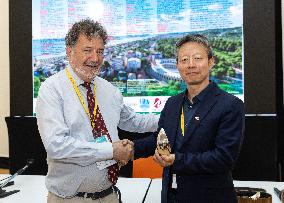
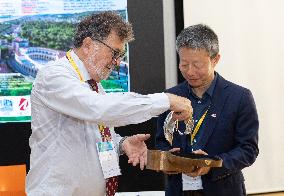
(240710) -- PESCARA (ITALY), July 10, 2024 Photo by Xinhua/ABACAPRESS.COM) -- Li Di (R), a Chinese radio astronomer and chief scientist of China's five-hundred-meter Aperture Spherical Radio Telescope (FAST), is presented the Marcel Grossmann Award by Remo Ruffini, director of the International Center for Relativistic Astrophysics Network (ICRANet), in Pescara, Italy, on July 9, 2024. The five-hundred-meter Aperture Spherical Radio Telescope (FAST) located in southwest China's Guizhou Province has yielded significant scientific results and created a new avenue for astronomical collaboration between China and European countries in recent years. Photo by Xinhua/ABACAPRESS.COM/Li Jing) TO GO WITH Feature: China's FAST telescope provides new platform for astronomical cooperation between China and European countries

  •  
ITALY-PESCARA-CHINA-FAST TELESCOPE-ASTRONOMICAL COOPERATION-CHINA-EUROPE-NEW PLATFORM

ITALY-PESCARA-CHINA-FAST TELESCOPE-ASTRONOMICAL COOPERATION-CHINA-EUROPE-NEW PLATFORM

(240710) -- PESCARA (ITALY), July 10, 2024 Photo by Xinhua/ABACAPRESS.COM) -- Li Di (R), a Chinese radio astronomer and chief scientist of China's five-hundred-meter Aperture Spherical Radio Telescope (FAST), is presented the Marcel Grossmann Award by Remo Ruffini, director of the International Center for Relativistic Astrophysics Network (ICRANet), in Pescara, Italy, on July 9, 2024. The five-hundred-meter Aperture Spherical Radio Telescope (FAST) located in southwest China's Guizhou Province has yielded significant scientific results and created a new avenue for astronomical collaboration between China and European countries in recent years. Photo by Xinhua/ABACAPRESS.COM/Li Jing) TO GO WITH Feature: China's FAST telescope provides new platform for astronomical cooperation between China and European countries

  •  

China's FAST telescope finds key evidence for nanohertz gravitational waves

STORY: China's FAST telescope finds key evidence for nanohertz gravitational waves DATELINE: June 29, 2023 LENGTH: 00:01:42 LOCATION: GUIYANG, China CATEGORY: TECHNOLOGY SHOTLIST: 1. various of FAST telescope 2. various of scientists and their research work with FAST telescope 3. various of images caught by FAST telescope STORYLINE: China's FAST telescope has found key evidence for the existence of nanohertz gravitational waves. The research, conducted by scientists from the National Astronomical Observatories of the Chinese Academy of Sciences (NAOC) and other institutes, was published in the journal Research in Astronomy and Astrophysics Thursday. Gravitational waves are the "ripples" produced by massive objects such as black holes as they rapidly move through the fabric of spacetime. The scientists monitored 57 millisecond pulsars with regular cadence for 41 months by taking advantage of the high sensitivity of FAST. Eventually, they found key evidence for quadrupole correlation signatures compatibl

  •  
CHINA-BEIJING-GRAVITATIONAL WAVE-RESEARCHER (CN)

CHINA-BEIJING-GRAVITATIONAL WAVE-RESEARCHER (CN)

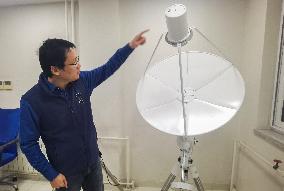
(230420) -- BEIJING, April 20, 2023 (Xinhua) -- Shao Lijing, researcher from the Kavli Institute for Astronomy and Astrophysics at Peking University, demonstrates how a radio telescope works at Peking University in Beijing, capital of China, on Nov. 1, 2022. TO GO WITH "Profile: Exploring mysteries of gravity in 'cosmic laboratory'" (Xinhua/Yu Fei)

  •  
CHINA-BEIJING-GRAVITATIONAL WAVE-RESEARCHER (CN)

CHINA-BEIJING-GRAVITATIONAL WAVE-RESEARCHER (CN)

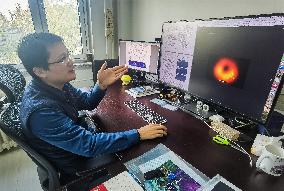
(230420) -- BEIJING, April 20, 2023 (Xinhua) -- Shao Lijing, researcher from the Kavli Institute for Astronomy and Astrophysics at Peking University, introduces an image of a black hole at Peking University in Beijing, capital of China, on Nov. 1, 2022. TO GO WITH "Profile: Exploring mysteries of gravity in 'cosmic laboratory'" (Xinhua/Yu Fei)

  •  
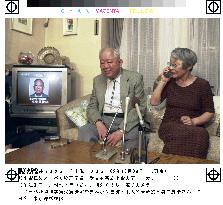
(2)Japan's Koshiba wins Nobel Prize in Physics

(2)Japan's Koshiba wins Nobel Prize in Physics

TOKYO, Japan - Physicist Masatoshi Koshiba (L) and his wife Kyoko watch a TV news program on his winning of the 2002 Nobel Prize in Physics at his home in Tokyo's Suginami Ward on Oct. 8. Koshiba, a 76-year-old professor emeritus at the University of Tokyo, and two others have won the physics prize for their contributions to astrophysics.

  •  

Italian scholar aspires to builds bridges linking countries, cultures

STORY: Italian scholar aspires to builds bridges linking countries, cultures DATELINE: Nov. 25, 2022 LENGTH: 00:02:25 LOCATION: GUANGZHOU, China CATEGORY: SOCIETY SHOTLIST: 1. various of Denis Bastieri in China 2. SOUNDBITE (English): DENIS BASTIERI, Italian scholar, chair professor of Center for astrophysics at Guangzhou University 3. various of Guangzhou, China STORYLINE: Denis Bastieri, from University of Padua in Italy, joined an exchange program in 2010 to work at Guangzhou University in south China. He aspires to build bridges linking different cultures and societies. SOUNDBITE (English): DENIS BASTIERI, Italian scholar, Professor with center for astrophysics, Guangzhou University "I am Denis Bastieri, professor at the University of Padua in Italy. I'm collaborating with China, and in particular with Guangzhou University since 2010. Originally, I'm a particle physicist. Then, later on, I was developing hardware and software to detect high-energy radiation. So I came here, because Guangzhou Universit

  •  
ROMANIA-BUCHAREST-SCIENCE & IMAGINATION CARAVAN EVENT

ROMANIA-BUCHAREST-SCIENCE & IMAGINATION CARAVAN EVENT

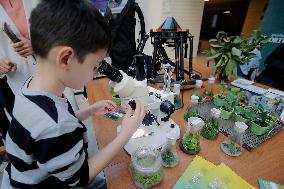
(220926) -- BUCHAREST, Sept. 26, 2022 (Xinhua) -- A child observes plant seeds through a microscope during the Science & Imagination Caravan event at Romania's National Library in Bucharest, capital of Romania, Sept. 25, 2022. The event aims to reach enthusiasts for the future of the science in the fields of astronomy, astrophysics, virtual reality, Earth physics, etc. (Photo by Cristian Cristel/Xinhua)

  •  
ROMANIA-BUCHAREST-SCIENCE & IMAGINATION CARAVAN EVENT

ROMANIA-BUCHAREST-SCIENCE & IMAGINATION CARAVAN EVENT

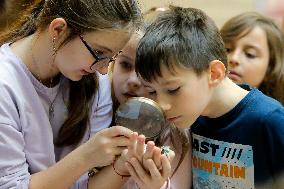
(220926) -- BUCHAREST, Sept. 26, 2022 (Xinhua) -- Children look at a rock during the Science & Imagination Caravan event at Romania's National Library in Bucharest, capital of Romania, Sept. 25, 2022. The event aims to reach enthusiasts for the future of the science in the fields of astronomy, astrophysics, virtual reality, Earth physics, etc. (Photo by Cristian Cristel/Xinhua)

  •  
(2)Japan's Koshiba wins Nobel Prize in Physics

(2)Japan's Koshiba wins Nobel Prize in Physics

TOKYO, Japan - Physicist Masatoshi Koshiba (L) and his wife Keiko watch a TV news program on his winning of the 2002 Nobel Prize in Physics at his home in Tokyo's Suginami Ward on Oct. 8. Koshiba, a 76-year-old professor emeritus at the University of Tokyo, and two others have won the physics prize for their contributions to astrophysics. (Kyodo)

  • Main
  • Top
  • Editorial
  • Creative
  • About Us
  • About ILG
  • Terms of use
  • Company
  • BEHIND
  • Price List
  • Single Plan
  • Monthly Plan
  • Services
  • Shooting
  • Rights Clearance
  • Support
  • FAQ
  • How To Buy
  • Contact Us
  • Become a Partner

© KYODO NEWS IMAGES INC

All Rights Reserved.

  • Editorial
  • Olympics
  • News
  • Sports
  • Japan
  • Tech
  • Royal
  • Disaster
  • NorthKorea
  • Old Japan
  • SNS
  • Creative
  • Food
  • Japan
  • Landscape
  • Animal
  • Popular
  • #Ukraine
  • #Thailand
  • #coronavirus
  • #N. Korea
  • #China
  • #Russia
  • #Ukraine
  • #Thailand
  • #coronavirus
  • #N. Korea
  • #China
  • #Russia
  • Food
  • Japan
  • Landscape
  • Animal
  • Olympics
  • News
  • Sports
  • Japan
  • Tech
  • Royal
  • Disaster
  • NorthKorea
  • Old Japan
  • SNS