•  
Actresses-in-the-making graduate from Takarazuka school

Actresses-in-the-making graduate from Takarazuka school

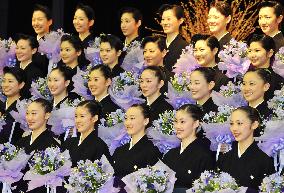
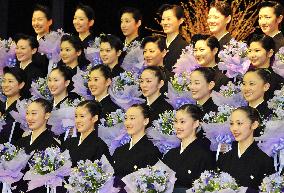
TAKARAZUKA, Japan - A total of 38 women at Takarazuka Music School, Japan's unique all-girl music academy, pose in their dark-green Japanese ''hakama'' skirts and black kimono called ''montsuki'' for a commemorative photo after a commencement ceremony at the academy in Takarazuka, Hyogo Prefecture, on March 1, 2010. After completing their two-year program at the school, they will join the renowned Takarazuka Revue and make their debut in a performance on April 16.

  •  
Archery event at Sanjusangen-do in Kyoto

Archery event at Sanjusangen-do in Kyoto

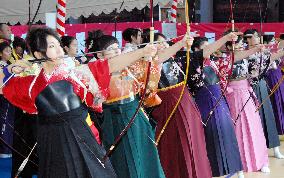
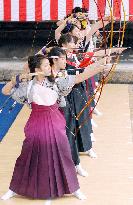
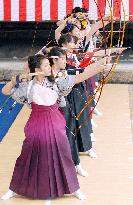
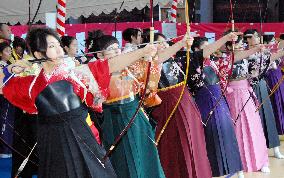
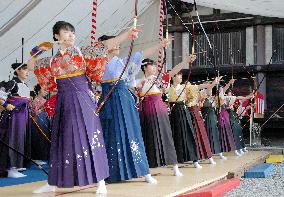
KYOTO, Japan - Young female archers dressed in traditional kimono and ''hakama'' ceremonial skirts take aim in the ''Toshiya'' arrow-shooting event at Sanjusangen-do, a Buddhist temple in Kyoto's Higashiyama district, on Jan. 17, 2010. About 2,000 people, including young archers who celebrated their coming-of-age on Jan. 11, took part in the annual event. The archers aim at hitting targets placed 60 meters away.

  •  
Archery event at Sanjusangen-do Temple in Kyoto

Archery event at Sanjusangen-do Temple in Kyoto

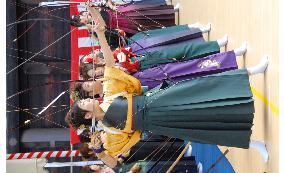
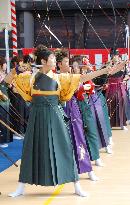
KYOTO, Japan - Young female archers dressed in traditional kimono and ''hakama'' ceremonial skirts take aim in the Toshiya arrow-shooting event at the Sanjusangen-do Temple in Kyoto on Jan. 18. About 2,000 people, including 1,800 young archers who celebrated their coming-of-age on Jan. 12, took part in the annual event. The archers aim at hitting a 1-meter bull's eye placed 60 meters away.

  •  
Archery event at Sanjusangen-do Temple in Kyoto

Archery event at Sanjusangen-do Temple in Kyoto

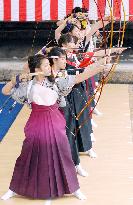
KYOTO, Japan - Young female archers dressed in traditional kimono and 'hakama' aim at the bull's eye in the Toshiya arrow-shooting event at the Sanjusangen-do Temple in Kyoto on Jan. 13. A total of 1,900 archers, young people who will celebrate their coming-of-age on Jan. 14, took part in the annual event. The archers try to hit a 1-meter bull's eye placed 60 meters away.

  •  
Koizumi pledges steps to prevent financial crisis

Koizumi pledges steps to prevent financial crisis

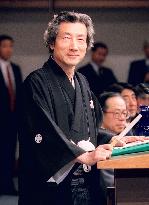
TOKYO, Japan - Prime Minister Junichiro Koizumi, dressed in a Japanese haori and hakama cloth, holds a New Year press conference at his official residence in Tokyo on Jan. 4. He promised to work to prevent a financial crisis, saying his government is prepared to take ''every possible measure'' to avert such an occurrence.

  •  
Storytellers point to stone turtle during "ghost tour" in west Japan

Storytellers point to stone turtle during "ghost tour" in west Japan

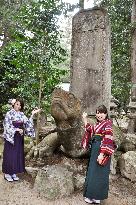
Female storytellers in traditional Japanese "hakama" costumes point to a big stone turtle as seen in this photo taken on March 24, 2015. The stone image is located midway in a "ghost tour" to visit places mentioned in the story "Kwaidan" by Greece-born writer Patrick Lafcadio Hearn, also known by the Japanese name of Koizumi Yakumo, who lived in various parts of the country until his death in 1904. (Kyodo) ==Kyodo

  •  
Students in disaster-hit city attend entrance ceremony

Students in disaster-hit city attend entrance ceremony

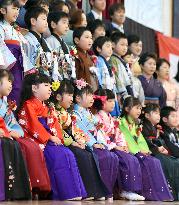
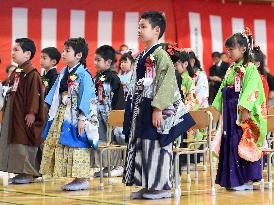
New students in traditional Japanese skirt-like trousers or "hakama" attend on April 1, 2015, an entrance ceremony for an elementary school in the northeastern Japanese city of Ofunato, severely damaged by the deadly earthquake and tsunami four years ago. (Kyodo) ==Kyodo

  •  
Students in disaster-hit city attend entrance ceremony

Students in disaster-hit city attend entrance ceremony

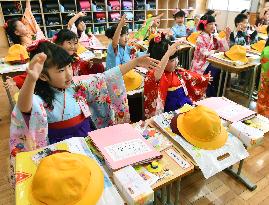
New students in traditional Japanese skirt-like trousers or "hakama" gather in a classroom on April 1, 2015, before an elementary school entrance ceremony in the northeastern Japanese city of Ofunato, heavily damaged by the deadly earthquake and tsunami four years ago. (Kyodo) ==Kyodo

  •  
Students in disaster-hit city attend entrance ceremony

Students in disaster-hit city attend entrance ceremony

New students in traditional Japanese skirt-like trousers or "hakama" attend on April 1, 2015, an entrance ceremony for an elementary school in the northeastern Japanese city of Ofunato, severely damaged by the deadly earthquake and tsunami four years ago. (Kyodo) ==Kyodo

  •  
Students in disaster-hit city attend entrance ceremony

Students in disaster-hit city attend entrance ceremony

New students in traditional Japanese skirt-like trousers or "hakama" attend on April 1, 2015, an entrance ceremony for an elementary school in the northeastern Japanese city of Ofunato, severely damaged by the deadly earthquake and tsunami four years ago. (Kyodo) ==Kyodo

  •  
Hanyu receives national honor award

Hanyu receives national honor award

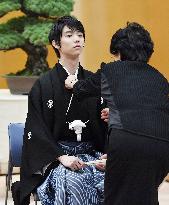
Japanese star figure skater Yuzuru Hanyu, wearing a special type of "hakama" skirt originated in his hometown Sendai, has his kimono fixed while waiting for a ceremony to begin in which he received the People's Honor Award at the prime minister's office in Tokyo on July 2, 2018. (Kyodo) ==Kyodo

  •  
Fukushima student thanks donors in N.Y. for funding outdoor programs

Fukushima student thanks donors in N.Y. for funding outdoor programs

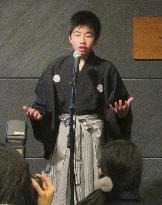
Clad in a traditional Japanese "hakama" costume, Masato Kaneko, a sixth-grade elementary school student from Fukushima Prefecture's Aizuwakamatsu city, delivers a speech in English at the Japan Society in New York on Oct. 16, 2015, thanking donors for funding nonprofit programs that enabled him and other children affected by the 2011 Fukushima Daiichi nuclear plant disaster to play outdoors in other parts of Japan not contaminated by radioactive fallout from the accident. (Kyodo) ==Kyodo

  •  
Actresses-in-the-making graduate from Takarazuka school

Actresses-in-the-making graduate from Takarazuka school

TAKARAZUKA, Japan - A total of 38 women at Takarazuka Music School, Japan's unique all-girl music academy, pose in their dark-green Japanese ''hakama'' skirts and black kimono called ''montsuki'' for a commemorative photo after a commencement ceremony at the academy in Takarazuka, Hyogo Prefecture, on March 1, 2010. After completing their two-year program at the school, they will join the renowned Takarazuka Revue and make their debut in a performance on April 16. (Kyodo)

  •  
Archery event at Sanjusangen-do Temple in Kyoto

Archery event at Sanjusangen-do Temple in Kyoto

KYOTO, Japan - Young female archers dressed in traditional kimono and ''hakama'' ceremonial skirts take aim in the Toshiya arrow-shooting event at the Sanjusangen-do Temple in Kyoto on Jan. 18. About 2,000 people, including 1,800 young archers who celebrated their coming-of-age on Jan. 12, took part in the annual event. The archers aim at hitting a 1-meter bull's eye placed 60 meters away. (Kyodo)

  •  
Archery event at Sanjusangen-do Temple in Kyoto

Archery event at Sanjusangen-do Temple in Kyoto

KYOTO, Japan - Young female archers dressed in traditional kimono and ''hakama'' ceremonial skirts take aim in the Toshiya arrow-shooting event at the Sanjusangen-do Temple in Kyoto on Jan. 18. About 2,000 people, including 1,800 young archers who celebrated their coming-of-age on Jan. 12, took part in the annual event. The archers aim at hitting a 1-meter bull's eye placed 60 meters away. (Kyodo)

  •  
Archery event at Sanjusangen-do Temple in Kyoto

Archery event at Sanjusangen-do Temple in Kyoto

KYOTO, Japan - Young female archers dressed in traditional kimono and 'hakama' aim at the bull's eye in the Toshiya arrow-shooting event at the Sanjusangen-do Temple in Kyoto on Jan. 13. A total of 1,900 archers, young people who will celebrate their coming-of-age on Jan. 14, took part in the annual event. The archers try to hit a 1-meter bull's eye placed 60 meters away. (Kyodo)

  •  
Pupils playing war at Ueno Park

Pupils playing war at Ueno Park

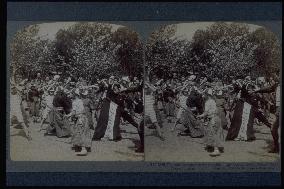
Children, possibly in elementary school, are fighting with wooden swords and tree branches, with adults watching from behind. This may be a kind of sports day. Ueno Park was the site of a battle between government and Shogitai (shogunate) troops. This photograph shows how times have changed, most notably the children's' hakama pants and sport caps.==Date:1904, Place:Tokyo, Photo:Underwood, (Credit:Nagasaki University Library/Kyodo News Images) [Cabinet Number97‐75‐0]

  •  
Kameido Shrine

Kameido Shrine

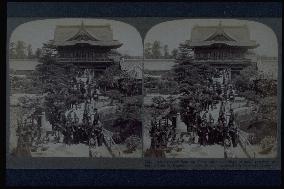
View of the Romon Gate from Taiko-bashi (Drum Bridge) located just through the torii gate at the entrance of the shrine. The five girls in hakama trousers are perhaps praying to pass a school examination. Three bridges span Shinji Pond: Taiko-bashi, Hira-bashi, and Taiko-bashi. They are said to represent the past, present, and future. This stereograph was published in 1904 by Underwood & Underwood Co.==Date:1904, Place:Tokyo, Photo:Underwood, (Credit:Nagasaki University Library/Kyodo News Images) [Cabinet Number97‐65‐0]

  •  
The Land-boat Pine Tree,Kinkakuji Temple

The Land-boat Pine Tree,Kinkakuji Temple

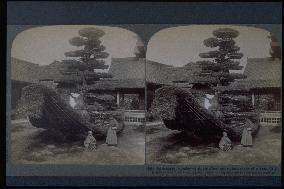
Stereograph of Rikushu-no-matsu (Land Boat Pine) of Rokuonji Temple taken from the west side of the hojo (head priest's quarters), facing west-northwest. It is said that this pine was planted by Yoshimitsu Ashikaga. The branches were formed to look like a boat. On the left is the ohjoin (large study), and the roof of the kuri is visible on the right. Two boys wearing hakama are facing each other. Taken in 1904.==Date:1904, Place:Kyoto, Photo:Underwood, (Credit:Nagasaki University Library/Kyodo News Images) [Cabinet Number97‐41‐0]

  •  
A family celebrating their child

A family celebrating their child

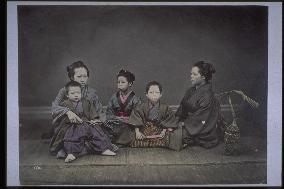
The boys are probably brothers with their older sister. They wear haori coats and hakama trousers. The woman holding the younger brother on her knees is probably the mother and the woman on the right her mother-in-law. A woven bamboo basket containing rice cakes or perhaps chimaki dumplings is nearby. This is probably a photograph to commemorate a Meiji Period Shichi-go-san children's day festival, because the padded clothing indicate early winter.==Date:unknown, Place:unknown, Photo:Usui Shuzaburo, (Credit:Nagasaki University Library/Kyodo News Images) [Cabinet Number94‐2‐0]

  •  
A samurai wearing hakama trousers and holding a bow

A samurai wearing hakama trousers and holding a bow

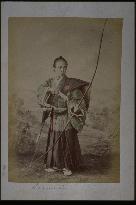
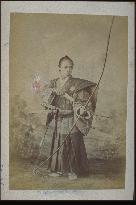
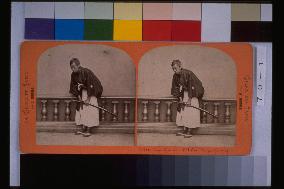
The man is wearing kamishimo ceremonial garb, an example of formal attire worn in the Edo Period. It consists of a stiff sleeveless robe and pleated loose-fitting trousers. It was worn over a crested robe or a short-sleeve kimono. The man has lowered the right shoulder portion of the kamishimo, apparently to draw a bow.==Date:unknown, Place:unknown, Photo:unknown, (Credit:Nagasaki University Library/Kyodo News Images) [Cabinet Number92‐31‐0]

  •  
A samurai warrior wearing hakama trousers

A samurai warrior wearing hakama trousers

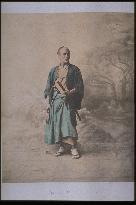
This is a photograph from an album by Farsari & Co. Entitled SAMURAI, it was staged with a man wearing a kamishimo vest and hakama trousers. He carries a samurai's big and small swords and holds a fan in his hand. The scene is altogether artificial.==Date:unknown, Place:unknown, Photo:A. Farsari, (Credit:Nagasaki University Library/Kyodo News Images) [Cabinet Number82‐60‐0]

  •  
Samurai warriors

Samurai warriors

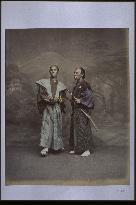
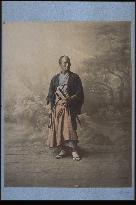
This photograph of two samurai comes from the album Views & Costumes by Stillfried & Andersen. The backdrop belongs to Stillfried's studio. Both samurai are wearing official hakama trousers and vests with family crests. The man on the left is wearing high geta clogs for rainy weather.==Date:unknown, Place:unknown, Photo:R. Stillfried, (Credit:Nagasaki University Library/Kyodo News Images) [Cabinet Number78‐70‐0]

  •  
A teahouse serving dango (dumplings)

A teahouse serving dango (dumplings)

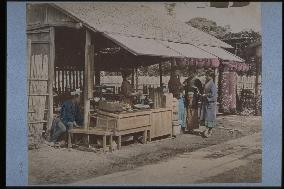
The woman has her kimono sleeves pulled up with a cord across the back. She is wearing an apron. At the store front there are long, round lanterns with the store's name written on them. The customer on the left has a modern hairstyle. The men standing are wearing haori jackets and hakama trousers with high geta clogs.==Date:unknown, Place:unknown, Photo:R. Stillfried, (Credit:Nagasaki University Library/Kyodo News Images) [Cabinet Number76‐41‐0]

  •  
A samurai warrior

A samurai warrior

This is the same as photograph #3084 but comes from the 1876 album of Stillfried. A comparison of the two photographs reveals that the hakama trousers are green in 3084 and red in this photograph, while the kimono is red in 3084 but purple in this one. It is interesting to see the differences in colouring.==Date:unknown, Place:unknown, Photo:R. Stillfried, (Credit:Nagasaki University Library/Kyodo News Images) [Cabinet Number76‐21‐0]

  •  
A man wearing hakama (traditional trousers)

A man wearing hakama (traditional trousers)

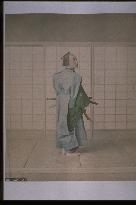
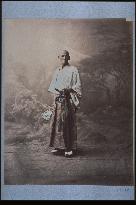
A man holds a fan in his right hand, a sword in his left hand, and a short sword at the waist. The short coat and pleated trousers were the typical casual attire of samurai.==Date:unknown, Place:unknown, Photo:R. Stillfried, (Credit:Nagasaki University Library/Kyodo News Images) [Cabinet Number76‐20‐0]

  •  
Parents and children

Parents and children

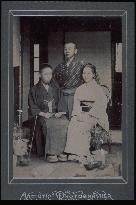
A husband and wife pose for a portrait their son. The father is wearing a kimono with a haori jacket, while the mother is wearing a kimono with a chuya-obi sash. Their son wears a crossed pattern kasuri kimono with hakama trousers.==Date:unknown, Place:unknown, Photo:unknown, (Credit:Nagasaki University Library/Kyodo News Images) [Cabinet Number72‐233‐0]

  •  
A mother and a girl

A mother and a girl

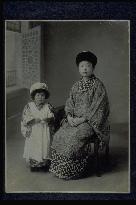
The mother wears her hair in modern hisashi-gami style, while her daughter wears a hat and apron. The costume is evocative of the mid-Meiji Period. This is a studio photograph. The hisashi-gami replaced the traditional nihon-gami and became a typical hairstyle for young women who wore maroon-coloured hakama skirts.==Date:unknown, Place:unknown, Photo:unknown, (Credit:Nagasaki University Library/Kyodo News Images) [Cabinet Number72‐190‐0]

  •  
Sisters

Sisters

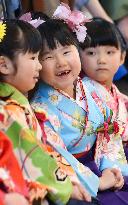
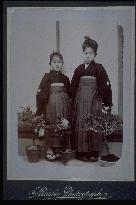
Sisters pose in hakama skirts with decorative objects in their hair. Their family crest is visible on the sleeves. The photographer may have paid a house visit on the gala festival day for children of three, five and seven years of age.==Date:unknown, Place:unknown, Photo:unknown, (Credit:Nagasaki University Library/Kyodo News Images) [Cabinet Number72‐169‐0]

  •  
Sisters

Sisters

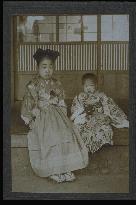
People celebrate the gala festival day for children of three, five and seven years of age. The girl on the left is wearing a hakama skirt while her sister on the right is holding a toy. Through the window panes behind them the interior of a room is partially visible. The photographer may have paid a house visit.==Date:unknown, Place:unknown, Photo:unknown, (Credit:Nagasaki University Library/Kyodo News Images) [Cabinet Number72‐167‐0]

  •  
Young brothers

Young brothers

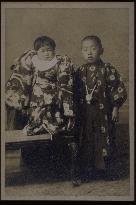
The girl on the left wears a furisode kimono. She still needs to wear a bib. An adult is holding her from behind. Her older brother wears a haori coat and hakama trousers. Only wealthy families could afford to have photographs taken in the Meiji Period.==Date:1921, Place:unknown, Photo:unknown, (Credit:Nagasaki University Library/Kyodo News Images) [Cabinet Number72‐86‐0]

  •  
Classmates

Classmates

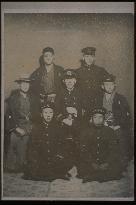
Classmates pose for a portrait in a photograph studio. Three of the seven are wearing haori jackets and hakama pants, while three others are wearing uniforms with stand-up collars. The man in the centre wearing a double-breasted jacket and holding a small knife with both hands is probably a police officer. Taken in 1905.==Date:1905, Place:Kyoto, Photo:unknown, (Credit:Nagasaki University Library/Kyodo News Images) [Cabinet Number72‐79‐0]

  •  
A memorial photo of marriage

A memorial photo of marriage

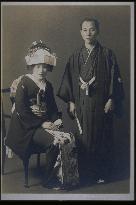
A bride and groom pose for a portrait. The bride is sitting on a chair wearing a black kimono. Cranes and flowers have been embroidered on her sash and the bottom part of her kimono. The groom is standing next to her wearing a haori jacket and hakama pants, and he holds a fan in his right hand.==Date:unknown, Place:Kyoto, Photo:unknown, (Credit:Nagasaki University Library/Kyodo News Images) [Cabinet Number72‐8‐0]

  •  
A mother and her children (the Amakasu family)

A mother and her children (the Amakasu family)

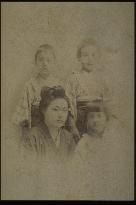
This is a family portrait. Although the image is unclear, the boys in the back seem to be wearing kimono and hakama trousers. The kimono styles indicate that the photograph was taken during summer.==Date:unknown, Place:unknown, Photo:unknown, (Credit:Nagasaki University Library/Kyodo News Images) [Cabinet Number71‐73‐0]

  •  
A mother and her children

A mother and her children

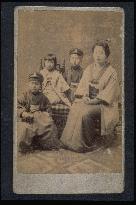
This is a family portrait. The mother and daughter are wearing kimono with haori jackets. The boys are wearing kimono, haori, hakama trousers and school hats.==Date:unknown, Place:unknown, Photo:unknown, (Credit:Nagasaki University Library/Kyodo News Images) [Cabinet Number71‐58‐0]

  •  
Samurai warriors greeting each other

Samurai warriors greeting each other

The scene of samurai exchanging greetings is recreated, with the two bowing deeply in the official attire of haori coat with family crest and hakama trousers. The Western-style handrail in the back was a fixture of the Ueno Hikoma studio in Nagasaki, where this stereograph seems to have been taken by Wilhelm Burger.==Date:Middle Meiji (1883-1897), Place:Nagasaki, Photo:Wilhelm Burger, (Credit:Nagasaki University Library/Kyodo News Images) [Cabinet Number70‐1‐0]

  •  
A samurai warrior

A samurai warrior

This is a studio photograph of a samurai wearing a haori jacket (with a family crest) and hakama pants. Japan 1881 is penciled in. The backdrop suggests that it is from the Stillfried album. The samurai may be holding an imitation wooden sword. He also has a fan in his hand. On the back of the photograph is a photograph of Alexandria by Felix Bonfils.==Date:unknown, Place:unknown, Photo:R. Stillfried, (Credit:Nagasaki University Library/Kyodo News Images) [Cabinet Number63‐6‐0]

  •  
A woman sorting cotton

A woman sorting cotton

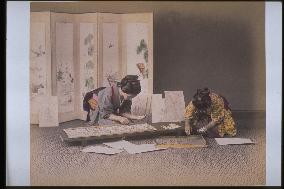
Two women are removing cotton seeds on a board. They may be a master wearing a tasuki cord and a maid in hakama skirt. A byobu screen depicting scenes from the four seasons is behind them.==Date:unknown, Place:unknown, Photo:unknown, (Credit:Nagasaki University Library/Kyodo News Images) [Cabinet Number61‐13‐0]

  •  
A girl on a jinrikisha

A girl on a jinrikisha

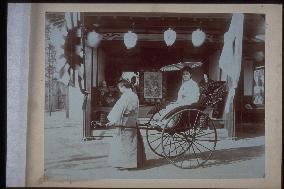
A kimono-clad woman is riding a jinrikisha (rickshaw) and holding an umbrella. The rickshaw man wears a long upper garment, hakama trousers and Western shoes. Paper lanterns are hanging from the eaves, and a Japanese national flag is displayed on each pillar of the house in the background.==Date:unknown, Place:unknown, Photo:unknown, (Credit:Nagasaki University Library/Kyodo News Images) [Cabinet Number51‐126‐0]

  •  
A samurai wearing hakama trousers and holding a bow

A samurai wearing hakama trousers and holding a bow

The man is wearing kamishimo ceremonial garb, an example of formal attire worn in the Edo Period. It consists of a stiff sleeveless robe and pleated loose-fitting trousers. It was worn over a crested robe or a short-sleeve kimono. The man has lowered the right shoulder portion of the kamishimo, apparently to draw a bow.==Date:unknown, Place:unknown, Photo:unknown, (Credit:Nagasaki University Library/Kyodo News Images) [Cabinet Number50‐26‐0]

  •  
Garden at harajuku

Garden at harajuku

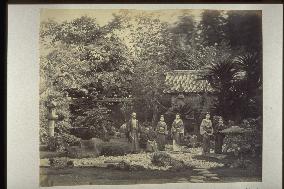
A prisine Japanese-style garden in a residence, with four women wearing kimonos and two men wearing haori coats and hakama. It looks like a commemorative photo.==Date:unknown, Place:Shizuoka, Photo:F. Beato, (Credit:Nagasaki University Library/Kyodo News Images) [Cabinet Number36‐10‐0]

  •  
Row of houses on a slope

Row of houses on a slope

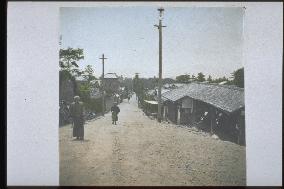
View of the approach to Yasaka Shinto Shrine looking west from the front gate of Maruyama Yaami Hotel. There is a rickshaw garage by the light post. An old man with a cane and a boy wearing hakama walk along the road. A Western-style building with hipped roof is visible to the left. This photo was taken after 1892, when electricity was introduced to Kyoto.==Date:unknown, Place:Kyoto, Photo:unknown, (Credit:Nagasaki University Library/Kyodo News Images) [Cabinet Number46‐93‐0]

  •  
Woman holding an umbrella and another in anesan-kabiri,headdress of a towel

Woman holding an umbrella and another in anesan-kabiri,headdress of a towel

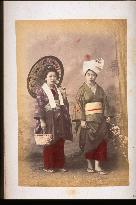
Two young women act out a walk in the mountains. One wears a kimono and hakama (divided skirt for formal wear), with a bamboo basket in her right hand, a Japanese umbrella in her left hand, and a towel over her neck. The other has tied her hem up and holds a cherry branch in her hand and a towel over her head.==Date:unknown, Place:unknown, Photo:unknown, (Credit:Nagasaki University Library/Kyodo News Images) [Cabinet Number16‐21‐0]

  •  
Dancing children

Dancing children

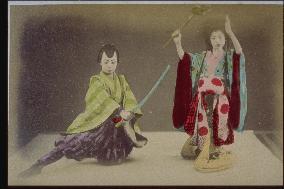
Two young women dance dressed as a woman and a man. The woman dressed as a man is a warrior with haori, hakama and a wooden sword. The other woman wears an courtesan costume and holds a stick to compete with the woman dressed as a man.==Date:unknown, Place:unknown, Photo:unknown, (Credit:Nagasaki University Library/Kyodo News Images) [Cabinet Number12‐48‐0]

  •  
Daiyuzan saijoji temple

Daiyuzan saijoji temple

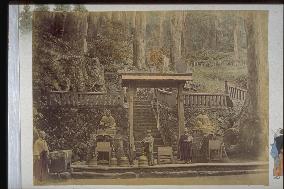
A photo taken at Saijoji Temple, Mt. Daiyu (located in present-day Minami Ashigara City). Priests, chigo (children in a Buddhist procession) and donated bells are seen in the photo. The tengu (long-nosed goblin) is the symbol of Mt. Daiyu. This statue does not exist at present, probably due to contribution to the government during World WarⅡ. This photo may date back to the mid-Meiji era. Chigo wore hakama (long kimono trousers) before World WarⅡ.==Date:unknown, Place:Minamiashigara, Photo:Ogawa Kazumasa, (Credit:Nagasaki University Library/Kyodo News Images) [Cabinet Number5‐27‐0]

  •  
Archery event at Sanjusangen-do in Kyoto

Archery event at Sanjusangen-do in Kyoto

KYOTO, Japan - Young female archers dressed in traditional kimono and ''hakama'' ceremonial skirts take aim in the ''Toshiya'' arrow-shooting event at Sanjusangen-do, a Buddhist temple in Kyoto's Higashiyama district, on Jan. 17, 2010. About 2,000 people, including young archers who celebrated their coming-of-age on Jan. 11, took part in the annual event. The archers aim at hitting targets placed 60 meters away. (Kyodo)

  •  
Archery event at Sanjusangen-do in Kyoto

Archery event at Sanjusangen-do in Kyoto

KYOTO, Japan - Young female archers dressed in traditional kimono and ''hakama'' ceremonial skirts take aim in the ''Toshiya'' arrow-shooting event at Sanjusangen-do, a Buddhist temple in Kyoto's Higashiyama district, on Jan. 17, 2010. About 2,000 people, including young archers who celebrated their coming-of-age on Jan. 11, took part in the annual event. The archers aim at hitting targets placed 60 meters away. (Kyodo)

  • Main
  • Top
  • Editorial
  • Creative
  • About Us
  • About ILG
  • Terms of use
  • Company
  • BEHIND
  • Price List
  • Single Plan
  • Monthly Plan
  • Services
  • Shooting
  • Rights Clearance
  • Support
  • FAQ
  • How To Buy
  • Contact Us
  • Become a Partner

© KYODO NEWS IMAGES INC

All Rights Reserved.

  • Editorial
  • Olympics
  • News
  • Sports
  • Japan
  • Tech
  • Royal
  • Disaster
  • NorthKorea
  • Old Japan
  • SNS
  • Creative
  • Food
  • Japan
  • Landscape
  • Animal
  • Popular
  • #Ukraine
  • #China
  • #coronavirus
  • #N. Korea
  • #Thailand
  • #Russia
  • #Ukraine
  • #China
  • #coronavirus
  • #N. Korea
  • #Thailand
  • #Russia
  • Food
  • Japan
  • Landscape
  • Animal
  • Olympics
  • News
  • Sports
  • Japan
  • Tech
  • Royal
  • Disaster
  • NorthKorea
  • Old Japan
  • SNS