•  
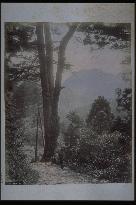
Near Hatayado,on the old Hakone Road

Near Hatayado,on the old Hakone Road

This photo depicts the Old Hakone Highway and Mt. Futago viewed from around the teahouse at Yumoto. Since the telegraph pole made in 1873 between Tokyo and Nagasaki is present, and therefore, this photo was taken after that time. The cobblestone paved road was renovated between 1861 to 64. This site was a resting place and a man carrying rectangular wooden holder on his back and a worker are resting. There are many photos like this one existing.==Date:unknown, Place:Hakone, Photo:unknown, (Credit:Nagasaki University Library/Kyodo News Images) [Cabinet Number93‐34‐0]

  •  
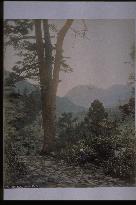
Mt. Futago seen from Yumoto

Mt. Futago seen from Yumoto

Futagoyama Mountain and the old Tokaido Highway viewed from around Yumoto Teahouse. This photo must have been taken after 1873 when the telegraph line was placed between Tokyo and Nagasaki because the telegraph line and the electric pole are visible. The stone pavement which was renovated extensively between 1861 and 1864 still remains. A worker and a woman carrying a wooden rack on the back are visible.==Date:unknown, Place:Hakone, Photo:unknown, (Credit:Nagasaki University Library/Kyodo News Images) [Cabinet Number86‐10‐0]

  •  
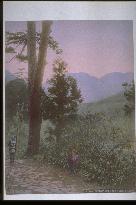
The Hakone field

The Hakone field

This photo depicts Mt. Futago and the old Hakone Highway viewed from a teahouse in Yumoto. Since the supporting wood for the telegraph line placed between Tokyo and Nagasaki in 1873 is sticking out of the pine tree and suppose it is for the electric pole to be made, it is probable that this photo was taken right after the line was placed. The photos with the same layout with the telegraph pole (catalog #4414) must have been taken later than this one.==Date:unknown, Place:Hakone, Photo:A. Farsari, (Credit:Nagasaki University Library/Kyodo News Images) [Cabinet Number82‐27‐0]

  •  
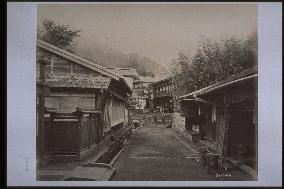
An inn in Oyama

An inn in Oyama

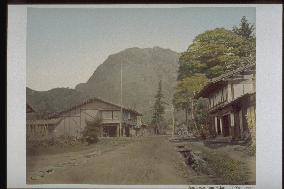
Oyamashuku was a post town located on the northeastern edge of Shizuoka Prefecture at the northern foot of Ashigara Pass. The pass was an important transportation link on Yagurazawa Okan Road. The house in the centre with the sign Itsuya may be an inn, and a teahouse is visible on the right. A house with a kabuki gate is also visible. This may be the Takenoshita district, where there were many inns. The inscription style suggests that this is the work of Felix Beato.==Date:unknown, Place:Shizuoka, Photo:F. Beato, (Credit:Nagasaki University Library/Kyodo News Images) [Cabinet Number78‐19‐0]

  •  
A row of pine trees and teahouses along the Tokaido Road

A row of pine trees and teahouses along the Tokaido Road

This is a Felice Beato photograph taken somewhere between Hodogaya and Fujisawa, possibly near the post town of Totsuka famous for its pine trees. The shop signs read Issen-meshi (One Sen Food) and Ochazuke (Rice with Green Tea). This was probably made from one of the original plates that Raimund von Stillfried received from Beato and then later sold.==Date:unknown, Place:Fujisawa, Photo:F. Beato, (Credit:Nagasaki University Library/Kyodo News Images) [Cabinet Number78‐9‐0]

  •  
Teahouses along the Koshu Road

Teahouses along the Koshu Road

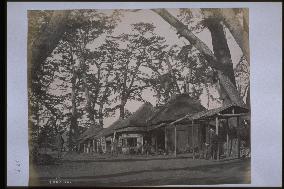
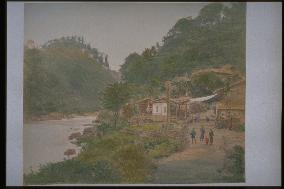
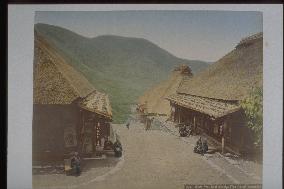
The bank of Katsura River, which separated the feudal domains of Sagami and Kai along the old Koshu Highway (present-day Uenohara-machi in southeastern Yamanashi Prefecture), seen from the east side (Sagami side) of the river. The buildings are teahouses standing along the highway, the existence of which is reported in travel journals as early as the Tenpo Period (1830-44). The mountain station Suwa-no-Sekisho (Kuchidome Bansho) is up the slope on the right. Mt. Gongen of Nakura is visible on the other side of Katsura River.==Date:unknown, Place:Yamanashi, Photo:Usui Shuzaburo?, (Credit:Nagasaki University Library/Kyodo News Images) [Cabinet Number65‐10‐0]

  •  
The Hakone Road

The Hakone Road

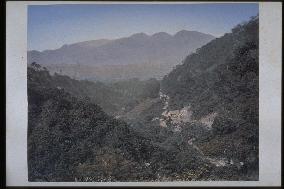
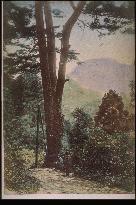
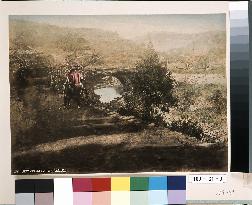
This photo depicts the Old Hakone Highway and the mountains of Hakone viewed from the mountain nearer Yumoto than Hatajuku Post Town. The winding old Tokaido Highway runs through the foot of Mt. Hakugin in the foreground. Three mountain peaks afar are from the right, Mt. Soun, Shinzan, and Komagadake. The flat hill lying before them is Mt. Takasu. There appears a teahouse along the highway.==Date:unknown, Place:Hakone, Photo:unknown, (Credit:Nagasaki University Library/Kyodo News Images) [Cabinet Number59‐9‐0]

  •  
Near Hatayado,on the old Hakone Road

Near Hatayado,on the old Hakone Road

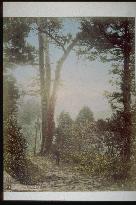
This photo depicts the Old Hakone Highway and Mt. Futago viewed from around the teahouse at Yumoto. The telegraph pole made in 1873 between Tokyo and Nagasaki is not present, and therefore, this photo was taken before that time. The cobblestone paved road was renovated between 1861 to 64. This site appears to have been a resting place and two workers are relaxing. There are many photos like this one existing.==Date:unknown, Place:Hakone, Photo:unknown, (Credit:Nagasaki University Library/Kyodo News Images) [Cabinet Number47‐14‐0]

  •  
Nakasendo Matsuida Inns from Usui River

Nakasendo Matsuida Inns from Usui River

The Usui River which originates from Mt. Komochi to the east of Usui range on the former Nakasendo. The houses of Matsuida juku can be seen. The center fore may be a broken bridge. A man fishes with his pole. Usui River is famous for fishing ayu (sweetfish) to the present day.==Date:unknown, Place:Gunma, Photo:Kusakabe Kinbei, (Credit:Nagasaki University Library/Kyodo News Images) [Cabinet Number38‐55‐0]

  •  
Usui Pass from Nakasendo Sakamoto Inns

Usui Pass from Nakasendo Sakamoto Inns

Sakamoto juku is located at the eastern foot of the range, and the 600 meters distance from here (500 meters above sea level) to the range is a climb of 450 meters. Hotels line along the road with a width of 15 meters. The mountain that looks like a pile of rocks is the Funzan. This path leads to Usui Range.==Date:unknown, Place:Gunma, Photo:Kusakabe Kinbei, (Credit:Nagasaki University Library/Kyodo News Images) [Cabinet Number38‐54‐0]

  •  
Nakasendo Usui Pass

Nakasendo Usui Pass

The range on the former Nakasendo, on the borders of Sakamoto of Matsuida-cho in Gunma prefecture and Karuizawa of Karuizawa-cho in Nagano Prefecture. It was an important cross road connecting the Kinai and Kanto areas via Shinshu. Because it was a difficult path, a new Usui range road was built, starting in 1884 and completing in 1886. Three waitresses look in the direction of the camera in front of the tea house to the right.==Date:unknown, Place:Gunma, Photo:Kusakabe Kinbei, (Credit:Nagasaki University Library/Kyodo News Images) [Cabinet Number38‐53‐0]

  •  
Nishi-Mochiya Teahouse at Nakasendo Wada Pass

Nishi-Mochiya Teahouse at Nakasendo Wada Pass

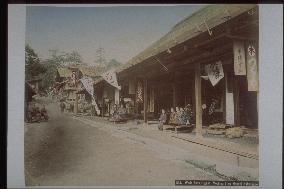
A view of the travelers resting in Wada range in Wadajuku, the most difficult pass on the Nakasendo. Tea houses line along the Nishimochiya, and was a resting spot for travelers going over the Wada range. In the winter, there was 3 meters of snowfall, and going over the range was terribly difficult.==Date:unknown, Place:Nagano, Photo:Kusakabe Kinbei, (Credit:Nagasaki University Library/Kyodo News Images) [Cabinet Number38‐41‐0]

  •  
Higashi-Mochiya Teahouse at Nakasendo Wada Pass

Higashi-Mochiya Teahouse at Nakasendo Wada Pass

The view of the Higashimochiya of Wada range in Wadajuku, the most difficult pass on the Nakasendo. There were five tea houses, and was a resting spot. Inhabitants also played the role of rescue workers for the travelers, so a fuji was provided per person (5 go of unpolished rice a day).==Date:unknown, Place:Nagano, Photo:Kusakabe Kinbei, (Credit:Nagasaki University Library/Kyodo News Images) [Cabinet Number38‐42‐0]

  •  
Fire bell and inn at Nakasendo Shimo-no-Suwa

Fire bell and inn at Nakasendo Shimo-no-Suwa

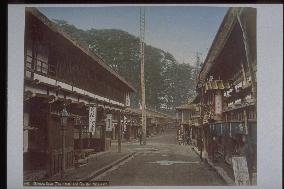
The townscape of Shimosuwa-juku(post town) on the Nakasendo. Tea houses line on both sides of the road and you can see the man at the foot of high ladder, hanging the fire bell in the center. In the back, you can see the Shaso(Shrine forest) of Suwa Taisha Shimosha Akimiya. Shimosuwa-juku is near Wada-toge(pass) and have much hot spings, it has prospered for a junction of Koshukaido.\r\n==Date:unknown, Place:Nagano, Photo:Kusakabe Kinbei, (Credit:Nagasaki University Library/Kyodo News Images) [Cabinet Number38‐39‐0]

  •  
Teahouse at Nezame-no-toko Pass

Teahouse at Nezame-no-toko Pass

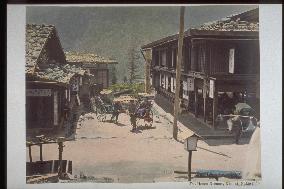
Probably the Fukushima juku with a sekisho on the Nakasendo, presently the Fukushimacho of Kisogun of Nagano prefecture. The annex of the Kiso family was built earlier than the other lodging villages in Kiso. The woman on the rickshaw in the center and a person with a balancing pole is seen in the bottom right.==Date:unknown, Place:Nagano, Photo:Kusakabe Kinbei, (Credit:Nagasaki University Library/Kyodo News Images) [Cabinet Number38‐10‐0]

  •  
Wisteria trellis at a teahouse,the Nakasendo Road

Wisteria trellis at a teahouse,the Nakasendo Road

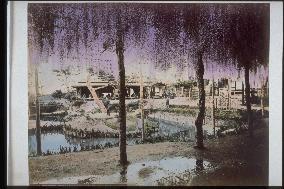
A resting spot for people walking along the Nakasendo. The wisteria trellises seen from the teahouse were famous, and many came to see them. There is an English caption by the compiler of the album, but it should be spelled Blossoms. A typical Japanese spelling error.==Date:unknown, Place:Tokyo, Photo:Ogawa Kazumasa, (Credit:Nagasaki University Library/Kyodo News Images) [Cabinet Number25‐73‐0]

  •  
Old hakone highway near yumoto teahouse

Old hakone highway near yumoto teahouse

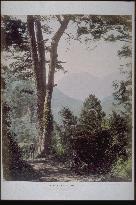
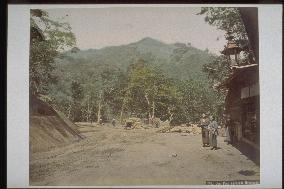
The stone pavement of Hakone Kyukaido seen from a slightly lower location than the Yumoto Chaya. The mountain in the distance is Futagoyama. The pine tree in the picture does not remain at present. An electric pole can be seen, so this photo was taken after 1892 when electricity came to Yumoto.==Date:unknown, Place:Hakone, Photo:unknown, (Credit:Nagasaki University Library/Kyodo News Images) [Cabinet Number14‐21‐0]

  •  
Old hakone highway near yumoto teahouse

Old hakone highway near yumoto teahouse

A view of the stone pavement on the old route of Hakone coming down from the tea house in Yumoto. Pictures at that time had to be taken with heavy glass panels and a darkroom in the shape of a telephone box carried by several men, so many pictures were taken at tea houses where the photography group was resting.==Date:unknown, Place:Hakone, Photo:Ogawa Kazumasa, (Credit:Nagasaki University Library/Kyodo News Images) [Cabinet Number7‐22‐0]

  •  
Hotarujaya and Ichinose-bashi Bridge

Hotarujaya and Ichinose-bashi Bridge

Hotarujaya is viewed from the upstream side. Ichinose Bridge is on the right of the teahouse, and the handrail is visible through the trees. The road on the left is Nagasaki Road leading to Himi Pass. A new road stretching from this point to Yagami on the other side of the mountain was constructed in 1882 by the Himi Shindo Co. led by Matsuda Gengoro and eight others. This was Japan's first toll road, charging one sen a person.==Date:unknown, Place:Nagasaki, Photo:unknown, (Credit:Nagasaki University Library/Kyodo News Images) [Cabinet Number109‐31‐0]

  • Main
  • Top
  • Editorial
  • Creative
  • About Us
  • About ILG
  • Terms of use
  • Company
  • BEHIND
  • Price List
  • Single Plan
  • Monthly Plan
  • Services
  • Shooting
  • Rights Clearance
  • Support
  • FAQ
  • How To Buy
  • Contact Us
  • Become a Partner

© KYODO NEWS IMAGES INC

All Rights Reserved.

  • Editorial
  • Olympics
  • News
  • Sports
  • Japan
  • Tech
  • Royal
  • Disaster
  • NorthKorea
  • Old Japan
  • SNS
  • Creative
  • Food
  • Japan
  • Landscape
  • Animal
  • Popular
  • #Ukraine
  • #Thailand
  • #coronavirus
  • #N. Korea
  • #Russia
  • #China
  • #Ukraine
  • #Thailand
  • #coronavirus
  • #N. Korea
  • #Russia
  • #China
  • Food
  • Japan
  • Landscape
  • Animal
  • Olympics
  • News
  • Sports
  • Japan
  • Tech
  • Royal
  • Disaster
  • NorthKorea
  • Old Japan
  • SNS