•  
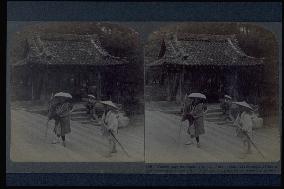
Women pilgriming in the Imperial Park

Women pilgriming in the Imperial Park

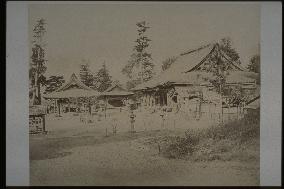
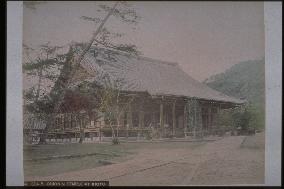
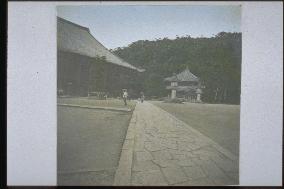
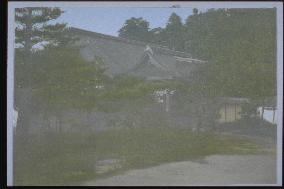
Female pilgrims climb the stone steps to Kondo Hall at Nin'naji Temple. The photograph was taken facing east from the eastern approach to Kan'nondo Hall. The women wear zori slippers, hold long walking sticks, and carry something on their backs. The irimoya-style building in the rear may be a place for drinking water. This may have been taken by the British photographer H. G. Ponting in 1904.==Date:1904, Place:Kyoto, Photo:Underwood, (Credit:Nagasaki University Library/Kyodo News Images) [Cabinet Number97‐39‐0]

  •  
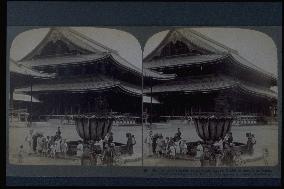
Higashi Honganji Temple

Higashi Honganji Temple

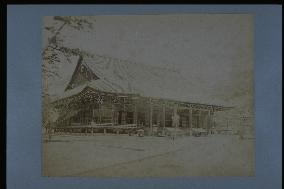
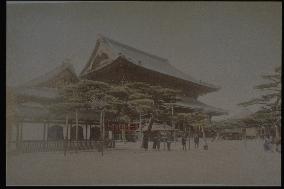
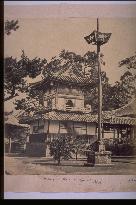
Taishi-do of Higashihonganji Temple is viewed from the southeast. There are many children around the big water fountain. The Taishi-do took 15 years to build. It was completed in 1895 according to the wishes of the head priest, Otani Kosho. Built in single-story irimoya style with a tiled roof, it is 76m wide, 56m deep, 38m high, and covers 3,800 square metres. It is the largest wooden structure in the world.==Date:1904, Place:Kyoto, Photo:Underwood, (Credit:Nagasaki University Library/Kyodo News Images) [Cabinet Number97‐37‐0]

  •  
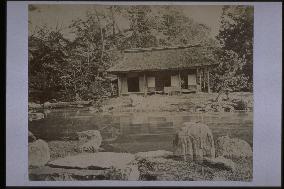
The detached garden of Shugaku-in Temple

The detached garden of Shugaku-in Temple

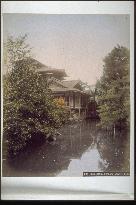
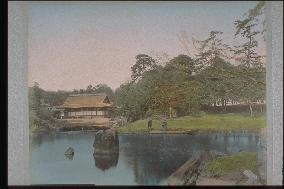
Shokintei of Katsura Rikyu Imperial Villa looking across the pond from the bridge. Shokintei was constructed as one of a series of additions to the villa started in 1641. Kobori Enshu was in charge of work on this second addition under orders from Prince Toshitada. Built in irimoya style with a thatched roof, the building has one 11 tatami mat room called Ichino-ma (First Room) and one six and a half tatami room called Tsugino-ma (Second Room). The garden and pine grove stretches away to the rear.==Date:unknown, Place:Kyoto, Photo:unknown, (Credit:Nagasaki University Library/Kyodo News Images) [Cabinet Number96‐106‐0]

  •  
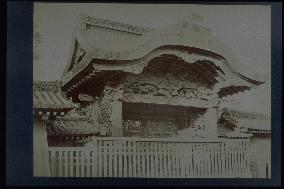
The Tomon Gate of Nishi Honganji Temple

The Tomon Gate of Nishi Honganji Temple

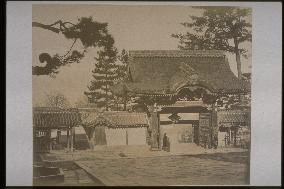
The Karamon Gate of Nishihonganji Temple is seen from the southeast, facing northeast. The four-legged gate facing Kitakoji Street is said to have been moved from Fushimi Castle in the Momoyama Period. The shingled roof is built in karahafu style front and back and in irimoya style left and right. The gate features paneled entrance doors, lintels and frog-leg struts. Carvings of a lion and peony, peacock and pine, kirin and clouds, and dragon and clouds decorate beams. The gate is also called Higuremon and Chokushimon.==Date:unknown, Place:Kyoto, Photo:unknown, (Credit:Nagasaki University Library/Kyodo News Images) [Cabinet Number96‐93‐0]

  •  
Chion-in Temple

Chion-in Temple

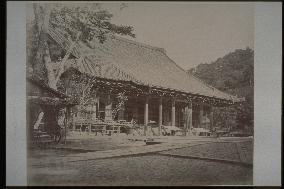
Miei-do at Chion-in Temple is viewed looking northeast. The temple's main hall, Miei-do contains the figure of the founder, Honen. The girder and cross beams are about 20m and 16m in length. The single-story irimoya-style building has a tiled roof. It was reconstructed in 1639.==Date:unknown, Place:Kyoto, Photo:unknown, (Credit:Nagasaki University Library/Kyodo News Images) [Cabinet Number96‐41‐0]

  •  
Miyajima Island,Aki

Miyajima Island,Aki

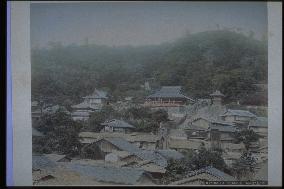
The five-story pagoda is viewed from Toyokuni Shrine (Senjokaku, or One Thousand Mat Hall ) on Tonooka Hill on the east side of Itsukushima Shinto Shrine. Senjokaku Hall was built in 1587 by Toyotomi Hideyoshi for the monthly Buddhist rite of reading of the Senbukyo sutra. The magnificent hall was built in irimoya architectural style with a tiled roof. The cross beams span about 27.27m and the parallel beams about 14.5m.==Date:unknown, Place:Miyajima, Photo:unknown, (Credit:Nagasaki University Library/Kyodo News Images) [Cabinet Number85‐30‐0]

  •  
The naiden (inner sanctuary) of Chion-in Temple

The naiden (inner sanctuary) of Chion-in Temple

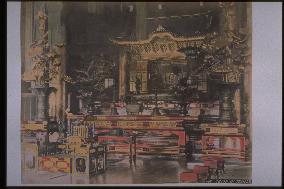
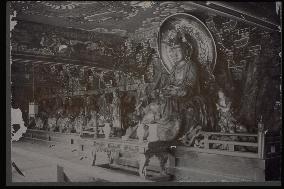
The shumidan and zushi of the Miei-do Hall of Chion-in Temple are viewed from the southwest. The shumidan is done in Zen style, with gild and lacquer, and has a sculpture of a seated Honen (the founder). Miei-do is the main hall of the temple. Its girder and cross beams are about 20m and 16.4m in length. Reconstructed in 1639, it is built in single-story irimoya style with a tiled roof.==Date:unknown, Place:Kyoto, Photo:A. Farsari, (Credit:Nagasaki University Library/Kyodo News Images) [Cabinet Number82‐14‐0]

  •  
The city of Kyoto seen from a hill

The city of Kyoto seen from a hill

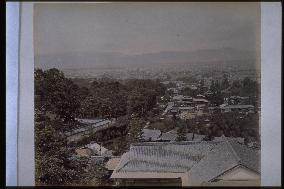
View of the southern part of Kyoto City facing west from Yoshimizu Hot Springs in Maruyama. On the left, surrounded by an earthen wall, is the Otani Mausoleum of Higashi Otani. Its approach stretches to the west. The irimoya-style roof of Yasaka Shinto Shrine is visible on the far right. The restaurants and other buildings in the picture are in the area that would later become known as Maruyama Park. The Nishiyama Range is faintly visible in the background.==Date:unknown, Place:Kyoto, Photo:A. Farsari, (Credit:Nagasaki University Library/Kyodo News Images) [Cabinet Number82‐11‐0]

  •  
Nagasaki Kiyomizudera Temple

Nagasaki Kiyomizudera Temple

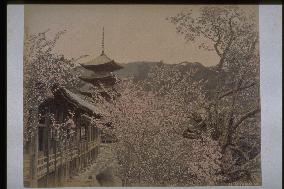
Kiyomizudera seen a short time before photograph #3854 was taken. A temple of the Shingon sect of Buddhism, it was founded by the Buddhist priest Keijun in 1623. There is a bell tower to the right when going up the stairs. The outer shape of the gate is square; the inside features an arch. The main building of the temple is in the centre of the photograph. It is made of wood, has a tiled roof, and is of the one-storied irimoya style. The Taishi-do hall is to the left of the main hall. Below that stands Shotendo which was built in 1822, burned to the ground, and was later rebuilt.==Date:Middle Meiji (1883-1897), Place:Nagasaki, Photo:unknown, (Credit:Nagasaki University Library/Kyodo News Images) [Cabinet Number75‐16‐0]

  •  
An image of Buddha at the top of Sanmon Gate Building,Chion-in Temple

An image of Buddha at the top of Sanmon Gate Building,Chion-in Temple

Buddhist statues on the Sanmon Gate of Chion-in Temple. The Buddha is seated in the middle, flanked by Zenzai-doji, Shudatsu-choja, and the 16 Buddhist Saints. Unryu (dragons in clouds) and other motifs are painted on the ceiling. This is the largest gate of its kind in Japan, with five bays and three entrances. Built in two-story irimoya style, it has a tiled roof and was erected in 1619 by the second shogun Tokugawa Ietada.==Date:unknown, Place:Kyoto, Photo:unknown, (Credit:Nagasaki University Library/Kyodo News Images) [Cabinet Number72‐42‐0]

  •  
Shinto priests

Shinto priests

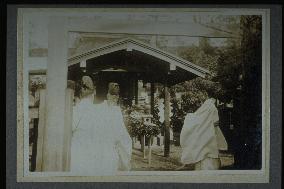
This photograph, taken from just outside the torii gate of a shrine, shows Shinto priests conducting a religious ritual, Elderly priests wearing formal robes face each other. An irimoya-style altar has been installed in front of the shrine. A koan with a small altar on top is placed on the straw matting. The location is not known.==Date:unknown, Place:Kyoto, Photo:unknown, (Credit:Nagasaki University Library/Kyodo News Images) [Cabinet Number72‐13‐0]

  •  
Higashi Honganji Temple

Higashi Honganji Temple

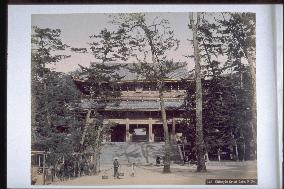
The Taishi-do of Higashihonganji Temple is viewed from the southeast. Men stand under magnificent looking pines in front of the building. The Taishi-do took 15 years to build. It was completed in 1895 according to the wishes of the head priest, Otani Kosho. Built in single-story irimoya style with a tiled roof, it is 76m wide, 56m deep, 38m high, and covers 3,800 square metres. It is the largest wooden structure in the world.==Date:unknown, Place:Kyoto, Photo:unknown, (Credit:Nagasaki University Library/Kyodo News Images) [Cabinet Number69‐61‐0]

  •  
The Sanmon Gate of Chion-in Temple

The Sanmon Gate of Chion-in Temple

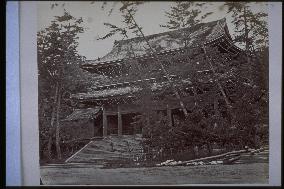
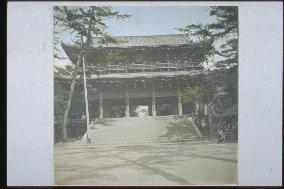
The Sanmon Gate of Chion-in Temple is viewed from the southwest. The tall pine trees south of the gate are slanted due to the wind, and pine logs are scattered about underneath. This is the largest gate of its kind in Japan, with five bays and three entrances. Built in two-story irimoya style, it has a tiled roof and was erected in 1619 by the second shogun Tokugawa Ietada.==Date:unknown, Place:Kyoto, Photo:R. Stillfried, (Credit:Nagasaki University Library/Kyodo News Images) [Cabinet Number63‐17‐0]

  •  
The Sanmon Gate of Nishi Otani Temple

The Sanmon Gate of Nishi Otani Temple

Main gate of the Otani Honbyo (Mausoleum) of Nishi Otani Temple, looking from the east side of the water fountain facing west-northwest. The irimoya style gate has a hiwada (Japanese hinoki tree bark) roof. Pine trees are growing in the back. The stone pavement in the foreground leads to the Otani honbyo (Mausoleum). Taken by Felix Beato.==Date:unknown, Place:Kyoto, Photo:F. Beato, (Credit:Nagasaki University Library/Kyodo News Images) [Cabinet Number62‐27‐0]

  •  
Monju-do,Kurodani Konkai Komyoji Temple

Monju-do,Kurodani Konkai Komyoji Temple

The Sanmon (two-story gate) of Kurodani Konkai Komyoji Temple was built in 1860 in the irimoya style (hip and gable roof) with ornate roof tiles. A hanging plaque bears an inscription by Emperor Gokomatsu (1377-1433) saying, The First Gate of Jodo Shinshu (Pure Land Buddhism). A stone bridge is visible in the right foreground. Taken by Felix Beato.==Date:unknown, Place:Kyoto, Photo:F. Beato, (Credit:Nagasaki University Library/Kyodo News Images) [Cabinet Number62‐26‐0]

  •  
Higashi Honganji Temple

Higashi Honganji Temple

Yasaka Shrine is seen from the east, facing west. The main hall is on the right and the worship hall on the left. The main hall, rebuilt by the fourth shogun Tokugawa Ietsuna in 1654, is modeled after the Shishinden. Built in single-story irimoya style with a cedar-bark roof, the front is about 12m and the sides about 11m wide. The deity Susano-no-mikoto is worshipped in the central chamber, Kushiinadahime-no-mikoto in the eastern chamber, and Hachiojishin in the western chamber. Taken by F. Beato.==Date:unknown, Place:Kyoto, Photo:F. Beato, (Credit:Nagasaki University Library/Kyodo News Images) [Cabinet Number62‐22‐0]

  •  
Higashi Honganji Temple

Higashi Honganji Temple

Yasaka Shrine is seen from the east, facing west. The main hall is on the right and the worship hall on the left. The main hall, rebuilt by the fourth shogun Tokugawa Ietsuna in 1654, is modeled after the Shishinden. Built in single-story irimoya style with a cedar-bark roof, the front is about 12m and the sides about 11m wide. The deity Susano-no-mikoto is worshipped in the central chamber, Kushiinadahime-no-mikoto in the eastern chamber, and Hachiojishin in the western chamber. Taken by F. Beato.==Date:unknown, Place:Kyoto, Photo:F. Beato, (Credit:Nagasaki University Library/Kyodo News Images) [Cabinet Number62‐17‐0]

  •  
Chion-in Temple

Chion-in Temple

Miei-do at Chion-in Temple is viewed looking northeast. The temple's main hall, Miei-do contains the figure of the founder, Honen. The temple's main hall, Miei-do contains the figure of the founder, Honen. The girder and cross beams are about 20m and 16m in length. The single-story irimoya-style building has a tiled roof. It was reconstructed in 1639. Mt. Kacho is visible in the back. Taken by Beato.==Date:unknown, Place:Kyoto, Photo:F. Beato, (Credit:Nagasaki University Library/Kyodo News Images) [Cabinet Number62‐2‐0]

  •  
The Uji River

The Uji River

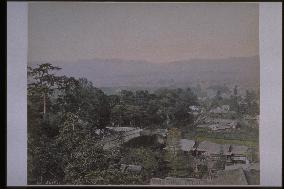
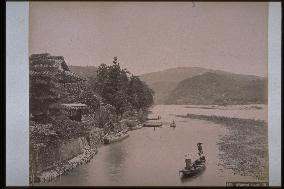
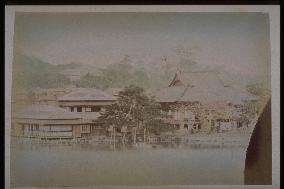
View of the upper reaches of the Ujigawa River looking southeast. At the eastern edge of the bridge stands a two-story irimoya style inn, built on stone riverbank reinforcements. A few boats are docked at the quay. A boat in the river carries a passenger with a parasol. Visible in the far left background is Tachibana Island and Tonoshima Island, with Mt. Makinoo behind.==Date:unknown, Place:Kyoto, Photo:unknown, (Credit:Nagasaki University Library/Kyodo News Images) [Cabinet Number57‐20‐2]

  •  
Nishi Honganji Temple

Nishi Honganji Temple

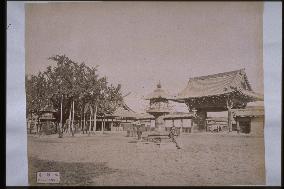
The grounds of Nishi Honganji Temple, looking from the southeastern side of the Goei-do facing northeast. The gate of the Goei-do and a mizubuki gingko tree are depicted on the right and left. A man is leaning against the bronze lantern in the centre. Other people are also present on the temple grounds. The Goei-do is in irimoya style with roof tiles and was built in 1645. The rails of a bridge over Horikawa River are visible beyond the Goei-do gate.==Date:unknown, Place:Kyoto, Photo:unknown, (Credit:Nagasaki University Library/Kyodo News Images) [Cabinet Number52‐28‐0]

  •  
The city of Kyoto seen from Maruyama

The city of Kyoto seen from Maruyama

Western view of the southern part of Kyoto from the Yoshimizu Hot Spring building. The Otani Mausoleum of Higashi (East) Otani with its earthen wall is visible on the left, with its approach stretching to the west. The main building of Yasaka Shinto Shrine and the roof of the shrine's irimoya building are visible in the garden. Although the site would later become Maruyama Park, no work has been done yet, and a few restaurants stand in the area. The Nishiyama Mountain Range is faintly visible in the background.==Date:unknown, Place:Kyoto, Photo:unknown, (Credit:Nagasaki University Library/Kyodo News Images) [Cabinet Number52‐14‐0]

  •  
Chion-in Temple

Chion-in Temple

Miei-do at Chion-in Temple is viewed looking northeast. The temple's main hall, Miei-do contains the figure of the founder, Honen. The temple's main hall, Miei-do contains the figure of the founder, Honen. The girder and cross beams are about 20m and 16m in length. The single-story irimoya-style building has a tiled roof. It was reconstructed in 1639. Mt. Kacho is visible in the back.==Date:unknown, Place:Kyoto, Photo:unknown, (Credit:Nagasaki University Library/Kyodo News Images) [Cabinet Number52‐2‐0]

  •  
Nishi Honganji Temple

Nishi Honganji Temple

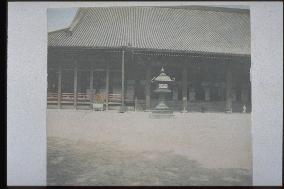
Goei-do of Nishi Honganji Temple, looking from the east side facing west. A bronze lantern is installed at the centre. People can be seen praying in front of the stairs. The Goei-do is also called the Taishi-do and was built in 1636. It is an irimoya-zukuri style building with roof tiles and an east-west width of 45 meters, a north-south length of 57 meters, and a height of 27 meters.==Date:unknown, Place:Kyoto, Photo:unknown, (Credit:Nagasaki University Library/Kyodo News Images) [Cabinet Number46‐111‐0]

  •  
The Sanmon Gate of Chion-in Temple

The Sanmon Gate of Chion-in Temple

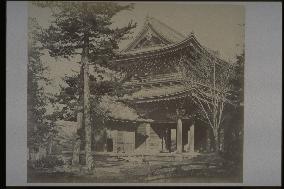
The Sanmon Gate of Chion-in is viewed from the west. The board south of the gate says Religious Lecture. A rickshaw with a passenger is visible. This is the largest gate of its kind in Japan, with five bays and three entrances. Built in two-story irimoya style, it has a tiled roof and was erected in 1619 by the second shogun Tokugawa Ietada. The word Kachozan on the tablet at the front of the gate is said to be the calligraphy of Emperor Reigen (1654-1732).==Date:unknown, Place:Kyoto, Photo:unknown, (Credit:Nagasaki University Library/Kyodo News Images) [Cabinet Number46‐89‐0]

  •  
Chion-in Temple

Chion-in Temple

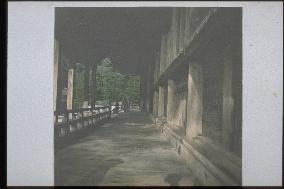
The north corridor of Miei-do at Chion-in Temple is seen from the east. The temple's main hall, Miei-do contains the figure of the founder, Honen. The girder and cross beams are about 20m and 16m in length. The single-story irimoya-style building has a tiled roof. It was reconstructed in 1639.==Date:unknown, Place:Kyoto, Photo:unknown, (Credit:Nagasaki University Library/Kyodo News Images) [Cabinet Number46‐90‐0]

  •  
Chion-in Temple

Chion-in Temple

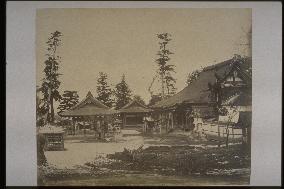
.Northeastern view of Chion-in Temple grounds, looking northeast from the southeastern side of Reito Pagoda. The straight stone approach leads to Goei-do (Buddha Sanctuary) of the main hall on the left and the Kyozo (Sutra Library) on the right. A man in Western dress with a cane stands in front of Goei-do. Goei-do was constructed in 1639 in the irimoya style with roof tiles. A pair of stone lanterns is visible in front of the Kyozo.==Date:unknown, Place:Kyoto, Photo:unknown, (Credit:Nagasaki University Library/Kyodo News Images) [Cabinet Number46‐92‐0]

  •  
Stone lantern in the garden of an inn

Stone lantern in the garden of an inn

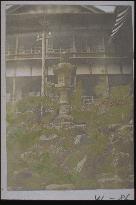
Various trees were planted among the rocks and stone lanterns in the garden. The electric pole indicates that the photograph was taken after 1892. The irimoya-style building has a balcony providing guests with scenic views. Inoue Mankichi Inoue of Nagasaki Prefecture bought a sub-temple called Yaami from Anyoji Temple at Maruyama in 1879, then renovated it in Western style and opened it as the Yaami Hotel.==Date:unknown, Place:Kyoto, Photo:unknown, (Credit:Nagasaki University Library/Kyodo News Images) [Cabinet Number46‐86‐0]

  •  
The Sanmon Gate of Chion-in Temple

The Sanmon Gate of Chion-in Temple

The western side of Chion-in Temple Sanmon Gate is seen looking east. There are three rickshaws parked in front, a vendor, and a child. This is the largest gate of its kind in Japan, with five bays and three entrances. Built in two-story irimoya style, it has a tiled roof and was erected in 1619 by the second shogun Tokugawa Ietada. The word Kachozan on the tablet at the front of the gate is said to be the calligraphy of Emperor Reigen (1654-1732).==Date:unknown, Place:Kyoto, Photo:unknown, (Credit:Nagasaki University Library/Kyodo News Images) [Cabinet Number42‐22‐0]

  •  
Hiunkaku at Nishi-Honganji Temple

Hiunkaku at Nishi-Honganji Temple

The northwestern part of Hiunkaku at Nishihonganji Temple is viewed from the north side of the pond in Tekisui Garden. Hiunkaku is said to be a part of a mansion built in the Momoyama Period. It is a three-story, cypress-shingle roofed, palace-style building. The north and south sides are about 25.8m long, the east side about 11.8m and the west side about 12.5m. The first story is built in undulating bargeboard style on the left side, and irimoya style on the right.==Date:unknown, Place:Kyoto, Photo:unknown, (Credit:Nagasaki University Library/Kyodo News Images) [Cabinet Number42‐16‐0]

  •  
Kitano Tenmangu Shinto Shrine

Kitano Tenmangu Shinto Shrine

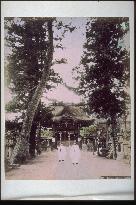
The Middle Gate at Kitano Tenmangu Shrine is seen facing north. The Shinto priests in the centre are wearing official white attire. Many stone lanterns and pine trees line the approach. The Middle Gate is also called Sankomon (Three Light Gate). Constructed during the Momoyama Period, the single-story, irimoya-style gate has a cedar-tile roof and four pillars. The word Tenmangu inscribed on the plaque is the calligraphy of Emperor Gosai. The Hall of Worship is partially visible on the far right.==Date:unknown, Place:Kyoto, Photo:unknown, (Credit:Nagasaki University Library/Kyodo News Images) [Cabinet Number42‐10‐0]

  •  
NIKKO TOSHOGU shrine

NIKKO TOSHOGU shrine

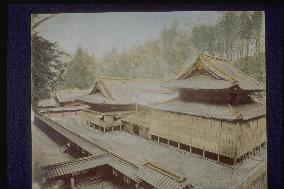
The Main Building of the Nikko Daiyuin from the stone fence to the rear of the Koga Gate. The main building which of irimoya style in many layers has an Ainoma, which connects to the hall of worship. It is built in the so-called Gongen style. The four walls are protected as if to prepare for the severe winter.==Date:unknown, Place:Nikko, Photo:unknown, (Credit:Nagasaki University Library/Kyodo News Images) [Cabinet Number37‐36‐0]

  •  
Bell tower of todaiji temple

Bell tower of todaiji temple

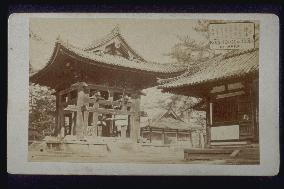
The location is the east side of the Daibutsu hall. The present building was built through donations collected by Todaiji Temple and rebuilt by Eisai during the Shogen years (1207-11). The style is a mixture of Indian and Chinese styles, in Irimoya style with tiled roofs.==Date:unknown, Place:Nara, Photo:unknown, (Credit:Nagasaki University Library/Kyodo News Images) [Cabinet Number30‐2‐0]

  •  
Main building of Otani School

Main building of Otani School

The Karamon Gate and main hall of Chion-in Temple are viewed from the southwest, facing northeast. Pines and other garden trees grow in front of the gate. The four-legged irimoya style gate has a hiwadabuki roof. The main is built in one-story irimoya style with hiwadabuki roof; its girder and cross beams are about 16.3m and 11m in length. Both buildings were built in 1641. Mt. Kacho is visible in the background.==Date:unknown, Place:Kyoto, Photo:unknown, (Credit:Nagasaki University Library/Kyodo News Images) [Cabinet Number46‐94‐0]

  •  
The bell tower at Kofukuji Temple

The bell tower at Kofukuji Temple

Written February 1866 by Beato. The bell tower to the right front of the Buddha Hall at Kofukuji Temple. It was built in 1663, restored in 1692 after being destroyed by fire, and repaired four times after 1731. It is a wooden building in two stories with roof tiles and irimoya. It has a balustrade and chidori barge.==Date:1866, Place:Nagasaki, Photo:F. Beato, (Credit:Nagasaki University Library/Kyodo News Images) [Cabinet Number17‐4‐0]

  •  
Shrine and a pond

Shrine and a pond

This may be Myoko Pond and the Onryo garden of Seizokuin, a subtemple of Enkakuji. Onryo is also called Ichigekitei. Seizokuin was moved from Kenchoji in the early ages. The facade is the Shariden, and the upper tier of the Shariden is done in Irimoya style, and the crossbeam is done in an arch.==Date:unknown, Place:Kamakura, Photo:unknown, (Credit:Nagasaki University Library/Kyodo News Images) [Cabinet Number16‐47‐0]

  •  
Lake Biwa seen from Miidera Temple

Lake Biwa seen from Miidera Temple

Location is the same as the photo numbered 2-25, but without the tree standing next to the stone pillar in the centre, bench and stand in the residence. The view has shifted to the right, so the Irimoya to the left next to the Hachu is seen.==Date:unknown, Place:Otsu, Photo:Tamamura Kozaburo, (Credit:Nagasaki University Library/Kyodo News Images) [Cabinet Number11‐32‐0]

  •  
Motomiya Garden,Hikone

Motomiya Garden,Hikone

The Hakkeitei is seen to the left facing the lake. The roof of the irimoya and the white shoji (paper doors) can be seen clearly. In front is a bridge from the bank. A Japanese boat floats on the lake with a helmsman and passenger aboard.==Date:unknown, Place:Shiga, Photo:Ogawa Kazumasa, (Credit:Nagasaki University Library/Kyodo News Images) [Cabinet Number10‐20‐0]

  •  
Outside view of nikko toshogu shrine

Outside view of nikko toshogu shrine

The back of the Yomei Gate can be seen between the cedar trees in the rear of the temple. To the left is the Kagura Hall, to the right the mikoshi hut, and to the fore the roof of the hall of worship. The roof of the Yomei Gate is done in Irimoya style with tohafu (Chinese gable) in four directions. The surrounding corridor which starts from the Yomei Gate goes around the main hall, and the back of the main hall is a stone wall. Above that is the Okusha.==Date:unknown, Place:Nikko, Photo:Kusakabe Kinbei, (Credit:Nagasaki University Library/Kyodo News Images) [Cabinet Number2‐39‐0]

  •  
Main Hall and Worship Hall at Suwa Shrine

Main Hall and Worship Hall at Suwa Shrine

The buildings starting from the right are, Worship Hall, Norito-den Hall, and the Main Hall at Suwa Shrine. Worship Hall is where commoners would worship. The building is made of hinoki (Japanese cypress) in irimoya-zukuri style (a hip-and- gable roof construction) with a hiwadabuki-style roof (Japanese cypress hinoki bark thatching). The right, left , and front walls flip open upwards like awnings. The tablet was written by Sawa Nobuyoshi who became the Kyushu Pacification Officer in 1868. The floor of the Norito-den Hall connected to the passageway is tatami-covered. The building in the far left is the main hall rebuilt in 1869 after burning down in 1857. The chancel enshrines the spirit of the three deities of the Suwa, Morisaki, and Sumiyoshi shrines.==Date:about 1874, Place:Nagasaki, Photo:Ueno Hikoma?, (Credit:Nagasaki University Library/Kyodo News Images)

  •  
Oura River and Benten-bashi Bridge

Oura River and Benten-bashi Bridge

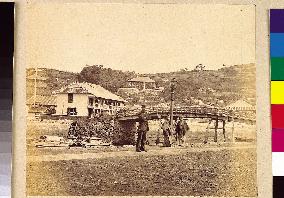
Benten Bridge was built in 1865 at the mouth of Oura River. The bridge is an arched wooden girder bridge with two bridge piers. Both ends of the bridge have stone steps. The buidling at Oura No.12 is an irimoya-style two-storied building. A photo taken a little bit before this photo does not show the veranda of the house while the building itself was no longer shown on an 1871 map of the settlement. Around 1868. ==Date:unknown, Place:Nagasaki, Photo:F. Beato, (Credit:Nagasaki University Library/Kyodo News Images)

  • Main
  • Top
  • Editorial
  • Creative
  • About Us
  • About ILG
  • Terms of use
  • Company
  • BEHIND
  • Price List
  • Single Plan
  • Monthly Plan
  • Services
  • Shooting
  • Rights Clearance
  • Support
  • FAQ
  • How To Buy
  • Contact Us
  • Become a Partner

© KYODO NEWS IMAGES INC

All Rights Reserved.

  • Editorial
  • Olympics
  • News
  • Sports
  • Japan
  • Tech
  • Royal
  • Disaster
  • NorthKorea
  • Old Japan
  • SNS
  • Creative
  • Food
  • Japan
  • Landscape
  • Animal
  • Popular
  • #Ukraine
  • #Thailand
  • #coronavirus
  • #N. Korea
  • #China
  • #Russia
  • #Ukraine
  • #Thailand
  • #coronavirus
  • #N. Korea
  • #China
  • #Russia
  • Food
  • Japan
  • Landscape
  • Animal
  • Olympics
  • News
  • Sports
  • Japan
  • Tech
  • Royal
  • Disaster
  • NorthKorea
  • Old Japan
  • SNS