•  
Newly Found Organics in Enceladus’ Plumes

Newly Found Organics in Enceladus’ Plumes

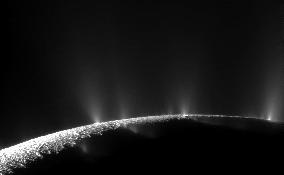
Handout photo to illustrate : Newly Found Organics in Enceladus’ Plumes. NASA's Cassini spacecraft captured dramatic plumes, both large and small, spray water ice out from many locations along the famed 'tiger stripes' near the south pole of Saturn's moon Enceladus. Dramatic plumes, both large and small, spray water ice out from many locations along the famed tiger stripes near the south pole of Saturn’s moon Enceladus in this image released on Feb. 23, 2010. A study published in October 2025 analyzed data from NASA’s Cassini mission and found evidence of previously undetected organic compounds in a plume of ice particles like the ones seen here. The ice particles were ejected from the ocean that lies under Enceladus’ frozen shell. Researchers spotted not only molecules they’ve found before but also new ones that lay a potential path to chemical or biochemical activity. Photo by NASA/JPL-Caltech/Space Science Institute via ABACAPRESS.COM

  •  
Newly Found Organics in Enceladus’ Plumes

Newly Found Organics in Enceladus’ Plumes

Handout photo to illustrate : Newly Found Organics in Enceladus’ Plumes. NASA's Cassini spacecraft captured dramatic plumes, both large and small, spray water ice out from many locations along the famed 'tiger stripes' near the south pole of Saturn's moon Enceladus. Dramatic plumes, both large and small, spray water ice out from many locations along the famed tiger stripes near the south pole of Saturn’s moon Enceladus in this image released on Feb. 23, 2010. A study published in October 2025 analyzed data from NASA’s Cassini mission and found evidence of previously undetected organic compounds in a plume of ice particles like the ones seen here. The ice particles were ejected from the ocean that lies under Enceladus’ frozen shell. Researchers spotted not only molecules they’ve found before but also new ones that lay a potential path to chemical or biochemical activity. Photo by NASA/JPL-Caltech/Space Science Institute via ABACAPRESS.COM

  •  
Red Spider Nebula

Red Spider Nebula

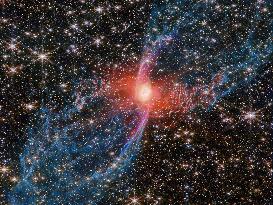
Handout photo dated on October 26, 2025 shows Red Spider Nebula. Using its Near-InfraRed Camera (NIRCam), NASA’s James Webb Space Telescope captured never-before-seen details of the Red Spider Nebula, a planetary nebula, in this image released on Oct. 26, 2025. NIRCam is Webb’s primary near-infrared imager, providing high-resolution imaging and spectroscopy for a wide variety of investigations. Webb’s new view of the Red Spider Nebula reveals for the first time the full extent of the nebula’s outstretched lobes, which form the ‘legs’ of the spider. These lobes, shown in blue, are traced by light emitted from H2 molecules, which contain two hydrogen atoms bonded together. Stretching over the entirety of NIRCam’s field of view, these lobes are shown to be closed, bubble-like structures that each extend about 3 light-years. Outflowing gas from the center of the nebula has inflated these massive bubbles over thousands of years. Photo by ESA/Webb, NASA & CSA, J. H. Kastner (Rochester Institute of Technolo via ABAC

  •  

3 scientists share 2023 Nobel Physics Prize

STORY: 3 scientists share 2023 Nobel Physics Prize DATELINE: Oct. 4, 2023 LENGTH: 00:02:15 LOCATION: Stockholm CATEGORY: SCIENCE SHOTLIST: 1. various of the press conference and photos of laureates of the 2023 Nobel Prize in Physics 2. various of the Royal Swedish Academy of Sciences STORYLINE: Three scientists, Pierre Agostini, Ferenc Krausz and Anne L'Huillier, won the 2023 Nobel Prize in Physics "for experimental methods that generate attosecond pulses of light for the study of electron dynamics in matter," the Royal Swedish Academy of Sciences announced here Tuesday. "The three Nobel Laureates in Physics 2023 are being recognized for their experiments, which have given humanity new tools for exploring the world of electrons inside atoms and molecules," the academy said in a statement. "The three scientists have demonstrated a way to create extremely short pulses of light that can be used to measure the rapid processes in which electrons move or change energy," it added. In a telephone interview on-s

  •  
James Webb View Of The Ring Nebula

James Webb View Of The Ring Nebula

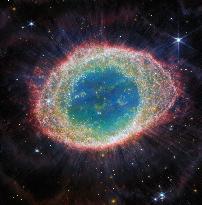
The NASA/ESA/CSA James Webb Space Telescope has observed the well-known Ring Nebula with unprecedented detail. Formed by a star throwing off its outer layers as it runs out of fuel, the Ring Nebula is an archetypal planetary nebula. Also known as M57 and NGC 6720, it is both relatively close to Earth at roughly 2,500 light-years away. This new image provides unprecedented spatial resolution and spectral sensitivity. For example, the intricate details of the filament structure of the inner ring are particularly visible in this dataset. There are some 20,000 dense globules in the nebula, which are rich in molecular hydrogen. In contrast, the inner region shows very hot gas. The main shell contains a thin ring of enhanced emission fromcarbon-based molecules known as polycyclic aromatic hydrocarbons (PAHs). Roughly ten concentric arcs are located just beyond the outer edge of the main ring. The arcs are thought to originate from the interaction of the central star with a low-mass companion orbiting at a distance

  •  
James Webb View Of The Ring Nebula

James Webb View Of The Ring Nebula

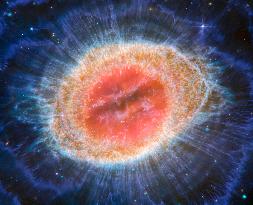
The NASA/ESA/CSA James Webb Space Telescope has observed the well-known Ring Nebula with unprecedented detail. Formed by a star throwing off its outer layers as it runs out of fuel, the Ring Nebula is an archetypal planetary nebula. Also known as M57 and NGC 6720, it is both relatively close to Earth at roughly 2,500 light-years away. This new image provides unprecedented spatial resolution and spectral sensitivity. In particular, Webb’s MIRI (Mid-InfraRed Instrument) reveals particular details in the concentric features in the outer regions of the nebulae’s ring (right). There are some 20,000 dense globules in the nebula, which are rich in molecular hydrogen. In contrast, the inner region shows very hot gas. The main shell contains a thin ring of enhanced emission fromcarbon-based molecules known as polycyclic aromatic hydrocarbons (PAHs). Roughly ten concentric arcs located just beyond the outer edge of the main ring. The arcs are thought to originate from the interaction of the central star with a low-mass

  •  
Technology to etch Kai semiconductor with fluoroplastic instead of CFC gas

Technology to etch Kai semiconductor with fluoroplastic instead of CFC gas

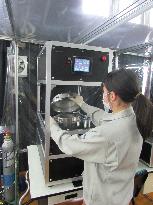
The established technology will be used for dry etching, thin film formation and cleaning of silicon. Easy-to-handle gases such as argon and nitrogen are irradiated onto solid fluoropolymers to generate fluorine-containing gas. The gas is then used for plasma treatment. Using a proto device with electrodes developed for special equipment, the company irradiated nitrogen gas and etched a glass substrate, and was able to etch 40 nanometers in one minute. The company plans to achieve an etching speed of 200 nanometers for commercialization. Plasma is an unstable state in which electrons have been removed from molecules, and it modifies the surface of materials, improving adhesion and cleaning effects. (Photo taken on March 30, 2020, location unknown, credit: Nikkan Kogyo Shimbun / Kyodo News Images)

  •  
The Limits Of Control (2009)

The Limits Of Control (2009)

Youki Kudoh Characters: Molecules Film: The Limits Of Control (USA/JP 2009) Director: Jim Jarmusch 01 May 2009 Date: 01 May 2009

  •  
Curiosity is Japanese researcher's driving force

Curiosity is Japanese researcher's driving force

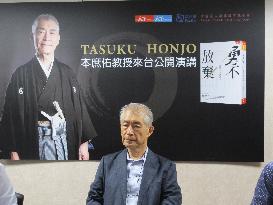
Tasuku Honjo, a Japanese biologist and a winner of Taiwan's Tang Prize in biopharmaceutical science, talks to reporters in Taipei on June 29, 2015. Honjo, along with a U.S. immunologist, were recognized by the first biannual Tang Prize for their discoveries of PD-1 and CTLA-4 as immune inhibitory molecules which together help reveal ways to harness the immune system to fight cancer. (Kyodo) ==Kyodo

  • Main
  • Top
  • Editorial
  • Creative
  • About Us
  • About ILG
  • Terms of use
  • Company
  • BEHIND
  • Price List
  • Single Plan
  • Monthly Plan
  • Services
  • Shooting
  • Rights Clearance
  • Support
  • FAQ
  • How To Buy
  • Contact Us
  • Become a Partner

© KYODO NEWS IMAGES INC

All Rights Reserved.

  • Editorial
  • Olympics
  • News
  • Sports
  • Japan
  • Tech
  • Royal
  • Disaster
  • NorthKorea
  • Old Japan
  • SNS
  • Creative
  • Food
  • Japan
  • Landscape
  • Animal
  • Popular
  • #Ukraine
  • #Russia
  • #coronavirus
  • #N. Korea
  • #China
  • #Thailand
  • #Ukraine
  • #Russia
  • #coronavirus
  • #N. Korea
  • #China
  • #Thailand
  • Food
  • Japan
  • Landscape
  • Animal
  • Olympics
  • News
  • Sports
  • Japan
  • Tech
  • Royal
  • Disaster
  • NorthKorea
  • Old Japan
  • SNS