•  
Tokyo to launch annual pass for 9 historical Japanese gardens

Tokyo to launch annual pass for 9 historical Japanese gardens

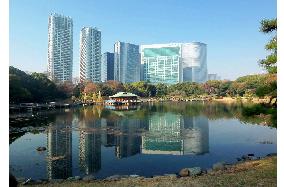
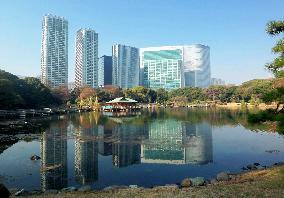
TOKYO, Japan - The Tokyo Metropolitan Park Association will introduce an annual pass for nine historical gardens in Tokyo beginning Feb. 1. The price is 4,000 yen for adults and 2,000 yen for people over 65. The nine Japanese gardens are: Hamarikyu Onshi Teien (photo), Kiyosumi Teien, Koishikawa-Korakuen, Kyu-Furukawa Teien, Kyu-Iwasaki-tei Teien, Kyu-Shibarikyu Onshi Teien, Mukojima Hyakka-en, Tonogayato Teien and Rikugi-en. The current annual pass is valid for one garden only.

  •  
Tokyo's Higashi-Mukojima area: Kids enjoy watching train wheels at museum

Tokyo's Higashi-Mukojima area: Kids enjoy watching train wheels at museum

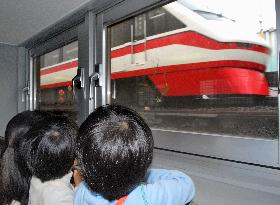
Children enjoy watching train wheels from the Tobu Museum in Tokyo's old downtown of Higashi-Mukojima on May 29, 2015, as express trains come and go. The museum is located underneath the elevated railway tracks of Tobu Railway Co.'s Higashi-Mukojima Station. (Kyodo) ==Kyodo

  •  
Tokyo's Higashi-Mukojima area: Big ginkgo tree towers over visitors

Tokyo's Higashi-Mukojima area: Big ginkgo tree towers over visitors

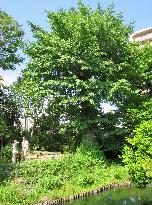
A big ginkgo tree at Mukojima-Hyakkaen Garden, a traditional flower garden in Tokyo's old downtown of Higashi-Mukojima, towers over visitors on May 30, 2015. The tree survived the Great Tokyo Air Raid on March 10, 1945, near the end of World War II. (Kyodo) ==Kyodo

  •  
Tokyo's Higashi-Mukojima area: Cozy cafe in old downtown

Tokyo's Higashi-Mukojima area: Cozy cafe in old downtown

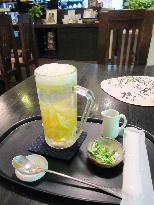
A cafe nestled in Tokyo's cozy old downtown of Higashi-Mukojima serves home-made juice as shown in this photo taken on May 30, 2015. The "Wa Cafe Mizuki" doubles as a gallery and holds an exhibition sale of artwork. (Kyodo) ==Kyodo

  •  
Tokyo's Higashi-Mukojima area: Railway museum popular with kids

Tokyo's Higashi-Mukojima area: Railway museum popular with kids

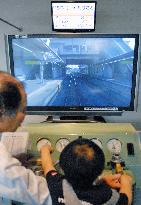
Photo taken on May 29, 2015, shows a train motorman's compartment at the Tobu Museum, a railway museum in Tokyo's old downtown of Higashi-Mukojima. It is one of the museum's biggest attractions, popular among children. (Kyodo) ==Kyodo

  •  
Tokyo's Higashi-Mukojima area: Garden in heart of metropolis

Tokyo's Higashi-Mukojima area: Garden in heart of metropolis

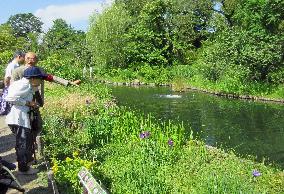
A volunteer guide (L) explains on May 30, 2015, about the attractiveness of the Mukojima-Hyakkaen Garden, the only surviving flower garden from the Edo period (1603-1867) in Tokyo's old downtown of Higashi-Mukojima, dubbed a land of cultural figures. (Kyodo) ==Kyodo

  •  
Tokyo to launch annual pass for 9 historical Japanese gardens

Tokyo to launch annual pass for 9 historical Japanese gardens

TOKYO, Japan - The Tokyo Metropolitan Park Association will introduce an annual pass for nine historical gardens in Tokyo beginning Feb. 1. The price is 4,000 yen for adults and 2,000 yen for people over 65. The nine Japanese gardens are: Hamarikyu Onshi Teien (photo), Kiyosumi Teien, Koishikawa-Korakuen, Kyu-Furukawa Teien, Kyu-Iwasaki-tei Teien, Kyu-Shibarikyu Onshi Teien, Mukojima Hyakka-en, Tonogayato Teien and Rikugi-en. The current annual pass is valid for one garden only. (Kyodo)

  •  
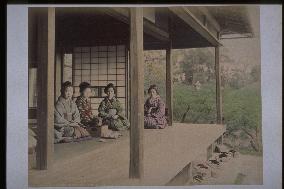
Teahouse at mukojima satake garden

Teahouse at mukojima satake garden

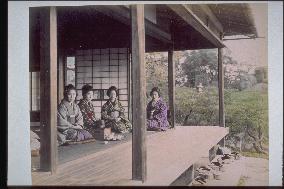
Four women with traditional hair styles sit on a sunny porch facing in this direction with a hot water pail in front of them. Under the porch, several pairs of sandals can be seen on the shoe rock. In the background is a stone lantern almost hidden by the trees in the garden.==Date:unknown, Place:Tokyo, Photo:Ogawa Kazumasa, (Credit:Nagasaki University Library/Kyodo News Images) [Cabinet Number8‐4‐0]

  •  
Hotta Garden,Mukojima

Hotta Garden,Mukojima

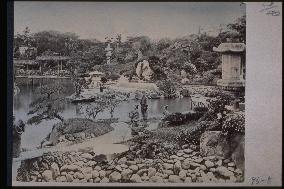
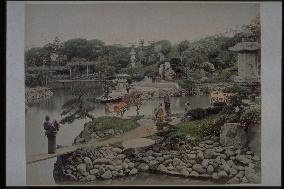
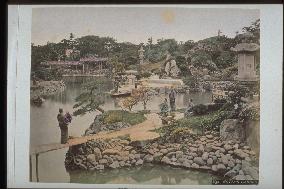
This is Shichishoen at Mukojima, the villa of the Hotta family, former feudal lords of the Sakura Clan. The villa was owned by the family from 1868 to 1887. Of kaiyushiki (garden with a pond and promenade style), the garden was watered by the Sumida River and changed according to the tides. It was referred to as one of the best gardens in Tokyo. The people posing for the photograph are probably members of the Hotta family.==Date:unknown, Place:Tokyo, Photo:unknown, (Credit:Nagasaki University Library/Kyodo News Images) [Cabinet Number96‐5‐0]

  •  
Yaomatsu Restaurant, Mukojima

Yaomatsu Restaurant, Mukojima

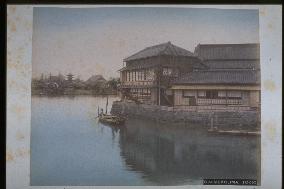
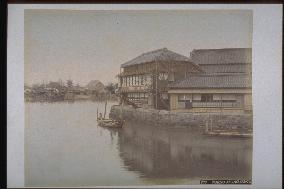
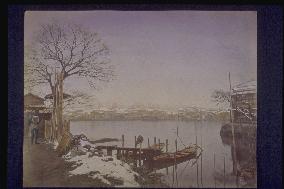
Yaomatsu-ro Restaurant seen from Makura Bridge at confluence of the Gennomori and Sumida rivers. The restaurant was opened in April 1870 as a branch of Yaomatsu located at Suijin-no-Mori. Customers drank sake while enjoying the view of boats crossing the Sumida River and Sensoji Temple across the river, and Yaomatsu-ro gained popularity as an early waterfront restaurant. Taken between 1887 and 1897. Same as photograph #2104.==Date:unknown, Place:Tokyo, Photo:unknown, (Credit:Nagasaki University Library/Kyodo News Images) [Cabinet Number93‐14‐0]

  •  
Hotta Garden,Mukojima

Hotta Garden,Mukojima

This is Shichishoen at Mukojima, the villa of the Hotta family, former feudal lords of the Sakura Clan. The villa was owned by the family from 1868 to 1887. Of kaiyushiki (garden with a pond and promenade style), the garden was watered by the Sumida River and changed according to the tides. It was referred to as one of the best gardens in Tokyo. The people posing for the photograph are probably members of the Hotta family.==Date:unknown, Place:Tokyo, Photo:unknown, (Credit:Nagasaki University Library/Kyodo News Images) [Cabinet Number92‐9‐0]

  •  
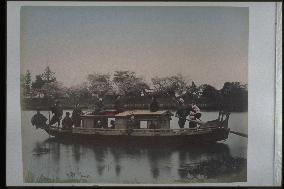
A leisure boat on the Sumida River

A leisure boat on the Sumida River

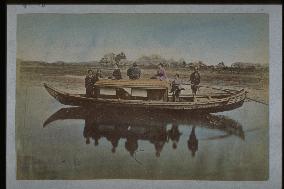
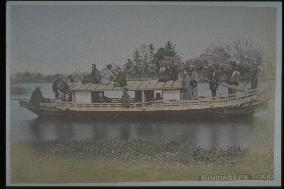
Roofed boat taken at the bank of Imado River in front of Yumei-ro where Sanya-bori (moat) merges with Sumida River. The water is too shallow to allow the boat to float, which explains why the photograph is so sharp. In the rear is Mukojima, site of Ushijima Shinto Shrine and Chomeiji Temple. Found in the collection of Uchida Kuichi preserved at Nagasaki Municipal Museum, this photograph was verified to have been taken by Uchida in 1872. This is one of the copies later made and sold.==Date:unknown, Place:Tokyo, Photo:Uchida Kuichi, (Credit:Nagasaki University Library/Kyodo News Images) [Cabinet Number90‐25‐0]

  •  
The ferries,Mukojima

The ferries,Mukojima

This same photograph was carried in Nihon no Meisho (Beautiful Places of Japan) published by Shiden Hensansho in 1900 under the title, Entertainment on a Boat at Sumida River, and also under the title Boat Play in Tokyo F?kei (Tokyo Scenery) published by Ogawa Kazumasa in 1911. This photograph resembles two photographs taken by Uchida Kuichi, but it is probably an Ogawa Kazumasa photograph taken around 1897. Says Ogawa in the caption to his photograph, Since ancient times, the boat outing on Sumida River has been the most sophisticated of all pleasures.==Date:unknown, Place:Tokyo, Photo:unknown, (Credit:Nagasaki University Library/Kyodo News Images) [Cabinet Number87‐7‐0]

  •  
Hotta Garden,Mukojima

Hotta Garden,Mukojima

This is Shichishoen at Mukojima, the villa of the Hotta family, former feudal lords of the Sakura Clan. The villa was owned by the family from 1868 to 1887. Of kaiyushiki (garden with a pond and promenade style), the garden was watered by the Sumida River and changed according to the tides. It was referred to as one of the best gardens in Tokyo. The people posing for the photograph are probably members of the Hotta family.==Date:unknown, Place:Tokyo, Photo:unknown, (Credit:Nagasaki University Library/Kyodo News Images) [Cabinet Number87‐8‐0]

  •  
Women at Satake Garden,Mukojima

Women at Satake Garden,Mukojima

The residence of the Satake family, former feudal lords of the Akita Clan, was located on the site of present-day Sumida Ward Office and the Asahi Beer Co. complex. The garden underwent major renovations at the end of the Edo Period and was opened to the public in 1890. In 1903, it was amalgamated into the Japan Beer Company Azuma Plant. A special part of the garden was called the Koyo-en.==Date:unknown, Place:Tokyo, Photo:unknown, (Credit:Nagasaki University Library/Kyodo News Images) [Cabinet Number85‐41‐0]

  •  
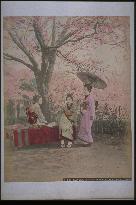
A teahouse and girls,Mukojima

A teahouse and girls,Mukojima

The English title is Wayside Resting Place. This is probably the endai bench at a teahouse on the Mukojima embankment. The kimono style of the three dressed-up girls indicates that they are geigi (young geisha). The food on the bench appears to be manju sweet buns. Sakura-mochi (cherry cake), which people ate in the cherry-blossom season, is said to have been created by Yamamoto Shinroku, the gateman at Chomeiji Temple in Mukojima during the Genroku Period.==Date:unknown, Place:Tokyo, Photo:unknown, (Credit:Nagasaki University Library/Kyodo News Images) [Cabinet Number85‐35‐0]

  •  
Satake Garden,Mukojima

Satake Garden,Mukojima

The garden at Nakanogo Kawara-machi (present-day Azumabashi 1-chome, site of Sumida Ward Hall and the Asahi Beer Co. Headquarters). Feudal lord Mizuno Tadaakira of Numazu Clan received the garden as a gift from the 11th Shogun Tokugawa Ienari sometime between 1818 and 1830. A resident of Mikawashima Village named Monzaburo is said to have designed it. According to historical records, the ownership later transferred to Matsudaira Echizennokami of the Fukui Clan of Echizen, and then to Satake Sakyodayu of Akita Clan in 1860. It is a Rinsen-style garden with a pond in the centre and many stones used for landscaping.==Date:unknown, Place:Tokyo, Photo:unknown, (Credit:Nagasaki University Library/Kyodo News Images) [Cabinet Number85‐8‐0]

  •  
Satake Garden,Mukojima

Satake Garden,Mukojima

Called Koyoen, the garden of the Akita Clan Satake family opened to the public in the mid-Meiji Period and gained fame as one of the most beautiful gardens of the former Edo. However, in 1903 it became the possession of Sapporo Brewery Company, which established its Azuma-bashi factory nearby and used the remainder of the garden as a beer garden where customers could enjoy the product of the brewery. In 1906, the facility became the Dai Nippon Brewery Company Azuma Factory, and the garden disappeared in the wake of factory expansions during the Taisho Period (1912-1926) and the Great Kanto Earthquake of 1923. Today, a few trees and an explanation panel next to the Sumida Ward Hall are the only reminders of the former garden.==Date:unknown, Place:Tokyo, Photo:unknown, (Credit:Nagasaki University Library/Kyodo News Images) [Cabinet Number85‐9‐0]

  •  
Hotta Garden,Mukojima

Hotta Garden,Mukojima

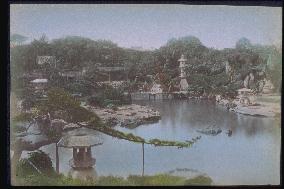
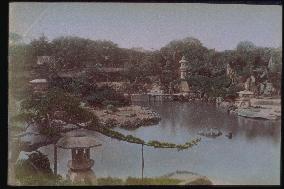
The water level here is higher than in photograph #4442. The landscaped rocks by the shore are underwater and the garden looks different. A banner with the crest of the Hotta family is visible over the wisterias on the far left. The neighbour's tiled roof visible over the foliage in the centre is not apparent in #4442. Thus, this photograph must have been taken somewhat later.==Date:unknown, Place:Tokyo, Photo:unknown, (Credit:Nagasaki University Library/Kyodo News Images) [Cabinet Number80‐26‐0]

  •  
Hotta Garden,Mukojima

Hotta Garden,Mukojima

This is Shichishoen at Mukojima, the villa of the Hotta family, former feudal lords of the Sakura Clan. The villa was owned by the family from 1868 to 1887. Of kaiyushiki (garden with a pond and promenade style), the garden was watered by the Sumida River and changed according to the tides. It was referred to as one of the best gardens in Tokyo. The people posing for the photograph are probably members of the Hotta family.==Date:unknown, Place:Tokyo, Photo:unknown, (Credit:Nagasaki University Library/Kyodo News Images) [Cabinet Number80‐27‐0]

  •  
Hotta Garden,Mukojima

Hotta Garden,Mukojima

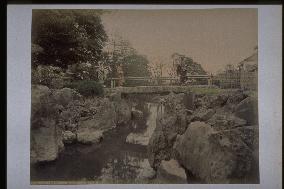
The water level here is higher than in photograph #4442. The landscaped rocks by the shore are underwater and the garden looks different. A banner with the crest of the Hotta family is visible over the wisterias on the far left. The neighbour's tiled roof visible over the foliage in the centre is not apparent in #4442. Thus, this photograph must have been taken somewhat later.==Date:unknown, Place:Tokyo, Photo:unknown, (Credit:Nagasaki University Library/Kyodo News Images) [Cabinet Number59‐78‐0]

  •  
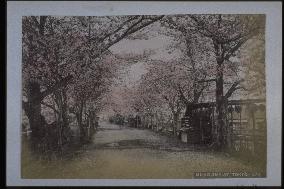
Cherry trees at Mukojima

Cherry trees at Mukojima

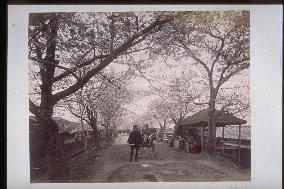
Although not visible here, Sumida River is on the left. This is the view from Boku-tei (riverbank) facing upstream. There are many famous historical places at Mukojima such as Ushijima Shinto Shrine (also called Ushi-no-Gozen), Chomeiji Temple which is famous for its sakuramochi (cherry-flavoured rice cakes), Mokuboji Temple, site of Umewaka Mound, Kofukuji Temple with its statue of Hotei, and Mukojima Hyakkaen (Hundred Flower) Park. Yaomatsu Restaurant and the Kototoi Dumpling Shop opened here in the early Meiji Period. Mukojima was a popular among the cultural elite. Same as photograph #2654.==Date:unknown, Place:Tokyo, Photo:unknown, (Credit:Nagasaki University Library/Kyodo News Images) [Cabinet Number59‐4‐2]

  •  
A view of the city of Onomichi

A view of the city of Onomichi

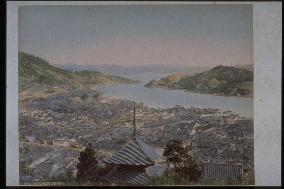
Onomichi City and Mukojima Island are visible beyond the three-story pagoda of Tenneiji Temple (today an Important Cultural Asset) on the hillside of Mt. Senkoji. The photograph shows the arrangement of buildings in the commercial district around Hondori Street, the white-walled Hamagura warehouses by the seashore, and the construction of the Sanyo Railroad.==Date:unknown, Place:Onomichi, Photo:unknown, (Credit:Nagasaki University Library/Kyodo News Images) [Cabinet Number59‐5‐0]

  •  
Hotta Garden,Mukojima

Hotta Garden,Mukojima

This is Shichishoen at Mukojima, the villa of the Hotta family, former feudal lords of the Sakura Clan. The villa was owned by the family from 1868 to 1887. Of kaiyushiki (garden with a pond and promenade style), the garden was watered by the Sumida River and changed according to the tides. It was referred to as one of the best gardens in Tokyo. The people posing for the photograph are probably members of the Hotta family.==Date:unknown, Place:Tokyo, Photo:unknown, (Credit:Nagasaki University Library/Kyodo News Images) [Cabinet Number59‐6‐2]

  •  
Hotta Garden,Mukojima

Hotta Garden,Mukojima

This is Shichishoen at Mukojima, the villa of the Hotta family, former feudal lords of the Sakura Clan. The villa was owned by the family from 1868 to 1887. Of kaiyushiki (garden with a pond and promenade style), the garden was watered by the Sumida River and changed according to the tides. It was referred to as one of the best gardens in Tokyo. The people posing for the photograph are probably members of the Hotta family.==Date:unknown, Place:Tokyo, Photo:unknown, (Credit:Nagasaki University Library/Kyodo News Images) [Cabinet Number59‐4‐0]

  •  
The ferries,Mukojima

The ferries,Mukojima

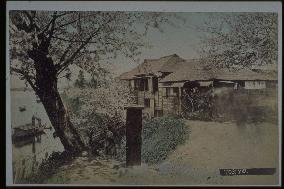
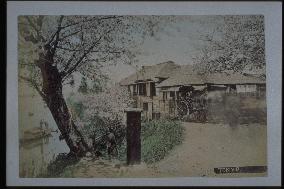
The square pillar in the centre foreground is a mail box. Made of pine and painted black, mail boxes were placed on the streets of Japan for the first time in 1872. Foundation stones were placed under the mail boxes starting in 1887, so the mail box in this photograph was taken after 1887. Same as photograph #2657.==Date:unknown, Place:Tokyo, Photo:unknown, (Credit:Nagasaki University Library/Kyodo News Images) [Cabinet Number53‐49‐0]

  •  
The ferries,Mukojima

The ferries,Mukojima

The area in front of Chomeiji Temple was called Kototoi-no-Oka. In 1869, Kototoi-tei opened and its Kototoi dumplings became a Mukojima specialty along with the cherry rice cakes of Chomeiji Temple. The shop curtain on the right seems to say Kototoi dango (dumplings), indicating that this is Kototoi-tei. Kototoi dumplings are still a local specialty at Mukojima. Taken in the mid-Meiji Period. Same as photograph #2664.==Date:unknown, Place:Tokyo, Photo:unknown, (Credit:Nagasaki University Library/Kyodo News Images) [Cabinet Number53‐43‐0]

  •  
A leisure boat on the Sumida River

A leisure boat on the Sumida River

Like photographs #2665 and #4543, this was taken at the bank of Imado River in front of Yumei-ro at the mouth of Sanya-bori. Ushijima Shinto Shrine, also called Ushi-no-Gozen (presently located at Mukojima 1-chome, downstream) and Choumeiji Temple are amid the tall trees at the rear. The person leaning on the handrail in the centre may be Uchida Kuichi. If so, this photograph was probably taken by his apprentice. The photograph was sold after being trimmed and tinted.==Date:unknown, Place:Tokyo, Photo:unknown, (Credit:Nagasaki University Library/Kyodo News Images) [Cabinet Number53‐44‐0]

  •  
Cherry trees at Mukojima

Cherry trees at Mukojima

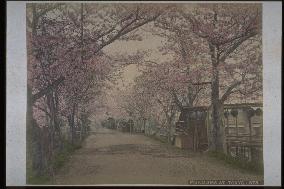
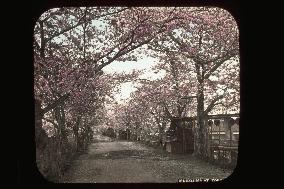
The area across Sumida River from Asakusa is Mukojima. There is no official boundary, but area from Mokuboji Temple to Makura Bridge is referred to as Mukojima. The banks of Sumida River at Mukojima are called Sumida-tei or Boku-tei. Cherry trees were planted here during the Kyoho Period (1716-36) by the 8th Shogun Tokugawa Yoshimune, and saplings were planted from time to time thereafter. This area thus became the most popular place to enjoy cherry blossoms in Edo. Taken around 1898.==Date:unknown, Place:Tokyo, Photo:unknown, (Credit:Nagasaki University Library/Kyodo News Images) [Cabinet Number53‐40‐0]

  •  
Hotta Garden,Mukojima

Hotta Garden,Mukojima

This is Shichishoen at Mukojima, the villa of the Hotta family, former feudal lords of the Sakura Clan. The villa was owned by the family from 1868 to 1887. Of kaiyushiki (garden with a pond and promenade style), the garden was watered by the Sumida River and changed according to the tides. It was referred to as one of the best gardens in Tokyo. The people posing for the photograph are probably members of the Hotta family.==Date:unknown, Place:Tokyo, Photo:unknown, (Credit:Nagasaki University Library/Kyodo News Images) [Cabinet Number53‐39‐0]

  •  
Ferries,the Sumida River

Ferries,the Sumida River

Probably the ferry dock called Takeya-no-Watashi at Mukojima. Another photograph taken downstream shows these people at the same time. Stone steps descend to the river from where the man is standing in the centre, and the ferry dock called Terashima-no-Watashi is visible upstream. However, the boat depicted here is not a ferry but a yanebune (roofed boat) used for entertainment. This is one of the photographs in the album sold at Kinpei Photograph Studio, indicating that it was taken by Kusakabe Kinbei in the early Meiji Period.==Date:unknown, Place:Tokyo, Photo:unknown, (Credit:Nagasaki University Library/Kyodo News Images) [Cabinet Number53‐31‐0]

  •  
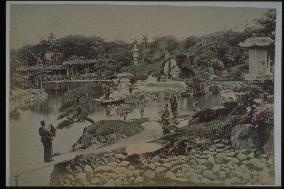
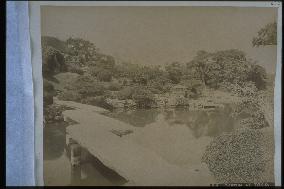
Hotta Garden,Mukojima

Hotta Garden,Mukojima

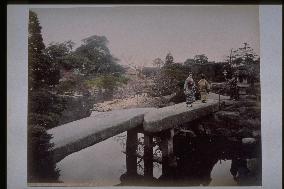
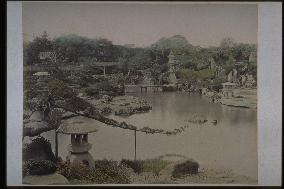
This is Shichisho Garden at the Hotta family villa. The bridge in front of the wisteria tree shown in #4442 was made from these three large flat stones. The elevated area on the left and the lantern in the centre are typical features of the garden of a feudal lord. The water level is lower than that in #2993.==Date:unknown, Place:Tokyo, Photo:unknown, (Credit:Nagasaki University Library/Kyodo News Images) [Cabinet Number53‐6‐0]

  •  
Hotta Garden,Mukojima

Hotta Garden,Mukojima

This is Shichishoen at Mukojima, the villa of the Hotta family, former feudal lords of the Sakura Clan. The villa was owned by the family from 1868 to 1887. Of kaiyushiki (garden with a pond and promenade style), the garden was watered by the Sumida River and changed according to the tides. It was referred to as one of the best gardens in Tokyo. The people posing for the photograph are probably members of the Hotta family.==Date:unknown, Place:Tokyo, Photo:Tamamura Kozaburo, (Credit:Nagasaki University Library/Kyodo News Images) [Cabinet Number48‐135‐0]

  •  
Hotta Garden,Mukojima

Hotta Garden,Mukojima

This is Shichishoen at Mukojima, the villa of the Hotta family, former feudal lords of the Sakura Clan. The villa was owned by the family from 1868 to 1887. Of kaiyushiki (garden with a pond and promenade style), the garden was watered by the Sumida River and changed according to the tides. It was referred to as one of the best gardens in Tokyo. The people posing for the photograph are probably members of the Hotta family.==Date:unknown, Place:Tokyo, Photo:Tamamura Kozaburo, (Credit:Nagasaki University Library/Kyodo News Images) [Cabinet Number48‐66‐0]

  •  
Hotta Garden,Mukojima

Hotta Garden,Mukojima

The water level here is higher than in photograph #4442. The landscaped rocks by the shore are underwater and the garden looks different. A banner with the crest of the Hotta family is visible over the wisterias on the far left. The neighbour's tiled roof visible over the foliage in the centre is not apparent in #4442. Thus, this photograph must have been taken somewhat later.==Date:unknown, Place:Tokyo, Photo:Tamamura Kozaburo, (Credit:Nagasaki University Library/Kyodo News Images) [Cabinet Number48‐60‐0]

  •  
Ueno Park

Ueno Park

A large number of men in Japanese-style dress are walking. Four policemen with sabers are walking behind them. What could be beyond this street? Teahouses are on the left side of the street. This is not a scene in Ueno Park, but it may be Mukojima.==Date:unknown, Place:Tokyo, Photo:Tamamura Kozaburo, (Credit:Nagasaki University Library/Kyodo News Images) [Cabinet Number48‐62‐0]

  •  
Yaomatsu Restaurant, Mukojima

Yaomatsu Restaurant, Mukojima

Yaomatsu Restaurant on the right was opened in a refurbished boat shed formerly owned by the Tokugawa family of Mito. The water in front is probably Gennomori River, seen from Makura Bridge. There was a ferry stop at the end of the bridge called Yamanoshuku-no-Watashi (Makurabashi-no-Watashi) for passage to Asakusa on the other side of the river. The five-story pagoda Kan'non-do Hall and the Nio Gate of Sensoji Temple are visible. The Ryounkaku built in 1890 is visible to the left of the pagoda, indicating that the photograph was taken after that year.==Date:unknown, Place:Tokyo, Photo:unknown, (Credit:Nagasaki University Library/Kyodo News Images) [Cabinet Number47‐7‐0]

  •  
Ueno Park

Ueno Park

In 1717, the 8th Shogun Tokugawa Yoshimune planted 100 cherry trees along the Mukojima riverbank, and the spot became popular for cherry blossom viewing. In 1883, when Okura Kihachiro planted an additional 1,000 trees here, the riverbank became full of cherry blossoms. Many simple teahouses were built along the riverbank for the use of visitors.==Date:unknown, Place:Tokyo, Photo:unknown, (Credit:Nagasaki University Library/Kyodo News Images) [Cabinet Number47‐8‐0]

  •  
Satake Garden,Mukojima

Satake Garden,Mukojima

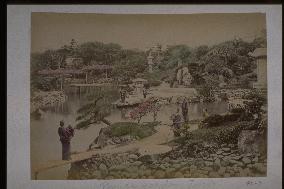
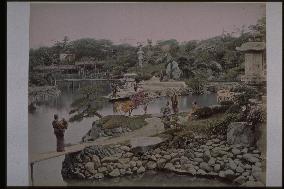
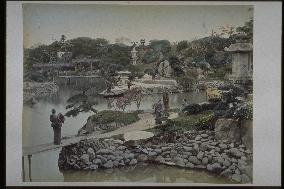
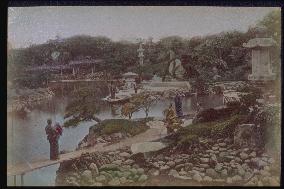
A landscape garden in the go-round style. A woman stands on the bridge, and further on are several people watching the garden. Lanterns are seen here and there, and a wisteria shelf is seen on the opposite bank. The same as the photo numbered 25-34.==Date:unknown, Place:Tokyo, Photo:Suzuki Shin-ichi, (Credit:Nagasaki University Library/Kyodo News Images) [Cabinet Number41‐45‐0]

  •  
Takeya Ferry Port,Mukojima

Takeya Ferry Port,Mukojima

One of the crossings to Mukojima, Takeyano watashi. It was called Mukojima because it looked like an island when viewed from the opposite side of the Sumida River from the Asakusa side. The pier in the photo is on the side of Mukojima. The tower of Sensoji can be faintly seen on the opposite bank.==Date:unknown, Place:Tokyo, Photo:unknown, (Credit:Nagasaki University Library/Kyodo News Images) [Cabinet Number37‐68‐0]

  •  
Teahouse at mukojima tsutsumi

Teahouse at mukojima tsutsumi

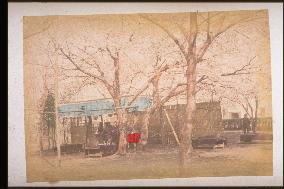
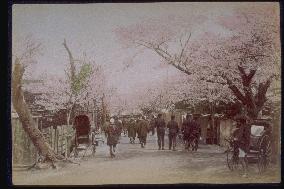
Bokutei is a favourite spot for viewing cherry blossoms. The cherry blossom boulevard on both sides of the road is magnificent. The lantern hanging from the teahouse could be for visitors coming to view cherry blossoms in the evening. There is a stand to sell souvenirs by the teahouse.==Date:unknown, Place:Tokyo, Photo:unknown, (Credit:Nagasaki University Library/Kyodo News Images) [Cabinet Number31‐61‐0]

  •  
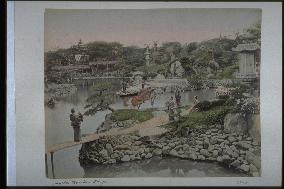
Satake Garden,Mukojima

Satake Garden,Mukojima

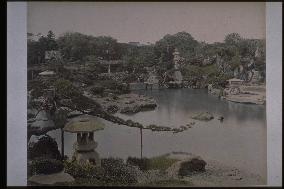
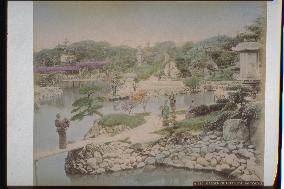
A landscape garden in the go-round style. A pine branch reaches over the pond, and people can be seen on the bridge built over the pond. Many lanterns can be seen here and there. To the left rear is a wisteria trellis.==Date:unknown, Place:Tokyo, Photo:Ogawa Kazumasa, (Credit:Nagasaki University Library/Kyodo News Images) [Cabinet Number25‐74‐0]

  •  
Teahouse at mukojima tsutsumi

Teahouse at mukojima tsutsumi

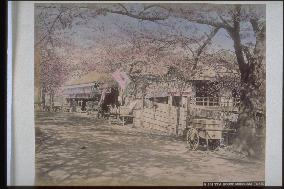
Sumizutsumi was a famous spot for viewing cherry blossoms. Under the cherry blossoms in full bloom there is a banner sign Sushi in front of the shop. A person stands on the street, and a cart with a load is parked to the fore. In the distance is a room with open doors.==Date:unknown, Place:Tokyo, Photo:Ogawa Kazumasa, (Credit:Nagasaki University Library/Kyodo News Images) [Cabinet Number25‐33‐0]

  •  
Satake Garden,Mukojima

Satake Garden,Mukojima

A landscape garden in the go-round style. A woman stands on the bridge, and several people enjoy the garden ahead of her. Lanterns stand here and there, and on the other side of the pond is a wisteria stand. The same picture as that numbered 41-45.==Date:unknown, Place:Tokyo, Photo:Ogawa Kazumasa, (Credit:Nagasaki University Library/Kyodo News Images) [Cabinet Number25‐34‐0]

  •  
MUKOJIMA SHIRAHIGE shrine

MUKOJIMA SHIRAHIGE shrine

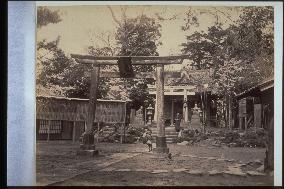
Worshipping one of the seven Gods of Fortune of Sumida, the Jurojin. This temple originates from the legend that Jikei Taishi invited the Shirahigue Daimyojin from Shigagun of the country of Omi in 951. It is the guardian of Terashimacho. The deity worshipped is Sarutahikogami. The building, which escaped fires during World WarⅡ, was built in 1864.==Date:unknown, Place:Tokyo, Photo:unknown, (Credit:Nagasaki University Library/Kyodo News Images) [Cabinet Number24‐1‐0]

  •  
Cherry trees and a teahouse

Cherry trees and a teahouse

There are many old pictures taken of cherry blossom sites such as Yokohama (no. 55-12, 55-41) Ueno (no.53-15) and Mukojima (no.53-40). The location of this photo cannot be specified, but the atmosphere of the cherry blossoms is well conveyed with the tea shop, reed screen, etc.==Date:unknown, Place:unknown, Photo:unknown, (Credit:Nagasaki University Library/Kyodo News Images) [Cabinet Number16‐37‐0]

  •  
Satake Garden,Mukojima

Satake Garden,Mukojima

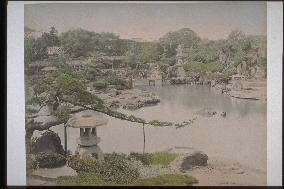
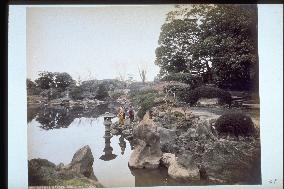
The lake takes up the left part of the photo, and trees are planted around it in the garden, with a rock. Four women dressed in kimono pause by the lake and a lantern stands in the water. Both shed shadows on the surface. To the right are tall trees.==Date:unknown, Place:Tokyo, Photo:Ogawa Kazumasa, (Credit:Nagasaki University Library/Kyodo News Images) [Cabinet Number9‐49‐0]

  •  
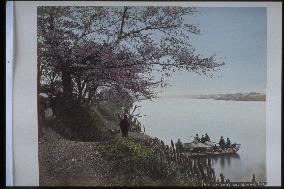
The ferries,Mukojima

The ferries,Mukojima

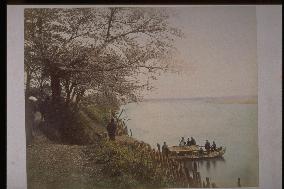
The commuter boat between Asakusa (in Taito Ward) and Kukojima (in Sumida Ward). Several men and women passengers are looking toward the camera. Some people seem to be waiting to meet passengers on arrival. Cherry trees in full bloom line the embankment. The characteristics of the boat can be observed in more detail in the photo marked 53-44.==Date:unknown, Place:Tokyo, Photo:Kusakabe Kinbei, (Credit:Nagasaki University Library/Kyodo News Images) [Cabinet Number3‐32‐0]

  •  
Tokyo Sky Tree parfait

Tokyo Sky Tree parfait

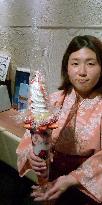
TOKYO, Japan - An employee holds up a Strawberry Sky Tree parfait at Sakura Cafe Mukojima, a Japanese sweet cafe located near the foot of Tokyo Sky Tree, the world's highest self-standing tower currently under construction, in Tokyo's Sumida Ward, on March 8, 2011. (Kyodo)

  •  
Aika-en at Mukojima

Aika-en at Mukojima

Aika-en at Mukojima==Date:Early Meiji, Place:Tokyo, Photo:unknown, (Credit:Nagasaki University Library/Kyodo News Images)

  • Main
  • Top
  • Editorial
  • Creative
  • About Us
  • About ILG
  • Terms of use
  • Company
  • BEHIND
  • Price List
  • Single Plan
  • Monthly Plan
  • Services
  • Shooting
  • Rights Clearance
  • Support
  • FAQ
  • How To Buy
  • Contact Us
  • Become a Partner

© KYODO NEWS IMAGES INC

All Rights Reserved.

  • Editorial
  • Olympics
  • News
  • Sports
  • Japan
  • Tech
  • Royal
  • Disaster
  • NorthKorea
  • Old Japan
  • SNS
  • Creative
  • Food
  • Japan
  • Landscape
  • Animal
  • Popular
  • #Ukraine
  • #China
  • #coronavirus
  • #N. Korea
  • #Thailand
  • #Russia
  • #Ukraine
  • #China
  • #coronavirus
  • #N. Korea
  • #Thailand
  • #Russia
  • Food
  • Japan
  • Landscape
  • Animal
  • Olympics
  • News
  • Sports
  • Japan
  • Tech
  • Royal
  • Disaster
  • NorthKorea
  • Old Japan
  • SNS