•  

China: Octopus Clings to Phone After Being Caught by Fisher in Fuzhou

In Fuzhou, Fujian, a video captured a man fishing when he unexpectedly caught an octopus with a phone stuck to one of its tentacles on September 28. The octopus refused to let go, wrapping its arms tightly around the device as if claiming it as its own.

  •  
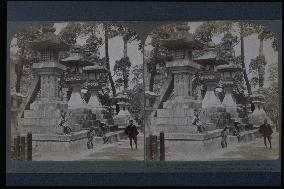
Stone Lantern in Sumiyoshi Shrine

Stone Lantern in Sumiyoshi Shrine

Many stone lanterns were donated to Sumiyoshi Shinto Shrine as prayers for safe sea voyages and successful business. Probably taken in the beginning of the Meiji Period.==Date:1904, Place:Osaka, Photo:Underwood, (Credit:Nagasaki University Library/Kyodo News Images) [Cabinet Number97‐18‐0]

  •  
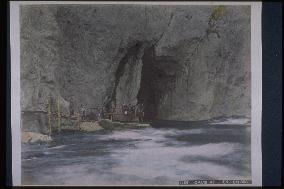
The cave on Enoshima Island

The cave on Enoshima Island

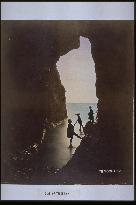
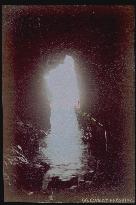
Photographer unknown. Entitled 1101 Cave at Enoshima. The entrance to the cave, Oniwaya, and a pier-like wooden passage is visible at the bottom of the cliff. This cave, the focal point of Enoshima worship, is also called Ryukutsu, Hongu Iwaya, or Okunomiya. The same photograph, tinted with color, is on display at the Yokohama Archives of History.==Date:unknown, Place:Enoshima, Photo:unknown, (Credit:Nagasaki University Library/Kyodo News Images) [Cabinet Number96‐49‐0]

  •  
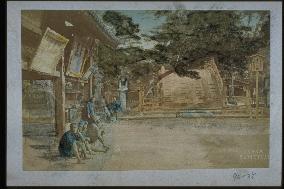
Soribashi bridge at Sumiyoshi Shrine

Soribashi bridge at Sumiyoshi Shrine

Ema-do is visible on the left. People donated ema (votive tablets) and stone lanterns as prayers for safe voyages at sea and success in business. Early Meiji Period.==Date:unknown, Place:Osaka, Photo:unknown, (Credit:Nagasaki University Library/Kyodo News Images) [Cabinet Number90‐35‐0]

  •  
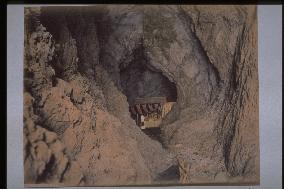
The Benzaiten (the Indian-origin Goddess of fortune),Enoshima Island

The Benzaiten (the Indian-origin Goddess of fortune),Enoshima Island

Photographer unknown. Entitled ENOSHIMA. 523. The small shrine visible in the centre could be the one located in the middle of Hongu Iwaya, or the small shrine worshipping tennyo (heavenly maidens). The Illustrated Map of Enoshima, Kugenuma, Zushi, and Kanazawa published in 1898 mentions the existence of two small shrines and a washroom.==Date:unknown, Place:Enoshima, Photo:unknown, (Credit:Nagasaki University Library/Kyodo News Images) [Cabinet Number85‐18‐0]

  •  
The cave on Enoshima Island

The cave on Enoshima Island

The entrance to the cave called Iwaya number one at Enoshima, a view similar to that in #2242 and #4874. The cave eroded by the sea was called Oniwaya, Hongu Iwaya, or Okunomiya. There is a wooden passageway with railing to the right. Said to have been taken by Shimooka Renjo (1823-1914), this photograph bears the note Cave of Yenoshima.==Date:unknown, Place:Enoshima, Photo:unknown, (Credit:Nagasaki University Library/Kyodo News Images) [Cabinet Number64‐42‐0]

  •  
The cave on Enoshima Island

The cave on Enoshima Island

Taken by Tamamura Kozaburo (1856-?). Entitled 96, Cave at Enoshima. This eroded sea cave was called Okunomiya. A passageway is visible on the right. Until the end of the Edo Period, this was the site of both Buddhist and Shinto worship. However, at the beginning of the Meiji Period, Buddhist structures were demolished. Since then, the shrine consists mainly of the Okunomiya and Enoshima shrine buildings.==Date:unknown, Place:Enoshima, Photo:Tamamura Kozaburo, (Credit:Nagasaki University Library/Kyodo News Images) [Cabinet Number48‐95‐0]

  •  
A teahouse at Honmoku Juniten

A teahouse at Honmoku Juniten

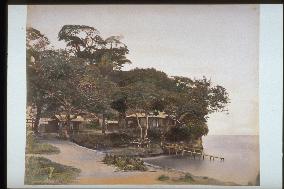
A promenade for foreigners was made around the Bluff, Honmoku and Negishi in 1864. Juniten shrine is the guardian of Hongo village in Honmoku. The scenic Honmoku Juniten has a side road, and there were tea houses along the way.==Date:unknown, Place:Yokohama, Photo:Suzuki Shin-ichi, (Credit:Nagasaki University Library/Kyodo News Images) [Cabinet Number41‐16‐0]

  •  
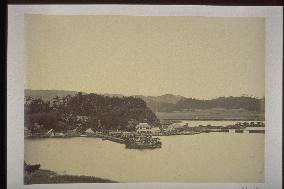
Hirakata Bay from Kyurantei

Hirakata Bay from Kyurantei

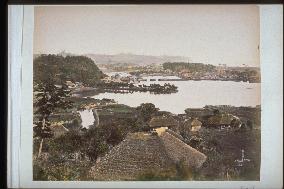
A view of Hiragata Bay, from the Kyurantei. In the center is the Benten of Biwa Island, and further on is Seto Shrine. A photo of the area around Hiragata Bay.==Date:unknown, Place:Yokohama, Photo:Suzuki Shin-ichi, (Credit:Nagasaki University Library/Kyodo News Images) [Cabinet Number41‐15‐0]

  •  
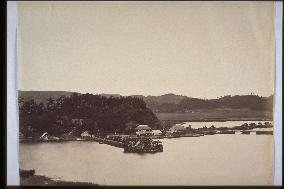
Hirakata Bay from Kyurantei

Hirakata Bay from Kyurantei

The view of Hiragata Bay from Kurantei. In the center is the Benten of Biwajima, and the distant one is Seto Shrine. The caption says, Tea House in Kanazawa. Photograph by F. Beato. Identical to photo No. 916 (19-32).==Date:unknown, Place:Yokohama, Photo:F. Beato, (Credit:Nagasaki University Library/Kyodo News Images) [Cabinet Number36‐17‐0]

  •  
Kanazawa Hakkei Bentensha

Kanazawa Hakkei Bentensha

A view of Hiragata Bay, from Kurantei. The centre is the Benten of Biwajima, and further ahead is Seto Shrine. The caption says that it is a teahouse at Kanazawa. Photo by F. Beato.==Date:unknown, Place:Yokohama, Photo:F. Beato, (Credit:Nagasaki University Library/Kyodo News Images) [Cabinet Number28‐1‐0]

  • Main
  • Top
  • Editorial
  • Creative
  • About Us
  • About ILG
  • Terms of use
  • Company
  • BEHIND
  • Price List
  • Single Plan
  • Monthly Plan
  • Services
  • Shooting
  • Rights Clearance
  • Support
  • FAQ
  • How To Buy
  • Contact Us
  • Become a Partner

© KYODO NEWS IMAGES INC

All Rights Reserved.

  • Editorial
  • Olympics
  • News
  • Sports
  • Japan
  • Tech
  • Royal
  • Disaster
  • NorthKorea
  • Old Japan
  • SNS
  • Creative
  • Food
  • Japan
  • Landscape
  • Animal
  • Popular
  • #Ukraine
  • #China
  • #coronavirus
  • #N. Korea
  • #Thailand
  • #Russia
  • #Ukraine
  • #China
  • #coronavirus
  • #N. Korea
  • #Thailand
  • #Russia
  • Food
  • Japan
  • Landscape
  • Animal
  • Olympics
  • News
  • Sports
  • Japan
  • Tech
  • Royal
  • Disaster
  • NorthKorea
  • Old Japan
  • SNS