•  

[Breaking News]Traditional boat race

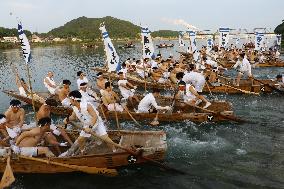
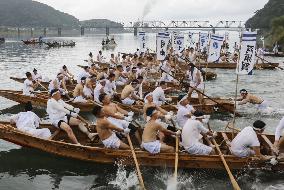
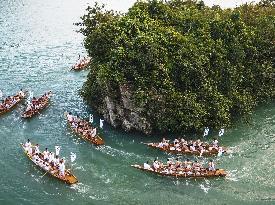
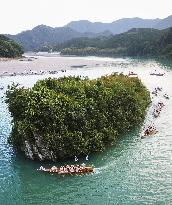
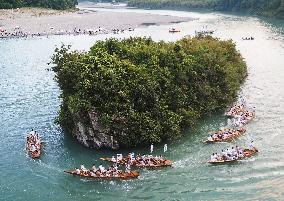
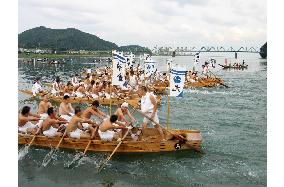
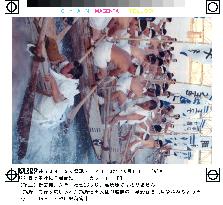
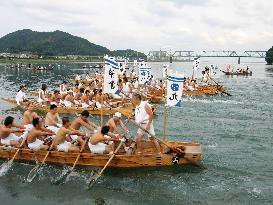
SHINGU, Japan, Oct. 16 Kyodo - Wooden "speedboats" rowed by shirtless men compete in a traditional boating race as part of the Mifune festival on the Kumano River running near World Heritage-listed Kumano Hayatama Taisha shrine in Shingu in the western Japan prefecture of Wakayama on Oct. 16, 2025. (Kyodo)

  •  
Traditional boat race

Traditional boat race

Wooden "speedboats" rowed by shirtless men compete in a traditional boating race as part of the Mifune festival on the Kumano River running near World Heritage-listed Kumano Hayatama Taisha shrine in Shingu in the western Japan prefecture of Wakayama on Oct. 16, 2025.

  •  
Rite at Ise Jingu shrine in Mie Pref.

Rite at Ise Jingu shrine in Mie Pref.

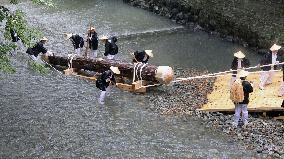
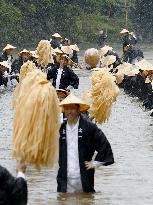
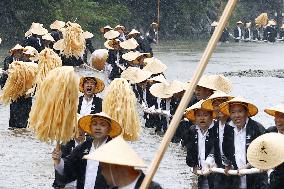
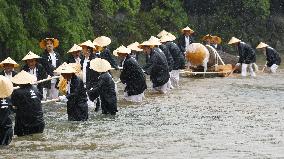
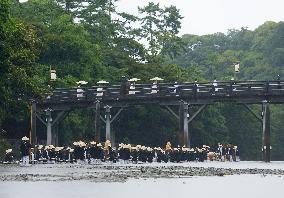
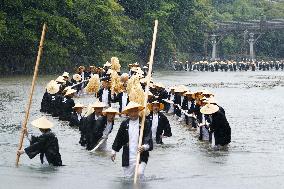
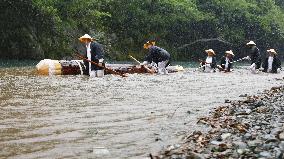
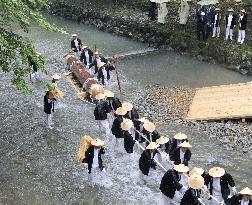
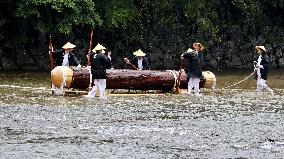
Ise Jingu shrine officials transport a "sacred" tree on the Isuzu River in Ise, Mie Prefecture, on June 9, 2025, as part of rites for the "Shikinen Sengu" shrine building reconstruction every 20 years at the Shinto shrine in the central Japan city. Over 30 rites are planned for the 63rd "Shikinen Sengu" with a history of about 1,300 years, which will culminate in 2033 when an object believed to contain the spirit of the shrine's deity will be transferred to the shrine's newly reconstructed main hall.

  •  
Rite at Ise Jingu shrine in Mie Pref.

Rite at Ise Jingu shrine in Mie Pref.

Ise Jingu shrine officials transport a "sacred" tree on the Isuzu River in Ise, Mie Prefecture, on June 9, 2025, as part of rites for the "Shikinen Sengu" shrine building reconstruction every 20 years at the Shinto shrine in the central Japan city. Over 30 rites are planned for the 63rd "Shikinen Sengu" with a history of about 1,300 years, which will culminate in 2033 when an object believed to contain the spirit of the shrine's deity will be transferred to the shrine's newly reconstructed main hall.

  •  
Rite at Ise Jingu shrine in Mie Pref.

Rite at Ise Jingu shrine in Mie Pref.

Ise Jingu shrine officials transport a "sacred" tree on the Isuzu River in Ise, Mie Prefecture, on June 9, 2025, as part of rites for the "Shikinen Sengu" shrine building reconstruction every 20 years at the Shinto shrine in the central Japan city. Over 30 rites are planned for the 63rd "Shikinen Sengu" with a history of about 1,300 years, which will culminate in 2033 when an object believed to contain the spirit of the shrine's deity will be transferred to the shrine's newly reconstructed main hall.

  •  
Rite at Ise Jingu shrine in Mie Pref.

Rite at Ise Jingu shrine in Mie Pref.

Ise Jingu shrine officials transport a "sacred" tree on the Isuzu River in Ise, Mie Prefecture, on June 9, 2025, as part of rites for the "Shikinen Sengu" shrine building reconstruction every 20 years at the Shinto shrine in the central Japan city. Over 30 rites are planned for the 63rd "Shikinen Sengu" with a history of about 1,300 years, which will culminate in 2033 when an object believed to contain the spirit of the shrine's deity will be transferred to the shrine's newly reconstructed main hall.

  •  
Rite at Ise Jingu shrine in Mie Pref.

Rite at Ise Jingu shrine in Mie Pref.

Ise Jingu shrine officials transport a "sacred" tree on the Isuzu River in Ise, Mie Prefecture, on June 9, 2025, as part of rites for the "Shikinen Sengu" shrine building reconstruction every 20 years at the Shinto shrine in the central Japan city. Over 30 rites are planned for the 63rd "Shikinen Sengu" with a history of about 1,300 years, which will culminate in 2033 when an object believed to contain the spirit of the shrine's deity will be transferred to the shrine's newly reconstructed main hall.

  •  
Rite at Ise Jingu shrine in Mie Pref.

Rite at Ise Jingu shrine in Mie Pref.

Ise Jingu shrine officials transport a "sacred" tree on the Isuzu River in Ise, Mie Prefecture, on June 9, 2025, as part of rites for the "Shikinen Sengu" shrine building reconstruction every 20 years at the Shinto shrine in the central Japan city. Over 30 rites are planned for the 63rd "Shikinen Sengu" with a history of about 1,300 years, which will culminate in 2033 when an object believed to contain the spirit of the shrine's deity will be transferred to the shrine's newly reconstructed main hall.

  •  
Rite at Ise Jingu shrine in Mie Pref.

Rite at Ise Jingu shrine in Mie Pref.

Ise Jingu shrine officials transport a "sacred" tree on the Isuzu River in Ise, Mie Prefecture, on June 9, 2025, as part of rites for the "Shikinen Sengu" shrine building reconstruction every 20 years at the Shinto shrine in the central Japan city. Over 30 rites are planned for the 63rd "Shikinen Sengu" with a history of about 1,300 years, which will culminate in 2033 when an object believed to contain the spirit of the shrine's deity will be transferred to the shrine's newly reconstructed main hall.

  •  
Rite at Ise Jingu shrine in Mie Pref.

Rite at Ise Jingu shrine in Mie Pref.

Ise Jingu shrine officials transport a "sacred" tree on the Isuzu River in Ise, Mie Prefecture, on June 9, 2025, as part of rites for the "Shikinen Sengu" shrine building reconstruction every 20 years at the Shinto shrine in the central Japan city. Over 30 rites are planned for the 63rd "Shikinen Sengu" with a history of about 1,300 years, which will culminate in 2033 when an object believed to contain the spirit of the shrine's deity will be transferred to the shrine's newly reconstructed main hall.

  •  
Rite at Ise Jingu shrine in Mie Pref.

Rite at Ise Jingu shrine in Mie Pref.

Ise Jingu shrine officials transport a "sacred" tree on the Isuzu River in Ise, Mie Prefecture, on June 9, 2025, as part of rites for the "Shikinen Sengu" shrine building reconstruction every 20 years at the Shinto shrine in the central Japan city. Over 30 rites are planned for the 63rd "Shikinen Sengu" with a history of about 1,300 years, which will culminate in 2033 when an object believed to contain the spirit of the shrine's deity will be transferred to the shrine's newly reconstructed main hall.

  •  
Foreign Tourists Visit Afghanistan

Foreign Tourists Visit Afghanistan

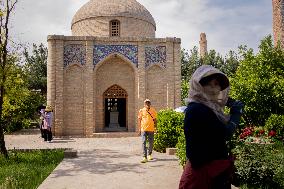
People outside the entrance of a historic shrine in Herat, Afghanistan, on May 18, 2024. Herat, the third-largest city in Afghanistan, is an oasis in the fertile Hari River valley, south of the Paropamisus Mountains. As the capital of Herat Province, it had an estimated population of 574,276 in 2020 and serves as a key cultural and historical center in western Afghanistan. Photo by Mustafa Noori/Middle East Images/ABACAPRESS.COM

  •  

[Breaking News]Traditional boat race

SHINGU, Japan, Oct. 16 Kyodo - Wooden "speedboats" rowed by shirtless men compete in a traditional boating race as part of the Mifune festival on the Kumano River running near World Heritage-listed Kumano Hayatama Taisha Grand Shrine in Shingu in the western Japan prefecture of Wakayama on Oct. 16, 2024. (Kyodo)

  •  
Traditional boat race

Traditional boat race

Wooden "speedboats" rowed by shirtless men compete in a traditional boating race as part of the Mifune festival on the Kumano River running near World Heritage-listed Kumano Hayatama Taisha Grand Shrine in Shingu in the western Japan prefecture of Wakayama on Oct. 16, 2024.

  •  
Traditional boat race near western Japan shrine

Traditional boat race near western Japan shrine

Wooden "speedboats" rowed by shirtless men compete in a traditional boating race as part of the Mifune festival on the Kumano River running near World Heritage-listed Kumano Hayatama Taisha Grand Shrine in Shingu in the western Japan prefecture of Wakayama on Oct. 16, 2023.

  •  
Traditional boat race near western Japan shrine

Traditional boat race near western Japan shrine

Wooden "speedboats" rowed by shirtless men compete in a traditional boating race as part of the Mifune festival on the Kumano River running near World Heritage-listed Kumano Hayatama Taisha Grand Shrine in Shingu in the western Japan prefecture of Wakayama on Oct. 16, 2023.

  •  
Traditional boat race near western Japan shrine

Traditional boat race near western Japan shrine

Wooden "speedboats" rowed by shirtless men compete in a traditional boating race as part of the Mifune festival on the Kumano River running near World Heritage-listed Kumano Hayatama Taisha Grand Shrine in Shingu in the western Japan prefecture of Wakayama on Oct. 16, 2023.

  •  
Colorful boats sail in Kashima Shrine's festival

Colorful boats sail in Kashima Shrine's festival

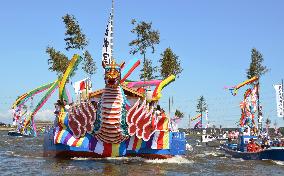
MITO, Japan - A flotilla of colorful boats sail out in a river on Sept. 2, 2014, to celebrate the "Mifune Matsuri," a festival that has been held since about 1,700 years ago in the Year of the Horse. The festival is held by the Kashima shrine in Kashima, Ibaraki Prefecture, eastern Japan.

  •  
'Saio-dai' festival queen holds ritual ceremony at Kyoto's Kamogamo Shrine

'Saio-dai' festival queen holds ritual ceremony at Kyoto's Kamogamo Shrine

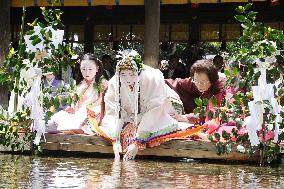
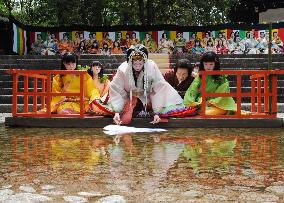
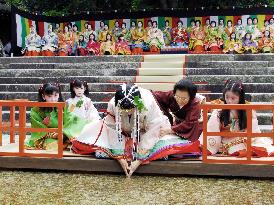
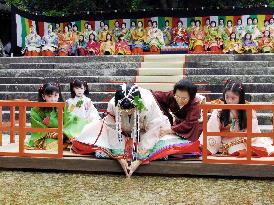
KYOTO, Japan - The 12-layered ceremonial kimono-clad Risako Ota, chosen as the "Saio-dai," reigning festival queen, for 2014, dips her hands into a river at Kamigamo Jinja, a World Heritage shrine in Kyoto, western Japan, in a purification ritual on May 4, 2014. It is one of the pre-events leading up to the May 15 Aoi (hollyhock) Festival, one of the three major festivals in Kyoto.

  •  
Matsuno Taisha shrine in Kyoto holds festival

Matsuno Taisha shrine in Kyoto holds festival

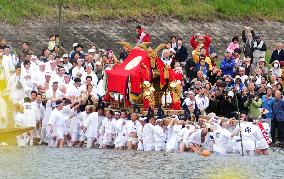
OSAKA, Japan - A "mikoshi" portable shrine of Matsuno Taisha in Kyoto is brought to the Katsura River by men during the "Shinkosai" festival on April 20, 2014.

  •  
Kyoto shrine's 'mikoshi' crosses Katsura River

Kyoto shrine's 'mikoshi' crosses Katsura River

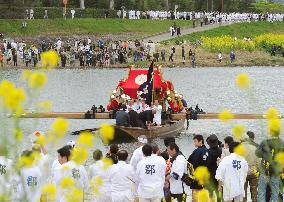
KYOTO, Japan - A boat carries a "mikoshi" portable shrine of Matsuno Taisha in Kyoto across the Katsura River during the "Shinkosai" festival on April 20, 2014.

  •  
Heroine of Kyoto's Aoi Festival

Heroine of Kyoto's Aoi Festival

KYOTO, Japan - Shiho Kanai, 23, who was selected for the role of Saiodai, the heroine of the upcoming Aoi Festival in Kyoto, dips her hands into a river as part of a purification ritual at Kyoto's Shimogamo Shrine on May 4, 2011, ahead of the ancient capital's major festival scheduled for May 15.

  •  
Japanese 'hina' dolls float down river

Japanese 'hina' dolls float down river

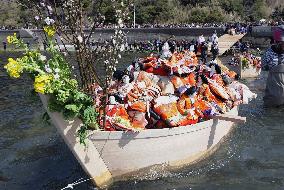
WAKAYAMA, Japan - Japanese 'hina' dolls, ornament dolls for the March 3 Girls' Day, go down a river by boat decorated with flowers around Awashima Shrine in Wakayama, western Japan, during a ritual called ''hina nagashi'' (hina floating) on March 3, 2011. The ritual aims at happiness for women and girls.

  •  
Partially restored statue of Colonel Sanders unveiled

Partially restored statue of Colonel Sanders unveiled

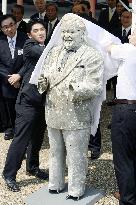
OSAKA, Japan - A partially restored statue of Colonel Sanders is unveiled to the media during a ritual at Sumiyoshi Grand Shrine in Osaka on June 25. The statue of Kentucky Fried Chicken founder, which had been tossed into a river in Osaka by exited Hanshin Tigers fans in 1985 after the Central League baseball club won the league title, was recovered from the bottom of a river in Osaka in March. The statue has been given a new protective coating.

  •  
Heroine of Kyoto's Aoi Festival purifies herself

Heroine of Kyoto's Aoi Festival purifies herself

KYOTO, Japan - Makiko Sen (C), who has been selected as the heroine of this year's Aoi Festival, one of the three major festivals in Kyoto, purifies herself in a ceremony May 4 by dipping her hands into a river at Shimogamo Shrine before the 1,400-year-old event on May 15.

  •  
Boating Festival at Kumano Hayatama Grand Shrine in Wakayama

Boating Festival at Kumano Hayatama Grand Shrine in Wakayama

SHINGU, Japan - Nine ''speedboats'' rowed by half-naked men perform a traditional boating race as part of the Boating Festival held Oct. 16 by the Kumano Hayatama Grand Shrine, one of the three Kumano grand shrines on the estuary of Kumano River, Wakayama Prefecture.

  •  
Boat race held on Kumano River

Boat race held on Kumano River

SHINGU, Japan - A boat race was held on Kumano River in Shingu, Wakayama Prefecture, on Oct. 16., highlighting the Kumano-Hayatama Shrine's shipping festival.

  •  
Kanwar Yatra

Kanwar Yatra

Kanwars, devotees of Lord Shiva takes holy dip in a river located outskirts of Kathmandu before setting off for annual pilgrimage of Kanwar Yatra on Monday. Devotees march for miles barefoot to reach the Shiva Shrine with vessels and bottles filled with sacred water to offer Lord Shiva every Monday on the month of Shrawan the fourth month as per the Lunar Calendar. The Kanwar Yatra in Nepal had stalled on for nearly 3 years due to the outbreak of COVID-19 pandemic.

  •  
Kanwar Yatra

Kanwar Yatra

Kanwars, devotees of Lord Shiva chant "Bol Bom" meaning "Hail Lord Shiva" as they take holy dips at a river in outskirts of Kathmandu before setting off for annual pilgrimage of Kanwar Yatra on Monday. Devotees march for miles barefoot to reach the Shiva Shrine with vessels and bottles filled with sacred water to offer Lord Shiva every Monday on the month of Shrawan the fourth month as per the Lunar Calendar. The Kanwar Yatra in Nepal had stalled on for nearly 3 years due to the outbreak of COVID-19 pandemic.

  •  
Kanwar Yatra

Kanwar Yatra

Kanwars, devotees of Lord Shiva takes holy dip in a river located outskirts of Kathmandu before setting off for annual pilgrimage of Kanwar Yatra on Monday. Devotees march for miles barefoot to reach the Shiva Shrine with vessels and bottles filled with sacred water to offer Lord Shiva every Monday on the month of Shrawan the fourth month as per the Lunar Calendar. The Kanwar Yatra in Nepal had stalled on for nearly 3 years due to the outbreak of COVID-19 pandemic.

  •  
Kanwar Yatra

Kanwar Yatra

Kanwars, devotees of Lord Shiva perform a ritual on the embankments of a river in outskirts of Kathmandu before setting off for annual pilgrimage of Kanwar Yatra on Monday. Devotees march for miles barefoot to reach the Shiva Shrine with vessels and bottles filled with sacred water to offer Lord Shiva every Monday on the month of Shrawan the fourth month as per the Lunar Calendar. The Kanwar Yatra in Nepal had stalled on for nearly 3 years due to the outbreak of COVID-19 pandemic.

  •  
Kanwar Yatra

Kanwar Yatra

Kanwars, devotees of Lord Shiva chant "Bol Bom" meaning "Hail Lord Shiva" and dance as they walk towards the water source to collect water from a river in outskirts of Kathmandu before setting off for annual pilgrimage of Kanwar Yatra on Monday. Devotees march for miles barefoot to reach the Shiva Shrine with vessels and bottles filled with sacred water to offer Lord Shiva every Monday on the month of Shrawan the fourth month as per the Lunar Calendar. The Kanwar Yatra in Nepal had stalled on for nearly 3 years due to the outbreak of COVID-19 pandemic.

  •  
Kanwar Yatra

Kanwar Yatra

Kanwars, devotees of Lord Shiva chant "Bol Bom" meaning "Hail Lord Shiva" as they take holy dips at a river in outskirts of Kathmandu before setting off for annual pilgrimage of Kanwar Yatra on Monday. Devotees march for miles barefoot to reach the Shiva Shrine with vessels and bottles filled with sacred water to offer Lord Shiva every Monday on the month of Shrawan the fourth month as per the Lunar Calendar. The Kanwar Yatra in Nepal had stalled on for nearly 3 years due to the outbreak of COVID-19 pandemic.

  •  
Hiroshige - 53 Stations of the Tokaido - Print 13

Hiroshige - 53 Stations of the Tokaido - Print 13

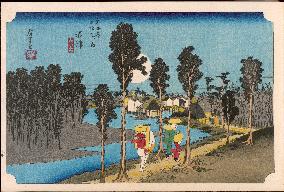
13 Namazu - Travellers walking along the river bank, lined with trees, towards the village ahead, under a huge full moon in a deep blue sky, one of them carrying on his back a large Tengu mask, the mark of a pilgrim to the Shinto shrine of Kompira on Shikoku Island. Dark forest of trees on further shore of river. Utagawa Hiroshige (1797 - 1858). The Fifty-Three Stations of the Tokaido - Hoeido edition (1831-4) Date: 1831 - 1834

  •  
Hiroshige - 53 Stations of the Tokaido - Print 27

Hiroshige - 53 Stations of the Tokaido - Print 27

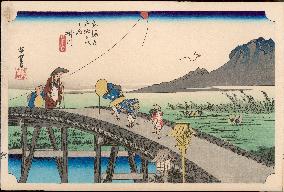
27 Kakegawa - Travellers crossing a high trestle-bridge over the Kake River, two of them peering into the water below, and behind a small boy watching a kite up in the air, while beyond another, with broken string, flutters to earth. Peasants transplanting rice in the flooded fields, and in the distance Mount Akiba rising above the mists. A shrine standing on the top of a mountain near this station attracted worshippers from all over Japan who came to pray for protection against the calamity of fire. An old couple of travellers are struggling against a strong wind as they toil to cross the arched bridge. A naughty boy is following them with a mocking gesture. Utagawa Hiroshige (1797 - 1858). The Fifty-Three Stations of the Tokaido - Hoeido edition (1831-4) Date: 1831 - 1834

  •  
Ise Grand Shrine a place of "appreciation" at Ise-Shima summit

Ise Grand Shrine a place of "appreciation" at Ise-Shima summit

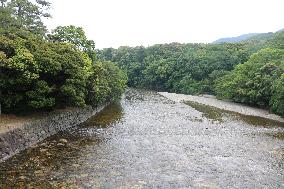
Photo taken May 25, 2016, shows a picturesque scene of the Isuzugawa river taken from Uji Bridge in the inner shrine at Ise Grand Shrine in Ise, Mie Prefecture. The most venerable shrine in Japan, it is dedicated to Amaterasu Omikami, the mythical ancestral sun goddess of the Imperial family. (Kyodo) ==Kyodo

  •  
Tokyo landscape: Traditional rice bowl served on shrine premises

Tokyo landscape: Traditional rice bowl served on shrine premises

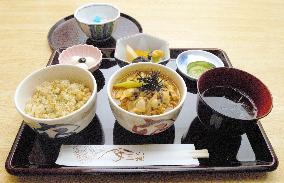
Photo taken on July 22, 2015, shows a traditional "Fukagawa-meshi" set meal that features a bowl of rice with deeply fried clams and onions in "miso" (soybean paste) soup and another bowl of rice cooked with various ingredients at a restaurant on the premises of the Tomioka Hachimangu shrine on the east side of the Sumida River in Tokyo. (Kyodo) ==Kyodo

  •  
Ancient boat festival back in Kyoto

Ancient boat festival back in Kyoto

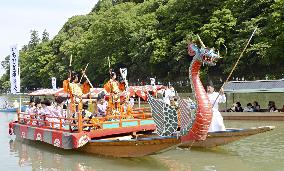
A colorful boat flows on the river in the Arashiyama district of Kyoto, western Japan, on May 17, 2015, with people clad in colorful ancient costumes during a festival reproducing a boat celebration from the Heian period (794-1192). The festival was canceled last year due to financial difficulties at Kurumazaki Shrine, the organizer of the event, and the effects of a powerful typhoon that hit the region in September the previous year. (Kyodo) ==Kyodo

  •  
Partially restored statue of Colonel Sanders unveiled

Partially restored statue of Colonel Sanders unveiled

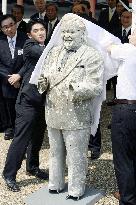
OSAKA, Japan - A partially restored statue of Colonel Sanders is unveiled to the media during a ritual at Sumiyoshi Grand Shrine in Osaka on June 25. The statue of Kentucky Fried Chicken founder, which had been tossed into a river in Osaka by exited Hanshin Tigers fans in 1985 after the Central League baseball club won the league title, was recovered from the bottom of a river in Osaka in March. The statue has been given a new protective coating. (Kyodo)

  •  
Heroine of Kyoto's Aoi Festival purifies herself

Heroine of Kyoto's Aoi Festival purifies herself

KYOTO, Japan - Makiko Sen (C), who has been selected as the heroine of this year's Aoi Festival, one of the three major festivals in Kyoto, purifies herself in a ceremony May 4 by dipping her hands into a river at Shimogamo Shrine before the 1,400-year-old event on May 15. (Kyodo)

  •  
Boating Festival at Kumano Hayatama Grand Shrine in Wakayama

Boating Festival at Kumano Hayatama Grand Shrine in Wakayama

SHINGU, Japan - Nine ''speedboats'' rowed by half-naked men perform a traditional boating race as part of the Boating Festival held Oct. 16 by the Kumano Hayatama Grand Shrine, one of the three Kumano grand shrines on the estuary of Kumano River, Wakayama Prefecture. (Kyodo)

  •  
Miyajima Island,Aki

Miyajima Island,Aki

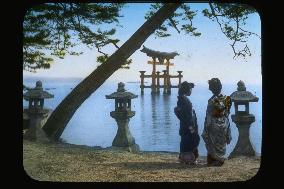
The Grand Torii Gate is viewed from Nishino Matsubara, which is west of Itsukushima Shinto Shrine. Nishino Matsubara is an artificial beach made with silt from Momijidani River. The pine trees and the numerous lanterns on the river bank create a distinct landscape.==Date:unknown, Place:Miyajima, Photo:unknown, (Credit:Nagasaki University Library/Kyodo News Images) [Cabinet Number98‐23‐0]

  •  
A procession of Shinto carrying the sacrement

A procession of Shinto carrying the sacrement

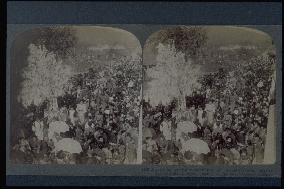
Stereograph depicting the annual festival at Fushimi Inari Shrine. A procession carrying a sacred image is crossing Kamogawa River at Shichijo Ohashi Bridge. The bridge is busy with people coming and going. The Kyoto Imperial Museum, built in 1895, is visible on the east side of Kamogawa River, but streetcar tracks laid on the bridge in 1913 are not visible. Taken in 1904.==Date:1904, Place:Kyoto, Photo:Underwood, (Credit:Nagasaki University Library/Kyodo News Images) [Cabinet Number97‐34‐0]

  •  
Miyajima Island,Aki

Miyajima Island,Aki

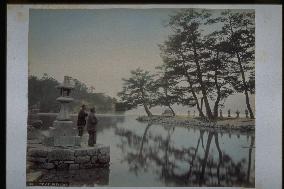
This is the mouth of Momijidani River, which flows to the west of Itsukushima Shinto Shrine. On the Onishimachi side of the river is the Nishino Matsubara with the red pines and stone lanterns. Mt. Suisho is visible in the distance. The stone lanterns on rocks protruding from the river were built in 1796. The taruki style head stones are uncommon in Japan.==Date:unknown, Place:Miyajima, Photo:unknown, (Credit:Nagasaki University Library/Kyodo News Images) [Cabinet Number93‐6‐0]

  •  
A leisure boat on the Sumida River

A leisure boat on the Sumida River

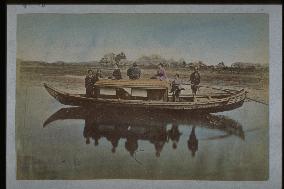
Roofed boat taken at the bank of Imado River in front of Yumei-ro where Sanya-bori (moat) merges with Sumida River. The water is too shallow to allow the boat to float, which explains why the photograph is so sharp. In the rear is Mukojima, site of Ushijima Shinto Shrine and Chomeiji Temple. Found in the collection of Uchida Kuichi preserved at Nagasaki Municipal Museum, this photograph was verified to have been taken by Uchida in 1872. This is one of the copies later made and sold.==Date:unknown, Place:Tokyo, Photo:Uchida Kuichi, (Credit:Nagasaki University Library/Kyodo News Images) [Cabinet Number90‐25‐0]

  •  
Mt. Fuji seen from the Fuji River

Mt. Fuji seen from the Fuji River

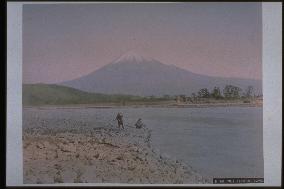
Northeastern view of the snow-capped peak of Mt. Fuji, taken from the bank of Fuji River in Iwabuchi, Fujikawa-machi. The mountain on the left is Mt. Iwamoto, and the tree line reaches to the forest of Matsuoka Sui Shinto Shrine (Fuji City) on the left. Two men are at the riverside, and Fujigawa Bridge, which crosses from the south of the shrine to Iwabuchi, is visible. This bridge was washed away many times from the beginning of the Meiji Period. It is difficult to determine exactly when this photograph was taken.==Date:unknown, Place:Shizuoka, Photo:unknown, (Credit:Nagasaki University Library/Kyodo News Images) [Cabinet Number86‐5‐0]

  •  
A teahouse and a leisure boat,Shimogamo,Kyoto

A teahouse and a leisure boat,Shimogamo,Kyoto

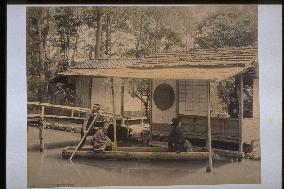
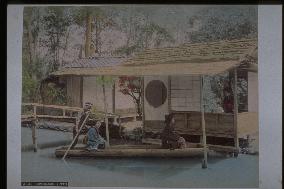
A teahouse by the Mitarashi River at Tadasunomori in Shimogamo is depicted. A small boat carrying two women arrives at this simple sukiya style teahouse. The Mitarashi River originates from a spring at Shimogamo Shinto Shrine. Fires were lit here in mid-July and visitors enjoyed Mitarashi Dango (dumplings) on the cool terraces of the teahouses.==Date:unknown, Place:Kyoto, Photo:unknown, (Credit:Nagasaki University Library/Kyodo News Images) [Cabinet Number85‐43‐0]

  •  
A teahouse,Shimogamo,Kyoto

A teahouse,Shimogamo,Kyoto

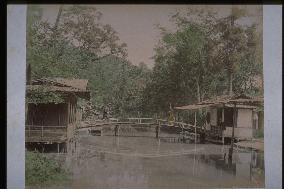
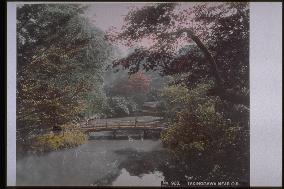
View of the Mitarashi River at Shimogamo Shinto Shrine. A woman riding a rickshaw and a woman with a parasol are passing each other on a bridge. There are summer pavilions on both sides of the river. The source of Mitarashi River is a spring at Mitarashi Shrine within the Shimogamo Shinto Shrine precincts. In the Meiji Period, bonfires were lit along the river and summer pavilions were built from which to observe them. In the back is Tadashi Forest.==Date:unknown, Place:Kyoto, Photo:unknown, (Credit:Nagasaki University Library/Kyodo News Images) [Cabinet Number85‐26‐0]

  •  
A teahouse and a leisure boat,Shimogamo,Kyoto

A teahouse and a leisure boat,Shimogamo,Kyoto

A teahouse by the Mitarashi River at Tadasunomori in Shimogamo is depicted. A small boat carrying two women arrives at this simple sukiya style teahouse. The Mitarashi River originates from a spring at Shimogamo Shinto Shrine. Fires were lit here in mid-July and visitors enjoyed Mitarashi Dango (dumplings) on the cool terraces of the teahouses.==Date:unknown, Place:Kyoto, Photo:A. Farsari, (Credit:Nagasaki University Library/Kyodo News Images) [Cabinet Number81‐42‐0]

  •  
Autumn tints of Takinogawa, Oji

Autumn tints of Takinogawa, Oji

The 8th Shogun, Tokugawa Yoshimune, visited this area in 1720-21 and was pleased to find that the Oji Gongen Shrine and the name of the Otonashi River originated in his home province, Kishu. As a result he ordered the planting of Yoshino cherry trees at Mt. Asuka and maple trees along Takinogawa to provide autumn colours. Consequently, the Oji area became a popular tourist spot for people from Edo. Taken in the mid-Meiji Period.==Date:unknown, Place:Tokyo, Photo:unknown, (Credit:Nagasaki University Library/Kyodo News Images) [Cabinet Number80‐34‐0]

  • Main
  • Top
  • Editorial
  • Creative
  • About Us
  • About ILG
  • Terms of use
  • Company
  • BEHIND
  • Price List
  • Single Plan
  • Monthly Plan
  • Services
  • Shooting
  • Rights Clearance
  • Support
  • FAQ
  • How To Buy
  • Contact Us
  • Become a Partner

© KYODO NEWS IMAGES INC

All Rights Reserved.

  • Editorial
  • Olympics
  • News
  • Sports
  • Japan
  • Tech
  • Royal
  • Disaster
  • NorthKorea
  • Old Japan
  • SNS
  • Creative
  • Food
  • Japan
  • Landscape
  • Animal
  • Popular
  • #Ukraine
  • #China
  • #coronavirus
  • #N. Korea
  • #Thailand
  • #Russia
  • #Ukraine
  • #China
  • #coronavirus
  • #N. Korea
  • #Thailand
  • #Russia
  • Food
  • Japan
  • Landscape
  • Animal
  • Olympics
  • News
  • Sports
  • Japan
  • Tech
  • Royal
  • Disaster
  • NorthKorea
  • Old Japan
  • SNS