•  
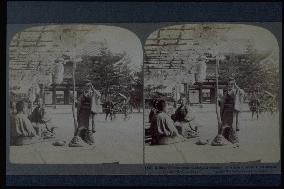
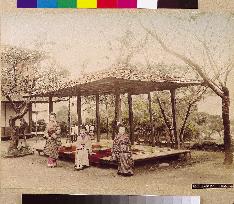
A teahouse in the precincts with a wisteria trellis

A teahouse in the precincts with a wisteria trellis

This is a teahouse in front of Otenmon Gate at Heian Shrine. Lanterns hang near the wisteria trellis. People are relaxing under the wisteria blossoms. A woman holding a parasol on a rickshaw is visible on the right, as well as Daigokuden Hall beyond the gate. The shrine was built in 1895. This may have been taken by the British photographer H. G. Ponting.==Date:unknown, Place:Kyoto, Photo:unknown, (Credit:Nagasaki University Library/Kyodo News Images) [Cabinet Number97‐43‐0]

  •  
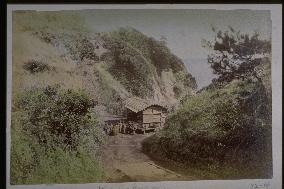
A mountain path and a teahouse

A mountain path and a teahouse

Photographer unknown. Entitled Kamakura. A shack that could be a teahouse is visible between two hills. According to the lithographic map The Illustrated Map of Enoshima, Kugenuma, Zushi, and Kanazawa of 1896, this is probably one of the scenic points around Yamafutatsu (literally Two Mountains ) located between Nakatsumiya and Okitsumiya of Enoshima Shinto Shrine.==Date:unknown, Place:Enoshima, Photo:unknown, (Credit:Nagasaki University Library/Kyodo News Images) [Cabinet Number92‐14‐0]

  •  
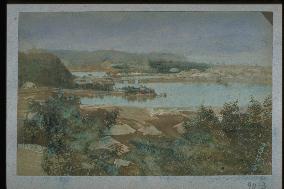
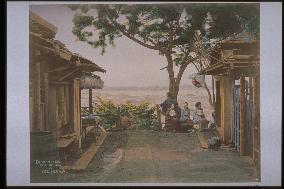
Kanazawa Hakkei

Kanazawa Hakkei

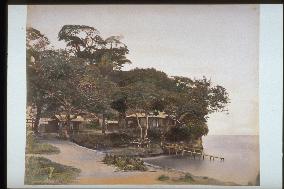
Hiragata Bay as seen from Kyurantei. Biwajima Benten is visible in the centre, with Seto Shinto Shrine at the tip of the peninsula. The teahouses on the right of the shrine are (from the left) Chiyomoto-ro and Ogiya, and Azumaya is in the rear. Suzaki Village is on the other side of Seto Bridge from Ogiya.==Date:unknown, Place:Yokohama, Photo:unknown, (Credit:Nagasaki University Library/Kyodo News Images) [Cabinet Number90‐3‐0]

  •  
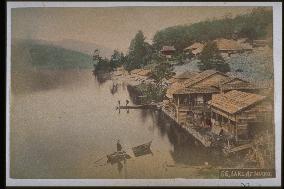
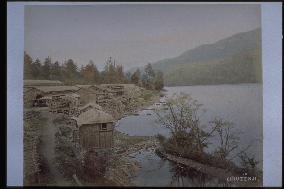
Lake Chuzenji

Lake Chuzenji

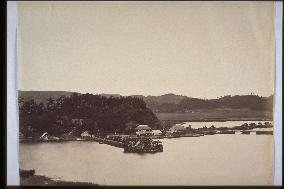
Chugushi is seen on the hill in the centre back, along with the shacks for pilgrims (centre) and a part of Rokken-jaya (right foreground). Mt. Nantai is to the right of the photograph. A typhoon caused a severe flood on the mountainside in 1902. This photograph was taken before the damage.==Date:unknown, Place:Nikko, Photo:unknown, (Credit:Nagasaki University Library/Kyodo News Images) [Cabinet Number89‐1‐0]

  •  
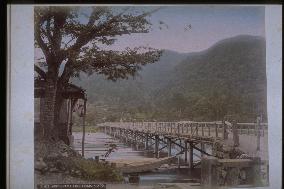
The Togetsukyo Bridge,Arashiyama

The Togetsukyo Bridge,Arashiyama

Togetsu Bridge at Arashiyama is viewed from the northern end, facing south. Horinji Temple is visible on the hillside. A sign at the northern end of the bridge informs people that cows and horses are not allowed to cross the bridge. A teahouse with hanging lanterns stands under a cherry tree. A maruko boat is docked nearby. The bridge was destroyed by a flood in 1892. The stone bridge to the right, Kinmonkyo, was later moved to Kurumazaki Shrine. Taken by Tamamura Kozaburo.==Date:unknown, Place:Kyoto, Photo:unknown, (Credit:Nagasaki University Library/Kyodo News Images) [Cabinet Number88‐6‐0]

  •  
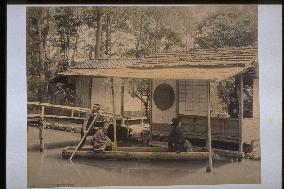
A teahouse and a leisure boat,Shimogamo,Kyoto

A teahouse and a leisure boat,Shimogamo,Kyoto

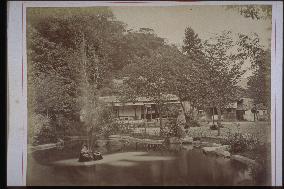
A teahouse by the Mitarashi River at Tadasunomori in Shimogamo is depicted. A small boat carrying two women arrives at this simple sukiya style teahouse. The Mitarashi River originates from a spring at Shimogamo Shinto Shrine. Fires were lit here in mid-July and visitors enjoyed Mitarashi Dango (dumplings) on the cool terraces of the teahouses.==Date:unknown, Place:Kyoto, Photo:unknown, (Credit:Nagasaki University Library/Kyodo News Images) [Cabinet Number85‐43‐0]

  •  
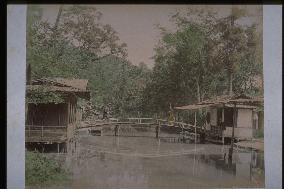
A teahouse,Shimogamo,Kyoto

A teahouse,Shimogamo,Kyoto

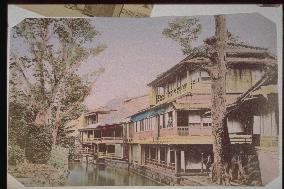
View of the Mitarashi River at Shimogamo Shinto Shrine. A woman riding a rickshaw and a woman with a parasol are passing each other on a bridge. There are summer pavilions on both sides of the river. The source of Mitarashi River is a spring at Mitarashi Shrine within the Shimogamo Shinto Shrine precincts. In the Meiji Period, bonfires were lit along the river and summer pavilions were built from which to observe them. In the back is Tadashi Forest.==Date:unknown, Place:Kyoto, Photo:unknown, (Credit:Nagasaki University Library/Kyodo News Images) [Cabinet Number85‐26‐0]

  •  
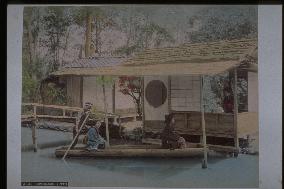
A teahouse and a leisure boat,Shimogamo,Kyoto

A teahouse and a leisure boat,Shimogamo,Kyoto

A teahouse by the Mitarashi River at Tadasunomori in Shimogamo is depicted. A small boat carrying two women arrives at this simple sukiya style teahouse. The Mitarashi River originates from a spring at Shimogamo Shinto Shrine. Fires were lit here in mid-July and visitors enjoyed Mitarashi Dango (dumplings) on the cool terraces of the teahouses.==Date:unknown, Place:Kyoto, Photo:A. Farsari, (Credit:Nagasaki University Library/Kyodo News Images) [Cabinet Number81‐42‐0]

  •  
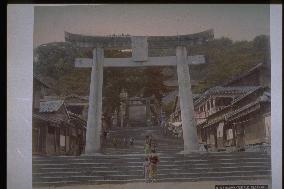
Torii,Suwa Shrine

Torii,Suwa Shrine

This hand-tinted photograph taken around 1887 depicts the view of Suwa Shinto Shrine from the Ninotorii (second torii gate) inside the Great Torii Gate. The Donko Teahouse is visible on the right. The Western-style building on the approach is indicative of the tide of modernization in the mid-Meiji Period.==Date:unknown, Place:Nagasaki, Photo:A. Farsari, (Credit:Nagasaki University Library/Kyodo News Images) [Cabinet Number81‐34‐0]

  •  
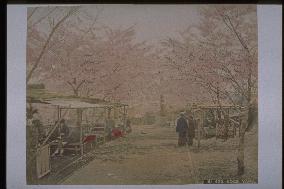
Cherry trees at Nogeyama Park,Yokohama

Cherry trees at Nogeyama Park,Yokohama

The Iseyama Kotaijingu precincts. This shrine was established after the relocation of a small shrine in Tobe-machi to Mt. Noge in 1870. After the opening of the new shrine, Mt. Noge was renamed Iseyama (Mt. Ise) and many people visited the area in the cherry blossom season.==Date:unknown, Place:Yokohama, Photo:Tamamura Kozaburo, (Credit:Nagasaki University Library/Kyodo News Images) [Cabinet Number79‐28‐0]

  •  
Lake Chuzenji

Lake Chuzenji

Rokken-jaya at the lakeside is viewed from the precincts of the Chugushi at Futarasan Shinto Shrine. The fact that not a single building is visible on the lakeside in the Utagahama area to the right indicates that the photograph was taken in the early Meiji Period. Also, no stone embankment work has been done at the lakeside near Rokken-jaya.==Date:unknown, Place:Nikko, Photo:R. Stillfried, (Credit:Nagasaki University Library/Kyodo News Images) [Cabinet Number77‐20‐0]

  •  
A teahouse above the hundred steps of Motomachi,Yokohama

A teahouse above the hundred steps of Motomachi,Yokohama

Tanabe-no-Chaya (Tanabe Teahouse) was located in the Sengen Shinto Shrine precincts at the top of the Motomachi Hyakudan (100 steps) located on Motomachi Street. This place attracted many visitors because it commanded a panoramic view of the city. Unfortunately, everything, including the steps, was destroyed by the Great Kanto Earthquake of 1923. The shrine was later rebuilt at the foot of the hill.==Date:unknown, Place:Yokohama, Photo:unknown, (Credit:Nagasaki University Library/Kyodo News Images) [Cabinet Number64‐65‐0]

  •  
A teahouse at Katase

A teahouse at Katase

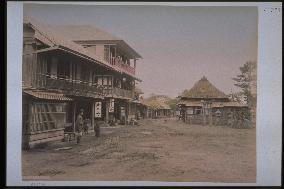
These are Katoya and Kashihaya in front of Ryukoji Temple. The torii gate and lanterns of Ryukomyo Shinto Shrine are visible on the right. Gakushuin (Peer's School) designated Katase Beach as a place for swimming lessons in 1891. The three-story Kashiwaya with its veranda evokes the atmosphere of the time. At present, the Enoshima Electric Railway passes in the left foreground of the photograph.==Date:unknown, Place:Fujisawa, Photo:unknown, (Credit:Nagasaki University Library/Kyodo News Images) [Cabinet Number59‐56‐0]

  •  
A teahouse at Oji

A teahouse at Oji

The teahouses of Oji were located along the approach to Oji Inari Shrine. Oji Inari is the head Inari shrine in the eight provinces of the Kanto region and enshrines the Inari Daimyojin deity. It is said that foxes from all over Kanto gather here on New Year's Eve and that they are transformed into court ladies at nearby Shozoku Inari and then visit this shrine. During the Edo and Meiji Periods, it was popular to go hiking from the Ueno hills to the Mt. Dokan and Mt. Asuka. Climbers stopped to enjoy a drink of sake at the restaurants and teahouses.==Date:unknown, Place:Tokyo, Photo:unknown, (Credit:Nagasaki University Library/Kyodo News Images) [Cabinet Number53‐19‐0]

  •  
A teahouse at Oji

A teahouse at Oji

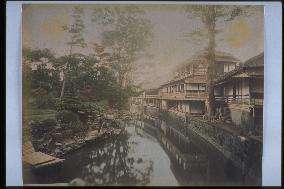
Oji was a considerable distance from Edo, but Mt. Asuka and the Takinogawa River gained fame for their cherry blossoms and autumn colours, respectively, and Oji Inari Shrine attracted more and more worshippers. Consequently, many teahouses and restaurants were built along the 450 m approach to the shrine at the foot of Mt. Asuka. Ogiya, with a garden on the other side of the river, and Ebiya were particularly well-known.==Date:unknown, Place:Tokyo, Photo:unknown, (Credit:Nagasaki University Library/Kyodo News Images) [Cabinet Number51‐35‐0]

  •  
A teahouse at Honmoku Juniten

A teahouse at Honmoku Juniten

A promenade for foreigners was made around the Bluff, Honmoku and Negishi in 1864. Juniten shrine is the guardian of Hongo village in Honmoku. The scenic Honmoku Juniten has a side road, and there were tea houses along the way.==Date:unknown, Place:Yokohama, Photo:Suzuki Shin-ichi, (Credit:Nagasaki University Library/Kyodo News Images) [Cabinet Number41‐16‐0]

  •  
Kanazawa Hakkei Bentensha

Kanazawa Hakkei Bentensha

A view of Hiragata Bay, from Kurantei. The centre is the Benten of Biwajima, and further ahead is Seto Shrine. The caption says that it is a teahouse at Kanazawa. Photo by F. Beato.==Date:unknown, Place:Yokohama, Photo:F. Beato, (Credit:Nagasaki University Library/Kyodo News Images) [Cabinet Number28‐1‐0]

  •  
The shrine at the top of Mt. Atago

The shrine at the top of Mt. Atago

The Atago Shrine was built through donations collected by the Atago Shrine in Kyoto at the top of Mt. Atago. To the left rear is a torii and the building. In front of the big steel lanterns, children look at the camera. A panoramic view is provided from the teahouse to the right. During the Edo era, Mt. Atago was a favorite spot for viewing the moon and snow.==Date:unknown, Place:Tokyo, Photo:unknown, (Credit:Nagasaki University Library/Kyodo News Images) [Cabinet Number24‐42‐0]

  •  
Fountain at Suwa Park

Fountain at Suwa Park

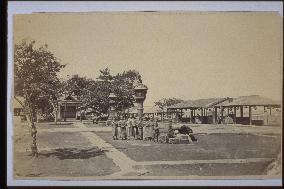
The fountain in front of the teahouse within the compounds of Suwa Shinto Shrine. It has been restored, but the fountain remains in the same position. It is said to be the oldest fountain in Japan.==Date:Middle Meiji, Place:Nagasaki, Photo:unknown, (Credit:Nagasaki University Library/Kyodo News Images) [Cabinet Number21‐17‐0]

  •  
A moon-view teahouse,Suwa Park

A moon-view teahouse,Suwa Park

The former building of the Tsukimi Teahouse within the Suwa Shinto Shrine compounds. The present building retains the flavour of the original tea house.==Date:Middle Meiji, Place:Nagasaki, Photo:unknown, (Credit:Nagasaki University Library/Kyodo News Images) [Cabinet Number21‐16‐0]

  •  
A teahouse in the precincts of Suwa Shrine

A teahouse in the precincts of Suwa Shrine

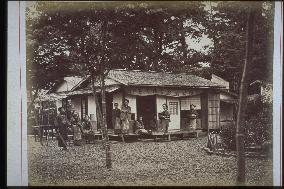
A teahouse in the precincts of Suwa Shrine==Date:unknown, Place:Nagasaki, Photo:unknown, (Credit:Nagasaki University Library/Kyodo News Images)

  • Main
  • Top
  • Editorial
  • Creative
  • About Us
  • About ILG
  • Terms of use
  • Company
  • BEHIND
  • Price List
  • Single Plan
  • Monthly Plan
  • Services
  • Shooting
  • Rights Clearance
  • Support
  • FAQ
  • How To Buy
  • Contact Us
  • Become a Partner

© KYODO NEWS IMAGES INC

All Rights Reserved.

  • Editorial
  • Olympics
  • News
  • Sports
  • Japan
  • Tech
  • Royal
  • Disaster
  • NorthKorea
  • Old Japan
  • SNS
  • Creative
  • Food
  • Japan
  • Landscape
  • Animal
  • Popular
  • #Ukraine
  • #China
  • #coronavirus
  • #N. Korea
  • #Russia
  • #Thailand
  • #Ukraine
  • #China
  • #coronavirus
  • #N. Korea
  • #Russia
  • #Thailand
  • Food
  • Japan
  • Landscape
  • Animal
  • Olympics
  • News
  • Sports
  • Japan
  • Tech
  • Royal
  • Disaster
  • NorthKorea
  • Old Japan
  • SNS