•  
Illustration - Surtourisme

Illustration - Surtourisme

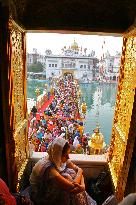
INDIA. AMRITSAR. GIRL MEDITATING IN THE WINDOW OF THE GOLDEN TEMPLE IN FRONT OF THE GURU'S BRIDGE Photo by Severine Dabadie/Only World/ABACAPRESS.COM

  •  
Illustration - Surtourisme

Illustration - Surtourisme

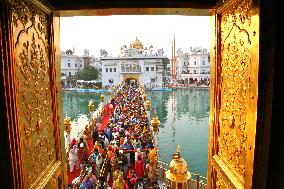
INDIA. AMRITSAR. VIEW OF THE GURU'S BRIDGE FROM GOLDEN TEMPLE Photo by Severine Dabadie/Only World/ABACAPRESS.COM

  •  
Illustration Strasbourg

Illustration Strasbourg

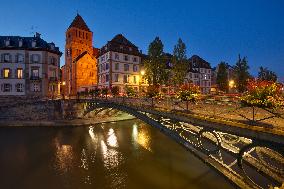
FRANCE, BAS-RHIN (67), STRASBOURG, ST. THOMAS BRIDGE AND ST. THOMAS CHURCH AT NIGHT Photo by Jean Isenmann/Only France/ABACAPRESS.COM

  •  
Tsutenbashi bridge at tofukuji temple

Tsutenbashi bridge at tofukuji temple

Tsutenbashi bridge at tofukuji temple==Date:c. 1880, Place:Kyoto, Photo:unknown ,Credit:Nagasaki University Library/Kyodo News Images [Institution Catalog Number:6887]

  •  

Cambodia inaugurates famed Angkor Wat temple's western causeway

STORY: Cambodia inaugurates famed Angkor Wat temple's western causeway SHOOTING TIME: Nov. 4, 2023 DATELINE: Nov. 5, 2023 LENGTH: 00:02:12 LOCATION: SIEM REAP, Cambodia CATEGORY: SOCIETY SHOTLIST: 1. various of inauguration of causeway 2. various of the causeway and Angkor Wat temple (file) STORYLINE: Cambodia inaugurated the western causeway of the famed Angkor Wat temple in the Angkor Archeological Park here on Saturday after 19 years of restoration. King Norodom Sihamoni, along with Prime Minister Hun Manet, attended the inauguration ceremony of the causeway leading to the main gate of the Angkor Wat in the west. The 192-meter-long, 11.6-meter-wide, and 4-meter-tall causeway is used as the gateway to visit the Angkor Wat, and the floating bridge south of the causeway is kept as the main exit for visitors. Speaking at the event, Sihamoni said the preservation and strengthening of the causeway by maintaining its original form has enhanced the value of the Angkor Wat temple. "The Angkor Wat
  •  

Lunar New Year observed around world with illuminated landmarks

STORY: Lunar New Year observed around world with illuminated landmarks DATELINE: Jan. 23, 2023 LENGTH: 00:00:54 LOCATION: Beijing CATEGORY: SOCIETY SHOTLIST: 1. various of celebrating the Chinese New Year 2. various of the Empire State Building in New York, U.S. 3. various of the Palace Bridge in St. Petersburg, Russia 4. various of the London Eye in London, Britain 5. various of the Tokyo Tower in Tokyo, Japan 6. various of the Thean Hou Temple in Kuala Lumpur, Malaysia STORYLINE: Landmarks around the globe have been lit up in the auspicious color red to celebrate the Lunar New Year, or Spring Festival, that fell on Sunday this year. Xinhua News Agency correspondents reporting from Beijing. (XHTV)

  •  
Ritual parade at Nara temple reproduces legend

Ritual parade at Nara temple reproduces legend

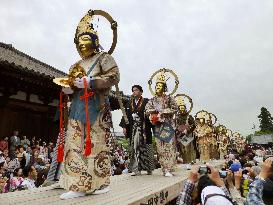
NARA, Japan - Buddhist "saints" wearing gold-colored masks march on a wooden bridge at an annual "Nerikuyo" parade at Taima-dera temple in Katsuragi, Nara Prefecture, western Japan, on May 14, 2014. The event is designed to reproduce a legend of "Chujyohime" princess, who is said to have turned into a Buddha while she was still alive.

  •  
Maple trees in Kyoto

Maple trees in Kyoto

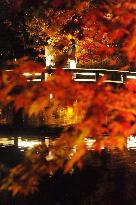
KYOTO, Japan - Two women chat on a bridge as illuminations for colored maple leaves are tested at Eikando, a Buddhist temple in Kyoto, on Nov. 2, 2010. Night viewing of the maple trees at the temple starts on Nov. 6 through Nov. 30.

  •  
Hiroshige - 53 Stations of the Tokaido - Print 7

Hiroshige - 53 Stations of the Tokaido - Print 7

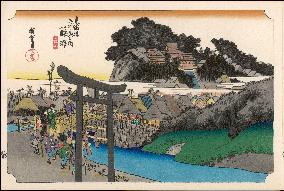
7 Fujisawa - The village by the edge of a stream, and a bridge leading to it, over which people are passing. In background, overlooking the village on a wooded hill, above the mists, stands the temple Yugi-o-ji; in the foreground a torii, and close to it four blind men following each other by the bank of the stream. This station was crowded with pilgrims visiting the famous temple at this station, and the neighbouring shrine. The imposing buildings of Yugyoji Temple (established in 1325) stand on a hillside in the background. The torii (archway) leads to the Enoshima Benten Shrine which is dedicated to the Goddess of Music. Utagawa Hiroshige (1797 - 1858). The Fifty-Three Stations of the Tokaido - Hoeido edition (1831-4) Date: 1831 - 1834

  •  
Stone steps of Kurodani Konkai Komyoji Temple

Stone steps of Kurodani Konkai Komyoji Temple

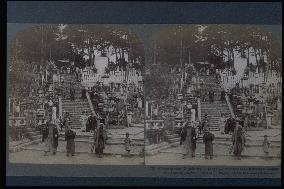
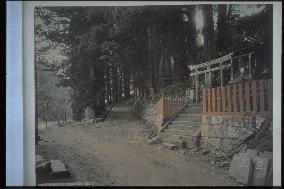
Stereograph depicting the stairs of Kurodani Komyoji Temple, taken from the stone bridge Gokuraku-bashi. Gravestones flank both sides of the stairs. Worshippers who seem to have finished praying are coming down the stairs. Monju Pagoda rises behind the trees above the stairs. The wooden signboard on the right says Gobyo (Mausoleum) . Taken in 1904.==Date:1904, Place:Kyoto, Photo:Underwood, (Credit:Nagasaki University Library/Kyodo News Images) [Cabinet Number97‐17‐0]

  •  
Stone steps of Kurodani Konkai Komyoji Temple

Stone steps of Kurodani Konkai Komyoji Temple

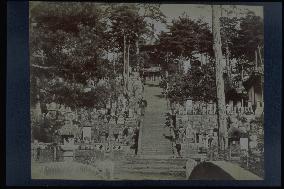
View of the stairs of Kurodani Komyoji Temple taken from Gokuraku-bashi, a stone bridge. Gravestones flank both sides of the stairs. A woman with a parasol poses for the camera in the middle of the stairs. Monju Pagoda rises behind the trees above the stairs. Renchi-in (Kumagai-do) is visible on the right. The statue of Amida Buddha on the left of the stairs was moved and no longer exists today.==Date:unknown, Place:Kyoto, Photo:Nobushige Horiuchi, (Credit:Nagasaki University Library/Kyodo News Images) [Cabinet Number96‐94‐0]

  •  
Yaomatsu Restaurant, Mukojima

Yaomatsu Restaurant, Mukojima

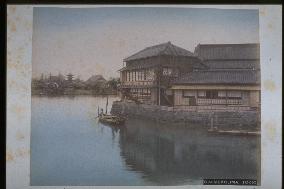
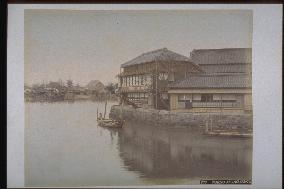
Yaomatsu-ro Restaurant seen from Makura Bridge at confluence of the Gennomori and Sumida rivers. The restaurant was opened in April 1870 as a branch of Yaomatsu located at Suijin-no-Mori. Customers drank sake while enjoying the view of boats crossing the Sumida River and Sensoji Temple across the river, and Yaomatsu-ro gained popularity as an early waterfront restaurant. Taken between 1887 and 1897. Same as photograph #2104.==Date:unknown, Place:Tokyo, Photo:unknown, (Credit:Nagasaki University Library/Kyodo News Images) [Cabinet Number93‐14‐0]

  •  
Five main halls (temples) of Matsushima

Five main halls (temples) of Matsushima

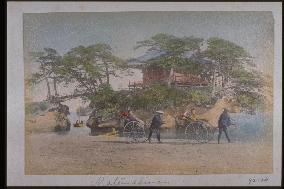
It is extremely rare to find rickshaws in a photo with Matsushima Beach in the background, implying that these women must be very upper class. At the time of construction, Godaido Shrine was vermillion, but, only a small part of the shrine building still bears its original color. It is odd that the bridge to the island is not vermillion.==Date:unknown, Place:Sendai, Photo:unknown, (Credit:Nagasaki University Library/Kyodo News Images) [Cabinet Number92‐26‐0]

  •  
Nishi Otani Entsu-kyo Bridge

Nishi Otani Entsu-kyo Bridge

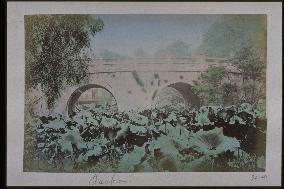
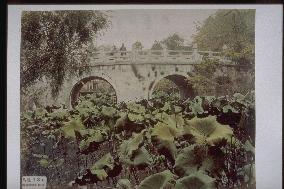
Enzu-kyo Bridge at Nishi Otani Temple, looking north-northeast from the southwestern edge of Kogetsu Pond. Made of stone, the bridge was built in 1865. Called Spectacles Bridge because of its shape, the bridge bustled with people who came here to view the red and white lotus flowers from the end of the Edo to the Meiji Period. There is a tea house on the other side of the bridge. The quality of the photo tinting is poor.==Date:unknown, Place:Kyoto, Photo:unknown, (Credit:Nagasaki University Library/Kyodo News Images) [Cabinet Number92‐20‐0]

  •  
Nishi Otani Entsu-kyo Bridge

Nishi Otani Entsu-kyo Bridge

Enzu-kyo Bridge at Nishi Otani Temple, looking north from the southern edge of Kogetsu Pond. Made of stone, the bridge was built in 1865. Called Spectacles Bridge because of its shape, the bridge bustled with people who came here to view the red and white lotus flowers from the end of the Edo to the Meiji Period. There is a tea house on the other side of the bridge. The quality of the photo tinting is poor.==Date:unknown, Place:Kyoto, Photo:unknown, (Credit:Nagasaki University Library/Kyodo News Images) [Cabinet Number90‐32‐0]

  •  
Autumn tints of Takinogawa, Oji

Autumn tints of Takinogawa, Oji

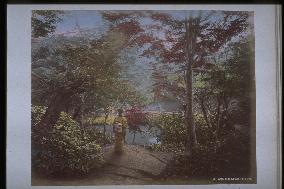
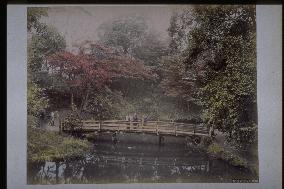
This seems to be Otonashi River (Shakujii River near Kongoji, the autumn colours temple. A bridge with a romantic atmosphere is said to have spanned a bend in the river. There was a bridge with a pleasant atmosphere. The deity Benzaiten was enshrined in a hollow in the rock near the bridge. A teahouse once stood on the hill. The river merges into Sumida River (formerly Arakawa), which flows northeast. Taken in the mid-Meiji Period.==Date:unknown, Place:Tokyo, Photo:unknown, (Credit:Nagasaki University Library/Kyodo News Images) [Cabinet Number88‐35‐0]

  •  
The Togetsukyo Bridge,Arashiyama

The Togetsukyo Bridge,Arashiyama

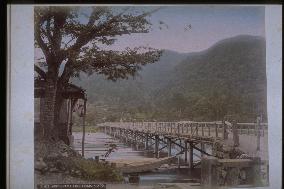
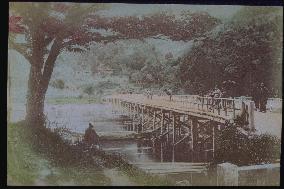
Togetsu Bridge at Arashiyama is viewed from the northern end, facing south. Horinji Temple is visible on the hillside. A sign at the northern end of the bridge informs people that cows and horses are not allowed to cross the bridge. A teahouse with hanging lanterns stands under a cherry tree. A maruko boat is docked nearby. The bridge was destroyed by a flood in 1892. The stone bridge to the right, Kinmonkyo, was later moved to Kurumazaki Shrine. Taken by Tamamura Kozaburo.==Date:unknown, Place:Kyoto, Photo:unknown, (Credit:Nagasaki University Library/Kyodo News Images) [Cabinet Number88‐6‐0]

  •  
The approach to Enkakuji Temple,Kamakura

The approach to Enkakuji Temple,Kamakura

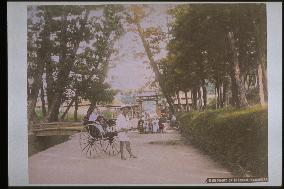
View of the Enkakuji Temple entrance area from the site of present-day Kita-Kamakura Station. There are two gates facing the street in front of the temple. The one in the background is the southeast gate. The temple is on the other side of the bridge. A horse road passes behind the mound on the right. It is possible that commoners were forbidden to use this gate during the Edo Period. The rickshaw in the centre seems to be an early model, indicating that this photograph was taken at the beginning of the Meiji Period.==Date:unknown, Place:Kamakura, Photo:unknown, (Credit:Nagasaki University Library/Kyodo News Images) [Cabinet Number86‐8‐0]

  •  
Nishi Otani Entsu-kyo Bridge

Nishi Otani Entsu-kyo Bridge

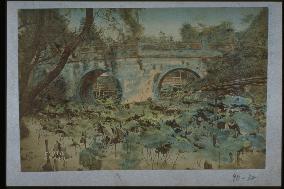
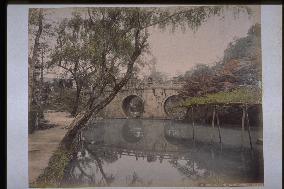
Enzu-kyo Bridge at Nishi Otani Temple, looking north from the southern edge of Kogetsu Pond. Made of stone, the bridge was built in 1865. Called Spectacles Bridge because of its shape, the bridge bustled with people who came here to view the red and white lotus flowers from the end of the Edo to the Meiji Period, but no flowers are visible here. Poles to support the branches of pine trees rise from the pond. The branches of a willow tree extend from the west bank.==Date:unknown, Place:Kyoto, Photo:unknown, (Credit:Nagasaki University Library/Kyodo News Images) [Cabinet Number85‐27‐0]

  •  
Benten Pond,Eikan-do Temple

Benten Pond,Eikan-do Temple

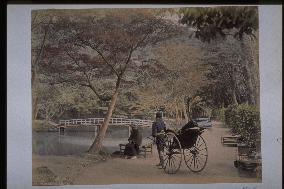
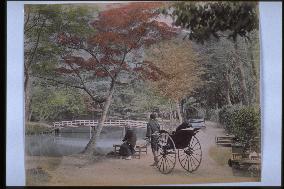
View of the Hojo Pond at Eikando Temple, looking south-southeast. A young rickshaw driver and an old woman sitting on a bench fill the centre of the picture. The gently curving wooden bridge connects to Benten Island on the left. The stone bridge leading to the main hall is visible in the rear. Japanese maple trees are growing along the pond. The goal of this photo is to show that Eikando was a well-known place for the enjoyment of autumn colours.==Date:unknown, Place:Kyoto, Photo:unknown, (Credit:Nagasaki University Library/Kyodo News Images) [Cabinet Number85‐25‐0]

  •  
Nishi Otani Entsu-kyo Bridge

Nishi Otani Entsu-kyo Bridge

Enzu-kyo Bridge at Nishi Otani Temple, looking west from the edge of the bridge. Made of stone, the bridge was built in 1865. It was called Spectacles Bridge because of its shape and bustled with people who came here to view the red and white lotus flowers from the end of the Edo to the Meiji Period. There are women and children standing along one of the bridge's railings. In the far back are private houses and people visiting the temple.==Date:unknown, Place:Kyoto, Photo:unknown, (Credit:Nagasaki University Library/Kyodo News Images) [Cabinet Number85‐23‐0]

  •  
Autumn tints of Takinogawa, Oji

Autumn tints of Takinogawa, Oji

This bridge appears many times in photographs of Takinogawa taken during the Meiji Period. The former Takinogawa Village was located west of Mt. Asuka. The groves of maple trees where people enjoyed the autumn colours centered around Kongoji, which was also called the autumn colours temple (present-day Takinogawa 3-chome, Kita Ward). People enjoyed the cherry blossoms at Mt. Asuka in spring and the colourful leaves of Takinogawa in autumn. Mid-Meiji Period.==Date:unknown, Place:Tokyo, Photo:unknown, (Credit:Nagasaki University Library/Kyodo News Images) [Cabinet Number85‐13‐0]

  •  
Maruyama Yaami Hotel

Maruyama Yaami Hotel

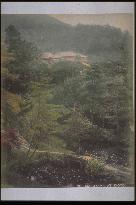
Distant view of the Maruyama Yaami Hotel from the top of the Sanmon Gate at Chion-in Temple, facing southeast. Long stone stairs, the stone bridge over the pond, and abundant nature with tall pines and maple trees are visible in the foreground. Several buildings of the Yaami Hotel stand on the Maruyama hillside, as well as a terrace built on the west side to enjoy the view.==Date:unknown, Place:Kyoto, Photo:Tamamura Kozaburo, (Credit:Nagasaki University Library/Kyodo News Images) [Cabinet Number80‐4‐0]

  •  
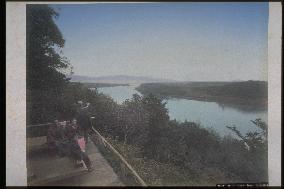
Lake Biwa seen from Ishiyama

Lake Biwa seen from Ishiyama

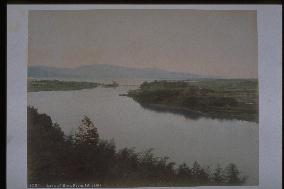
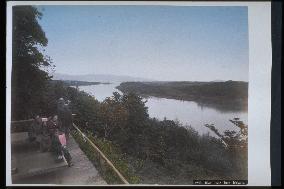
View of Seta River from Tsukimi-tei at Ishiyamadera Temple, with Lake Biwa and the Hira Mountain Range in the distance. The bridge in the centre is Seta-no-Karahashi, formerly the only bridge spanning Seta River and an important transportation route in ancient times. At present there are many bridges over the river.==Date:unknown, Place:Shiga, Photo:Tamamura Kozaburo, (Credit:Nagasaki University Library/Kyodo News Images) [Cabinet Number79‐14‐0]

  •  
Arima Spa

Arima Spa

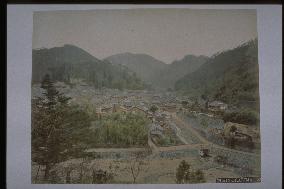
View of the ancient Arima Spa, taken from the north looking south. Visitors crossed Taikobashi Bridge, visible in the background, and proceeded to the left (east) to the bath houses (present-day Kin-no-yu). Zenpukuji, a temple of the Soto Sect of Zen Buddhism, is on the right. Taikobashi Bridge was replaced with an iron bridge in 1891, indicating that this photograph was taken before that year, probably in the mid-Meiji Period. Present-day Kita Ward.==Date:unknown, Place:Kobe, Photo:Tamamura Kozaburo, (Credit:Nagasaki University Library/Kyodo News Images) [Cabinet Number79‐12‐0]

  •  
Tonosawa

Tonosawa

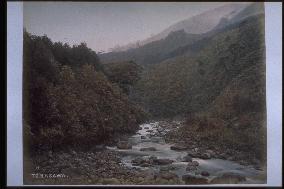
This is a little higher up from the present iron bridge of Deyama. The Hayakawa River flows in the center. The gradient is milder around here, and so is the flow. The mountain on the right is the foot of Tonomine and a part of Mt. Myougadake is visible behind. There is Amida Temple in Tonomine. The forest on the left is at the foot of Mt. Yusaka, and at present National Route 1 runs along Hayakawa River.==Date:unknown, Place:Hakone, Photo:R. Stillfried, (Credit:Nagasaki University Library/Kyodo News Images) [Cabinet Number77‐15‐0]

  •  
Furumachi-bashi Bridge over Nakashima River and Koeiji Temple

Furumachi-bashi Bridge over Nakashima River and Koeiji Temple

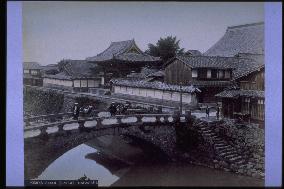
Furumachi-bashi Bridge over Nakashima River and Koeiji Temple==Date:unknown, Place:Nagasaki, Photo:unknown, (Credit:Nagasaki University Library/Kyodo News Images)

  •  
Ohashi Bridge at the entrance to the inner sanctum,Mt. Koya

Ohashi Bridge at the entrance to the inner sanctum,Mt. Koya

Okunoin, located on the east side of Mt. Koya, is the sacred land surrounding the grave of the founder, Kobo-Taishi, or Kukai. The worship of Kobo-Taishi spread from Mt. Koya throughout Japan during the Kamakura Period, and now more than 200,000 graves, large and small, can be seen from Ohashi Bridge (Ichino-hashi) at the entrance to the area and the grave of Kobo-Taishi.==Date:unknown, Place:Wakayama, Photo:unknown, (Credit:Nagasaki University Library/Kyodo News Images) [Cabinet Number71‐6‐0]

  •  
The railway in Noge

The railway in Noge

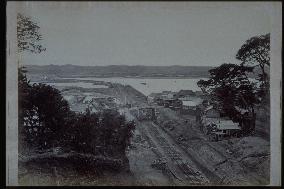
This photograph, carried in the October 2, 1871 issue of The Far East, depicts the bridge Aoki-bashi at the intersection of the Tokaido Highway and the train tracks. The foliage on the right is part of Honkakuji Temple. The train line to Yokohama follows the embankment made by Takashima Kaemon. The Shinbashi-Yokohama train line opened in its entirety about a year later.==Date:unknown, Place:Yokohama, Photo:unknown, (Credit:Nagasaki University Library/Kyodo News Images) [Cabinet Number69‐72‐0]

  •  
Nunobiki Falls

Nunobiki Falls

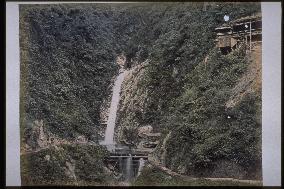
Medaki waterfall at Nunobiki Falls, taken around the same time as photograph #2271 (Shinkoji Temple), #4092 (Mt. Suwa), and #4094 (Arima Spa) in the mid-Meiji Period. Visitors normally took the path on the right side of the river and then proceeded along the road to the left to Medaki waterfall. After that, they crossed a wooden bridge and negotiated the winding mountain path to Odaki waterfall.==Date:unknown, Place:Kobe, Photo:Tamamura Kozaburo, (Credit:Nagasaki University Library/Kyodo News Images) [Cabinet Number68‐4‐2]

  •  
Sokokura Spa

Sokokura Spa

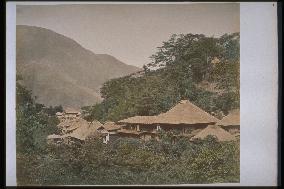
This is the Sokokura Spa viewed from the opposite side of Jakotsu River, after crossing Mannen Bridge. The hip roof on the left is Jizodo (a temple hall where a Buddhist deity is enshrined). The house with a thatched roof before it is Yorozuya , Umeya is in front of that. The two-storied building on the right is Tsutaya. The house partially visible on the right is Sengokuya Inn. The roofs of these spa houses are thatched. Therefore, this photo was taken before the big fire of 1881.==Date:unknown, Place:Hakone, Photo:Usui Shuzaburo?, (Credit:Nagasaki University Library/Kyodo News Images) [Cabinet Number65‐16‐0]

  •  
The garden of Ginkakuji Temple

The garden of Ginkakuji Temple

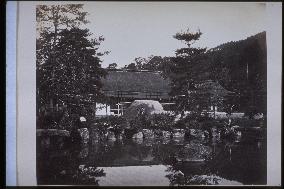
View of the main hall of Jionji Temple (left) and Togu-do (right) from the edge of Kinkyo Pond, from south of the Silver Pavilion facing east north-east. The truncated-cone shaped Kogetsudai, a sand form, in the middle and Ginshadan, on the right, are visible on the far side of Kinkyo Pond. Bunkai Bridge and Geisen Bridge are on the right and left, respectively. Both the main hall and Togu-do were constructed by order of Ashikaga Yoshimasa in 1486, and they were restored in 1615 and 1640.==Date:unknown, Place:Kyoto, Photo:R. Stillfried, (Credit:Nagasaki University Library/Kyodo News Images) [Cabinet Number63‐11‐0]

  •  
Ginkakuji Temple

Ginkakuji Temple

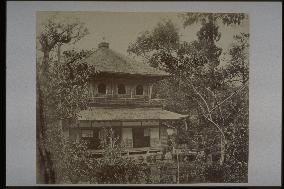
The Silver Pavilion at Jionji Temple seen from the western edge of Kikyo Pond, facing west. Also called Kannon-do, the pavilion was built in 1489 by order of Ashikaga Yoshimasa and restored in 1639. The building is in two-story houkei style with a kokera (thin long plank) roof. The greenery on the left is Sen'nin-shu. Yamanaseki (rock) is visible under the right bush with Bunkai Bridge behind it.==Date:unknown, Place:Kyoto, Photo:F. Beato, (Credit:Nagasaki University Library/Kyodo News Images) [Cabinet Number62‐24‐0]

  •  
Monju-do,Kurodani Konkai Komyoji Temple

Monju-do,Kurodani Konkai Komyoji Temple

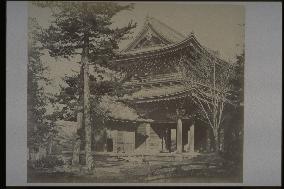
The Sanmon (two-story gate) of Kurodani Konkai Komyoji Temple was built in 1860 in the irimoya style (hip and gable roof) with ornate roof tiles. A hanging plaque bears an inscription by Emperor Gokomatsu (1377-1433) saying, The First Gate of Jodo Shinshu (Pure Land Buddhism). A stone bridge is visible in the right foreground. Taken by Felix Beato.==Date:unknown, Place:Kyoto, Photo:F. Beato, (Credit:Nagasaki University Library/Kyodo News Images) [Cabinet Number62‐26‐0]

  •  
Nishi Otani (Otani Honbyo Mausoleum of Honganji Temple)

Nishi Otani (Otani Honbyo Mausoleum of Honganji Temple)

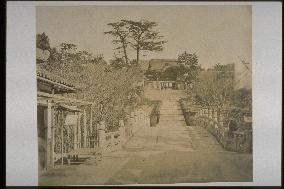
The approach to Nishi-Otani Temple is viewed from the western edge of Entsu Bridge, facing east. There are two giant pine trees by the sanmon gate in the back. This stone bridge was built in 1865. It was referred to as a spectacles bridge because of its shape. It was famous for its red and white lotus flowers in the mid-19th century. There are teahouses with benches on the northwestern edge of the bridge. Taken by F. Beato.==Date:unknown, Place:Kyoto, Photo:F. Beato, (Credit:Nagasaki University Library/Kyodo News Images) [Cabinet Number62‐19‐0]

  •  
Mt. Fuji seen from Suzukawa

Mt. Fuji seen from Suzukawa

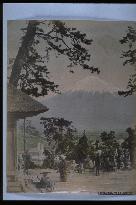
Northern view of Mt. Fuji from Jizo-do on the sand dune of Suzukawa in Fuji City. Stone jizo statues line a path in the temple grounds, and the Jizo-do temple is partially visible. The four people are obviously posing for the photograph. The train tracks of Tokaido Line and Kawai Bridge are visible in the background, indicating that the photograph was taken after 1890.==Date:unknown, Place:Shizuoka, Photo:unknown, (Credit:Nagasaki University Library/Kyodo News Images) [Cabinet Number59‐47‐0]

  •  
A view of Lake Biwa from Ishiyamadera Temple

A view of Lake Biwa from Ishiyamadera Temple

View of Seta River from Tsukimi-tei at Ishiyamadera Temple. During the Heian Period, aristocratic women worshipped at the temple, and in later years it attracted many commoners as the 13th temple in the circuit of 33 Holy Kannon Temples of Western Japan. One of the Eight Scenes of Oumi, it was referred to as Ishiyama-no-Shugetsu (Autumn Moon at Ishiyama Temple). This image appears on postcards and in various photographs.==Date:unknown, Place:Shiga, Photo:unknown, (Credit:Nagasaki University Library/Kyodo News Images) [Cabinet Number59‐23‐0]

  •  
Maruyama Yaami Hotel

Maruyama Yaami Hotel

Distant view of the Maruyama Yaami Hotel from the top of the Sanmon Gate at Chion-in Temple, facing southeast. Long stone stairs, the stone bridge over the pond, and abundant nature with tall pines and maple trees are visible in the foreground. Several buildings of the Yaami Hotel stand on the Maruyama hillside, as well as a terrace built on the west side to enjoy the view.==Date:unknown, Place:Kyoto, Photo:unknown, (Credit:Nagasaki University Library/Kyodo News Images) [Cabinet Number57‐11‐2]

  •  
The approach to Toshogu Shrine,Nikko

The approach to Toshogu Shrine,Nikko

This is the entrance to the Sannai area encompassing Nikko Toshogu Shrine and Sanrinoji Temple. Shinkyo Bridge and Nikko Bridge are located to the left. Daiya River is visible in the background to the left. Nagasaka Slope is in the centre. The shrine on the right is Jinjaodo. Stones cut for construction are visible on the left.==Date:unknown, Place:Nikko, Photo:unknown, (Credit:Nagasaki University Library/Kyodo News Images) [Cabinet Number54‐6‐0]

  •  
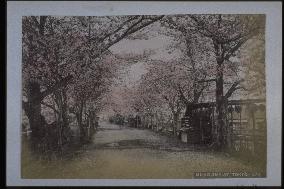
Cherry trees at Mukojima

Cherry trees at Mukojima

The area across Sumida River from Asakusa is Mukojima. There is no official boundary, but area from Mokuboji Temple to Makura Bridge is referred to as Mukojima. The banks of Sumida River at Mukojima are called Sumida-tei or Boku-tei. Cherry trees were planted here during the Kyoho Period (1716-36) by the 8th Shogun Tokugawa Yoshimune, and saplings were planted from time to time thereafter. This area thus became the most popular place to enjoy cherry blossoms in Edo. Taken around 1898.==Date:unknown, Place:Tokyo, Photo:unknown, (Credit:Nagasaki University Library/Kyodo News Images) [Cabinet Number53‐40‐0]

  •  
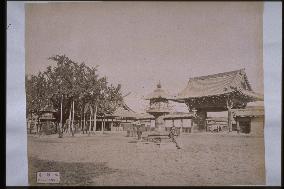
Nishi Honganji Temple

Nishi Honganji Temple

The grounds of Nishi Honganji Temple, looking from the southeastern side of the Goei-do facing northeast. The gate of the Goei-do and a mizubuki gingko tree are depicted on the right and left. A man is leaning against the bronze lantern in the centre. Other people are also present on the temple grounds. The Goei-do is in irimoya style with roof tiles and was built in 1645. The rails of a bridge over Horikawa River are visible beyond the Goei-do gate.==Date:unknown, Place:Kyoto, Photo:unknown, (Credit:Nagasaki University Library/Kyodo News Images) [Cabinet Number52‐28‐0]

  •  
Nishi Otani Entsu-kyo Bridge

Nishi Otani Entsu-kyo Bridge

Enzu-kyo Bridge at Nishi Otani Temple, looking north-northeast from the southwestern edge of Kogetsu Pond. Made of stone, the bridge was built in 1865. Called Spectacles Bridge because of its shape, the bridge bustled with people who came here to view the red and white lotus flowers from the end of the Edo to the Meiji Period. Two men are posing on the bridge looking down at the flowers. People are also visible in the tea house on the other side of the bridge.==Date:unknown, Place:Kyoto, Photo:unknown, (Credit:Nagasaki University Library/Kyodo News Images) [Cabinet Number52‐25‐0]

  •  
A view of Lake Biwa from Ishiyamadera Temple

A view of Lake Biwa from Ishiyamadera Temple

View of Seta River from Tsukimi-tei at Ishiyamadera Temple. During the Heian Period, aristocratic women worshipped at the temple, and in later years it attracted many commoners as the 13th temple in the circuit of 33 Holy Kannon Temples of Western Japan. One of the Eight Scenes of Oumi, it was referred to as Ishiyama-no-Shugetsu (Autumn Moon at Ishiyama Temple). This image appears on postcards and in various photographs.==Date:unknown, Place:Shiga, Photo:unknown, (Credit:Nagasaki University Library/Kyodo News Images) [Cabinet Number52‐18‐0]

  •  
Benten Pond,Eikan-do Temple

Benten Pond,Eikan-do Temple

View of the Hojo Pond at Eikando Temple, looking south-southeast. A young rickshaw driver and an old woman sitting on a bench fill the centre of the picture. The gently curving wooden bridge connects to Benten Island on the left. The stone bridge leading to the main hall is visible in the rear. Japanese maple trees are growing along the pond. The goal of this photo is to show that Eikando was a well-known place for the enjoyment of autumn colours.==Date:unknown, Place:Kyoto, Photo:unknown, (Credit:Nagasaki University Library/Kyodo News Images) [Cabinet Number52‐11‐0]

  •  
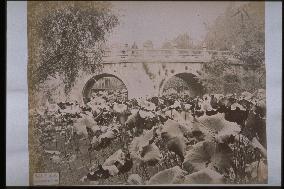
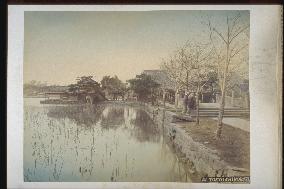
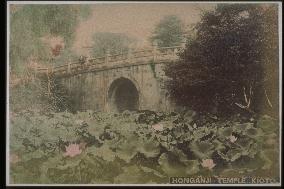
Nishi Otani Entsu-kyo Bridge

Nishi Otani Entsu-kyo Bridge

Enzu-kyo Bridge at Nishi Otani Temple, looking north from the southern edge of Kogetsu Pond. Made of stone, the bridge was built in 1865. Called Spectacles Bridge because of its shape, the bridge bustled with people who came here to view the red and white lotus flowers from the end of the Edo to the Meiji Period. Two men are posing on the bridge looking down at the flowers. Stone lanterns are installed along the eastern side of the bridge. Red lotus flowers are blooming in the pond.==Date:unknown, Place:Kyoto, Photo:unknown, (Credit:Nagasaki University Library/Kyodo News Images) [Cabinet Number52‐10‐0]

  •  
The Togetsukyo Bridge,Arashiyama

The Togetsukyo Bridge,Arashiyama

Togetsu Bridge at Arashiyama is viewed from the northern end, facing south. Horinji Temple is visible on the hillside. Kimono-clad women look toward the camera from the bridge. A man is fishing under the cherry tree. The bridge was destroyed by a flood in 1892. The stone bridge in the foreground is Kinmonkyo, which was later moved to Kurumazaki Shrine. Taken by Tamamura Kozaburo.==Date:unknown, Place:Kyoto, Photo:Tamamura Kozaburo, (Credit:Nagasaki University Library/Kyodo News Images) [Cabinet Number48‐113‐0]

  •  
Nishi Otani Entsu-kyo Bridge

Nishi Otani Entsu-kyo Bridge

Enzu-kyo Bridge at Nishi Otani Temple, looking north-northeast from the southwestern edge of Kogetsu Pond. Made of stone, the bridge was built in 1865. Called Spectacles Bridge because of its shape, the bridge bustled with people who came here to view the red and white lotus flowers from the end of the Edo to the Meiji Period. Two men are posing on the bridge looking down at the flowers. People are also visible in the tea house on the other side of the bridge.==Date:unknown, Place:Kyoto, Photo:unknown, (Credit:Nagasaki University Library/Kyodo News Images) [Cabinet Number47‐38‐0]

  •  
Yaomatsu Restaurant, Mukojima

Yaomatsu Restaurant, Mukojima

Yaomatsu Restaurant on the right was opened in a refurbished boat shed formerly owned by the Tokugawa family of Mito. The water in front is probably Gennomori River, seen from Makura Bridge. There was a ferry stop at the end of the bridge called Yamanoshuku-no-Watashi (Makurabashi-no-Watashi) for passage to Asakusa on the other side of the river. The five-story pagoda Kan'non-do Hall and the Nio Gate of Sensoji Temple are visible. The Ryounkaku built in 1890 is visible to the left of the pagoda, indicating that the photograph was taken after that year.==Date:unknown, Place:Tokyo, Photo:unknown, (Credit:Nagasaki University Library/Kyodo News Images) [Cabinet Number47‐7‐0]

  •  
Shinobazu Pond

Shinobazu Pond

Benten-do on Nakanoshima and the path to it are seen at Shinobazu Pond. The Buddhist priest Tenkai modeled the pond after Lake Biwa and built the shrine to worship the deity Benzaiten of Chikubushima. The stone bridge was built between 1789 and 1801. Numerous dead lotus stems remain in the water, indicating that the season is winter.==Date:unknown, Place:Tokyo, Photo:unknown, (Credit:Nagasaki University Library/Kyodo News Images) [Cabinet Number47‐1‐0]

  •  
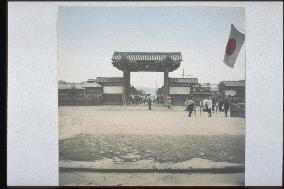
Rickshaw in front of a great gate

Rickshaw in front of a great gate

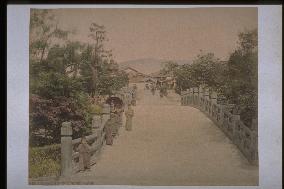
The Somon Gate of Nishihonganji Temple is seen from the Miei-do Gate. The bustling front street stretches away behind the gate. The railing of the bridge over the Horikawa River is visible on the right. A national flag is flying at the Miei- Gate, above the bridge. Three rickshaw men are waiting for customers in front of the gate. The Higashiyama mountains are visible in the far back.==Date:unknown, Place:Kyoto, Photo:unknown, (Credit:Nagasaki University Library/Kyodo News Images) [Cabinet Number46‐113‐0]

  • Main
  • Top
  • Editorial
  • Creative
  • About Us
  • About ILG
  • Terms of use
  • Company
  • BEHIND
  • Price List
  • Single Plan
  • Monthly Plan
  • Services
  • Shooting
  • Rights Clearance
  • Support
  • FAQ
  • How To Buy
  • Contact Us
  • Become a Partner

© KYODO NEWS IMAGES INC

All Rights Reserved.

  • Editorial
  • Olympics
  • News
  • Sports
  • Japan
  • Tech
  • Royal
  • Disaster
  • NorthKorea
  • Old Japan
  • SNS
  • Creative
  • Food
  • Japan
  • Landscape
  • Animal
  • Popular
  • #Ukraine
  • #China
  • #coronavirus
  • #N. Korea
  • #Russia
  • #Thailand
  • #Ukraine
  • #China
  • #coronavirus
  • #N. Korea
  • #Russia
  • #Thailand
  • Food
  • Japan
  • Landscape
  • Animal
  • Olympics
  • News
  • Sports
  • Japan
  • Tech
  • Royal
  • Disaster
  • NorthKorea
  • Old Japan
  • SNS