•  
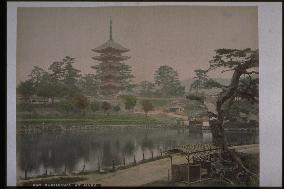
Sarusawa Pond and the five-story pagoda

Sarusawa Pond and the five-story pagoda

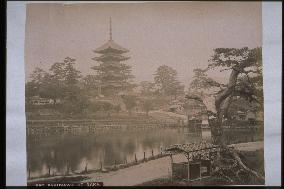
This photo captures Sarusawa Pond in the foreground and the five-storied pagoda of Kofukuji Temple when facing southwest. This composition which is also seen in the following, catalog #2934, 3182, and 3693, was probably thought of as the typical Nara photo. Some inns are seen around the temple.==Date:unknown, Place:Nara, Photo:Tamamura Kozaburo, (Credit:Nagasaki University Library/Kyodo News Images) [Cabinet Number80‐11‐0]

  •  
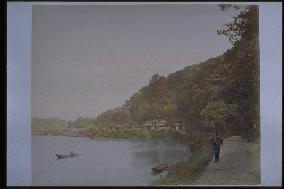
Ishiyama,Laka Biwa

Ishiyama,Laka Biwa

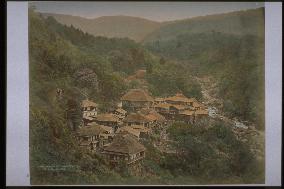
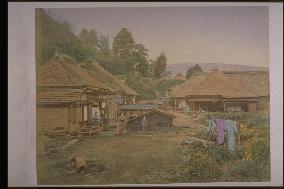
Inns on the approach to Ishiyamadera. Visitors passed along this road in large numbers to the temple, which is located at the hill protruding in the centre. The neighbourhood was called Katahara-machi (One Side Field Town) because buildings were erected on only one side of the road. This is the view looking south from the area of present-day Ishiyamadera Station on the Keihan Dentetsu Line.==Date:unknown, Place:Otsu, Photo:R. Stillfried, (Credit:Nagasaki University Library/Kyodo News Images) [Cabinet Number77‐19‐0]

  •  
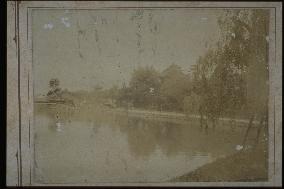
Sarusawa Pond

Sarusawa Pond

This photo depicts Sarusawa Pond in the foreground with Nan'endo and Sanjunoto (three-storied pagoda) of Kofukuji Temple viewed from southeastern part of the pond, a little north caompared to catalogue #2934. Above, the roof of the second story of Sanjunoto and only the roof of Nan'endo can be seen because of the trees.The inn in #2934 is also captured in the photo.==Date:1893, Place:Nara, Photo:unknown, (Credit:Nagasaki University Library/Kyodo News Images) [Cabinet Number72‐154‐0]

  •  
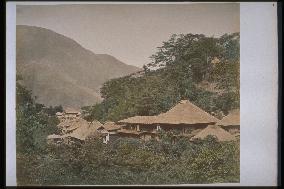
Sokokura Spa

Sokokura Spa

This is the Sokokura Spa viewed from the opposite side of Jakotsu River, after crossing Mannen Bridge. The hip roof on the left is Jizodo (a temple hall where a Buddhist deity is enshrined). The house with a thatched roof before it is Yorozuya , Umeya is in front of that. The two-storied building on the right is Tsutaya. The house partially visible on the right is Sengokuya Inn. The roofs of these spa houses are thatched. Therefore, this photo was taken before the big fire of 1881.==Date:unknown, Place:Hakone, Photo:Usui Shuzaburo?, (Credit:Nagasaki University Library/Kyodo News Images) [Cabinet Number65‐16‐0]

  •  
Kiga Spa

Kiga Spa

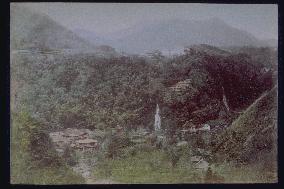
This is the spa town of Kiga before the new road to Miyagino opened in 1889. The torii gate a little far back is Yakushido ( a Buddhist temple hall housing a statue of the Buddha of healing,) and the building on the left is Yuyoin. The buildings before them belong to Kameya Inn. The house on the right is Jindairo. Matsuzakaya Inn is across from it on the other side of Susawa River. The building with a white wall on the left is Chokairo of Matsuzakaya Inn. Finally the one in the foreground is Sengokuya. Hayakawa Rver is visible on the right and continues to Kiga Valley.==Date:unknown, Place:Hakone, Photo:unknown, (Credit:Nagasaki University Library/Kyodo News Images) [Cabinet Number64‐23‐0]

  •  
Sarusawa Pond

Sarusawa Pond

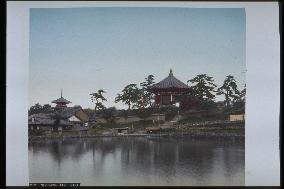
This photo depicts Sarusawa Pond in the foreground with Nan'endo and Sanjunoto (three-storied pagoda) of Kofukuji Temple viewed from southeastern part of the pond. The earthen wall cannot be seen. Nan'endo can be seen almost entirely, whereas only the roof of the pagod's second tier, and above, are visible. The large house with the smoke emitting is an inn. Uneme Shrine stands at the corner of Sanjo Street in front of the inn.==Date:unknown, Place:Nara, Photo:unknown, (Credit:Nagasaki University Library/Kyodo News Images) [Cabinet Number59‐25‐0]

  •  
Sarusawa Pond

Sarusawa Pond

This photo captures Sarusawa Pond in the foreground and the five-storied pagoda of Kofukuji Temple when facing southwest. This composition which is also seen in the following, catalog #2934, 3182, and 3693, was probably thought of as the typical Nara photo. Some inns are seen around the temple.==Date:unknown, Place:Nara, Photo:unknown, (Credit:Nagasaki University Library/Kyodo News Images) [Cabinet Number57‐13‐2]

  •  
Miyanoshita and Dogashima

Miyanoshita and Dogashima

During Edo era, there were Naraya, Edoya, Maruya, Yamatoya, and Ohmiya Inns in Dogashima. The two-story building on the left is Yamatoya, the red tower is Yakushi-do (a Buddhist temple hall housing a statue of Yakushi). The waterfall in the centre is Shirabeno-taki. Godan Ryokan Inn stands above the falls. The white western building on the hill is Naraya Hotel and Fujiuya Hotel is to its left. This photo was taken after the completion of the main buildings in 1891 after the big fire in 1883.==Date:unknown, Place:Hakone, Photo:Tamamura Kozaburo, (Credit:Nagasaki University Library/Kyodo News Images) [Cabinet Number48‐97‐0]

  •  
Stone lantern in the garden of an inn

Stone lantern in the garden of an inn

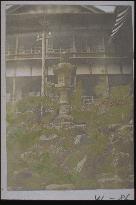
Various trees were planted among the rocks and stone lanterns in the garden. The electric pole indicates that the photograph was taken after 1892. The irimoya-style building has a balcony providing guests with scenic views. Inoue Mankichi Inoue of Nagasaki Prefecture bought a sub-temple called Yaami from Anyoji Temple at Maruyama in 1879, then renovated it in Western style and opened it as the Yaami Hotel.==Date:unknown, Place:Kyoto, Photo:unknown, (Credit:Nagasaki University Library/Kyodo News Images) [Cabinet Number46‐86‐0]

  •  
Scene of an inn

Scene of an inn

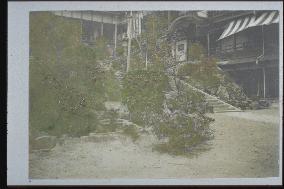
The garden contains various trees, and lanterns and landscaping stones decorate the garden on the slope. The hotel entrance has a karahafu style roof. Inoue Mankichi Inoue of Nagasaki Prefecture bought a sub-temple called Yaami from Anyoji Temple at Maruyama in 1879, then renovated it in Western style and opened it as the Yaami Hotel. Many foreigners stayed here, but the building burned down in 1906. The electric pole indicates that this photograph was taken after 1892.==Date:unknown, Place:Kyoto, Photo:unknown, (Credit:Nagasaki University Library/Kyodo News Images) [Cabinet Number46‐85‐0]

  •  
Scene of an inn

Scene of an inn

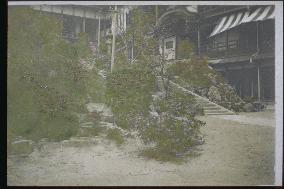
The garden contains various trees, and lanterns and landscaping stones decorate the garden on the slope. The hotel entrance has a karahafu style roof. Inoue Mankichi Inoue of Nagasaki Prefecture bought a sub-temple called Yaami from Anyoji Temple at Maruyama in 1879, then renovated it in Western style and opened it as the Yaami Hotel. Many foreigners stayed here, but the building burned down in 1906. The electric pole indicates that this photograph was taken after 1892.==Date:unknown, Place:Kyoto, Photo:unknown, (Credit:Nagasaki University Library/Kyodo News Images) [Cabinet Number46‐83‐0]

  •  
Ashinoyu hot spring

Ashinoyu hot spring

A view of the Ashinoyu hot springs before the great winter fire of 1872. The right rear is Matsuzakaya, further inwards is Yoshidaya, left from the front is Yamatoya, Daikokuya and Kinokuniya. The central building is the Tokoan (Kumano Gongen) frequently visited by novelists and calligraphers such as Shinen and Sekiryo during the Edo era.==Date:Before 4th year of Meiji, Place:Hakone, Photo:Kusakabe Kinbei, (Credit:Nagasaki University Library/Kyodo News Images) [Cabinet Number3‐39‐0]

  • Main
  • Top
  • Editorial
  • Creative
  • About Us
  • About ILG
  • Terms of use
  • Company
  • BEHIND
  • Price List
  • Single Plan
  • Monthly Plan
  • Services
  • Shooting
  • Rights Clearance
  • Support
  • FAQ
  • How To Buy
  • Contact Us
  • Become a Partner

© KYODO NEWS IMAGES INC

All Rights Reserved.

  • Editorial
  • Olympics
  • News
  • Sports
  • Japan
  • Tech
  • Royal
  • Disaster
  • NorthKorea
  • Old Japan
  • SNS
  • Creative
  • Food
  • Japan
  • Landscape
  • Animal
  • Popular
  • #Ukraine
  • #Russia
  • #coronavirus
  • #N. Korea
  • #Thailand
  • #China
  • #Ukraine
  • #Russia
  • #coronavirus
  • #N. Korea
  • #Thailand
  • #China
  • Food
  • Japan
  • Landscape
  • Animal
  • Olympics
  • News
  • Sports
  • Japan
  • Tech
  • Royal
  • Disaster
  • NorthKorea
  • Old Japan
  • SNS