•  
Cluny Abbey - France

Cluny Abbey - France

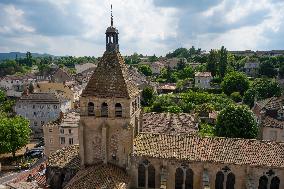
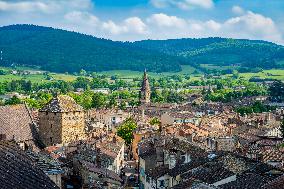
FRANCE. BURGUNDY. SAONE-ET-LOIRE (71) CLUNY. AERIAL VIEW OF GOLDEN TILED ROOFS, THE MILL TOWER AND SAINT-MARCEL CHURCH, MAJESTIC REMINDERS OF THE MEDIEVAL MONASTIC HERITAGE. Photo by Vincent Schneider/Only France/ABACAPRESS.COM

  •  
Cluny Abbey - France

Cluny Abbey - France

FRANCE. BURGUNDY. SAONE-ET-LOIRE (71) CLUNY. AERIAL VIEW OF GOLDEN TILED ROOFS, THE MILL TOWER AND SAINT-MARCEL CHURCH, MAJESTIC REMINDERS OF THE MEDIEVAL MONASTIC HERITAGE. Photo by Vincent Schneider/Only France/ABACAPRESS.COM

  •  
Kharkiv hosts regional swimming championship for veterans

Kharkiv hosts regional swimming championship for veterans

A crutch and a leg of an athlete are on the tiled floor during the Kharkiv Regional Swimming Championship for War Veterans, Kharkiv, Ukraine, on May 3, 2025. (Photo by Viacheslav Madiievskyi/Ukrinform)

  •  
Religious Coming-of-Age - Iran

Religious Coming-of-Age - Iran

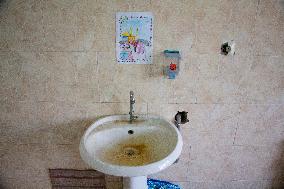
A sink is seen mounted on a tiled wall with a children's drawing and soap dispenser above it during her Jashn-e Taklif in Shazand, Iran on January 12, 2019. The area is likely used for performing wudu (ablution), a purification ritual before prayer in Islamic practice. Photo by Sina Yaghoobpoor/Middle East Images/ABACAPRESS.COM

  •  
XINHUA PHOTOS OF THE DAY

XINHUA PHOTOS OF THE DAY

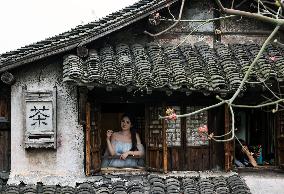
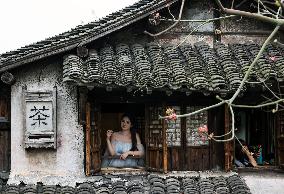
(240419) -- BEIJING, April 19, 2024 (Xinhua) -- A tourist looks outside at a tea house in the water town Wuzhen in Jiaxing City, east China's Zhejiang Province, April 11, 2024. Located in east China's Zhejiang Province, the waterside city Jiaxing is renowned for tourist destinations Nanhu Lake and Wuzhen. In the breezy month of April, the two tourist hotspots come alive with the gentle touch of spring. Nanhu Lake, with its shimmering waters and willow trees swaying along the lakeside, is a sight to behold. The historic water town Wuzhen also enchants with its emerald waters and whitewashed walls adorned with black tiled roofs. Visitors can immerse themselves in the scenery by donning traditional Hanfu attire and leisurely gliding along the river on rowing boats. The juxtaposition of ancient dwellings, stone bridges, and willow trees along the riverbanks resembles scenes from a classical ink painting, transporting visitors to a bygone era. (Xinhua/Lan Hongguang)

  •  
CHINA-ZHEJIANG-JIAXING-SPRING-SCENERY (CN)

CHINA-ZHEJIANG-JIAXING-SPRING-SCENERY (CN)

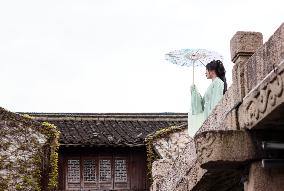
(240418) -- JIAXING(ZHEJIANG), April 18, 2024 (Xinhua) -- A tourist donning traditional Hanfu attire visits the water town Wuzhen in Jiaxing City, east China's Zhejiang Province, April 11, 2024. Located in east China's Zhejiang Province, the waterside city Jiaxing is renowned for tourist destinations Nanhu Lake and Wuzhen. In the breezy month of April, the two tourist hotspots come alive with the gentle touch of spring. Nanhu Lake, with its shimmering waters and willow trees swaying along the lakeside, is a sight to behold. The historic water town Wuzhen also enchants with its emerald waters and whitewashed walls adorned with black tiled roofs. Visitors can immerse themselves in the scenery by donning traditional Hanfu attire and leisurely gliding along the river on rowing boats. The juxtaposition of ancient dwellings, stone bridges, and willow trees along the riverbanks resembles scenes from a classical ink painting, transporting visitors to a bygone era. (Xinhua/Lan Hongguang)

  •  
CHINA-ZHEJIANG-JIAXING-SPRING-SCENERY (CN)

CHINA-ZHEJIANG-JIAXING-SPRING-SCENERY (CN)

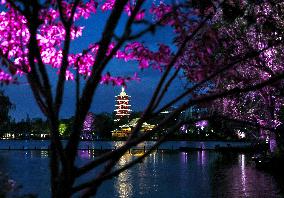
(240418) -- JIAXING(ZHEJIANG), April 18, 2024 (Xinhua) -- A tower is seen at night by the Nanhu Lake in Jiaxing City, east China's Zhejiang Province, April 10, 2024. Located in east China's Zhejiang Province, the waterside city Jiaxing is renowned for tourist destinations Nanhu Lake and Wuzhen. In the breezy month of April, the two tourist hotspots come alive with the gentle touch of spring. Nanhu Lake, with its shimmering waters and willow trees swaying along the lakeside, is a sight to behold. The historic water town Wuzhen also enchants with its emerald waters and whitewashed walls adorned with black tiled roofs. Visitors can immerse themselves in the scenery by donning traditional Hanfu attire and leisurely gliding along the river on rowing boats. The juxtaposition of ancient dwellings, stone bridges, and willow trees along the riverbanks resembles scenes from a classical ink painting, transporting visitors to a bygone era. (Xinhua/Lan Hongguang)

  •  
CHINA-ZHEJIANG-JIAXING-SPRING-SCENERY (CN)

CHINA-ZHEJIANG-JIAXING-SPRING-SCENERY (CN)

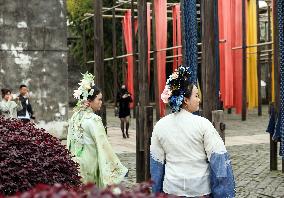
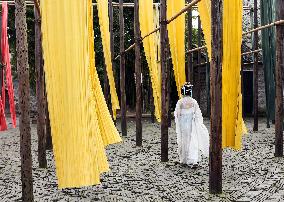
(240418) -- JIAXING(ZHEJIANG), April 18, 2024 (Xinhua) -- Tourists donning traditional attire visit a dyeing house in the water town Wuzhen in Jiaxing City, east China's Zhejiang Province, April 11, 2024. Located in east China's Zhejiang Province, the waterside city Jiaxing is renowned for tourist destinations Nanhu Lake and Wuzhen. In the breezy month of April, the two tourist hotspots come alive with the gentle touch of spring. Nanhu Lake, with its shimmering waters and willow trees swaying along the lakeside, is a sight to behold. The historic water town Wuzhen also enchants with its emerald waters and whitewashed walls adorned with black tiled roofs. Visitors can immerse themselves in the scenery by donning traditional Hanfu attire and leisurely gliding along the river on rowing boats. The juxtaposition of ancient dwellings, stone bridges, and willow trees along the riverbanks resembles scenes from a classical ink painting, transporting visitors to a bygone era. (Xinhua/Lan Hongguang)

  •  
CHINA-ZHEJIANG-JIAXING-SPRING-SCENERY (CN)

CHINA-ZHEJIANG-JIAXING-SPRING-SCENERY (CN)

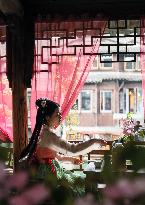
(240418) -- JIAXING(ZHEJIANG), April 18, 2024 (Xinhua) -- A tourist donning traditional Hanfu attire drinks tea in the water town Wuzhen in Jiaxing City, east China's Zhejiang Province, April 11, 2024. Located in east China's Zhejiang Province, the waterside city Jiaxing is renowned for tourist destinations Nanhu Lake and Wuzhen. In the breezy month of April, the two tourist hotspots come alive with the gentle touch of spring. Nanhu Lake, with its shimmering waters and willow trees swaying along the lakeside, is a sight to behold. The historic water town Wuzhen also enchants with its emerald waters and whitewashed walls adorned with black tiled roofs. Visitors can immerse themselves in the scenery by donning traditional Hanfu attire and leisurely gliding along the river on rowing boats. The juxtaposition of ancient dwellings, stone bridges, and willow trees along the riverbanks resembles scenes from a classical ink painting, transporting visitors to a bygone era. (Xinhua/Lan Hongguang)

  •  
CHINA-ZHEJIANG-JIAXING-SPRING-SCENERY (CN)

CHINA-ZHEJIANG-JIAXING-SPRING-SCENERY (CN)

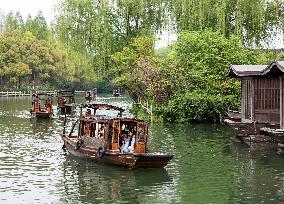
(240418) -- JIAXING(ZHEJIANG), April 18, 2024 (Xinhua) -- Tourists visit the water town Wuzhen on rowing boats in Jiaxing City, east China's Zhejiang Province, April 11, 2024. Located in east China's Zhejiang Province, the waterside city Jiaxing is renowned for tourist destinations Nanhu Lake and Wuzhen. In the breezy month of April, the two tourist hotspots come alive with the gentle touch of spring. Nanhu Lake, with its shimmering waters and willow trees swaying along the lakeside, is a sight to behold. The historic water town Wuzhen also enchants with its emerald waters and whitewashed walls adorned with black tiled roofs. Visitors can immerse themselves in the scenery by donning traditional Hanfu attire and leisurely gliding along the river on rowing boats. The juxtaposition of ancient dwellings, stone bridges, and willow trees along the riverbanks resembles scenes from a classical ink painting, transporting visitors to a bygone era. (Xinhua/Lan Hongguang)

  •  
CHINA-ZHEJIANG-JIAXING-SPRING-SCENERY (CN)

CHINA-ZHEJIANG-JIAXING-SPRING-SCENERY (CN)

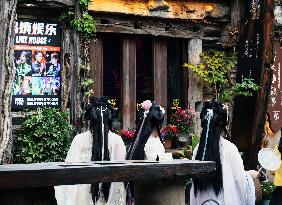
(240418) -- JIAXING(ZHEJIANG), April 18, 2024 (Xinhua) -- Tourists donning traditional Hanfu attire walk in the water town Wuzhen in Jiaxing City, east China's Zhejiang Province, April 11, 2024. Located in east China's Zhejiang Province, the waterside city Jiaxing is renowned for tourist destinations Nanhu Lake and Wuzhen. In the breezy month of April, the two tourist hotspots come alive with the gentle touch of spring. Nanhu Lake, with its shimmering waters and willow trees swaying along the lakeside, is a sight to behold. The historic water town Wuzhen also enchants with its emerald waters and whitewashed walls adorned with black tiled roofs. Visitors can immerse themselves in the scenery by donning traditional Hanfu attire and leisurely gliding along the river on rowing boats. The juxtaposition of ancient dwellings, stone bridges, and willow trees along the riverbanks resembles scenes from a classical ink painting, transporting visitors to a bygone era. (Xinhua/Lan Hongguang)

  •  
CHINA-ZHEJIANG-JIAXING-SPRING-SCENERY (CN)

CHINA-ZHEJIANG-JIAXING-SPRING-SCENERY (CN)

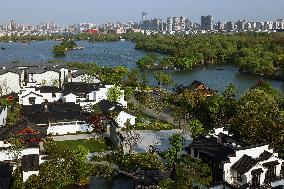
(240418) -- JIAXING(ZHEJIANG), April 18, 2024 (Xinhua) -- Ancient dwellings are seen against the distant city skyline near the Nanhu Lake in Jiaxing City, east China's Zhejiang Province, April 10, 2024. Located in east China's Zhejiang Province, the waterside city Jiaxing is renowned for tourist destinations Nanhu Lake and Wuzhen. In the breezy month of April, the two tourist hotspots come alive with the gentle touch of spring. Nanhu Lake, with its shimmering waters and willow trees swaying along the lakeside, is a sight to behold. The historic water town Wuzhen also enchants with its emerald waters and whitewashed walls adorned with black tiled roofs. Visitors can immerse themselves in the scenery by donning traditional Hanfu attire and leisurely gliding along the river on rowing boats. The juxtaposition of ancient dwellings, stone bridges, and willow trees along the riverbanks resembles scenes from a classical ink painting, transporting visitors to a bygone era. (Xinhua/Lan Hongguang)

  •  
CHINA-ZHEJIANG-JIAXING-SPRING-SCENERY (CN)

CHINA-ZHEJIANG-JIAXING-SPRING-SCENERY (CN)

(240418) -- JIAXING(ZHEJIANG), April 18, 2024 (Xinhua) -- A tourist looks outside at a tea house in the water town Wuzhen in Jiaxing City, east China's Zhejiang Province, April 11, 2024. Located in east China's Zhejiang Province, the waterside city Jiaxing is renowned for tourist destinations Nanhu Lake and Wuzhen. In the breezy month of April, the two tourist hotspots come alive with the gentle touch of spring. Nanhu Lake, with its shimmering waters and willow trees swaying along the lakeside, is a sight to behold. The historic water town Wuzhen also enchants with its emerald waters and whitewashed walls adorned with black tiled roofs. Visitors can immerse themselves in the scenery by donning traditional Hanfu attire and leisurely gliding along the river on rowing boats. The juxtaposition of ancient dwellings, stone bridges, and willow trees along the riverbanks resembles scenes from a classical ink painting, transporting visitors to a bygone era. (Xinhua/Lan Hongguang)

  •  
CHINA-ZHEJIANG-JIAXING-SPRING-SCENERY (CN)

CHINA-ZHEJIANG-JIAXING-SPRING-SCENERY (CN)

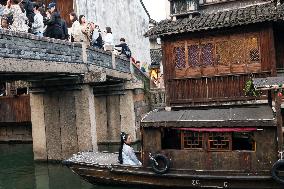
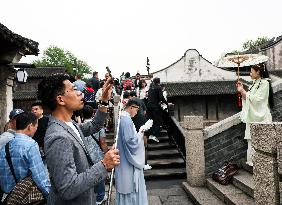
(240418) -- JIAXING(ZHEJIANG), April 18, 2024 (Xinhua) -- Tourists are seen on a stone bridge while a woman donning traditional attire visits on a rowing boat in water town Wuzhen in Jiaxing City, east China's Zhejiang Province, April 11, 2024. Located in east China's Zhejiang Province, the waterside city Jiaxing is renowned for tourist destinations Nanhu Lake and Wuzhen. In the breezy month of April, the two tourist hotspots come alive with the gentle touch of spring. Nanhu Lake, with its shimmering waters and willow trees swaying along the lakeside, is a sight to behold. The historic water town Wuzhen also enchants with its emerald waters and whitewashed walls adorned with black tiled roofs. Visitors can immerse themselves in the scenery by donning traditional Hanfu attire and leisurely gliding along the river on rowing boats. The juxtaposition of ancient dwellings, stone bridges, and willow trees along the riverbanks resembles scenes from a classical ink painting, transporting visitors to a bygone era

  •  
CHINA-ZHEJIANG-JIAXING-SPRING-SCENERY (CN)

CHINA-ZHEJIANG-JIAXING-SPRING-SCENERY (CN)

(240418) -- JIAXING(ZHEJIANG), April 18, 2024 (Xinhua) -- Tourists donning traditional attire visit water town Wuzhen on a rowing boat in Jiaxing City, east China's Zhejiang Province, April 11, 2024. Located in east China's Zhejiang Province, the waterside city Jiaxing is renowned for tourist destinations Nanhu Lake and Wuzhen. In the breezy month of April, the two tourist hotspots come alive with the gentle touch of spring. Nanhu Lake, with its shimmering waters and willow trees swaying along the lakeside, is a sight to behold. The historic water town Wuzhen also enchants with its emerald waters and whitewashed walls adorned with black tiled roofs. Visitors can immerse themselves in the scenery by donning traditional Hanfu attire and leisurely gliding along the river on rowing boats. The juxtaposition of ancient dwellings, stone bridges, and willow trees along the riverbanks resembles scenes from a classical ink painting, transporting visitors to a bygone era. (Xinhua/Lan Hongguang)

  •  
CHINA-ZHEJIANG-JIAXING-SPRING-SCENERY (CN)

CHINA-ZHEJIANG-JIAXING-SPRING-SCENERY (CN)

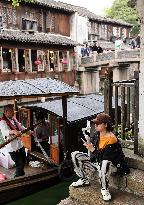
(240418) -- JIAXING(ZHEJIANG), April 18, 2024 (Xinhua) -- A social media influencer is livestreaming in the water town Wuzhen in Jiaxing City, east China's Zhejiang Province, April 11, 2024. Located in east China's Zhejiang Province, the waterside city Jiaxing is renowned for tourist destinations Nanhu Lake and Wuzhen. In the breezy month of April, the two tourist hotspots come alive with the gentle touch of spring. Nanhu Lake, with its shimmering waters and willow trees swaying along the lakeside, is a sight to behold. The historic water town Wuzhen also enchants with its emerald waters and whitewashed walls adorned with black tiled roofs. Visitors can immerse themselves in the scenery by donning traditional Hanfu attire and leisurely gliding along the river on rowing boats. The juxtaposition of ancient dwellings, stone bridges, and willow trees along the riverbanks resembles scenes from a classical ink painting, transporting visitors to a bygone era. (Xinhua/Lan Hongguang)

  •  
CHINA-ZHEJIANG-JIAXING-SPRING-SCENERY (CN)

CHINA-ZHEJIANG-JIAXING-SPRING-SCENERY (CN)

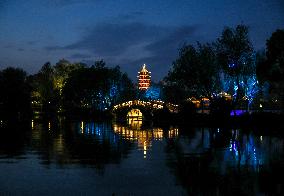
(240418) -- JIAXING(ZHEJIANG), April 18, 2024 (Xinhua) -- A stone bridge and a tower are seen at night in the Nanhu Lake in Jiaxing City, east China's Zhejiang Province, April 10, 2024. Located in east China's Zhejiang Province, the waterside city Jiaxing is renowned for tourist destinations Nanhu Lake and Wuzhen. In the breezy month of April, the two tourist hotspots come alive with the gentle touch of spring. Nanhu Lake, with its shimmering waters and willow trees swaying along the lakeside, is a sight to behold. The historic water town Wuzhen also enchants with its emerald waters and whitewashed walls adorned with black tiled roofs. Visitors can immerse themselves in the scenery by donning traditional Hanfu attire and leisurely gliding along the river on rowing boats. The juxtaposition of ancient dwellings, stone bridges, and willow trees along the riverbanks resembles scenes from a classical ink painting, transporting visitors to a bygone era. (Xinhua/Lan Hongguang)

  •  
CHINA-ZHEJIANG-JIAXING-SPRING-SCENERY (CN)

CHINA-ZHEJIANG-JIAXING-SPRING-SCENERY (CN)

(240418) -- JIAXING(ZHEJIANG), April 18, 2024 (Xinhua) -- A tourist donning traditional Hanfu attire visits a dyeing house in the water town Wuzhen in Jiaxing City, east China's Zhejiang Province, April 11, 2024. Located in east China's Zhejiang Province, the waterside city Jiaxing is renowned for tourist destinations Nanhu Lake and Wuzhen. In the breezy month of April, the two tourist hotspots come alive with the gentle touch of spring. Nanhu Lake, with its shimmering waters and willow trees swaying along the lakeside, is a sight to behold. The historic water town Wuzhen also enchants with its emerald waters and whitewashed walls adorned with black tiled roofs. Visitors can immerse themselves in the scenery by donning traditional Hanfu attire and leisurely gliding along the river on rowing boats. The juxtaposition of ancient dwellings, stone bridges, and willow trees along the riverbanks resembles scenes from a classical ink painting, transporting visitors to a bygone era. (Xinhua/Lan Hongguang)

  •  
CHINA-ZHEJIANG-JIAXING-SPRING-SCENERY (CN)

CHINA-ZHEJIANG-JIAXING-SPRING-SCENERY (CN)

(240418) -- JIAXING(ZHEJIANG), April 18, 2024 (Xinhua) -- A social media influencer prepares a livestreaming in the water town Wuzhen in Jiaxing City, east China's Zhejiang Province, April 11, 2024. Located in east China's Zhejiang Province, the waterside city Jiaxing is renowned for tourist destinations Nanhu Lake and Wuzhen. In the breezy month of April, the two tourist hotspots come alive with the gentle touch of spring. Nanhu Lake, with its shimmering waters and willow trees swaying along the lakeside, is a sight to behold. The historic water town Wuzhen also enchants with its emerald waters and whitewashed walls adorned with black tiled roofs. Visitors can immerse themselves in the scenery by donning traditional Hanfu attire and leisurely gliding along the river on rowing boats. The juxtaposition of ancient dwellings, stone bridges, and willow trees along the riverbanks resembles scenes from a classical ink painting, transporting visitors to a bygone era. (Xinhua/Lan Hongguang)

  •  
Decontamination work in Fukushima

Decontamination work in Fukushima

FUKUSHIMA, Japan - Workers use water to remove radioactive substances, leaked from the crippled Fukushima Daiichi nuclear power plant, from the tiled roof of a house in the Onami district in the city of Fukushima on Oct. 18, 2011. The city, which is situated about 60 kilometers from the nuclear plant, began implementing a major decontamination project the same day.

  •  

"Red Building," a witness of China's revolution | Stories shared by Xi Jinping

STORY: "Red Building," a witness of China's revolution | Stories shared by Xi Jinping DATELINE: Nov. 23, 2022 LENGTH: 00:04:00 LOCATION: Beijing CATEGORY: POLITICS/CULTURE SHOTLIST: 1. various of the "Red Building" 2. SOUNDBITE 1 (Chinese): CHENG HAO, Researcher of a museum of CPC's early revolutionary activities in Beijing 3. various of offices in "Red Building" 4. SOUNDBITE 2 (Chinese): CAI QIANG, Guide at a museum of CPC's early revolutionary activities in Beijing 5. various of reenactment of CPC's early revolutionary activities in Beijing SOUNDBITE 3 (Chinese): XI JINPING, Chinese President STORYLINE: This four-story "Red Building," built from 1916 to 1918, was named for its red brick walls and tiled roof. It witnessed several of China's major historical events, including the New Culture Movement and the May Fourth Movement, both of which greatly contributed to the early spread of Marxism in China and the founding of the Communist Party of China (CPC). In June 2021, Xi Jinping led members of the Poli

  •  
Big quake hits southwestern Japan

Big quake hits southwestern Japan

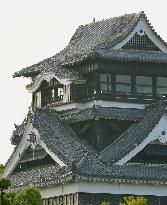
Photo taken April 15, 2016, shows damage to the tiled roof of Kumamoto Castle in the southwestern Japan city of Kumamoto, hit by a magnitude-6.5 quake that registered a maximum 7 on the Japanese seismic scale on April 14. (Kyodo) ==Kyodo

  •  
Big quake topples roof tiles from Kumamoto Castle

Big quake topples roof tiles from Kumamoto Castle

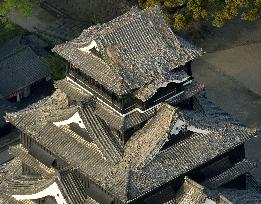
Photo taken April 15, 2016, from a Kyodo News helicopter shows damage to the tiled roof of Kumamoto Castle in the southwestern Japan city of Kumamoto following a powerful earthquake. (Kyodo) ==Kyodo

  •  
Decontamination work in Fukushima

Decontamination work in Fukushima

FUKUSHIMA, Japan - Workers use water to remove radioactive substances, leaked from the crippled Fukushima Daiichi nuclear power plant, from the tiled roof of a house in the Onami district in the city of Fukushima on Oct. 18, 2011. The city, which is situated about 60 kilometers from the nuclear plant, began implementing a major decontamination project the same day. (Kyodo)

  •  
Higashi Honganji Temple

Higashi Honganji Temple

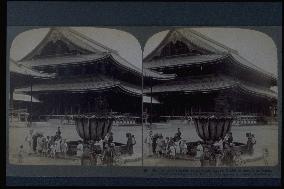
Taishi-do of Higashihonganji Temple is viewed from the southeast. There are many children around the big water fountain. The Taishi-do took 15 years to build. It was completed in 1895 according to the wishes of the head priest, Otani Kosho. Built in single-story irimoya style with a tiled roof, it is 76m wide, 56m deep, 38m high, and covers 3,800 square metres. It is the largest wooden structure in the world.==Date:1904, Place:Kyoto, Photo:Underwood, (Credit:Nagasaki University Library/Kyodo News Images) [Cabinet Number97‐37‐0]

  •  
Five-story pagoda at Hokanji Temple

Five-story pagoda at Hokanji Temple

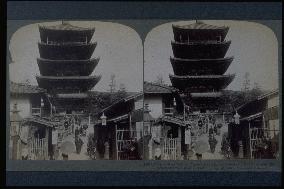
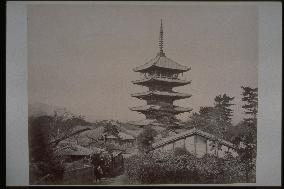
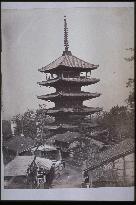
The five-story pagoda of Hokanji Temple is viewed facing east. There are many visitors on the temple approach, and a gas light is visible. The pagoda, also called Yasaka Tower, was built in 1440 by Ashikaga Yoshinori and underwent major repair work in 1618. Featuring a tiled roof, it is 40m tall and 5.5m wide. This may have been taken by the British photographer H. G. Ponting.==Date:1904, Place:Kyoto, Photo:Underwood, (Credit:Nagasaki University Library/Kyodo News Images) [Cabinet Number97‐33‐0]

  •  
Chion-in Temple

Chion-in Temple

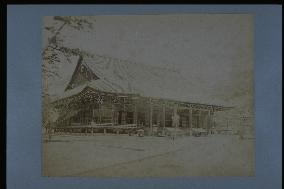
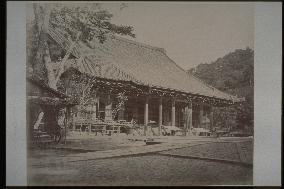
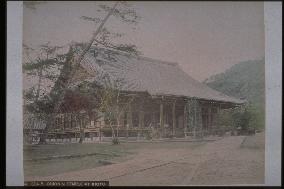
Miei-do at Chion-in Temple is viewed looking northeast. The temple's main hall, Miei-do contains the figure of the founder, Honen. The girder and cross beams are about 20m and 16m in length. The single-story irimoya-style building has a tiled roof. It was reconstructed in 1639.==Date:unknown, Place:Kyoto, Photo:unknown, (Credit:Nagasaki University Library/Kyodo News Images) [Cabinet Number96‐41‐0]

  •  
Miyajima Island,Aki

Miyajima Island,Aki

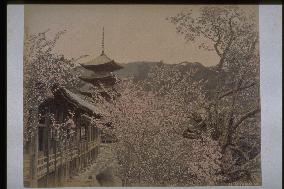
The five-story pagoda is viewed from Toyokuni Shrine (Senjokaku, or One Thousand Mat Hall ) on Tonooka Hill on the east side of Itsukushima Shinto Shrine. Senjokaku Hall was built in 1587 by Toyotomi Hideyoshi for the monthly Buddhist rite of reading of the Senbukyo sutra. The magnificent hall was built in irimoya architectural style with a tiled roof. The cross beams span about 27.27m and the parallel beams about 14.5m.==Date:unknown, Place:Miyajima, Photo:unknown, (Credit:Nagasaki University Library/Kyodo News Images) [Cabinet Number85‐30‐0]

  •  
The curtain gate to the tomb in Bunsho-in,Zojoji Temple,Shiba

The curtain gate to the tomb in Bunsho-in,Zojoji Temple,Shiba

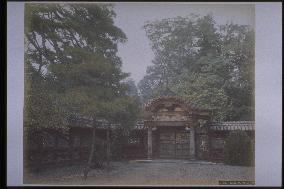
The Shikiri Gate dividing the Hall of Worship and the inner shrine at Bunshoin Mausoleum is seen from the Hall of Worship. This is Mukaikaramon, a four-legged gate with one opening and a copper-tiled roof. A fence stretched to both sides of the gate, connecting the corridors of Karamon Gate to the Hall of Worship. The fence stretches about 140 metres around the main hall and the Hall of Worship.==Date:unknown, Place:Tokyo, Photo:A. Farsari, (Credit:Nagasaki University Library/Kyodo News Images) [Cabinet Number82‐30‐0]

  •  
The naiden (inner sanctuary) of Chion-in Temple

The naiden (inner sanctuary) of Chion-in Temple

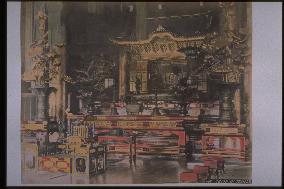
The shumidan and zushi of the Miei-do Hall of Chion-in Temple are viewed from the southwest. The shumidan is done in Zen style, with gild and lacquer, and has a sculpture of a seated Honen (the founder). Miei-do is the main hall of the temple. Its girder and cross beams are about 20m and 16.4m in length. Reconstructed in 1639, it is built in single-story irimoya style with a tiled roof.==Date:unknown, Place:Kyoto, Photo:A. Farsari, (Credit:Nagasaki University Library/Kyodo News Images) [Cabinet Number82‐14‐0]

  •  
Hotta Garden,Mukojima

Hotta Garden,Mukojima

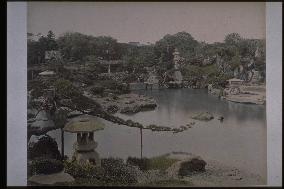
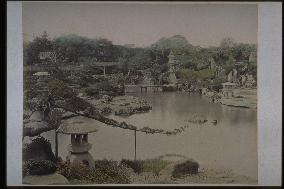
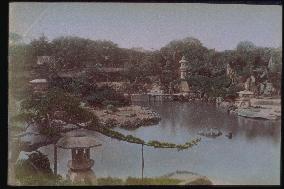
The water level here is higher than in photograph #4442. The landscaped rocks by the shore are underwater and the garden looks different. A banner with the crest of the Hotta family is visible over the wisterias on the far left. The neighbour's tiled roof visible over the foliage in the centre is not apparent in #4442. Thus, this photograph must have been taken somewhat later.==Date:unknown, Place:Tokyo, Photo:unknown, (Credit:Nagasaki University Library/Kyodo News Images) [Cabinet Number80‐26‐0]

  •  
Nagasaki Kiyomizudera Temple

Nagasaki Kiyomizudera Temple

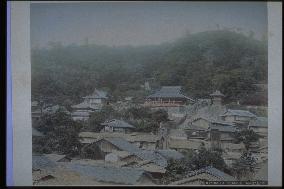
Kiyomizudera seen a short time before photograph #3854 was taken. A temple of the Shingon sect of Buddhism, it was founded by the Buddhist priest Keijun in 1623. There is a bell tower to the right when going up the stairs. The outer shape of the gate is square; the inside features an arch. The main building of the temple is in the centre of the photograph. It is made of wood, has a tiled roof, and is of the one-storied irimoya style. The Taishi-do hall is to the left of the main hall. Below that stands Shotendo which was built in 1822, burned to the ground, and was later rebuilt.==Date:Middle Meiji (1883-1897), Place:Nagasaki, Photo:unknown, (Credit:Nagasaki University Library/Kyodo News Images) [Cabinet Number75‐16‐0]

  •  
An image of Buddha at the top of Sanmon Gate Building,Chion-in Temple

An image of Buddha at the top of Sanmon Gate Building,Chion-in Temple

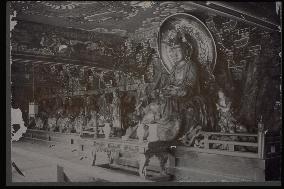
Buddhist statues on the Sanmon Gate of Chion-in Temple. The Buddha is seated in the middle, flanked by Zenzai-doji, Shudatsu-choja, and the 16 Buddhist Saints. Unryu (dragons in clouds) and other motifs are painted on the ceiling. This is the largest gate of its kind in Japan, with five bays and three entrances. Built in two-story irimoya style, it has a tiled roof and was erected in 1619 by the second shogun Tokugawa Ietada.==Date:unknown, Place:Kyoto, Photo:unknown, (Credit:Nagasaki University Library/Kyodo News Images) [Cabinet Number72‐42‐0]

  •  
Higashi Honganji Temple

Higashi Honganji Temple

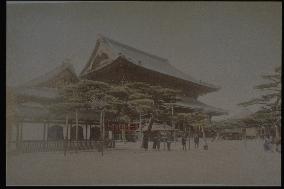
The Taishi-do of Higashihonganji Temple is viewed from the southeast. Men stand under magnificent looking pines in front of the building. The Taishi-do took 15 years to build. It was completed in 1895 according to the wishes of the head priest, Otani Kosho. Built in single-story irimoya style with a tiled roof, it is 76m wide, 56m deep, 38m high, and covers 3,800 square metres. It is the largest wooden structure in the world.==Date:unknown, Place:Kyoto, Photo:unknown, (Credit:Nagasaki University Library/Kyodo News Images) [Cabinet Number69‐61‐0]

  •  
The Sanmon Gate of Chion-in Temple

The Sanmon Gate of Chion-in Temple

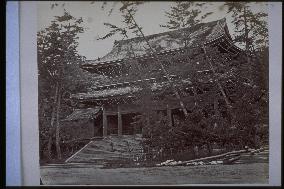
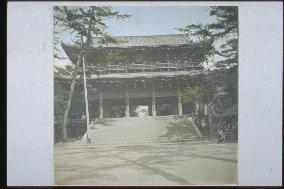
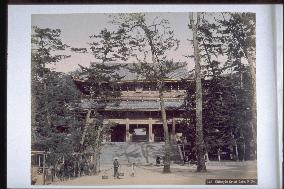
The Sanmon Gate of Chion-in Temple is viewed from the southwest. The tall pine trees south of the gate are slanted due to the wind, and pine logs are scattered about underneath. This is the largest gate of its kind in Japan, with five bays and three entrances. Built in two-story irimoya style, it has a tiled roof and was erected in 1619 by the second shogun Tokugawa Ietada.==Date:unknown, Place:Kyoto, Photo:R. Stillfried, (Credit:Nagasaki University Library/Kyodo News Images) [Cabinet Number63‐17‐0]

  •  
Chion-in Temple

Chion-in Temple

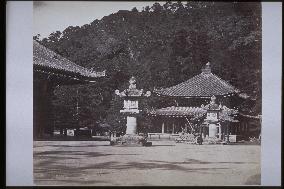
Kyozo (Sutra Library) of Chion-in Temple seen from the south side, facing east. The Kyozo was built in 1615. The building style is two story hokei-zukuri with a tiled roof. There are no walls, doors, or windows. This style is called shuchu-shiki (radiating column). Mt. Kacho rises in the background. The roof of the Goei-do is visible on the left.==Date:unknown, Place:Kyoto, Photo:R. Stillfried, (Credit:Nagasaki University Library/Kyodo News Images) [Cabinet Number63‐16‐0]

  •  
Five-story pagoda at Hokanji Temple

Five-story pagoda at Hokanji Temple

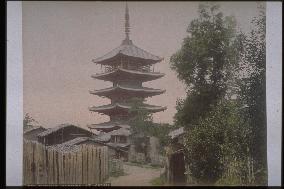
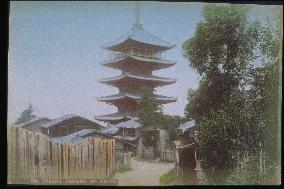
The five-story pagoda of Hokanji Temple is viewed from a path stretching southeast, facing northwest. The pagoda, also called Yasaka Tower, was built in 1440 by Ashikaga Yoshinori and underwent major repair work in 1618. Featuring a tiled roof, it is 40m tall and 5.5m wide. The photograph must have been taken before 1908, when the fence on the fifth story was removed during major repair work. The houses around the pagoda are brothels, and the area is currently called Tatsumi-Shinchi.==Date:unknown, Place:Kyoto, Photo:R. Stillfried, (Credit:Nagasaki University Library/Kyodo News Images) [Cabinet Number63‐13‐0]

  •  
Fushimi Shrine

Fushimi Shrine

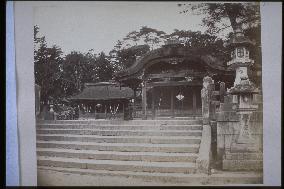
The main hall of Fushimi Inari Shrine is viewed from the bottom of the stairs on the east side of the offertory shrine. A nocturnal stone lantern is visible on the right. The main hall was built in 1494 and repaired by Toyotomi Hideyoshi in 1589. The karahafu-style building in the centre was added in 1694. The shrine is of gokensharyu construction with cedar-tiled roof. The Gonden is visible in the background to the left.==Date:unknown, Place:Kyoto, Photo:R. Stillfried, (Credit:Nagasaki University Library/Kyodo News Images) [Cabinet Number63‐5‐0]

  •  
Five-story pagoda at Hokanji Temple

Five-story pagoda at Hokanji Temple

The five-story pagoda of Hokanji Temple is viewed from a path stretching southeast, facing northwest. The pagoda, also called Yasaka Tower, was built in 1440 by Ashikaga Yoshinori and underwent major repair work in 1618. Featuring a tiled roof, it is 40m tall and 5.5m wide. The photograph must have been taken before 1908, when the fence on the fifth story was removed during major repair work. The houses around the pagoda are brothels, and the area is currently called Tatsumi-Shinchi. Taken by F. Beato.==Date:unknown, Place:Kyoto, Photo:F. Beato, (Credit:Nagasaki University Library/Kyodo News Images) [Cabinet Number62‐14‐0]

  •  
Chion-in Temple

Chion-in Temple

Miei-do at Chion-in Temple is viewed looking northeast. The temple's main hall, Miei-do contains the figure of the founder, Honen. The temple's main hall, Miei-do contains the figure of the founder, Honen. The girder and cross beams are about 20m and 16m in length. The single-story irimoya-style building has a tiled roof. It was reconstructed in 1639. Mt. Kacho is visible in the back. Taken by Beato.==Date:unknown, Place:Kyoto, Photo:F. Beato, (Credit:Nagasaki University Library/Kyodo News Images) [Cabinet Number62‐2‐0]

  •  
Hotta Garden,Mukojima

Hotta Garden,Mukojima

The water level here is higher than in photograph #4442. The landscaped rocks by the shore are underwater and the garden looks different. A banner with the crest of the Hotta family is visible over the wisterias on the far left. The neighbour's tiled roof visible over the foliage in the centre is not apparent in #4442. Thus, this photograph must have been taken somewhat later.==Date:unknown, Place:Tokyo, Photo:unknown, (Credit:Nagasaki University Library/Kyodo News Images) [Cabinet Number59‐78‐0]

  •  
Chion-in Temple

Chion-in Temple

Miei-do at Chion-in Temple is viewed looking northeast. The temple's main hall, Miei-do contains the figure of the founder, Honen. The temple's main hall, Miei-do contains the figure of the founder, Honen. The girder and cross beams are about 20m and 16m in length. The single-story irimoya-style building has a tiled roof. It was reconstructed in 1639. Mt. Kacho is visible in the back.==Date:unknown, Place:Kyoto, Photo:unknown, (Credit:Nagasaki University Library/Kyodo News Images) [Cabinet Number52‐2‐0]

  •  
Five-story pagoda at Hokanji Temple

Five-story pagoda at Hokanji Temple

The five-story pagoda of Hokanji Temple is viewed from a path stretching southeast, facing northwest. The pagoda, also called Yasaka Tower, was built in 1440 by Ashikaga Yoshinori and underwent major repair work in 1618. Featuring a tiled roof, it is 40m tall and 5.5m wide. The photograph must have been taken before 1908, when the fence on the fifth story was removed during major repair work. The houses around the pagoda are brothels, and the area is currently called Tatsumi-Shinchi. Taken by Tamamura Kozaburo.==Date:unknown, Place:Kyoto, Photo:unknown, (Credit:Nagasaki University Library/Kyodo News Images) [Cabinet Number52‐1‐0]

  •  
Five-story pagoda at Hokanji Temple

Five-story pagoda at Hokanji Temple

The five-story pagoda of Hokanji Temple is viewed from a path stretching southeast, facing northwest. The pagoda, also called Yasaka Tower, was built in 1440 by Ashikaga Yoshinori and underwent major repair work in 1618. Featuring a tiled roof, it is 40m tall and 5.5m wide. The photograph must have been taken before 1908, when the fence on the fifth story was removed during major repair work. The houses around the pagoda are brothels, and the area is currently called Tatsumi-Shinchi. Taken by Tamamura Kozaburo.==Date:unknown, Place:Kyoto, Photo:Tamamura Kozaburo, (Credit:Nagasaki University Library/Kyodo News Images) [Cabinet Number48‐110‐0]

  •  
Hotta Garden,Mukojima

Hotta Garden,Mukojima

The water level here is higher than in photograph #4442. The landscaped rocks by the shore are underwater and the garden looks different. A banner with the crest of the Hotta family is visible over the wisterias on the far left. The neighbour's tiled roof visible over the foliage in the centre is not apparent in #4442. Thus, this photograph must have been taken somewhat later.==Date:unknown, Place:Tokyo, Photo:Tamamura Kozaburo, (Credit:Nagasaki University Library/Kyodo News Images) [Cabinet Number48‐60‐0]

  •  
Houses by the riverside

Houses by the riverside

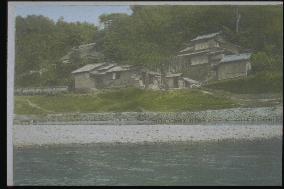
This is a farming village by a river. The water level is low, the flow is gentle, and the sandbank is visible. The stone embankment is built to prevent erosion. Houses with straw roofs and ceramic tiled roofs are built on relatively higher ground as a precaution for flooding and are connected by a small road. The rice crop hung out to dry indicates autumn. This may be an area near the source of the Hozu River in Kameoka. A bamboo grove is visible in the background.==Date:unknown, Place:Kyoto, Photo:unknown, (Credit:Nagasaki University Library/Kyodo News Images) [Cabinet Number46‐96‐0]

  •  
The Sanmon Gate of Chion-in Temple

The Sanmon Gate of Chion-in Temple

The Sanmon Gate of Chion-in is viewed from the west. The board south of the gate says Religious Lecture. A rickshaw with a passenger is visible. This is the largest gate of its kind in Japan, with five bays and three entrances. Built in two-story irimoya style, it has a tiled roof and was erected in 1619 by the second shogun Tokugawa Ietada. The word Kachozan on the tablet at the front of the gate is said to be the calligraphy of Emperor Reigen (1654-1732).==Date:unknown, Place:Kyoto, Photo:unknown, (Credit:Nagasaki University Library/Kyodo News Images) [Cabinet Number46‐89‐0]

  •  
Chion-in Temple

Chion-in Temple

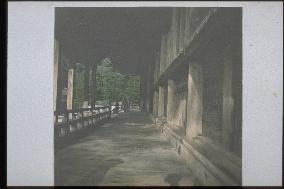
The north corridor of Miei-do at Chion-in Temple is seen from the east. The temple's main hall, Miei-do contains the figure of the founder, Honen. The girder and cross beams are about 20m and 16m in length. The single-story irimoya-style building has a tiled roof. It was reconstructed in 1639.==Date:unknown, Place:Kyoto, Photo:unknown, (Credit:Nagasaki University Library/Kyodo News Images) [Cabinet Number46‐90‐0]

  •  
The Sanmon Gate of Chion-in Temple

The Sanmon Gate of Chion-in Temple

The western side of Chion-in Temple Sanmon Gate is seen looking east. There are three rickshaws parked in front, a vendor, and a child. This is the largest gate of its kind in Japan, with five bays and three entrances. Built in two-story irimoya style, it has a tiled roof and was erected in 1619 by the second shogun Tokugawa Ietada. The word Kachozan on the tablet at the front of the gate is said to be the calligraphy of Emperor Reigen (1654-1732).==Date:unknown, Place:Kyoto, Photo:unknown, (Credit:Nagasaki University Library/Kyodo News Images) [Cabinet Number42‐22‐0]

  •  
Bell tower of todaiji temple

Bell tower of todaiji temple

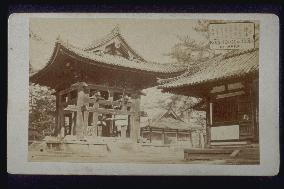
The location is the east side of the Daibutsu hall. The present building was built through donations collected by Todaiji Temple and rebuilt by Eisai during the Shogen years (1207-11). The style is a mixture of Indian and Chinese styles, in Irimoya style with tiled roofs.==Date:unknown, Place:Nara, Photo:unknown, (Credit:Nagasaki University Library/Kyodo News Images) [Cabinet Number30‐2‐0]

  • Main
  • Top
  • Editorial
  • Creative
  • About Us
  • About ILG
  • Terms of use
  • Company
  • BEHIND
  • Price List
  • Single Plan
  • Monthly Plan
  • Services
  • Shooting
  • Rights Clearance
  • Support
  • FAQ
  • How To Buy
  • Contact Us
  • Become a Partner

© KYODO NEWS IMAGES INC

All Rights Reserved.

  • Editorial
  • Olympics
  • News
  • Sports
  • Japan
  • Tech
  • Royal
  • Disaster
  • NorthKorea
  • Old Japan
  • SNS
  • Creative
  • Food
  • Japan
  • Landscape
  • Animal
  • Popular
  • #Ukraine
  • #Thailand
  • #coronavirus
  • #N. Korea
  • #China
  • #Russia
  • #Ukraine
  • #Thailand
  • #coronavirus
  • #N. Korea
  • #China
  • #Russia
  • Food
  • Japan
  • Landscape
  • Animal
  • Olympics
  • News
  • Sports
  • Japan
  • Tech
  • Royal
  • Disaster
  • NorthKorea
  • Old Japan
  • SNS