•  
Hokusai exhibition in France

Hokusai exhibition in France

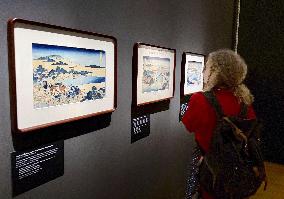
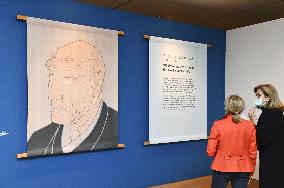
A woman looks at works of Japanese ukiyo-e artist Katsushika Hokusai (1760-1849) during a preview on June 27, 2025, of an exhibition at the History Museum in Nantes, France. The event from the following day through Sept. 7 will display over 160 works Hokusai created in Obuse, a Nagano Prefecture town where he lived toward the end of his life.

  •  
Hokusai exhibition in France

Hokusai exhibition in France

A woman looks at works of Japanese ukiyo-e artist Katsushika Hokusai (1760-1849) during a preview on June 27, 2025, of an exhibition at the History Museum in Nantes, France. The event from the following day through Sept. 7 will display over 160 works Hokusai created in Obuse, a Nagano Prefecture town where he lived toward the end of his life.

  •  
Hokusai exhibition in France

Hokusai exhibition in France

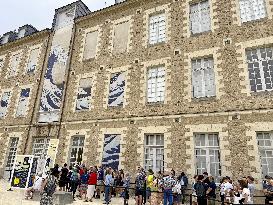
People form a line at the History Museum in Nantes, France, on June 28, 2025 as an exhibition of Japanese ukiyo-e artist Katsushika Hokusai (1760-1849) kicks off. On display during the event through Sept. 7 are over 160 works Hokusai created in Obuse, a Nagano Prefecture town where he lived toward the end of his life.

  •  
LITHUANIA-VILNIUS-EXHIBITION-JAPAN-ART-POP CULTURE TRADITION

LITHUANIA-VILNIUS-EXHIBITION-JAPAN-ART-POP CULTURE TRADITION

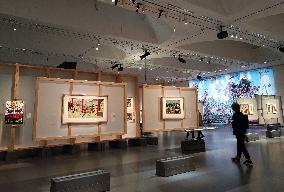
(240724) -- VILNIUS, July 24, 2024 Photo by Xinhua/ABACAPRESS.COM) -- A visitor walks past artworks during an exhibition on the Japanese pop culture tradition at National Gallery of Art in Vilnius, Lithuania, on July 24, 2024. Titled Beauties, Ghosts, and Samurai--The Japanese Pop Culture Tradition from Edo Ukiyo-e to Manga, Anime, and Supa Furatto in the 20th and 21st Centuries, the exhibition is held here from July 19 to Oct. 13, presenting works of more than 70 artists. (Photo by Yang Weihua/Xinhua/ABACAPRESS.COM

  •  
LITHUANIA-VILNIUS-EXHIBITION-JAPAN-ART-POP CULTURE TRADITION

LITHUANIA-VILNIUS-EXHIBITION-JAPAN-ART-POP CULTURE TRADITION

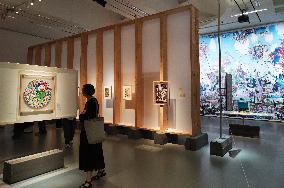
(240724) -- VILNIUS, July 24, 2024 Photo by Xinhua/ABACAPRESS.COM) -- A visitor views an artwork during an exhibition on the Japanese pop culture tradition at National Gallery of Art in Vilnius, Lithuania, on July 24, 2024. Titled Beauties, Ghosts, and Samurai--The Japanese Pop Culture Tradition from Edo Ukiyo-e to Manga, Anime, and Supa Furatto in the 20th and 21st Centuries, the exhibition is held here from July 19 to Oct. 13, presenting works of more than 70 artists. (Photo by Yang Weihua/Xinhua/ABACAPRESS.COM

  •  
Japan's new banknotes

Japan's new banknotes

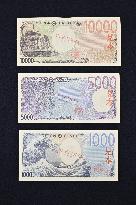
Photo taken at the Bank of Japan headquarters in Tokyo shows the reverse side of Japan's new banknotes, which will be released in 2024, with the 1,000 yen bill (bottom) featuring ukiyo-e master Katsushika Hokusai's "The Great Wave off Kanagawa.

  •  
"Ukiyo-e" artist Utamaro's newly found work to be shown

"Ukiyo-e" artist Utamaro's newly found work to be shown

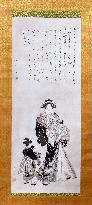
FUKUOKA, July 27 Kyodo - Popular "Ukiyo-e" artist Kitagawa Utamaro's painting of a courtesan drawn solely with black ink in the late 18th century with Utamaro's friend and writer Santo Kyoden's writing on the lives of courtesans is seen in Fukuoka, southwestern Japan, on July 22, 2015. The painting, discovered in April, will be exhibited at the Fukuoka Art Museum from Aug. 8.

  •  
Huge signboard of Hokusai exhibition stands in Paris

Huge signboard of Hokusai exhibition stands in Paris

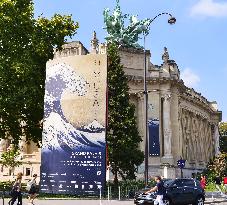
PARIS, France - A huge signboard stands in front of the Grand Palais museum in Paris on Sept. 25, 2014, to promote an exhibition featuring famed Japanese "ukiyo-e" artist Katsushika Hokusai. The exhibition, opening on Oct. 1, will display more than 700 works by the Japanese artist of the Edo period (1603-1867) under the Tokugawa shogunate.

  •  
Light event marks 150th anniv. of Japan-Switzerland ties

Light event marks 150th anniv. of Japan-Switzerland ties

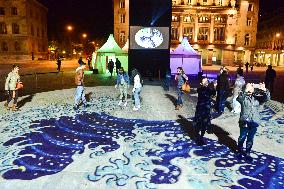
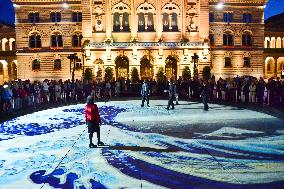
BERN, Switzerland - Tourists walk in a plaza in the Swiss capital Bern on Sept. 28, 2014, where an image of "The Great Wave off Kanagawa" ukiyo-e woodblock print is reflected on the ground at a lighting event to celebrate the 150th anniversary of the establishment of diplomatic ties between Switzerland and Japan.

  •  
Image of 'Great Wave' reflected on Swiss capital's ground

Image of 'Great Wave' reflected on Swiss capital's ground

BERN, Switzerland - An image of "The Great Wave off Kanagawa" ukiyo-e woodblock print is reflected on the ground in a plaza in the Swiss capital Bern on Sept. 28, 2014, at a lighting event to commemorate the 150th anniversary of the establishment of diplomatic ties between Switzerland and Japan.

  •  
Modern ukiyo-e artist refreshes old masters' pictures

Modern ukiyo-e artist refreshes old masters' pictures

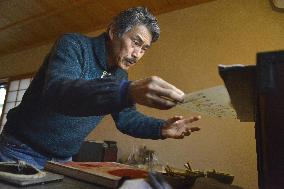
KYOTO, Japan - Photo taken March 13, 2014 shows ukiyo-e artist Inuki Tachihara working at his home studio in Kyoto. (Photo by Tatsuya Hagiwara)

  •  
Modern ukiyo-e artist refreshes old masters' works

Modern ukiyo-e artist refreshes old masters' works

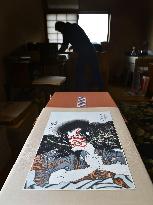
KYOTO, Japan - Photo taken March 14, 2014 in Kyoto shows one of ukiyo-e artist Inuki Tachihara's reproductions of the seven-part series "Oatari Kyogen" (Smash Hit Farces) by Utagawa Kunisada (1786-1865). Titled "Kan Shojo" -- the nickname of Sugawara no Michizane (845-903), the work uses a bright shade of red to represent anger. (Photo by Tatsuya Hagiwara)

  •  
Fashion show on kimono arrangements

Fashion show on kimono arrangements

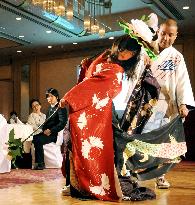
KYOTO, Japan - A model wears a kimono with Ukiyo-e print design during a fashion show in Kyoto, western Japan, on July 31, 2011.

  •  
(2)Japan Week celebrated at Aichi Expo

(2)Japan Week celebrated at Aichi Expo

NAGAKUTE, Japan - Shamisen (three-stringed banjo) players give a performance with a Katsushika Hokusai ukiyo-e in the background as part of events to mark Japan Week at the 2005 World Exposition in Aichi Prefecture on June 7.

  •  
Hokusai exhibition of publicly unseen sketches to open in London

Hokusai exhibition of publicly unseen sketches to open in London

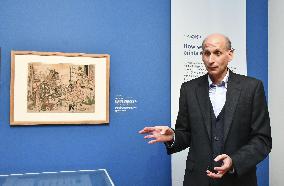
Curator Alfred Haft explains works by Japanese ukiyo-e artist Katsushika Hokusai at London's British Museum on Sept. 28, 2021. An exhibition of 103 publicly unseen sketches by Hokusai was unveiled to the media the same day ahead of its opening on Sept. 30.

  •  
Hokusai exhibition of publicly unseen sketches to open in London

Hokusai exhibition of publicly unseen sketches to open in London

An exhibition of 103 publicly unseen sketches by Japanese ukiyo-e artist Katsushika Hokusai at London's British Museum is shown to the media on Sept. 28, 2021, ahead of its opening on Sept. 30.

  •  

Post offices become popular shopping spots for Olympians, reporters

Temporary post offices opened in the Tokyo Olympic athletes' village and the main press center have become valuable souvenir shopping spots for foreign athletes and news reporters whose activities are restricted amid the coronavirus pandemic. Among popular souvenirs at the post office in the main press center are postcards with images of ukiyo-e works as well as a book containing Olympic and Paralympic Games stamps, with some purchasing more than 10 books priced at 10,000 yen ($91) each.

  •  
Hiroshige - 53 Stations of the Tokaido - Print 32

Hiroshige - 53 Stations of the Tokaido - Print 32

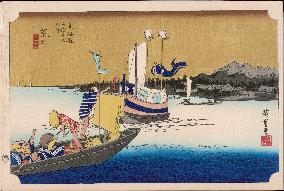
32 Arai - A large ferry boat, with an awning round it, taking a daimyo across from Maisaka, followed by a smaller boat with his retainers. A high range of hills on the further shore; golden sky. Travellers made the journey from Maisaka to Arai Station by ferryboat. On the shore was a government barrier station for the inspection of travellers. The compound remains largely intact even today. Utagawa Hiroshige (1797 - 1858). The Fifty-Three Stations of the Tokaido - Hoeido edition (1831-4) Date: 1831 - 1834

  •  
Hiroshige - 53 Stations of the Tokaido - Print 55

Hiroshige - 53 Stations of the Tokaido - Print 55

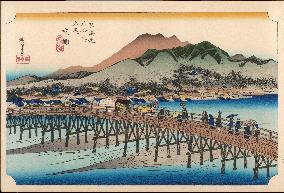
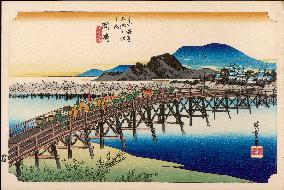
55 Kyoto - In the foreground the "long" bridge over the Kamo River, and people crossing over, with the town beyond, behind which rise hills overlooking it, the most distant printed from graded colourblock only. While decending to Kyoto, travellers could enjoy a panoramic view of the elegant imperial capital from the mountain pass and undoubtedly felt joy and relief at seeing the final destination of their journey from Edo. In those days it was the wish of every Japanese to see Kyoto once in his life.Utagawa Hiroshige (1797 - 1858). The Fifty-Three Stations of the Tokaido - Hoeido edition (1831-4) Date: 1831 - 1834

  •  
Hiroshige - 53 Stations of the Tokaido - Print 54

Hiroshige - 53 Stations of the Tokaido - Print 54

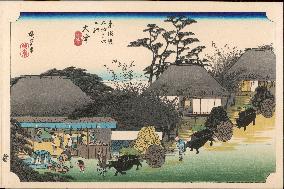
54 Otsu - Three bullock-carts passing down the main street of the village, and an open tea-house on the left. This station located on the south-western shore of Lake Biwa was the last station on the Tokaido Highway. Being close to Kyoto, there were many popularly known shrines and temples in its vicinity. Utagawa Hiroshige (1797 - 1858). The Fifty-Three Stations of the Tokaido - Hoeido edition (1831-4) Date: 1831 - 1834

  •  
Hiroshige - 53 Stations of the Tokaido - Print 31

Hiroshige - 53 Stations of the Tokaido - Print 31

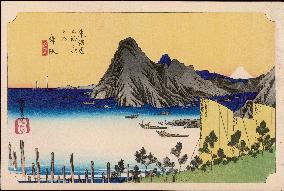
31 Maisaka - View of Imaki Point jutting out into the sea, and a white Fuji (without outline) in the distance. This station was a fishing port lying on the south-eastern edge of Lake Hamana. The Lake Hamana and the Pacific Ocean meet at this point and travellers had to cross this mouth of the lake by boats. Utagawa Hiroshige (1797 - 1858). The Fifty-Three Stations of the Tokaido - Hoeido edition (1831-4) Date: 1831 - 1834

  •  
Hiroshige - 53 Stations of the Tokaido - Print 53

Hiroshige - 53 Stations of the Tokaido - Print 53

53 Kusatsu - View of a rest-house on for coolies, and horses on the road; coolies passing in foreground with a kago and a covered palanquin. The Nakasendo, another large highway which ran through the mountainous region between Edo and Kyoto joined the Tokaido at this station to form a single highway for the remainder of the highway to Kyoto. Utagawa Hiroshige (1797 - 1858). The Fifty-Three Stations of the Tokaido - Hoeido edition (1831-4) Date: 1831 - 1834

  •  
Hiroshige - 53 Stations of the Tokaido - Title Page

Hiroshige - 53 Stations of the Tokaido - Title Page

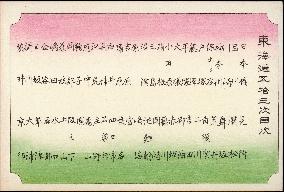
The Title Page with Japanese Script - Utagawa Hiroshige (1797 - 1858). The Fifty-Three Stations of the Tokaido - Hoeido edition (1831-4) Date: 1831 - 1834

  •  
Hiroshige - 53 Stations of the Tokaido - Print 51

Hiroshige - 53 Stations of the Tokaido - Print 51

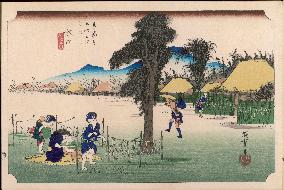
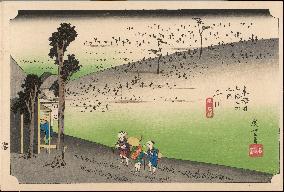
51 Minakuchi - A solitary traveller walking through the village, where women are peeling and drying gourds; in the backgound a range of hills, printed in colour-block only. This station located in a desolate rural area was famous for its production of dried gourd shavings for use on Japanese dishes. Women are busy making them: one is shaving a gourd, one is helping the shavers, and one is drying the shaved gourd on a rope. Utagawa Hiroshige (1797 - 1858). The Fifty-Three Stations of the Tokaido - Hoeido edition (1831-4) Date: 1831 - 1834

  •  
Hiroshige - 53 Stations of the Tokaido - Print 48

Hiroshige - 53 Stations of the Tokaido - Print 48

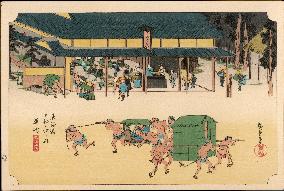
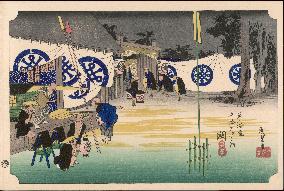
48 Seki - View outside a resthouse in the early morning, where a daimyo is stopping, the retainers preparing, by the aid of lanterns, to proceed on the journey. Each station was required to maintain lodging houses for travellers. The inn shown is one for upper class travellers such as Shogunate officials and feudal lords. Retinue are making preparations for a feudal lord to leave from the lodging house. Utagawa Hiroshige (1797 - 1858). The Fifty-Three Stations of the Tokaido - Hoeido edition (1831-4) Date: 1831 - 1834

  •  
Hiroshige - 53 Stations of the Tokaido - Print 49

Hiroshige - 53 Stations of the Tokaido - Print 49

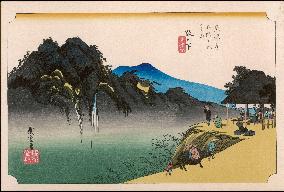
49 Saka-no-shita - Travellers resting at an open teahouse, looking across a ravine to the rocky heights opposite; blue hills beyond, in colour blocks only. In olden times, the beauty of the rugged mountain ranges in this area attracted many visitors from Kyoto. Travellers enjoyed the spectacular view of the mountain from a teahouse located on the mountain pass. Utagawa Hiroshige (1797 - 1858). The Fifty-Three Stations of the Tokaido - Hoeido edition (1831-4) Date: 1831 - 1834

  •  
Hiroshige - 53 Stations of the Tokaido - Print 42

Hiroshige - 53 Stations of the Tokaido - Print 42

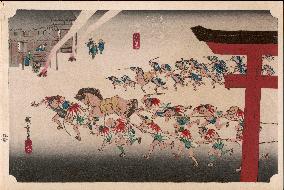
42 Miya - Two gangs of men and horse dragging a festival car (not shown) past the entrance to Miya Temple on a f괥 day. The name Miya literally means "shrine", and is a shortened word denoting the Atsuta Shrine. It is one of the most important shrines in the country because it holds one of the three divine symbols of the Japanese imperial throne. Now Nagoya City has grown around the shrine to become the third largest metropolis in Japan. Utagawa Hiroshige (1797 - 1858). The Fifty-Three Stations of the Tokaido - Hoeido edition (1831-4) Date: 1831 - 1834

  •  
Hiroshige - 53 Stations of the Tokaido - Print 44

Hiroshige - 53 Stations of the Tokaido - Print 44

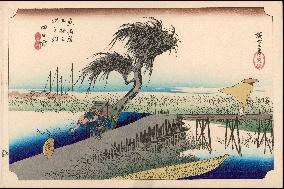
44 Yokkaichi - The hurricane. A man racing after his hat, bowled along by the wind, and another crossing a small bridge over a stream, his coat blown about him. Yokkaichi Station was not only a port, but also a thriving market town. The name Yokkaichi literally means 'fourth day market' and is derived from the traditional market held on the fourth day of each month at this town.Travellers had to cross a series of tiny bridge built over the small rivers flowing through low level land along the seashore. Utagawa Hiroshige (1797 - 1858). The Fifty-Three Stations of the Tokaido - Hoeido edition (1831-4) Date: 1831 - 1834

  •  
Hiroshige - 53 Stations of the Tokaido - Print 45

Hiroshige - 53 Stations of the Tokaido - Print 45

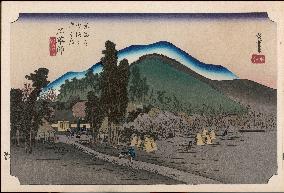
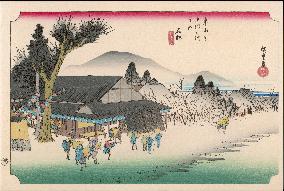
45 Ishiyakushi - A temple in a grove of trees on the left and the village on the right; behind, a high range of hills, printed from colour blocks. This station developed around an old temple located in peaceful and quiet country surroundings. In the temple, Ishiyakushi, a stone image of Buddha Yakushi was enshrined and it was frequented by many worshippers. Utagawa Hiroshige (1797 - 1858). The Fifty-Three Stations of the Tokaido - Hoeido edition (1831-4) Date: 1831 - 1834

  •  
Hiroshige - 53 Stations of the Tokaido - Print 41

Hiroshige - 53 Stations of the Tokaido - Print 41

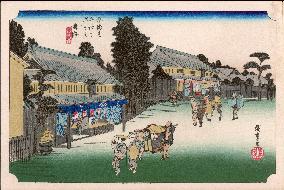
41 Narumi - A woman carried in a kago and two others walking in front, followed by a man on horseback and two attendants, passing two large open shops in the main street, where dyed cloths are sold. On the fascia over the front of the nearer shop is the monogram Hiro in the centre, and that of the publisher, Take-no-Uchi, each side of it. This station and the nearby town of Arimatsu are both famous for the production of tie-dyed fabrics which were suitable for making yukata, the kimono worn in summer and after a bath. Utagawa Hiroshige (1797 - 1858). The Fifty-Three Stations of the Tokaido - Hoeido edition (1831-4) Date: 1831 - 1834

  •  
Hiroshige - 53 Stations of the Tokaido - Print 52

Hiroshige - 53 Stations of the Tokaido - Print 52

52 Ishibe - View of a tea-house on left, under a large tree, and travellers watching a man dancing; hills in background from graded colour-block, the lower part in mist. This station was one of the most desolate stations on the highway. The road-side restaurant offered travellers rice wine, rice boiled with leafy vegetables, and baked bean-curd coated with bean paste. Utagawa Hiroshige (1797 - 1858). The Fifty-Three Stations of the Tokaido - Hoeido edition (1831-4) Date: 1831 - 1834

  •  
Hiroshige - 53 Stations of the Tokaido - Print 47

Hiroshige - 53 Stations of the Tokaido - Print 47

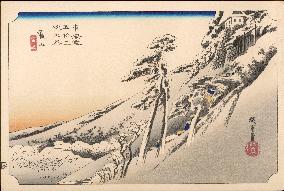
47 Kameyama - Travellers ascending a steep hillside, under deep snow, to the entrance to the castle of Kameyama. This station developed around a castle town. The keep and gate of Kameyama Castle on a hill towers over the village. And a procession of a feudal lord is ascending the hill. Utagawa Hiroshige (1797 - 1858). The Fifty-Three Stations of the Tokaido - Hoeido edition (1831-4) Date: 1831 - 1834

  •  
Hiroshige - 53 Stations of the Tokaido - Print 46

Hiroshige - 53 Stations of the Tokaido - Print 46

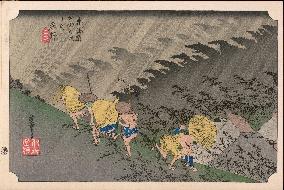
46 Shono - Rainstorm in the mountains; coolies carrying a kago, with a straw coat thrown over it, up the hill, and two others, one with an umbrella, rushing down. This plate depicts a group of travellers caught in a sudden summer thunderstorm and hurrying towards shelter. Utagawa Hiroshige (1797 - 1858). The Fifty-Three Stations of the Tokaido - Hoeido edition (1831-4) Date: 1831 - 1834

  •  
Hiroshige - 53 Stations of the Tokaido - Print 43

Hiroshige - 53 Stations of the Tokaido - Print 43

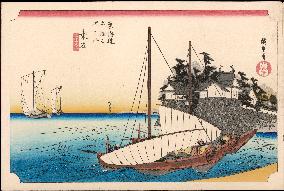
43 Kuwana - Two large junks moored at the mouth of the Kiso River, and others sailing away to sea. To avoid crossing the numerous rivers flowing inland between Miya and Kuwana, travellers made their journey by boat. The boat trip was reputed to have been enjoyable. Utagawa Hiroshige (1797 - 1858). The Fifty-Three Stations of the Tokaido - Hoeido edition (1831-4) Date: 1831 - 1834

  •  
Hiroshige - 53 Stations of the Tokaido - Print 38

Hiroshige - 53 Stations of the Tokaido - Print 38

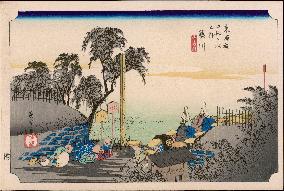
38 Fujikawa - The head of a daimyo's procession at the entrance to a village, and three peasants making obeisance as it passes. The most frequent user of the highway was the feudal lord with his retinue. Commoners who came across the procession had to kneel down on the ground to pay their respects and stay there until the procession had passed. Utagawa Hiroshige (1797 - 1858). The Fifty-Three Stations of the Tokaido - Hoeido edition (1831-4) Date: 1831 - 1834

  •  
Hiroshige - 53 Stations of the Tokaido - Print 35

Hiroshige - 53 Stations of the Tokaido - Print 35

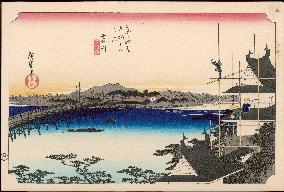
35 Yoshida - Bridge over the Toyo River, and in the right foreground workmen repairing the castle. This station flourished following the erection of the castle in 1505. Here a bridge was allowed to be built over the river flowing west of the station. The town has now grown to become Toyohashi City. Utagawa Hiroshige (1797 - 1858). The Fifty-Three Stations of the Tokaido - Hoeido edition (1831-4) Date: 1831 - 1834

  •  
Hiroshige - 53 Stations of the Tokaido - Print 30

Hiroshige - 53 Stations of the Tokaido - Print 30

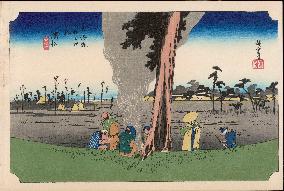
30 Hamamatsu - A party of coolies warming themselves by a bonfire beside a large tree, a traveller, with a pipe in hand, looking on, and a peasant woman carrying a child on her back, approaching from the right. Bare, flat rice-fields, across which stand the castle and village in the background. This plate depicts a wintry rural scene on the outskirts of Hamamatsu Station. The village and Hamamatsu Castle are visible in the distance. Hiroshige always depicted travellers and local people appropriate to the landscape and setting. Utagawa Hiroshige (1797 - 1858). The Fifty-Three Stations of the Tokaido - Hoeido edition (1831-4) Date: 1831 - 1834

  •  
Hiroshige - 53 Stations of the Tokaido - Print 39

Hiroshige - 53 Stations of the Tokaido - Print 39

39 Okazaki - A daimyo's cort觥 crossing the bridge over the Yahagi River towards the village and castle on the further bank; in the background a blue hill, printed from colour blocks only. Tokugawa Ieyasu, the founder of the Tokugawa Shogunate, was born in the castle shown in the prints. The bridge over the Yahagi River, flowing west of the castle, was the largest on the entire highway. Utagawa Hiroshige (1797 - 1858). The Fifty-Three Stations of the Tokaido - Hoeido edition (1831-4) Date: 1831 - 1834

  •  
Hiroshige - 53 Stations of the Tokaido - Print 36

Hiroshige - 53 Stations of the Tokaido - Print 36

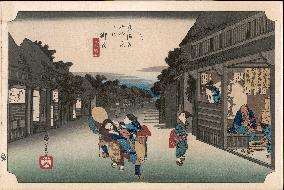
36 Goyu - Main street of the village at nightfall and female touts dragging travellers into the teahouse on the right, where one is already resting. The large circle on the wall bears the sign of the publisher of the series, Take-no-Uchi. On the signboard inside are given the names of the engraver, Jirobei; the printer, Heibei; and the artist, Ichiryusai. This station was lined with many inns and restaurants. The waitresses were renowned for their persistence in trying to entice customers into their shops. Utagawa Hiroshige (1797 - 1858). The Fifty-Three Stations of the Tokaido - Hoeido edition (1831-4) Date: 1831 - 1834

  •  
Hiroshige - 53 Stations of the Tokaido - Print 14

Hiroshige - 53 Stations of the Tokaido - Print 14

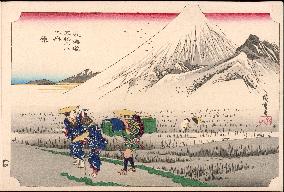
14 Hara - Two women wayfarers, and a coolie carrying their boxes, passing along by rice fields, overlooked by the huge snowy mass of Fuji. The neighbourhood of Hara is considered the best vantage point for magnificent views of Mount Fuji. In the Edo Period, travelling on the highway was considered very dangerous and woman travellers were usually accompanied by their manservant. Utagawa Hiroshige (1797 - 1858). The Fifty-Three Stations of the Tokaido - Hoeido edition (1831-4) Date: 1831 - 1834

  •  
Hiroshige - 53 Stations of the Tokaido - Print 40

Hiroshige - 53 Stations of the Tokaido - Print 40

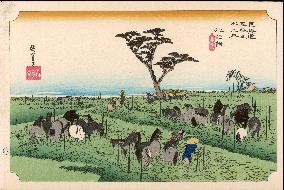
40 Chiryu - A number of horses tethered near a tree in the fields, where a fair is held in the summer. This area was noted for Japanese iris(kakitsubata). A famous poet who once passed by this vicinity adorned with irises composed a poem expressing the loneliness of his long journey from Kyoto where his wife remained. Utagawa Hiroshige (1797 - 1858). The Fifty-Three Stations of the Tokaido - Hoeido edition (1831-4) Date: 1831 - 1834

  •  
Hiroshige - 53 Stations of the Tokaido - Print 37

Hiroshige - 53 Stations of the Tokaido - Print 37

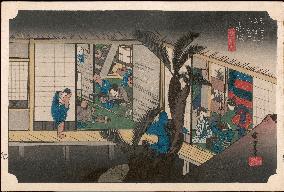
37 Akasaka - The courtyard of a resthouse, in the centre of which a sago-palm is growing; on the left, guests being served with refreshments, and on the right, geisha dressing up for their performance. Most male travellers enjoyed staying at this station for here in the entertainment quarters they could find the friendliest hostesses of the entire trip. Dinners are being served by a waitress and geisha girls are doing their faces for the evening. Utagawa Hiroshige (1797 - 1858). The Fifty-Three Stations of the Tokaido - Hoeido edition (1831-4) Date: 1831 - 1834

  •  
Hiroshige - 53 Stations of the Tokaido - Print 33

Hiroshige - 53 Stations of the Tokaido - Print 33

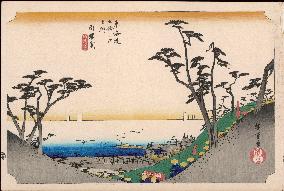
33 Shirasuka - View out to sea through a dip in the hill, at the foot of which a daimyo's procession is passing; clumps of trees to right and left. The view of the seascape from Shiomizaka Slope near this station was one of the most picturesque of all the fifty-three stations, with the blue Pacific Ocean framed by outreaching branches of pine trees. A long procession of a feudal lord descends the hill towards Shirasuka Station.Utagawa Hiroshige (1797 - 1858). The Fifty-Three Stations of the Tokaido - Hoeido edition (1831-4) Date: 1831 - 1834

  •  
Hiroshige - 53 Stations of the Tokaido - Print 8

Hiroshige - 53 Stations of the Tokaido - Print 8

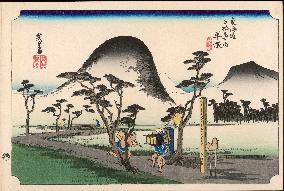
8 Hiratsuka - A zigzag road, lined with a few trees, traversing fields, and a courier running along and passing two other travellers. In the background a dark, round-topped hill, behind which a white Fuji appears in the distance. Here, the Tokaido Highway runs along a low causeway by the ocean. The man running is one of the professional couriers who worked in relays and covered the distance of 489 km between Edo and Kyoto in about 90 hours. Utagawa Hiroshige (1797 - 1858). The Fifty-Three Stations of the Tokaido - Hoeido edition (1831-4) Date: 1831 - 1834

  •  
Hiroshige - 53 Stations of the Tokaido - Print 11

Hiroshige - 53 Stations of the Tokaido - Print 11

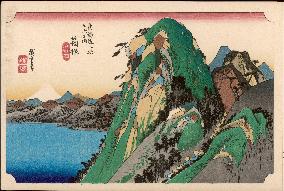
11 Hakone - A high peak, round the base of which, through a gorge, a daimyo's cort觥 is wending it's way; on the left the Hakone Lake, with Fuji in the distance. The Hakone pass was the most arduous stretch of the entire Tokaido Highway. It was steep and difficult to climb, and harboured many roaming bandits. However, the pass abounded in scenic spots and hot spring resorts and continues to attact many visitors.Utagawa Hiroshige (1797 - 1858). The Fifty-Three Stations of the Tokaido - Hoeido edition (1831-4) Date: 1831 - 1834

  •  
Hiroshige - 53 Stations of the Tokaido - Print 15

Hiroshige - 53 Stations of the Tokaido - Print 15

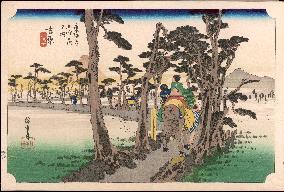
15 Yoshiwara - A road lined with trees running through ricefields, along which a man leads a horse carrying three women; Fuji in the distance. This section of highway was lined with pine trees for the comfort of travellers. Through the trees, Mount Fuji was seen on the left-hand side of the highway and was popularly called "left Fuji". Utagawa Hiroshige (1797 - 1858). The Fifty-Three Stations of the Tokaido - Hoeido edition (1831-4) Date: 1831 - 1834

  •  
Hiroshige - 53 Stations of the Tokaido - Print 29

Hiroshige - 53 Stations of the Tokaido - Print 29

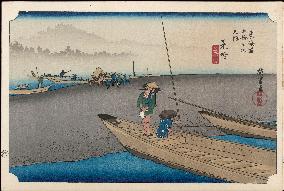
29 Mitsuke - A large sand-bank in the centre of the "Heaven-dragon" River, and people crossing the further arm in boats; two other boats in foreground, moored to the sand-bank, and the distant shore enveloped in mist. The name of this station was derived from the fact that people travelling from Kyoto to Edo were able to get their first glimpse of Mount Fuji from here. The rapidly flowing river "Tenryu" flowed west of the station and travellers had to cross the river by ferryboat. Utagawa Hiroshige (1797 - 1858). The Fifty-Three Stations of the Tokaido - Hoeido edition (1831-4) Date: 1831 - 1834

  •  
Hiroshige - 53 Stations of the Tokaido - Print 13

Hiroshige - 53 Stations of the Tokaido - Print 13

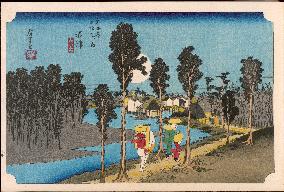
13 Namazu - Travellers walking along the river bank, lined with trees, towards the village ahead, under a huge full moon in a deep blue sky, one of them carrying on his back a large Tengu mask, the mark of a pilgrim to the Shinto shrine of Kompira on Shikoku Island. Dark forest of trees on further shore of river. Utagawa Hiroshige (1797 - 1858). The Fifty-Three Stations of the Tokaido - Hoeido edition (1831-4) Date: 1831 - 1834

  •  
Hiroshige - 53 Stations of the Tokaido - Print 12

Hiroshige - 53 Stations of the Tokaido - Print 12

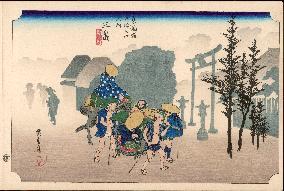
12 Mishima - Travellers setting forth in the mists of early morning, one on horseback and the other in a kago. Situated at the entrance to Hakone pass, this station was packed with travellers all through the year. Utagawa Hiroshige (1797 - 1858). The Fifty-Three Stations of the Tokaido - Hoeido edition (1831-4) Date: 1831 - 1834

  •  
Hiroshige - 53 Stations of the Tokaido - Print 34

Hiroshige - 53 Stations of the Tokaido - Print 34

34 Futagawa - A low hill, covered with small cider trees; on the left at teahouse, at which a traveller is taking refreshment, and three others approaching it. Because of the poor soil in this barren district,only small pine trees and shrubs were able to grow. What relieved travellers from an otherwise monotonous walk was a teahouse which sold refreshments and sweet rice cakes. Utagawa Hiroshige (1797 - 1858). The Fifty-Three Stations of the Tokaido - Hoeido edition (1831-4) Date: 1831 - 1834

  • Main
  • Top
  • Editorial
  • Creative
  • About Us
  • About ILG
  • Terms of use
  • Company
  • BEHIND
  • Price List
  • Single Plan
  • Monthly Plan
  • Services
  • Shooting
  • Rights Clearance
  • Support
  • FAQ
  • How To Buy
  • Contact Us
  • Become a Partner

© KYODO NEWS IMAGES INC

All Rights Reserved.

  • Editorial
  • Olympics
  • News
  • Sports
  • Japan
  • Tech
  • Royal
  • Disaster
  • NorthKorea
  • Old Japan
  • SNS
  • Creative
  • Food
  • Japan
  • Landscape
  • Animal
  • Popular
  • #Ukraine
  • #China
  • #coronavirus
  • #N. Korea
  • #Thailand
  • #Russia
  • #Ukraine
  • #China
  • #coronavirus
  • #N. Korea
  • #Thailand
  • #Russia
  • Food
  • Japan
  • Landscape
  • Animal
  • Olympics
  • News
  • Sports
  • Japan
  • Tech
  • Royal
  • Disaster
  • NorthKorea
  • Old Japan
  • SNS