•  
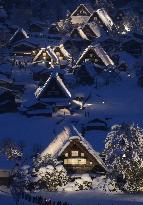
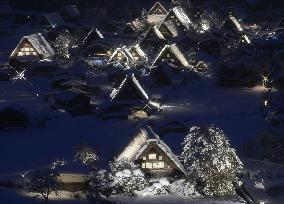
Gasho-zukuri farmhouses in Shirakawa-go lit up

Gasho-zukuri farmhouses in Shirakawa-go lit up

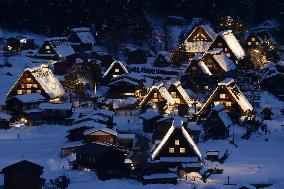
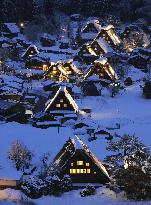
SHIRAKAWA, Japan - Snow-covered gasho-zukuri farmhouses in Shirakawa-go in central Japan's Gifu Prefecture are lit up on Jan. 17, 2015, as the annual illumination event began. The traditional houses with steep thatched roofs are designed to withstand the large amounts of heavy snow during the winter. The Shirakawa-go and neighboring Gokayama regions were declared a UNESCO world heritage site in 1995.

  •  
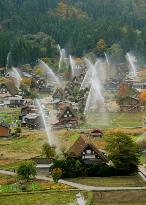
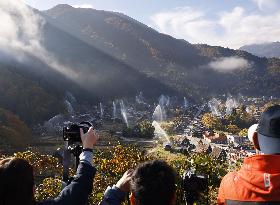
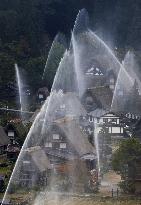
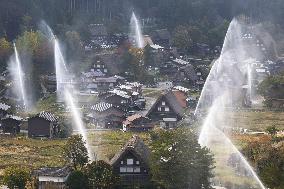
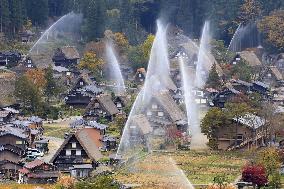
Water-discharge drill at Shirakawa-go

Water-discharge drill at Shirakawa-go

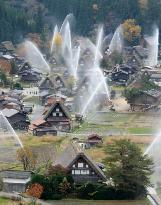
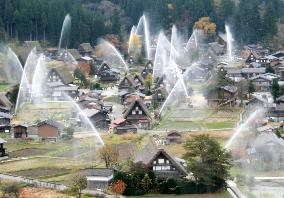
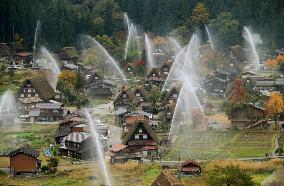
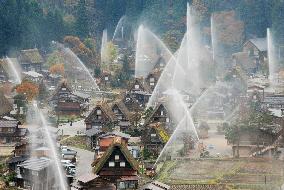
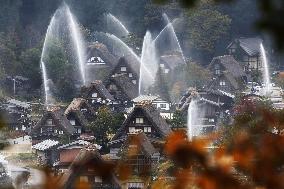
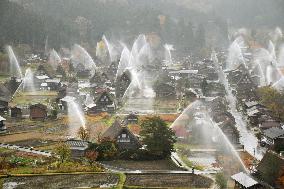
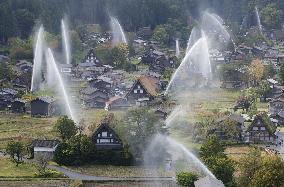
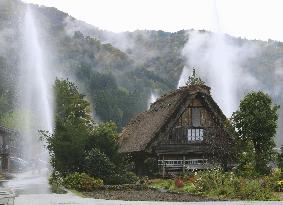
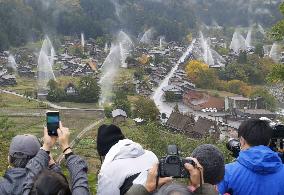
GIFU, Japan - Columns of water are discharged over traditional gassho-zukuri farmhouses during an annual water-discharge drill in the village of Shirakawa in the central Japan prefecture of Gifu on Nov. 9, 2014. The Shirakawa-go and neighboring Gokayama regions were declared a UNESCO World Cultural Heritage site in 1995 for their farmhouses' steep thatched roofs designed to withstand the large amount of heavy snow in winter.

  •  
Water-discharge drill at Shirakawa-go

Water-discharge drill at Shirakawa-go

GIFU, Japan - Columns of water are discharged over traditional gassho-zukuri farmhouses during an annual water-discharge drill in the village of Shirakawa in the central Japan prefecture of Gifu on Nov. 9, 2014. The Shirakawa-go and neighboring Gokayama regions were declared a UNESCO World Cultural Heritage site in 1995 for their farmhouses' steep thatched roofs designed to withstand the large amount of heavy snow in winter.

  •  
Gasho-zukuri farmhouses in Shirakawa-go lit up

Gasho-zukuri farmhouses in Shirakawa-go lit up

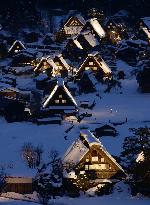
SHIRAKAWA, Japan - Snow-covered gasho-zukuri farmhouses in Shirakawa-go, Gifu Prefecture, are lit up during an annual event on Jan. 18, 2014. The traditional houses with steep thatched roofs, some of which are more than 250 years old, are designed to withstand the large amount of heavy snow. The Shirakawa-go and neighboring Gokayama regions were declared a UNESCO world heritage site in 1995.

  •  
Gasho-zukuri farmhouses in Shirakawa-go lit up

Gasho-zukuri farmhouses in Shirakawa-go lit up

SHIRAKAWA, Japan - Snow-covered gasho-zukuri farmhouses in Shirakawa-go, Gifu Prefecture, are lit up during an annual event on Jan. 18, 2014. The traditional houses with steep thatched roofs, some of which are more than 250 years old, are designed to withstand the large amount of heavy snow. The Shirakawa-go and neighboring Gokayama regions were declared a UNESCO world heritage site in 1995.

  •  
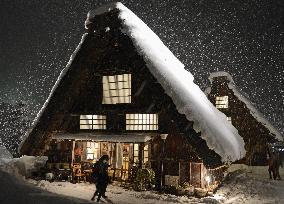
Snow-covered 'gassho-zukuri' houses lit up

Snow-covered 'gassho-zukuri' houses lit up

SHIRAKAWA, Japan - Houses with thatched and steeply slanting roofs, built in the style known as gassho-zukuri, are lit up for tourists in the snow-blanketed village of Shirakawa in Gifu Prefecture on Jan. 19, 2013. The area has been designated a UNESCO World Heritage Site.

  •  
Snow-covered 'gassho-zukuri' houses lit up

Snow-covered 'gassho-zukuri' houses lit up

SHIRAKAWA, Japan - Houses with thatched and steeply slanting roofs, built in the style known as gassho-zukuri, are lit up for tourists in the snow-blanketed village of Shirakawa in Gifu Prefecture on Jan. 19, 2013. The area has been designated a UNESCO World Heritage Site.

  •  
Snow-covered 'gassho-zukuri' houses lit up

Snow-covered 'gassho-zukuri' houses lit up

SHIRAKAWA, Japan - Houses with thatched and steeply slanting roofs, built in the style known as gassho-zukuri, are lit up for tourists in the snow-blanketed village of Shirakawa in Gifu Prefecture on Jan. 19, 2013. The area has been designated a UNESCO World Heritage Site.

  •  
Water-discharge drill at Shirakawa-go World Heritage site

Water-discharge drill at Shirakawa-go World Heritage site

GIFU, Japan - Columns of water are discharged over traditional thatched houses at the World Cultural Heritage site of Shirakawa-go in the central Japan prefecture of Gifu during an annual drill to prevent fire on Nov. 4, 2012. Shirakawa-go is known for its houses constructed in the "gassho-zukuri" architectural style.

  •  
Water-discharge drill at Shirakawa-go World Heritage site

Water-discharge drill at Shirakawa-go World Heritage site

GIFU, Japan - Columns of water are discharged over traditional thatched houses at the World Cultural Heritage site of Shirakawa-go in the central Japan prefecture of Gifu during an annual drill to prevent fire on Nov. 4, 2012. Shirakawa-go is known for its houses constructed in the "gassho-zukuri" architectural style.

  •  
Shirakawa-go World Heritage site lit up

Shirakawa-go World Heritage site lit up

SHIRAKAWA, Japan - Traditional thatched houses at the World Cultural Heritage site of Shirakawa-go in the central Japan prefecture of Gifu are lit up during an annual lighting up event on Jan. 23, 2010. Shirakawa-go is known for its houses constructed in the ''gassho-zukuri'' architectural style.

  •  
Water-discharge drill at Shirakawa-go World Heritage site

Water-discharge drill at Shirakawa-go World Heritage site

SHIRAKAWA, Japan - Columns of water are discharged by firefighters over traditional thatched houses at the World Cultural Heritage site of Shirakawa-go in the central Japan prefecture of Gifu during an annual drill on Nov. 8, 2009. Shirakawa-go is known for its houses constructed in the ''gassho-zukuri'' architectural style.

  •  
Water-discharge drill at World Heritage-listed Shirakawa-go

Water-discharge drill at World Heritage-listed Shirakawa-go

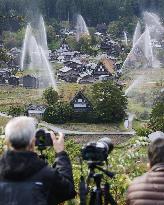
An annual water-discharge fire drill is held on Oct. 30, 2022, in Shirakawa-go, a World Heritage site famous for traditional "gassho-zukuri" thatched farmhouses in the Gifu Prefecture village of Shirakawa, central Japan.

  •  
Water-discharge drill at World Heritage-listed Shirakawa-go

Water-discharge drill at World Heritage-listed Shirakawa-go

An annual water-discharge fire drill is held on Oct. 30, 2022, in Shirakawa-go, a World Heritage site famous for traditional "gassho-zukuri" thatched farmhouses in the Gifu Prefecture village of Shirakawa, central Japan.

  •  
Water-discharge drill at World Heritage-listed Shirakawa-go

Water-discharge drill at World Heritage-listed Shirakawa-go

An annual water-discharge fire drill is held on Oct. 30, 2022, in Shirakawa-go, a World Heritage site famous for traditional "gassho-zukuri" thatched farmhouses in the Gifu Prefecture village of Shirakawa, central Japan.

  •  
Water-discharge drill at World Heritage-listed Shirakawa-go

Water-discharge drill at World Heritage-listed Shirakawa-go

An annual water-discharge fire drill is held on Oct. 30, 2022, in Shirakawa-go, a World Heritage site famous for traditional "gassho-zukuri" thatched farmhouses in the Gifu Prefecture village of Shirakawa, central Japan.

  •  
Water-discharge drill at World Heritage-listed Shirakawa-go

Water-discharge drill at World Heritage-listed Shirakawa-go

An annual water-discharge fire drill is held on Nov. 7, 2021, in Shirakawa-go, a World Heritage site famous for traditional "gassho-zukuri" thatched farmhouses in the Gifu Prefecture village of Shirakawa, central Japan.

  •  
Water-discharge drill at World Heritage-listed Shirakawa-go

Water-discharge drill at World Heritage-listed Shirakawa-go

An annual water-discharge fire drill is held on Nov. 7, 2021, in Shirakawa-go, a World Heritage site famous for traditional "gassho-zukuri" thatched farmhouses in the Gifu Prefecture village of Shirakawa, central Japan.

  •  
Water-discharge drill at World Heritage-listed Shirakawa-go

Water-discharge drill at World Heritage-listed Shirakawa-go

An annual water-discharge fire drill is held on Nov. 7, 2021, in Shirakawa-go, a World Heritage site famous for traditional "gassho-zukuri" thatched farmhouses in the Gifu Prefecture village of Shirakawa, central Japan.

  •  
Water-discharge drill at World Heritage-listed Shirakawa-go

Water-discharge drill at World Heritage-listed Shirakawa-go

An annual water-discharge fire drill is held on Nov. 7, 2021, in Shirakawa-go, a World Heritage site famous for traditional "gassho-zukuri" thatched farmhouses in the Gifu Prefecture village of Shirakawa, central Japan.

  •  
Water-discharge drill at World Heritage-listed Shirakawa-go

Water-discharge drill at World Heritage-listed Shirakawa-go

An annual water-discharge fire drill is held on Nov. 7, 2021, in Shirakawa-go, a World Heritage site famous for traditional "gassho-zukuri" thatched farmhouses in the Gifu Prefecture village of Shirakawa, central Japan.

  •  
Water-discharge drill at Shirakawa-go in central Japan

Water-discharge drill at Shirakawa-go in central Japan

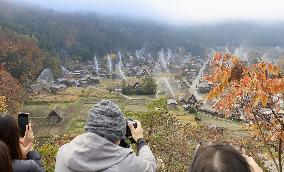
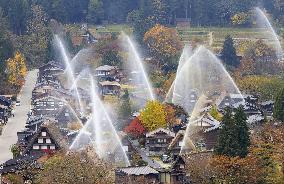
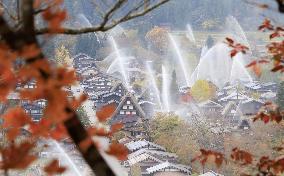
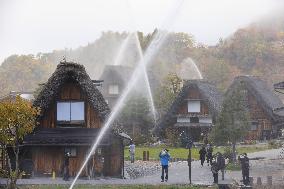
Columns of water reaching up to 30 meters high are discharged over traditional gassho-zukuri farmhouses during an annual water-discharge drill in the village of Shirakawa in the central Japan prefecture of Gifu on Nov. 8, 2015. The Shirakawa-go and neighboring Gokayama regions were declared a UNESCO World Cultural Heritage site in 1995 for their farmhouses' steep thatched roofs designed to withstand heavy snow in winter. (Kyodo) ==Kyodo

  •  
Shirakawa Village expects Hokuriku Shinkansen to bring more tourists

Shirakawa Village expects Hokuriku Shinkansen to bring more tourists

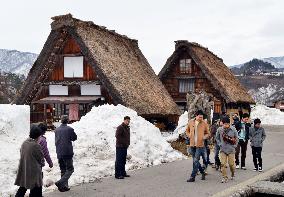
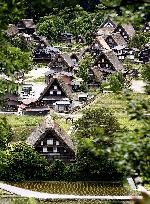
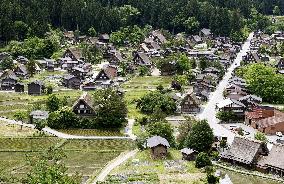
Tourists walk in Shirakawa Village, known for traditional "gassho-zukuri" Japanese farmhouses, in Gifu Prefecture, on March 7, 2015. The village expects the number of visitors to increase as the Hokuriku Shinkansen bullet train line began operating on March 14. (Kyodo) ==Kyodo

  •  
Water-discharge drill at World Heritage-listed Shirakawa-go

Water-discharge drill at World Heritage-listed Shirakawa-go

An annual water-discharge fire drill is held on Oct. 25, 2020, in Shirakawa-go, a World Heritage site famous for traditional "gassho-zukuri" thatched farmhouses in Gifu Prefecture, central Japan.

  •  
Water-discharge drill at World Heritage-listed Shirakawa-go

Water-discharge drill at World Heritage-listed Shirakawa-go

An annual water-discharge fire drill is held on Oct. 25, 2020, in Shirakawa-go, a World Heritage site famous for traditional "gassho-zukuri" thatched farmhouses in Gifu Prefecture, central Japan.

  •  
Reopening of World Heritage farmhouses

Reopening of World Heritage farmhouses

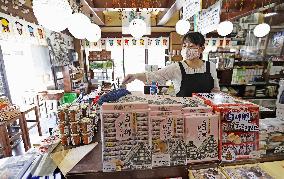
Plastic sheets are installed to reduce the risk of new coronavirus droplet infections at a gift shop in the hamlet of Shirakawa-go in Gifu Prefecture, central Japan, on June 1, 2020. Shirakawa-go, a World Heritage site with "gassho-zukuri" thatched farmhouses, reopened the same day after being closed due to the coronavirus pandemic. (Kyodo) ==Kyodo

  •  
Reopening of World Heritage farmhouses

Reopening of World Heritage farmhouses

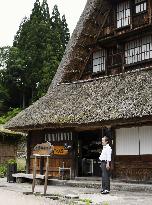
A woman prepares to reopen a gift shop in the hamlet of Shirakawa-go in Gifu Prefecture, central Japan, on June 1, 2020. Shirakawa-go, a World Heritage site with "gassho-zukuri" thatched farmhouses, reopened the same day after being closed due to the coronavirus pandemic. (Kyodo) ==Kyodo

  •  
Shirakawa-go World Heritage site lit up

Shirakawa-go World Heritage site lit up

SHIRAKAWA, Japan - Traditional thatched houses at the World Cultural Heritage site of Shirakawa-go in the central Japan prefecture of Gifu are lit up during an annual lighting up event on Jan. 23, 2010. Shirakawa-go is known for its houses constructed in the ''gassho-zukuri'' architectural style. (Kyodo)

  •  
Water-discharge drill at Shirakawa-go World Heritage site

Water-discharge drill at Shirakawa-go World Heritage site

SHIRAKAWA, Japan - Columns of water are discharged by firefighters over traditional thatched houses at the World Cultural Heritage site of Shirakawa-go in the central Japan prefecture of Gifu during an annual drill on Nov. 8, 2009. Shirakawa-go is known for its houses constructed in the ''gassho-zukuri'' architectural style. (Kyodo)

  •  
Sensoji Temple

Sensoji Temple

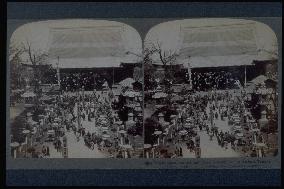
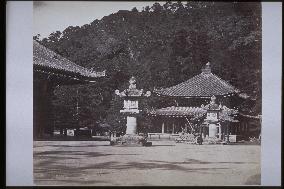
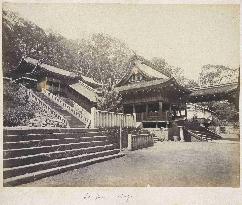
This Kannon-do was rebuilt by the third shogun Tokugawa Iemitsu in 1649. The style of construction is koran mitesaki-zukuri. The photograph captures a flock of pigeons flying from Niomon (gate). The building burned down in an air raid on March 10, 1945. The present-day Kannon-do was erected on October 17, 1958. Taken by Herbert George Ponting. Stereograph published in 1904.==Date:1904, Place:Tokyo, Photo:Underwood, (Credit:Nagasaki University Library/Kyodo News Images) [Cabinet Number97‐69‐0]

  •  
The Kyoto Imperial Palace

The Kyoto Imperial Palace

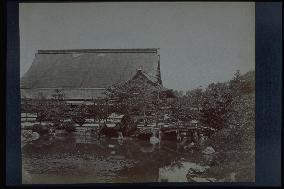
Northern view of Oike Pond Garden and Otsune Palace from Keyaki Bridge, looking over Nakashima Island in the Garden. The stone bridge on the right leads to the northern island. Pines and firs grow in front of the palace. Oike Garden was built during the Enpo Period (1673-81). This type of garden, called kaiyushiki, had bridges, lanterns, and small pavilions to enhance enjoyment of the beauty of the garden. Otsune Palace is built in the shoin-zukuri style and was rebuilt in 1855. This was one of the palaces where the emperor would stay when traveling.==Date:unknown, Place:Kyoto, Photo:unknown, (Credit:Nagasaki University Library/Kyodo News Images) [Cabinet Number96‐111‐0]

  •  
The city of Kyoto seen from Maruyama

The city of Kyoto seen from Maruyama

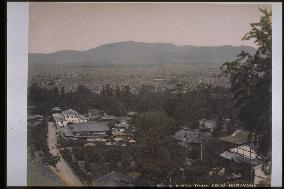
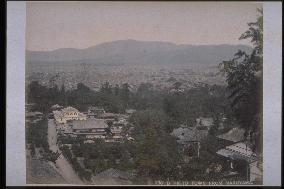
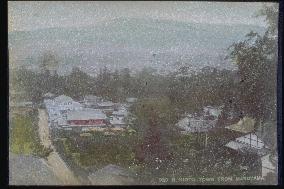
Western view of the northern part of Kyoto from the Yoshimizu Hot Spring building. The road stretching from the centre of the photo to the left corner is the approach to Yasaka Shinto Shrine. Although the site would later become Maruyama Park, no work has been done yet, and a few restaurants stand in the area. A two-story Western-style building of yosemune-zukuri style stands on the northeast side of the street where cherry blossoms would later become a tourist attraction. The Nishiyama Mountain Range is faintly visible in the background.==Date:unknown, Place:Kyoto, Photo:Tamamura Kozaburo, (Credit:Nagasaki University Library/Kyodo News Images) [Cabinet Number80‐3‐0]

  •  
The city of Kyoto seen from Maruyama

The city of Kyoto seen from Maruyama

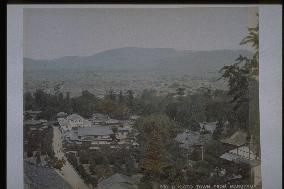
Western view of the northern part of Kyoto from the Yoshimizu Hot Spring building. The road stretching from the centre of the photo to the left corner is the approach to Yasaka Shinto Shrine. Although the site would later become Maruyama Park, no work has been done yet, and a few restaurants stand in the area. A two-story Western-style building of yosemune-zukuri style stands on the northeast side of the street where cherry blossoms would later become a tourist attraction. The Nishiyama Mountain Range is faintly visible in the background.==Date:unknown, Place:Kyoto, Photo:Tamamura Kozaburo, (Credit:Nagasaki University Library/Kyodo News Images) [Cabinet Number79‐5‐0]

  •  
Chion-in Temple

Chion-in Temple

Kyozo (Sutra Library) of Chion-in Temple seen from the south side, facing east. The Kyozo was built in 1615. The building style is two story hokei-zukuri with a tiled roof. There are no walls, doors, or windows. This style is called shuchu-shiki (radiating column). Mt. Kacho rises in the background. The roof of the Goei-do is visible on the left.==Date:unknown, Place:Kyoto, Photo:R. Stillfried, (Credit:Nagasaki University Library/Kyodo News Images) [Cabinet Number63‐16‐0]

  •  
The city of Kyoto seen from Maruyama

The city of Kyoto seen from Maruyama

Western view of the northern part of Kyoto from the Yoshimizu Hot Spring building. The road stretching from the centre of the photo to the left corner is the approach to Yasaka Shinto Shrine. Although the site would later become Maruyama Park, no work has been done yet, and a few restaurants stand in the area. A two-story Western-style building of yosemune-zukuri style stands on the northeast side of the street where cherry blossoms would later become a tourist attraction. The Nishiyama Mountain Range is faintly visible in the background.==Date:unknown, Place:Kyoto, Photo:unknown, (Credit:Nagasaki University Library/Kyodo News Images) [Cabinet Number52‐32‐0]

  •  
The city of Kyoto seen from Maruyama

The city of Kyoto seen from Maruyama

Western view of the northern part of Kyoto from the Yoshimizu Hot Spring building. The road stretching from the centre of the photo to the left corner is the approach to Yasaka Shinto Shrine. Although the site would later become Maruyama Park, no work has been done yet, and a few restaurants stand in the area. A two-story Western-style building of yosemune-zukuri style stands on the northeast side of the street where cherry blossoms would later become a tourist attraction. The Nishiyama Mountain Range is faintly visible in the background.==Date:unknown, Place:Kyoto, Photo:unknown, (Credit:Nagasaki University Library/Kyodo News Images) [Cabinet Number52‐22‐0]

  •  
The city of Kyoto seen from Maruyama

The city of Kyoto seen from Maruyama

Western view of the northern part of Kyoto from the Yoshimizu Hot Spring building. The road stretching from the centre of the photo to the left corner is the approach to Yasaka Shinto Shrine. Although the site would later become Maruyama Park, no work has been done yet, and a few restaurants stand in the area. A two-story Western-style building of yosemune-zukuri style stands on the northeast side of the street where cherry blossoms would later become a tourist attraction. The Nishiyama Mountain Range is faintly visible in the background.==Date:unknown, Place:Kyoto, Photo:Tamamura Kozaburo, (Credit:Nagasaki University Library/Kyodo News Images) [Cabinet Number48‐115‐0]

  •  
Nishi Honganji Temple

Nishi Honganji Temple

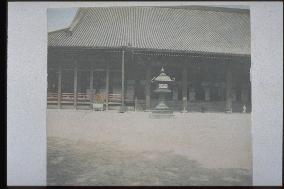
Goei-do of Nishi Honganji Temple, looking from the east side facing west. A bronze lantern is installed at the centre. People can be seen praying in front of the stairs. The Goei-do is also called the Taishi-do and was built in 1636. It is an irimoya-zukuri style building with roof tiles and an east-west width of 45 meters, a north-south length of 57 meters, and a height of 27 meters.==Date:unknown, Place:Kyoto, Photo:unknown, (Credit:Nagasaki University Library/Kyodo News Images) [Cabinet Number46‐111‐0]

  •  
Shimogamo Shirine

Shimogamo Shirine

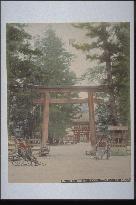
Shimokamo Shinto Shrine is located on the delta of Kamo River and Takano River in the Sakyo district of Kyoto. A torii in the popular Myojo style stands in the trees of Tadasuno Forest, and the main building can be seen in the rear. At Shimokamo Shrine, Shikinen Sengu (removal and dedication of the shrine) has been conducted every 20 years since the Heian period, but the present main hall was built in 1863 and exhibits nagare zukuri (a shrine construction style with the front roof spreading out in arch form, seen from the fist half of the Heian period) . At the foot of the torii are rickshaws with their handles placed down. One is empty, but the rickshaw man sits on the other one wearing a manto hat.==Date:unknown, Place:Kyoto, Photo:Tamamura Kozaburo, (Credit:Nagasaki University Library/Kyodo News Images) [Cabinet Number11‐37‐0]

  •  
Inside of nikko toshogu shrine

Inside of nikko toshogu shrine

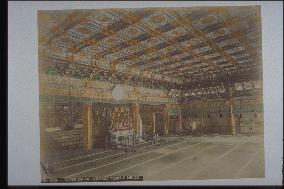
A sacred mirror is set at the front of the worship hall, and under it are strips of material. The Misu shade is raised between the main building and the hall of worship, so the stone room can be seen. The style of construction with a connecting room between the main hall and the hall of worship,called Gongen zukuri , began at the Toshogu. The floor is done with granite, and the room is called the hall of stone.==Date:unknown, Place:Nikko, Photo:Tamamura Kozaburo, (Credit:Nagasaki University Library/Kyodo News Images) [Cabinet Number11‐14‐0]

  •  
Kinkakuji Temple

Kinkakuji Temple

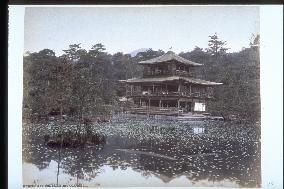
Kinkakuji in the Kita district of Kyoto city. A view of Kinkakuji Temple with the three-story building reflected on the surface of the Kyoko Pond. The first floor is done in shinden zukuri (Fujiwara palace style), the second is in Shoin zukuri (drawing-room style) and the third floor where the Buddha is enshrined is in Chinese style. The second and third floors are covered in gold, and thus the name of Kinkaku (Golden Pavilion). To the left is Ashibara island and Nakajima.==Date:unknown, Place:Kyoto, Photo:Ogawa Kazumasa, (Credit:Nagasaki University Library/Kyodo News Images) [Cabinet Number9‐30‐0]

  •  
Gasho-zukuri farmhouses in Shirakawa-go lit up

Gasho-zukuri farmhouses in Shirakawa-go lit up

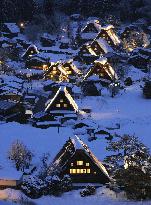
SHIRAKAWA, Japan - Snow-covered gasho-zukuri farmhouses in Shirakawa-go in central Japan's Gifu Prefecture are lit up on Jan. 17, 2015, as the annual illumination event began. The traditional houses with steep thatched roofs are designed to withstand the large amounts of heavy snow during the winter. The Shirakawa-go and neighboring Gokayama regions were declared a UNESCO world heritage site in 1995. (Kyodo)

  •  
Reopening of World Heritage farmhouses

Reopening of World Heritage farmhouses

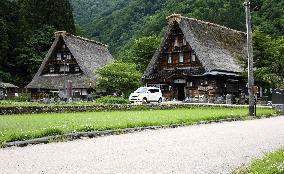
Photo taken June 1, 2020, shows "gassho-zukuri" thatched farmhouses in the hamlet of Shirakawa-go in Gifu Prefecture, central Japan. The World Heritage site reopened the same day after being closed due to the coronavirus pandemic. (Kyodo) ==Kyodo

  •  
Reopening of World Heritage farmhouses

Reopening of World Heritage farmhouses

Photo taken June 1, 2020, shows "gassho-zukuri" thatched farmhouses in the hamlet of Gokayama in Toyama Prefecture, central Japan. The World Heritage site reopened the same day after being closed due to the coronavirus pandemic. (Kyodo) ==Kyodo

  •  
Main Hall and Worship Hall at Suwa Shrine

Main Hall and Worship Hall at Suwa Shrine

The buildings starting from the right are, Worship Hall, Norito-den Hall, and the Main Hall at Suwa Shrine. Worship Hall is where commoners would worship. The building is made of hinoki (Japanese cypress) in irimoya-zukuri style (a hip-and- gable roof construction) with a hiwadabuki-style roof (Japanese cypress hinoki bark thatching). The right, left , and front walls flip open upwards like awnings. The tablet was written by Sawa Nobuyoshi who became the Kyushu Pacification Officer in 1868. The floor of the Norito-den Hall connected to the passageway is tatami-covered. The building in the far left is the main hall rebuilt in 1869 after burning down in 1857. The chancel enshrines the spirit of the three deities of the Suwa, Morisaki, and Sumiyoshi shrines.==Date:about 1874, Place:Nagasaki, Photo:Ueno Hikoma?, (Credit:Nagasaki University Library/Kyodo News Images)

  •  
Water-discharge drill at World Heritage-listed Shirakawa-go

Water-discharge drill at World Heritage-listed Shirakawa-go

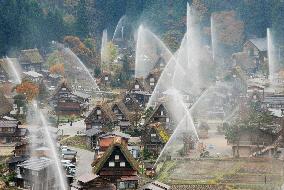
An annual water-discharge fire drill is held on Oct. 25, 2020, in Shirakawa-go, a World Heritage site famous for traditional "gassho-zukuri" thatched farmhouses in Gifu Prefecture, central Japan.

  •  
Water-discharge drill at World Heritage-listed Shirakawa-go

Water-discharge drill at World Heritage-listed Shirakawa-go

An annual water-discharge fire drill is held on Oct. 25, 2020, in Shirakawa-go, a World Heritage site famous for traditional "gassho-zukuri" thatched farmhouses in Gifu Prefecture, central Japan.

  •  
Water-discharge drill at World Heritage-listed Shirakawa-go

Water-discharge drill at World Heritage-listed Shirakawa-go

An annual water-discharge fire drill is held on Oct. 25, 2020, in Shirakawa-go, a World Heritage site famous for traditional "gassho-zukuri" thatched farmhouses in Gifu Prefecture, central Japan.

  •  
Reopening of World Heritage farmhouses

Reopening of World Heritage farmhouses

Photo taken June 1, 2020, shows "gassho-zukuri" thatched farmhouses in the hamlet of Shirakawa-go in Gifu Prefecture, central Japan. The World Heritage site reopened the same day after being closed due to the coronavirus pandemic. (Kyodo) ==Kyodo

  •  
Reopening of World Heritage farmhouses

Reopening of World Heritage farmhouses

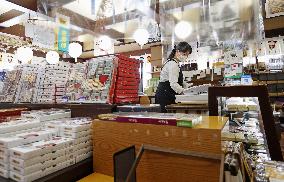
Photo taken June 1, 2020, shows a gift shop in the hamlet of Gokayama in Toyama Prefecture, central Japan. Gokayama, a World Heritage site with "gassho-zukuri" thatched farmhouses, reopened the same day after being closed due to the coronavirus pandemic. (Kyodo) ==Kyodo

  • Main
  • Top
  • Editorial
  • Creative
  • About Us
  • About ILG
  • Terms of use
  • Company
  • BEHIND
  • Price List
  • Single Plan
  • Monthly Plan
  • Services
  • Shooting
  • Rights Clearance
  • Support
  • FAQ
  • How To Buy
  • Contact Us
  • Become a Partner

© KYODO NEWS IMAGES INC

All Rights Reserved.

  • Editorial
  • Olympics
  • News
  • Sports
  • Japan
  • Tech
  • Royal
  • Disaster
  • NorthKorea
  • Old Japan
  • SNS
  • Creative
  • Food
  • Japan
  • Landscape
  • Animal
  • Popular
  • #Ukraine
  • #China
  • #coronavirus
  • #N. Korea
  • #Thailand
  • #Russia
  • #Ukraine
  • #China
  • #coronavirus
  • #N. Korea
  • #Thailand
  • #Russia
  • Food
  • Japan
  • Landscape
  • Animal
  • Olympics
  • News
  • Sports
  • Japan
  • Tech
  • Royal
  • Disaster
  • NorthKorea
  • Old Japan
  • SNS