•  
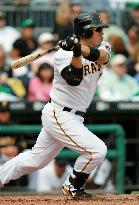
Pittsburgh Pirates' Iwamura 1-for-4 against Milwaukee Brewers

Pittsburgh Pirates' Iwamura 1-for-4 against Milwaukee Brewers

PITTSBURGH, United States - Pittsburgh Pirates second baseman Akinori Iwamura hits a single to right in the seventh inning of a game against the Milwaukee Brewers at PNC Park in Pittsburgh on April 22, 2010. Iwamura went 1-for-4 as the Pirates lost 20-0 to the Brewers.

  •  
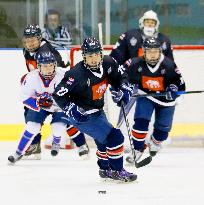
Asian Games: Thailand makes debut in women's ice hockey

Asian Games: Thailand makes debut in women's ice hockey

Players of the Thai women's ice hockey team (navy blue) are seen in action in a 20-0 loss to South Korea at the Asian Winter Games in Sapporo on Feb. 18, 2017. The tropical country, where less than 40 women play ice hockey, took part in the Asian Games competition for the first time. (Kyodo) ==Kyodo

  •  
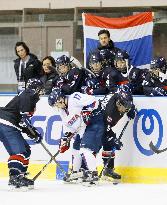
Asian Games: Thailand makes debut in women's ice hockey

Asian Games: Thailand makes debut in women's ice hockey

Players of the Thai women's ice hockey team (navy blue) are seen in action in a 20-0 loss to South Korea at the Asian Winter Games in Sapporo on Feb. 18, 2017. The tropical country, where less than 40 women play ice hockey, took part in the Asian Games competition for the first time. (Kyodo) ==Kyodo

  •  
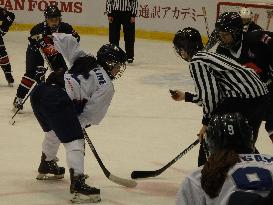
Feature: Asian Games: Good medicine lifting South Korean women's hockey

Feature: Asian Games: Good medicine lifting South Korean women's hockey

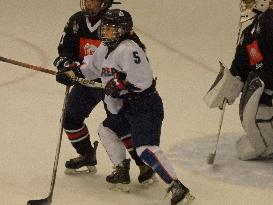
South Korea's Caroline Park (L) faces off against a Thailand player on Feb. 18, 2017, in the women's ice hockey tournament at the Asian Winter Games in Sapporo on Japan's northernmost main island of Hokkaido. South Korea beat Thailand 20-0. (Kyodo) ==Kyodo

  •  
Feature: Asian Games: Good medicine lifting South Korean women's hockey

Feature: Asian Games: Good medicine lifting South Korean women's hockey

Caroline Park (5) of South Korea plays against Thailand on Feb. 18, 2017, in the women's ice hockey tournament at the Asian Winter Games in Sapporo on Japan's northernmost main island of Hokkaido. South Korea beat Thailand 20-0. (Kyodo) ==Kyodo

  •  
Fukuzumi inn at yumoto hot spring

Fukuzumi inn at yumoto hot spring

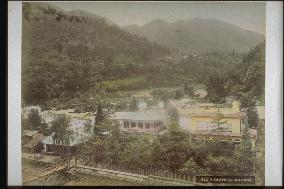
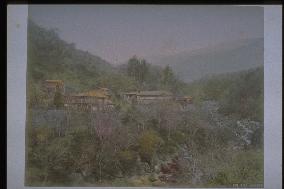
A view of Yumoto Hot Springs with the Western-style building of Mansuiro Fukuzumi in the center. The truss bridge build over the Haya River in the photo was built as Fukuzumi Bridge to compensate for Asahi bridge which was moved upstream. So this photo was taken after 1893.==Date:unknown, Place:Hakone, Photo:Ogawa Kazumasa, (Credit:Nagasaki University Library/Kyodo News Images) [Cabinet Number7‐20‐0]

  •  
Inside of daitokuin's tomb at shiba zojoji temple

Inside of daitokuin's tomb at shiba zojoji temple

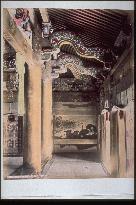
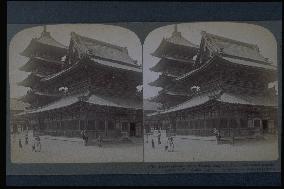
The outer nave of the main hall, and the inner nave is within the round shaped pillars. Gold is inlaid in the pillars of the inner nave, and flowers and birds are carved in the see-through sculptures in the pillars by the ceiling. The brilliant colors adorning the upper perpendicular pillars call our attention.==Date:unknown, Place:Tokyo, Photo:Ogawa Kazumasa, (Credit:Nagasaki University Library/Kyodo News Images) [Cabinet Number6‐20‐0]

  •  
The cave on Enoshima Island

The cave on Enoshima Island

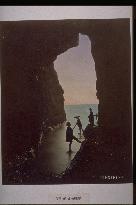
The cave in Enoshima can no longer be entered. Three people are seen in the photo. The person in the centre holding the helm may be a guiding boatsman.==Date:unknown, Place:Enoshima, Photo:Kusakabe Kinbei, (Credit:Nagasaki University Library/Kyodo News Images) [Cabinet Number3‐20‐0]

  •  
The five-story pagoda and Kondo, Shitennoji Temple

The five-story pagoda and Kondo, Shitennoji Temple

One of the seven buildings built by Shotoku Taishi. The picture is that of the five-story pagoda (to the rear) and the Golden Hall (fore).==Date:1904, Place:Osaka, Photo:Underwood, (Credit:Nagasaki University Library/Kyodo News Images) [Cabinet Number97‐20‐0]

  •  
Making unbrellas

Making unbrellas

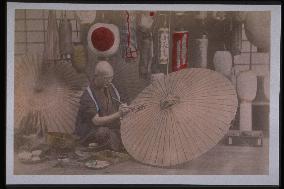
This is a scene in an umbrella workshop. The umbrellas visible here, called bangasa, were used daily by commoners during the Edo Period. The man is writing something on the finished umbrella. It was common practice to write the names of customers or shops on umbrellas.==Date:unknown, Place:unknown, Photo:unknown, (Credit:Nagasaki University Library/Kyodo News Images) [Cabinet Number96‐20‐0]

  •  
Women on jinrikishas

Women on jinrikishas

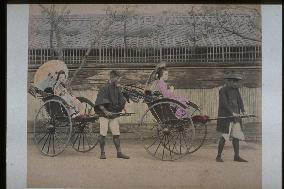
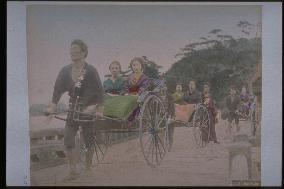
Kimono-clad women hold umbrellas on jinrikisha (rickshaws). The rickshaw man in front wears a straw hat, hanten coat, a stomach warmer, long underwear, and heavy cloth socks. The short-haired rickshaw man in the rear is similarly dressed. This was taken near the wooden fence of a large residence.==Date:unknown, Place:unknown, Photo:A. Farsari, (Credit:Nagasaki University Library/Kyodo News Images) [Cabinet Number95‐20‐0]

  •  
A leisure boat on the Sumida River

A leisure boat on the Sumida River

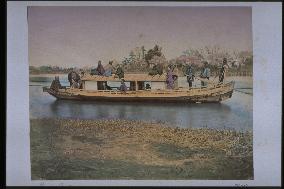
This same photograph was carried in a special issue of Asahi Graph published by Tokyo Asahi Newspaper in 1925 to commemorate the centennial of photography in Japan, under the heading Boat Outing on Tokyo Sumida River with Uchida Kuichi around 1874. The caption says that the man leaning on the railing in the centre is Uchida Kuichi and that the photograph belongs to Hirata Kenichi. The fashion-conscious Uchida usually wore Western-style clothes in photographs, so this is a rare shot of him wearing a kimono.==Date:unknown, Place:Tokyo, Photo:unknown, (Credit:Nagasaki University Library/Kyodo News Images) [Cabinet Number94‐20‐0]

  •  
The Kirifuri Falls,Nikko

The Kirifuri Falls,Nikko

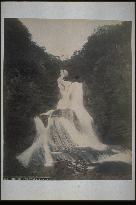
Kirifuri Falls, Kegon Falls, and Urami Falls are the three famous waterfalls at Nikko. A unflaggingly popular tourist attraction, Kirifuri Falls is 75 metres high including its upper and the lower stages and is surrounded by the rich natural beauty of the valley. The observation deck offers a breathtaking view year-round, from the new green of spring to the bright colours of autumn.==Date:unknown, Place:Nikko, Photo:unknown, (Credit:Nagasaki University Library/Kyodo News Images) [Cabinet Number93‐20‐0]

  •  
Nishi Otani Entsu-kyo Bridge

Nishi Otani Entsu-kyo Bridge

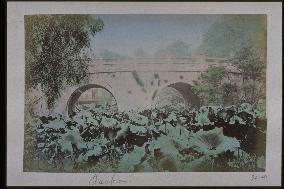
Enzu-kyo Bridge at Nishi Otani Temple, looking north-northeast from the southwestern edge of Kogetsu Pond. Made of stone, the bridge was built in 1865. Called Spectacles Bridge because of its shape, the bridge bustled with people who came here to view the red and white lotus flowers from the end of the Edo to the Meiji Period. There is a tea house on the other side of the bridge. The quality of the photo tinting is poor.==Date:unknown, Place:Kyoto, Photo:unknown, (Credit:Nagasaki University Library/Kyodo News Images) [Cabinet Number92‐20‐0]

  •  
Shamisen practice

Shamisen practice

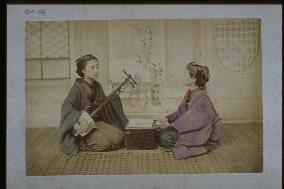
A woman is practicing an indigenous song or ballad accompanied by shamisen lute. The alcove behind is not real.==Date:unknown, Place:unknown, Photo:unknown, (Credit:Nagasaki University Library/Kyodo News Images) [Cabinet Number90‐20‐0]

  •  
A girl playing with a ball

A girl playing with a ball

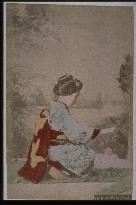
A girl stoops to play with a ball. She is wearing a loosely-tied sash and bokkuri wooden clogs. The photograph skillfully captures the white hairpin in her gleaming black hair and her white hands bouncing the ball.==Date:unknown, Place:unknown, Photo:unknown, (Credit:Nagasaki University Library/Kyodo News Images) [Cabinet Number89‐20‐0]

  •  
The carving of the three wise monkeys,Toshogu Shrine,Nikko

The carving of the three wise monkeys,Toshogu Shrine,Nikko

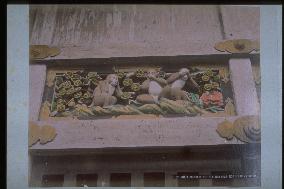
The Mizaru, Iwazaru, Kikazaru (see no evil, speak no evil and hear no evil) monkey carvings decorate the beams of the Shinkyu (Divine Horse Stable) at Nikko Toshogu. The Shinkyu is the only building in the precinct without any lacquer work. There are eight sets of the monkey carvings, which are symbols of a moral teaching.==Date:unknown, Place:Nikko, Photo:unknown, (Credit:Nagasaki University Library/Kyodo News Images) [Cabinet Number88‐20‐0]

  •  
The Karamon Gate,Toshogu Shrine,Nikko

The Karamon Gate,Toshogu Shrine,Nikko

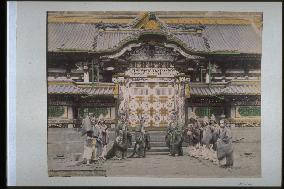
Karamon is the main gate of Toshogu Shinto Shrine. Only high ranking government officials and feudal lords, who were allowed to meet the shogun directly, could use this gate during the Edo Period. The gate was painted white with kofun and embellished with carvings of dragons. The inscription on the upper portion reads Shuntei Choken-no-gi (Emperor Shun's Morning Greetings) and consists of 27 figures carved from one zelkova tree in four rows. The people in front of the gate are wearing the costumes of the Toshogu Festival.==Date:unknown, Place:Nikko, Photo:unknown, (Credit:Nagasaki University Library/Kyodo News Images) [Cabinet Number87‐20‐0]

  •  
A girl and women smoking

A girl and women smoking

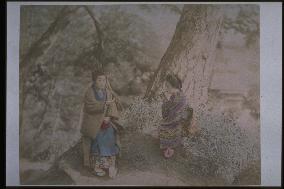
The women are holding tobacco pipes. The kiseru consisted of three parts, the bowl for tobacco, the mouthpiece, and the pipe between. There were many shapes and sizes of pipe.==Date:unknown, Place:unknown, Photo:unknown, (Credit:Nagasaki University Library/Kyodo News Images) [Cabinet Number86‐20‐0]

  •  
Men looking up at Mt.Fuji

Men looking up at Mt.Fuji

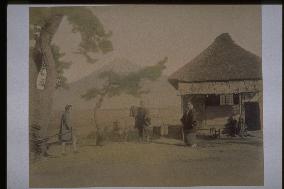
It is difficult to determine the exact location, but the shape of Mt. Fuji and the fact that there are neither trees on the north side of the street nor a pond indicates that this was taken on the Tokaido Highway east of Yoshiwara Post Town, facing north. A house with a thatched roof, a rickshaw man, and a man carrying a load are visible.==Date:unknown, Place:Shizuoka, Photo:unknown, (Credit:Nagasaki University Library/Kyodo News Images) [Cabinet Number85‐20‐0]

  •  
Women on jinrikishas

Women on jinrikishas

Women are riding on three jinrikisha (rickshaws). The women are all in kimono. The rickshaw men in the front and middle wear inhanten coats, long underwear and straw sandals, while the rickshaw man in the rear wears a sacerdotal robe, long underwear and straw sandals. He is holding an umbrella. This seems to have been taken on a bridge.==Date:unknown, Place:unknown, Photo:unknown, (Credit:Nagasaki University Library/Kyodo News Images) [Cabinet Number84‐20‐0]

  •  
A candy seller and girls with sunshades

A candy seller and girls with sunshades

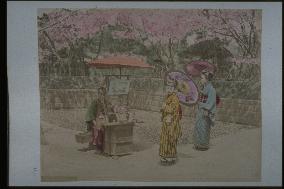
Two young women with parasols who have come to view cherry blossoms are stopping in front of a candy peddler. The candy peddler's shop is a foldable and therefore mobile structure. People are visible strolling in the distance.==Date:unknown, Place:unknown, Photo:unknown, (Credit:Nagasaki University Library/Kyodo News Images) [Cabinet Number83‐20‐0]

  •  
Enoshima coast

Enoshima coast

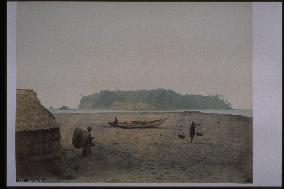
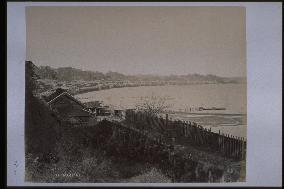
Photographer unknown. Entitled L25 Enoshima. The structure on the left could be a fisherman's shack. The name Enoshima appears in Azumakagami (chronicle of the Kamakura Shogunate) as follows: Mongaku built the Great Benzaiten at Enoshima on April 5th, 1182. Apparently Benten worship spread among commoners and samurai alike and many people visited the site.==Date:unknown, Place:Enoshima, Photo:A. Farsari, (Credit:Nagasaki University Library/Kyodo News Images) [Cabinet Number82‐20‐0]

  •  
Kiga Spa

Kiga Spa

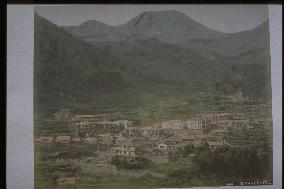
This photo captures the area around Kameya of Kiga Spa. The three-storied Jindairo of Kameya Inn is visible in the centre. Since the entrance of Kameya facing the new road between Miyanoshita and Miyagino can be seen, this photo was taken between 1889 and 1892 when the spa town of Kiga was lost in a fire. Hayakawa River flows on the right and one of the outer mountain ranges of Hakone, Myojingadake, is visible.==Date:unknown, Place:Hakone, Photo:A. Farsari, (Credit:Nagasaki University Library/Kyodo News Images) [Cabinet Number81‐20‐0]

  •  
Miyanoshita Spa

Miyanoshita Spa

Both Fujiya Hotel and Naraya Hotel were burnt by a large fire in the Miyanoshita area in 1883. The one-story building in the centre left is the Japanese-style Fujiya Hotel completed in 1885. The round building at the centre right is the Hermitage completed in 1886. Since the main building of the hotel is not visible, it indicates that this photo was taken between 1886 and 1890.==Date:unknown, Place:Hakone, Photo:unknown, (Credit:Nagasaki University Library/Kyodo News Images) [Cabinet Number79‐20‐0]

  •  
The city of Shinagawa facing the sea

The city of Shinagawa facing the sea

View of Tokyo from the northern edge of the Shinagawa Shuku (post town), where inns and rest stops for horses were located. The hill on the left indicates that this photograph was taken from around present-day Yatsuyama Bridge. The street in the foreground is probably the Tokaido Highway. This was taken by Felix Beato before train tracks were laid along the sea following land reclamation. Although Shinagawa Station was originally planned near Shinagawa Shuku, the local people were against the plan and eventually the station was built further north than originally planned. Photographs taken much later from the same angle indicate that the station was built behind the tree in the centre.==Date:unknown, Place:Tokyo, Photo:F. Beato, (Credit:Nagasaki University Library/Kyodo News Images) [Cabinet Number78‐20‐0]

  •  
Lake Chuzenji

Lake Chuzenji

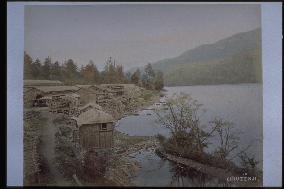
Rokken-jaya at the lakeside is viewed from the precincts of the Chugushi at Futarasan Shinto Shrine. The fact that not a single building is visible on the lakeside in the Utagahama area to the right indicates that the photograph was taken in the early Meiji Period. Also, no stone embankment work has been done at the lakeside near Rokken-jaya.==Date:unknown, Place:Nikko, Photo:R. Stillfried, (Credit:Nagasaki University Library/Kyodo News Images) [Cabinet Number77‐20‐0]

  •  
A man wearing hakama (traditional trousers)

A man wearing hakama (traditional trousers)

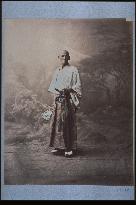
A man holds a fan in his right hand, a sword in his left hand, and a short sword at the waist. The short coat and pleated trousers were the typical casual attire of samurai.==Date:unknown, Place:unknown, Photo:R. Stillfried, (Credit:Nagasaki University Library/Kyodo News Images) [Cabinet Number76‐20‐0]

  •  
A gold cup and a cigarette case

A gold cup and a cigarette case

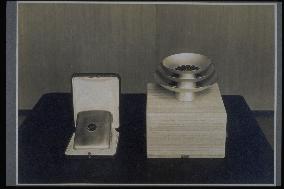
The chrysanthemum crest, denoted by the fourteen petals together in one layer, belongs to the imperial family. The golden cups are bequeathed by the Imperial Agency of Awards, but the meaning of the cups is unknown. Also, there are various cigarette cases with the chrysanthemum crest, but the story behind this one is unclear.==Date:unknown, Place:Tochigi, Photo:unknown, (Credit:Nagasaki University Library/Kyodo News Images) [Cabinet Number72‐20‐0]

  •  
Shintomi-za Theatre

Shintomi-za Theatre

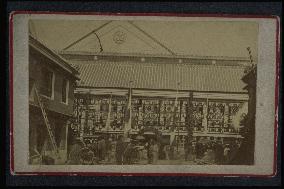
After Kabuki-za opened in 1889, Shintomi-za gradually lost its appeal. Renamed Fukaya-za in 1892 and Miyako-za in 1896, it again adopted the name of Shintomi-za in 1898. Although popular for many years with theatre aficionados, it was converted to a movie theatre of the same name after the Great Earthquake of Kanto of 1923. This is a business card-sized photograph taken in the mid-Meiji Period.==Date:unknown, Place:Tokyo, Photo:unknown, (Credit:Nagasaki University Library/Kyodo News Images) [Cabinet Number71‐20‐0]

  •  
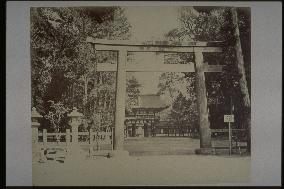
The torii gate on the approach to Hakone Shrine

The torii gate on the approach to Hakone Shrine

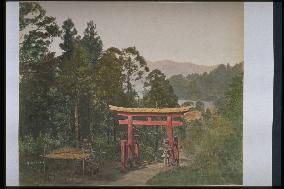
This is the Byobu Torii Gate stading at the entrance of Hakone Shrine after going down Gongen Slope of the old highway. There used to be a shack (possibly an amazake shop) on the right side of the gate during the Meiji Period. Instead, there is a shack-like place with just straw mat. Although there are many photos teken from the same angle, it is interesting to see the slight difference in each one.==Date:unknown, Place:Hakone, Photo:Usui Shuzaburo?, (Credit:Nagasaki University Library/Kyodo News Images) [Cabinet Number65‐20‐0]

  •  
Mt. Fuji seen from Iwabuchi,Tokaido Road

Mt. Fuji seen from Iwabuchi,Tokaido Road

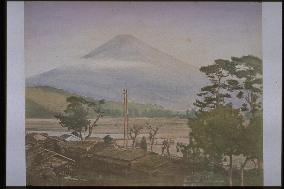
Northeastern view of Mt. Fuji from the terraced bank of Fuji River near Iwabuchi, Fujigawa-cho. Houses line the Tokaido Highway, and Fujigawa Bridge is visible on the north side of the town. Pine trees line the riverbank on the right, and Mt. Iwamoto is visible on the left. Fujigawa Bridge was built in the beginning of the Meiji Period. However, it was washed away and repaired many times.==Date:unknown, Place:Shizuoka, Photo:unknown, (Credit:Nagasaki University Library/Kyodo News Images) [Cabinet Number64‐20‐0]

  •  
Shimogamo Shirine

Shimogamo Shirine

View of the second torii gate and two-story romon gate of Shimogamo Shinto Shrine from the shrine approach, facing north. There is a stone lantern on the left and a wooden notice board on the right. The board probably carries a message prohibiting entry to carriages, hunting, fishing and the cutting of trees and plants. A coniferous forest with huge trees surrounds the area. This photo was taken by Felix Beato.==Date:unknown, Place:Kyoto, Photo:F. Beato, (Credit:Nagasaki University Library/Kyodo News Images) [Cabinet Number62‐20‐0]

  •  
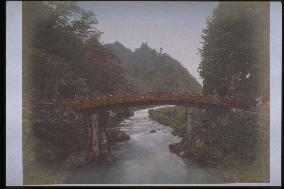
Shinkyo Bridge,the Daiyagawa River

Shinkyo Bridge,the Daiyagawa River

Shinkyo Bridge spans Daiya River at the entrance to Nikko-Sannai. The bridge is also called Jabashi (Snake Bridge), referring to the legend that the priest Shodoshonin, when founding Nikko, crossed the river by walking over two big snakes released by Shinja-Daio. The bridge in this photograph was washed away by a flood in 1902.==Date:unknown, Place:Nikko, Photo:unknown, (Credit:Nagasaki University Library/Kyodo News Images) [Cabinet Number61‐20‐0]

  •  
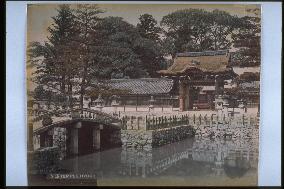
Rokuharamitsuji Temple

Rokuharamitsuji Temple

The Karamon Gate of Rokuson-o Shinto Shrine is seen facing east from the northeastern side of the Shinryu Pond. This shrine was rebuilt by Nankokushonin of Henjoshinin with the help of the Tokugawa Shogunate in 1702 and completed in 1707. It enshrines Rokuson-o (Minamoto Tsunemoto, a descendent of the Genji clan. The shape of the stone fence surrounding the pond indicates that this photograph was taken before 1911.==Date:unknown, Place:Kyoto, Photo:unknown, (Credit:Nagasaki University Library/Kyodo News Images) [Cabinet Number56‐20‐0]

  •  
Daibutsu (the Great Buddha) of Kamakura

Daibutsu (the Great Buddha) of Kamakura

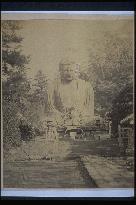
Bronze lotus petals (four existing today) are visible at the front of the pedestal of the Great Buddha. The building with a thatched roof on the right and the sharply raking finials on the cap of the lantern in the foreground are the same as those depicted in a photograph in the May 30th, 1870 issue of The Far East, indicating that it was taken around the same time. The Great Buddha is an object of worship and climbing upon it is prohibited today.==Date:unknown, Place:Kamakura, Photo:unknown, (Credit:Nagasaki University Library/Kyodo News Images) [Cabinet Number55‐20‐0]

  •  
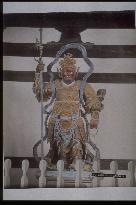
The Nio statue at Manpukuji Temple,Mt. Obaku

The Nio statue at Manpukuji Temple,Mt. Obaku

This photo captures the Zouchoutenzou, one of the Shiten'nos (guardian kings) at Manpukuji Temple at Mt. Oubaku. The statues of Shiten'nos here were built along with the statues of Kashosonja and Anansonja of the temple with the donation by Fukushimashinji of Ise and Eizoshinni of Kamakura in 1674 and it is reported that they were made by Yuzan and Koho.==Date:unknown, Place:Uji, Photo:unknown, (Credit:Nagasaki University Library/Kyodo News Images) [Cabinet Number54‐20‐0]

  •  
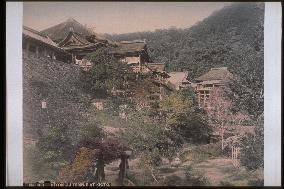
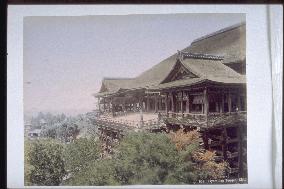
The stage of Kiyomizudera Temple,Kyoto

The stage of Kiyomizudera Temple,Kyoto

View (from the left) of Okuno-in, Amitabha Hall, and the main hall of Kiyomizu Temple, looking from the south garden. Mt. Otowa is visible in the background. A number of trees had been planted, but the South Garden was not as yet complete. The cherry trees and maple trees stand at irregular intervals, and the temple approach has not yet been made. This photo is thought to have been taken before 1898 when regular temple maintenance procedures were established.==Date:unknown, Place:Kyoto, Photo:unknown, (Credit:Nagasaki University Library/Kyodo News Images) [Cabinet Number52‐20‐0]

  •  
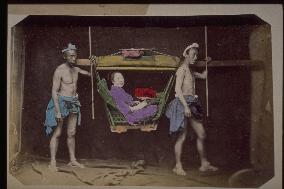
A girl in a basket palanquin

A girl in a basket palanquin

This may be a shitekago because the straw curtain seems to be rolled up. This kind of palanquin was made simply of four bamboo poles and braided bamboo sticks with straw curtain attached. The palanquin bearers had no set uniforms but carried ikizue (breath sticks) to regulate breathing. ==Date:unknown, Place:unknown, Photo:unknown, (Credit:Nagasaki University Library/Kyodo News Images) [Cabinet Number51‐20‐0]

  •  
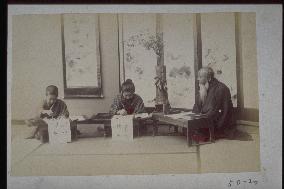
Calligraphy lesson

Calligraphy lesson

Children learn calligraphy under a master. Since this is an individual lesson, they are most likely from the wealthy class. A scroll, a byobu screen and arranged flowers are visible in the background.==Date:unknown, Place:unknown, Photo:unknown, (Credit:Nagasaki University Library/Kyodo News Images) [Cabinet Number50‐20‐0]

  •  
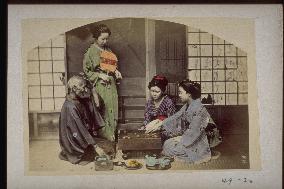
An old man and girls playing go

An old man and girls playing go

An elderly man in a haori coat is enjoying a game of go with young women in this portrayal of everyday life. He is patting his forehead playfully and acknowledging defeat. The woman standing on the left with a fan in her hand and the woman playing go wear their hair in tenjin-mage style. The woman in the middle wears hers in toin style. The background setting is a second-story zashiki guest room with a handrail and torn paper sliding doors. The outside scene is a studio prop. Taken in the mid-Meiji Period.==Date:unknown, Place:unknown, Photo:unknown, (Credit:Nagasaki University Library/Kyodo News Images) [Cabinet Number49‐20‐0]

  •  
Women enjoying the cool evening

Women enjoying the cool evening

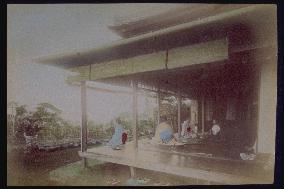
The sudare bamboo screens are rolled up to the eaves of the house, and removable doors and paper screens are put away to allow entry to the cool air. The older woman in front of the tokonoma alcove is holding a large fan. A shamisen lute is lying by the woman sitting with her back to the camera.==Date:unknown, Place:unknown, Photo:Tamamura Kozaburo, (Credit:Nagasaki University Library/Kyodo News Images) [Cabinet Number48‐20‐0]

  •  
Portrait of a woman

Portrait of a woman

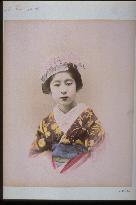
A portrait of the woman bust-up. Her eyes are strongly fixed on the camera, which conveys her strong will. She wears a decorative hair ornament, but it is not known whether it had a special meaning. It is a magnificent portrait.==Date:unknown, Place:unknown, Photo:Ogawa Kazumasa, (Credit:Nagasaki University Library/Kyodo News Images) [Cabinet Number45‐20‐0]

  •  
Shime-kazari,a sacred festoon,and a geisha

Shime-kazari,a sacred festoon,and a geisha

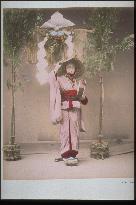
A geisha stands under the Shimekazari (rope decoration) dressed as a strolling singer (Torioi onna). Strolling singers collected donations wearing a braided hat and playing the shamisen.==Date:unknown, Place:unknown, Photo:Ogawa Kazumasa, (Credit:Nagasaki University Library/Kyodo News Images) [Cabinet Number44‐20‐0]

  •  
Grand Hotel

Grand Hotel

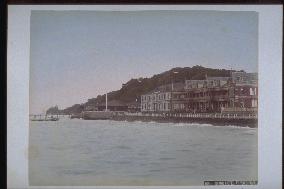
A view of the direction from the Bluff and the east corner of the Band. The Grand Hotel has the old building opened in 1873 and the new building numbered 18 and 19. This building was designed by the architect Salda of the French settlement, and was opened in 1887.==Date:unknown, Place:Yokohama, Photo:Kusakabe Kinbei, (Credit:Nagasaki University Library/Kyodo News Images) [Cabinet Number43‐20‐0]

  •  
The stage of Kiyomizudera Temple,Kyoto

The stage of Kiyomizudera Temple,Kyoto

The balcony off the main hall of Kiyomizu Temple seen from Okuno-in, facing west-northwest. There are two people on the balcony. The fallen leaves in the South Garden suggest winter. The balcony was renovated in 1633. The yosemune style building is roofed entirely with hinoki tree bark. Wings flank the west side and the east and west of the south side. The wooden fencing inside the railing is to prevent people from falling. The approach stretches westward to the left through the South Garden.==Date:unknown, Place:Kyoto, Photo:unknown, (Credit:Nagasaki University Library/Kyodo News Images) [Cabinet Number42‐20‐0]

  •  
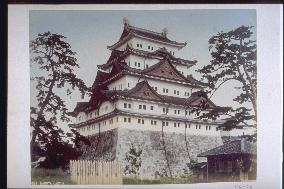
Nagoya Castle

Nagoya Castle

A close view of the castle tower before it was destroyed in the bombing of 1945. After it was completed in the 19th year of Keicho (1614), commercial houses, shrines, Buddhist temples were forced to move to the region near Nagoya castle from the area near Kiyosu Castle. This is the so-called Kiyosugoshi (moving from Kiyosu).==Date:unknown, Place:Nagoya, Photo:Kusakabe Kinbei, (Credit:Nagasaki University Library/Kyodo News Images) [Cabinet Number40‐20‐0]

  •  
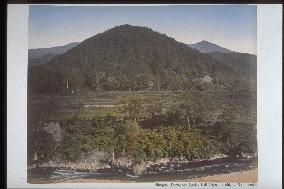
Great Nobi Earthquake (new lake at Neomura Midoridani)

Great Nobi Earthquake (new lake at Neomura Midoridani)

Rivers were stopped by mountains collapsing and the ground sinking in many places forming lakes like in this picture, by the Nobi earthquake. So flooding occurred in Neoya, and the inhabitants escaped to higher places.==Date:unknown, Place:Gifu, Photo:Kusakabe Kinbei, (Credit:Nagasaki University Library/Kyodo News Images) [Cabinet Number39‐20‐0]

  •  
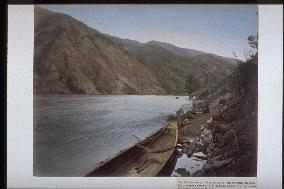
Site of Yoshinaka s castle at Nakasendo Miyanokoshi

Site of Yoshinaka s castle at Nakasendo Miyanokoshi

Kiso River runs to the fore, and the mountain to the rear is the Komagatake which is located to the north of the Kiso range. The peak of Komagateke is formed of the Main peak, middle peak, front peak, and Hokendake etc., and especially the Tengu Rock of Hokendake is famous for its rare shape.==Date:unknown, Place:Nagano, Photo:Kusakabe Kinbei, (Credit:Nagasaki University Library/Kyodo News Images) [Cabinet Number38‐20‐0]

  •  
Enoshima Island

Enoshima Island

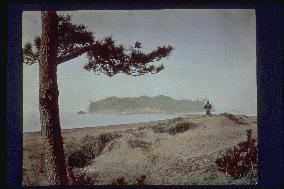
Enoshima from the opposite shore. The beach can be seen stretching to Enoshima to the right. A man stands facing in the direction of Enoshima on the dune with his back to the camera. A pine tree stands to the left.==Date:unknown, Place:Enoshima, Photo:unknown, (Credit:Nagasaki University Library/Kyodo News Images) [Cabinet Number37‐20‐0]

  • Main
  • Top
  • Editorial
  • Creative
  • About Us
  • About ILG
  • Terms of use
  • Company
  • BEHIND
  • Price List
  • Single Plan
  • Monthly Plan
  • Services
  • Shooting
  • Rights Clearance
  • Support
  • FAQ
  • How To Buy
  • Contact Us
  • Become a Partner

© KYODO NEWS IMAGES INC

All Rights Reserved.

  • Editorial
  • Olympics
  • News
  • Sports
  • Japan
  • Tech
  • Royal
  • Disaster
  • NorthKorea
  • Old Japan
  • SNS
  • Creative
  • Food
  • Japan
  • Landscape
  • Animal
  • Popular
  • #Ukraine
  • #China
  • #coronavirus
  • #N. Korea
  • #Thailand
  • #Russia
  • #Ukraine
  • #China
  • #coronavirus
  • #N. Korea
  • #Thailand
  • #Russia
  • Food
  • Japan
  • Landscape
  • Animal
  • Olympics
  • News
  • Sports
  • Japan
  • Tech
  • Royal
  • Disaster
  • NorthKorea
  • Old Japan
  • SNS