•  
Miyanoshita naraya inn

Miyanoshita naraya inn

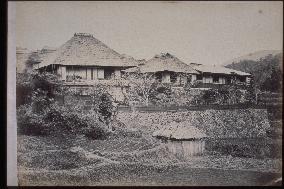
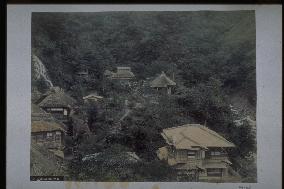
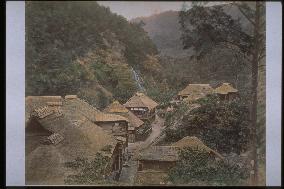
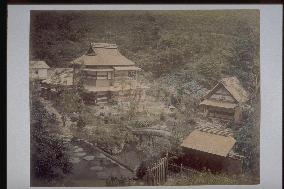
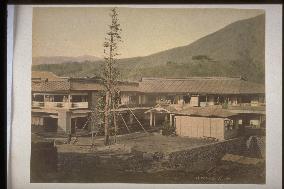
A Japanese building of the Naraya Hotel in Miyanoshita. This coincides with the information book of the seven spas. It was destroyed in the fire of 1884. This is an important photo because few pictures taken before that time remain. Emperor Meiji stayed at this hotel in 1874.==Date:unknown, Place:Hakone, Photo:unknown, (Credit:Nagasaki University Library/Kyodo News Images) [Cabinet Number19‐43‐0]

  •  
Dogashima Spa

Dogashima Spa

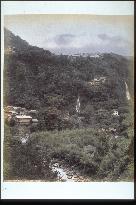
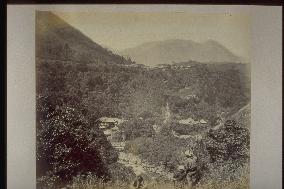
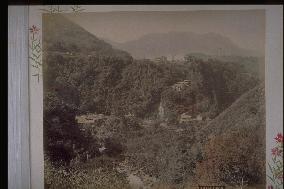
In the upper left are the houses in Miyanoshita, in the upper right the Naraya Hotel, in the lower left the Yamatoya, and to its right the former hermitage of Muso Kokushi. In the centre is the Shirabeno Falls, to the upper right of the falls is the Godan Hotel. The falls to the right of the hotel disappeared due to the expansion of the road. The building to the lower right is the present Taiseikan.==Date:unknown, Place:Hakone, Photo:Ogawa Kazumasa, (Credit:Nagasaki University Library/Kyodo News Images) [Cabinet Number9‐8‐0]

  •  
Miyanoshita Spa

Miyanoshita Spa

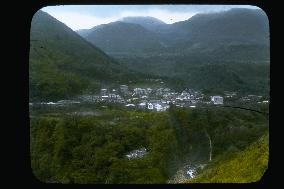
This is Miyanoshita as seen from Mukoyama. The white building in the centre is the Naraya Hotel completed n 1887. As Fujiya Hotel, built in 189,1 is visible behind, this photo was taken after that. The large two-story building at the right is the Tsutaya Ryokan (Inn). Shirasagi Waterfall and Hayakawa River are seen below. The building at the bottom centre is Godan Ryokan.==Date:unknown, Place:Hakone, Photo:unknown, (Credit:Nagasaki University Library/Kyodo News Images) [Cabinet Number98‐28‐0]

  •  
Miyanoshita Spa

Miyanoshita Spa

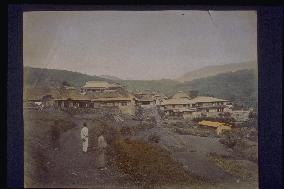
The building on the far left is Fujiya Hotel at the time of their grand opening. It was built in 1878 and was standing until December, 1883 when it was lost in a fire. The building to the right is Naraya Ryokan (inn) which was rebuilt after a fire of 1874. This photo is probably taken around the same time as that of catalogue #3313.==Date:unknown, Place:Hakone, Photo:Usui Shuzaburo, (Credit:Nagasaki University Library/Kyodo News Images) [Cabinet Number94‐43‐0]

  •  
Dogashima Spa

Dogashima Spa

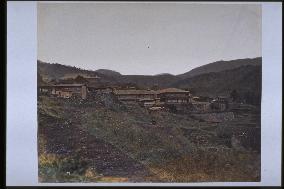
This is bDogashima. The building in the left foreground is Ohmiya Inn, Yamatoya is behind it, and continues on to Edoya. The building with a new roof is also Yamatoya. The hall on top of the stairs is Yamaiyama. The building behind it is the Hiramatsu villa which was built where Naraya Inn used to be. Since the villa was constructed around 1887, this photo was taken after that.==Date:unknown, Place:Hakone, Photo:unknown, (Credit:Nagasaki University Library/Kyodo News Images) [Cabinet Number93‐44‐0]

  •  
Naraya Hotel,Miyanoshita

Naraya Hotel,Miyanoshita

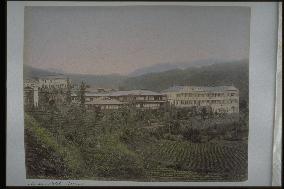
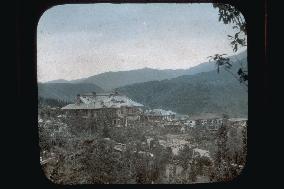
The white building on the right is Naraya Hotel. This Western-style structure was completed in 1887 after the great fire of Miyanoshita in 1883. The building on the left is the Hermitage of Fujiya Hotel built in 1886. Since the main building of the hotel is not in view, it may be assumed that this photo was taken between 1887 and 1891.==Date:unknown, Place:Hakone, Photo:unknown, (Credit:Nagasaki University Library/Kyodo News Images) [Cabinet Number87‐31‐0]

  •  
Dogashima Island

Dogashima Island

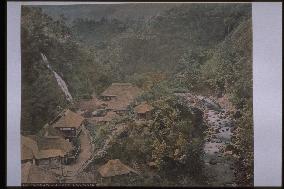
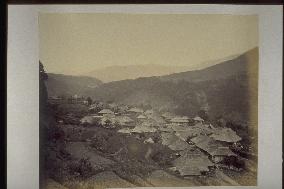
This is the spa town of Dogashima. The buildings are from the foreground, Ohmiya, Yamatoya across from it, Maruya is next to it, and then Edoya. The small hall above the stairs is Yamai-yama. Naraya stands behind it. The waterfall on the left is Shirabe and the river on the right is Hayakawa. There is a wooden bridge to cross to Mukoyama. Since the Hiramatsu villa is not visible, this photo was taken before 1887.==Date:unknown, Place:Hakone, Photo:A. Farsari, (Credit:Nagasaki University Library/Kyodo News Images) [Cabinet Number82‐22‐0]

  •  
Miyanoshita Spa

Miyanoshita Spa

Miyanoshita and Dogashima viewed from Mukoyama. The Fujiya and Naraya hotels are visible at Miyanoshita. Thus, this was taken after the completion of the main building of Fujiya Hotel in 1891, after the big fire of Miyanoshita in 1883. Godan Ryokan (inn) is also visible on the way to Dogashima. At both sides of the inn the falls of Shirabenotaki and Shirasaginotaki cascade. Hiramatsu villa stands under Godan Ryokan.==Date:unknown, Place:Hakone, Photo:Tamamura Kozaburo, (Credit:Nagasaki University Library/Kyodo News Images) [Cabinet Number80‐16‐0]

  •  
Miyanoshita Spa

Miyanoshita Spa

Both Fujiya Hotel and Naraya Hotel were burnt by a large fire in the Miyanoshita area in 1883. The one-story building in the centre left is the Japanese-style Fujiya Hotel completed in 1885. The round building at the centre right is the Hermitage completed in 1886. Since the main building of the hotel is not visible, it indicates that this photo was taken between 1886 and 1890.==Date:unknown, Place:Hakone, Photo:unknown, (Credit:Nagasaki University Library/Kyodo News Images) [Cabinet Number79‐20‐0]

  •  
Miyanoshita Spa

Miyanoshita Spa

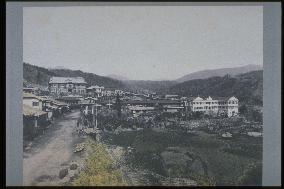
This is the rebuilt Miyanoshita Spa after the fire of 1883. The big building on the left is Fujiya Hotel, completed in 189,1and the white one on the right is Naraya Hotel, completed in 1887. The street on the left opened to Tonosawa in 1887. It eventually was known as the course of the Hakone Ekiden road race, the present-day National Route 1.==Date:unknown, Place:Hakone, Photo:Tamamura Kozaburo, (Credit:Nagasaki University Library/Kyodo News Images) [Cabinet Number68‐10‐0]

  •  
Miyanoshita Spa

Miyanoshita Spa

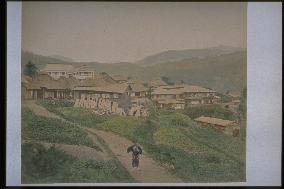
The building on the far left is Fujiya Hotel at the time of its grand opening. It was built in 1878 and was standing until December, 1883 when it was destroyed in a fire. The building to the right is Naraya Ryokan (inn) which was rebuilt after a fire in 1874. The road where a worker stands is the old Seven Hot Spring Road.==Date:unknown, Place:Hakone, Photo:Usui Shuzaburo?, (Credit:Nagasaki University Library/Kyodo News Images) [Cabinet Number65‐4‐0]

  •  
Dogashima Spa

Dogashima Spa

This is Dogashima. The building in the foreground is Ohmiya, Yamatoya across from it, Maruya next to it, and Edoya next to it. The small hall on top of the steps is Yamaiyama. Naraya is behind it. The waterfall on the left is Shirabe. Since the Hiramatsu villa is not visible, this photo was taken before 1887.==Date:unknown, Place:Hakone, Photo:unknown, (Credit:Nagasaki University Library/Kyodo News Images) [Cabinet Number64‐41‐0]

  •  
Miyanoshita Spa

Miyanoshita Spa

Both Fujiya Hotel and Naraya Hotel were burnt by a large fire in the Miyanoshita area in 1883. The one-story building in the centre left is the Japanese-style Fujiya Hotel completed in 1885. The round building at the centre right is the Hermitage completed in 1886. Since the main building of the hotel is not visible, it indicates that this photo was taken between 1886 and 1890.==Date:unknown, Place:Hakone, Photo:unknown, (Credit:Nagasaki University Library/Kyodo News Images) [Cabinet Number59‐82‐0]

  •  
Miyanoshita and Dogashima

Miyanoshita and Dogashima

Miyanoshita and Dogashima viewed from Mukoyama. The Fujiya and Naraya hotels are visible at Miyanoshita. Thus, this was taken after the completion of the main building of Fujiya Hotel in 1891, and after the big fire of Miyanoshita in 1883. Godan Ryokan (inn) is visible on the way to Dogashima and Shirabeno-taki, and Shirasagino-taki Falls cascade on both sides.==Date:unknown, Place:Hakone, Photo:unknown, (Credit:Nagasaki University Library/Kyodo News Images) [Cabinet Number59‐63‐0]

  •  
Naraya Hotel,Miyanoshita

Naraya Hotel,Miyanoshita

Naraya Hotel,Miyanoshita==Date:unknown, Place:Hakone, Photo:unknown, (Credit:Nagasaki University Library/Kyodo News Images)

  •  
Miyanoshita and Dogashima

Miyanoshita and Dogashima

During Edo era, there were Naraya, Edoya, Maruya, Yamatoya, and Ohmiya Inns in Dogashima. The two-story building on the left is Yamatoya, the red tower is Yakushi-do (a Buddhist temple hall housing a statue of Yakushi). The waterfall in the centre is Shirabeno-taki. Godan Ryokan Inn stands above the falls. The white western building on the hill is Naraya Hotel and Fujiuya Hotel is to its left. This photo was taken after the completion of the main buildings in 1891 after the big fire in 1883.==Date:unknown, Place:Hakone, Photo:Tamamura Kozaburo, (Credit:Nagasaki University Library/Kyodo News Images) [Cabinet Number48‐97‐0]

  •  
Owaku-dani Valley

Owaku-dani Valley

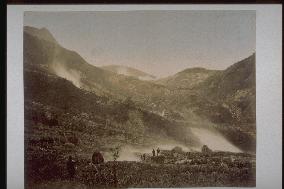
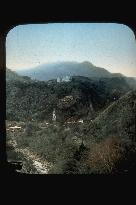
Owakudani is the crater formed by the erruption of Mt. Hakone. Until the beginning of Meiji, it was called Ohjigoku (Big Hell) and was believed to a place where spirits dwell. When Emperor and Empress Meiji spent time at Naraya Hotel of Miyanoshita in 1873, they thought it was unpleasant to have hell nearby, and therefore Ojigoku was renamed Owakudani. Some people are visible. The mountain on the left is Kanmuridake.==Date:unknown, Place:Hakone, Photo:unknown, (Credit:Nagasaki University Library/Kyodo News Images) [Cabinet Number47‐15‐0]

  •  
The Hakone post town

The Hakone post town

The Hiramatsu Villa was located at a corner of Dogashima Spa. Jinshiro Hiramatsu was a banker in Tokyo. He did not quite enjoy the cohlera epidemic in Tokyo in 1886. Consequently, he bought the site of old Naraya Hotel in Dogashima Spa. Pulling water from Shirabe Waterfall, he made a beautiful garden and built a houe with a teahouse and study surrounding it. This is the site of present-day Taiseikan Hotel.==Date:unknown, Place:Hakone, Photo:unknown, (Credit:Nagasaki University Library/Kyodo News Images) [Cabinet Number47‐12‐0]

  •  
Shrine among mountains

Shrine among mountains

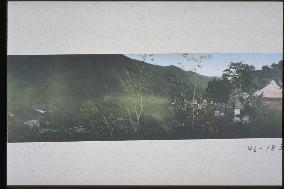
A view from the Fujiya Hotel. The left is the Naraya Hotel, the front mountain is the Myojogatake, and the right corner is the Kumano Gongen. The Odo Bunko which was built in 1894 by Chamberlain, who stayed for a long period at the Fujiya hotel, cannot be seen right under the Gongen, so the photo was probably taken before that.==Date:unknown, Place:Hakone, Photo:unknown, (Credit:Nagasaki University Library/Kyodo News Images) [Cabinet Number46‐183‐0]

  •  
Miyanoshita Spa

Miyanoshita Spa

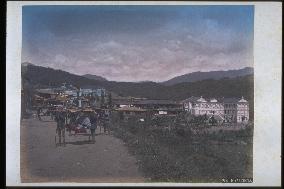
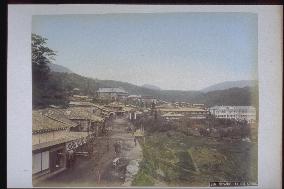
The roads of Miyanoshita are presently the national route no.1, and more or less takes the same course to this day. The right corner is the Naraya Hotel, and the Fujiya Hotel in the front has a hanging screen over it, and there are seats and lanterns indicating that there is a festival on. The people look as if they are waiting or something to begin.==Date:unknown, Place:Hakone, Photo:Kusakabe Kinbei, (Credit:Nagasaki University Library/Kyodo News Images) [Cabinet Number40‐15‐0]

  •  
Miyanoshita Spa

Miyanoshita Spa

The Naraya hotel before redecorating to the western style building, and the Fujiya Hotel before it was opened can be seen. This photo is the same as that numbered 3-37, and from the position of the person, style the hands are crossed etc., this is the original, and the photo numbered 3-37 is a photo of a samurai with added coloring.==Date:unknown, Place:Hakone, Photo:unknown, (Credit:Nagasaki University Library/Kyodo News Images) [Cabinet Number37‐70‐0]

  •  
Miyanoshita village

Miyanoshita village

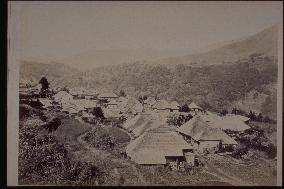
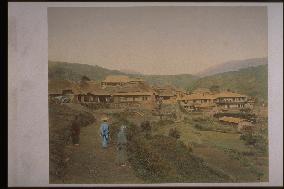
The Naraya Hotel can be seen, but not the Fujiya Hotel, so this photo was taken before 1877. Miyanoshita was a spa from the old days, with inns such as Fujiya, Naraya and Yamadaya and was famous for the stone bath of the Taiko in Sokokura. Baelz and Chamberlain also enjoyed the scenery.==Date:unknown, Place:Hakone, Photo:F. Beato, (Credit:Nagasaki University Library/Kyodo News Images) [Cabinet Number36‐6‐0]

  •  
Miyanoshita and Dogashima

Miyanoshita and Dogashima

Dogashima and Miyanoshita from the opposite shore of Haya River. In Dogashima, from left, are Omiya, Yamatoya and Edoya inns. The triangular roof is the hut of Musokokushi. The waterfall in the centre is Shirabeno Falls. In Miyanoshita, the Naraya Hotel and surrounding houses can be seen. The person in the picture is probably a carrier of photography equipment.==Date:unknown, Place:Hakone, Photo:F. Beato, (Credit:Nagasaki University Library/Kyodo News Images) [Cabinet Number36‐5‐0]

  •  
Fujiya Hotel,Miyanoshita

Fujiya Hotel,Miyanoshita

A photo of the Fujiya Hotel thought to be taken between 1892 and 1894 from the buildings in the picture. The hotel entered into a pact with its competitor Naraya Hotel, so that foreign guests were to stay at the Fujiya Hotel. This photo was probably taken by a foreign guest.==Date:unknown, Place:Hakone, Photo:unknown, (Credit:Nagasaki University Library/Kyodo News Images) [Cabinet Number31‐6‐0]

  •  
Miyanoshita Spa

Miyanoshita Spa

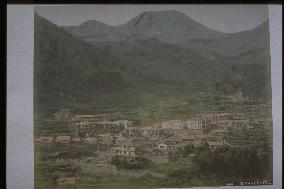
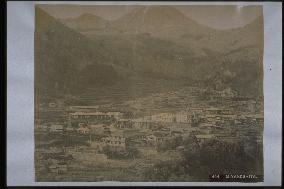
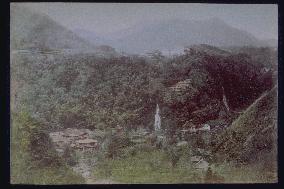
A view of Miyanoshita and Dogashima Spa from the opposite bank of Haya River. The white building in the centre is Naraya Hotel. Under that is the Godan Hotel. To the left below is Shirabeno Falls. The inns by the falls are from left, Omiya, Yamatoya and Edoya, and the triangular roof is the former hermitage of Musokokushi.==Date:unknown, Place:Hakone, Photo:unknown, (Credit:Nagasaki University Library/Kyodo News Images) [Cabinet Number31‐4‐0]

  •  
Miyanoshita hot spring inn

Miyanoshita hot spring inn

A photo of the Naraya Hotel in Miyanoshita. At present, the building and trees stand in the same state, but National Route 1 runs by the trees. The Naraya Hotel is one of the oldest hotels in Hakone at present, and many guests have stayed there, including Emperor Meiji and Empress Shoken.==Date:unknown, Place:Hakone, Photo:Tamamura Kozaburo, (Credit:Nagasaki University Library/Kyodo News Images) [Cabinet Number29‐4‐0]

  •  
Miyanoshita Spa

Miyanoshita Spa

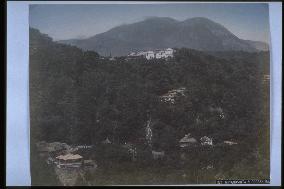
This overall view of Miyanoshita from the peak of Myojogadake has a rare structure. The white Western-style building is the Naraya Hotel, and the background is the Fujiya Hotel. The houses in the back are the Kowakudani, and the white building is the Sounkaku ,the summer house of the Mitsui family. The house to the bottom right may be Dr.Baelz's summer home.==Date:unknown, Place:Hakone, Photo:Ogawa Kazumasa, (Credit:Nagasaki University Library/Kyodo News Images) [Cabinet Number25‐83‐0]

  •  
Miyanoshita Spa

Miyanoshita Spa

A view of Miyanoshita Hot Springs in the autumn of 1872. In the right background is the Japanese-style Naraya Hotel, where many foreigners stayed there from the early days. There were still no wide roads where rickshaws could pass, so travelers had to rely on palanquins. The mountain to the right is Myojodake.==Date:unknown, Place:Hakone, Photo:unknown, (Credit:Nagasaki University Library/Kyodo News Images) [Cabinet Number19‐37‐0]

  •  
Dogashima Spa

Dogashima Spa

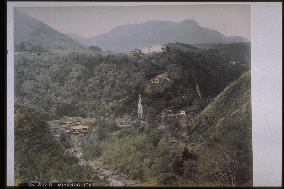
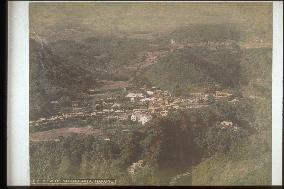
The scene around the Dogashima valley from the opposite side of Miyanoshita. The title shows that it was photographed by Shima Shukichi who started his business in 1878 in Miyanoshita. The central river below the falls is Haya River, and to the lower right of the falls is Taiseikan. To the upper right of the falls is the Godan hotel and above that is Naraya.==Date:unknown, Place:Hakone, Photo:Ogawa Kazumasa, (Credit:Nagasaki University Library/Kyodo News Images) [Cabinet Number5‐9‐0]

  •  
Miyanoshita Spa

Miyanoshita Spa

On the right is the Naraya hotel before it was redecorated in Western-style, and on the left is the Fujiya Hotel under construction. The Fujiya Hotel opened in 1879, so this is a rare photo depicting the hotel immediately before its opening. The bushi (warrior)-like person in the photo is also of interest.==Date:10th - 11th year of Meiji, Place:Hakone, Photo:Kusakabe Kinbei, (Credit:Nagasaki University Library/Kyodo News Images) [Cabinet Number3‐37‐0]

  • Main
  • Top
  • Editorial
  • Creative
  • About Us
  • About ILG
  • Terms of use
  • Company
  • BEHIND
  • Price List
  • Single Plan
  • Monthly Plan
  • Services
  • Shooting
  • Rights Clearance
  • Support
  • FAQ
  • How To Buy
  • Contact Us
  • Become a Partner

© KYODO NEWS IMAGES INC

All Rights Reserved.

  • Editorial
  • Olympics
  • News
  • Sports
  • Japan
  • Tech
  • Royal
  • Disaster
  • NorthKorea
  • Old Japan
  • SNS
  • Creative
  • Food
  • Japan
  • Landscape
  • Animal
  • Popular
  • #Ukraine
  • #Russia
  • #coronavirus
  • #N. Korea
  • #China
  • #Thailand
  • #Ukraine
  • #Russia
  • #coronavirus
  • #N. Korea
  • #China
  • #Thailand
  • Food
  • Japan
  • Landscape
  • Animal
  • Olympics
  • News
  • Sports
  • Japan
  • Tech
  • Royal
  • Disaster
  • NorthKorea
  • Old Japan
  • SNS