•  

Bank of Japan cuts purchases of Japanese government bonds

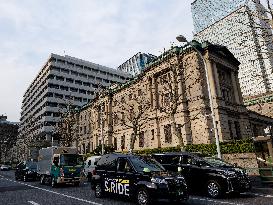
STORY: Bank of Japan cuts purchases of Japanese government bonds SHOOTING TIME: April 30, 2024 DATELINE: May 14, 2024 LENGTH: 00:01:44 LOCATION: Tokyo CATEGORY: ECONOMY SHOTLIST: 1. various of Bank of Japan 2. various of banks in Tokyo STORYLINE: The Bank of Japan (BOJ) on Monday announced a reduction of the amount of Japanese government bonds it offered to buy in a regular purchase operation. The central bank offered to buy 425 billion yen (about 2.73 billion U.S. dollars) in Japanese government bonds with five to 10 years left to maturity, down 50 billion yen from the previous such operation. The benchmark yield on the 10-year Japanese government bond subsequently climbed to a six-month high of 0.935 percent at one point. The reduction was the first since the BOJ in March adjusted its massive monetary easing, including ending its negative interest rate policy. Some market participants saw the move as the BOJ's latest effort to counter the weakening yen. BOJ Governor Kazuo Ueda has said r

  •  

Bank of Japan keeps interest rate unchanged, yen sinks below 156

STORY: Bank of Japan keeps interest rate unchanged, yen sinks below 156 SHOOTING TIME: file DATELINE: April 27, 2024 LENGTH: 00:01:37 LOCATION: Tokyo CATEGORY: ECONOMY SHOTLIST: 1. various of Bank of Japan 2. various of city view in Tokyo 3. various of fresh food in supermarkets 4. various of city view in Tokyo STORYLINE: The Japanese central bank on Friday maintained its policy rate unchanged after wrapping up its two-day policy meeting, which sent the Japanese yen to its fresh 34-year low past the 156 line. The Bank of Japan (BOJ) decided to guide short-term interest rates in a range of zero and 0.1 percent, a month after it ended the negative interest rate policy in its first rate hike in 17 years. The announcement weakened the country's currency against the U.S. dollar to the lowest level since May 1990, raising the risk of forex intervention by Japanese authorities. The BOJ, which also maintained its policy regarding government bond buying, said the country's core inflation, which excludes volatile

  •  

BOJ ends negative rate policy

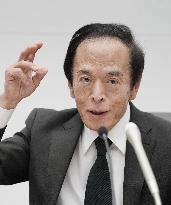
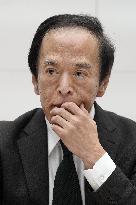
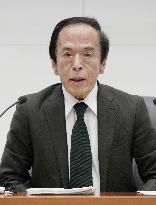
TOKYO, Japan, March 19 Kyodo -Bank of Japan Governor Kazuo Ueda holds a press conference at the central bank's headquarters in Tokyo on March 19, 2024, after the BOJ decided to end its negative interest rate policy at a two-day policy-setting meeting.(Kyodo)

  •  

[Breaking News]BOJ ends negative rate policy

TOKYO, Japan, March 19 Kyodo -Bank of Japan Governor Kazuo Ueda holds a press conference at the central bank's headquarters in Tokyo on March 19, 2024, after the BOJ decided to end its negative interest rate policy at a two-day policy-setting meeting.(Kyodo)

  •  
JAPAN-INTEREST RATE POLICY

JAPAN-INTEREST RATE POLICY

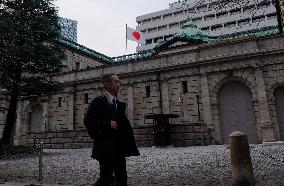
(240319) -- TOKYO, March 19, 2024 (Xinhua) -- The Bank of Japan is pictured in Tokyo, Japan, March 19, 2024. The Bank of Japan (BOJ) on Tuesday decided to end its negative interest rate policy in its first rate hike in 17 years, marking a major shift away from the long-running monetary easing that Japan has seen over the past decade to put an end to deflation. (Xinhua/Zhang Xiaoyu)

  •  
JAPAN-INTEREST RATE POLICY

JAPAN-INTEREST RATE POLICY

(240319) -- TOKYO, March 19, 2024 (Xinhua) -- A man walks past the Bank of Japan in Tokyo, Japan, March 19, 2024. The Bank of Japan (BOJ) on Tuesday decided to end its negative interest rate policy in its first rate hike in 17 years, marking a major shift away from the long-running monetary easing that Japan has seen over the past decade to put an end to deflation. (Xinhua/Zhang Xiaoyu)

  •  
Japan PM, BOJ chief meeting

Japan PM, BOJ chief meeting

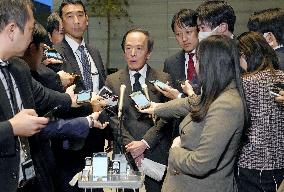
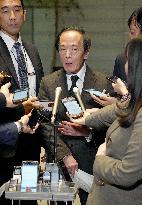
Bank of Japan Governor Kazuo Ueda (C) speaks to reporters at the premier's office in Tokyo on March 19, 2024, after holding talks with Prime Minister Fumio Kishida following the central bank's decision to end its negative interest rate policy.

  •  
Japan PM, BOJ chief meeting

Japan PM, BOJ chief meeting

Bank of Japan Governor Kazuo Ueda speaks to reporters at the premier's office in Tokyo on March 19, 2024, after holding talks with Prime Minister Fumio Kishida following the central bank's decision to end its negative interest rate policy.

  •  
BOJ ends negative rate policy

BOJ ends negative rate policy

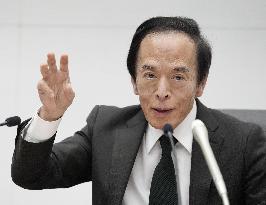
Bank of Japan Governor Kazuo Ueda holds a press conference at the central bank's headquarters in Tokyo on March 19, 2024, after the BOJ decided to end its negative interest rate policy at a two-day policy-setting meeting.

  •  
BOJ ends negative rate policy

BOJ ends negative rate policy

Bank of Japan Governor Kazuo Ueda holds a press conference at the central bank's headquarters in Tokyo on March 19, 2024, after the BOJ decided to end its negative interest rate policy at a two-day policy-setting meeting.

  •  
BOJ ends negative rate policy

BOJ ends negative rate policy

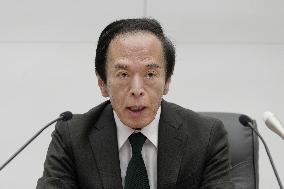
Bank of Japan Governor Kazuo Ueda holds a press conference at the central bank's headquarters in Tokyo on March 19, 2024, after the BOJ decided to end its negative interest rate policy at a two-day policy-setting meeting.

  •  

Bank of Japan ends negative interest rates in historic policy overhaul

STORY: Bank of Japan ends negative interest rates in historic policy overhaul SHOOTING TIME: Earlier footage DATELINE: March 19, 2024 LENGTH: 0:00:41 LOCATION: Tokyo CATEGORY: ECONOMY SHOTLIST: 1. various of the Bank of Japan 2. various of city views in Tokyo STORYLINE: The Bank of Japan (BOJ) on Tuesday decided to end its negative interest rate policy in its first rate hike in 17 years, marking a major shift away from the long-running monetary easing that Japan has seen over the past decade to put an end to deflation. After a two-day policy meeting, the central bank's policy board decided to guide short-term rate to a range of 0 to 0.1 percent, up a fraction from minus 0.1 to 0 percent, judging that its goal of attaining a stable 2 percent inflation is "in sight." "It came into sight that the price stability target of 2 percent would be achieved in a sustainable and stable manner," the BOJ said in a post-meeting statement. On top of returning to positive rates, the BOJ also decided to scrap it

  •  
BOJ ends negative rate

BOJ ends negative rate

Bank of Japan governor Kazuo Ueda holds a press conference in Tokyo on March 19, 2024, after the central bank decided to end its long-running negative interest rate policy, raising its key short-term interest rates for the first time in 17 years at a two-day policy-setting meeting.

  •  
BOJ ends negative rate

BOJ ends negative rate

Bank of Japan governor Kazuo Ueda holds a press conference in Tokyo on March 19, 2024, after the central bank decided to end its long-running negative interest rate policy, raising its key short-term interest rates for the first time in 17 years at a two-day policy-setting meeting.

  •  

India's wholesale inflation contracts 0.52 pct in Oct.

STORY: India's wholesale inflation contracts 0.52 pct in Oct. SHOOTING TIME: Nov. 10, 2023 DATELINE: Nov. 15, 2023 LENGTH: 00:01:36 LOCATION: New Delhi CATEGORY: ECONOMY SHOTLIST: 1. various of the India Gate 2. various of wholesale market area 3. various of fuel station 4. various of traffic STORYLINE: India's wholesale price index (WPI) contracted 0.52 percent in October, data released by the federal ministry of commerce and industry showed Tuesday. WPI inflation, an indicator of prices in the wholesale market rises or falls mainly due to steep increases or decreases in commodity prices. WPI-based inflation rate has been in the negative zone for the seventh month since April in the South Asian country. WPI food inflation decreased from 1.54 percent in September to 1.07 percent in October. The index for the manufactured products group in October remained at 140.3 (provisional), the same as in September. The index for primary articles group increased 5 percent to 184.5 (provisional) in October from 18

  •  

Turkish inflation keeps rising, adding burden to ordinary Turks

STORY: Turkish inflation keeps rising, adding burden to ordinary Turks DATELINE: Oct. 4, 2023 LENGTH: 00:02:12 LOCATION: Ankara CATEGORY: ECONOMY SHOTLIST: 1. various of people on the streets 2. SOUNDBITE 1 (Turkish): HASAN DENIZ ARPACI, Unemployed mechanical engineer 3. SOUNDBITE 2 (Turkish): OZAN SENOL, Student STORYLINE: According to the Turkish Statistical Institute, Türkiye's annual inflation rate rose to 61.53 percent in Sept., climbing for a third straight month since it started to slide from Oct. last year. Due to runaway inflation, Turks are often on a bargain hunt for deals. SOUNDBITE 1 (Turkish): HASAN DENIZ ARPACI, Unemployed mechanical engineer "We have to juggle between several stores to find cheaper goods but then risk spending more transport fares. I don't see a bright future ahead of us. This high inflation will create high unemployment, impact further the economy in a negative way, and create social problems. Inflation has impacted everyone." SOUNDBITE 2 (Turkish): OZAN SENOL, Student

  •  

U.S. homebuilder sentiment turns negative for first time in five months

STORY: U.S. homebuilder sentiment turns negative for first time in five months DATELINE: Sept. 19, 2023 LENGTH: 00:01:02 LOCATION: Washington D.C. CATEGORY: ECONOMY SHOTLIST: 1. various of construction sites 2. various of local residential areas STORYLINE: U.S. homebuilder confidence dropped below the key break-even measure of 50 for the first time in five months amid high mortgage rates, according to the National Association of Home Builders (NAHB)/Wells Fargo Housing Market Index (HMI) released Monday. Builder confidence in the market for newly-built single-family homes in September fell five points to 45, as persistently high mortgage rates above 7 percent continue to erode builder confidence, the association said in a statement. The decrease follows a 6-point drop in August. The average rate on the 30-year fixed mortgage has been over 7 percent since June, due to the U.S. Federal Reserve's aggressive rate hikes since March last year. The target range for the federal funds rate is at 5.25 percent to 5

  •  

Moody's downgrades Egypt's ratings to B3, changes outlook to stable

STORY: Moody's downgrades Egypt's ratings to B3, changes outlook to stable DATELINE: Feb. 9, 2023 LENGTH: 00:00:46 LOCATION: Cairo CATEGORY: ECONOMY SHOTLIST: 1. various of the central bank of Egypt 2. various of vessels in Egypt 3. various of a fuel station in Egypt STORYLINE: Moody's Investors Service lowered Egypt's long-term foreign-currency and local-currency issuer ratings to B3 from B2. In its ranking report published on Tuesday, Moody's also changed outlook to "stable from negative." The report cited that the downgrade to B3 reflects Egypt's reduced external buffers and shock absorption capacity while the economy undergoes a structural change toward a more export- and private sector-led growth model under a flexible exchange rate regime. The International Monetary Fund (IMF) approved a three-billion U.S. dollar financial support package to Egypt in December 2023 amid a commitment to flexible currency and monetary reforms. Over the past year, the Egyptian currency had depreciated by nearly 50 pe

  •  

Malaysia's IPI up 3 pct in December

STORY: Malaysia's IPI up 3 pct in December DATELINE: Feb. 8, 2023 LENGTH: 00:02:15 LOCATION: Kuala Lumpur CATEGORY: ECONOMY SHOTLIST: 1. various of Malaysia's national flag and Kuala Lumpur street views 2. various of traffic 3. various of trucks on road 4. various of container vessels at Northport of Port Klang, Selangor STORYLINE: Malaysia's industrial production index (IPI) rose 3 percent in December 2022, spearheaded by expansion in manufacturing and mining sectors, official data showed Tuesday. The mining index and manufacturing index grew 4.1 percent and 3 percent, respectively in December 2022, the Department of Statistics Malaysia said in a statement. The electricity index, however, turned downward to negative 1.1 percent during the month. In terms of month-on-month comparison, the IPI weakened by 0.6 percent as against the expansion of 0.9 percent registered in the previous month. Overall, for the final quarter of 2022, the IPI grew at a slower rate of 4.1 percent as compared to 12.2

  •  

Spain posts 5.5 pct GDP growth in 2022

STORY: Spain posts 5.5 pct GDP growth in 2022 DATELINE: Jan. 28, 2023 LENGTH: 00:01:12 LOCATION: Madrid CATEGORY: ECONOMY SHOTLIST: 1. various of different sectors of the Spanish economy STORYLINE: Spain's economy grew by 5.5 percent in 2022, the country's Statistical Office (INE) said on Friday. Gross domestic product (GDP) increased by 0.2 percent in the final quarter of last year, allowing for an annual growth of 5.5 percent, despite the negative effects of the ongoing conflict in Ukraine. Economic growth was considerably higher in 2022 than the government's forecast of 4.4 percent and the Bank of Spain's projection of 4.5 percent. Prime Minister Pedro Sanchez welcomed the news, highlighting "the solidity and resilience of the Spanish economy." He also recalled that Spain had created 278,900 jobs in 2022 and had its lowest unemployment rate since 2008. In 2021, the country logged 5.1 percent GDP growth against a 10.8 percent contraction the year before due to the COVID-19 pandemic. P

  •  
FSA to monitor effects of negative interest rate on banks: Aso

FSA to monitor effects of negative interest rate on banks: Aso

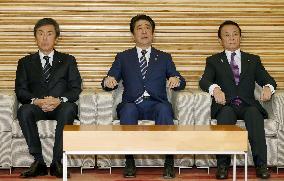
TOKYO, Feb. 2 Kyodo - Japanese Prime Minister Shinzo Abe (C), Economic and Fiscal Policy Minister Nobuteru Ishihara (L) and Finance Minister Taro Aso attend a Cabinet meeting in Tokyo on Feb. 2, 2016. Aso later told a press conference that the government will monitor the effects of the Bank of Japan's negative interest policy on financial institutions.

  •  
Ex-MOF official doubts China will make quick forex shift

Ex-MOF official doubts China will make quick forex shift

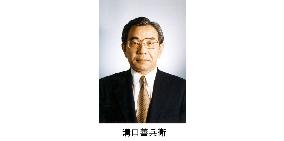
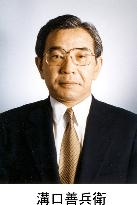
TOKYO, Japan - Zembei Mizoguchi (in file photo), a former Japanese vice finance minister for international affairs and now president of the Japan Center for International Finance, says in a media interview that China making an early shift in its foreign exchange rate policy is unlikely due to potentially enormous negative effects on its economy.

  •  

U.S. Fed's rate hikes lead to currency devaluation, inflation worldwide

STORY: U.S. Fed's rate hikes lead to currency devaluation, inflation worldwide DATELINE: Sept. 23, 2022 LENGTH: 00:02:06 LOCATION: Beijing CATEGORY: ECONOMY SHOTLIST: 1. various of the U.S. Federal Reserve and U.S. dollar related footage 2. SOUNDBITE 1 (English): JAMES MORRISON, Associate professor, London School of Economics and Political Science 3. SOUNDBITE 2 (English): MIR MOHAMMAD ALI KHAN, Former investment banker at Wall Street 4. SOUNDBITE 3 (Turkish): MURAT TUFAN, Analyst with Turkish broadcaster Ekoturk STORYLINE: The U.S. Federal Reserve on Wednesday enacted the third consecutive three-quarter-point rate hike as it continued to ramp up its fight against surging inflation. Experts have warned of various negative impacts of the rate hikes on the global economy, including currency devaluation and high inflation. SOUNDBITE 1 (English): JAMES MORRISON, Associate professor, London School of Economics and Political Science "Will there be negative effects in the global economy by these rises in intere

  •  

Scholars warn negative effects of U.S. interest rate hikes on global economy

STORY: Scholars warn negative effects of U.S. interest rate hikes on global economy DATELINE: Sept. 22, 2022 LENGTH: 0:01:24 LOCATION: Washington D.C. CATEGORY: ECONOMY SHOTLIST: 1. various of the U.S. 2. SOUNDBITE 1 (English): JAMES MORRISON, Associate professor, London School of Economics and Political Science 3. SOUNDBITE 2 (Turkish): ENVER ERKAN, Chief economist at Istanbul's Tera Securities 4. various of Türkiye 5. SOUNDBITE 3 (Turkish): KAYA ARDIC, Scholar, Piri Reis University, Türkiye STORYLINE: The U.S. Federal Reserve on Wednesday enacted the third consecutive three-quarter-point rate hike, as it continues to ramp up its fight against surging inflation. The Federal Open Market Committee (FOMC), the Fed's policy-setting body, decided to raise the target range for the federal funds rate to 3 to 3.25 percent. The Fed's latest action came after it raised the benchmark interest rate by three-quarters of a point (75 basis points) at both its June and July meetings, marking the boldest move in d

  •  

EU's economic outlook dimmed by inflation, energy crisis

STORY: EU's economic outlook dimmed by inflation, energy crisis DATELINE: Aug. 16, 2022 LENGTH: 00:01:57 LOCATION: BRUSSELS CATEGORY: ECONOMY SHOTLIST: 1. various of the views in European countries 2. SOUNDBITE 1 (English): OSCAR, Unemployed citizen in Germany 3. SOUNDBITE 2 (English): PAUL, Accounting manager in Germany 4. SOUNDBITE 3 (Hungarian): MARA KISS, Bakery shop owner in Hungary STORYLINE: The inflations in Europe have been constantly hitting new highs for quite a while, leading to weak consumption. In face of a potential energy supply shortage, the European Union's voluntary energy cut plans are also questioned. Under the attack by inflation and the energy crisis, the economic outlook in Europe has become increasingly bleak with a lingering risk of recession. Under the combined effect of several negative factors including the backlash of sanctions and the spillover effect of the United States' aggressive interest rate hikes, the ramifications of the surge in energy prices are seen everywhere in

  •  

Turkey keeps benchmark interest rate unchanged for 4th straight month

STORY: Turkey keeps benchmark interest rate unchanged for 4th straight month DATELINE: April 15, 2022 LENGTH: 00:01:04 LOCATION: Ankara CATEGORY: ECONOMY SHOTLIST: 1. Various of Turkish central bank 2. Various of Turkish lira 3. Various of Turkish people at ATM 4. Various of Turkish people at fresh vegetable bazaar (courtesy of Ihlas news agency) 5. Various of cars on the streets in Turkey 6. Various of a gas station in Turkey 7. Various of Turkish central bank 8. Various of Turkish President Recep Tayyip Erdogan 9. Various of Turkish people at a supermarket STORYLINE: Turkey's central bank kept its benchmark interest rate unchanged at 14 percent for a fourth straight month on Thursday despite the rising inflation. The recent increase in inflation has been driven by rising energy costs resulting from geopolitical developments and strong negative supply shocks caused by the rise in global energy, food and agricultural commodity prices, the central bank's Monetary Policy Committee (MPC) said. The MP

  •  
GERMANY-FRANKFURT-COVID-19-2G PLUS-RULE

GERMANY-FRANKFURT-COVID-19-2G PLUS-RULE

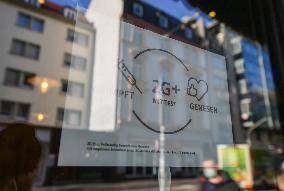
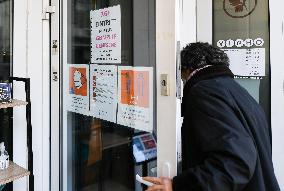
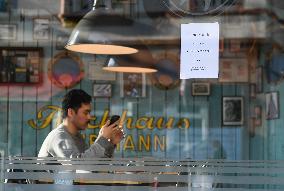
(220110) -- FRANKFURT, Jan. 10, 2022 (Xinhua) -- Photo taken on Jan. 10, 2022 shows a sign notifying people of the "2G+" anti-epidemic rules against COVID-19 at a restaurant in Frankfurt, Germany. Germany's seven-day COVID-19 incidence rate per 100,000 inhabitants continued to rise and reached 375.7, up from 362.7 on the previous day, the Robert Koch Institute (RKI) for infectious diseases reported on Monday. Last Friday, the German and federal state governments had agreed on a so-called 2G-plus rule for the gastronomy sector, limiting access to vaccinated and recovered people with negative COVID-19 tests and people with booster vaccinations only. (Xinhua/Lu Yang)

  •  
GERMANY-FRANKFURT-COVID-19-2G PLUS-RULE

GERMANY-FRANKFURT-COVID-19-2G PLUS-RULE

(220110) -- FRANKFURT, Jan. 10, 2022 (Xinhua) -- Photo taken on Jan. 10, 2022 shows a sign notifying people of the "2G+" anti-epidemic rules against COVID-19 outside a restaurant in Frankfurt, Germany. Germany's seven-day COVID-19 incidence rate per 100,000 inhabitants continued to rise and reached 375.7, up from 362.7 on the previous day, the Robert Koch Institute (RKI) for infectious diseases reported on Monday. Last Friday, the German and federal state governments had agreed on a so-called 2G-plus rule for the gastronomy sector, limiting access to vaccinated and recovered people with negative COVID-19 tests and people with booster vaccinations only. (Xinhua/Lu Yang)

  •  
GERMANY-FRANKFURT-COVID-19-2G PLUS-RULE

GERMANY-FRANKFURT-COVID-19-2G PLUS-RULE

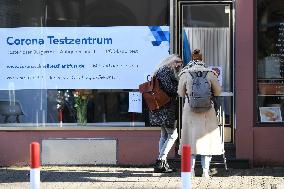
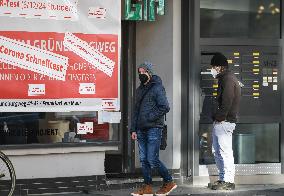
(220110) -- FRANKFURT, Jan. 10, 2022 (Xinhua) -- People wait outside a COVID-19 test center in Frankfurt, Germany, Jan. 10, 2022. Germany's seven-day COVID-19 incidence rate per 100,000 inhabitants continued to rise and reached 375.7, up from 362.7 on the previous day, the Robert Koch Institute (RKI) for infectious diseases reported on Monday. Last Friday, the German and federal state governments had agreed on a so-called 2G-plus rule for the gastronomy sector, limiting access to vaccinated and recovered people with negative COVID-19 tests and people with booster vaccinations only. (Xinhua/Lu Yang)

  •  
GERMANY-FRANKFURT-COVID-19-2G PLUS-RULE

GERMANY-FRANKFURT-COVID-19-2G PLUS-RULE

(220110) -- FRANKFURT, Jan. 10, 2022 (Xinhua) -- Photo taken on Jan. 10, 2022 shows a sign notifying people of the "2G+" anti-epidemic rules against COVID-19 outside a restaurant in Frankfurt, Germany. Germany's seven-day COVID-19 incidence rate per 100,000 inhabitants continued to rise and reached 375.7, up from 362.7 on the previous day, the Robert Koch Institute (RKI) for infectious diseases reported on Monday. Last Friday, the German and federal state governments had agreed on a so-called 2G-plus rule for the gastronomy sector, limiting access to vaccinated and recovered people with negative COVID-19 tests and people with booster vaccinations only. (Xinhua/Lu Yang)

  •  
GERMANY-FRANKFURT-COVID-19-2G PLUS-RULE

GERMANY-FRANKFURT-COVID-19-2G PLUS-RULE

(220110) -- FRANKFURT, Jan. 10, 2022 (Xinhua) -- People wait outside a COVID-19 test center in Frankfurt, Germany, Jan. 10, 2022. Germany's seven-day COVID-19 incidence rate per 100,000 inhabitants continued to rise and reached 375.7, up from 362.7 on the previous day, the Robert Koch Institute (RKI) for infectious diseases reported on Monday. Last Friday, the German and federal state governments had agreed on a so-called 2G-plus rule for the gastronomy sector, limiting access to vaccinated and recovered people with negative COVID-19 tests and people with booster vaccinations only. (Xinhua/Lu Yang)

  •  
GERMANY-FRANKFURT-COVID-19-2G PLUS-RULE

GERMANY-FRANKFURT-COVID-19-2G PLUS-RULE

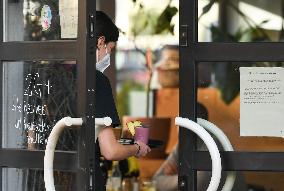
(220110) -- FRANKFURT, Jan. 10, 2022 (Xinhua) -- A customer enters a restaurant with signs notifying people of the "2G+" anti-epidemic rules against COVID-19 in Frankfurt, Germany, Jan. 10, 2022. Germany's seven-day COVID-19 incidence rate per 100,000 inhabitants continued to rise and reached 375.7, up from 362.7 on the previous day, the Robert Koch Institute (RKI) for infectious diseases reported on Monday. Last Friday, the German and federal state governments had agreed on a so-called 2G-plus rule for the gastronomy sector, limiting access to vaccinated and recovered people with negative COVID-19 tests and people with booster vaccinations only. (Xinhua/Lu Yang)

  •  
GERMANY-FRANKFURT-COVID-19-2G PLUS-RULE

GERMANY-FRANKFURT-COVID-19-2G PLUS-RULE

(220110) -- FRANKFURT, Jan. 10, 2022 (Xinhua) -- A customer waits to be served at a restaurant with a sign notifying people of the "2G+" anti-epidemic rules against COVID-19 in Frankfurt, Germany, Jan. 10, 2022. Germany's seven-day COVID-19 incidence rate per 100,000 inhabitants continued to rise and reached 375.7, up from 362.7 on the previous day, the Robert Koch Institute (RKI) for infectious diseases reported on Monday. Last Friday, the German and federal state governments had agreed on a so-called 2G-plus rule for the gastronomy sector, limiting access to vaccinated and recovered people with negative COVID-19 tests and people with booster vaccinations only. (Xinhua/Lu Yang)

  •  
Ex-MOF official doubts China will make quick forex shift

Ex-MOF official doubts China will make quick forex shift

TOKYO, Japan - Zembei Mizoguchi (in file photo), a former Japanese vice finance minister for international affairs and now president of the Japan Center for International Finance, says in a media interview that China making an early shift in its foreign exchange rate policy is unlikely due to potentially enormous negative effects on its economy. (Kyodo)

  •  
Shirakawa reiterates BOJ focus on negative effects of rate cuts

Shirakawa reiterates BOJ focus on negative effects of rate cuts

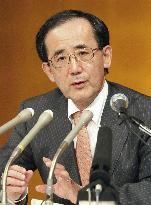
FUKUOKA, Japan - Bank of Japan Governor Masaaki Shirakawa speaks during a press conference in Fukuoka on Dec. 1. He again expressed his reluctance to cut interest rates, saying the central bank is concerned about the adverse effects of too much credit easing and that priority should be given to ensuring money markets work appropriately. (Kyodo)

  •  
BOJ chief says "positive" impact of negative rate on economy emerging

BOJ chief says "positive" impact of negative rate on economy emerging

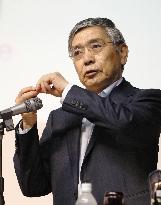
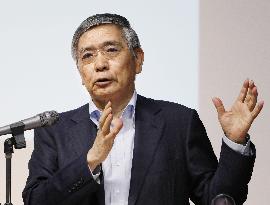
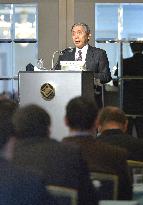
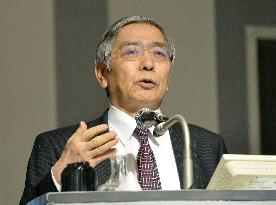
Bank of Japan Governor Haruhiko Kuroda delivers a speech at Keio University in Tokyo on June 20, 2016. Kuroda said he sees a "positive" impact emerging on the real economy from the BOJ's negative interest rate. (Kyodo) ==Kyodo

  •  
BOJ chief says "positive" impact of negative rate on economy emerging

BOJ chief says "positive" impact of negative rate on economy emerging

Bank of Japan Governor Haruhiko Kuroda delivers a speech at Keio University in Tokyo on June 20, 2016. Kuroda said he sees a "positive" impact emerging on the real economy from the BOJ's negative interest rate. (Kyodo) ==Kyodo

  •  
BOJ board member says to be watchful of monetary easing effects

BOJ board member says to be watchful of monetary easing effects

Bank of Japan Policy Board member Yukitoshi Funo attends a press conference after giving a lecture in the western Japanese city of Kobe on March 23, 2016. Funo said that the central bank needs to steadily implement monetary easing measures including the negative interest rate to achieve its inflation target, though attention needs to be paid to their various effects on the economy. (Kyodo) ==Kyodo

  •  
BOJ holds 2nd day of policy meeting

BOJ holds 2nd day of policy meeting

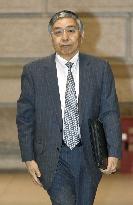
Bank of Japan Governor Haruhiko Kuroda arrives at the BOJ's head office in Tokyo on March 15, 2016, to attend the second day of a two-day policy meeting to examine the effects of a surprise decision in January to adopt a negative interest rate. (Kyodo) ==Kyodo

  •  
BOJ chief Kuroda attends upper house budget panel

BOJ chief Kuroda attends upper house budget panel

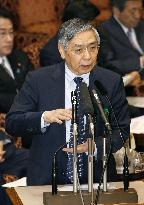
Bank of Japan Governor Haruhiko Kuroda attends a House of Councillors Budget Committee on March 4, 2016, in Tokyo. Kuroda said the central bank is not currently considering further slashing its interest rate after introducing a negative rate policy. (Kyodo) ==Kyodo

  •  
BOJ launches negative interest rate to beat deflation

BOJ launches negative interest rate to beat deflation

Japanese Finance Minister Taro Aso speaks to reporters at the Diet building in Tokyo on Feb. 16, 2016. On the Bank of Japan's introduction of its first-ever negative interest rate policy, Aso said the policy "is expected to have a positive effect on consumption and investment and bring changes to ways of managing funds, which have shifted one-sidedly to deposits and savings." (Kyodo) ==Kyodo

  •  
BOJ launches negative interest rate to beat deflation

BOJ launches negative interest rate to beat deflation

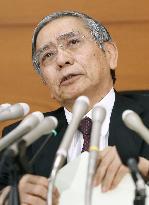
Bank of Japan Governor Haruhiko Kuroda attends a House of Representatives Budget Committee in Tokyo on Feb. 16, 2016. The central bank introduced its first-ever negative interest policy on the day to conquer deflation as the Japanese economy faces the risk of downturn amid uncertain prospects about the global economy. (Kyodo) ==Kyodo

  •  
BOJ launches negative interest rate to beat deflation

BOJ launches negative interest rate to beat deflation

Bank of Japan Governor Haruhiko Kuroda (L) attends a House of Representatives Budget Committee in Tokyo on Feb. 16, 2016. The central bank introduced its first-ever negative interest policy on the day to conquer deflation as the Japanese economy faces the risk of downturn amid uncertain prospects about the global economy. (Kyodo) ==Kyodo

  •  
BOJ launches negative interest rate to beat deflation

BOJ launches negative interest rate to beat deflation

Bank of Japan Governor Haruhiko Kuroda (L) attends a House of Representatives Budget Committee in Tokyo on Feb. 15, 2016. The central bank introduced its first-ever negative interest policy on Feb. 16 to conquer deflation as the Japanese economy faces the risk of downturn amid uncertain prospects about the global economy. (Kyodo) ==Kyodo

  •  
Japan's key bond yield turns negative for 1st time

Japan's key bond yield turns negative for 1st time

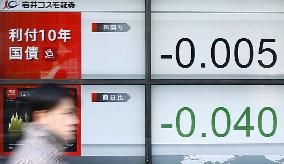
A financial data screen in Tokyo shows on Feb. 9, 2016, the yield on the benchmark 10-year Japanese government bond having turned negative for the first time ever. Investors continued to buy the debt after the Bank of Japan said in late January it would adopt a negative interest rate. (Kyodo) ==Kyodo

  •  
Japan's key bond yield hits 0%

Japan's key bond yield hits 0%

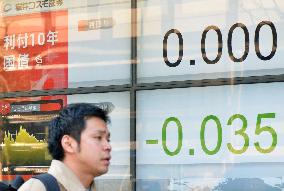
A financial data monitor in Tokyo shows the yield on the benchmark 10-year Japanese government bond hitting 0 percent on Feb. 9, 2016. Investors continued to buy the debt after the Bank of Japan's decision in late January to adopt a negative interest rate. (Kyodo) ==Kyodo

  •  
Some BOJ policymakers feared side effects of negative interest rate

Some BOJ policymakers feared side effects of negative interest rate

File photo shows Bank of Japan Governor Haruhiko Kuroda speaking to the press after a policy meeting in Tokyo on Jan. 29, 2016. A summary of the meeting showed on Feb. 8 that some policymakers of the BOJ had expressed concerns about the possible side effects of a negative interest rate. (Kyodo) ==Kyodo

  •  
BOJ chief shows readiness for further interest rate cut if needed

BOJ chief shows readiness for further interest rate cut if needed

Bank of Japan Governor Haruhiko Kuroda calls the central bank's negative interest rate policy a "powerful weapon" for monetary easing in a speech in Tokyo on Feb. 3, 2016, saying it will further cut the rate if needed to overcome deflation. (Kyodo) ==Kyodo

  •  
BOJ chief shows readiness for further interest rate cut if needed

BOJ chief shows readiness for further interest rate cut if needed

Bank of Japan Governor Haruhiko Kuroda answers questions after giving a speech in Tokyo on Feb. 3, 2016. Kuroda called the central bank's recently implemented negative interest rate a "powerful weapon" for monetary easing, saying it will further cut the rate if needed to overcome deflation. (Kyodo) ==Kyodo

  •  
BOJ's Kuroda shows readiness for further interest rate cut if needed

BOJ's Kuroda shows readiness for further interest rate cut if needed

Bank of Japan Governor Haruhiko Kuroda calls the central bank's negative interest rate policy a "powerful weapon" for monetary easing in a speech in Tokyo on Feb. 3, 2016, saying it will further cut the rate if needed to overcome deflation. (Kyodo) ==Kyodo

  • Main
  • Top
  • Editorial
  • Creative
  • About Us
  • About ILG
  • Terms of use
  • Company
  • BEHIND
  • Price List
  • Single Plan
  • Monthly Plan
  • Services
  • Shooting
  • Rights Clearance
  • Support
  • FAQ
  • How To Buy
  • Contact Us
  • Become a Partner

© KYODO NEWS IMAGES INC

All Rights Reserved.

  • Editorial
  • Olympics
  • News
  • Sports
  • Japan
  • Tech
  • Royal
  • Disaster
  • NorthKorea
  • Old Japan
  • SNS
  • Creative
  • Food
  • Japan
  • Landscape
  • Animal
  • Popular
  • #Ukraine
  • #Russia
  • #coronavirus
  • #N. Korea
  • #Thailand
  • #China
  • #Ukraine
  • #Russia
  • #coronavirus
  • #N. Korea
  • #Thailand
  • #China
  • Food
  • Japan
  • Landscape
  • Animal
  • Olympics
  • News
  • Sports
  • Japan
  • Tech
  • Royal
  • Disaster
  • NorthKorea
  • Old Japan
  • SNS